Home / Blog / Capacity & Sizing
What Fits in a 35L Dry Bag
A 35L roll-top dry bag holds roughly 30 litres of usable kit once the mouth has been folded three times, and that volume takes a full three-season sleep system, four days of clothing and a compact cooking kit at 9 to 12 kg packed. The gap between the 35 litre label and the 30 litres you actually get is not marketing slack: it is the fabric consumed by the roll, plus the air gap you must leave for the folds to meet cleanly. Treat 30 litres as the planning number and 12 kg as the comfort ceiling, and the rest of the sizing decision becomes straightforward.
Thirty-five litres is the first size that stops behaving like a day bag and starts behaving like a piece of expedition kit. It is big enough to hold a sleeping bag and a pad together, heavy enough that harness geometry matters, and bulky enough that hatch openings and rack widths start to decide where it can go. This guide works through the real loads that 35 litres absorbs, the weights those loads produce, the four activities where 35L is the correct answer, and the spec details that separate a bag that lasts from one that splits at the fold in its second season.
- What 35 litres becomes after the third fold
- The 35L core load, item by item
- Sleep systems that fit: bag, liner and pad
- Clothing volume across three seasons
- Food, water and a cooking kit inside 35 litres
- What a loaded 35L bag weighs and how it carries
- Where 35L runs out: expedition and winter loads
- Body shape, mouth width and how geometry decides packing
- 35L on the water: canoe, raft and sailboat fits
- 35L on land: backpacking, bikepacking and overland travel
- Compressing a 35L load without breaking the seal
- Pairing 35L with smaller bags in a system
- Spec checks before you commit to 35L
What 35 litres becomes after the third fold
Every roll-top sacrifices volume at the top. Each fold consumes a band of fabric roughly the height of the fold itself, and a 35L body with a 260 mm mouth loses between 3.5 and 5 litres to a three-fold closure depending on how tightly you roll. Add the 10% headroom you need so the folds meet without tension, and the honest figure for planning is 29 to 31 litres.
That is still a great deal of space, but the arithmetic changes what you should buy. If your real load measures 33 litres, a 35L bag will not close safely; you need a 40L. The reverse error is equally common: people buy a 45L bag for a 26 litre load, then find the empty fabric flapping, the roll thick and awkward, and the bag sliding around a canoe because it is only half full. The measurement method behind these numbers is explained in our capacity measurement guide.
| Fill level | Folds used | Usable volume | Closure security | Best for |
|---|---|---|---|---|
| 100% of stated volume | None | 35 L | None | Never acceptable |
| 95% filled | Two folds | 31 L | Splash only | Dry hold storage |
| 88% filled | Three folds | 30 L | IPX7 immersion | All on-water use |
| 80% filled | Four folds | 27 L | Maximum seal | Whitewater, surf entries |
| 70% filled | Three folds | 26 L | IPX7 immersion | Compressible sleep kits |
The 35L core load, item by item
The most useful way to judge a size is to load it with real objects rather than abstractions. The list below is a genuine three-season load: a synthetic sleeping bag, an inflatable pad, four days of clothing, a stove kit, food for three days, and a wash and repair pouch. Packed loosely the same kit measures 31 litres; packed with compression it comes down to 27 litres and closes with four folds.
Notice where the volume actually goes. Clothing and the sleep system consume 21 of the 30 litres between them, which means food, cooking and electronics are fighting over the last 9 litres. If your trip needs a camera body, a drone and a laptop, the clothing volume has to come down first, because a down jacket compresses and a lens does not.
| Item | Packed volume | Weight | Cumulative volume | Compresses? |
|---|---|---|---|---|
| Synthetic sleeping bag, 0 °C | 9.0 L | 1.35 kg | 9.0 L | Yes, to 6.5 L |
| Inflatable sleeping pad | 3.2 L | 0.62 kg | 12.2 L | No |
| Four days of clothing | 8.5 L | 2.10 kg | 20.7 L | Yes, to 6.0 L |
| Stove, pot and fuel | 2.4 L | 0.85 kg | 23.1 L | No |
| Three days of food | 4.0 L | 2.40 kg | 27.1 L | Partly |
| Wash kit and repair pouch | 1.6 L | 0.45 kg | 28.7 L | No |
| Waterproof shell, packed last | 1.3 L | 0.38 kg | 30.0 L | Yes |

Sleep systems that fit: bag, liner and pad
Thirty-five litres is the smallest size that comfortably holds a sleeping bag and a sleeping pad in one waterproof shell, which is why it is the standard expedition size for canoe and packraft trips. A 0 °C synthetic bag packs to about 9 litres uncompressed; an inflatable pad in a stuff sack adds 3.2 litres; a silk liner adds 0.6 litres. Together they occupy 12.8 litres, leaving 17 litres for everything else.
Down changes the maths in your favour. A 650-fill down bag rated to 0 °C packs to roughly 5.5 litres, which frees 3.5 litres for food or a camera. The trade-off is obvious to anyone who has paddled in the rain for two days: down that gets wet stops insulating. If the bag lives inside a welded dry bag that is genuinely IPX7, down is defensible. If the bag is opened ten times a day in a drizzle, synthetic is the safer choice.
| Sleep system | Packed volume | Weight | Leaves for other kit | Verdict in 35L |
|---|---|---|---|---|
| Synthetic bag, 0 °C, plus pad | 12.2 L | 1.97 kg | 17.8 L | Fits with room |
| Down bag, 0 °C, plus pad | 8.7 L | 1.55 kg | 21.3 L | Fits easily |
| Down bag plus compact air pad | 7.4 L | 1.28 kg | 22.6 L | Best for long trips |
| Winter bag, -10 °C, plus pad | 17.5 L | 3.10 kg | 12.5 L | Tight, use 40L |
| Sleeping bag plus closed-cell foam | 14.0 L | 1.85 kg | 16.0 L | Fits, bulky shape |
Clothing volume across three seasons
Clothing is the variable that decides whether a 35L trip is comfortable or miserable. A summer load of two shirts, shorts, a light fleece and a rain shell packs to 4.5 litres. The same trip in shoulder season needs a mid-layer, gloves, a hat and a warmer shell, which takes the figure to 8.5 litres. A winter load with insulated trousers and a heavy parka reaches 13 litres and leaves almost nothing for food.
The practical rule is to pack clothing by activity rather than by day. Two shirts worn on alternate days plus one dry sleep shirt beats five shirts, and it saves 2.4 litres. Compression sacks help with fleece and down but do nothing for a waterproof shell, which is a stiff laminate that refuses to compress below about 70% of its folded volume.
| Season | Clothing list | Packed volume | Weight | Litres left for food |
|---|---|---|---|---|
| Summer, 4 days | 2 shirts, shorts, light fleece, shell | 4.5 L | 1.25 kg | 8.5 L |
| Shoulder, 4 days | Add mid-layer, gloves, hat, warm shell | 8.5 L | 2.10 kg | 4.5 L |
| Winter, 4 days | Add insulated trousers, parka, spare base | 13.0 L | 3.40 kg | 0.0 L |
| Tropical, 4 days | Light layers, rain shell, sun shirt | 3.8 L | 0.95 kg | 9.2 L |
| Alpine, 3 days | Insulated jacket, shell, gloves, thermals | 11.5 L | 2.95 kg | 1.5 L |
If your clothing list pushes past 11 litres, a 35L bag stops being the right tool. Move up to a 40L, or split clothing into a second 10L bag and keep the sleep system alone in the 35L. Splitting has a real advantage on the water: two smaller bags pack into awkward hull shapes far better than one large cylinder.

Food, water and a cooking kit inside 35 litres
Food is the heaviest thing in any 35L load and the least compressible. Three days of dehydrated meals for one person occupies 4 litres at 2.4 kg; the same three days of fresh food occupies 5.5 litres at 3.8 kg once you add the water content. A compact stove, a 900 ml pot, a 230 g fuel canister and a lighter take another 2.4 litres and 0.85 kg.
Water belongs outside the bag unless it is in a sealed bottle you can retrieve in seconds. A 2 litre bladder inside a 35L dry bag takes 2 litres of volume and adds 2 kg of dead weight that cannot be shared with a cooking pot. Carry water in a separate 5L roll-top with a wide mouth; it doubles as a wash basin and keeps the main bag dry. The food and cooking sizing detail is covered further in our food and cooking kit sizing guide.
What a loaded 35L bag weighs and how it carries
A typical 35L expedition load weighs 9 to 12 kg. That is the point at which carrying geometry starts to matter more than volume. A 12 kg cylinder with a single shoulder strap is painful after 400 m; the same mass in a bag with a padded harness and a sternum strap is manageable for two hours. Nothing about waterproofing changes that, which is why the harness is a capacity decision, not a comfort accessory.
For boat use, weight distribution matters more than total mass. A 12 kg bag placed forward in a canoe raises the bow and makes the boat wander in a crosswind; the same bag against the centre thwart keeps trim neutral. On a packraft, a 12 kg bag should be lashed low and aft so it cannot shift when the bow rides up in a rapid. Details of the harness options available across our waterproof backpack line apply directly to 35L bodies.
The other practical limit is lift height. Twelve kilograms lifted from a wet beach into the back of a vehicle is a two-person job with twin welded handles; the same mass dragged by a single strap will eventually tear the strap weld, which is a repair most people cannot do in the field. This is the reason our 35L bodies specify twin handles at the base as well as a single top grab point.
Where 35L runs out: expedition and winter loads
Thirty-five litres stops being enough in three situations. The first is winter: a -10 °C bag, insulated clothing and a four-day food load reach 34 litres before compression, which means the closure is fighting for its last fold. The second is a trip longer than five days without resupply, where food alone passes 8 litres. The third is any trip carrying a second person’s share of shared kit.
The escape routes are different in each case. Winter loads should move to a 40L or split into two bags. Long trips should be planned with a resupply point rather than a bigger bag, because a 55L bag full of food is a 20 kg object nobody can lift. Shared kit should be split by category across two mid-size bags rather than consolidated, so a single seal failure does not soak half the group’s gear.
Body shape, mouth width and how geometry decides packing
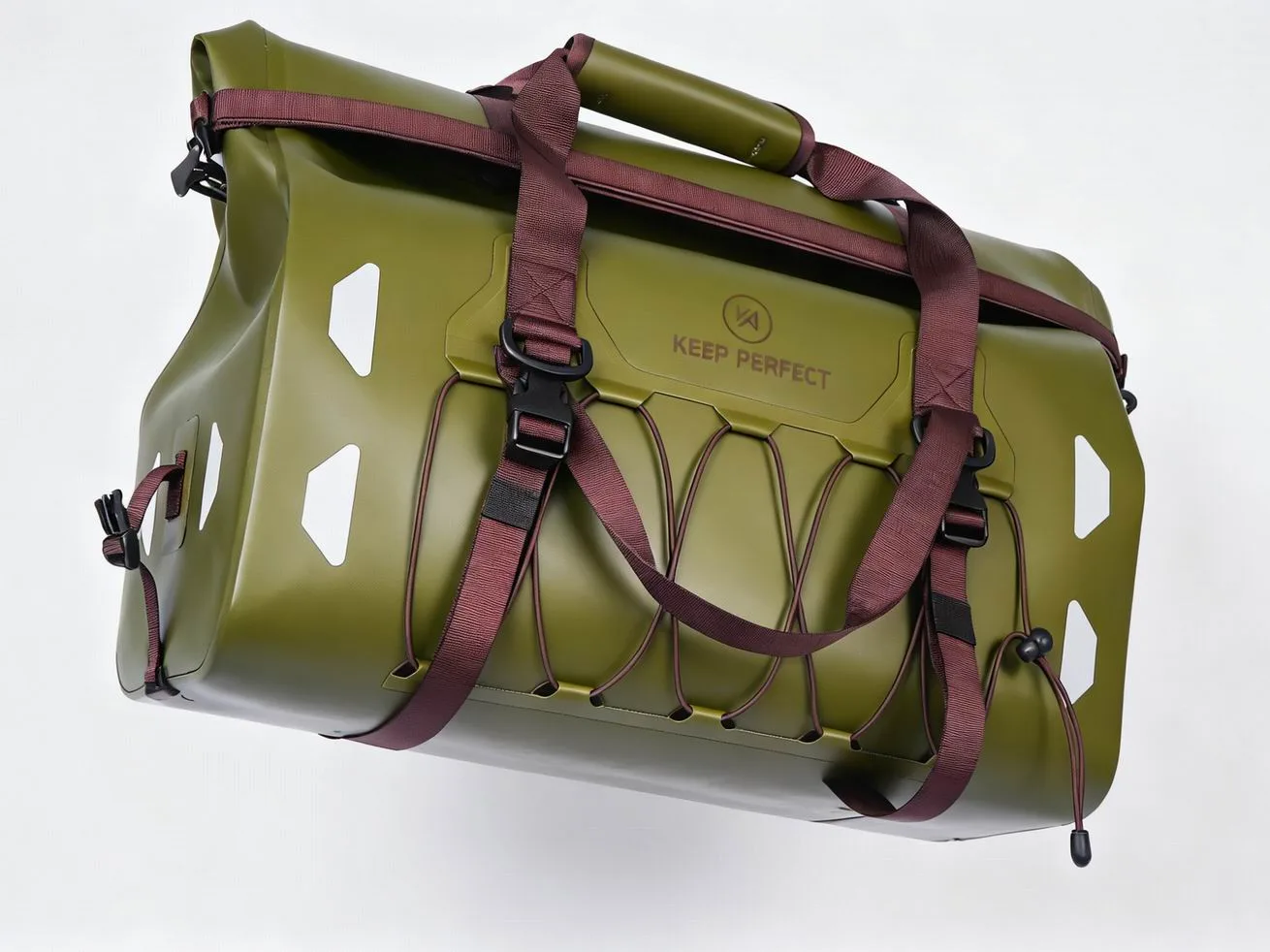
Two 35L bags can pack very differently. A tall narrow body with a 200 mm mouth accepts a rolled sleeping pad easily but makes it hard to reach items at the bottom; a squat body with a 300 mm mouth loads like a duffel but will not slide into a circular kayak hatch. Height matters too: a 620 mm tall bag fits a canoe, a 700 mm tall bag may not fit under a dinghy thwart.
Mouth width is the single most underrated specification at this size. A 35L bag with a narrow mouth forces you to pack in a strict order and unpack almost everything to reach the stove. The same volume with a wide rectangular mouth lets you lift out one item from the middle. When you compare two bags of identical stated capacity, put the same test load in both and count how many items you must remove to reach the bottom.
35L on the water: canoe, raft and sailboat fits
In a canoe, 35L is the classic portage size. It carries a two-person sleep system, fits between the thwarts of a 16 ft boat, and stays under the 14 kg that one person can shoulder for a short carry. The failure mode is water in the bilge: a bag sitting in 30 mm of standing water for six hours will test a closure that is only rated for splash. Use IPX7 welded bags and raise them off the hull floor with a foam pad.
On a raft, 35L bags are lashed to the frame rather than carried, so abrasion resistance matters more than harness comfort. A 0.5 mm TPU film on a 500D face survives strap rub against an aluminium frame for several seasons; a 0.3 mm film shows scuffing within weeks. On a sailboat, 35L is a good single-bunk storage size that fits under a berth or into a wet locker, and it should be colour-coded so crew can identify contents without opening it.
| Water activity | Typical 35L load | Weight | Attachment | Film spec |
|---|---|---|---|---|
| Canoe tripping | Sleep system, clothing | 9-11 kg | Under thwarts, off the bilge | 0.5 mm TPU |
| Whitewater rafting | Group food and dry bags | 10-13 kg | Frame lashing, 2 straps | 0.5 mm TPU, 500D |
| Packrafting | Sleep and stove in one | 8-10 kg | Bow or stern lash point | 0.5 mm TPU |
| Sailing, coastal | Spare clothing, sails repair kit | 7-9 kg | Wet locker, tethered | 0.4 mm TPU |
| Dive boat day | Towel, change of clothes, logbook | 5-7 kg | Bench, no lashing | 0.3 mm TPU |
35L on land: backpacking, bikepacking and overland travel
On foot, a 35L dry bag is usually a liner inside or strapped outside a carrying pack rather than the pack itself. Used as a liner it keeps a sleeping bag dry through three days of rain and adds 380 g to the load. Used as an external cylinder strapped to the top of a pack it handles well at 9 kg but starts to swing above 11 kg, which is tiring on rough ground.
For bikepacking, the cylindrical shape is a genuine asset. A 35L body strapped across handlebars or into a frame bag void carries sleep and clothing in one waterproof unit, and the roll-top lets you shrink the bag as food is consumed. The limit is width: handlebar rolls wider than 280 mm interfere with brake levers and cable routing, so check the packed diameter rather than the litre figure. Our roll-top dry bag range lists packed dimensions for every size.
Compressing a 35L load without breaking the seal
Compression is how you fit a 33 litre load into 30 litres of usable space. It works on down, fleece and base layers, and it fails on food, fuel canisters, pads and electronics. Compress the compressible items first with a strap or a compression sack, then place the incompressible items around them so the bag keeps a roughly cylindrical shape and the roll has a flat surface to close against.
Never compress by forcing the closure. A roll-top that is closed under tension puts constant load on the weld at the mouth, and that weld is where 35L bags fail. If you cannot close the bag with three folds by hand, remove 2 litres of kit. The full trade-off between compression systems and real capacity is set out in our compression and capacity guide.
Pairing 35L with smaller bags in a system
A 35L bag is rarely used alone. The most common pairing is 35L plus 10L plus 2L: the big bag holds sleep and clothing, the 10L holds food and cooking so smells and spills stay contained, and the 2L holds phone, wallet, keys and a head torch. That arrangement has a genuine safety advantage, because the one bag you open constantly is not the one protecting your sleep system.
Colour coding makes the system work at speed. Assign black to sleep, olive to clothing, blue to food, and a bright colour to electronics, then never mix. On a dark beach or in a wet cockpit, being able to grab the right bag by colour rather than by opening three of them is worth more than any feature on a spec sheet.

Spec checks before you commit to 35L
- Measure your real load first; buy 35L only if the packed volume is 26 to 31 litres.
- Check packed dimensions, not litres: height, diameter and mouth width decide fit.
- Require a 0.5 mm TPU film on a 420D or 500D face for any load above 10 kg.
- Confirm welded seams and an IPX7 test standard, not a splash-proof adjective.
- Look for welded D-rings and a harness rated above 12 kg if you carry it on foot.
- Verify the fold line is reinforced; that is where large bags fatigue first.
- Ask for the packed weight of the empty bag: 380 g to 620 g is normal at this size.
- Compare the whole platform on the product line page before you standardise.
For clubs, rental fleets and retail ranges the same checklist becomes a purchasing brief, and at 35 litres the brief has two extra lines that matter commercially. The first is a consistent packed dimension across every size in the range so a rental desk can quote hatch fit with confidence. The second is a documented test standard for closure and seam, because a 35L bag that fails on day two of a seven-day rental costs more in refunds than the whole order. Our production line has built waterproof bags since 2014 in an SGS-verified 4,950 m2 facility, with a 500-piece minimum and sampling in 6 to 10 working days.
Two external checks are worth doing before a long trip with a 35L load. Water temperature drives hypothermia risk far more than rain does, and the safety guidance published by the CDC is the reference most rescue services use for immersion timelines. If the trip crosses open water, check swell and wind predictions through NOAA before committing to a route that puts a 12 kg bag in the wrong part of the boat.
Sizing comparisons work best against the sizes either side. Read our 30L fit guide when your load sits at 25 litres, and our 40L fit guide when winter clothing pushes past 11 litres. For trips of two or three nights, the weekend sizing figures in our weekend trip guide give a faster answer than any single-item table.
Frequently asked questions
Q1. What fits in a 35L dry bag?
About 30 litres of usable kit after three folds: a 0 °C sleeping bag, an inflatable pad, four days of clothing, a stove and three days of food. Packed weight lands between 9 and 12 kg.
Q2. How much usable volume does a 35L roll-top really have?
Plan on 29 to 31 litres. Each of the three folds consumes a band of fabric, and you need roughly 12% headroom so the folds meet without tension that could stress the mouth weld.
Q3. Will a sleeping bag and pad both fit in 35 litres?
Yes. A synthetic 0 °C bag plus an inflatable pad takes 12.2 litres, leaving 17.8 litres for everything else. A -10 °C winter bag plus a pad reaches 17.5 litres and is better in a 40L.
Q4. Is 35L too big for a day trip?
Yes for most day trips. A 35L bag half full is awkward to roll and slides around; a 20L or 25L body is the better day size, and 35L earns its place from two nights upward.
Q5. How heavy is a full 35L dry bag?
A standard three-season load weighs 10.5 kg; summer loads run 7.5 kg and winter loads reach 13.5 kg. The empty bag itself adds 380 to 620 g depending on film thickness and harness.
Q6. Does 35L fit in a kayak hatch?
Usually yes in a sea kayak day hatch, but check packed dimensions rather than litres. A bag taller than 620 mm or wider than 280 mm in diameter will not pass a standard round hatch rim.
Q7. Should I use one 35L bag or two smaller bags?
Two bags is better on water. Splitting gives redundancy if a seal fails, packs into awkward hull shapes more easily, and keeps the bag you open constantly away from your sleep system.
Q8. What film thickness should a 35L bag use?
At least 0.5 mm TPU on a 420D or 500D face. Loads above 10 kg put real strain on the mouth weld and the base, and a 0.3 mm film scuffs through quickly when lashed against a frame.
Q9. Can a 35L dry bag be carried comfortably?
Only with a padded harness and a hip belt. A 10.5 kg cylinder on a single strap is uncomfortable after 400 m; the same mass in a proper harness is manageable for about 3 km on flat ground.
Q10. How many days of food fit in 35 litres?
Three to four days of dehydrated food at 4 to 5 litres, or two to three days of fresh food at 5.5 litres. Beyond five days without resupply you need a second bag or a larger size.
Q11. Is 35L a good size for canoe tripping?
It is the classic canoe size. It fits between the thwarts of a 16 ft boat, holds a sleep system and clothing, and stays under the 14 kg one person can shoulder for a short portage.
Q12. Can I compress a 35L load to close the bag?
Only the compressible parts: down, fleece and base layers. Food, fuel canisters and pads do not compress. If you cannot close with three folds by hand, remove 2 litres rather than forcing the closure.
Q13. What is the difference between 30L, 35L and 40L in practice?
Thirty litres suits a 25 litre summer load, 35 litres handles a three-season load with a sleep system, and 40 litres is needed once winter clothing or a -10 °C bag enters the list.
Q14. Can I put water bottles inside a 35L bag?
You can, but it is poor practice. Two litres of water takes 2 litres of volume and 2 kg that cannot be shared with cooking. Carry water in a separate wide-mouth 5L bag.
Q15. Does a 35L dry bag float when full?
A sealed bag with trapped air floats; a tightly packed bag with the air pressed out may float low or sink slowly. Never treat a dry bag as a buoyancy aid or a substitute for a life jacket.
Q16. How long does a 35L TPU dry bag last?
With rinsing after saltwater use and shaded storage, a 0.5 mm TPU body with welded seams typically gives five to ten years of regular use. Fold-line fatigue and UV exposure are the two limits.
People also ask
How do you pack a 35L dry bag?
Put the sleeping bag in first and press it into the corners, add the pad flat against one wall, then clothing, then food and the stove last so they sit nearest the mouth. Leave 12% headroom and close with three folds.
What size dry bag do I need for a week?
A 35L bag covers three to four days; a week usually needs 35L plus a 20L, or a single 60L for clothing and sleep with a 10L for food. Plan a resupply point before you buy a bigger bag.
Is a 35L dry bag carry-on size?
No. A packed 35L body is roughly 620 mm tall and 280 mm in diameter, which exceeds typical 55 x 40 x 20 cm cabin limits. A 20L or 25L bag is the practical carry-on size.
Can you fit a tent in a 35L dry bag?
A one-person backpacking tent in a compression sack packs to 6 to 8 litres and fits alongside a sleep system. A two-person tent at 10 to 12 litres needs its own bag or a 40L.
How do you lift a heavy 35L dry bag safely?
Bend at the knees, hold the welded handles rather than the rolled mouth, and keep the bag close to your torso. Above 12 kg, use twin handles and a two-person lift for canoes and vehicles.
Why does my 35L bag feel smaller than expected?
Rolling consumes volume and so does irregular packing. A sleeping bag stuffed rather than folded wastes 2 to 3 litres in air pockets; pack flat items against the walls and soft items into voids.
Need this in production volume?
QUANZHOU JUNYUAN BAGS has produced waterproof bags since 2014 in an SGS-verified 4,950 m2 facility in Fujian, China. Minimum order 500 pieces, sampling in 6–10 working days, bulk in 35–50 days, FOB Xiamen — write to service@junyuanbags.com with your spec and target market.