Dry Bags and Waterproof Backpacks Built for Real Water
KEEPDRYBAG produces roll-top dry bags from 2L to 90L, TPU waterproof backpacks, dry duffels, floating bags and welded totes. Every model uses RF-welded seams rather than stitched-through panels, so there are no needle holes in the waterproof layer. Production has run since 2014 in an SGS-verified 4,950 m2 facility in Fujian, China.
The short answer if you are specifying today: minimum order is 500 pieces per style, sampling takes 6–10 working days, bulk runs 35–50 days after sample approval, inspection is to AQL 2.5, payment is T/T 30/70 and the default shipping term is FOB Xiamen.

Choose by product family
Product line at a glance
| Family | Volume range | Construction | Water rating | Best for |
|---|---|---|---|---|
| Roll-top dry bag | 2L – 90L | TPU or PVC laminate, RF welded | IPX6 – IPX8 | Paddling, camping, expeditions |
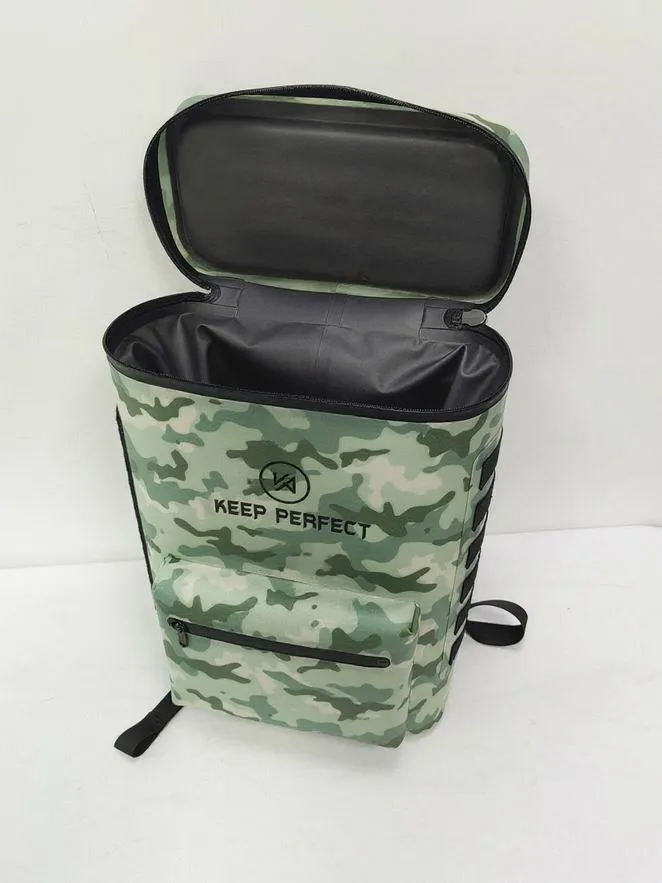
| TPU waterproof backpack | 18L – 55L | 0.3–0.5 mm TPU on 420D or 500D | IPX5 – IPX7 | Commute, travel, marine |
| Dry duffel | 30L – 90L | TPU laminate, welded zip or roll-top | IPX6 – IPX7 | Rafting, expedition, gear haul |
| Floating dry bag | 5L – 30L | 500D TPU, foam collar | IPX7 | Open water, rescue support |
| Waterproof tote | 12L – 25L | TPU laminate, welded handles | IPX5 – IPX6 | City, beach, boat |
| Roll-top cooler / wet bag | 10L – 30L | TPU with welded liner | IPX6 | Pool, beach, picnic |
| Accessory pouch | 1L – 5L | TPU film, welded zip | IPX5 – IPX7 | Electronics, documents |
Every family above is built to order, so closure type, hardware colour, strap geometry, print method and labelling all sit inside the specification rather than in a fixed catalogue. Full details sit on the product line page.
How a roll-top seal keeps water out
A roll-top dry bag has no zip and no stitched lid. The top of the bag extends past the body, you squeeze the air out, fold the extension down three or more times, and clip the buckle. Those folds press two flat coated surfaces together across the full width, and the clip holds the pressure. Water has to travel up, over three folded ridges and back down again to reach the contents — and each ridge is under compression.
Two habits cause almost every leak reported in the field. The first is folding unevenly, so one corner opens a channel. The second is leaving grit on the fold line, which holds the surfaces apart. Three clean folds beat six sloppy ones every time.
From enquiry to shipment
- Specification. Send your brief, target price and quantity. We come back with a fabric recommendation, tooling note and a costed specification, usually within two working days.
- Sampling. A sewn or welded sample is built in 6–10 working days from approved artwork. Films, colours and prints are signed off on this sample.
- Bulk production. Runs of 35–50 days after sample approval, cut, welded, printed and assembled across 7 lines with 149 machines. In-line checks cover weld peel strength and print adhesion.
- Inspection and shipment. Finished goods are inspected to AQL 2.5 by default, packed to your carton specification and shipped FOB Xiamen against the agreed balance payment.
Need the numbers behind each step? The full timeline with buffer days sits in the dry bag journal.
Frequently read guides
- Dry Bag for Day Kayaking: Packing and Sizing Guide
- Dry Bag Capacity Guide: 2L to 90L Explained
- TPU vs PVC for Dry Bag Fabric
- How Roll-Top Closures Actually Seal
- How to Clean a Roll-Top Dry Bag
- Recycled TPU Dry Bags
- Roll-Top vs Zipper Dry Bags
- What Is a Dry Bag and How Does It Work?
- Sea Kayaking: What Size Dry Bag Do You Need?
- Hydrostatic Head Explained for Dry Bags
- IPX Waterproof Ratings for Dry Bags
- PFAS-Free Waterproof Fabric
All 301 guides are listed in the dry bag journal, grouped by activity, capacity, material, technology, care, sustainability, design, travel and buying comparisons.
Frequently asked questions
What sizes do dry bags come in?
Production sizes run from a 2L essentials pouch up to a 90L expedition sack, with 5L, 10L, 15L, 20L, 25L, 30L, 40L, 60L and 70L in between. Volume tolerance is typically ±5% because a roll-top closure has no fixed top edge. If you need an exact filled volume, specify the filled-litres method rather than the flat-pack method.
What is the minimum order?
The standard minimum is 500 pieces per style, size and colourway. That figure covers full specification runs including welded tooling setups, printed panels and colour-matched webbing. Smaller pilot runs can be discussed where the fabric and colour already exist in the line.
How long do samples and bulk take?
Sampling takes 6–10 working days from a confirmed specification and artwork approval. Bulk production runs 35–50 days after sample sign-off, depending on fabric lead time and order size. Both figures assume stocked base fabrics; a mill-ordered colourway can add 15–20 days.
Are these bags really waterproof?
Yes within their stated rating. Every model is tested against a defined IEC 60529 IPX method published by the IEC, and against a hydrostatic head figure measured to an ISO pressure method. Roll-top models rated IPX7 survive 30 minutes at one metre; IPX8 models are tested to a deeper agreed time and depth. No dry bag is rated for continuous submersion beyond its test window.
What fabric and film do you use?
Face fabrics are 420D or 500D polyester or nylon laminated with TPU or PVC film at 0.3–0.5 mm. TPU is the default for cold-weather and eco-led lines because it stays flexible below freezing; PVC costs less and suits warm-climate leisure products. Both are RF welded, not sewn through.
What payment and shipping terms apply?
Standard terms are T/T with 30% deposit and 70% against the bill of lading, FOB Xiamen by default. Other Incoterms and payment structures can be arranged for established accounts. Every shipment is inspected to AQL 2.5 as standard, with tighter levels available.
Can you add our logo and brand colours?
Yes. Silk-screen prints, heat transfers, woven labels, rubber badges and welded logos all run in-house, and webbing, buckles and film can be colour-matched. Pantone-referenced artwork should arrive as vector files; colour swatches are approved before the bulk fabric is cut.
Which compliance documents can you provide?
REACH and RoHS declarations for hardware and trims, PFAS-free finish statements, GRS transaction records for recycled content, and test reports from recognised laboratories for hydrostatic head, colour fastness and restricted substances. Environmental claims are checked against current EPA guidance, and buoyancy and safety limits against US Coast Guard rules on the water.
How should a dry bag be cleaned after salt water?
Rinse the outside and the inside of the rolled collar in fresh water, wipe the welds with a mild soap solution, then air-dry open and unrolled in shade. Never machine wash, never tumble dry, and do not store compressed while damp — trapped moisture is what causes mildew and delamination.
What happens if a seam leaks?
Welded seams rarely fail outright; most leaks come from a badly rolled collar or grit in the fold. Field repair is possible with a TPU patch and a roller, or heat from a low iron through a cloth. Send photographs and the batch code for a warranty assessment before attempting a repair that could void it.