TPU Waterproof Backpacks
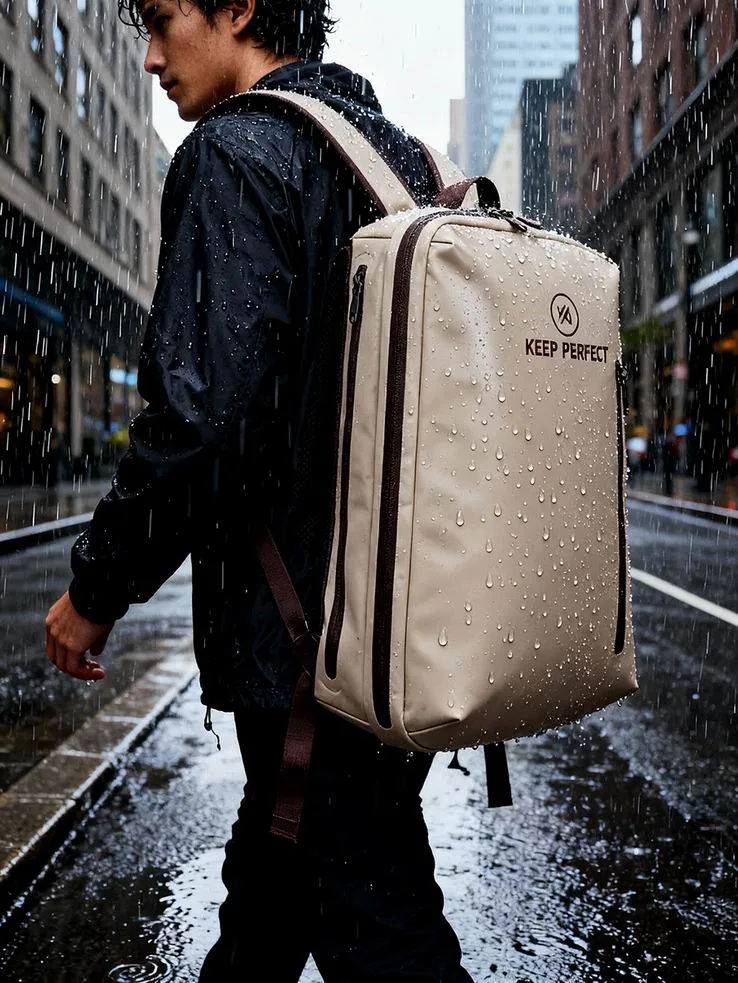
A TPU waterproof backpack gets its water resistance from a thermoplastic polyurethane film laminated to the face fabric, then joined with radio-frequency welds instead of needle holes. The result carries like a normal daypack but survives a downpour and a drop in shallow water. This page sets out which film thickness suits which use, where welded seams fail if they are badly specified, and what to ask for in a production order.
Our line runs 0.3 mm film for lightweight commuter packs and 0.5 mm for expedition and marine use, both over 420D or 500D face fabric. Every model ships from the SGS-verified 4,950 m2 facility in Fujian, minimum order 500 pieces, sampling in 6–10 working days, bulk in 35–50 days, FOB Xiamen.
Specification
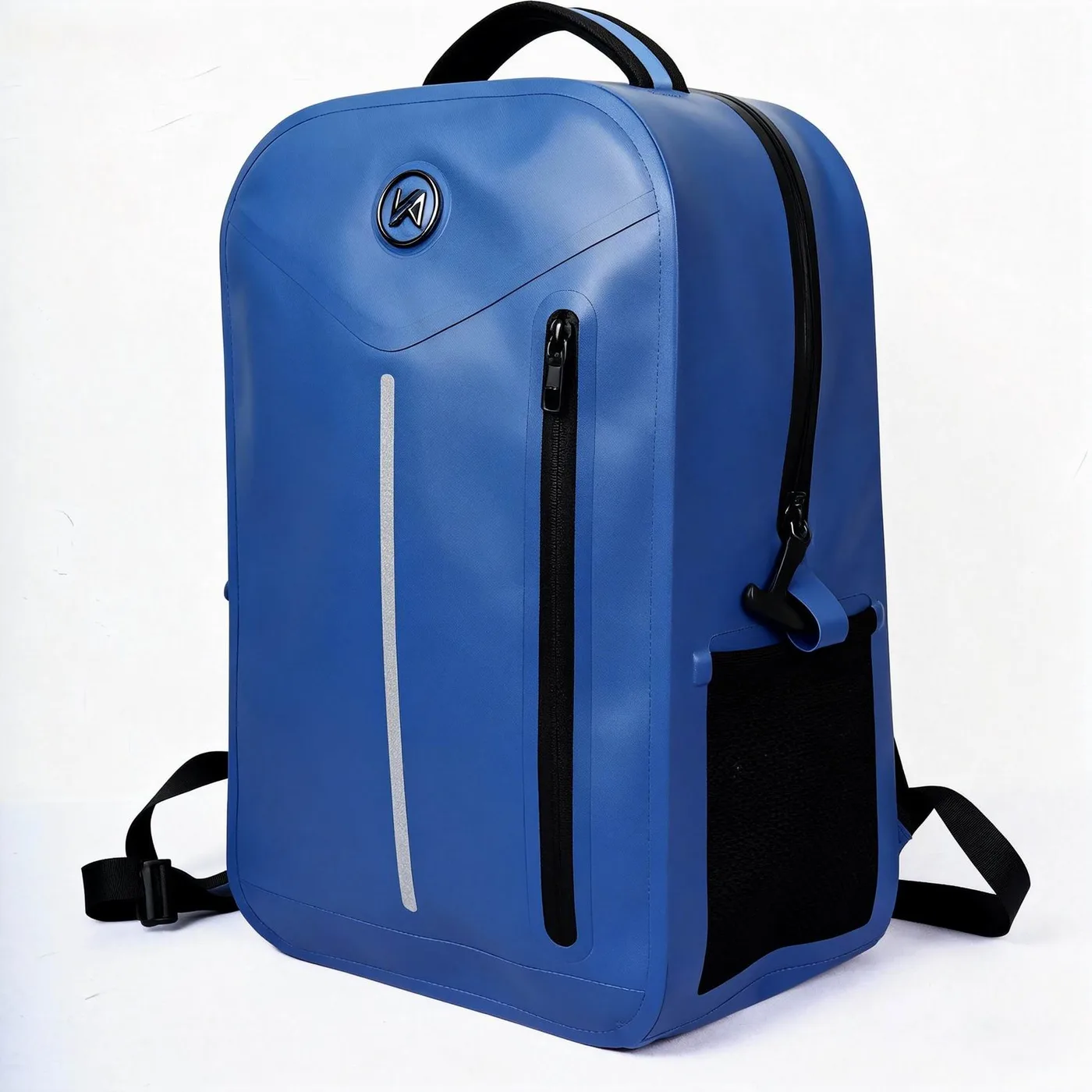
- Construction: TPU laminate, RF welded seams, no through stitching in wet zones
- Closure: Roll-top with clip, or water-resistant coil zip with storm flap
- Back panel: Closed-cell foam, welded mesh cover, quick drain
- Laptop sleeve: Floating welded sleeve, 13–16 inch options
- Rating: IPX5 front panel and IPX6 body typical, immersion on roll-top builds
- Minimum order: 500 pieces per style
- Sampling: 6–10 working days
- Bulk lead time: 35–50 days
Options
| Film | Face fabric | Where it fits | Trade-off |
|---|---|---|---|
| 0.3 mm | 420D polyester | Commuter daypacks 18–22L | Light, folds small, lower abrasion life |
| 0.4 mm | 420D nylon | Travel and camera packs 25–30L | Balanced weight and cut resistance |
| 0.5 mm | 500D polyester | Marine, expedition 35–55L | Highest puncture life, heavier hand |
| 0.5 mm matte | 500D nylon | Premium branded lines | Low sheen, print receptive |
| Recycled 0.4 mm | rPET face | Sustainability-led ranges | Same weld window, GRS traceable |
Welded seam versus sewn seam
A sewn seam punches thousands of needle holes through the waterproof layer and then relies on tape to cover the damage. A radio-frequency weld melts two TPU surfaces into one another, so there is nothing to leak along the seam line. The trade-off is repairability and tooling: welding needs a jig per geometry, while sewing needs none. For any run above a few hundred units the tooling pays for itself in returned goods alone.
Film thickness and what it actually buys you
Film thickness is the single most quoted number in a waterproof backpack specification and the most frequently misread one. It governs puncture resistance and flex life, not water resistance. A 0.3 mm film laminated correctly to a sound face fabric will keep water out just as well as a 0.5 mm film; what the thicker film adds is survival against sharp gear, repeated abrasion against rock, and a longer fatigue life at the fold lines. Paying for 0.5 mm on a commuter pack that never leaves pavement buys weight and cost with no functional return.
The decision rule is abrasion zone rather than overall spec. Use 0.3 mm for packs under 22L that live on shoulders and in offices, 0.4 mm for travel and camera packs that meet rough surfaces occasionally, and 0.5 mm for marine and expedition use where the bag is dragged across decks and gravel. Where a sustainability story matters, recycled TPU film now welds in the same window as virgin film, so no process change is needed.
Welded versus sewn and taped
This is the construction decision that determines whether the bag is waterproof or merely water resistant. A sewn seam punches needle holes through the waterproof layer at every stitch; taping covers the damage rather than eliminating it. Radio-frequency welding melts the two thermoplastic surfaces into each other under pressure, so the join has no holes to begin with.
| Attribute | RF welded seam | Sewn and taped seam |
|---|---|---|
| Water path | None through the seam line | Needle holes covered by tape |
| Typical peel strength | Film tears before the weld separates | Tape adhesion is the limit |
| UV ageing | Weld ages with the film | Tape adhesive degrades first |
| Tooling | Jig required per geometry | No tooling, any sewing line |
| Repairability | Needs welding equipment | Can be re-stitched in the field |
| Best for | Runs above a few hundred units | Prototypes, one-off shapes, repairs |
There is one genuine advantage to sewing: repairability. A welded bag cannot be mended on a trail. For expedition use where a field repair might be the difference between finishing and aborting, some buyers specify welded seams in the wet zones and sewn construction in dry structural panels.

Back panels, drainage and carry comfort
The back panel is where waterproof packs most often lose the comfort argument. Closed-cell foam is the cheap option and it is wrong for a rain pack: it holds water, and once wet it stays wet for days. A welded mesh cover over a drainage channel sheds water and dries in an hour. If you are specifying a pack for daily commuting in a wet climate, put the drain path in the specification explicitly, because it will otherwise be value-engineered out.
Strap anchors deserve the same attention. Anchors are frequently sewn through a loaded panel, and that panel is then the failure point under a heavy pack. Welded reinforcement patches spread the load. The failure data from returns consistently shows straps and anchors second only to closures, well ahead of film failure.
Laptop sleeves and the immersion question
A floating welded sleeve — one that is bonded to the body so it never sits against the base — protects against the two impacts that actually damage laptops: a drop onto the base corner and water entering at the bottom of the main compartment. It does not make the pack submersible. If the pack has a water-resistant zip rather than a roll-top, immersion will eventually win, because a coil zip is a controlled leak path by design.
Be precise in the product copy here. A pack rated IPX5 on the front panel and IPX6 on the body will survive a downpour and a splash, which is what commuters need. Claiming immersion on a zip-closure pack generates returns that the rating never promised to cover.
What to specify when you order
Nine items make a quote comparable across sources: volume, film type and thickness, face fabric denier and weave, seam method and overlap width, closure type, back panel construction, hardware grade, colour reference and print method, and quantity per style. Add the target rating with the test method named — IEC 60529 for IPX codes, published by the IEC — and the inspection level. Abrasion and tear figures should cite the ASTM method used, because two common abrasion tests give numbers that are not interchangeable.
Minimum order is 500 pieces per style, sampling takes 6–10 working days from artwork approval, bulk runs 35–50 days after sample sign-off, FOB Xiamen, T/T 30/70, inspected to AQL 2.5 as standard.
Where waterproof backpacks fail first
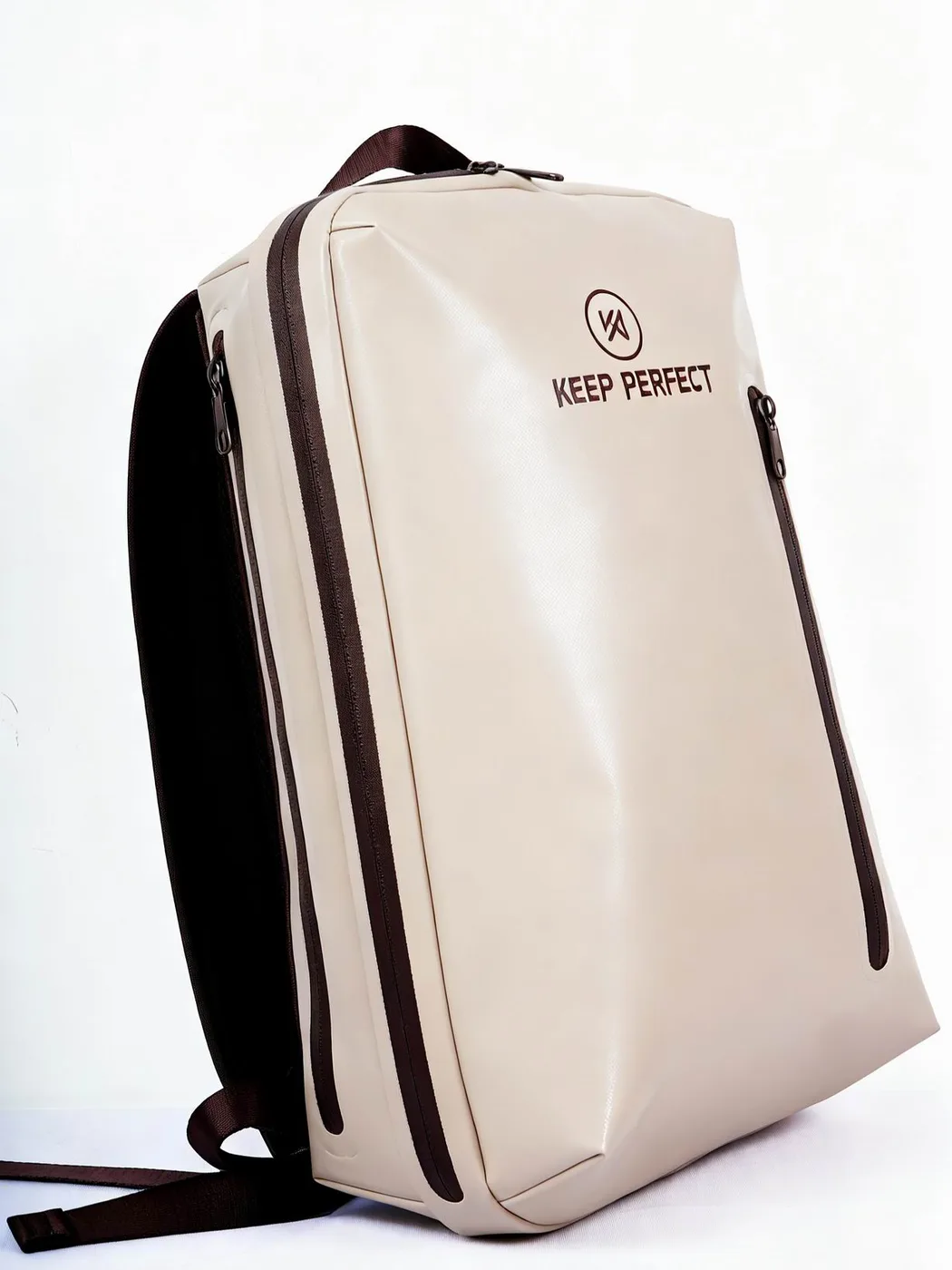
Toothless closures and seam kinks cause far more returns than film failure. A water-resistant zip needs a storm flap that sits flat under load; if the flap lifts, spray runs along the coil and into the main compartment. Straps carry the second-highest failure rate, because anchor points are often sewn through a loaded panel rather than welded onto a reinforcement patch.
The third failure point is the back panel. Closed-cell foam holds water and takes days to dry, so any backpack meant for daily rain should use a welded mesh cover with a drain path instead of a laminated foam pad. If those three areas are specified correctly, the film itself rarely gives trouble.
Frequently asked questions
Is TPU better than PVC for a waterproof backpack?
For most uses yes. TPU stays flexible in cold weather, does not need plasticisers that can migrate out, and welds reliably. PVC is cheaper and stiffer but becomes brittle in freezing conditions and carries restricted-substance concerns in several markets. Choose PVC only where cost dominates and cold flex is not a requirement.
Can a waterproof backpack be submerged?
Only roll-top builds with welded seams. A water-resistant coil zip with a storm flap is designed to shed rain and spray, not to survive immersion. If the pack has a zip closure, treat any IPX rating as spray resistance rather than submersion protection.
How do I clean a TPU waterproof backpack?
Rinse with fresh water, wipe with mild soap and a soft cloth, rinse again and dry open in shade. Never machine wash, never use solvents or a heat gun, and pay attention to the closure channel where grit collects. Salt water should always be rinsed off the same day.
What laptop size will a waterproof backpack hold?
Floating welded sleeves are produced for 13 to 16 inch machines. The sleeve should be welded, not stitched, so water entering the main compartment cannot wick into the sleeve along a needle line.
Why does my waterproof backpack feel damp inside?
Usually condensation rather than a leak. A sealed pack in a humid climate traps body moisture and warm air; when the pack cools, water condenses on the film. Open the pack daily and dry it, and avoid packing wet clothing with dry electronics.
How long does a TPU laminated pack last?
Three to five seasons of regular use is typical, longer if stored open and out of sunlight. UV exposure is the main ageing factor, followed by crease damage at fold lines. Welded seams generally outlast the film around them.
Guides in this category
46 detailed guides, each with its own specification tables and answers section.
Waterproof Technology
- AQL Inspection for Dry Bags
- Buoyancy Science of Dry Bags
- Condensation Inside a Dry Bag
- Dry Bag Terminology Glossary
- Field vs Lab Testing for Dry Bags
- How Brands Claim Waterproofing
- How Many Rolls Are Actually Needed
- How Roll-Top Closures Actually Seal
- How Water Still Gets Into a Dry Bag
- How Waterproof Ratings Degrade
- Hydrostatic Head Explained for Dry Bags
- IPX Waterproof Ratings for Dry Bags
- Immersion Testing a Dry Bag
- Pressure Differential Inside a Dry Bag
- Quality Control for Waterproof Bags
- Rain Protection vs Submersion
- Saltwater vs Freshwater Testing
- Seam Integrity Over Service Life
- Testing a Dry Bag at Home
- The Air Inflation Leak Test
- Warranty Testing Standards for Dry Bags
- Water Column Test Basics
- Water-Resistant vs Waterproof Packs
- What Happens When a Seam Fails
- Why Air Traps Matter in Dry Bags
Materials & Construction
- Abrasion Resistance of TPU Dry Bags
- Cold Crack Temperature of TPU
- Phthalate-Free TPU Explained
- TPU Film Thickness: 0.3mm vs 0.5mm
- TPU vs PVC for Dry Bag Fabric
- Welded Handles on TPU Dry Bags
Activity Guides
- Dry Bag Care After Backpacking
- TPU Dry Bags for ATV Riding: Durability Notes
- TPU Dry Bags for Dinghy Racing: Durability Notes
- TPU Dry Bags for Dinghy Sailing: Durability Notes
- TPU Dry Bags for Packrafting: Durability Notes
- TPU Dry Bags for Waterfowl Hunting: Durability Notes
Buying & Comparisons
Sustainability & Compliance
Care & Repair
Dry Bag Answers
Capacity & Sizing
Ready to move from reading to specifying? Send your brief to service@junyuanbags.com.