Floating Dry Bags
A floating dry bag traps air in the rolled top so the sealed pack stays on the surface if it goes overboard. Buoyancy depends on how much air stays inside, which depends on how many folds you put in and how full the bag is. This page covers the physics of that float margin, which sizes actually support a loaded pack, and where a floating bag should never be used as a life-saving device.
All floating models are built with RF-welded seams and closed-cell foam collars in our SGS-verified 4,950 m2 facility in Fujian. Minimum order 500 pieces, sampling 6–10 working days, bulk 35–50 days, FOB Xiamen.
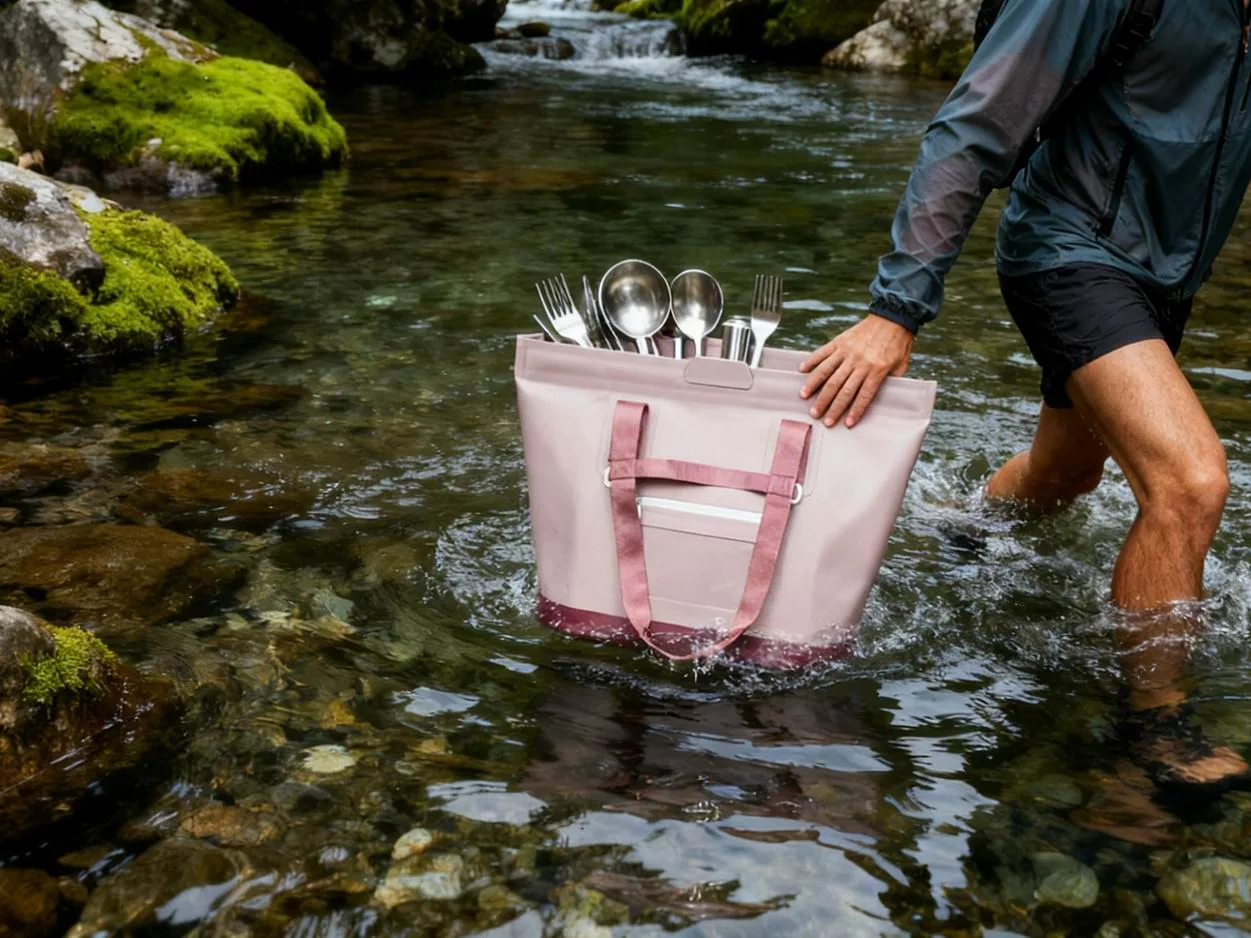
Specification
- Buoyancy method: Trapped air in triple-fold collar, closed-cell foam collar optional
- Body: 500D TPU laminate, high-visibility panels available
- Hardware: 316 stainless D-rings, reflective webbing loops
- Rating: IPX7 immersion, 30 minutes at 1 m
- Warning: Not a personal flotation device, always pair with a PFD
- Minimum order: 500 pieces
- Sampling: 6–10 working days
- Bulk lead time: 35–50 days
Options
| Size | Positive buoyancy | Typical load | Field note |
|---|---|---|---|
| 5L | 3–5 kg | Paddle board essentials | Floats with camera and snacks |
| 10L | 6–8 kg | Kayak day kit | Floats with clothing layer |
| 20L | 10–14 kg | Canoe overnight kit | Needs four folds when loaded |
| 30L | 14–18 kg | Rafting crew bag | Floats low, keep lines attached |
| Throw bag 20 m | Rescue line | Whitewater safety | Not a personal flotation device |
Float margin in practice
Archimedes decides the outcome: a bag floats when the water it displaces weighs more than the bag and its contents. Air is what provides that displacement, so anything that reduces trapped air reduces buoyancy — over-filling, over-rolling or squeezing the bag down before closing it. In rough water the collar also takes spray, so folds should sit above the waterline and the bag should always be tethered.
The physics of the float margin
A bag floats when the water it displaces weighs more than the bag and its contents. Air provides that displacement, so anything that removes trapped air removes buoyancy. This is why a bag packed solid with camera bodies can sink while the same bag packed with a sleeping bag floats: the volume is identical but the weight is not.
The rolled collar is the air chamber. Three folds trap two pockets of air; four folds trap three. The difference is roughly a kilogram of positive buoyancy on a 10L bag, which is meaningful when the load is marginal. Anything that compresses the collar — a tight strap across the roll, squeezing the bag to close it, or packing to the brim so there is nothing left to fold — reduces the chamber and therefore the margin. Treat the float margin as a design output, not an inherent property of the product.
Buoyancy in real conditions
Laboratory buoyancy figures assume still water, a clean four-fold closure and a fully inflated chamber. Field conditions are worse on all three counts. The table below gives the working figures we quote, which are measured with the load in place rather than with the bag empty.
| Condition | Effect on buoyancy | Working adjustment |
|---|---|---|
| Bag filled to 100% of volume | Collar cannot fold fully, chamber lost | Fill to 80% maximum |
| Two folds instead of three | Loses roughly one air pocket | Three folds minimum, four in rough water |
| Compression strap across the roll | Collapses the chamber | Strap above or below the folds, never across |
| Contents denser than water (tools, camera) | Margin falls sharply | Add a closed-cell foam collar |
| Collar stiffened by age or cold | Fold holds less air, seal weakens | Replace after two hard seasons |
| Salt water rather than fresh | Margin improves slightly | No adjustment needed |
The single largest error in the field is over-filling. A bag packed to the brim has no material left to fold, so the collar closes flat with no chamber at all, and the bag behaves like a sealed sack of whatever is inside it. If the contents outweigh the displaced water, it goes down.
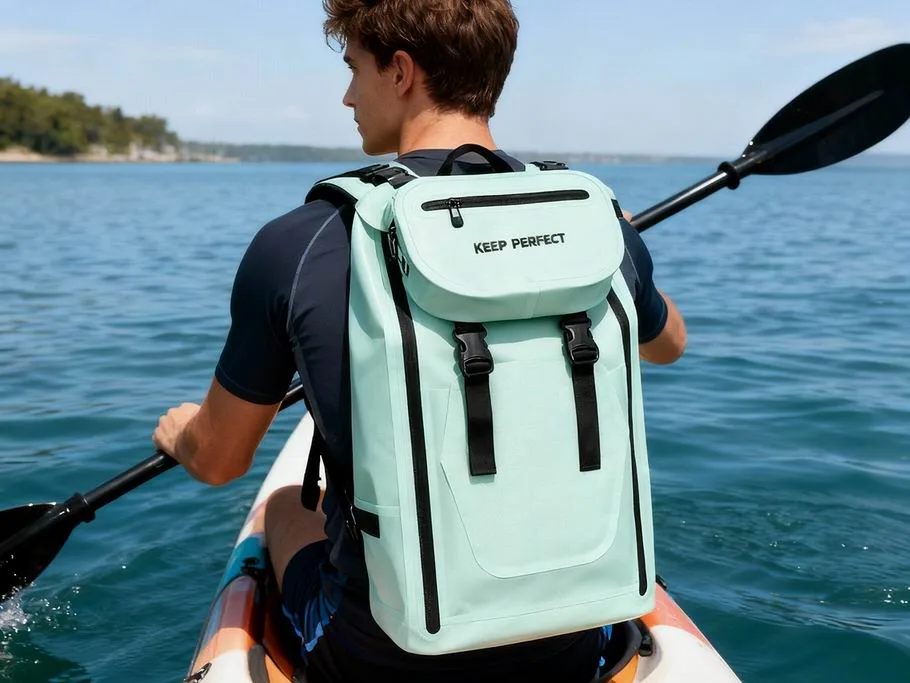
Where floating bags fail
Failures cluster in three places. The collar loses stiffness with age, so a bag that floated eight kilograms new may float five after two seasons of hard use; this is the most common cause and the least often checked. The weld relaxes under repeated flexing, letting air escape from the chamber rather than water enter the bag — the contents stay dry while the bag sinks, which is a confusing failure to diagnose. And hardware corrodes: a D-ring that has lost its plating becomes a leak path through the reinforcement patch.
Check the margin at the start of every season rather than trusting the figure on the label. Load the bag as you would carry it, close it as you would close it, and push it under in shallow water where you can retrieve it. If it does not come back up promptly, the collar has aged out.
Colour, visibility and rescue use
A floating bag that cannot be seen is a floating bag that will not be recovered. High-visibility panels and reflective webbing loops cost very little and make the difference between spotting a bag in broken water and losing it. For rescue applications the convention is a separate throw bag with a dedicated line, not a gear bag pressed into service; the two products look similar and should never be substituted for one another.
Reflective trim should be specified as a material, not a colour. Retroreflective tape bonded to the film returns light to the source and works at night; a bright yellow panel does not. If night recovery is plausible, ask for both.

Safety limits you must state in the copy
Three statements belong on every floating bag and in every product page that sells one: the bag is not a personal flotation device; it must be tethered to the boat, board or craft; and the stated buoyancy figure applies to a specific closure and load, not to any load the user chooses. Omitting the first is a liability exposure, not a marketing choice, and regulators in most markets treat gear presented as safety equipment without certification as a compliance matter. Flotation-device rules for US waters are published by the US Coast Guard Boating Safety Division, and coastal conditions and tides should be checked against NOAA before any open-water trip.
Production specification is the same as the rest of the line: minimum order 500 pieces, sampling 6–10 working days, bulk 35–50 days, FOB Xiamen, T/T 30/70, AQL 2.5 inspection. Closed-cell foam collars and 316 stainless fittings are available where the buoyancy or corrosion requirement justifies them.
Using a floating bag correctly
Treat the bag as recoverable gear rather than safety equipment. Clip it to the boat, board or kayak with a short tether so a capsize does not take it downstream alone, choose a high-visibility colour so it can be spotted in broken water, and check the float margin at the start of every season by loading it as you would in the field and pushing it under.
Expect that margin to shrink over time as the collar loses stiffness and the weld relaxes. A bag that floated eight kilograms new may float five after two seasons of hard use, and knowing that number is the difference between retrieving your kit and watching it sink.
Frequently asked questions
Does a dry bag float if it is full?
It depends on the weight of the contents, not on how full the bag is. Buoyancy comes from displaced water, so a bag filled with a sleeping bag floats while the same bag filled with tools may sink. Fill to about 80 percent so the collar still has material to fold, and roll three or four times.
Can a floating dry bag replace a life jacket?
No. A floating dry bag is gear-recovery equipment, not personal flotation equipment. It is not certified to support a person, it can deflate if the closure opens, and it offers no freeboard in moving water. Always wear a certified personal flotation device on the water.
How much weight will a 10L floating bag support?
A well-rolled 10L bag gives roughly six to eight kilograms of positive buoyancy with the collar folded four times. The figure drops as soon as the bag is squeezed, partially filled, or closed with fewer folds than the specification assumes.
Why does my floating bag sink after two seasons?
The collar loses stiffness with age and UV exposure, so the fold holds less air. The weld can also relax and let air escape from the chamber even while the contents stay dry. Test the margin every season and retire the bag when it stops coming back up.
Should I choose a foam collar or an air-only chamber?
An air-only chamber is lighter and packs smaller, but its margin depends on correct closing every time. A closed-cell foam collar floats regardless of how the bag is rolled, which suits rescue, marine and any use where the bag may be closed in a hurry.
What colour should a floating dry bag be?
The most visible colour available, with retroreflective trim rather than just a bright panel. Retroreflective tape returns light to the source and works at night; a bright panel does not. Recovering a bag in broken water is mostly a visibility problem.
Guides in this category
15 detailed guides, each with its own specification tables and answers section.
Dry Bag Answers
- Are Dry Bags Really 100% Waterproof?
- Can a Dry Bag Sink With Air Inside?
- Do Dry Bags Keep Water In as Well as Out?
- Does a Dry Bag Float When It Is Full?
- How Do Roll-Top Dry Bags Keep Water Out?
- How Long Do Dry Bags Last in Saltwater?
- What Happens If You Submerge a Dry Bag?
Waterproof Technology
Activity Guides
Sustainability & Compliance
Buying & Comparisons
Travel & Packing
Ready to move from reading to specifying? Send your brief to service@junyuanbags.com.