Can a Dry Bag Sink With Air Inside?
Yes, a dry bag can sink with air sealed inside it, but it takes a load most people never pack. A sealed 20L bag displaces 20 kg of fresh water and generates that much upward force, so it only sinks once the contents plus the bag exceed that figure, which means a packed density above 1.0 kg per litre. Clothing packs at about 0.25 kg per litre and a camera kit around 0.7, so both float with a wide margin. A 20L bag holding 21 kg of tools, spares or water has a density of 1.05 and goes straight down despite its air pocket.
The subtle case is depth. Air compresses, so a bag pulled under loses lift as it descends: at 10 metres the pressure is roughly double the surface value and an 8 litre air pocket shrinks to about 4 litres, cutting displacement by 4 kg. A bag that floated at the surface can cross into negative buoyancy somewhere between 10 and 20 metres and then keep sinking. This guide covers the arithmetic, the home test, and the difference between a bag that floats and a device that is certified to keep a person afloat.
- The short answer and the number behind it
- Packed density: the figure that decides everything
- Why a half-full bag floats and a packed one does not
- What happens as the bag is pulled deeper
- Where the air actually goes
- Salt water buys you about 2.5% more lift
- A bathtub protocol for measuring your own bag
- Floating is not flotation
- If the bag goes over the side: the recovery window
- Packing a bag so it floats on purpose
- Reading a buoyancy claim on a product page
- The rules that never bend
The short answer and the number behind it
Buoyancy is a comparison between two numbers: the mass of water the sealed bag pushes aside, and the total mass of the bag plus everything in it. One litre of fresh water weighs one kilogram, so a 20 litre sealed volume displaces 20 kg. If the bag and contents together weigh 5 kg, there is 15 kg of spare lift and the bag sits high in the water with roughly three quarters of its volume above the surface.
Air itself weighs almost nothing here. A litre of air at sea level is about 1.2 grams, so 8 litres of trapped air adds 10 grams of mass while contributing 8 litres, or 8 kilograms, of displacement. That is the entire reason a dry bag floats: the air is not lifting the bag, it is keeping the bag inflated so the shape displaces water it would otherwise collapse out of.
So the question is not whether there is air inside, but whether the average density of the sealed system is above or below the surrounding water. Above 1.0 kg per litre in fresh water and it sinks; below and it floats. Everything else in this guide is detail on how to work out that average density for a real load.
Packed density: the figure that decides everything
Packed density is not the density of the material, it is the mass of the packed item divided by the space it occupies including the air trapped between fibres and around odd shapes. A down sleeping bag compresses to about 0.12 kg per litre because loft is mostly air. Synthetic clothing sits near 0.25. Dry pasta and rice are around 0.6, canned food around 1.1, and hand tools or steel spares run to 1.8 or more.
This is why two bags of identical volume behave differently. Twenty litres of clothing weighs roughly 5 kg and floats with 15 kg to spare; twenty litres of canned food and tools weighs 22 kg and sinks. The air pocket is the same in both cases, and it is irrelevant to the outcome, because the outcome is set by the average.
| Contents | Packed density | Mass in a 20L bag | Floats in fresh water? | Freeboard |
|---|---|---|---|---|
| Down sleeping bag | 0.12 kg/L | 2.4 kg | Yes | Very high |
| Synthetic clothing | 0.25 kg/L | 5.0 kg | Yes | High |
| Camera kit with pouches | 0.70 kg/L | 14.0 kg | Yes | Low |
| Canned food and water | 1.05 kg/L | 21.0 kg | No | Sinks |
| Hand tools and steel spares | 1.80 kg/L | 36.0 kg | No | Sinks fast |
| Mixed expedition load | 0.40 kg/L | 8.0 kg | Yes | High |
Why a half-full bag floats and a packed one does not
A bag packed to 85%, which is the practical maximum if you want a three-fold closure, still contains 15% air by volume. On a 20L bag that is 3 litres of air, worth 3 kg of displacement, and the contents weigh maybe 5 kg. Total 5.64 kg against 20 kg of displacement: it floats, and it floats with most of its body out of the water.
The failure case is not packing it full, it is packing it dense. A 20L bag holding 12 cans, 2 litres of water and 3 kg of ice weighs about 14 kg in a 20 litre volume, which floats but with only 6 litres of reserve. Add a wet towel, which contributes mass while displacing almost nothing extra because it is already inside the sealed volume, and the reserve drops further. That is the bag that floats in the morning and sinks by the afternoon once the ice melts and the water sloshes.
Wet items are the hidden variable in this calculation. A dry towel is 210 g; the same towel saturated holds 400 to 600 g of water, all of which counts as mass and none of which adds volume if it is inside the sealed bag. Pack wet gear in a separate bag and the arithmetic of the main bag stays predictable.

What happens as the bag is pulled deeper
Pressure rises by roughly one atmosphere for every 10 metres of depth, and a flexible bag responds to that pressure by shrinking. Boyle’s law is the relevant relationship: double the absolute pressure and the gas volume halves. An 8 litre air pocket at the surface is 4 litres at 10 metres, 2.7 litres at 20 metres and about 2 litres at 30 metres.
Each litre lost is a kilogram of lift lost. Take a 20L bag carrying 16 kg of gear that occupies 12 litres, leaving 8 litres of air. At the surface it displaces 20 kg against 16.6 kg of total mass, so it floats with about 4 litres of freeboard. At 10 metres the air has halved to 4 litres and the bag volume is 16 litres, giving 16 kg of displacement against 16.6 kg of mass: it is now negatively buoyant and will keep descending.
That is the runaway. Once a bag crosses into negative buoyancy, it accelerates downward, pressure rises faster, the air shrinks further and the descent speeds up. In practice this matters for anything tethered to a sinking object, anything towed behind a boat at speed, and anything dropped into deep water during a rescue. It is also the reason a bag recovered from 15 metres often comes up looking half empty.
| Depth | Absolute pressure | 8 L air pocket becomes | Displacement lost | Effect on a 16.6 kg bag |
|---|---|---|---|---|
| 0 m | 1.0 bar | 8.0 L | 0 kg | Floats with 4 L freeboard |
| 5 m | 1.5 bar | 5.3 L | 2.7 kg | Freeboard down to 1.3 L |
| 10 m | 2.0 bar | 4.0 L | 4.0 kg | Neutral, then sinks |
| 20 m | 3.0 bar | 2.7 L | 5.3 kg | Sinking faster |
| 30 m | 4.0 bar | 2.0 L | 6.0 kg | Sinking, bag visibly collapsed |
Where the air actually goes
In the field, bags lose air far more often through the closure than through the film. A roll-top with three folds holds air well at the surface, but under sustained pressure the folds can burp: a small amount of air escapes each time the bag is squeezed or rolled by a wave, and over an hour of being towed that adds up to litres. A bag that started with 8 litres of air can end the afternoon with 2.
Purge valves make this deliberate. A valve lets you squeeze air out so a bag packs flat in a hatch, and the same valve lets water pressure push remaining air out if the bag is dragged. If you want maximum flotation, leave the valve closed and do not compress the bag; if you want a flat, stable load in a kayak hatch, purge it and accept that the bag will not float.
Slow film leaks are rare on welded TPU but real on cheap coated fabric. A pinhole at the corner of a weld lets water in and air out simultaneously, and the exchange is roughly equal by volume, so displacement stays constant while mass climbs. That is the worst possible failure mode: the bag looks fine, floats lower each hour, and eventually submerges without any visible damage.
Salt water buys you about 2.5% more lift
Seawater is denser than fresh water, typically around 1.025 kg per litre against 1.0, because of dissolved salt. That gives a sealed bag about 2.5% more displacement in the sea than in a lake, which on a 20L bag is a difference of half a kilogram. It is a small margin, but it is the margin that decides the outcome for a bag loaded near neutral buoyancy.
Temperature moves the number in the same direction but by less. Cold fresh water is at its densest near 4 °C at about 1.000 kg per litre and drops to roughly 0.997 at 25 °C, a swing of three tenths of a percent that is negligible next to the effect of contents density. Salinity varies much more than temperature does, and estuaries where fresh and salt water mix can sit anywhere between the two values; salinity and density data are published by NOAA.
A bathtub protocol for measuring your own bag
You can measure the buoyancy of any bag in fifteen minutes with a bath, a spring balance and a marker pen. Fill the bath, load the bag exactly as you would for a trip, seal it with the closure you actually use, and lower it in. Mark the waterline on the outside of the bag with the pen, then read off roughly how much of the volume is above the surface.
- Weigh the packed bag on a spring balance and note the mass in kilograms.
- Lower the bag into a full bath and let it settle without pushing it under.
- Mark the waterline on the film, then remove the bag and measure the submerged height.
- Estimate submerged volume from the height and the bag footprint; compare it with the mass.
- Repeat at a deeper forced immersion: push the bag under 60 cm and note how much it shrinks.
- If submerged volume at rest is above 90% of total, treat the bag as sinkable and tether it.
The forced immersion step is the one people skip and the one that predicts real behaviour. Pushing the bag under 60 cm raises the pressure by about 6%, which compresses the air slightly and shows whether the bag is near the tipping point. A bag that barely comes back up is a bag that will sink if it is ever towed or dragged deeper, whatever it did in the bath.
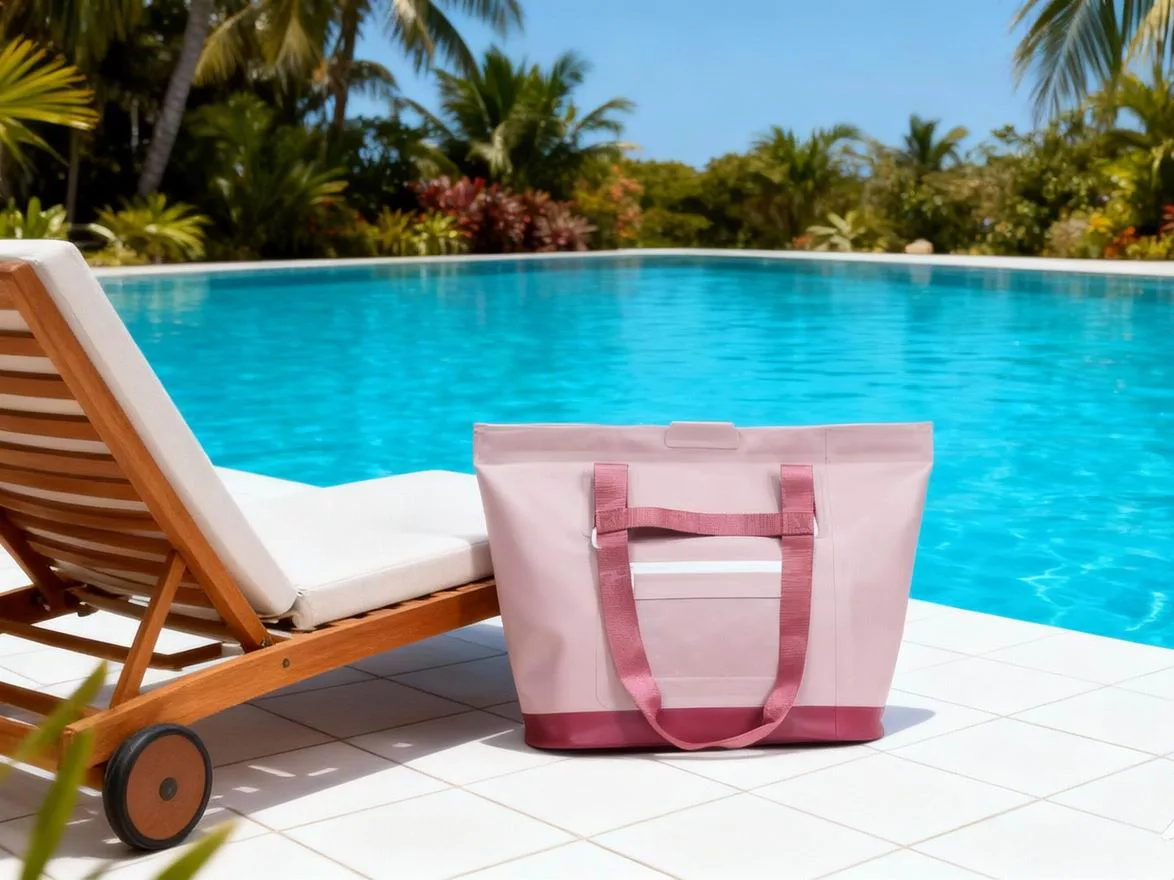
Floating is not flotation
A dry bag that floats is not a buoyancy aid, and the gap between the two is measured in certification rather than in litres. A personal flotation device is built to turn an unconscious person face up, to keep the airway clear in rough water, and to hold its buoyancy after prolonged immersion, puncture and use. A dry bag does none of those things, and no amount of trapped air changes that.
The practical risk is behavioural. A bag that floats confidently invites people to rely on it: to hold onto it in the water, to strap it on for a swim, or to leave a life jacket in the boat because the bag looks buoyant enough. That is the failure path that causes real incidents. The performance classes and test methods for actual buoyancy aids are set out in the ISO 12402 series published by ISO, and nothing in a dry bag specification overlaps with them.
If the bag goes over the side: the recovery window
Recovery is a timing problem, not a swimming problem. A bag floating with high freeboard is visible for 200 to 400 metres in calm water and maybe 80 metres in a chop, and it drifts with the wind faster than a swimmer can paddle because so much of it sits above the surface. Every minute in the water roughly doubles the search area.
Act in the first thirty seconds. Note the bearing relative to a fixed object on shore before the boat or board moves, because the reference disappears the moment you turn around. If you are in a group, one person points continuously while the other moves; a bag that is being pointed at is recovered far more often than one that is being looked for.
Colour matters more than any other choice at this moment. A black bag in a 0.5 metre chop is effectively invisible beyond 60 metres, while an orange, yellow or mint bag stays visible at 150 metres or more. If you paddle or sail anywhere with a real risk of losing gear over the side, pick the colourway for visibility and add a reflective patch for low light.
Packing a bag so it floats on purpose
Sometimes you want guaranteed flotation: a throw bag for a group, a marker for a dive site, or simply insurance for a bag you cannot afford to lose. The method is to reserve air deliberately rather than incidentally. Pack the bag to no more than 60% with low-density items, roll it with three folds without squeezing the air out, and leave the purge valve closed. On a 20L bag that leaves 8 litres of air and gives roughly 12 kg of reserve lift, which will support the bag plus a wet towel plus a small amount of water ingress.
Two additions make the margin robust. A closed-cell foam block of 2 litres, weighing about 60 g, provides lift that cannot be compressed away at depth and cannot leak out; it is the cheapest flotation insurance available. And a bright webbing loop or a 20 mm reflective band on the outside turns a floating bag into a visible one, which matters more than another litre of air once the bag is 100 metres away.
| Setup | Air reserved | Reserve lift in fresh water | Holds at 10 m? | Visibility |
|---|---|---|---|---|
| Packed to 85%, purged | 3 L | 3 kg | Marginal | Depends on colour |
| Packed to 60%, not purged | 8 L | 8 kg | Yes | Depends on colour |
| Packed to 60% plus 2 L foam | 8 L + foam | 10 kg | Yes | Depends on colour |
| Bright colourway, reflective band | 8 L | 8 kg | Yes | 150 m or more |
| Black bag, fully packed | 3 L | 3 kg | No | Under 60 m in chop |

Reading a buoyancy claim on a product page
Be sceptical of any listing that says a dry bag floats without saying how much it carries. The honest version states a volume, a load and a water type: a 20L bag with 5 kg of clothing floats in fresh water with about 15 kg of reserve. The dishonest version shows a photograph of an empty bag on a lake, which proves nothing about the bag you will actually pack.
Look for three specific pieces of information. The sealed volume after the closure is rolled, which is not the nominal capacity. The empty weight of the bag, which is mass you have to lift. And whether the closure holds air under pressure, which is the property that decides whether the bag keeps its buoyancy for an hour or loses it in ten minutes. If a listing gives only litres and a photograph, treat flotation as unproven.
The floating dry bag range is built around that third point: closure geometry that holds air while being towed, closed-cell assistance rather than reliance on trapped air alone, and colourways chosen for recovery. Compare the sealed-volume figures against your own packed load rather than against the nominal size, and you will know the answer before you get on the water.
The rules that never bend
Three rules cover every case in this guide. First, a sealed bag floats only while its average density stays below the water around it, so packed density is the number to watch rather than the presence of air. Second, buoyancy falls with depth, so a bag that floats at the surface can sink at ten metres and will accelerate once it starts. Third, nothing about a floating dry bag makes it a safety device, and the only equipment certified to keep a person afloat is a personal flotation device worn on the body.
Tether anything you cannot afford to lose. A 6 mm cord and a screw-gate carabiner clipped to a welded D-ring weigh 60 g and convert a lost kit into a recovered one in almost every scenario, including the ones where the bag sinks, because a tethered bag can be hauled up from far deeper than a swimmer can dive. Our line has produced waterproof bags since 2014 in an SGS-verified 4,950 m2 facility, with a 500-piece minimum and sampling in 6 to 10 working days.
For the related cases, read the full-bag flotation answer for the simpler version of this question, and the buoyancy science guide for the underlying physics in more depth. If the bag is being relied on for safety in any way, stop and read when a dry bag is not a life jacket first. Sealing behaviour under sustained immersion is covered in the waterproof claim guide, and practical depth effects in the submersion guide. Our academy section carries the rest of the technical background.
Frequently asked questions
Q1. Can a dry bag sink with air inside it?
Yes, if the bag and contents together are denser than the water. A sealed 20L bag displaces 20 kg, so it sinks once the load exceeds about 20 kg in fresh water. Clothing and camera gear stay well under that; tools, canned goods and water can go over it.
Q2. How much weight can a 20L dry bag float?
About 20 kg of total mass in fresh water and 20.5 kg in seawater, minus a safety margin. In practice keep the load under 15 kg if you want the bag to float with useful freeboard rather than sitting awash at the surface.
Q3. Why does a floating dry bag sink when it gets deeper?
Because air compresses. Pressure doubles by 10 metres, so an 8 litre air pocket becomes 4 litres and the bag loses 4 kg of displacement. A bag near neutral buoyancy at the surface crosses into negative buoyancy and then accelerates downward.
Q4. Does a dry bag float better in salt water?
Yes, by about 2.5%. Seawater is around 1.025 kg per litre against 1.0 for fresh, which gives a 20L bag roughly half a kilogram more lift. That margin decides the outcome for any bag loaded close to neutral.
Q5. Will a full dry bag still float?
Usually. Packed to 85%, a 20L bag still holds about 3 litres of air and typical clothing loads weigh 5 kg, leaving a wide margin. It stops floating when the contents are dense rather than merely voluminous, as with water, cans or tools.
Q6. Can I use a dry bag as a floatation device?
No. A dry bag has no turning moment, no airway protection and no guarantee after puncture. Use a certified personal flotation device; the test classes for real buoyancy aids are set out in the ISO 12402 series.
Q7. How much air should I leave in a bag I want to float?
Reserve about 40% of the volume as air: pack to 60%, do not squeeze the bag before rolling, and leave the purge valve closed. On a 20L bag that is 8 litres of air and roughly 8 kg of reserve lift.
Q8. What is the densest thing people pack that sinks a bag?
Water and canned goods at around 1.0 to 1.1 kg per litre, and tools or steel spares at 1.8 or more. Twelve cans, two litres of water and three kilograms of ice weigh about 14 kg in a 20L bag, which floats with a thin margin until the ice melts.
Q9. How do I test whether my packed bag will float?
Weigh it, lower it into a bath and mark the waterline, then estimate the submerged volume. If more than about 90% of the bag is below the waterline at rest, treat it as sinkable and tether it. Push it under 60 cm and see whether it comes back up.
Q10. Do purge valves make a bag sink?
They can. A valve lets pressure push air out when the bag is dragged or squeezed, so a purged bag has little reserve lift. Close the valve and skip the compression if you want flotation; purge it if you want a flat, stable load in a kayak hatch.
Q11. Does the colour of the bag affect recovery?
Yes, more than any buoyancy change. A black bag in a half-metre chop is invisible beyond about 60 metres while an orange, yellow or mint bag stays visible past 150 metres. Add a reflective band for low light.
Q12. Why does my dry bag float in the morning and sink by the afternoon?
Because mass was added without volume: melting ice, a saturated towel or a slow leak. Wet gear is the usual cause, since 400 to 600 grams of absorbed water counts as mass and displaces nothing extra inside a sealed volume.
Q13. Does cold water change buoyancy?
Very slightly. Fresh water is densest near 4 °C at about 1.000 kg per litre and around 0.997 at 25 °C, a swing of three tenths of a percent. Salinity changes the figure far more than temperature does.
Q14. How deep does a bag have to go before air compression matters?
About 5 metres, where pressure is 1.5 bar and an 8 litre pocket loses 2.7 litres, or 2.7 kg of lift. By 10 metres the loss is 4 kg, which is enough to sink a bag loaded near 16 kg in a 20 litre volume.
Q15. Should I add foam to a dry bag for flotation?
Yes if flotation matters. A 2 litre closed-cell block weighs about 60 grams and gives lift that cannot compress away at depth or leak out, which trapped air alone cannot promise. Pair it with a bright webbing loop so the bag can be seen.
Q16. What is the single best way to avoid losing a bag overboard?
Tether it. A 6 mm cord and a screw-gate carabiner on a welded D-ring weigh 60 grams and turn a loss into a recovery, including cases where the bag sinks, because a tethered bag can be hauled up from deeper than a swimmer can dive.
People also ask
Why does a dry bag sink even with air in it?
Because buoyancy depends on average density, not on the presence of air. If the bag plus contents weigh more than the water the sealed volume displaces, it sinks. Tools, water and canned goods push a 20L bag over the 20 kg threshold.
How much weight can a dry bag support?
One kilogram per litre of sealed volume in fresh water and about 1.025 kg per litre in seawater. A 20L bag therefore supports roughly 20 kg at the surface, but that figure falls with depth as the trapped air compresses.
Do dry bags float when they are full?
Most do. Even at 85% fill a 20L bag keeps about 3 litres of air, and typical clothing loads weigh around 5 kg. Dense loads are the exception: water, cans and tools carry the average density above 1.0 kg per litre.
Can you use a dry bag as a flotation device?
No. It has no turning moment and no airway protection, and a puncture removes the buoyancy instantly. Only a certified personal flotation device worn on the body should be relied on in the water.
What happens to a dry bag underwater?
It shrinks as the air compresses, losing about a kilogram of lift per litre of air lost. Pressure doubles by 10 metres, so an 8 litre pocket halves, and a bag that floated at the surface may sink once it is pulled down.
How do you make a dry bag float better?
Pack it to no more than 60%, do not squeeze the air out before rolling, keep the purge valve closed, and add a 2 litre closed-cell foam block for lift that cannot compress away. Choose a bright colourway so it can be seen.
Need this in production volume?
QUANZHOU JUNYUAN BAGS has produced waterproof bags since 2014 in an SGS-verified 4,950 m2 facility in Fujian, China. Minimum order 500 pieces, sampling in 6–10 working days, bulk in 35–50 days, FOB Xiamen — write to service@junyuanbags.com with your spec and target market.