Home / Blog / Waterproof Technology
Buoyancy Science of Dry Bags
A sealed 20L dry bag displaces 20 kg of fresh water when it is fully submerged, so with a 6 kg load inside it carries about 14 kg of reserve buoyancy and rides with roughly 70% of its volume above the surface. Take the same bag down to 3 m and the enclosed air compresses by around a quarter, cutting that reserve to 10.8 kg; at 10 m the reserve is down to 7 kg, which is why a bag that floats cheerfully on the surface behaves very differently once it is dragged under by a rope or a current.
Buoyancy is not a marketing feature, it is arithmetic: displacement minus mass, adjusted for the fact that air compresses and gear does not. This guide sets out the numbers for each common bag size, shows which loads push a bag underwater, explains what depth does to the calculation, and makes the case for treating a dry bag as a flotation aid for your kit rather than a lifejacket for you.
- Archimedes applied to a dry bag
- What each bag size displaces
- Load density: why two 6 kg loads behave differently
- How much of the bag sits above the surface
- Depth: what compression does to the numbers
- A worked example from a real capsize
- Air traps, purge valves and deliberate buoyancy
- Why a dry bag is not a buoyancy aid
- Testing buoyancy at home
- Buoyancy requirements by activity
- Design choices that change float behaviour
- Practical rules to carry away
Archimedes applied to a dry bag
Any object in water receives an upward force equal to the weight of the water it pushes aside. A sealed dry bag pushes aside its full external volume when submerged, so a 20L bag displaces 20 litres of water, which weighs 20 kg in fresh water and 20.5 kg in seawater. Whether the bag sinks or floats depends on whether its own contents weigh more or less than that.
The useful figure is reserve buoyancy, which is displacement minus the mass of the bag and everything in it. A 20L bag holding 6 kg of clothing has 14 kg of reserve and will ride high. The same bag holding 21 kg of camera bodies and diving weights has negative reserve and goes straight down, regardless of how much air was trapped inside when you rolled the top.
This is why the phrase "it floats because it has air inside" is only half true. The air is what makes the sealed volume large relative to the mass, but the calculation is always about the total enclosed volume against the total mass. Squeeze the air out and the volume shrinks; add weight and the mass grows. Both move the same number in the wrong direction.
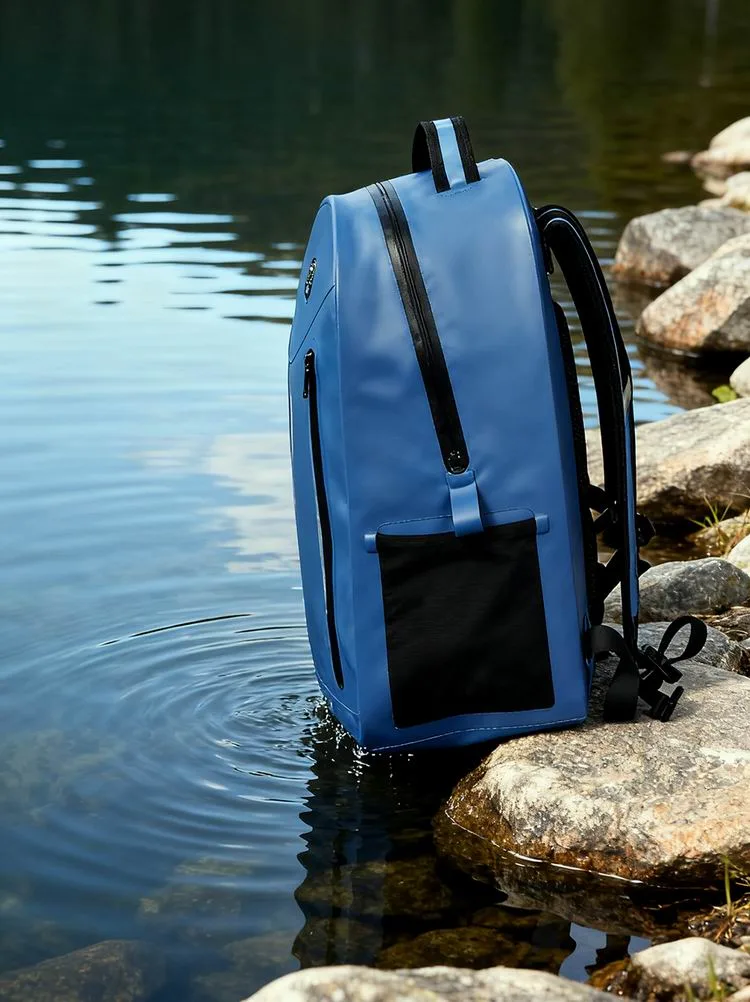
What each bag size displaces
The table below assumes a well-rolled bag that is genuinely sealed and holds its shape under modest pressure. Real numbers run slightly lower because a soft bag deforms and because the roll consumes a little of the nominal volume, so treat these as upper bounds with a 5 to 10% margin.
| Bag size | Displaced water, fresh | Displaced water, salt | Load that sinks it | Reserve with a 5 kg load |
|---|---|---|---|---|
| 5 L | 5.0 kg | 5.1 kg | Over 5.0 kg | 0.0 kg |
| 10 L | 10.0 kg | 10.3 kg | Over 10.0 kg | 5.0 kg |
| 20 L | 20.0 kg | 20.5 kg | Over 20.0 kg | 15.0 kg |
| 30 L | 30.0 kg | 30.8 kg | Over 30.0 kg | 25.0 kg |
| 40 L | 40.0 kg | 41.0 kg | Over 40.0 kg | 35.0 kg |
| 60 L | 60.0 kg | 61.5 kg | Over 60.0 kg | 55.0 kg |
The pattern is linear and brutally simple: a 5L bag with 5 kg inside is neutrally buoyant and will hover just under the surface, drifting wherever the current takes it. A 5L grab bag with a 1.2 kg phone, camera and snack has 3.8 kg of reserve and pops straight back up, which is exactly what you want from something you might drop over the side.
Note the saltwater column. Seawater at 1025 kg per cubic metre gives you 2.5% more lift than a freshwater lake, which is worth about half a kilogram on a 20L bag. That margin is small, but it is the reason a load that barely floats in a river can ride noticeably higher at the coast.
Load density: why two 6 kg loads behave differently
Mass alone is misleading; what matters is mass per litre of enclosed volume. Six kilograms of down and clothing occupies close to 20 litres, so a 20L bag packed with clothing is full of gear and still floats on its own volume. Six kilograms of camera bodies and lenses occupies about 3 litres, leaving 17 litres of air in the same bag, and the result is a bag that floats even higher.
| Contents | Density, kg per litre | Effect on float behaviour | Watch out for |
|---|---|---|---|
| Down sleeping bag, compressed | 0.08-0.15 | Adds almost no mass for its volume | Expands if the bag is opened underwater |
| Clothing, rolled | 0.25-0.35 | Keeps the average density well below water | Wet clothing doubles in mass |
| Dry food | 0.55-0.70 | Neutral, predictable | Canned food is far heavier |
| Fresh water carried inside | 1.00 | Neutral buoyancy, no reserve gain | A bag of water neither floats nor sinks |
| Canned or bottled drink | 1.20-1.50 | Pulls the average density upward | A 20L bag of cans can exceed 20 kg |
| Camera body and lens | 1.80-2.50 | Dense, but small in volume | Check the total, not the item count |
| Steel tools and weights | 7.80 | Sinks any bag it is placed in | Never pack tools with float-critical kit |
The practical rule is to work out the average density of the load: total mass divided by total enclosed volume. Below 1.0 kg per litre and the bag floats; above 1.0 and it sinks, no matter how many litres of air were inside when it left your hands.
Wet gear is the hidden variable. A dry sleeping bag is the lightest thing you own; a soaked one can hold 2 to 3 kg of water and triples its mass without changing the bag volume. That is the most common reason a bag that floated on the way out sinks on the way back.
How much of the bag sits above the surface
A floating object submerges until the weight of the displaced water equals its own weight. For a bag, the fraction underwater is simply load mass divided by displacement capacity. A 20L bag with a 6 kg load submerges 30% of its volume; with a 14 kg load it submerges 70% and what is left above water is a small, easily missed target.
- A 20L bag with 2 kg inside: 10% submerged, 18 litres visible above the surface.
- A 20L bag with 6 kg inside: 30% submerged, 14 litres visible.
- A 20L bag with 12 kg inside: 60% submerged, 8 litres visible.
- A 20L bag with 18 kg inside: 90% submerged, 2 litres visible and hard to spot in chop.
- A 20L bag with 20 kg inside: 100% submerged, neutrally buoyant and drifting.
Visibility matters more than floatation in a recovery situation. A bag showing 2 litres of black film in a 0.5 m chop is effectively invisible from 30 m away, which is a strong argument for bright colourways and reflective accents on anything that might end up in the water. Our floating dry bag range is built around that idea.
There is a second reason to keep the load light: freeboard. A bag riding high presents its closure above the waterline, so the seal stays dry and the contents stay dry even during a long tow. A bag riding low puts the roll-top at the waterline, where wave action works on the fold with every passing ripple.
Depth: what compression does to the numbers
Atmospheric pressure at the surface is about 1 bar, and it rises by roughly 1 bar for every 10 m of depth. The air inside a sealed bag obeys Boyle's law, so its volume falls in proportion to the pressure: 1.3 bar at 3 m means the air occupies 77% of its surface volume. The gear inside does not compress, so the total volume falls more slowly than the air volume alone.
| Depth | Absolute pressure | Air volume in a 20L bag with 6 L of gear | Total enclosed volume | Reserve buoyancy |
|---|---|---|---|---|
| Surface | 1.0 bar | 14.0 L | 20.0 L | 14.0 kg |
| 1 m | 1.1 bar | 12.7 L | 18.7 L | 12.7 kg |
| 3 m | 1.3 bar | 10.8 L | 16.8 L | 10.8 kg |
| 5 m | 1.5 bar | 9.3 L | 15.3 L | 9.3 kg |
| 10 m | 2.0 bar | 7.0 L | 13.0 L | 7.0 kg |
| 20 m | 3.0 bar | 4.7 L | 10.7 L | 4.7 kg |
Read the reserve column carefully: it never reaches zero in this example, because the incompressible gear keeps the bag at 10.7 litres even at 20 m. A bag cannot sink through compression alone unless its load is denser than water, which is why the depth effect is usually a problem of reduced visibility rather than of total loss.
That said, compression does two real things. It reduces freeboard, so a bag that was riding high sits lower and its closure enters the splash zone. And it increases the pressure difference across the film, which is exactly the situation our pressure differential notes describe for immersion testing.
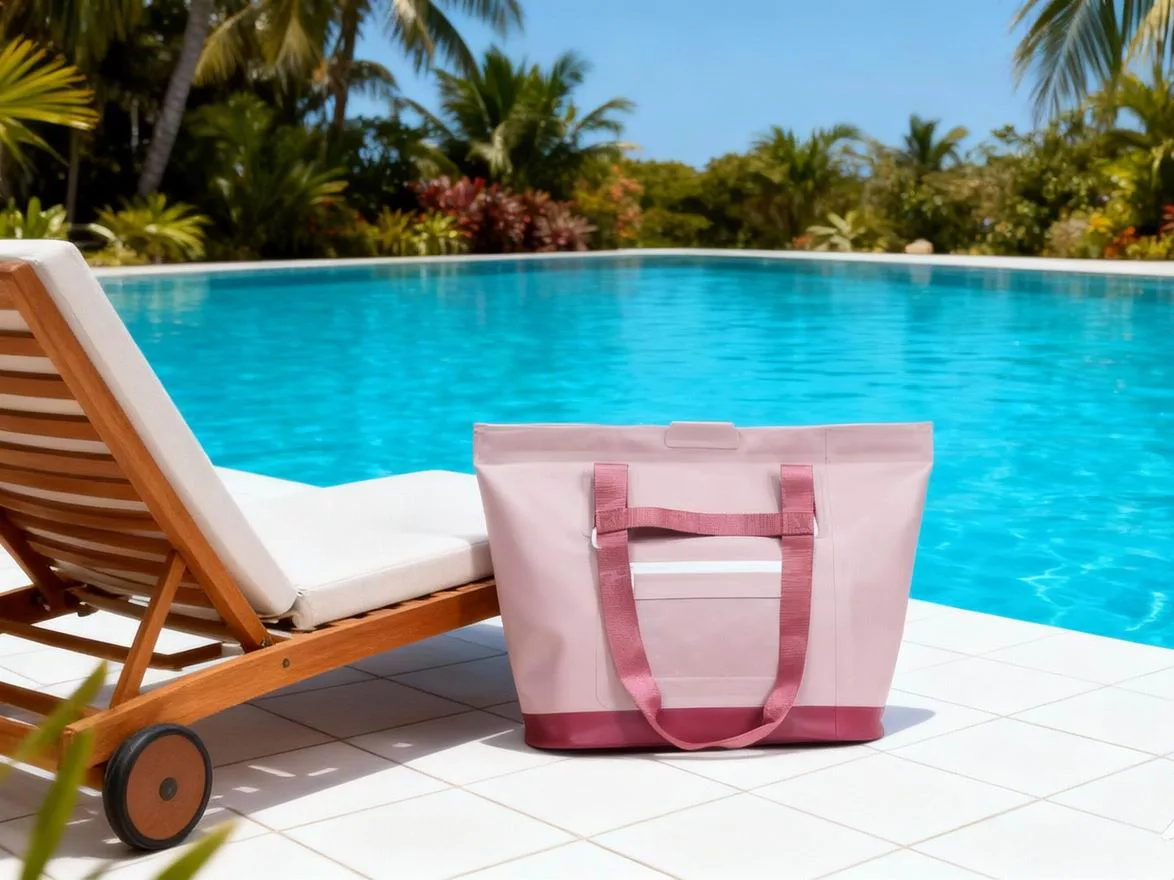
A worked example from a real capsize
Take a sea kayaker carrying a 20L roll-top with a 6 kg load: spare layers, a towel, lunch and a camera. The bag is rolled three times, the air is pressed out to roughly 14 litres of enclosed air, and the total enclosed volume is 20 litres. On the surface the bag displaces 20.5 kg of seawater against a 6 kg load, so it has 14.5 kg of reserve and rides with about 70% of its volume clear of the water.
The kayak capsizes in 4 m of water and the bag is dragged down by its leash for a minute. At 4 m the pressure is 1.4 bar, the air shrinks to 10 litres, and the total volume drops to 16 litres. Reserve falls from 14.5 kg to 10 kg, which still returns the bag to the surface, but with 28% less freeboard than it started with.
The failure in this story is rarely the bag. It is the leash, the untethered second bag, or the fact that the paddler treated a floating bag as a spare flotation device. Kit floats; people need a lifejacket rated and tested for the job, which our comparison of dry bags and lifejackets covers in detail.
Air traps, purge valves and deliberate buoyancy
Some designs deliberately trap air rather than expelling it. A bag with a sealed air chamber at the top keeps a fixed volume of air that cannot be squeezed out by packing, which makes the float behaviour predictable no matter how full the bag is. That is the thinking behind the air-trap constructions covered in our air trap guide.
A purge valve pulls in the opposite direction. It lets you compress the bag after closing so the load sits flat in a hatch, and that compression removes buoyancy. Used well, a valve is a packing tool; used without thinking, it turns a floating bag into a marginally buoyant one.
The decision is straightforward. If the bag might go overboard, leave air in it and skip the valve. If the bag lives in a hatch, a rack or a pannier, compress it and accept the loss of reserve. Our purge valve comparison walks through both cases with numbers.
Why a dry bag is not a buoyancy aid
Personal flotation devices are rated in newtons of buoyancy and tested on people. An ISO 12402 buoyancy aid delivers at least 50 N, roughly 5 kg of lift, and it is cut and strapped so that it turns an unconscious person face up. A dry bag has no rating, no harness and no guarantee that it will stay sealed under a person clinging to it.
Consider what happens if someone hugs a 20L bag in the water. Part of the bag goes under with them, the enclosed air compresses under the added load, and the film is asked to hold a person's weight against an untested seam. The bag may keep a conscious swimmer afloat for a few minutes, and it may not; there is no standard behind the claim.
The ISO publishes the ISO 12402 series that lifejackets and buoyancy aids are certified against, and cold-water immersion risk is documented by NOAA. Both make the same point from different angles: flotation for people has to be rated, worn and maintained, not improvised.
Testing buoyancy at home
- Weigh the packed bag on a kitchen or luggage scale and write the number down.
- Fill a bath or a bin with enough water to fully submerge the bag.
- Push the bag under and watch how much of it stays above the surface once released.
- Estimate the submerged fraction and multiply by the bag volume to confirm the displacement.
- Add 1 kg and repeat; note the load at which the bag stops returning to the surface.
- Record the result and treat anything under 3 kg of reserve as float-critical.
The bath test is crude but honest. It tells you the freeboard you will actually see on the water, which no specification sheet does, and it catches the single most common surprise: a load that is much heavier than its owner assumed.
For the seal itself, combine the float test with an air test. Inflate the bag until it is firm, leave it for 20 minutes and check whether it has softened; a bag that loses firmness has a closure or seam path, and our air inflation leak test gives the full procedure.
Buoyancy requirements by activity
| Activity | Does the bag need to float? | Target reserve | Recommended size | Note |
|---|---|---|---|---|
| Sea kayaking | Yes, when tethered on deck | 8 kg or more | 20L or 30L | Bright colour for visibility |
| Whitewater rafting | Yes, gear goes overboard often | 10 kg or more | 30L or 40L | Lash every bag without exception |
| Stand-up paddleboarding | Yes, board and bag separate | 5 kg or more | 10L or 20L | Leash the bag to the board |
| Canoe camping | Yes, in moving water | 12 kg or more | 40L or 60L | Barrels float even when full |
| Diving support | No, bags are weighted | Neutral is acceptable | Any | Do not rely on it for recovery |
| Urban commute | No | Any | 20L | Rain protection is the priority |
Two entries deserve a comment. Rafting gets a high target because gear genuinely does go overboard, and a floating bag is the difference between a recovery and a loss. Diving support is the opposite case: bags are often deliberately weighted or clipped to a shot line, and negative buoyancy is a feature rather than a fault.
Design choices that change float behaviour
Colour is the cheapest safety upgrade available. A mint, orange or pink shell is visible from a long way off when it is 80% submerged; a black one is not. Reflective piping adds a second cue for low light and costs a few grams.
Shape matters too. A tall, narrow bag floats upright with more of its body above water, because the heavy end sinks and the light end rises. A squat duffel lies flat on the surface and presents less freeboard for the same volume, though it is easier to grab.
Finally, consider dedicated float chambers. A welded air pocket at the top of a bag cannot be squeezed out during packing, so the reserve stays constant across trips. If you repeatedly carry loads near the limit of a bag size, that construction is worth specifying; compare the options across the product line.
Practical rules to carry away
- Work out reserve buoyancy: bag size in litres minus load mass in kilograms, in fresh water.
- Keep at least 3 kg of reserve on any bag that could go overboard; 8 kg in open water.
- Remember that wet gear can triple the mass of a sleeping bag or a towel.
- Expect roughly 25% less air volume at 3 m and half at 10 m; freeboard falls with it.
- Choose bright colourways and reflective accents for anything carried on deck.
- Never substitute a dry bag for a rated lifejacket, for yourself or for anyone else.
- Test your own packed bag in a bath once per season rather than trusting the label.
For clubs, rental fleets and guided operations, these rules belong in the briefing rather than the brochure. A rental bag that floats with 8 kg of reserve on a bright shell is a genuinely safer product, and it is specified the same way any other safety equipment is: with a number, a test and a colour.
We have produced waterproof bags since 2014 in an SGS-verified 4,950 m2 facility, and buoyancy questions come up in nearly every project brief: how much a size will carry, whether an air chamber is worth tooling, and which closure survives a tow. Minimum order is 500 pieces, sampling runs 6 to 10 working days and bulk 35 to 50 days, FOB Xiamen.
Frequently asked questions
Q1. Do dry bags float?
Yes, if the load is lighter than the water the bag displaces. A sealed 20L bag displaces 20 kg of fresh water, so any load under 20 kg floats, and a typical 6 kg load leaves about 14 kg of reserve buoyancy.
Q2. How much weight can a dry bag float?
Roughly its volume in litres minus its own load in kilograms. A 30L bag with a 10 kg load has 20 kg of reserve; the same bag with 32 kg inside sinks because the load exceeds its displacement.
Q3. Does a full dry bag still float?
Usually, because most camping gear is far less dense than water. A 20L bag packed with 18 kg of canned food or camera gear is the exception: it submerges almost completely and shows only a couple of litres above the surface.
Q4. Why does my dry bag sink when I push it underwater?
Compression. At 3 m the enclosed air shrinks by about 23%, so the bag displaces less water and its reserve falls. It still returns to the surface unless the load itself is denser than water.
Q5. How does saltwater change buoyancy?
Seawater is about 2.5% denser than fresh water, so a 20L bag displaces 20.5 kg instead of 20 kg. That is roughly half a kilogram of extra lift, which is enough to notice on a heavily loaded bag.
Q6. Can I use a dry bag as a lifejacket?
No. A buoyancy aid is rated in newtons, tested on people and shaped to turn an unconscious person face up. A dry bag has no rating, no harness and no guarantee that it stays sealed under a person's weight.
Q7. How much buoyancy does an ISO buoyancy aid give?
At least 50 N under ISO 12402, which is about 5 kg of lift, with higher levels at 100 N, 150 N and 275 N. A dry bag offers whatever the displacement arithmetic gives it on the day, with no certification behind it.
Q8. What is reserve buoyancy on a 20L bag with a 6 kg load?
About 14 kg in fresh water and 14.5 kg in seawater. The bag submerges roughly 30% of its volume, so 14 litres stay above the surface and the closure remains clear of the splash zone.
Q9. Does a purge valve make a dry bag sink?
Not on its own, but compressing the bag after closing removes air volume and therefore removes buoyancy. If the bag may go overboard, leave the air in and skip the valve; see our valve comparison.
Q10. How do I test whether my bag floats?
Weigh the packed bag, submerge it in a bath and note how much stays above the surface once released. Add a kilogram at a time until it stops returning, and treat anything under 3 kg of reserve as float-critical.
Q11. Why does wet gear make a bag sink?
Because absorbed water adds mass without adding volume. A dry towel or sleeping bag is the lightest item you carry; a soaked one can hold 2 to 3 kg of water and triple its weight inside the same enclosed space.
Q12. Do larger dry bags float better?
They displace more water, so they carry a bigger absolute reserve, but the principle is identical: displacement minus load. A 60L bag with 58 kg inside is just as marginal as a 5L bag with 4.8 kg inside.
Q13. What happens to a dry bag at 10 m depth?
Pressure doubles, so the enclosed air halves. A 20L bag holding 6 litres of gear falls to about 13 litres of total volume and its reserve drops from 14 kg to roughly 7 kg.
Q14. Are floating dry bags different from normal ones?
Some are. Purpose-built floating designs use a sealed air chamber that cannot be squeezed out during packing, so the reserve stays constant. Bright shells and reflective accents are usually added for visibility. See the floating range.
Q15. Should I lash a bag that floats?
Yes. Floating only helps if the bag stays with the boat. Use two attachment points and a single full turn so the bag cannot shift but can be released quickly in an emergency.
Q16. Does trapped air make a bag more buoyant?
Yes, up to the point where the bag reaches its full external volume. Once the bag is fully expanded, extra air pressure adds nothing; only the enclosed volume matters, which is why squeezing air out reduces buoyancy and leaving it in increases it.
People also ask
How does a dry bag float?
A sealed bag pushes aside its full external volume, so a 20L bag displaces 20 kg of water. If the bag and its contents weigh less than that displaced water, the bag floats, with the surplus appearing as reserve buoyancy.
Are dry bags buoyant enough to hold a person?
Not reliably. A bag may keep a conscious swimmer up for a few minutes, but it has no rating, no harness and no test behind it. Use an ISO-rated buoyancy aid or lifejacket for people, every time.
Why does a dry bag lose buoyancy when deep?
Pressure compresses the enclosed air. At 10 m the pressure is double the surface value, so the air volume halves, the bag displaces less water, and reserve buoyancy falls accordingly.
What size dry bag floats the most?
The largest one you fill with light gear. Reserve buoyancy scales with volume, so a 40L bag carrying 8 kg has 32 kg of reserve, while a 10L bag with the same load has only 2 kg.
Do dry bags float better in the sea?
Slightly. Seawater is around 1025 kg per cubic metre against 1000 for fresh water, so the same bag gets about 2.5% more lift, which is half a kilogram on a 20L bag.
Can you make a dry bag float higher?
Yes: pack lighter, leave air inside rather than purging it, choose a larger size for the same load, and pick a bright shell so what remains above water is easy to see.
Need this in production volume?
QUANZHOU JUNYUAN BAGS has produced waterproof bags since 2014 in an SGS-verified 4,950 m2 facility in Fujian, China. Minimum order 500 pieces, sampling in 6–10 working days, bulk in 35–50 days, FOB Xiamen — write to service@junyuanbags.com with your spec and target market.