Can You Machine Wash a Dry Bag?
You can machine wash a welded dry bag, but only under narrow conditions: a front-loading drum, cold or 30 °C water, a mild detergent at half dose, no bleach, no softener and no spin cycle above 400 rpm. What destroys bags is not the water, it is the rest of the cycle: a top-loader agitator twists a welded seam through 180 degrees hundreds of times, a 60 °C wash softens thermoplastic film, and a tumble dryer at 70 °C can permanently crease a closure fold.
The safe routine for most owners is a ten-minute hand wash and a shaded air dry, which removes salt, sand and sunscreen without stressing a single weld. This guide explains what each part of a machine cycle does to film and seam, gives temperature limits by material, sets out when machine washing is genuinely acceptable, and covers the mildew and smell problems that make people reach for the machine in the first place.
- The honest answer, with the conditions attached
- What a washing machine actually does to a welded seam
- Temperature limits by material
- Detergent, bleach and softener
- Top loaders, agitators and impeller plates
- Spin cycle and why it matters more than the wash
- Tumble drying is worse than washing
- When machine washing is genuinely acceptable
- The hand-wash method that replaces the machine
- Mildew, smell and the problems people want the machine to fix
- What about waterproof backpacks and printed bags?
- How often to wash, and how to test afterwards
- Care choices that decide how long a bag lasts
The honest answer, with the conditions attached
A welded dry bag has no coating to strip, so the waterproof barrier is the film itself and washing does not wash it away. That is the good news. The risk is mechanical and thermal: the drum tumbles a stiff, slippery object against itself, the water is heated, and the spin cycle applies centrifugal force to a shape that was never designed to be spun. Each of those can shorten a bag life without leaving an obvious mark.
So the answer depends on which machine you own. A front loader with a wool or delicates programme tumbles gently in shallow water and can be used with care. A top loader with a central agitator, common in North America, wraps a bag around the post and should never be used. If you cannot change the cycle settings, wash by hand; the ten minutes you save are not worth a bag.
There is one more condition that matters more than the machine: the state of the bag. A bag with a torn seam, a cracked weld or a buckle that no longer clips should not go near a drum, because the machine will find the weak point. Inspect the bag in good light, including the inside of the fold, before you decide how to wash it.
What a washing machine actually does to a welded seam
A weld is a narrow band, typically 8 to 12 mm wide, where two film layers have been fused under radio-frequency energy. It is strong in tension and in peel, and it is less tolerant of repeated flexing along its length. A tumbling drum folds a bag along random axes roughly 40 times a minute, and a 30-minute programme therefore puts more than a thousand flex cycles into seams that were tested for hundreds.
The second mechanism is abrasion against the drum and against the bag itself. A rivet pattern embossed into a stainless drum acts like a file on a 0.5 mm film, and a bag washed with a zip, a buckle or a carabiner attached will score both the drum and its own surface. Empty the bag, remove or pad the hardware, and never wash a dry bag alongside jeans or anything with a metal rivet.
The third mechanism is trapped water. A roll-top bag closed during a wash keeps water inside, and a bag that goes into the spin cycle half full of water puts a surprisingly large load on the weld at the base. Always wash the bag open and unrolled, with the mouth held open by a rolled towel, so water can enter and leave freely.
Temperature limits by material
| Material | Max safe wash temperature | Spin limit | Tumble dry | Failure mode above the limit |
|---|---|---|---|---|
| TPU film, 0.4-0.5 mm | 40 °C | 400 rpm | Never | Film softens, creases set in |
| TPU film, 0.7 mm | 40 °C | 400 rpm | Never | Slower creasing, same limit |
| PVC coated shell | 30 °C | No spin | Never | Plasticiser migration, stiffening |
| PE or PP laminate | 30 °C | 300 rpm | Never | Film distortion |
| rPET face fabric only | 40 °C | 400 rpm | Never | Face shrinks, film buckles |
Those limits are conservative on purpose. Film does not melt at 40 °C, but it does soften enough to take a permanent crease, and a crease across the closure fold is the most common way a machine wash ruins a bag that was otherwise fine. Cold water at 20 to 30 °C removes salt and sand just as effectively and removes the risk almost entirely.
Hardware has its own limits. Acetal buckles tolerate warm water but deform under a hot dryer, and a metal spring in a cam buckle can lose temper above about 80 °C. Padded harnesses on waterproof backpacks are the worst case, because foam retains water and a dryer overheats the foam long before it dries the bag. That is why the standard instruction for any bag with a harness is hand wash and air dry.
Detergent, bleach and softener
Use a small amount of mild liquid detergent, roughly half the dose you would use for a normal load, and nothing else. Powdered detergent can leave undissolved granules in the fold, and those granules abrade the film once the bag is rolled. Rinse twice, because a soap film left inside a waterproof bag becomes a slip hazard on the closure and a food source for mildew.
- Mild liquid detergent at half dose: safe, rinse twice.
- Bleach: avoid. It attacks the film surface and any print, and it is unnecessary.
- Fabric softener: avoid. It deposits a film that reduces closure friction and attracts grit.
- Stain remover sprays: avoid on prints and welds; spot test on a hidden panel first.
- White vinegar at 1:10 in water: acceptable for mildew, followed by a full fresh-water rinse.
- Disinfectant wipes: avoid. The solvent content accelerates surface cracking.
Sunscreen deserves a specific note, because it is the hardest common contaminant and it is oily rather than water-soluble. A mild detergent at 30 °C lifts most of it; what remains responds to a wipe with a little isopropyl alcohol on a cloth, used sparingly and kept away from the weld zone. Never soak a bag in solvent, and never use acetone, which attacks polyurethane directly.

Top loaders, agitators and impeller plates
A central agitator is the single worst thing you can put a dry bag near. The post rotates a bag through repeated reversals, and because a dry bag is stiff and buoyant, it tends to wrap rather than tumble. Every reversal pulls the wrapped bag tight against the post, which is exactly the peel geometry a weld resists least well. Owners of agitator machines should hand wash without exception.
Impeller washers, which use a low plate instead of a post, are milder but still aggressive because they rely on high-speed water movement and load-on-load contact. If you must use one, choose the lowest agitation setting, put the bag in a large mesh laundry bag, and add two or three towels so the drum is balanced and the bag is cushioned. The towels also stop the bag from floating on top of the water.
Spin cycle and why it matters more than the wash
Spin is where most machine damage happens. A drum at 1,200 rpm generates enough force at the periphery to press a wet bag against the drum wall with significant pressure, and any fold in the bag becomes a crease under that load. Creases in thermoplastic film are semi-permanent: the polymer chains rearrange slightly and the sheet remembers the bend. A creased closure fold leaks, and no amount of re-rolling fixes it.
If your machine allows it, skip the spin entirely and let the bag drain in a sink for ten minutes. If it does not, use the lowest available speed, 400 rpm or below, and remove the bag the moment the cycle ends rather than leaving it in a hot, damp drum. Leaving a wet bag in a closed machine for two hours is how mildew starts, which is usually the problem the wash was meant to solve.
Tumble drying is worse than washing
Never tumble dry a dry bag. Dryer air runs at 60 to 80 °C, which is above the crease threshold for every film in the table, and the tumbling action adds the same random flexing as the wash but against a dry, stiffer sheet. The combination produces the classic failure: a bag that comes out looking fine and leaks at the fold the first time it is used.
Air dry in shade with the mouth held open, which takes four to eight hours depending on humidity, or about two hours in moving air. Hang the bag upside down so water leaves the base rather than pooling in a weld corner, and turn it inside out halfway through if the interior is still damp. Direct sun is not a faster option: UV is the main ageing agent for these films, and two hours of strong sun does more damage than a season of shaded use.
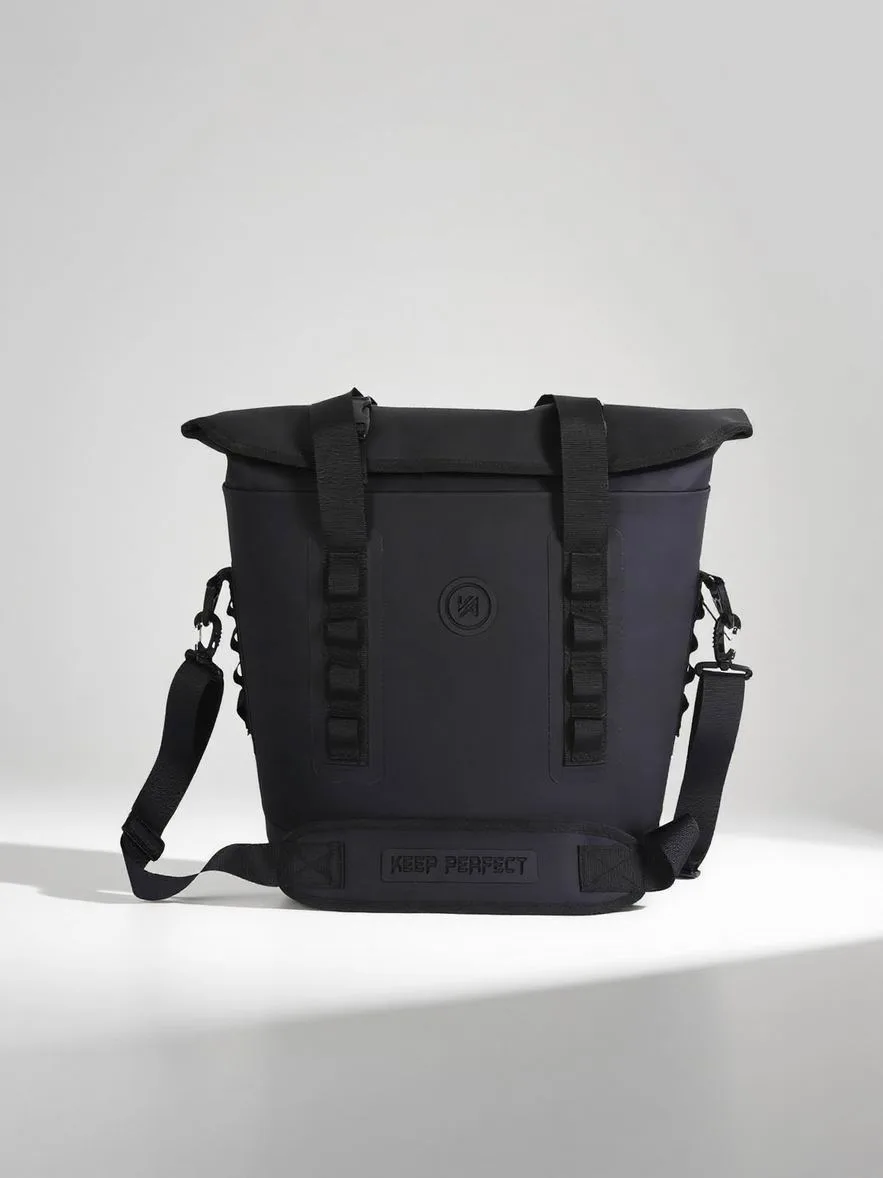
When machine washing is genuinely acceptable
| Bag type | Machine wash | Conditions | Better alternative | Risk if ignored |
|---|---|---|---|---|
| Plain roll-top, no harness | Occasionally | Front loader, 30 °C, no spin | Hand wash in a tub | Creased fold |
| Waterproof backpack with harness | No | Not recommended | Sponge and hose | Foam damage, strap warp |
| Dry duffel with welded handles | Rarely | Front loader, 30 °C, no spin | Hand wash | Handle weld fatigue |
| Bag with a metal zip | No | Never | Brush the teeth by hand | Zip and drum damage |
| Inflatable or valve-fitted bag | No | Never | Wipe and flush the valve | Valve seat distortion |
Read the table as a default of no, with one narrow exception. A plain roll-top bag with no padding and no hardware beyond a plastic buckle can take an occasional gentle cycle, perhaps twice a season, and will show no ill effect if the water is cold and the spin is skipped. Everything else in the range is better washed by hand.
Age matters as well. A bag in its first season has film with full plasticiser content and full flexibility; a bag in its sixth season has lost some of both and creases far more easily. If a bag is old enough that you are thinking about replacing it, it is old enough that a machine wash is the likely last straw. Hand wash the old ones, machine wash the new ones if you must.
The hand-wash method that replaces the machine
- Empty the bag completely, including the pockets, and unroll the closure.
- Fill a tub or a sink with 10 litres of water at 20 to 30 °C.
- Add a cap of mild liquid detergent and submerge the bag open.
- Wipe the interior and the fold line with a soft cloth, not a brush.
- Flush the closure channel with clean water from a hose or a jug.
- Work each buckle through its travel while wet to push grit out.
- Rinse twice in fresh water and drain upside down for ten minutes.
- Dry open in shade with moving air for four to eight hours.
That routine takes about ten minutes of actual work and removes everything a machine would, including salt crystals and sand packed into the fold. It also lets you inspect the bag properly, which is the real maintenance value: most seam failures are visible as a white stress line at the weld corner weeks before they leak, and you only see that if you are looking at the bag in good light.
Mildew, smell and the problems people want the machine to fix
People reach for the machine because a bag smells, and smell comes from mildew growing on organic residue inside a bag that was stored damp. The machine is the wrong tool because it does not reliably reach the corners where the growth sits. A dilute vinegar solution at one part vinegar to ten parts water, wiped through the interior and left for ten minutes before a full rinse, deals with it more reliably and without heat.
| Problem | Cause | Safe treatment | Avoid | Prevention |
|---|---|---|---|---|
| Musty smell | Damp storage | Vinegar 1:10 wipe, then air dry | Bleach, scented softener | Dry fully before storage |
| Black spots in the fold | Mildew on residue | Vinegar wipe, soft brush | Scrubbing the weld | Rinse after every trip |
| Sunscreen film | Oils on the surface | Detergent, then alcohol wipe | Acetone, solvents | Wipe the bag after use |
| Salt crystals at the closure | Dried seawater | Fresh-water flush | Hot water | Rinse before each roll |
| Sticky film surface | Plasticiser migration | Wipe, retire the bag if severe | Solvent cleaning | Shaded storage |
Prevention beats treatment, and it is mostly about how the bag is stored. Dry it fully, store it loosely rolled with the buckle open, and keep it out of a sealed plastic tub where humidity has nowhere to go. A bag stored open in a ventilated space rarely develops mildew at all, whatever it has been through on the water.
Health is a reason to take mildew seriously rather than cosmetic. Mould exposure can trigger respiratory symptoms in sensitive people, and cleaning a heavily affected bag should be done outdoors with the bag fully open. Guidance from the CDC on mould cleanup is the right reference for a bag that has been stored damp for months.
What about waterproof backpacks and printed bags?
A waterproof backpack adds three things a roll-top does not have: a padded harness, a back panel with foam or a moulded sheet, and often a sternum strap with a buckle attached under load. Foam holds water like a sponge, so a machine-washed backpack goes into the spin cycle holding several hundred grams of water in the straps, and the resulting imbalance batters the drum and the bag together.
Wash a backpack by sponge and hose instead: wipe the harness with detergent solution, rinse the shell, and dry the straps separately by hanging the pack from the haul loop. If the foam inside a strap stays wet for more than 24 hours, compress it gently by hand to push water out and repeat. Persistent damp in a harness is the usual source of smell in a backpack, not the shell.
Printed bags need one extra caution. A bonded print survives dozens of washes, but a surface print that sits on top of the film starts to crack and flake under the combination of detergent and flexing. Keep prints clear of the fold line when specifying a bag, and wash printed panels by hand. The EPA publishes guidance on detergent choice and water use that is worth a look if you are washing technical gear often.
How often to wash, and how to test afterwards
Frequency should follow exposure rather than the calendar. A bag used in salt water or muddy conditions needs a rinse after every trip and a full wash every four to six outings. A bag used for a dry commute or as a gym bag needs a wash every two to three months. Over-washing is its own problem: every wash is flexing, and a bag washed weekly will age faster than one washed when it needs it.
Test after every wash, because the wash is exactly when damage would occur. Roll three folds, close the buckle, squeeze the bag and listen for a hiss, then submerge it in a bath for 30 minutes with a paper towel inside. Any damp patch on the towel means the bag is out of service for anything important, though it may still be fine as a liner or a laundry sack.
Care choices that decide how long a bag lasts
Three habits account for most of the difference between a bag that lasts three seasons and one that lasts ten: rinse with fresh water after salt exposure, dry fully in shade before storage, and store loosely rolled with the buckle open. None of them takes more than five minutes, and each removes one of the three main ageing agents, which are salt, UV and crease damage.
The fourth habit is inspection. Once a season, turn the bag inside out in good light and look at the weld corners, the base fold and the strap attachment points. A white stress line, a small crack at a corner, or a buckle that slips under load are all cheap to deal with early: a welded patch costs a few minutes, while a bag that fails on a trip costs the kit inside it.
If you are specifying bags for a rental fleet, a club or a retail range, care instructions belong in the specification as much as the fabric does. We have produced waterproof bags since 2014 in an SGS-verified 4,950 m2 facility, with a 500-piece minimum and sampling in 6 to 10 working days, and the care card we write for a programme is part of the deliverable; see our production team for the process. More detail sits in our machine washing notes, the roll-top cleaning guide, mildew removal and safe deodorising, and the broader questions are covered on our frequently asked questions page.

Frequently asked questions
Q1. Can you machine wash a dry bag?
Occasionally, in a front loader at 30 °C with mild detergent, no bleach and no spin above 400 rpm. Never in a top loader with an agitator, and never in a tumble dryer. Hand washing is safer and takes about ten minutes.
Q2. Will machine washing ruin the waterproofing?
Not directly, because the film is the waterproof layer rather than a coating. The risk is mechanical: tumbling flexes welded seams and a creased closure fold will leak.
Q3. What water temperature is safe for a dry bag?
30 °C is the safe default and 40 °C is the upper limit for TPU. Warmer water does not clean better but does soften film enough for a permanent crease to set in.
Q4. Can you tumble dry a dry bag?
No. Dryer air runs at 60 to 80 °C, above the crease threshold for every film used in dry bags, and the tumbling flexes a dry, stiffer sheet. Air dry in shade instead.
Q5. Can I use detergent on a dry bag?
Yes, a mild liquid detergent at half the normal dose, followed by two rinses. Avoid powders, which leave granules that abrade the fold line once the bag is rolled.
Q6. Is bleach safe for a dry bag?
No. It attacks the film surface, fades prints and is unnecessary for anything a vinegar solution will not handle. Use white vinegar at one part to ten parts water instead.
Q7. Should I use fabric softener?
No. Softener deposits a film that reduces closure friction, attracts grit and feeds mildew growth inside a bag that is stored damp.
Q8. Can I use a top-loading washing machine?
No. A central agitator wraps a stiff bag around the post and reverses it repeatedly, which is the peel geometry a welded seam resists least well. Wash those bags by hand.
Q9. Can I machine wash a waterproof backpack?
No. Foam in the harness holds several hundred grams of water, which unbalances the spin cycle and overheats in a dryer. Sponge and hose the pack, and dry the straps separately.
Q10. How do I remove mildew from a dry bag?
Wipe the interior with white vinegar diluted one part to ten in water, leave it for ten minutes, then rinse twice and dry fully in shade. Vinegar reaches corners a machine cannot.
Q11. How do I get the smell out of a dry bag?
Find the source first: it is usually residue in the fold or damp in a harness. Treat with dilute vinegar, rinse, and dry fully open. Scented products mask the smell and leave a film.
Q12. Can I wash a dry bag in a dishwasher?
No. Dishwasher detergent is far more alkaline than laundry detergent and the drying cycle runs hot. A dishwasher will damage the film faster than any washing machine.
Q13. How often should I wash a dry bag?
Rinse after every saltwater or muddy trip, and do a full wash every four to six outings in heavy use, or every two to three months for light use. Over-washing ages the film.
Q14. Will washing remove the print on my bag?
A bonded print survives dozens of washes. A surface print starts to crack under detergent and flexing, so keep graphics clear of the fold and wash printed panels by hand.
Q15. Can machine washing void a warranty?
It often does, because care instructions on most technical bags specify hand washing and air drying. If the bag is under warranty, follow the card that came with it.
Q16. What is the safest wash routine overall?
Empty the bag, hand wash in 10 litres of water at 20 to 30 °C with a cap of mild detergent, wipe the fold line, rinse twice, drain upside down, and air dry open in shade for four to eight hours.
People also ask
Can you put a dry bag in the washing machine?
Only in a front loader, at 30 °C, with no spin above 400 rpm and no bleach or softener. A top loader with an agitator will flex and eventually peel the welded seams.
How do you wash a dry bag by hand?
Use 10 litres of water at 20 to 30 °C with a cap of mild detergent, wipe the interior and fold line with a soft cloth, rinse twice, then dry open in shade for four to eight hours.
Can you tumble dry a dry bag?
Never. Dryer temperatures of 60 to 80 °C exceed the point at which dry bag film takes a permanent crease, and a creased closure fold leaks the next time you roll it.
Does washing damage waterproof coating?
Welded bags have no coating to strip, so detergent does not remove waterproofing. Damage comes from heat, flexing and spin, which is why cold water and no spin are the rules.
How do you get mould out of a dry bag?
Wipe with white vinegar diluted one to ten with water, leave for ten minutes, rinse twice and dry fully in the shade. Clean outdoors if the growth is heavy, since mould spores irritate the lungs.
How often should you wash a dry bag?
Rinse after every saltwater or muddy outing and do a full wash every four to six trips. Light-use bags need a wash every two to three months; more frequent washing just ages the film.
Need this in production volume?
QUANZHOU JUNYUAN BAGS has produced waterproof bags since 2014 in an SGS-verified 4,950 m2 facility in Fujian, China. Minimum order 500 pieces, sampling in 6–10 working days, bulk in 35–50 days, FOB Xiamen — write to service@junyuanbags.com with your spec and target market.