Machine Washing a Dry Bag: What Survives and What Doesn't
No, a dry bag should not go in a washing machine if you want it to stay waterproof. A 40-minute drum cycle at 600 to 1,200 rpm folds a 0.5 mm TPU shell against itself thousands of times, which creases the film at the fold lines, works the welded seams in torsion and strips any durable water-repellent finish on the face fabric. Detergent residue then sits in the roll-top channel and makes the closure slippery, so a bag that came out clean may go in the water less reliable than it went in.
The good news is that a dry bag rarely needs anything a machine would do. Salt, sand, sunscreen and food residue all come off with fresh water, a soft cloth and a pH-neutral soap, and a full hand wash takes about 12 minutes per bag. This guide explains what the drum actually does to a welded shell, sets out temperature limits by material, covers the three problems a machine cannot fix, and gives a drying routine that prevents the mildew most people blame on a failed bag.
- The short answer, with the caveat
- What a washing machine does to a welded shell
- Detergent, temperature and the film
- Spin cycles and seam peel
- Buckles, D-rings and the drum
- Hand washing that actually removes salt
- Mildew, odour and what machines cannot fix
- Drying after any wash: heat limits by material
- Prints, labels and coatings in the drum
- Comparing wash methods: results and risk
- A twelve-minute hand wash that scales
- When retirement beats cleaning
- Care schedule by how often you paddle
The short answer, with the caveat
A welded dry bag is a flexible tank, not a garment. Its waterproofing comes from a continuous film and continuous seams, and both are sensitive to creasing under load and to heat. A domestic machine subjects the bag to repeated folding, tumbling against a hard drum and a spin cycle that applies real force to a shape never designed to be spun. None of that is needed to remove salt, which is the only thing most dry bags ever need cleaned off.
The caveat is that a machine wash will not destroy a bag in one cycle. A single gentle wash at 30 °C with no spin will probably leave a good 500D TPU bag no worse. The damage is cumulative: crease lines that form in the drum become the places where the film crazes and where the closure stops sealing flat two seasons later. If you already washed one, dry it properly and inspect the fold lines rather than assuming it is ruined.
What a washing machine does to a welded shell
Three mechanisms do the damage. Abrasion is the first: the bag tumbles against a stainless drum and, if it is washed with anything else, against zips, buttons and hook fasteners. A 0.5 mm TPU laminate loses roughly 5 to 10% of its thickness at a crease after a few hundred flex cycles, and drum abrasion accelerates that by scuffing the outer face. The second is torsion: a bag that is not packed holds its shape badly and twists, and a twist applied to a welded corner is exactly the load a seam is weakest against.
| Drum action | What it does to the bag | Damage after one cycle | Damage after ten cycles |
|---|---|---|---|
| Tumbling against the drum | Scuffs the outer face fabric | Light marks | Visible thinning at fold lines |
| Folding under its own weight | Sets hard creases in the film | Soft creases | Permanent crease lines |
| Spin at 600 to 1,200 rpm | Torsion on welded corners | Usually none | Seam lift at the corners |
| Detergent contact | Strips the face finish, leaves residue | Slight | Closure feels slippery |
| Warm water above 40 °C | Softens TPU and PVC coatings | None if brief | Film deformation near seams |
The spin cycle is the part people underestimate. At 1,200 rpm a wet 40L bag with 3 kg of water held in its folds generates considerable force at the corners, and a welded corner joint is loaded in peel rather than in shear, which is its weakest direction. Laboratory peel tests on welded TPU show the joint is strongest in shear and far weaker in peel, so anything that peels a corner repeatedly is doing the worst possible thing to it.
Detergent, temperature and the film
Temperature is the first hard limit. Keep wash water at or below 30 °C for TPU laminate and below 40 °C for PVC-coated fabric, and never use a hot hose straight from a tap left in the sun, which can exceed 60 °C on a summer afternoon. Above about 60 °C a 0.5 mm TPU film softens enough to deform under its own weight, and a deformed mouth stiffener will never roll flat again. Cold water plus mechanical action removes salt perfectly well because salt is highly soluble.
Detergent choice matters less than rinsing. Use a small amount of pH-neutral soap, roughly 5 ml in 10 litres, and avoid anything with bleach, enzymes, fabric softener or citrus solvents. Bleach attacks the face fabric and the printed logos; softener leaves a slippery film in the closure channel that reduces friction where you actually want grip. Whatever you use, rinse twice, because leftover surfactant is what makes a closure slip open in the first wave.
| Agent | Safe on TPU | Safe on PVC-coated | Rinsing needed | Notes |
|---|---|---|---|---|
| Fresh water at 20 to 30 °C | Yes | Yes | None | Removes salt and loose sand |
| pH-neutral soap, 5 ml per 10 L | Yes | Yes | Twice | The general purpose choice |
| Mild dish liquid | Yes | Yes | Twice | Cuts sunscreen and food oils |
| White vinegar, 1 part in 10 | Yes | Yes | Once | Useful for light mildew |
| Bleach or chlorine cleaner | No | No | Extensive | Attacks fabric and print |
| Citrus solvent degreaser | No | No | Extensive | Can soften coatings |
| Fabric softener | No | No | Extensive | Leaves the closure slippery |
One agent deserves a specific warning: do not use a pressure washer. A domestic unit delivers 8 to 12 MPa at the nozzle, which is two to three orders of magnitude more than any waterproof rating a soft bag carries, and it will drive water through a closure or a marginal weld that would otherwise be fine in ordinary use. A hose at taps pressure, around 0.3 MPa, is plenty for rinsing sand out of a buckle.
Spin cycles and seam peel
Seam peel is the failure mode that ends a bag, and it is worth understanding why a drum produces it. A radio-frequency welded seam on TPU is a melt bond with no stitching, so its strength comes entirely from the interfacial area and from the film on either side of it. Loaded in shear, a 20 mm wide weld on 0.5 mm film carries well over 300 N. Loaded in peel, with the two sides being pulled apart at an angle, the same weld fails at a small fraction of that.
A bag tumbling in a drum is repeatedly folded so that its corners turn inside out, which is a peel load applied over and over at the exact point where the weld geometry is already weakest. Ten wash cycles is enough to start visible lift at a base corner on a lightweight bag. If you must wash hardware-heavy items such as harnesses or strap sets, put them in a mesh bag, use the wool cycle at 30 °C and skip the spin entirely rather than letting the machine extract water by force.
Buckles, D-rings and the drum
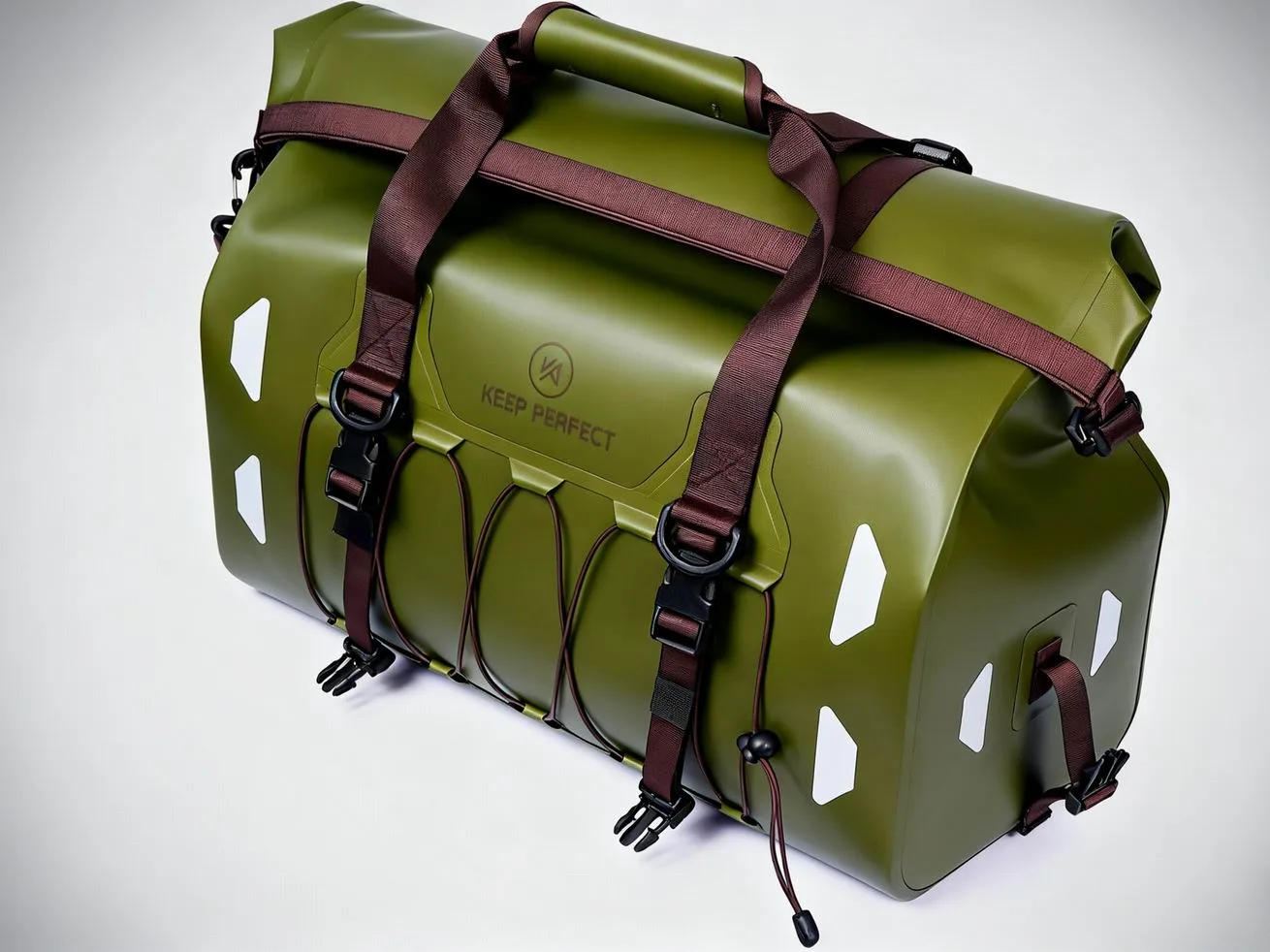
Hardware is the loudest argument against machine washing, and not because the hardware breaks. A polyoxymethylene buckle or a welded D-ring surviving a cycle is not in question. What happens instead is that the hardware beats the film around it: every tumble brings a hard plastic edge into contact with the panel, and the panel loses. D-rings and lash points are welded onto reinforced patches precisely because the surrounding film needs help, and a drum is a way of undoing that engineering.
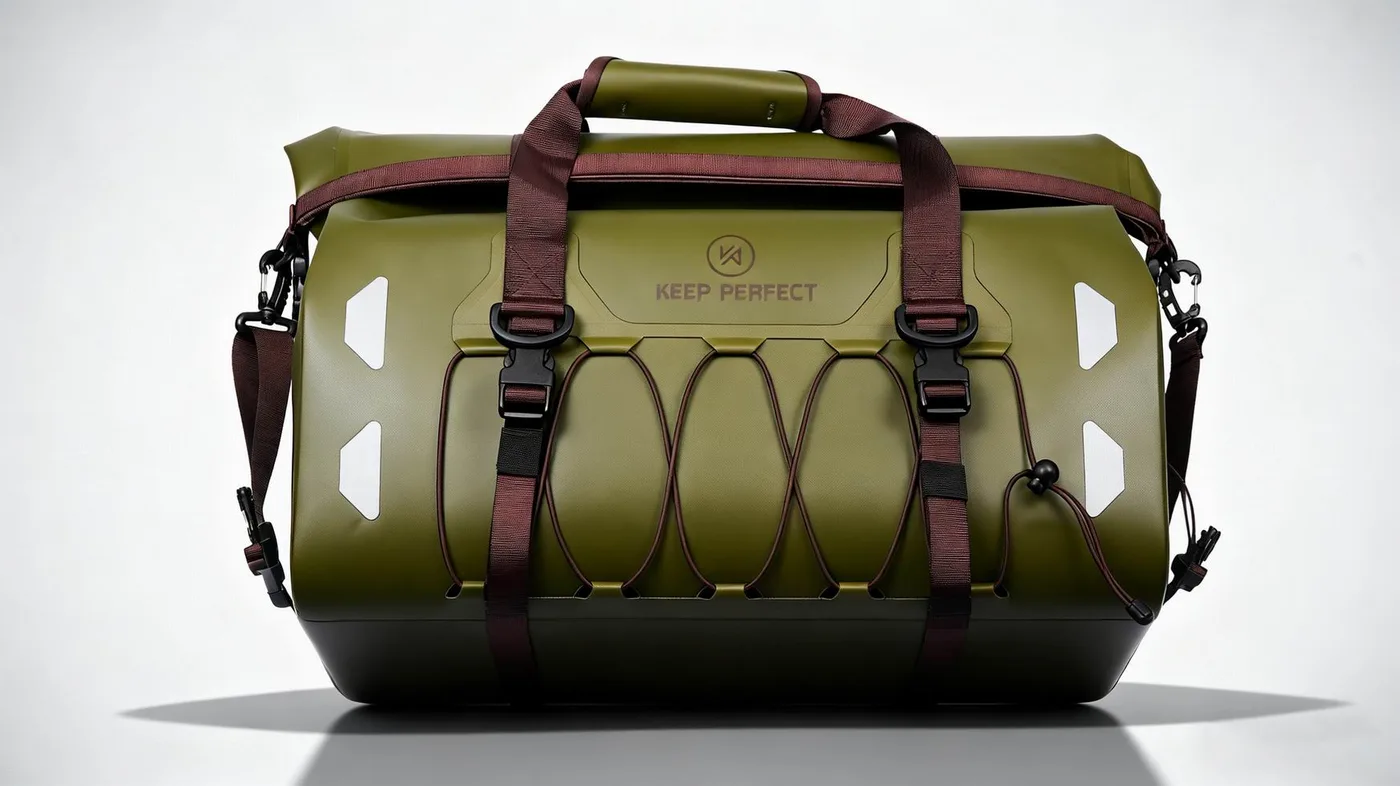
There is also a noise and damage risk to the machine. A buckle caught in the door seal or against the drum paddles can chip a drum or jam a pump, and a webbing strap that unravels can wrap the agitator. If the straps need cleaning, detach them where the design allows and wash them separately in a mesh bag. Otherwise clean them in place with a cloth and a soft brush around the buckle teeth, which is where salt crystals actually collect.
Hand washing that actually removes salt
- Empty the bag completely, including the roll-top channel, and shake out loose sand.
- Fill a tub with 10 to 15 litres of fresh water at 20 to 30 °C.
- Add about 5 ml of pH-neutral soap and submerge the bag.
- Wipe the whole outer surface with a soft cloth, working from the base upward.
- Turn the bag inside out over a rail and repeat on the inner surface.
- Brush the buckle teeth and the valve housing with a soft brush.
- Drain, refill with clean water and rinse twice until no suds remain.
- Shake out the water and dry in shade with the mouth propped open.
Twelve minutes per bag is realistic once you have done it twice, and the whole job can be done in a tub, a bath or a bucket at a campsite. The inside-out step is the one people skip and it is the one that matters after a saltwater trip, because salt spray wicks into the mouth and dries on the inner surface where you never see it. Left there, it attracts moisture and becomes the mildew patch you discover in spring.
For heavy sunscreen or fish residue, wipe the affected area with a cloth dampened in mild dish liquid before the general wash. Dish liquid is formulated to cut oils and works at cold temperatures, which is exactly the requirement here. Follow with the two rinses, because any surfactant left in the closure channel will reduce the friction that holds the roll closed. The full routine for a saltwater trip is set out in our saltwater rinsing guide.
Mildew, odour and what machines cannot fix
A machine cannot fix mildew, and neither can soap alone. Mildew grows on the surface of the film where organic residue and moisture meet, and it leaves a black speckle that is partly stain and partly living growth. Soap removes the food source but not the pigment, so the mark remains. The effective treatment is a dilute white vinegar solution at one part in ten, applied with a cloth and left for ten minutes, followed by a thorough fresh-water rinse.
Odour is a different problem and usually points at storage rather than at washing. A bag sealed while damp for two weeks develops a sour smell that survives any amount of rinsing, because the bacteria are inside the film surface rather than on it. Sunlight is the cheapest remedy: two hours of indirect daylight with the bag open and inside out kills most of what remains. Full instructions, including what to do when vinegar is not enough, are in our mildew removal guide and our deodorising guide. Anyone cleaning heavy mould growth should also follow the handling advice published by the CDC, which covers gloves, ventilation and when to discard soft goods rather than clean them.
Drying after any wash: heat limits by material
Drying is where most bags die, not washing. Never put a dry bag in a tumble dryer, on a radiator or in direct sun for hours. TPU tolerates surface temperatures up to about 60 °C before it starts to soften, and a tumble dryer on a normal setting reaches 70 °C or more, which is enough to deform a mouth stiffener and to make welded seams creep under their own weight. PVC-coated fabric is worse: plasticiser migration accelerates sharply above about 50 °C and the coating stiffens.
| Drying method | Typical temperature | Time for a 20L bag | Safe | Risk |
|---|---|---|---|---|
| Shade, mouth open, hung upside down | 20 to 25 °C | 4 to 8 hours | Yes | None |
| Indirect daylight indoors | 25 to 30 °C | 3 to 5 hours | Yes | Low |
| Direct sun, midday | 45 to 60 °C | 1 to 2 hours | Marginal | UV and heat together |
| Radiator or heater | 60 to 80 °C | 1 to 2 hours | No | Film deformation |
| Tumble dryer | 70 °C plus | 30 to 60 min | No | Seam creep, stiffener damage |
| On a closed boat in summer | 50 to 65 °C | Variable | No | Heat soak, no airflow |
Airflow matters more than heat. Hang the bag upside down with the mouth propped open so air can circulate through the tube, and put it somewhere with a through draught rather than in a closed cupboard. A 20L bag dries in four to eight hours in shade; a 60L bag packed with a damp sleeping bag may take two days, which is a good argument for emptying and drying kit separately. Storage advice for the months afterwards is in our drying and airflow guide.

Prints, labels and coatings in the drum
Printed and branded bags have one more reason to stay out of the machine. Screen-printed and heat-transferred logos sit on top of the face fabric and are bonded with a layer that flexes with the shell but abrades against anything hard. A single wash can dull a printed logo noticeably, and ten will lift fine detail entirely. Water-based inks on TPU are more robust than plastisol on PVC, but neither is designed for tumbling.
Care labels and compliance markings have a different problem: they are often the item that fails first, and in regulated markets the label is part of the product. A bag whose fibre-content or compliance label has washed off is a problem for a retailer even if the shell is fine. Clean printed areas with a damp cloth and pat them dry rather than rubbing, and never use a solvent on a print, because ink lifted by solvent cannot be put back.
Comparing wash methods: results and risk
It helps to see the options side by side with what each actually achieves. The comparison below assumes a typical weekend bag carrying salt, sand and sunscreen residue, and scores cleaning on whether the closure channel and inner surface come clean. Notice that the machine offers no advantage in cleaning power and carries every category of risk, which is the whole argument in one table.
| Method | Salt removal | Sand removal | Risk to seams | Risk to print | Time |
|---|---|---|---|---|---|
| Hose rinse only | Good | Partial | None | None | 3 min |
| Hand wash with soap | Complete | Complete | None | None | 12 min |
| Hand wash plus vinegar | Complete | Complete | None | Low | 20 min |
| Machine, wool cycle, no spin | Complete | Good | Moderate | Moderate | 45 min |
| Machine, normal cycle | Complete | Good | High | High | 50 min |
| Pressure washer | Complete | Complete | Very high | Very high | 5 min |
The one situation where a machine is genuinely tempting is a rental fleet at the end of a season, where dozens of bags need doing at once. Even there, a two-stage tub system works better: a wash tub with pH-neutral soap, a rinse tub with clean water, and a drying rack with forced air. One person can process thirty bags in a day that way, and the fleet keeps its warranty rather than its creases.
A twelve-minute hand wash that scales
Set the job up as a line rather than as a single task. Put a wash tub and a rinse tub side by side, hang a rail above them, and work through bags one at a time: wash, rinse, hang, move to the next. The first bag takes twelve minutes and every one after it takes about nine, because the tubs stay full and the cloth stays wet. Ten bags takes roughly an hour and a half, which is less time than a single machine cycle plus the repair work afterwards.
Finish with a check rather than just hanging the bag. Roll the top three times, squeeze and listen for a hiss, and confirm the closure is still seating cleanly after washing. A five-second check catches the one case in which cleaning did cause a problem: a stiffener that has gone soft from hot water. If the closure feels different from before, dry the bag completely and repeat the squeeze test before it goes back into service.
When retirement beats cleaning
No amount of cleaning rescues a bag that has lost its barrier. Retire it when you see any of the following: creases that have gone white and cracked through the film, a weld that has lifted for more than a few millimetres, a closure that no longer seats even after cleaning, or a shell that stays tacky or brittle to the touch. Cleaning addresses dirt; these are material failures and they do not reverse.
The economics are worth stating plainly. A hand-washed 500D TPU bag lasts eight to twelve years of weekend use; the same bag machine washed monthly typically shows crease damage by year three. If a bag costs the equivalent of six hours of use per year over its life, then three years of machine washing costs you two replacement bags and a wet sleeping bag. Guidance on judging the end of service is in our retirement guide.
Care schedule by how often you paddle
- After every saltwater trip: fresh-water rinse inside and out, buckles worked while wet.
- After every trip in sand or silt: brush the closure channel and buckle teeth, then rinse.
- Once a month in regular use: full hand wash with pH-neutral soap and two rinses.
- At the end of each season: wash, treat any mildew with vinegar, dry for 24 hours and inspect.
- Before long storage: wash, dry completely, then store rolled loosely with the buckle unclipped.
- Every spring: run a squeeze test and a ten-minute bath test before the first trip.
Write the schedule on a card and keep it with the drying rack, because the reason care routines fail is not complexity, it is forgetting. A bag rinsed after every trip needs a full wash perhaps three times a year; a bag rinsed never needs one every month and still dies younger. The EPA publishes guidance on reducing detergent runoff into waterways, which is a good reason to wash in a tub rather than in a river or a lake.
Where a fleet or a retail range is involved, the same schedule becomes part of the product documentation, and it is worth checking that the care label matches what the materials can actually take. Our production team has built waterproof bags since 2014 in an SGS-verified 4,950 m2 facility, working to AQL 2.5 inspection with sampling in 6 to 10 working days, and care instructions are agreed at sampling rather than added at the end.Start with the basics in our roll-top cleaning guide if you are setting up a routine for the first time.
Frequently asked questions
Q1. Can you machine wash a dry bag?
No, not if you want it to stay waterproof. The drum creases the film, the spin twists welded corners and detergent residue in the closure channel makes the roll slip. Hand wash at 20 to 30 °C instead; it takes about 12 minutes.
Q2. What happens if you put a dry bag in the washing machine?
Usually nothing dramatic after one cycle, but the damage is cumulative. Expect scuffed face fabric, set crease lines, slippery closure channels and, after ten cycles or so, seam lift at the corners where peel loads are highest.
Q3. Can you tumble dry a dry bag?
Never. A normal cycle exceeds 70 °C, which is past the point where a 0.5 mm TPU film softens and PVC coatings lose plasticiser. Dry in shade with the mouth open and air moving through the bag, four to eight hours for a 20L.
Q4. What temperature water is safe for washing a dry bag?
20 to 30 °C for TPU laminate and up to 40 °C for PVC-coated fabric. Above about 60 °C the film deforms under its own weight and a mouth stiffener will never roll flat again.
Q5. What detergent is safe for a dry bag?
A pH-neutral soap at about 5 ml in 10 litres, or a mild dish liquid for sunscreen and food oils. Avoid bleach, enzymes, fabric softener and citrus solvents, and always rinse twice.
Q6. Will machine washing void a warranty?
Very often, yes. Care instructions on waterproof bags typically specify hand washing and cool water, and drum damage such as creased film and scuffed welds is easy for an inspector to identify. Check the label before you try it.
Q7. How do I get salt off a dry bag without a machine?
Empty it, rinse inside and out with fresh water at tap pressure, then hand wash in 10 litres of water with 5 ml of neutral soap. Rinse twice and dry in shade with the mouth open.
Q8. Can I use a pressure washer on a dry bag?
No. A domestic unit delivers 8 to 12 MPa, which drives water through closures and marginal welds that would be fine in ordinary use. A hose at about 0.3 MPa is plenty for sand.
Q9. How do I remove mildew from a dry bag?
Wipe with white vinegar diluted one part in ten, leave for ten minutes, then rinse twice and dry in daylight. Soap removes the food source but not the pigment, which is why mildew marks survive ordinary washing.
Q10. Why does my dry bag smell after washing?
Because it was stored damp. The smell comes from bacteria at the film surface, not from dirt, so more soap will not shift it. Open the bag, turn it inside out and give it two hours of indirect daylight.
Q11. Can I wash dry bag straps and harnesses in a machine?
Only if they detach, and then in a mesh bag on a wool cycle at 30 °C with no spin. Detached webbing can also be hand washed in the same tub as the bag, which is safer for the stitching.
Q12. Does washing damage printed logos?
Yes, in a machine. Print sits on the face fabric and abrades against the drum; one cycle can dull it and ten can lift fine detail. Clean printed areas with a damp cloth and never use solvent on them.
Q13. How long does a dry bag take to dry?
Four to eight hours for a 20L hung upside down in shade with the mouth open, and up to two days for a 60L that was packed with damp kit. Airflow matters more than warmth.
Q14. Should I wash a dry bag before storing it for winter?
Yes. Wash, treat any mildew, dry for a full 24 hours, then store rolled loosely with the buckle unclipped. A bag stored dirty or damp will be mouldy by spring no matter how well it was made.
Q15. Can I wash a dry bag in a river or a lake?
Wash in a tub and dispose of the water responsibly instead. Detergent and sunscreen residue harm freshwater systems, and washing kit in the water you paddle in is poor practice wherever it is not explicitly allowed.
Q16. Is a hand wash really as clean as a machine?
Yes, because a dry bag only ever carries salt, sand and sunscreen, all of which dissolve or lift with cool water and a cloth. The machine adds no cleaning power here and adds every category of risk.
People also ask
Can you put a dry bag in the washing machine?
You can, but you should not. The drum creases the film and abrades the face, the spin applies peel loads to welded corners, and detergent residue makes the closure slip. Hand wash at cool temperatures.
How do you wash a dry bag safely?
Empty it, wash in 10 litres of water at 20 to 30 °C with 5 ml of pH-neutral soap, wipe both surfaces, brush the buckles, rinse twice, then dry in shade with the mouth open.
Can you put a dry bag in the dryer?
No. A tumble dryer exceeds 70 °C, which softens TPU film and drives plasticiser out of PVC coatings. Air dry in shade with airflow through the bag instead.
What ruins a waterproof bag fastest?
Heat and creasing: tumble drying, hot hoses, radiators and storing the bag folded flat for months. Salt left on the closure runs a close second because it abrades the fold.
How do you get the salt smell out of a dry bag?
Rinse twice after the soap wash, then dry it open and inside out in indirect daylight for two hours. The smell is bacterial, so soap alone will not remove it.
Do dry bags need washing after every trip?
A fresh-water rinse after every saltwater or sandy trip, yes. A full soap wash is needed about once a month in regular use and at the end of each season.
Need this in production volume?
QUANZHOU JUNYUAN BAGS has produced waterproof bags since 2014 in an SGS-verified 4,950 m2 facility in Fujian, China. Minimum order 500 pieces, sampling in 6–10 working days, bulk in 35–50 days, FOB Xiamen — write to service@junyuanbags.com with your spec and target market.