Home / Blog / Waterproof Technology
Condensation Inside a Dry Bag
A sealed 60-litre dry bag holds only about 0.5 to 1.5 grams of water as vapour even at 28 °C and 80% relative humidity, so condensation from trapped air can never produce more than a film of moisture on the inside of the film. The water that soaks a load comes from somewhere else: one damp towel carries 150 to 300 grams, which is roughly two hundred times the entire moisture content of the air sealed inside the bag. Understanding that ratio is what stops people blaming the closure for a problem that started with a wet swimsuit sealed in beside a sleeping bag.
Condensation is still real and still worth managing, because even 5 grams of water is enough to fog a lens, corrode a charging port or stick a paper map into pulp. This guide covers the dew point arithmetic in plain numbers, the four sources of internal water ranked by mass, the temperature swings that trigger deposition, what desiccants actually absorb, the ventilation tricks that do not break the seal, and the diagnostic that separates condensation from a genuine leak.
- Why a sealed bag can wet its own contents
- Dew point arithmetic you can do on a bank
- Four sources of the water inside a sealed bag
- Warm day, cold water: the classic setup
- What moisture does to electronics, optics and paper
- Temperature swings: night, altitude and a black bag in the sun
- Desiccants and absorbents: what actually works
- Ventilation tricks that do not break the seal
- Telling condensation apart from a real leak
- A field test for internal moisture
- Packing rules that keep the inside dry
- Seasonal and climate adjustments
- When the water inside means the bag is finished
Why a sealed bag can wet its own contents
A waterproof bag is a closed system. Whatever water is inside it when the closure is rolled stays inside, and if the film cools below the dew point of the air trapped within, some of that vapour turns back into liquid on the coldest surface available, which is usually the inside face of the film itself. That liquid then runs, and because the bag has no drain and no internal cavity, it wicks into whatever it lands on.
The reason this is usually a minor effect is arithmetic. Air at 28 °C and 80% humidity carries about 22 grams of water per cubic metre. A 60-litre bag holds 0.06 cubic metres, so the total water available in the trapped air is around 1.3 grams. Cool that air to 8 °C and most of it deposits, but it still only deposits as about a gram of water spread over half a square metre of film, which is a haze rather than a soak.
The reason it sometimes is not minor is that the trapped air is rarely the source. Water already present as liquid in damp gear, or water generated by evaporation from a wet item over eight hours in a warm bag, is measured in hundreds of grams. If you have ever opened a dry bag on a river trip and found a dry sleeping bag sitting in a puddle, the puddle did not come from the air.
Dew point arithmetic you can do on a bank
Dew point is the temperature at which air of a given humidity becomes saturated and starts to deposit liquid. You do not need a formula to use it: the rule of thumb is that dew point falls about 1 °C for every 5 percentage points of relative humidity below 100%, so air at 20 °C and 70% humidity has a dew point near 14 °C. If any surface inside the bag drops below 14 °C, water forms on it.
On the water this matters because the bag wall takes the temperature of what it touches. A bag sitting in a bilge at 12 °C while the air sealed inside it is 26 °C and humid will deposit water on its underside all morning. A black bag in full sun at 34 °C with the same contents will not deposit anything at all, and will in fact re-evaporate whatever is there. The film is the coldest surface, and it is also the surface that touches the load.
| Air temperature | Relative humidity | Dew point | Water in 60 L of trapped air | Deposition risk |
|---|---|---|---|---|
| 28 °C | 80% | 24 °C | 1.3 g | Low unless on cold water |
| 24 °C | 75% | 19 °C | 1.0 g | Low |
| 20 °C | 70% | 14 °C | 0.7 g | Moderate on cold water |
| 14 °C | 85% | 11 °C | 0.6 g | Moderate |
| 8 °C | 90% | 6 °C | 0.5 g | High at night |
| 2 °C | 95% | 1 °C | 0.3 g | High, frost possible |
Note the direction of the numbers. Cold air holds very little water, so a winter bag has almost no vapour to deposit, and the condensation problem is effectively a warm-weather one. The wet-load problem, by contrast, is a year-round problem and is worst in winter, because a wet suit or a soaked glove sealed in a cold bag never dries. That is why the two get confused: users see water inside a winter bag, assume condensation, and the cause is actually the kit they packed.
Four sources of the water inside a sealed bag
Ranking the sources by mass is the fastest way to diagnose a wet bag. Trapped humid air contributes under 2 grams. Evaporation from one damp item sealed inside contributes 150 to 400 grams. Liquid carried in on a wet item that was never wrung contributes more again. A genuine leak contributes anywhere from 20 grams of seepage to a flooded bag. Breathing into a bag before closing it contributes well under a gram and is the least important of the four.
The second source dominates so completely that it changes the rules. If you seal a damp swimsuit, a used towel or a wet pair of shoes into a bag with dry clothing, the water redistributes across the whole load within a few hours as vapour moves from the wet item to the coolest, driest surface, which is the film, and then drips back onto everything. A roll-top bag is a sealed terrarium in this respect, not a container.
| Source | Typical water mass | Share of a wet load | How to prevent it |
|---|---|---|---|
| Humid air sealed in | 0.3-1.5 g | Under 1% | Purge air, add a desiccant |
| Damp towel | 150-300 g | 30-45% | Wring it, pack it outside |
| Wet swimsuit or wetsuit | 200-400 g | 35-50% | Mesh bag on the deck, never inside |
| Wet shoes or boots | 120-250 g | 20-35% | Drain, then a separate small bag |
| Breathing into the bag | 0.2-0.4 g | Under 1% | Never blow into a mouth to open it |
| Genuine leak | 20-500 g | Variable | Air test and immersion test |
The practical conclusion is blunt: the single most effective thing you can do to keep the inside of a dry bag dry has nothing to do with condensation control. It is refusing to seal wet items in with dry ones. A 300 g towel is worth more than every desiccant sachet you could fit in the bag, and the fix costs nothing.
Warm day, cold water: the classic setup
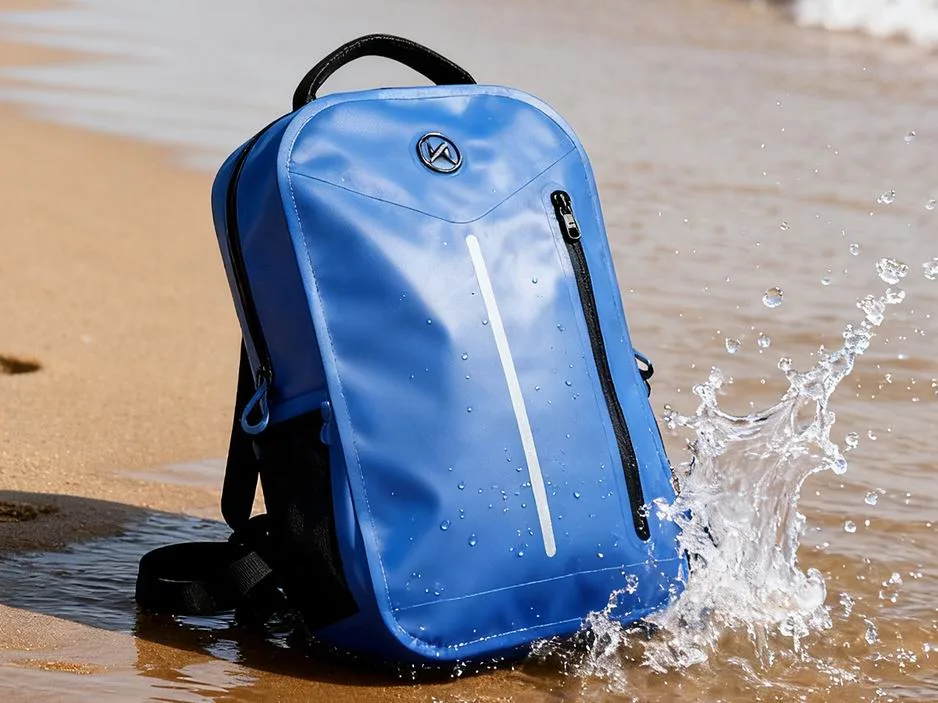
The classic condensation scenario is a summer paddle on cold water. Air at 26 °C, water at 11 °C, a bag packed in the sun and then stowed in a hatch or a bilge where the hull is chilled. The film wall drops to 12 or 13 °C, the trapped air inside has a dew point of 20 °C, and water deposits on the inside face of the film along the chilled side of the bag. Open it at lunch and the lower third of the load is damp while the top is bone dry.
The pattern is diagnostic. Condensation appears on the side that was in contact with the cold surface, follows the waterline of the chilled area, and is evenly distributed as fine droplets rather than pooling in one place. A leak, by contrast, appears at a point: the closure fold, a weld corner, a valve. If the dampness has an edge that matches where the bag touched something cold, it is condensation every time.
The fix is insulation rather than absorption. Sliding a closed-cell foam pad or even a folded fleece under the bag lifts the film away from the chilled hull and keeps the wall a few degrees above the dew point, which is usually enough. On a raft with an aluminium frame, the same trick matters more, because metal conducts heat away from the bag base far faster than water does.
What moisture does to electronics, optics and paper
Two grams of water is irrelevant to a fleece and serious to a camera. A lens element fogs when its surface drops below the dew point of the air immediately around it, and internal fogging inside a sealed lens body can take hours to clear. Condensation inside a phone charging port promotes corrosion on the contacts long after the visible moisture is gone, and paper maps and passport pages wick water along their edges and then stick together permanently.
The protection is a second barrier rather than a drier bag. Electronics and documents belong in a small inner roll-top or a sealed pouch inside the main bag, which gives them their own microclimate and their own dew point. A 2-litre inner pouch with 20 grams of silica gel inside it will keep a camera dry even when the outer bag is dripping on the inside, because the desiccant only has to manage 2 litres of air, not 60.
There is a temperature trap with optics worth knowing. A cold camera brought into a warm humid tent fogs instantly, and so does a cold camera taken out of an air-conditioned vehicle into tropical air. Let equipment warm up inside its sealed pouch before opening it, so the condensation forms on the outside of the pouch rather than on the lens. That single habit prevents more fogged shoots than any amount of silica gel.
Temperature swings: night, altitude and a black bag in the sun
A bag that is sealed in the afternoon and opened the next morning has been through a 15 to 20 °C swing. The warm afternoon air inside holds vapour; the cold night air outside chills the film; deposition happens in the small hours and is at its worst just before dawn. Open the bag at 6 am and it is wet inside; open the same bag at 11 am after an hour of sun and the moisture has re-evaporated and is invisible.
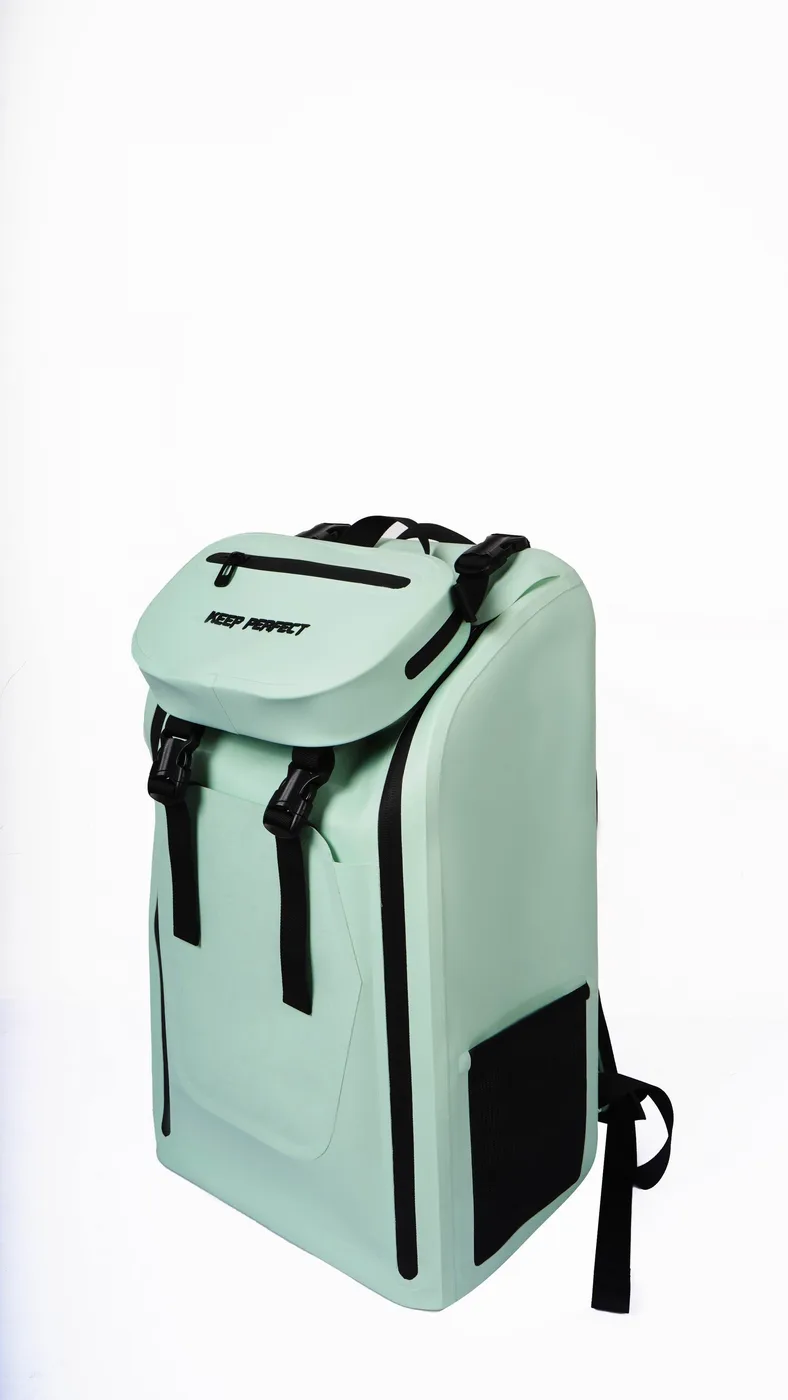
Colour changes the numbers more than most people expect. A black bag in direct sun at an air temperature of 25 °C can reach 55 to 65 °C on its upper surface, which drives the internal air temperature up, lowers the relative humidity and evaporates internal moisture aggressively. The same bag in mint or olive sits 10 to 15 °C cooler. That is an argument for a light colourway in hot climates and for keeping any bag out of direct sun when it holds electronics.
Altitude and aridity move the problem in the other direction. In dry mountain air at 15% humidity the water content of the trapped air is so low that deposition essentially cannot happen, and the dominant risk is static rather than moisture. In the tropics at 90% humidity and 32 °C, a 60-litre bag holds over 2 grams of vapour and a cold-drink bottle inside it will sweat continuously. Adjust the strategy to the climate rather than carrying one routine everywhere.
Desiccants and absorbents: what actually works
Desiccant capacity is quoted as a percentage of the sachet mass at a stated relative humidity, and the numbers are smaller than buyers assume. Silica gel adsorbs roughly 25 to 35% of its own weight at 60% humidity, so a 100-gram sachet removes about 30 grams of water, and a 20-gram sachet removes about 6. That is comfortably more than the 1 gram of vapour in a 60-litre bag and hopelessly less than the 300 grams in a damp towel.
Regeneration is the difference between a desiccant that works for a season and one that works for a week. Silica gel can be dried in an oven at 120 °C for two hours and reused indefinitely, and indicating gel changes colour so you can see when it is spent. Calcium chloride absorbs more per gram but turns into a brine that can leak, which makes it a poor choice inside a bag holding clothing. Molecular sieve is fast and works at low humidity but costs several times more.
| Desiccant | Uptake at 60% RH | Mass for a 60 L bag | Regenerable? | Field suitability |
|---|---|---|---|---|
| Silica gel, indicating | 25-35% of mass | 50-100 g | Yes, oven at 120 °C | Best all-round choice |
| Silica gel, non-indicating | 25-35% of mass | 50-100 g | Yes, but no end-of-life signal | Good, cheaper |
| Molecular sieve | 20-25% of mass | 40-80 g | Yes, 200 °C | Fast, costly, fragile |
| Calcium chloride | 100%+ of mass | 30-60 g | No | Avoid, turns to brine |
| Bentonite clay | 18-22% of mass | 80-150 g | Partly | Cheap, bulky, dusty |
| Microfibre towel | 300-500% of mass | One small towel | Yes, wring and dry | Best for liquid, not vapour |
The honest summary is that a desiccant manages vapour, and a towel manages liquid, and they are not substitutes. Carry a 100-gram indicating silica sachet in the bag that holds electronics and documents, keep it in a mesh sleeve so it cannot abrade the film, and dry it out every few trips. For the bag that holds the wet suit, no desiccant will help; put a microfibre towel in instead and wring it out at camp.
Ventilation tricks that do not break the seal
Real ventilation means the bag is no longer waterproof, so the useful options all work within a sealed system. The first is purge and dry: before closing, press the air out, then open the bag briefly in dry shade at midday so the internal air is exchanged for the driest air available. Doing this once a day on a multi-day trip keeps the internal humidity drifting down rather than up.
The second is a purge valve used correctly. A one-way valve lets you squeeze air out after closing without letting water in, and squeezing a bag down to half its air volume removes half the vapour it holds. It does not dry the contents, but on a trip where the only source of moisture is trapped air it reduces deposition measurably, and it also lets the bag sit flat in a hatch. Our comparison of valved and unvalved closures covers the trade-off in detail.
The third is separation, which is the most effective of the three. Splitting the load so that wet items live in one small bag and dry items in another means the dry bag never receives vapour from the wet one. Two 20-litre bags with a clear job each beat one 40-litre bag holding everything, and that is the same argument that makes a three-bag system work on a kayak deck.
Telling condensation apart from a real leak
The diagnostic rests on three questions. Where is the water, how much is there, and does it reappear after the bag has been dried and re-tested? Condensation is distributed, small and reproduceable by temperature; a leak is localised, often larger, and reproduceable by immersion regardless of temperature. Run both tests before you blame a closure that is probably fine.
The air test is the quickest first step. Roll the bag closed with three folds, squeeze it firmly and listen for a hiss at the closure or at a weld. Then submerge it in a bath for 30 seconds with the mouth above water and look for a stream of bubbles. A bag with a pinhole will bubble; a bag that is sound will not, and the water inside it was condensation. Full method in our air inflation leak test guide.
| Symptom | Amount of water | Distribution | Likely cause |
|---|---|---|---|
| Fine haze on the film | Under 2 g | Even, on the cold side | Condensation |
| Damp patch at one corner | 5-30 g | Localised at a weld | Seam defect or pinhole |
| Water along the fold line | 10-60 g | Tracks the closure | Roll was not clean or grit in the fold |
| Soaked base of the load | 100-400 g | Bottom concentrates | Wet item sealed inside |
| Everything evenly wet | 200 g+ | Whole load | Leak or a bag left open in rain |
| Water reappears after drying | Any | Same place each time | Genuine leak, retire or repair |
One more check separates the two conclusively. Dry the bag completely, leave it open overnight in a dry room, then pack it with dry kit on a cool morning, close it and leave it sealed for six hours in the shade. If it is dry inside at the end, the closure is fine and your last wet load came from the kit. If water appears again with no wet item inside, you have a leak and the bag should be repaired or retired.
A field test for internal moisture
Reading a bag by touch is unreliable, because a gram of water spread over half a square metre of film feels like nothing at all and two grams pooled in a corner feels like a flood. A structured test removes that ambiguity: control the starting condition, control the exposure, and give the bag enough time for vapour to move. Six hours sealed is the practical minimum, because deposition is slow and a 30-minute test will usually show nothing either way.
- Dry the bag completely and leave it open for at least two hours in shade before the test.
- Pack only dry items and add a small hygrometer or a humidity indicator card if you carry one.
- Close with three folds, purge the air if the bag has a valve, and note the air temperature.
- Place the bag where it will actually travel: a bilge, a cold deck or a chilled hull.
- Leave it sealed for six hours, then open it and feel the inside of the film along the cold side.
- Weigh the indicator card before and after if you want a number rather than a impression.
A humidity indicator card costing very little turns this from a subjective test into a measurement. Sealed in the bag with dry kit, a card that reads 40% in the morning and 75% in the evening tells you vapour is being generated inside, which points at a damp item rather than at the closure. A card that holds steady tells you the bag is behaving and the last wet load had another cause.

Packing rules that keep the inside dry
- Wring every item before it goes in; a towel that feels damp carries 150 g or more.
- Give wet kit its own bag and lash that bag outside the main load, never beside dry clothing.
- Purge the air after packing, using a valve if the bag has one, so there is less vapour to deposit.
- Insulate the bag from chilled hulls, aluminium frames and cold decks with a pad or a fleece.
- Keep electronics and documents in a small inner pouch with 50 to 100 g of indicating silica gel.
- Let cold optics warm up inside their pouch before opening, so fog forms outside rather than on the lens.
- Open the bag in dry shade at midday on multi-day trips to exchange the internal air.
- Choose a light colourway in hot climates; a black film in full sun runs 10 to 15 °C hotter.
Applied consistently, those rules reduce internal moisture to the point where the question stops mattering for clothing and sleeping kit, and remains relevant only for optics and electronics. That is the correct outcome: condensation is a manageable nuisance for soft goods and a genuine risk for sensors and lenses, so spend the effort on the second category and keep the first simple.
For a club, a rental fleet or a retail range, the same rules become a specification line rather than a habit, because an inner pouch and a purge valve have to be designed in before the bag is welded. Our production partner has built waterproof bags since 2014 in an SGS-verified 4,950 m2 facility, with sampling in 6 to 10 working days, bulk in 35 to 50 days and a 500-piece minimum.
Seasonal and climate adjustments
In a temperate summer the dominant risks are trapped humidity and cold-water contact, so the routine is purge the air, insulate the base and keep wet kit out. In a tropical wet season the air itself is the load: at 32 °C and 90% humidity a 60-litre bag holds more than 2 grams of vapour, and any cold surface inside, including a chilled drink bottle, will sweat for hours. Pack a towel around cold bottles and keep the desiccant fresh.
In winter the vapour problem essentially disappears and the liquid problem gets worse, because nothing dries. Wet gloves, a damp hat and a soaked rope all carry water that redistributes over the load and then freezes overnight into a film of frost inside the bag. The winter rule is absolute separation: wet kit in one bag that lives outside the tent, dry kit in a bag that never receives anything damp.
For long expeditions, add a weekly dry-out. Every five to seven days, empty every bag completely in dry conditions, wipe the inside of the film with a microfibre cloth, regenerate the silica sachets and re-pack. That single hour prevents the slow accumulation of moisture that turns a comfortable load into a damp one by day ten, which is the point at which sleeping bags start losing loft and users start blaming their equipment.
When the water inside means the bag is finished
Condensation is not a defect and is not grounds to retire a bag. A leak is. If an immersion test produces a bubble stream from a weld, if water tracks the same corner every time the bag is filled, or if the film has begun to craze and weep moisture through the surface itself, the bag has reached the end of its waterproof life regardless of how good the closure looks. The distinction matters: retire for leaks, keep using for condensation.
Where a bag is genuinely leaking, the decision between repair and replacement is usually driven by where the leak is. A closure-line leak is often grit or technique and costs nothing to fix. A corner weld can sometimes be re-welded on a bench. Film crazing across a wide area cannot be repaired at all, and a bag showing that pattern should be demoted to non-critical use rather than trusted with a sleeping bag. The physics of how water enters through a closure is set out in our guide to water ingress.
Two final references are worth keeping to hand. The relationship between internal air volume and pressure behaviour, which drives both buoyancy and purge behaviour, is explained in the pressure differential guide, and the reasons a well-sealed bag still gets wet inside are covered in the air trap guide. For humidity and dew point data for a specific trip window, the forecasts published by NOAA give both figures directly, and the measurement methods behind textile and film water-vapour testing are maintained by the ISO.
Frequently asked questions
Q1. Why is there water inside my dry bag?
Almost always from a damp item sealed in with dry kit: one towel carries 150 to 300 grams, while the air sealed in a 60-litre bag holds only 0.5 to 1.5 grams. Condensation from trapped air is real but tiny by comparison.
Q2. Is condensation inside a dry bag normal?
Yes. If the film cools below the dew point of the air sealed inside, a gram or so of water deposits on the inside face. It is a thin haze, appears on the side touching something cold, and is not a defect.
Q3. How much water can condensation actually produce?
About 0.5 to 1.5 grams in a 60-litre bag, because air at 28 °C and 80% humidity carries roughly 22 grams per cubic metre. That is a film of moisture, not a soak, and it cannot explain a wet sleeping bag.
Q4. How do I tell condensation from a leak?
Condensation is evenly distributed on the cold side of the film and follows a temperature pattern. A leak is localised at a weld, a closure fold or a valve, and reappears after you dry the bag and re-test it with dry contents.
Q5. Do silica gel sachets work in a dry bag?
Yes for vapour, no for liquid. A 100-gram sachet removes about 30 grams of water, far more than the 1 gram of vapour in the bag and far less than the 300 grams in a damp towel. Use them for electronics, not for wet kit.
Q6. Should I put a wet swimsuit in a dry bag?
No. A wet swimsuit carries 200 to 400 grams of water that will redistribute across the whole load. Keep it in a mesh bag on the deck, or in its own small bag lashed outside the main load.
Q7. Does a black dry bag condense more?
Not directly, but a black film in full sun reaches 55 to 65 °C, which drives internal moisture into vapour and then deposits it when the bag cools at night. In hot climates a lighter colourway runs 10 to 15 °C cooler and stays more stable.
Q8. Can condensation damage a camera in a dry bag?
Yes. Two grams of water is enough to fog a lens element and start corrosion in a charging port. Keep optics and electronics in a small inner pouch with 50 to 100 grams of silica gel so they have their own microclimate.
Q9. Does a purge valve stop condensation?
It reduces it. Squeezing air out through a one-way valve removes vapour along with the air, so there is less to deposit. It does not dry the contents, and it will not help if a wet item is sealed inside.
Q10. Why does my bag get wet inside only in the morning?
Because deposition peaks just before dawn, when the film is at its coldest and the trapped air has cooled past its dew point. By late morning the same moisture has usually re-evaporated and is invisible.
Q11. Is it bad to breathe into a dry bag before closing?
It adds very little water, around 0.2 to 0.4 grams, so it is not a serious problem, but it does add warm humid air. Press the air out with a knee instead and you remove vapour rather than adding it.
Q12. How often should I dry out a dry bag on a long trip?
Every five to seven days. Empty every bag completely in dry conditions, wipe the inside of the film, regenerate the silica sachets and re-pack. That prevents the slow build-up that damps a load by day ten.
Q13. Do desiccants need replacing?
Indicating silica gel can be regenerated in an oven at 120 °C for two hours and reused indefinitely. Non-indicating gel works the same but gives no signal, so weigh it or replace it on a schedule instead.
Q14. Can condensation freeze inside a dry bag?
Yes, in winter. Water redistributed from wet gloves or a damp rope freezes overnight into a film of frost on the inside of the film, then melts into the load when the bag warms. Absolute separation of wet and dry kit is the only real fix.
Q15. Does insulation under a bag reduce condensation?
Yes, and it is one of the most effective fixes. A closed-cell pad or a folded fleece lifts the film off a chilled hull or an aluminium frame and keeps the wall a few degrees above the dew point, which stops deposition entirely.
Q16. Should I retire a bag because it gets wet inside?
Only if it leaks. Condensation is not a defect. Retire a bag that bubbles in an immersion test, leaks at the same corner every time, or shows film crazing that weeps moisture through the surface itself.
People also ask
How do you stop condensation in a dry bag?
Purge the air before closing, keep wet items in a separate bag, insulate the base from cold hulls, and add 50 to 100 grams of indicating silica gel to the bag holding electronics. Those four steps remove most of the water.
Why does a dry bag get wet inside with nothing wet in it?
Because the film cooled below the dew point of the trapped air. Warm air sealed in at 26 °C deposits water on a wall chilled to 12 °C by cold water or a cold hull, usually as a fine haze on one side.
Are dry bags airtight?
A welded roll-top bag is effectively airtight when properly rolled, which is why it can trap both air and moisture. That is also why a purge valve helps: it lets you remove air without breaking the seal.
Can you put electronics in a dry bag safely?
Yes, in a second barrier. A small inner roll-top with 50 to 100 grams of silica gel gives a phone or camera its own microclimate and dew point, and protects it even when the outer bag is damp inside.
What absorbs moisture best inside a bag?
Indicating silica gel for vapour, at 25 to 35% of its own weight, and a microfibre towel for liquid, at several times its own weight. They solve different problems and are not interchangeable.
Does a wet dry bag mean it is leaking?
Usually not. Rank the sources first: trapped air contributes under 2 grams, a damp towel 150 to 300 grams. Run an air squeeze and a 30-second immersion test before blaming the closure or the seams.
Need this in production volume?
QUANZHOU JUNYUAN BAGS has produced waterproof bags since 2014 in an SGS-verified 4,950 m2 facility in Fujian, China. Minimum order 500 pieces, sampling in 6–10 working days, bulk in 35–50 days, FOB Xiamen — write to service@junyuanbags.com with your spec and target market.