Home / Blog / Waterproof Technology
Water-Resistant vs Waterproof Packs
A water-resistant pack survives 30 minutes of steady rain; a waterproof pack survives 30 minutes under one metre of water. The gap between them is not a marketing detail, it is about 9,000 mm of hydrostatic head, the difference between a stitched seam and a welded one, and usually 200 g of extra weight. A coated 420D shell with a durable water repellent finish and taped seams will dry your laptop after a commute, but it will fill within 90 seconds of a capsize.
This guide separates the two categories by what each one actually resists, walks through the four paths water takes into any pack, and gives you the numbers behind IPX grades and hydrostatic head readings. You get field tables matching exposure to required rating, a degradation curve showing how a coating loses half its performance in two years, a home test procedure that takes fifteen minutes, and a list of the claim phrases that should make you ask for the test report.
- What the two words actually mean
- The four paths water takes into a pack
- Coatings, membranes and laminates compared
- Seams: welded, taped and stitched
- Closures: zips, roll-tops and lids
- Ratings: IPX grades and hydrostatic head
- Matching exposure to the rating you need
- Where water-resistant is the right choice
- Where waterproof is non-negotiable
- Condensation: the leak that comes from inside
- How waterproof performance degrades
- Testing a pack at home in fifteen minutes
- Reading a spec sheet without being misled
What the two words actually mean
Water-resistant describes a surface property. It means the outer fabric sheds water for a period, usually because of a durable water repellent finish and a coating on the reverse face, and it means the seams have been covered with tape. Nothing about that construction is sealed. Put the pack under pressure, squeeze it, or leave it in a puddle for an hour, and water will enter through the needle holes and eventually through the fabric itself.
Waterproof describes a system property. It means there is a continuous barrier: a film or membrane laminated to the face fabric, joined by welds rather than stitches at every seam, and a closure that maintains that barrier when the pack is flexed. A genuine waterproof pack can be submerged. The rating then tells you how deep and for how long, which is why a serious spec sheet quotes a standard rather than an adjective.
The useful mental model is pressure, not volume. Rain arrives at low pressure and high duration. Immersion arrives at low duration and high pressure: one metre of water is about 0.1 bar, and 0.1 bar pushing against a needle hole is very different from a raindrop landing on a coated face. That is why a pack can be excellent in one condition and useless in the other, and why the two words are not two points on one scale.
The four paths water takes into a pack
Water enters a pack in four ways, and a design that blocks three of them still leaks. The first is through the face fabric, by wetting out and then by pressure-driven flow. The second is through the seams, along the stitch holes. The third is through the closure, whether that is a zip, a roll-top or a lid. The fourth is around hardware: strap anchors, buckle attachment points, eyelets and any place a hole has been made in the barrier.
Fabric and seams are the two that dominate in practice. A coated nylon face fabric wets out when the durable water repellent finish wears off, typically after 20 to 30 wash cycles or a season of abrasion against a back panel. Once the face is wet, the coating behind it takes the load, and a polyurethane coating rated at 1,500 mm of hydrostatic head will pass at about the force of a firm kneel on wet ground, which is not a demanding test.
The closure is where most waterproof packs actually fail, and it is the path people forget. A welded body with a stitched-in zip is a bucket with a hole in the lid. A welded body with a roll-top is genuinely sealed, and that is why roll-tops dominate the dry bag category while zipped packs sit in the water-resistant category unless they use a specialised waterproof zip with a moulded tooth profile and a polyurethane sealing lip.
Coatings, membranes and laminates compared
There are three ways to make a face fabric resist water, and they behave very differently over time. A coating is a layer of polyurethane or PVC applied to the reverse of the fabric; it is cheap, it adds weight, and it hydrolyses, meaning it breaks down chemically with age and humidity whether or not you use the bag. A membrane is a thin film bonded inside a laminate; it breathes and lasts longer but is more delicate.
A laminate, which is what a TPU dry bag uses, bonds a solid thermoplastic film to the face fabric in a single sheet. There is no coating to hydrolyse because the barrier is a homogeneous polymer rather than a cured layer. It does not breathe, which is irrelevant in a dry bag and a real limitation in a backpack you carry for eight hours, and it welds cleanly with radio-frequency energy, which is what makes a continuous seam possible.
The numbers make the difference concrete. A durable water repellent finish on its own offers under 300 mm of resistance and lasts about 20 to 30 wash cycles. A light polyurethane coating reaches 1,000 to 1,500 mm and hydrolyses within three to five years whether the pack is used or not. A heavy coating reaches 3,000 to 5,000 mm. A TPU laminate starts above 10,000 mm and has no hydrolysis failure mode at all, because the barrier is solid polymer rather than a cured layer.
Read those service-life figures carefully, because they are what separate the categories in the real world. A coated pack bought this year will not perform the same way in four years even if it sits in a cupboard, because hydrolysis continues in humid air. A TPU laminate does not have that failure mode, which is why rental fleets and rescue services buy welded bags despite the higher initial cost per unit.

Seams: welded, taped and stitched
Stitching is the original sin of waterproof construction. Every needle pass leaves a hole, and a hole is a capillary. Under pressure, water does not need to force its way through the fabric; it simply walks along the thread into the pack. That is why a stitched seam on a coated pack always has tape applied over it, and why the tape is the maintenance item most owners never think about.
Seam tape works by adhesion. A thermoplastic film is heat-pressed over the stitch line, bridging the holes. It works well for a few years and then it lifts, usually at the corners where the tape was folded and at the ends where it was cut short. Once tape lifts at one end it peels progressively, and the leak appears slowly enough that most people blame the fabric. Re-ironing tape on a low setting can buy another season.
Welding removes the problem rather than covering it. Radio-frequency welding heats the polymer molecules themselves, so two pieces of TPU laminate fuse into one continuous sheet with no thread and no hole. The weld is usually stronger than the fabric beside it, which is why a well-made welded bag tears beside the seam rather than at it. The technique is described in more detail in our welding guide.
Closures: zips, roll-tops and lids
A zip is a long line of interlocking teeth with a slider that forces them together. Conventional zips leak freely; water-resistant zips add a polyurethane coating that swells slightly when wet and slows the flow but does not stop it under pressure. A true waterproof zip uses a moulded tooth profile with a sealing lip that is compressed when the slider passes, and it is stiff, expensive, and needs regular lubrication to stay sealed.
The roll-top takes the opposite approach: instead of trying to seal a line, it removes the line entirely by folding the fabric onto itself. Three folds create three contact lines, and because the folds are pressed together by the buckle, the seal improves with pressure rather than degrading with it. That is the single most important property of a roll-top and the reason it remains the standard on any bag that will be immersed.
Lids and storm flaps are the water-resistant compromise. A flap over a zip reduces the volume of water reaching the teeth, which is enough for rain and useless in immersion. If a pack has a lid, assume it is water-resistant regardless of what the hang tag says, and check whether the body itself is welded before believing any immersion claim. Combinations exist, but a welded body with a protected zip is still limited by the zip.
Ratings: IPX grades and hydrostatic head
Two numbering systems dominate the category and they measure different things. Hydrostatic head measures fabric: a column of water is stood on the fabric and the height in millimetres at which the third drop penetrates is the rating. It is a material test, it says nothing about seams or closures, and it is the number to look at when comparing face fabrics rather than finished packs.
IPX grades measure a finished item. The IEC defines the scale in IEC 60529: IPX4 covers splashing from any direction, IPX5 and IPX6 cover water jets, IPX7 covers 30 minutes at one metre, and IPX8 covers continuous immersion at a depth the brand specifies. A pack quoting IPX7 has passed a whole-item test, which is far more meaningful than a fabric rating, and the standard behind it is worth checking at ASTM for related test methods.
| Rating | Test condition | What it survives | Typical construction |
|---|---|---|---|
| IPX4 | Splashing, 10 min | Light rain, brief shower | Coated fabric, taped seams |
| IPX5 | 6.3 mm jet, 3 min | Heavy rain, road spray | Coated fabric, protected zip |
| IPX6 | 12.5 mm jet, 3 min | Storm rain, bow spray | Welded body, roll-top |
| IPX7 | 1 m immersion, 30 min | Capsize, short submersion | Welded body, roll-top, 0.5 mm film |
| IPX8 | Deeper immersion, specified | Sustained submersion | Welded body, heavy film, tested closure |
A practical translation: a commuter who walks 20 minutes in rain needs IPX4 to IPX5 and nothing more. A kayaker who might capsize in shallow water needs IPX7. A diver or a rescue worker who expects the bag to be under water for more than a few minutes needs an IPX8 rating with the test depth stated, because IPX8 without a depth figure is an empty claim.
Matching exposure to the rating you need
Buying more rating than you need costs money, weight and access convenience. Buying less costs you the contents of the bag. The table below maps common situations to the level that actually holds, based on field reports rather than laboratory optimism. Note how many everyday situations sit at IPX4, and how few activities justify IPX8.
| Situation | Water contact | Duration | Rating that holds | Construction that works |
|---|---|---|---|---|
| Urban walk in drizzle | Light rain | 20 min | IPX4 | Coated shell, taped seams |
| Cycling commute in rain | Road spray and rain | 45 min | IPX5 | Coated shell, protected zip |
| Hiking in sustained rain | Rain and pack abrasion | 6 h | IPX5 to IPX6 | Welded body or rain cover |
| Kayak day paddle | Spray and cockpit wash | 4 h | IPX6 | Welded roll-top |
| Canoe capsize | Full immersion | 1-2 min | IPX7 | Welded roll-top, 3 folds |
| Raft flip in a rapid | Immersion under load | 2-5 min | IPX7 to IPX8 | Welded, 0.5 mm film, lashed |
| Dive boat kit storage | Deck wash all day | 8 h | IPX6 to IPX7 | Welded roll-top, welded D-rings |
Two rows deserve attention. Sustained rain over six hours is harder on a pack than most people expect, because the pack is pressed against a wet back for hours and the contact points see constant pressure; this is where a coated pack wets through at the shoulders even though the rest of the shell is fine. And raft flip is the one case where lashing matters: a bag that is not secured will be dragged under and see pressures far beyond the static rating.
Where water-resistant is the right choice
Water-resistant packs win on three counts: weight, breathability and access. A coated 420D shell with taped seams weighs roughly 400 g less than an equivalent welded TPU pack in the same volume, and the difference is felt over a day of walking. Coated fabrics also let a little vapour through, which matters when the pack is against your back, and zipped access is genuinely faster than unrolling a closure.
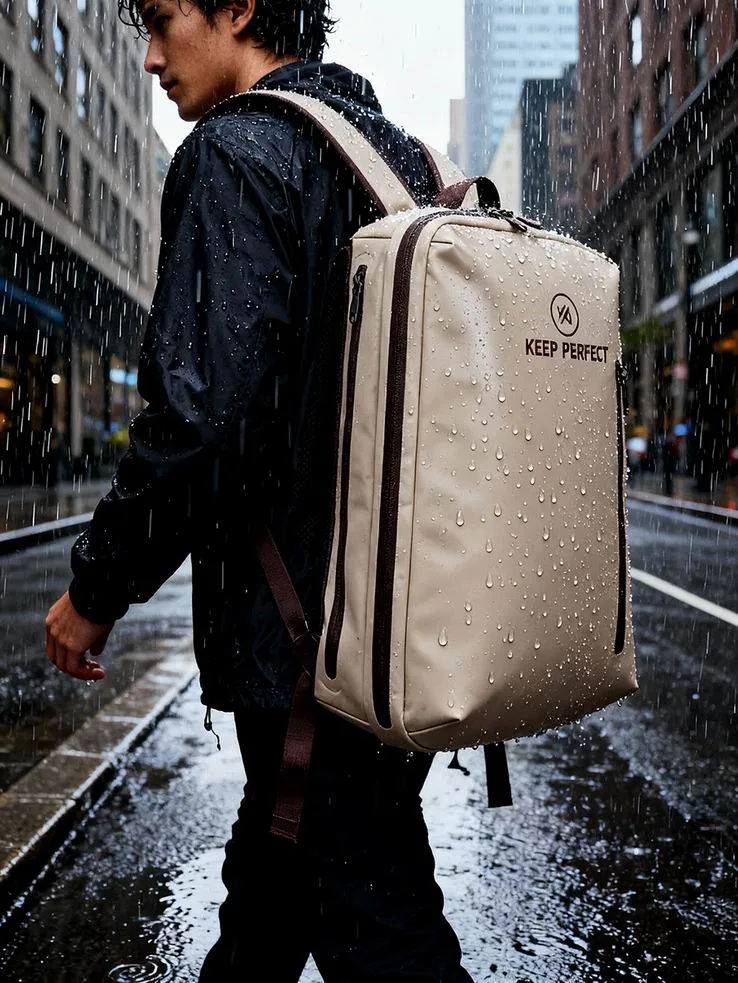
For a daily commute the calculation is clear. You are protecting a laptop and a notebook from a 20-minute walk in rain, the pack spends the rest of the day indoors, and you want to open it on a train without putting it on the floor. A water-resistant pack with a padded sleeve and a protected zip is the better tool. Paying for welded construction here buys protection you will use once a year.
There is a maintenance angle as well. A durable water repellent finish can be refreshed at home with a spray or a wash-in product and twenty minutes in a tumble dryer on low, which restores beading for a season. Refreshing the finish every six months is a realistic routine for a commuter pack; the equivalent maintenance on a welded bag is simply inspecting the welds, which is easier but offers no performance gain.
Where waterproof is non-negotiable
There are situations where the consequence of failure is not inconvenience but danger or genuine loss. Cold water immersion with a spare clothing layer inside a water-resistant pack is a hypothermia risk, not a packing annoyance. A satellite messenger or a phone in a pack that fills during a capsize removes your only means of calling for help. Those are the cases where the welded construction earns its cost immediately.
Professional use pushes the same way. Rescue teams, dive operations and rental fleets put bags in the water every day, and a coated pack would need replacing monthly. Welded TPU bags in commercial service typically run five to ten years before retirement, and the cost per year is a fraction of a coated bag replaced annually. The initial price difference is recovered within the first eighteen months of daily use.
Salt water is the third case. A welded bag rinses clean, dries, and is ready the next morning. A coated pack that has been soaked in salt water holds moisture in the foam of its back panel and its shoulder straps, and that salt continues to attract moisture and abrade stitching for weeks. If the bag goes near the sea more than a few times a year, specify welded construction and welded attachment hardware.
Condensation: the leak that comes from inside
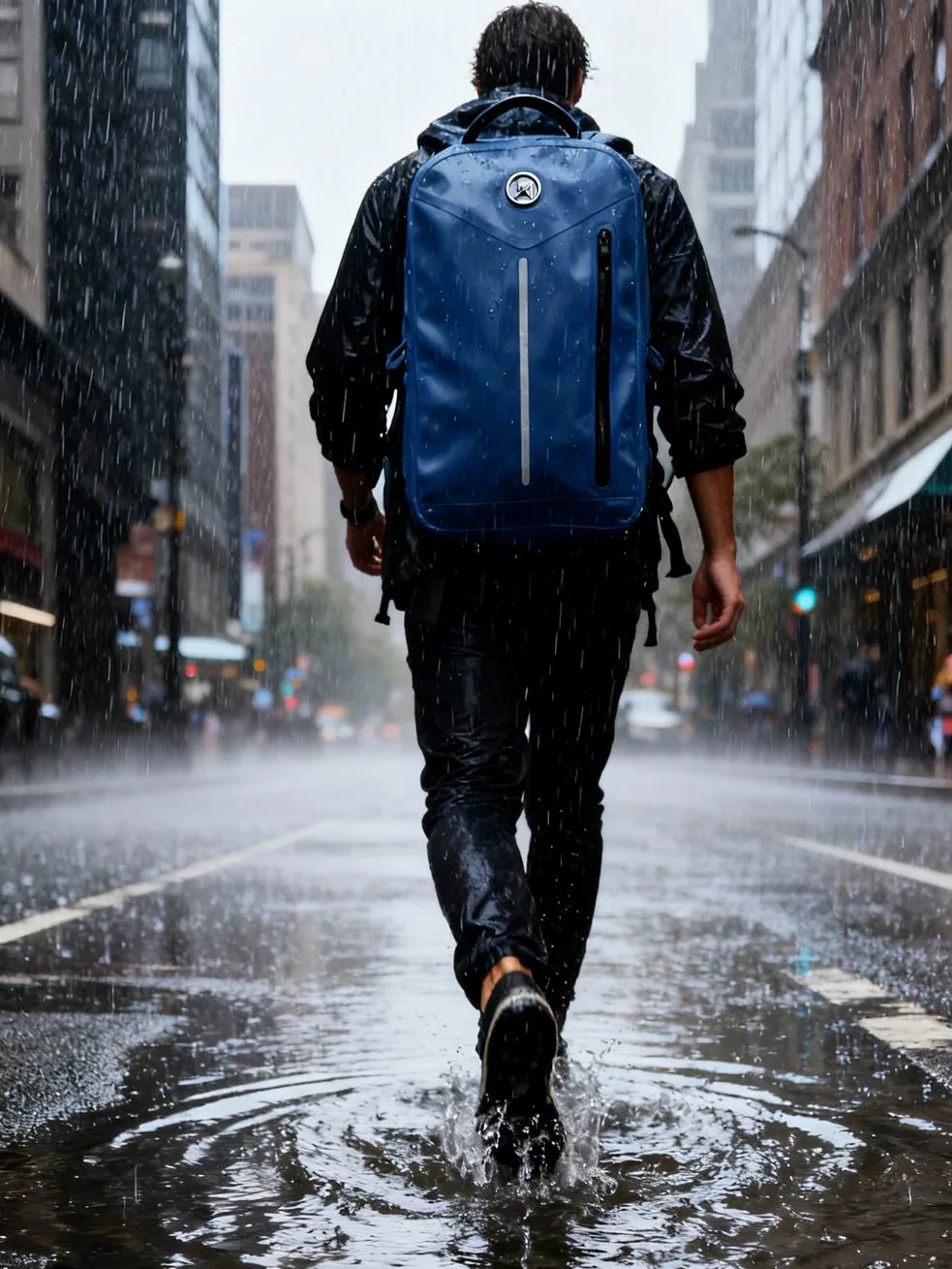
A sealed bag that has never been near water can still contain a wet sleeping bag. Air trapped inside a welded pack holds moisture, the moisture condenses on the coolest surface when the temperature drops, and because there is no breathability at all, it cannot leave. Over a three-day trip with 10 °C nights this can put 20 to 40 ml of water inside a 40L bag, which is enough to damp the contents.
The mitigation is separation and drying, not ventilation. Pack moisture sources such as wet swimwear, a damp towel or fresh food in a separate small bag, and open the main bag fully at camp each evening rather than leaving it rolled. Silica gel sachets help in camera and electronics bags. Our condensation guide sets out the temperature ranges where this becomes a real problem.
How waterproof performance degrades
Nothing stays at its original rating. A durable water repellent finish abrades off the face fabric, a polyurethane coating hydrolyses, seam tape lifts at the folds, and a welded seam loses strength where it has been repeatedly creased. The table below gives typical figures for a bag used about fifty days a year and rinsed after salt exposure. Use it to decide when to re-proof and when to retire rather than trusting the original number forever.
| Age | Hydrostatic head remaining | DWR beading | Seam condition | Recommended action |
|---|---|---|---|---|
| New | 100% of rating | Beads and runs off | Continuous | None |
| 1 year | 85-95% | Beads on the body | Tape lifting at one corner | Inspect welds |
| 2 years | 65-80% | Wets out at contact points | Tape lifting along folds | Re-proof or re-tape |
| 4 years | 45-60% | Wets out broadly | Visible peel at ends | Downgrade to water-resistant |
| 7 years | 25-40% | No beading | Pinholes at creases | Retire from immersion use |
| 10 years | Under 25% | None | Seam failure likely | Retire or repurpose |
Two things accelerate that curve dramatically. The first is UV: a bag stored on a balcony or in the back of a pickup loses a third of its coating life to sunlight alone. The second is creasing in the same place, which is why a bag that is always folded at exactly the same line will split there long before the rest of the fabric shows wear. Vary the fold line by a centimetre and you extend the life measurably.
If you want the full picture on how ratings fade, our rating degradation guide covers the chemistry, and the water column test notes explain how the head figures are actually produced. Both are worth reading before you buy a pack on the strength of a single number on a hang tag.
Testing a pack at home in fifteen minutes
You do not need a laboratory to find out which category your pack belongs to. A bath, a shower head and a roll of paper towel will separate a genuinely welded bag from a coated one with a taped seam, and the whole procedure takes about fifteen minutes plus drying time. Run it when a pack is new so you have a baseline, and repeat it every season.
- Line the pack with dry paper towel, right into the corners and up the sides.
- Close it exactly as you would in the field: three folds on a roll-top, zip fully home.
- Weigh it down so it sits half-submerged in a bath for ten minutes.
- Lift it out, dry the outside, and check the towel for damp patches.
- Mark any damp area on the outside with chalk so you know where to inspect.
- Repeat under a shower at arm's length for three minutes to simulate jets.
- Finally, squeeze the closed pack firmly and listen for air escaping at the closure.
Interpret the result by location rather than by severity. Damp at a seam means tape failure or a pinhole weld and can often be repaired. Damp across the whole lining means the face fabric has wetted out, which no home repair will fix, and the pack has dropped a category. Damp only near the closure means the seal is not completing properly, which is usually a packing problem rather than a bag problem.
Reading a spec sheet without being misled
The language on packaging is where most buyers get caught. Certain phrases have no standard behind them at all, and others sound precise while actually describing a fabric test rather than a whole-item test. The table gives the common claims, what they usually mean in practice, and the one question that settles it. Ask for the test report rather than the adjective and you will rarely be disappointed.
| Claim on the tag | What it usually means | Question that settles it |
|---|---|---|
| Water-resistant | Coated fabric, taped seams, no rating | Which IPX grade, and tested by whom? |
| Water-repellent | DWR finish only, no coating rating | What is the hydrostatic head in mm? |
| Waterproof fabric | Fabric test, not a finished pack test | Is the whole pack rated, or the fabric? |
| Stormproof | No standard at all | Can I see the test report? |
| IPX7 certified | Whole item passed IEC 60529 | Which lab, and what was the sample date? |
| Welded seams | Seams fused, no needle holes | Are the attachment points welded too? |
One more check is worth making on any pack you intend to immerse: look at the attachment points. A welded body with sewn-on D-rings is not waterproof, because the stitching around the ring penetrates the barrier. Ask whether lash points, handles and harness anchors are welded to reinforced panels. That single detail separates a bag that survives a season of paddling from one that leaks at the shoulder strap anchors.
Our production team has built waterproof bags since 2014 in an SGS-verified 4,950 m2 facility, running 7 production lines with a 500-piece minimum and sampling in 6 to 10 working days, and the rating question comes up in every brief we receive. For the rating scale itself, start with our IPX guide, then read the rain versus submersion comparison and the hydrostatic head explainer.
If water is already getting into a bag, the diagnosis sequence in our leak path guide will save you an afternoon. Whole-pack builds are listed on the product line, and the welded TPU backpack range shows what continuous-seam construction looks like in a carry format. Everything else in this series is indexed on the blog.
Frequently asked questions
Q1. What is the difference between water-resistant and waterproof?
Water-resistant sheds rain through a coating and taped seams but has needle holes in the fabric. Waterproof uses a laminated film with welded seams and a closure that seals under pressure, so it survives immersion. One is a surface property, the other a system property.
Q2. Is a water-resistant pack enough for commuting?
Yes for most commutes. A 20-minute walk in rain is an IPX4 situation, which a coated shell with taped seams and a protected zip handles comfortably. Paying for welded construction buys protection you would use once or twice a year.
Q3. What does IPX7 actually mean?
Protection against immersion in one metre of water for 30 minutes, tested on the finished item under IEC 60529. It is the rating that covers a capsize or a short submersion, and it is the level to look for on any bag used on the water.
Q4. Do waterproof packs breathe?
No. A TPU laminate is a continuous barrier, so vapour cannot pass through it. That is fine in a dry bag and a real limitation in a pack worn against the back for hours, where condensation and sweat build up inside.
Q5. Can a water-resistant pack be upgraded to waterproof?
Not really. You can re-proof the durable water repellent finish and re-tape seams, which restores rain performance, but the needle holes remain. Immersion protection requires welded construction, which cannot be added afterwards.
Q6. Why does my waterproof pack have water inside?
Usually condensation. A sealed bag traps moist air, which condenses on the coolest surface overnight. Pack wet items separately, open the bag fully at camp each evening, and use silica gel in electronics bags.
Q7. How long does waterproofing last?
A TPU laminate holds most of its performance for around ten years of regular use. A polyurethane coating loses 20 to 35% of its hydrostatic head within two years and continues to hydrolyse even in storage, which is the main reason coated packs drop a category.
Q8. Are welded seams better than taped seams?
Yes for immersion. Welding fuses the fabric into one continuous sheet with no holes, while tape covers holes that still exist underneath. Tape lifts at folds and corners after a few years; a weld usually outlasts the fabric beside it.
Q9. What hydrostatic head do I need for rain?
Around 1,500 mm handles light to moderate rain on a commuter pack. Heavy sustained rain with pack-to-back pressure needs 3,000 to 5,000 mm. Above 10,000 mm you are in immersion territory, which requires welded seams to make use of it.
Q10. Can I test my pack at home?
Yes. Line it with paper towel, close it as you would in the field, weight it half-submerged in a bath for ten minutes, then check the towel. Repeat under a shower for three minutes to simulate water jets.
Q11. Does salt water damage waterproof packs?
It damages coated packs more than welded ones, because salt stays in foam and stitching and keeps attracting moisture. A welded TPU bag rinses clean and dries overnight. Rinse hardware and closures after every saltwater trip regardless of construction.
Q12. Is a roll-top more waterproof than a zip?
Yes, in nearly every case. A roll-top has no line to seal; it folds the fabric onto itself and the seal improves with pressure. A zip depends on a sealing lip that needs lubrication and eventually wears, however good it is when new.
Q13. What does stormproof mean on a bag tag?
Nothing standardised. It is a marketing phrase with no test method behind it. Ask which IPX grade the pack achieved, which laboratory tested it, and whether the whole item or only the fabric was tested before you rely on it.
Q14. Why does my pack leak at the shoulder straps?
Because the strap anchors penetrate the barrier. A welded body with sewn-on strap attachment points leaks at the stitching. Look for harness and handle anchors welded onto reinforced panels rather than stitched through the film.
Q15. Do I need a rain cover as well?
On a water-resistant pack, yes for sustained rain: a cover removes the back-panel pressure that makes coated fabric wet through. On a welded pack a cover is unnecessary and mainly protects against abrasion and UV.
Q16. How much does welded construction add to the weight?
Around 300 to 400 g on a 30L pack compared with a coated equivalent, mostly from the heavier film and reinforced attachment panels. That is the price of immersion protection, and it is why commuters often choose the lighter coated option.
People also ask
How do you know if a pack is truly waterproof?
Look for an IPX grade tested on the finished item, welded rather than taped seams, and welded attachment points. Then test it at home with paper towel and a ten-minute bath immersion before you trust it with anything valuable.
Are waterproof backpacks worth the extra weight?
If the bag will be immersed, or if wet contents would be dangerous, yes. For a commute or a day hike where the only exposure is rain, the lighter coated pack is usually the better tool and the difference is around 400 g.
What happens if you submerge a water-resistant pack?
It fills. The coating resists low-pressure rain but not immersion pressure of about 0.1 bar at one metre, which pushes water through the stitch holes within 60 to 90 seconds. The contents are wet and the pack needs full drying.
Why does a waterproof bag get wet inside?
Condensation rather than leakage. Trapped moist air condenses on the cool inner surface overnight and cannot escape through a non-breathable barrier. Separate wet items, air the bag each evening, and use silica gel for electronics.
Can you re-proof a water-resistant pack?
Yes. Wash it, apply a spray or wash-in durable water repellent product, and tumble dry on low for twenty minutes to cure the finish. This restores beading for a season but does not repair lifted seam tape or hydrolysis of the coating.
Is IPX7 better than a 10,000 mm hydrostatic head?
They measure different things. Hydrostatic head tests fabric only; IPX7 tests the finished pack including seams and closure. A pack can have 10,000 mm fabric and still leak through its seams, so prefer the whole-item rating.
Need this in production volume?
QUANZHOU JUNYUAN BAGS has produced waterproof bags since 2014 in an SGS-verified 4,950 m2 facility in Fujian, China. Minimum order 500 pieces, sampling in 6–10 working days, bulk in 35–50 days, FOB Xiamen — write to service@junyuanbags.com with your spec and target market.