Protecting Gear During Festival Camping
Protecting gear at a festival means defending against water that arrives from the ground, not from the sky. One millimetre of rain puts a litre of water on every square metre of field, and a 3 m2 tent footprint therefore collects 3 litres per millimetre; a 20 mm overnight storm puts 60 litres under your tent floor. A three-bag setup handles it: a 40L bag for clothing and sleeping kit, a 20L bag for electronics and documents raised at least 150 mm off the ground, and a 5L body bag for phone, cash and wristband. Welded seams matter more than any rating printed on the label.
This guide covers the four ways water reaches festival kit, the tent placement rule that prevents most losses, the mud and condensation problems that follow rain, the dry-weather dust problem that replaces it, and a four-day kit list with real volumes and weights. It also deals with the two risks that no bag can solve on its own: opportunistic theft and a field that turns to slurry. Use the tables to build your own load plan before you arrive, not after the first night.
- What festival camping does to gear that ordinary camping does not
- The four routes water takes to reach your kit
- Reading the field: why a litre per square metre matters
- Three bags, three jobs, one rule
- Placement heights inside the tent
- Phone, cash and wristband: the body-carry kit
- Mud is abrasion, not just dirt
- Condensation, the leak that is not a leak
- Four-day kit list with real volumes and weights
- Dry festivals: dust, sun and heat instead
- Security: what a bag can and cannot do
- The pack-down routine
- Checklist before you commit to a setup
What festival camping does to gear that ordinary camping does not
A campsite in a field used by 30,000 people for four days is a different environment from any campsite you have used before. The grass is gone by day two, the soil is compacted to something close to concrete, and the surface has no infiltration capacity left. Rain that would soak into a meadow runs sideways across a festival field, pooling in the shallow depressions where tents happen to be pitched, because those depressions were the flattest spots when everyone arrived.
Crowd behaviour adds a second factor. Drinks get spilled, water carriers leak at the tap stand, and everyone walks the same lines until they become channels. By day three a festival field has an informal drainage network, and the tents sitting in it are the ones that flood. That is why the same bag that has been fine on ten backpacking trips can come home soaked from one weekend in a field.
The third factor is duration and access. You cannot move your tent once the field is full, you cannot dry anything in a rainstorm, and you will not drive to a shop. Every decision has to be made on the first afternoon, and the margin for error is smaller than it looks. Protection at a festival is a planning problem with a packing answer.
The four routes water takes to reach your kit
Most people plan for rain from above and lose their kit to water from below. Ground water arrives by capillary action through a groundsheet, by seepage under the tent edge, and by outright pooling when the field saturates. It is silent, it starts at the lowest corner, and it is usually discovered at 02:00 when someone rolls onto a wet sleeping bag.
The other three routes are easier to anticipate. Rain from above is what a fly is for, but wind-driven rain enters through any vent you have opened to fight condensation. Spill and splash from sideways is the most common daytime cause of a wet phone. Condensation from inside, generated by two people breathing into a small sealed tent, is the one everybody blames on a leak that does not exist.
| Route | Mechanism | Typical volume | What it ruins first | Defence that works |
|---|---|---|---|---|
| From below | Pooling and capillary seepage | 3 L per mm on 3 m2 | Sleeping bag, spare socks | Raise kit 150 mm, welded floor |
| From above | Wind-driven rain through vents | 1-2 L per hour of storm | Anything under the door | Close vents to leeward, fly taut |
| Sideways | Spilled drinks, crowd splash | 0.2-0.5 L per incident | Phone, power bank | Body bag, hip carry |
| From inside | Breath and damp clothing | 0.7 L per person per night | Bag interior, camera lens | Vent 100 mm, open bag daily |
Reading the field: why a litre per square metre matters
The litre-per-millimetre rule is the fastest way to think about festival flooding. A small two-person tent covers about 3 m2 of ground, so 1 mm of rain deposits 3 litres onto that footprint, and a routine 20 mm overnight storm deposits 60 litres. Compacted festival soil absorbs almost none of it, so that 60 litres has to go somewhere, and it goes downhill through the tent rows.
This is why the pitch itself is the first line of protection. Arrive early enough to choose ground that is 100 to 200 mm above the surrounding field, avoid the obvious hollows that everyone else avoids because they are wet, and never pitch in a wheel rut or a walked-in channel. A 150 mm difference in ground height is the difference between a wet corner and a flooded sleeping bag.
Check the forecast before you leave and treat anything above 10 mm overnight as a flooding event. The NOAA forecasts cover US venues and most countries run an equivalent service; look at hourly rainfall rather than the daily total, because 20 mm in one hour does far more damage than 20 mm spread over ten.
Three bags, three jobs, one rule
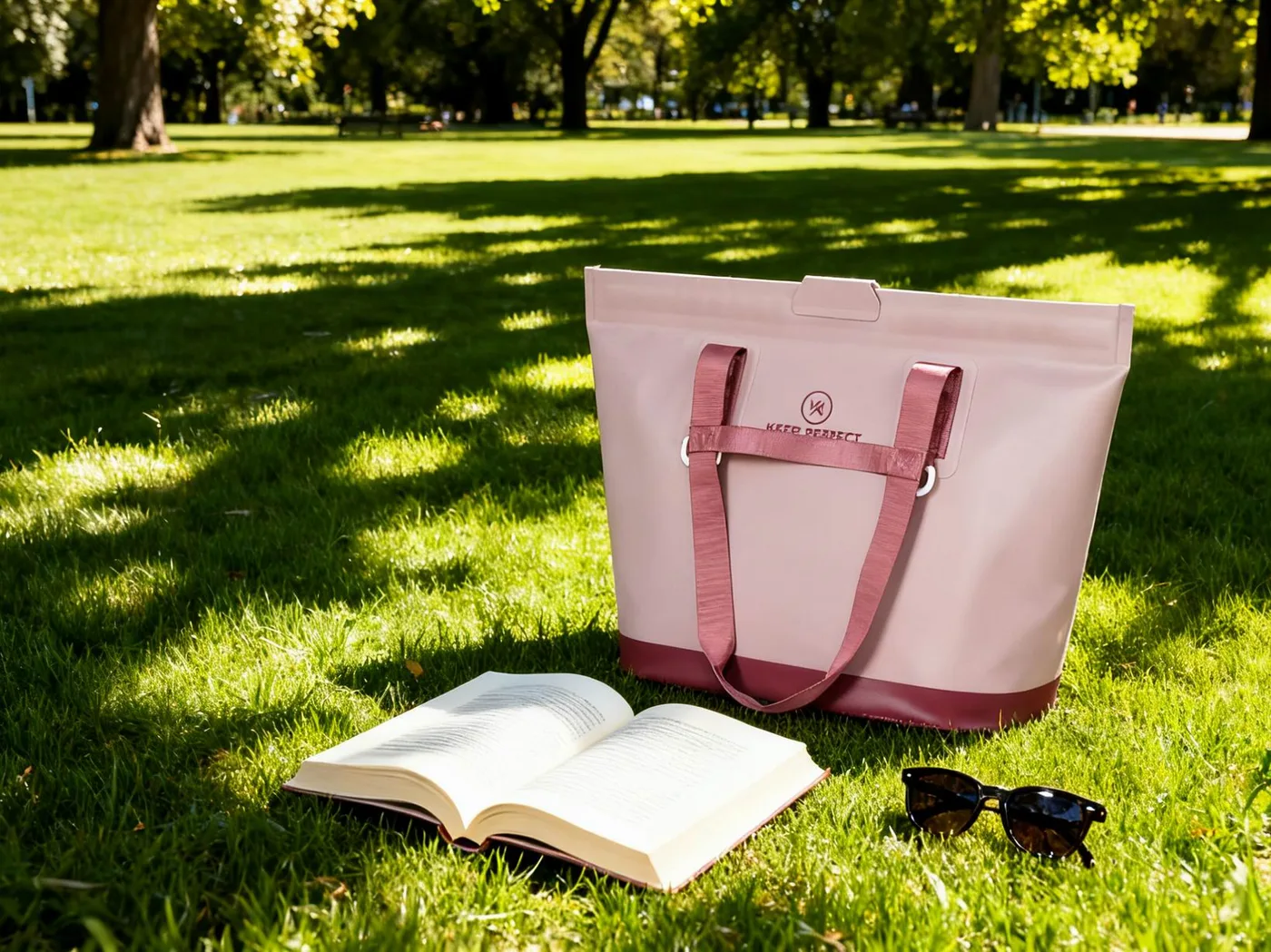
Give each bag a fixed job before you arrive and never swap contents between them. The 40L bag holds clothing and the sleeping bag, because those are the items that fail silently and cannot be replaced on site. The 20L bag holds electronics, documents and medication, because those are the items that cannot be replaced at any price. The 5L bag stays on your body, because a phone in a tent is a phone you will not have when you need it.
The rule that binds them is the same for all three: the closure must finish above the highest water you expect, and the bag must be able to survive being squeezed while wet. A roll-top bag closed correctly leaves the folded section at the top of the load, well clear of a few centimetres of standing water. A side-zip bag does not, which is why zipped designs are a poor choice for a festival floor.
| Bag | Volume | Job | Packed weight | Placement | Failure consequence |
|---|---|---|---|---|---|
| Wardrobe bag | 40 L | Clothing, sleeping bag | 6.5 kg | Raised on a crate or chair | Cold night, wet sleep |
| Electronics bag | 20 L | Phone spares, camera, docs | 3.2 kg | Hung from the ridge, 400 mm | Unrecoverable loss |
| Body bag | 5 L | Phone, cash, wristband | 0.8 kg | On your person, always | Lockout and no payment |
| Wet bag | 10 L | Damp clothing, muddy shoes | 2.0 kg | Vestibule, outside the door | Odour only |
Placement heights inside the tent
Height is the single cheapest protection you can buy at a festival. Lift the electronics bag 400 mm by hanging it from the tent ridge or a pole, lift the wardrobe bag 150 mm by standing it on an upturned crate or a folding chair, and keep nothing of value on the floor. Water in a tent almost never exceeds 50 mm unless you are in a genuine hollow, and 150 mm of clearance covers it.
Hanging needs care. A 3.2 kg bag on a ridge line puts a real load on a tent pole that was designed to hold fabric, so spread the load across two points or use the pole crossing where the structure is stiffest. Do not hang from the fly alone, and do not hang anything heavier than 4 kg from a single point on a two-person dome.
If you cannot hang, stack. An upturned plastic crate gives 150 mm of clearance and doubles as a seat, a table and a step over the mud line at the tent door. Two crates and a folded tarp under the wardrobe bag cost almost nothing, weigh under 2 kg and protect 6.5 kg of clothing that you cannot dry.
Phone, cash and wristband: the body-carry kit
A festival wristband is worth the whole weekend and cannot be replaced in a field. Phone, card, cash, ID and the wristband go in a 5L roll-top that is clipped to a belt loop or worn crossbody, and it does not go into the tent until you are asleep, at which point it goes into the sleeping bag with you rather than into a corner. Everything else is replaceable; this kit is not.
Power is the second half of the problem. A 10,000 mAh bank weighs about 220 g and gives two to three full phone charges, which covers a four-day event if you keep the screen dim and use flight mode in the arena. Keep the bank in the body bag during the day and in the 20L electronics bag at night, because a lithium cell in a bag that has been sitting in slurry is a bad combination.
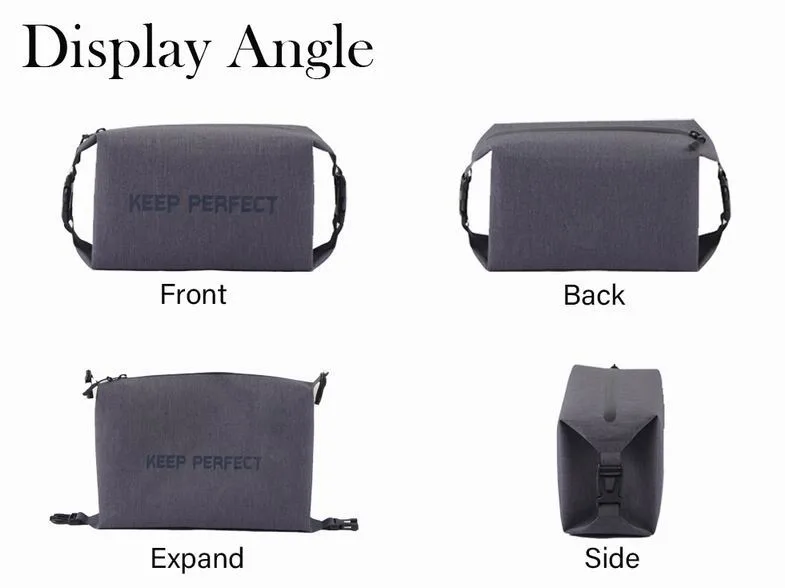
Water contact at a festival is usually a spill, not a storm: a 330 ml drink knocked into a bag, a water carrier that leaks at the tap queue. A roll-top closure survives that easily. A phone left in a back pocket survives it less well, which is why the body bag is not optional equipment for anyone carrying a device they intend to use on the Monday.
Mud is abrasion, not just dirt
Festival mud is a mixture of mineral soil, organic matter and whatever else 30,000 people have dropped, and it behaves like a fine abrasive paste. It packs into zip sliders, buckle teeth and the fold line of a roll-top, and every time you roll the closure with grit in it you score the film. One weekend of careless mud handling can shorten a bag life by a season.
The routine is simple: wipe the fold with a wet wipe before closing, keep a dedicated 10L wet bag for muddy shoes and damp clothing, and never put a muddy item into a clean bag because you will fix it later. Later never comes, and the mud migrates to everything. Rinse the outside of bags at a tap stand while you are there, not at home four days later.
Condensation, the leak that is not a leak
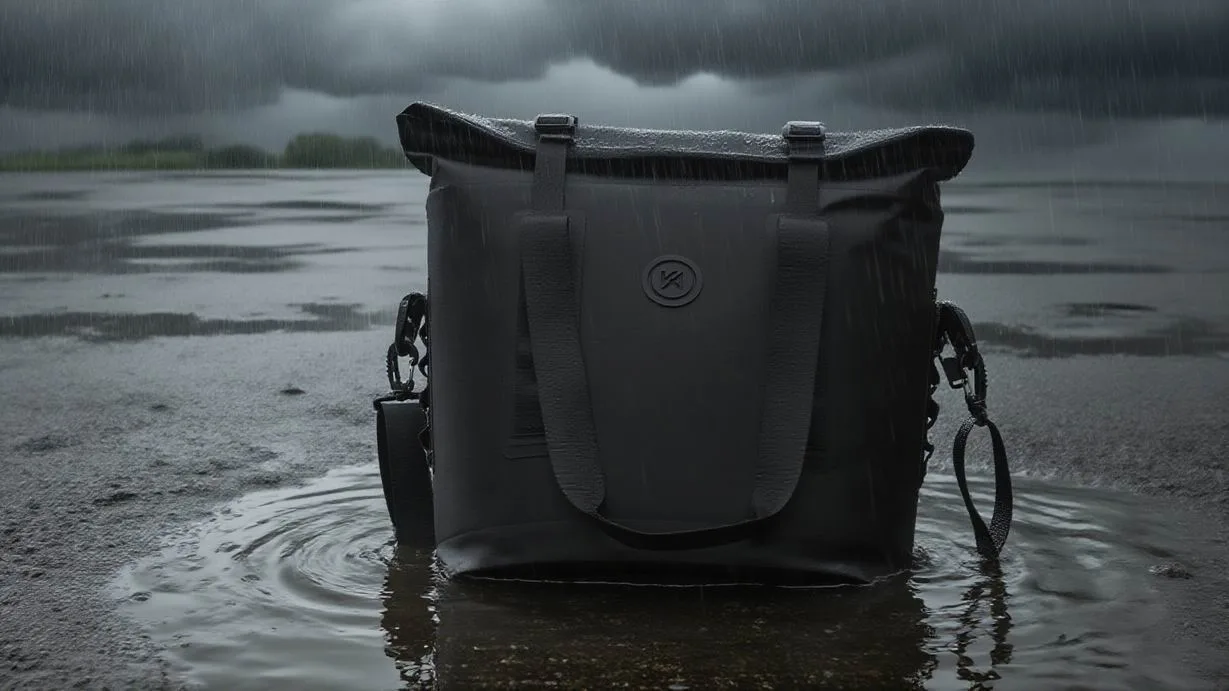
Two adults exhale roughly 0.7 litres of water vapour overnight, and a small tent with the door zipped shut has nowhere to put it. The vapour condenses on the coldest surface available, which on a clear night is the underside of the fly, and then drips. Campers routinely report a leaking tent when what they actually have is a perfectly sound tent and no ventilation.
Ventilation and separation solve it. Leave a 100 mm gap at both ends of the tent so air can move through even at 0.2 m per second, keep bags 100 mm off the fly, and put damp clothing in the 10L wet bag rather than in the wardrobe bag. Open the wardrobe bag for 20 minutes each morning, because a bag closed around a damp towel will keep that moisture for the whole event.
Four-day kit list with real volumes and weights
The list below covers one person for four days and three nights at a summer field event. Volumes are packed volumes, so a hoodie that compresses to 2 litres in a shop counts as 3 litres here. Leave 15 per cent headroom in each bag: a roll-top packed to the brim cannot complete three folds, and a closure that cannot complete three folds is not sealed.
| Item | Volume | Weight | Bag | Note |
|---|---|---|---|---|
| Sleeping bag, 5 °C | 9 L | 1.2 kg | 40 L | Compresses less after night one |
| Four days of clothing | 14 L | 2.8 kg | 40 L | One outfit per day plus thermal |
| Towel and wash kit | 3 L | 0.7 kg | 40 L | Microfibre, not cotton |
| Spare shoes | 6 L | 1.1 kg | 40 L | In a separate inner pouch |
| Camera and two lenses | 4 L | 1.4 kg | 20 L | Silica gel sachet in the pouch |
| Power bank and cables | 1 L | 0.5 kg | 20 L | Two 10,000 mAh banks |
| Documents and medication | 0.5 L | 0.2 kg | 20 L | Hang highest in the bag |
| Wristband, phone, card | 0.3 L | 0.3 kg | 5 L | On your person at all times |
| Damp and muddy clothing | 5 L | 1.8 kg | 10 L wet | Opened every day |
Notice that the 40L wardrobe bag is the heaviest at about 5.8 kg of the list, and the 20L electronics bag carries only 2.1 kg but everything irreplaceable. That asymmetry should drive where you spend your effort: the electronics bag gets the best placement, the most careful closure and the daily check, while the wardrobe bag gets the crate.
Dry festivals: dust, sun and heat instead
A dry festival simply swaps the problem. Without rain, the field generates dust: fine mineral particles under 10 microns that are kicked up by thousands of footsteps and carried on any breeze above about 15 km/h. That dust settles inside tents, inside bags and inside camera bodies, and it is abrasive in exactly the same way mud is, just drier and finer.
The same closure logic applies, and roll-tops win again because a fold has no slider to pump dust. Add one habit: close every bag the moment you have taken what you need from it, and keep the tent door shut on the windward side. UV is the other dry-weather factor; a bag left outside for four days at UV index 8 will surface-measure 55 to 60 °C and age measurably.
Heat also changes what you can store. Anything above about 32 °C for more than two hours is a food safety question, and the CDC two-hour rule is the standard reference for perishable food in exactly these conditions. A dry bag is not a cooler, and a sealed black bag in direct sun is closer to an oven than to storage.
Security: what a bag can and cannot do
A waterproof bag is not a security device. A roll-top closure is quick to open, welded fabric is quick to slash, and a tent is quick to unzip. What a good bag does is reduce opportunity: a closed bag with no visible branding takes longer to assess than an open rucksack with a laptop sleeve showing, and longer is usually enough in a crowded field.
The practical measures are dull and effective. Keep irreplaceable items on your body during the day and in the sleeping bag at night, do not leave the electronics bag in the tent unattended, and do not advertise. If you need a bag that is both waterproof and clearly identifiable for a group, colour coding does more for you than a lock, because theft at festivals is overwhelmingly opportunistic rather than planned.
The pack-down routine
- Empty every bag in the sun on the last dry morning, even if it is only 20 minutes.
- Brush dry mud off before it cakes; never wash a bag while it is still caked.
- Wipe every fold line with a wet wipe and check for grit before you roll.
- Turn the electronics bag inside out and check the weld corners for white stress lines.
- Rinse the wet bag at a tap stand and leave it open in the boot for the drive home.
- Store all four bags rolled loosely, buckles unclipped, out of direct sun at home.
The drive home is where most festival gear dies. A wet bag sealed for six hours in a hot boot grows mildew in a week, and the smell is very hard to remove from TPU. Bag the wet items separately, open the boot at every stop, and unpack the same day you get home rather than the following weekend.
Checklist before you commit to a setup
- Buy one 40L, one 20L and one 5L rather than one 60L bag, so failure is recoverable.
- Confirm welded seams, not taped seams, on anything that might sit in water.
- Check that the closure sits at the top of the load, not on the side.
- Weigh the packed electronics bag and confirm your tent pole can carry it hung.
- Pack a 10L wet bag for damp kit and commit to opening it every day.
- Carry wet wipes specifically for fold lines, which is the highest-value habit.
- Choose a mid-tone colourway so the bag stays cooler and shows less mud.
Groups and event organisers run into the same decisions at scale. If you are specifying bags for a festival retail line, a crew kit or a branded giveaway, the volume, seam type, closure position, colour and hard points are the five lines that decide whether the bag survives the weekend. Our production partner has built waterproof bags since 2014 in an SGS-verified 4,950 m2 facility, with a 500-piece minimum and sampling in 6 to 10 working days, and the brief is always the same five questions.
Finish the plan by checking it against the two failure modes you cannot design out: a field that turns to slurry and a crowd that spills things. Both are handled by preparation rather than by specification, which is why the placement rule and the body bag come ahead of any fabric discussion. Compare your load plan with our festival weekend plan and the wild camping packing guide, and use the weekend sizing notes if you are still choosing between sizes. Grit in hardware is covered in the buckle cleaning guide, and a bag that comes home smelling musty needs the treatment in our mildew removal notes. The full product line shows which sizes share the same closure geometry, which matters when a group wants one system.
Frequently asked questions
Q1. How do I protect gear during festival camping?
Use three bags with fixed jobs, raise them off the tent floor, and keep phone, cash and wristband on your body. A 40L wardrobe bag on a crate, a 20L electronics bag hung 400 mm up, and a 5L body bag covers a four-day field event.
Q2. Why does gear get wet inside a tent that does not leak?
Condensation and ground water. Two adults exhale about 0.7 litres of vapour a night, and a saturated field pushes water up through the groundsheet. Both are solved by ventilation and by raising kit 150 mm, not by a better fly.
Q3. How much water falls on a tent footprint?
One millimetre of rain is one litre per square metre. A 3 m2 tent footprint collects 3 litres per millimetre, so a 20 mm overnight storm puts 60 litres under the floor, and compacted festival soil absorbs almost none of it.
Q4. Should I hang my dry bag in the tent?
Yes, for the electronics bag: hang it 400 mm up from the tent ridge or the stiffest pole crossing. Do not hang more than 4 kg from a single point on a two-person dome, and never hang from the fly alone.
Q5. Are roll-top bags better than zips at a festival?
Yes. A roll-top closure finishes at the top of the load, clear of standing water, and has no slider to pack with mud or dust. A side zip sits lower and jams once grit gets into the teeth.
Q6. What should I keep on my body at a festival?
Phone, card, cash, ID and the wristband, in a 5L roll-top worn crossbody or clipped to a belt loop. At night it goes into the sleeping bag with you rather than into a corner of the tent.
Q7. How do I stop mud damaging my bag?
Wipe the fold line with a wet wipe before every close, keep a dedicated 10L wet bag for muddy items, and rinse the bag exterior at a tap stand while you are still on site. Grit in the fold scores the film each time you roll.
Q8. Can a dry bag sit in standing water overnight?
A welded bag with three folds and the closure above the water line can, yes. It is not designed for it, so treat it as insurance rather than a plan, and keep the closure clear of the water surface.
Q9. What size dry bag for a four-day festival?
About 40 litres for clothing and sleeping kit, 20 litres for electronics and documents, 5 litres worn on the body, and optionally 10 litres as a wet bag. That is roughly 57 litres and 12.5 kg for one person.
Q10. How do I stop my bag smelling after a festival?
Empty it in the sun on the last dry morning, never seal a wet bag for the drive home, and unpack the same day. A wet bag closed for six hours in a hot boot grows mildew within a week.
Q11. Does dust get into dry bags at dry festivals?
Yes, and through exactly the paths water uses. Fine mineral dust under 10 microns passes a zip slider and a loose fold. Roll-top closures resist it best because there is no slider to pump particles in.
Q12. Is a waterproof bag also theft-proof?
No. A roll-top is quick to open and welded fabric is quick to cut. What it does is reduce opportunity: a closed, unbranded bag takes longer to assess, and festival theft is almost always opportunistic rather than planned.
Q13. Can I keep food in a dry bag at a festival?
Only shelf-stable food. A sealed black bag in direct sun reaches 55 to 60 °C inside, and perishable food above 32 °C for two hours is a genuine safety risk. A dry bag is not a cooler.
Q14. How heavy can a hung bag be?
Keep it under 4 kg hung from a single point on a two-person dome, and spread heavier loads across two attachment points. A 3.2 kg electronics bag is fine; a 6.5 kg wardrobe bag belongs on a crate.
Q15. What is the cheapest protection I can add?
Height. An upturned plastic crate gives 150 mm of clearance, doubles as a seat and a step, weighs under 2 kg and protects 6.5 kg of clothing you cannot dry in a field.
Q16. Should I rinse my bag before or after the drive home?
Rinse before. Brush off dry mud, wipe the folds, rinse the exterior at a tap stand and leave wet bags open in the boot. Washing a caked bag four days later is far harder and rarely removes the odour.
People also ask
How do you keep gear dry at a music festival?
Raise it off the ground and separate it by value. Put clothing in a 40L bag on a crate, electronics and documents in a 20L bag hung 400 mm up, and phone, cash and wristband in a 5L bag you wear. Wipe the fold line before every close.
Why does the inside of my tent get wet when it is not raining?
Condensation. Two people breathe out about 0.7 litres of water vapour overnight and it condenses on the coldest surface, which is usually the underside of the fly. Vent both ends of the tent and keep bags clear of the fabric.
What size dry bag do I need for festival camping?
Roughly 40 litres for clothing and the sleeping bag, 20 litres for electronics and documents, 5 litres worn on the body and optionally 10 litres for wet kit. That is about 57 litres per person for four days.
Do dry bags work in mud?
They work better than anything else, provided you keep grit out of the closure. Mud packs into zip sliders and fold lines and acts as an abrasive paste, so wipe the fold before rolling and keep muddy items in a separate wet bag.
Can you leave a dry bag outside the tent at a festival?
You can, but it is a poor idea. It advertises that something is worth taking, it collects condensation overnight and it takes four days of UV for no benefit. Keep bags inside or in the vehicle.
How do you dry gear at a festival with no sun?
Ventilate rather than heat. Open the bag mouths, hang damp items from the ridge with 100 mm of air gap, and keep wet clothing in a dedicated bag that is opened every day. Airflow removes more moisture than warmth in a sealed tent.
Need this in production volume?
QUANZHOU JUNYUAN BAGS has produced waterproof bags since 2014 in an SGS-verified 4,950 m2 facility in Fujian, China. Minimum order 500 pieces, sampling in 6–10 working days, bulk in 35–50 days, FOB Xiamen — write to service@junyuanbags.com with your spec and target market.