How Do Roll-Top Dry Bags Keep Water Out?
A roll-top dry bag keeps water out by pressing two film faces together along three parallel contact lines, not by sealing them with a gasket. Each fold creates roughly 34 kPa of contact pressure when the buckle is pulled to about 60 N, while water at one metre of depth pushes back with only 9.8 kPa, so the seal wins by a factor of three per fold. Water would have to cross three compressed lines in succession, and it has no pressure gradient to do it with. Add a continuous welded seam around the body and there is no needle-hole path left anywhere on the bag.
That is the mechanism, and it explains every failure mode you will ever meet. A grain of sand in the fold opens a gap bigger than the capillary threshold and water walks through it. A jacket strap caught in the roll does the same thing over a longer distance. Cold film that will not conform reduces contact area and therefore pressure. This article works through the physics fold by fold, then through depth, seams, geometry, temperature, testing and the ranked list of reasons a good bag still gets wet inside.
- The short answer: pressure, not a gasket
- What one fold does, and why the number is three
- Contact pressure: the numbers behind the seal
- Why a grain of sand or a strap defeats the fold
- Depth, immersion time and hydrostatic push
- Welded seams: the part that actually carries the rating
- Stiffeners, buckles and the geometry nobody reads
- What the air inside the bag actually does
- Temperature: when the film stops cooperating
- Testing the seal in the lab and in your bath
- Ranked: the ways a good bag still lets water in
- Where a roll-top loses to a zip or a lid
- Keeping the fold reliable for a decade
The short answer: pressure, not a gasket
There is no rubber seal in a roll-top closure. There is no gasket, no O-ring and no adhesive. What there is, is geometry: two flat faces of the same waterproof laminate folded over each other so that they are held in contact under load. Water on the outside has to travel inward along the fold, and at every fold line it meets a region where the two faces are pressed together hard enough that there is no continuous gap to flow through.
This is why a roll-top works with any film and fails with any contamination. The seal is a function of contact pressure and contact area, and both are destroyed by anything that holds the two faces apart. A 0.3 mm grain of sand holds them apart by 0.3 mm over the few millimetres around it, which is a capillary channel wide enough to move water. A fabric strap is worse, because it holds them apart over 40 mm.
It is also why the closure is forgiving in a way zips are not. A roll-top degrades gracefully: one imperfect fold still leaves two, and a bag with two good folds survives splash and light immersion. A waterproof zip either is closed or is not, and a single grit particle in the track creates a failure that no amount of extra care downstream can compensate for.
What one fold does, and why the number is three
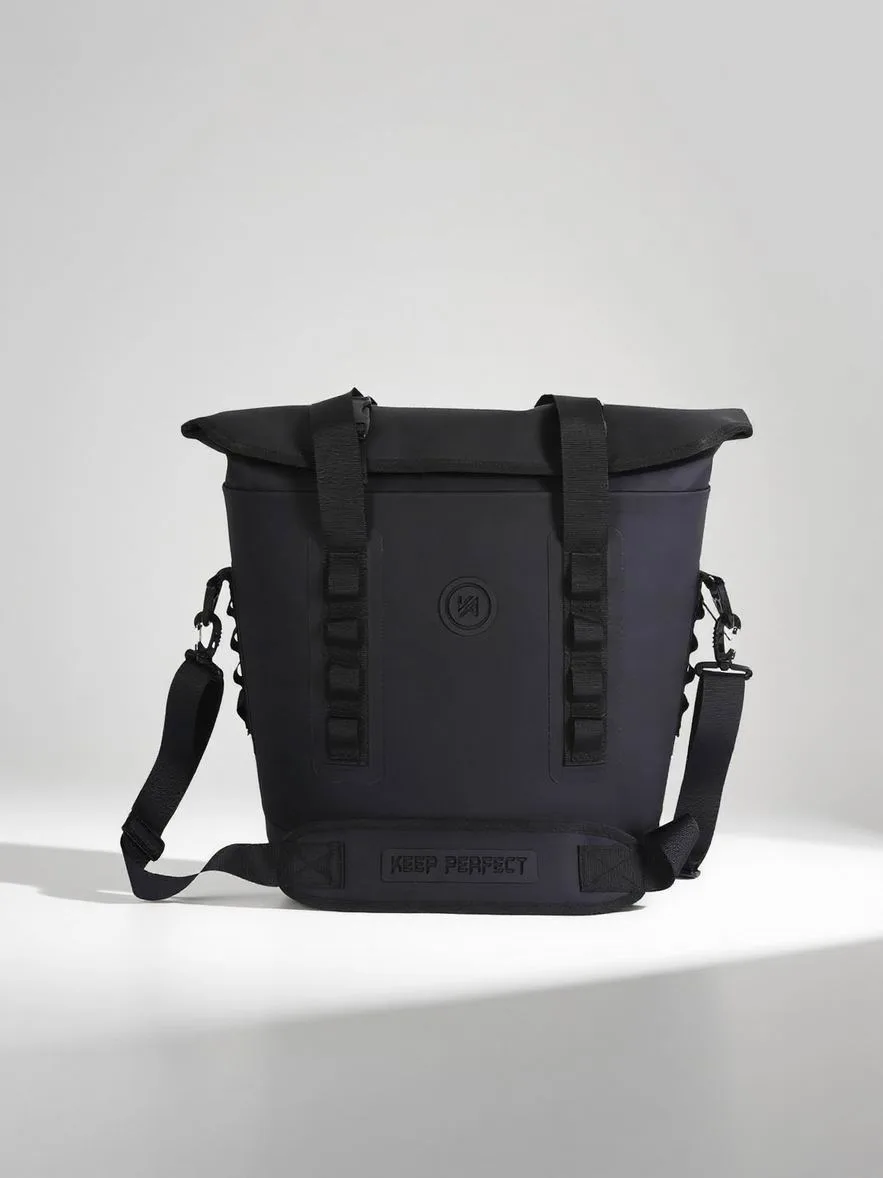
One fold creates one contact line: the region where the film turns back on itself and the two faces meet. It is perhaps 30 to 45 mm of folded material with 6 to 10 mm of true contact at the tightest point. One fold is enough for rain running down the outside of a bag in a pack, which is why a single-fold roll survives a shower and fails a capsize.
Two folds double the barrier and add a mechanical advantage: the second fold presses on the first, so the load from the buckle is shared and the outer fold is held in place by the inner one. Two folds is the working minimum for paddling spray and is what most people achieve when they roll a bag in a hurry on a moving deck.
Three folds is the standard because it is the point where the failure probability drops below what a season of use will expose. Four folds adds little protection and costs 30 to 40 mm more of height, which on a 20L bag means another litre of lost capacity, plus a tighter radius that creases the film harder. The reasoning behind the number is set out in full in our article on rolling three times.
Contact pressure: the numbers behind the seal
The arithmetic is simple and worth knowing. Pull a side-release buckle to roughly 60 N of tension and that load is carried by the contact area of the folds. A fold on a 20L bag has a mouth about 220 mm wide and a true contact band of roughly 8 mm, giving 17.6 square centimetres per fold. Sixty newtons over that area is about 34 kPa of contact pressure. Water at one metre of depth exerts 9.8 kPa. The seal holds by a wide margin, and it holds three times over.
The margin is what protects you from imperfect technique. Even if a cold, stiff film reduces effective contact area by half, the remaining pressure is still three to four times the hydrostatic load at a metre. That margin is also why an under-tensioned buckle is dangerous: slack the buckle to 20 N and contact pressure drops near 11 kPa, which is inside the range where a wave slap at 2 m can force water past the first fold.
| Folds | Contact lines | Buckle load | Approx. contact pressure | What it survives |
|---|---|---|---|---|
| 1 | 1 | 60 N | 34 kPa | Rain and spray, IPX4 |
| 2 | 2 | 60 N | 34 kPa x 2 | Bow spray, IPX5-IPX6 |
| 3 | 3 | 60 N | 34 kPa x 3 | Immersion at 1 m, IPX7 |
| 3, loose buckle | 3 | 20 N | 11 kPa | Splash only, fails a wave slap |
| 4 | 4 | 60 N | 34 kPa x 4 | No practical gain, loses 1 L |
Why a grain of sand or a strap defeats the fold
Contact pressure only exists where the faces touch. Anything between them converts a compressed region into an open channel, and water moves through an open channel by capillary action without needing pressure at all. A single 0.3 mm grain of sand is enough, which is why the standard field advice is to rinse the mouth of the bag before rolling it and to run a thumb along the fold line.
Straps, cords and clothing are the more common culprit because they are larger and they are usually invisible from outside. A compression strap, a jacket cuff or an earphone cable caught in the first fold creates an opening across the full width of the mouth. The bag looks perfect, the buckle is tight, and water walks in along the cable over an hour of paddling. Always clear the mouth before you start the first fold.
Hair is the classic case, and it is the reason this failure feels baffling when it happens. A single human hair is about 0.07 mm across, small enough to be invisible in the fold and large enough to wick water continuously. If you have ever found a dry bag damp inside with no visible cause, look for the hair before you blame the film.

Depth, immersion time and hydrostatic push
Hydrostatic pressure rises linearly with depth at about 9.8 kPa per metre of fresh water, a little more in salt. At 0.5 m the load on the closure is 4.9 kPa; at 1 m it is 9.8 kPa; at 3 m it is 29 kPa. The seal’s 34 kPa per fold therefore covers a casual immersion comfortably and starts to look thin at 3 m, which is a fair description of what IPX7 does and does not promise.
Time matters as much as depth, because a seal that resists a pressure pulse may still seep over 30 minutes. IPX7 specifies 30 minutes at one metre, not indefinite submersion. A bag dragged under a hull for five minutes in a current sees a higher effective pressure than the test, because the flow adds dynamic load on top of the static head. Treat IPX7 as a capsize rating, not a towing rating.
| Depth | Hydrostatic pressure | Against 34 kPa per fold | Realistic outcome | Typical event |
|---|---|---|---|---|
| 0.3 m | 2.9 kPa | Margin 11x | Dry indefinitely | Bag in a flooded footwell |
| 1.0 m | 9.8 kPa | Margin 3.5x | Dry for 30 min | IPX7 test, wet exit |
| 2.0 m | 19.6 kPa | Margin 1.7x | Dry for minutes | Capsize in deep water |
| 3.0 m | 29.4 kPa | Margin 1.2x | Risk of seepage | Dragged under a hull |
| 10.0 m | 98 kPa | Seal overwhelmed | Wet | Dive use, beyond dry bag scope |
Welded seams: the part that actually carries the rating
A perfect closure on a stitched body is still a leak. Every needle hole is a hole, and a seam tape applied over stitching is an adhesive bond that degrades with heat, salt and flex. Radio-frequency or hot-wedge welding melts the two film faces into each other so the joint is continuous with the body, with peel strengths typically in the 60 to 120 N per 50 mm range against 30 to 60 N for a taped stitched seam.
The weld is also where a bag fails mechanically rather than hydraulically. A weld that is too hot thins the film and creates a weak line; too cold and the two faces never fully fuse, producing a seam that holds on the bench and opens under a 12 kg load in a hatch. This is why seam inspection is part of a serious quality process rather than a visual glance, and why the comparison in our welded versus stitched seam article matters more than any other specification line.
Corners are the stress concentration. On a box-shaped bag the weld turns a 90-degree corner, and the film on the inside of the turn is compressed while the outside is stretched. Good designs use a radius of 12 mm or more and reinforce the corner with a second weld pass. If you are inspecting a sample, pull gently on the corner welds before you pull anywhere else.
Stiffeners, buckles and the geometry nobody reads
The closure works because the mouth is stiff. A roll-top has a stiffened band, usually a welded-on strip of thicker film or a moulded insert, running across the mouth; without it the first fold has nothing to press against and collapses into a soft curl that no buckle can tension. The stiffener is typically 25 to 40 mm wide and is the reason a genuine dry bag mouth feels firmer than the body.
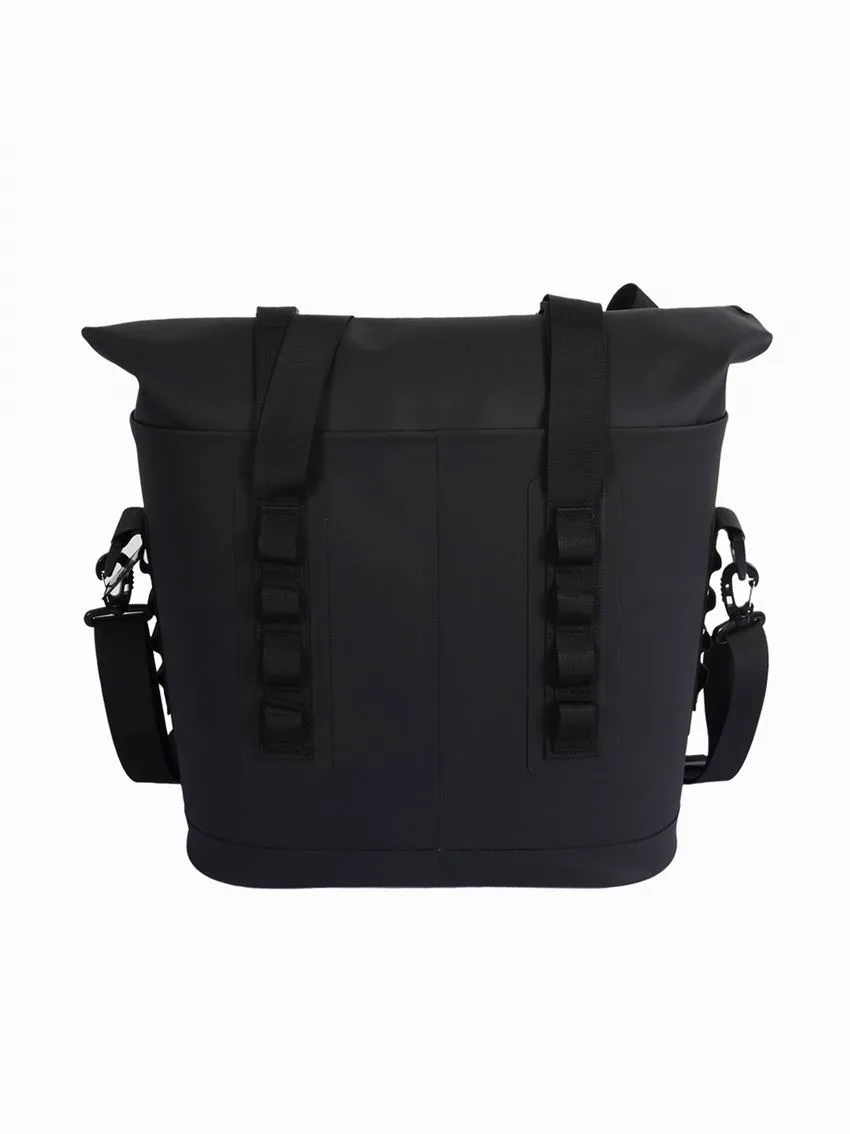
The buckle sets the load path. A centre-release buckle pulls the two ends of the stiffener together and puts tension through all three folds; a side-release buckle on one end does the same job with one hand, which is why it is common on deck bags. A clip bar that snaps down over the roll adds a second, independent compression point and is worth having on any bag that will be strapped to a moving boat.
Width matters too. A wide mouth on a 40L duffel is easier to pack and harder to seal, because the fold line is longer and any irregularity is repeated over 400 mm rather than 220 mm. This is the real reason large bags move to zips: not because a roll-top cannot work at that width, but because a single operator cannot reliably roll 400 mm of stiff film with cold hands.
What the air inside the bag actually does
Trapped air is a double-edged thing. On one side it makes the bag float, which is useful on a deck and useless in a hatch. On the other it raises internal pressure, so when the bag is squeezed or the sun warms it, the closure sees load from the inside as well as the outside. A bag rolled shut at 15 C and left in a car at 45 C gains roughly 10% internal pressure, which is usually harmless and occasionally enough to push a weak first fold open.
The practical consequence is about packing, not physics. Expel most of the air before the first fold and the bag sits flat, packs efficiently and stops behaving like a float in a hatch. Leave the air in and you have a buoyant, unpredictable object that also telegraphs pressure into the closure. Use a purge valve if the bag has one, after packing and before rolling.
Air is also the diagnostic tool. Roll the bag closed, squeeze it firmly and listen: a healthy seal holds pressure and the bag resists, while a compromised one hisses at the fold. That 30-second test catches almost every closure fault before you launch, and it is the single habit that prevents most wet-kit incidents. The formal version is described in the air inflation leak test.
Temperature: when the film stops cooperating
Contact pressure depends on the film conforming to itself, and conformation depends on flexibility. TPU stays flexible to roughly -30 C before it reaches its cold-crack threshold, which is why it is the material of choice for winter paddling and for anyone who packs a bag in a cold garage. PVC stiffens noticeably below about 0 C and by -5 C resists the tight radius of a third fold, which is a slow, invisible way to lose a seal.
Heat is the gentler problem but the more common one. Above 40 C a thin film becomes noticeably softer and more prone to creep under buckle load, so a bag left in a hot car can slowly relax its own closure. Store bags out of direct sun, and be aware that a bag baked at 60 C on a tropical deck for a week has aged more than a season of normal use. UV is the real agent here, and it attacks the film long before the closure.
Testing the seal in the lab and in your bath
Laboratory testing separates the film from the closure. Hydrostatic head tests the fabric: a column of water is raised against a clamped sample until three drops penetrate, and a welded laminate typically exceeds 10,000 mm while a coated woven fabric sits at 1,500 to 5,000 mm. Immersion testing tests the whole assembly, and IPX7 means 30 minutes at one metre with the closure rolled as instructed. The two numbers answer different questions and neither guarantees the other.
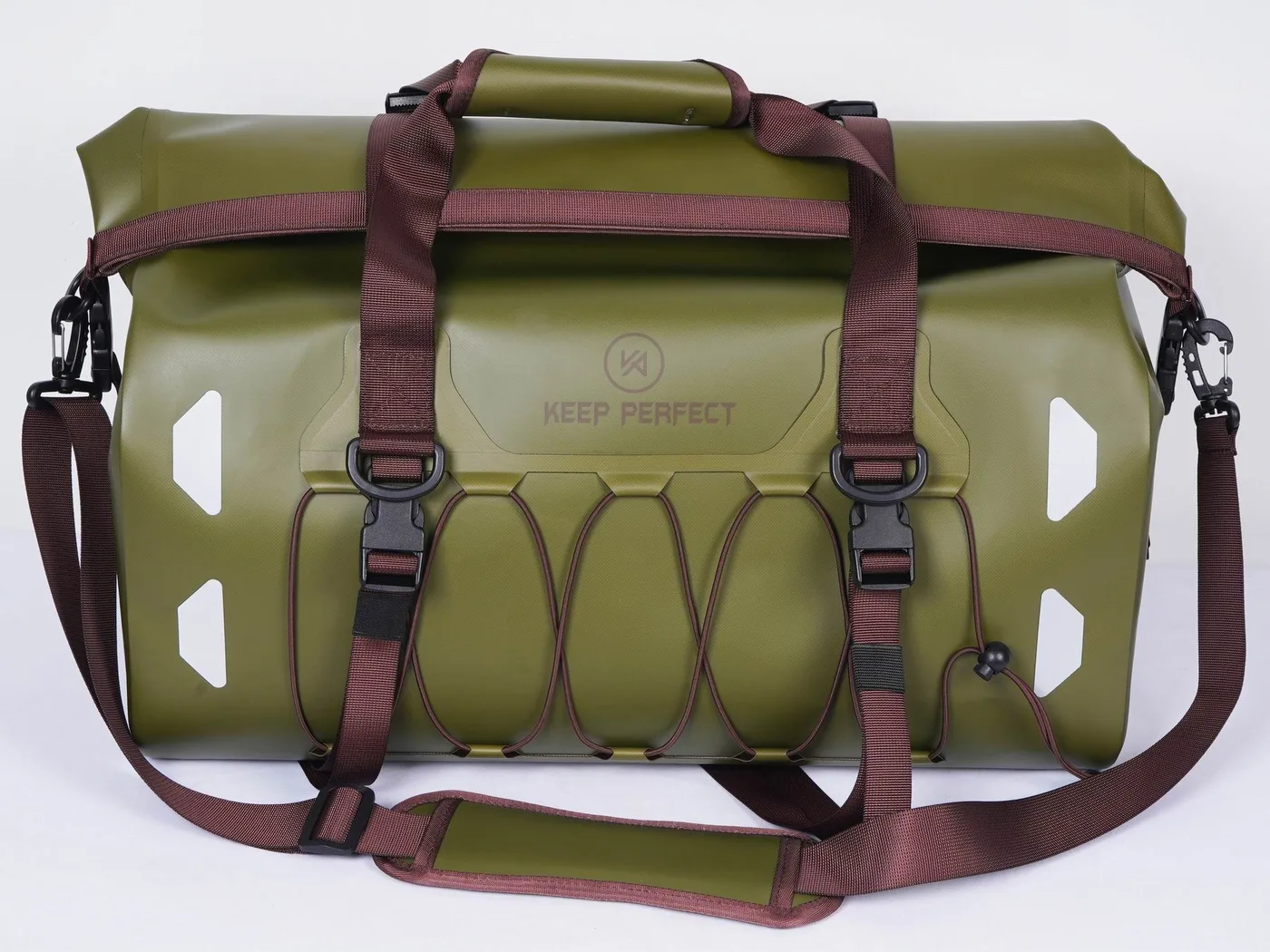
At home you can do three useful checks in ten minutes. First the squeeze test: roll, squeeze, listen for a hiss. Second the bath test: roll the bag around a dry towel, submerge it for 30 seconds under a weight, and check the towel. Third the paper test: put a dry tissue at the bottom, roll, submerge for five minutes, and inspect. None replaces a lab, but all three catch the failures that actually happen. The IEC defines the ingress codes used on spec sheets, and ASTM publishes the standard test methods behind fabric and seam claims.
| Test | What it measures | Typical pass figure | What it does not prove |
|---|---|---|---|
| Hydrostatic head | Fabric resistance to penetration | 10,000 mm + | Says nothing about the closure |
| IPX7 immersion | Whole bag at 1 m for 30 min | No ingress | Not a towing or depth rating |
| Squeeze and listen | Closure integrity | No hiss for 10 s | Misses a slow capillary path |
| Bath with a towel | Closure and seams | Towel dry after 30 s | Short duration, low pressure |
| Tissue test, 5 min | Slow seepage | Tissue dry | Does not reproduce wave loading |
| Seam peel test | Weld strength | 60-120 N per 50 mm | Does not measure pinholes |
Ranked: the ways a good bag still lets water in
Field experience puts the causes in a consistent order, and the film is not on the list. The closure is rolled over something — a strap, a cord, a hair — more often than anything else. The second cause is an overfilled bag, where the load pushes against the fold from inside and opens the first contact line. Third is grit in the fold. Fourth is a buckle that was never fully tensioned. Fifth, a long way behind, is genuine damage to the film or a weld.
Condensation is the false positive that sits alongside all of them. A bag packed with damp kit, or sealed in warm humid air and carried into cold water, will show moisture inside that never came from outside. Three to eight millilitres over a long winter paddle is typical. If the water is evenly distributed as a film on the inside surface, suspect condensation; if it is pooled at the lowest point, you have a real ingress path. Our guide to water ingress covers the diagnosis in detail.
| Cause | Share of field failures | Symptom | Fix |
|---|---|---|---|
| Object caught in the fold | 35-45% | Damp along one side | Clear the mouth before folding |
| Overfilled bag | 20-25% | Seep at the first fold | Fill to 85%, expel air |
| Grit or hair in the fold | 15-20% | Slow damp over hours | Rinse and thumb-check the fold |
| Buckle not tensioned | 8-12% | Leak only under a wave | Pull to firm resistance |
| Weld or film damage | 3-5% | Wet at a predictable point | Repair or retire the bag |
| Condensation (false positive) | common | Even film on inner surface | Air the bag, silica sachet |
Where a roll-top loses to a zip or a lid
Three situations genuinely favour a different closure. The first is a bag wider than about 350 mm, where one person cannot roll the mouth evenly with cold hands. The second is a bag that must be opened and closed 20 times a day, where a roll becomes tedious and a waterproof zip is faster. The third is a bag that lives inside another bag on a long trip, where compression matters more than immersion and a light roll-top with no stiffener is actually the better choice.
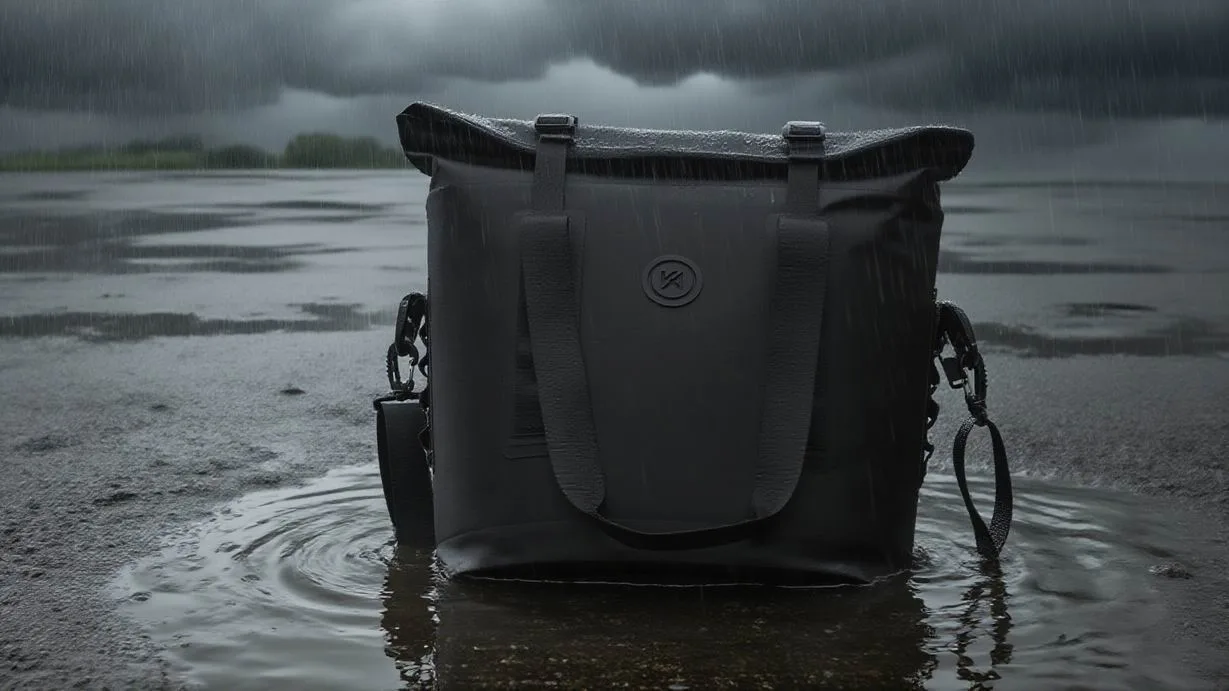
The fourth is dive and prolonged-submersion use, where the pressure head exceeds what any flexible closure should be asked to hold. Below about 3 m, a hard case with a mechanical latch and an O-ring is the correct engineering answer. A roll-top dry bag is a splash, spray and capsize device, and it is an excellent one; it is not a dive container, and claiming otherwise is how people lose cameras.
For everything else — paddling, rafting, sailing, commuting, travel, hunting — the roll-top wins on weight, cost, repairability and grace under damage. It weighs less than a zip of equivalent width, costs a fraction, can be repaired with a patch and a heat source in the field, and still works reasonably with two folds instead of three. That combination is why it remains the default across the category.
Keeping the fold reliable for a decade
- Rinse the mouth with fresh water before every roll, especially after salt or sand.
- Clear straps, cords and clothing from the mouth before the first fold.
- Fill to 85% of volume and press the air out before folding.
- Make three folds and pull the buckle to firm resistance, not to a stop.
- Store the bag loosely rolled with the buckle unclipped, never folded flat.
- Keep it out of direct sun; UV ages film faster than any amount of use.
- Run the 30-second squeeze test before every launch.
- Retire the bag when the fold band shows crazing or the weld clouds.
The fold band is the wearing part and it is worth watching. After roughly 300 to 500 roll cycles a 0.5 mm TPU film starts to show a permanent crease at the first fold line, and by 800 to 1,200 cycles that crease can develop fine crazing that no longer conforms. Rotate which part of the mouth you start the fold from and you spread the wear over three lines instead of one.
Programmes that buy in volume should specify the closure geometry explicitly: stiffener width, fold count guidance, buckle type and pull strength, film thickness, and the test standard behind the rating. Waterproof bags have been produced here since 2014 in an SGS-verified 4,950 m2 site with 7 lines and 149 machines, sampling in 6 to 10 working days and bulk in 35 to 50 days FOB Xiamen at a 500-piece minimum, inspected to AQL 2.5.Compare the closure against the roll-top range, and read the honest answer on 100% waterproof claims before you write a marketing line.
Frequently asked questions
Q1. How do roll-top dry bags keep water out?
Three folds press two film faces together along three contact lines at about 34 kPa each, against 9.8 kPa of water pressure at one metre. There is no gasket: the seal is contact pressure plus a welded, hole-free body.
Q2. Is there a rubber seal inside a roll-top closure?
No. The closure is the same laminate folded against itself. The only added parts are a stiffened band across the mouth and a buckle that supplies the tension, typically 60 N on a 20 L bag.
Q3. Why does one grain of sand make a dry bag leak?
Because contact pressure only exists where the faces touch. A 0.3 mm grain holds them apart over a few millimetres, creating a capillary channel that moves water without any pressure at all.
Q4. How much pressure does a rolled closure resist?
Roughly 34 kPa per fold at a 60 N buckle load, against 9.8 kPa at one metre of depth. Three folds therefore give a margin of about three and a half times at IPX7 depth.
Q5. Can water get through a correctly rolled dry bag?
Not at IPX7 depth within 30 minutes. Beyond about 3 m, or under the dynamic load of being dragged under a hull, the margin narrows and seepage becomes possible. That is a depth limit, not a defect.
Q6. What does IPX7 actually test?
Thirty minutes of immersion at one metre with the closure rolled as instructed. It is a capsize rating, not a towing rating and not an indefinite submersion rating, and it says nothing about flow load.
Q7. Do welded seams matter more than the closure?
Both matter, but the seam is what makes the rating achievable. A stitched body has thousands of needle holes, so a perfect roll-top on a stitched bag still leaks. Welded seams are continuous with the film.
Q8. Why is my bag wet inside when the closure was perfect?
Two likely causes: condensation from damp kit or warm humid air, typically 3 to 8 ml, or something caught in the fold. Even film on the inner surface means condensation; a pool at the lowest point means ingress.
Q9. Does a roll-top work in freezing weather?
Yes with TPU, which stays flexible to about -30 C. PVC stiffens below 0 C and resists the tight radius of a third fold by -5 C, which is a slow way to lose a seal without noticing.
Q10. How many times can you roll a dry bag before it wears out?
A 0.5 mm TPU film shows a permanent crease after roughly 300 to 500 roll cycles and fine crazing by 800 to 1,200. Rotate the starting point of the fold to spread wear across three lines instead of one.
Q11. Why is a wide-mouth duffel harder to seal than a sack?
Because the fold line is longer. An irregularity over 400 mm of mouth is four times the problem of the same irregularity over 220 mm, and one person cannot roll 400 mm evenly with cold hands.
Q12. Should I use a purge valve?
Use it after packing and before rolling to expel air, so the bag sits flat and stops pressurising the closure from inside. It adds one more seal to maintain, so skip it on small bags.
Q13. What is the fastest way to check a seal?
Roll closed, squeeze hard and listen for 10 seconds. A healthy bag holds pressure and resists; a compromised one hisses at the fold. It takes 30 seconds and catches almost every closure fault.
Q14. Do roll-top bags work at depth for diving?
No. Below about 3 m the hydrostatic head overwhelms a flexible closure. Use a hard case with a mechanical latch and an O-ring for anything involving sustained submersion.
Q15. Why does my bag leak only in waves?
Because a slack buckle or a marginal fold survives static conditions and fails under dynamic load. A wave slap adds pressure on top of the hydrostatic head, so tighten the buckle to firm resistance and add the third fold.
Q16. How should I store a roll-top bag between trips?
Loosely rolled, buckle unclipped, out of direct sun, in a dry place. Never fold it flat, because a flat crease at the fold band is the single fastest route to a permanent leak path.
People also ask
How does a roll-top dry bag seal without a zip?
By folding the waterproof laminate over itself three times so two faces are pressed together under buckle tension. The pressure at each fold, about 34 kPa, exceeds the water pressure at one metre, so water cannot cross the contact line.
Why do you have to roll a dry bag three times?
Each fold is an independent barrier. Two folds survive spray; three survive a 30-minute immersion at one metre. A fourth adds no practical protection and costs another litre of usable volume on a 20 L bag.
What makes a dry bag leak if the film is not damaged?
Something holding the folded faces apart: a strap, a cord, a hair or a grain of sand. Overfilling and a slack buckle come next. Real film or weld damage accounts for under 5% of field failures.
Are roll-top dry bags waterproof or just water-resistant?
Waterproof within their rating. A welded bag with three clean folds reaches IPX7, meaning 30 minutes at one metre. The rating is a test result with a defined depth and duration, not an absolute promise.
Can you submerge a dry bag underwater for a long time?
Not beyond its rating. IPX7 covers 30 minutes at one metre. Longer durations, greater depths or being dragged under a hull all add load the closure was not tested for.
How do you know if a dry bag seal has failed?
Squeeze the rolled bag and listen for a hiss, submerge it for 30 seconds with a dry towel inside, or leave a tissue at the bottom for five minutes. Any dampness means the fold is compromised or contaminated.
Need this in production volume?
QUANZHOU JUNYUAN BAGS has produced waterproof bags since 2014 in an SGS-verified 4,950 m2 facility in Fujian, China. Minimum order 500 pieces, sampling in 6–10 working days, bulk in 35–50 days, FOB Xiamen — write to service@junyuanbags.com with your spec and target market.