Wet-Weather Kit for Pool Days
A pool day needs two bags, not one: a dry roll-top holding clothing, electronics and towels at roughly 12 litres, and a wet compartment holding swimsuits, goggles and sandals at 5 to 8 litres. Keeping them apart is the whole system, because a sealed roll-top has no internal wall and no drain, so two damp swimsuits carrying about 120 ml of water will redistribute that moisture through the entire load within 20 minutes. Add a third 2L pouch for coins, locker tokens and the key card if you are swimming at a municipal pool.
Everything below assumes real pool conditions: free chlorine between 1 and 3 ppm, air temperature of 28 to 30 °C in an indoor hall, relative humidity above 60%, and wet tile underfoot that makes every dropped item a slipping hazard rather than just an inconvenience. Since CDC guidance notes that Crypto can survive for days in a properly chlorinated pool, the bag you choose also decides how easily you can wash contamination off it afterwards.
- What a pool day actually exposes your bag to
- The two-bag pool system and what each one holds
- How chlorine and other pool chemicals affect TPU
- Condensation, humidity and the mildew clock
- Outdoor pools: rain, wind and lightning rules
- Goggles, caps and the small-parts problem
- Choosing between a roll-top, a tote and a duffel
- Valuables: what to do with money, cards and keys
- Sizes for lane swimming versus family sessions
- Poolside hygiene: where the bag goes
- Rinse and dry: the four-step post-swim routine
- Failure modes we see after a season at the pool
- Checklist for any pool session
What a pool day actually exposes your bag to
Swimming is the gentlest thing that happens to a bag at a pool. The harder loads come from chemistry, humidity and floor surfaces. Chlorinated water is dosed to between 1 and 3 ppm free chlorine and held at pH 7.2 to 7.8, and although that is mild for skin, it is a continuous low-level oxidiser on any polymer left damp on the pool deck for four hours. Combined chlorine above 0.4 ppm produces both the classic smell and a film that clings to handles.
Mechanical abuse follows close behind. Bags live on wet tile, get kicked along changing-room benches, and are stacked three deep in lockers. An indoor hall runs 28 to 30 °C at 60 to 80% relative humidity, and the locker room often pushes past 90%, which is why condensation becomes an issue the moment a warm humid bag meets an air-conditioned car or a corridor at 21 °C. Plan for chemical contact plus humidity plus abrasion, in that order of importance.
The two-bag pool system and what each one holds
Give the dry bag one job: everything that must still be dry when you get dressed. Give the wet compartment the opposite job: everything that leaves the water slightly dripping and will never be worn dry again today. Draw the line hard. A pair of goggles that touched pool water belongs wet; a spare T-shirt that never left the bag belongs dry and stays that way for the whole visit.
| Compartment | Size | Contents | Why it matters | Weight |
|---|---|---|---|---|
| Dry roll-top | 12 L | Towel, underwear, T-shirt, phone | The load you dress from | 1.4-1.8 kg |
| Wet compartment | 5-8 L | Swimsuits, goggles, swim cap, sandals | Isolates 120 ml of residual water | 0.9-1.4 kg |
| Small valuables pouch | 2 L | Coins, locker key, bank card | Everything that rusts or drowns | 0.2 kg |
| Optional kit bag | 20 L | Kickboard, fins, pull buoy, drink bottle | Keeps training fins out of your clothing | 2.5-3.5 kg |
| Family share bag | 30 L | Four towels, spare swimsuits, snacks | One drop point, one person responsible | 5.0-6.5 kg |
Lane swimmers can compress this to a 12L dry bag plus a wet bag that is little more than a liner: a 45-minute session produces one damp swimsuit and one pair of goggles. Family visits cannot be compressed, because four people generate four sets of everything and the failure mode is mismatched footwear at the exit rather than a soaked shirt.
How chlorine and other pool chemicals affect TPU
Thermoplastic polyurethane tolerates pool chemistry well compared with PVC, which can lose plasticiser faster under repeated wet-dry cycling in warm chlorinated water. The failure path for TPU is not chemical attack so much as residue: chloramines and dissolved solids dry onto the film surface and leave a dull bloom that attracts grit. A bag that is never rinsed after swimming will look tired after one season and feel slightly tacky by the second.
There is one exception worth knowing. Higher hydrolysis grades of polyester-based TPU can embrittle under long warm-wet exposure, whereas polyether-based film resists it, so a bag used daily at an indoor pool benefits from the better grade. This is one reason to ask what film is laminated to the face fabric rather than only asking what it costs; our notes on deodorising a bag safely cover which cleaning agents are also safe for that film.
Condensation, humidity and the mildew clock
An indoor pool creates the textbook condensation setup. A bag packed in a 29 °C changing room at 85% relative humidity holds air containing roughly 24 g of water per cubic metre; move that same bag into a 21 °C car at 45% humidity and the air inside crosses its dew point against the cooler film, depositing droplets on the interior walls within 10 to 15 minutes. Nothing leaked; you simply carried a small cloud into a colder space.
The mildew clock starts when a damp bag stays closed. Visible spotting typically appears after 48 hours and a smell within 24, both of which are faster in summer heat. The fix is airflow rather than chemicals: open the moment you reach the car, hang mouth-down for two hours, and only then roll for storage. If smell has already set in, work through the sequence in our odour removal guide before reaching for anything stronger than white vinegar.
Outdoor pools: rain, wind and lightning rules
Outdoor pool sessions add two hazards indoor swimmers never meet. The first is rain while you are already in the water: everything on the deck starts absorbing, the bag included, and paper items such as pool passes or a paperback go first. Keep the dry bag closed and place it so the open edge faces away from the prevailing wind, even if it means tucking it under a lounger.
The second hazard is lightning, and it is not negotiable. The flash-to-bang rule used by lifeguard services says that if fewer than 30 seconds elapse between the flash and the thunder, the storm is within about 10 km and you leave the water; pool closures normally run for 30 minutes after the last thunder. The NOAA storm guidance is a good reference to read before a trip to a lido or a holiday pool where staff may not enforce a policy.
Goggles, caps and the small-parts problem
Small kit is what gets lost at pools, not big kit. A single pair of goggles costs more than the average dry bag and spends most of its life wet, which means it never goes into the dry compartment. Give every child their own 2L pouch in the same colour as their goggles; that one rule removes most of the arguments about whose equipment is whose.
There is also a mechanical argument for the pouch: goggle straps and nose bridges abrade film from the inside. A silicone strap dragging across TPU for six sessions per week scuffs the interior surface, and scuffs collect both water and residue. If you swim often enough to own fins, keep them in a separate kit bag so the stiff edges never press against the dry clothing compartment.
| Item | Volume | Wet? | Compartment | Notes |
|---|---|---|---|---|
| Swimsuit, adult | 0.4 L | Wet | 5-8 L liner | Holds 40-70 ml of water when wrung |
| Towel, large | 3.0 L | Damp | Dry bag outer pocket | Roll it, never fold it wet |
| Goggles and cap | 0.3 L | Wet | 2 L pouch | Straps abrade film interiors |
| Training fins, short blade | 4.5 L | Wet | 20 L kit bag | Stiff edges puncture soft-sided loads |
| Phone and card holder | 0.2 L | Dry | 2 L valuables pouch | Two-seal rule always applies |
Choosing between a roll-top, a tote and a duffel
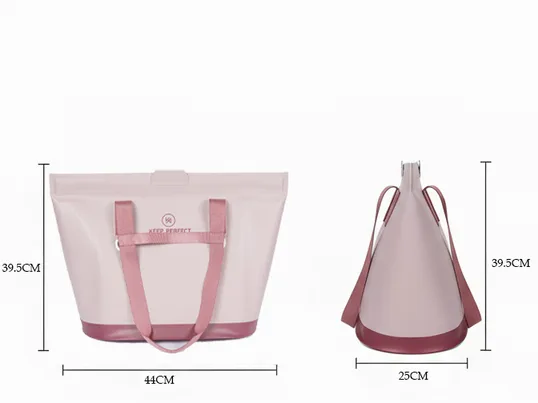
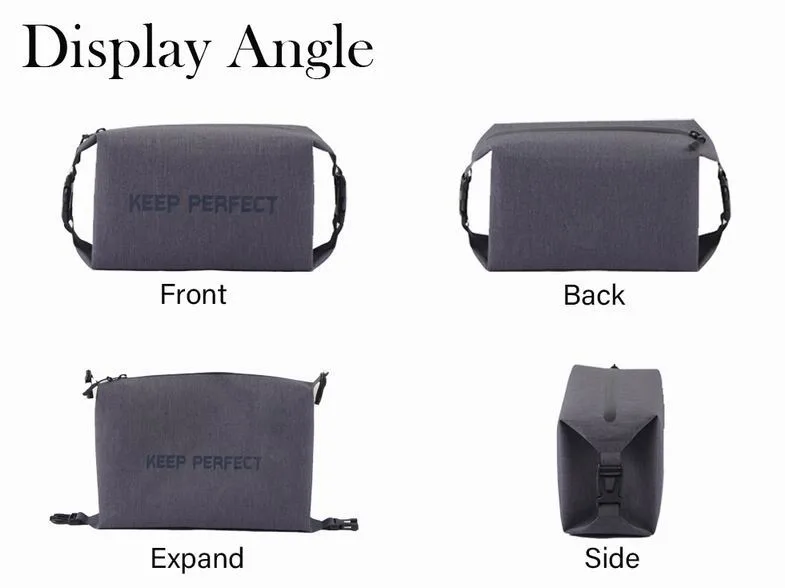
The right format depends on how many times you open it. A roll-top closure takes four to six seconds to open and re-roll, which is fine twice an hour and annoying every five minutes. A waterproof tote stays open, lets you drop things in one-handed while holding a child with the other, and has no buckle to fumble; its weak point is that an open mouth collects splashes from passing feet.
Cost follows the same logic as durability. A printed nylon tote with a coated interior is cheap and perfectly adequate for six weekends a year; a welded TPU duffel costs several times more but wipes clean, does not absorb 8 g of water per session into its own fabric, and survives being packed wet on holiday for two weeks. Match the spend to the session count, not to how the bag looks in a photograph.
A dry duffel suits lane swimmers who walk in with fins and a kickboard, because the long opening takes bulky training equipment without bending it. Families usually end up with two of the three: a duffel or tote for the wet gear and a roll-top that never leaves the locker. When you compare constructions, our full product line shows which formats share the same film and closure.
Valuables: what to do with money, cards and keys
Pool lockers take three inputs and each has a failure mode: coins get wet in a costume pocket, paper tokens dissolve within minutes of contact with a wet costume, and metal keys rust and then stain everything they touch. Use a 2L valuables pouch with the two-seal rule, then treat that pouch as the item you never put down, even when you are only moving between pool and lounger.
RFID wristbands and key cards are safer but not waterproof in every version; check whether yours is specified for immersion before you take it into the water. Phones belong somewhere dry and shaded, not balanced on a lane rope or tucked into a rolled towel on hot tiles that reach 45 °C. If you are the unofficial bag guardian for a group, assign one pouch and one person responsibility for the whole afternoon.
Theft at public pools is opportunistic rather than targeted, and unattended changing rooms are the weak point. A pocketed liner inside the bag keeps small items out of sight when the bag hangs open on a hook, while the roll-top closure means nothing falls out if the bag is knocked off a bench. Choose a muted colourway if you leave the kit unattended; the advantage of a bright pack for family identification is also its disadvantage in a busy corridor.
Sizes for lane swimming versus family sessions
Capacity follows session length and headcount rather than the amount of clothing involved. A lane swimmer needs surprisingly little dry volume and quite a lot of wet resilience; a family needs the opposite. Use the planning table below rather than guessing, and remember that dry volume and wet volume never add up to one convenient number because they must stay separated.
| Session | Duration | Headcount | Dry volume | Wet volume |
|---|---|---|---|---|
| Lane swim before work | 45 min | 1 | 8-12 L | 2-3 L |
| Swim lesson with a child | 1 h | 2 | 15-20 L | 4-6 L |
| Family recreational swim | 3 h | 4 | 30-40 L | 8-12 L |
| Holiday pool day | 6 h | 4 | 45-60 L | 10-15 L |
| Squad training evening | 2 h | 1 | 12-15 L | 5-8 L |
Notice that the wet compartment scales faster than the dry one for families: four swimsuits generate closer to 250 ml of residual water, which is why the 5L liner that suits a lane swimmer becomes an 8L bag for a family outing. If you are buying one bag to start, buy 20L and treat it as the dry side, then add the wet liner later.
Poolside hygiene: where the bag goes
Decks are dirty in ways that matter. Splash-back, drips from hundreds of passing feet, and cleaning products used between sessions all collect in the same 100 mm margin around the pool edge. Keep bags at least one metre back from the water, and never on the drain channel, which is where the highest concentration of everything ends up.
If you must place a bag on the floor, put something disposable underneath: a folded towel you intend to wash anyway. Consider also where you open it; a locker room bench that looks dry is often damp enough to transfer 5 ml of water to whatever you set down. Hang straps over hooks rather than letting them trail in whatever is running along the bench.
Rinse and dry: the four-step post-swim routine
- Empty the wet compartment at the pool if there is a tap; otherwise do it within 30 minutes of leaving.
- Rinse with fresh water at ambient temperature, spending about 30 seconds per bag.
- Open every compartment fully once home and hang the bag mouth-down for two hours.
- Store loosely rolled with buckles unclipped, away from radiators and direct sun.
Timing beats technique here. A bag rinsed within 30 minutes of leaving a chlorinated pool needs nothing more than water; one left sealed for the drive, the walk and the evening needs soap and sometimes vinegar. Thirty seconds of attention at the pool saves twenty minutes at the weekend.
Winter changes the order of priorities. Leaving a warm indoor hall for a car at 4 °C means condensation forms inside the bag rather than outside, so open everything before you start the engine and let the warm humid air escape for two minutes. Racing to get warm is how February bags develop spring mildew.
Failure modes we see after a season at the pool
- White bloom on the film where chlorinated water dried instead of being rinsed off.
- Buckles stiffened by dried pool solids, requiring over 50 N of release force instead of the usual 25 N.
- Interior scuffing from goggle straps and fin edges carried loose in the dry compartment.
- Mildew spotting inside the wet liner after repeated 48-hour closed storage.
- Rusted key rings leaving permanent orange transfer marks on pale TPU.
- Tote rims deformed by being sat on poolside while wet and loaded with 6 kg.
Most of those are reversible if caught early. The bloom wipes off with a 1:10 white vinegar solution followed by a water rinse; stiffened buckles respond to a soak and a scrub with a soft toothbrush. Rust transfer is the exception because iron oxide binds into the film surface; prevention with a covered key pouch is much cheaper than living with the mark.
Prevention fits into a short calendar rather than a long chore list. Once a month, run a 1:10 vinegar wipe over the interior and the fold line; once a quarter, soak the buckles and scrub the spring channels with a soft brush; twice a year, check every weld corner for lifting. Ten minutes a month costs less than replacing even one 20L bag.
Checklist for any pool session
- One dry roll-top kept permanently dry and never opened poolside.
- One wet liner sized to the number of swimmers, not the number of towels.
- One small valuables pouch with the two-seal rule applied.
- Bags placed at least one metre back from the water line and off the drain channel.
- Rinse within 30 minutes, dry mouth-down for two hours at home.
- Lightning plan checked before an outdoor session, including re-entry timing.
For clubs, schools and hotel operations building the same kit at scale, these six lines convert directly into a specification: film grade for chlorinated environments, compartment layout, hardware finish for rust resistance, colour coding for family sharing, cleaning guidance and documentation language. Our team has produced waterproof bags since 2014 in an SGS-verified 4,950 m2 facility, with a 500-piece minimum, sampling in 6 to 10 working days and bulk lead time of 35 to 50 days.
Two further reads round out the pool picture. If the damp load is your main problem, start with the dedicated notes on keeping wet swimwear out of your bag; if you travel between hotels, gyms and pools, use the hotel, gym and pool kit plan. Larger groups should read the poolside and aquapark guide, and anyone buying their first bag should compare closures in the roll-top dry bag range.
Frequently asked questions
Q1. What should I put in a wet-weather kit for a pool day?
Two compartments and one pouch: a dry roll-top of about 12 litres for clothing and towels, a 5 to 8 litre wet liner for swimsuits and goggles, and a 2 litre pouch for coins, cards and keys.
Q2. Can I put a wet swimsuit in a dry bag?
You can, but it is a mistake. A sealed roll-top has no drain, so the 40 to 70 ml left in a wrung swimsuit spreads through towels and clothing within about 20 minutes and starts to smell within a day.
Q3. Does chlorine damage TPU dry bags?
Pool chlorine at 1 to 3 ppm does not attack the film, but the solids it leaves behind dry onto the surface and attract grit. Rinse within 30 minutes and the film stays clean; skip rinsing and expect a white bloom within one season.
Q4. Why is my dry bag wet inside after swimming at an indoor pool?
Condensation, not leakage. Air packed at 29 °C and 85% humidity holds about 24 g of water per cubic metre, and as soon as the bag cools below its dew point in a car or corridor, that water condenses on the interior walls.
Q5. How quickly does mildew grow in a damp bag?
Odour usually appears after 24 hours and visible spotting after 48 hours, both faster in summer heat. Open the bag when you reach the car and hang it mouth-down for two hours to stop the clock.
Q6. Should I use a tote or a roll-top at the pool?
Use a tote for anything you open every few minutes, because it stays open and takes one-handed drops. Use a roll-top for anything that must be genuinely dry, since a three-fold closure is the only reliable seal against a splash from the deck.
Q7. How much water does a wet swimsuit actually hold?
A wrung adult swimsuit holds 40 to 70 ml and a children's costume about 25 to 40 ml. Four family members therefore return roughly 250 ml of water, which is why families need an 8 litre wet liner rather than 5.
Q8. Can I leave my bag on the pool deck?
Keep it at least one metre back from the water and never on the drain channel, where splash, foot traffic and cleaning concentrate. Set it on a folded towel you intend to wash, since benefits and splash-back make decks dirty even when they look clean.
Q9. What do I do with keys and coins while swimming?
Put them in a 2 litre pouch sealed with three folds and then place the pouch inside your dry bag, which is the two-seal rule. Cosmetic pockets are unsuitable: metal key rings rust and leave orange marks that bind into pale film.
Q10. How do I stop my pool bag smelling?
Rinse within 30 minutes, open it fully at home, and hang it mouth-down for two hours. If odour has already set in, use a 1:10 white vinegar solution, then rinse with fresh water and dry in shade with the mouth open.
Q11. Is it safe to swim outdoors in the rain?
Rain itself is fine; lightning is not. If fewer than 30 seconds pass between flash and thunder, the storm is within roughly 10 km, and standard practice is to leave the water and wait 30 minutes after the last thunder before re-entering.
Q12. What size bag does a lane swimmer need?
Eight to 12 litres dry plus 2 to 3 litres wet for a 45 minute session. Training fins change that: short blades occupy 4.5 litres on their own and are better carried in a separate 20 litre kit bag.
Q13. Can goggle straps damage my bag interior?
Yes, slowly. Silicone straps dragging across TPU over several weeks of daily swimming scuff the interior surface, and the scuffs then hold both water and residue. Keep them in a dedicated 2 litre pouch.
Q14. Should I use a PVC or TPU bag at the pool?
TPU. Repeated wet-dry cycling in warm chlorinated water accelerates plasticiser loss in PVC, which then stiffens and cracks at the folds. Polyether-based TPU resists hydrolysis better than polyester-based grades for daily indoor use.
Q15. How hot can pool deck surfaces get outdoors?
Midday tiles frequently reach 45 to 50 °C in summer sun, hot enough to soften screen prints and accelerate chemical residue bonding. Keep bags in shade and never leave electronics resting directly on tile.
Q16. Do I need to wash the bag after every swim?
A 30 second fresh-water rinse after every session is enough if done promptly. A deeper wash with mild soap or dilute vinegar is only needed every 10 to 15 sessions, unless the bag has been left sealed damp overnight.
People also ask
How do you keep things dry at a pool?
Split the load: one roll-top for clothing and towels that never opens poolside, one wet liner for swimsuits and goggles, and one small pouch for valuables. Rinse everything within 30 minutes of leaving and dry the bags open at home.
Why does my bag smell after swimming?
Residual chloramines combined with trapped damp begin producing odour within about 24 hours. The smell is in the film rather than on the surface, so airflow first and diluted vinegar second; never reach for bleach.
Are waterproof tote bags good for pools?
Very good for the changing-in-and-out stages, because they stay open and accept one-handed drops from wet hands. They are weaker against directed splash, since an open mouth has no seal, so keep clothing in a roll-top inside the tote.
Can chlorine ruin a dry bag?
Not usually within normal pool dosing, but it does leave residue that dries into a white bloom and attracts grit. The practical risk is cosmetic plus accelerated stiffening at fold lines, both avoided by prompt rinsing.
What size dry bag do I need for a family pool day?
Plan 30 to 40 litres dry and 8 to 12 litres wet for four people over three hours, rising to 45 to 60 litres dry for a full holiday day. Buy the dry side as one 20L plus one 10L so two people can share the carry.
Is it safe to keep a phone in a bag at the pool?
Yes if the bag stays shaded and closed. Pool decks can exceed 45 °C in direct sun, above the comfortable limit for lithium cells, so keep the phone in a 2 litre pouch inside the dry bag and never on top of it.
Need this in production volume?
QUANZHOU JUNYUAN BAGS has produced waterproof bags since 2014 in an SGS-verified 4,950 m2 facility in Fujian, China. Minimum order 500 pieces, sampling in 6–10 working days, bulk in 35–50 days, FOB Xiamen — write to service@junyuanbags.com with your spec and target market.