Home / Blog / Travel & Packing
Storing Wet Swimwear Without Soaking Your Bag
A wet swimsuit holds roughly 120 to 220 millilitres of water after a 30-second drip and still around 80 millilitres after a firm hand wring, so one suit plus a towel puts close to 300 millilitres of free water into whatever you seal it inside. Close that into a roll-top dry bag and the water has nowhere to go: it wicks into dry clothing within 20 minutes and the load starts to smell within 24 hours at 28 degrees C. The fix is a two-stage system rather than a bigger bag.
Stage one is mechanical: wring hard, then roll the suit in a microfibre towel and press, which drops the retained water to about 25 millilitres. Stage two is containment: seal the damp bundle in a small welded wet pouch and place that pouch inside the dry shell, never against the fold line. This guide gives the water numbers by fabric, the pouch materials that work, the mildew clock on the road, and a drying routine for hotel rooms, gym lockers and pool decks.
- Why a sealed dry bag turns one damp suit into a soaked load
- How much water swimsuit fabric actually holds
- Wringing, rolling and the microfibre step
- Two-stage containment: the wet pouch inside the dry shell
- Choosing the wet pouch: film, mesh or lining fabric
- Odour and mildew: the clock that starts when you seal the bag
- Chlorine, salt and sunscreen: rinse order on the road
- Hotel, gym and pool: three scenarios with real numbers
- What must never share a bag with damp swimwear
- Drying the shell itself after a wet week
- Odour control that does not damage the film
- A packing order that keeps the dry zone dry
- Buying checklist for a wet-kit setup
Why a sealed dry bag turns one damp suit into a soaked load
A dry bag is a closed system with no drain, no vent and no absorbent lining, so any water you put inside stays inside until you open it. Water spreads by capillary action along fabric folds, which means a single damp swimsuit pressed against a dry cotton t-shirt will move moisture through the whole load in about 20 minutes. What began as 80 millilitres in one corner ends as a uniformly damp bag.
The second problem is pressure. When you roll the top down three times and clip the buckle, you squeeze the air out of the load and push damp fabric into contact with dry fabric. That contact is what transfers water, and it is why a bag packed loosely with a wet item sometimes performs better than one packed tightly. Neither is a solution, though: the only reliable answer is to reduce the water before packing and contain what remains.
How much water swimsuit fabric actually holds
Retention depends on fabric construction far more than on garment size. A lined polyester-elastane suit with a sewn-in gusset holds the most water because the lining acts as a reservoir, while a thin unlined nylon brief holds the least. Towels are the real problem in any load: a 400 gram cotton terry towel can hold over 900 millilitres when saturated, against roughly 140 millilitres for a microfibre towel of the same drying capacity.
Measure your own kit once and the rest of the packing decisions become arithmetic. Weigh the item dry on a travel scale, soak it, drip for 30 seconds, weigh again, and subtract. The difference in grams is the water in millilitres, because one gram of water occupies one millilitre. Do this for the suit, the towel and the goggles strap, and you will know exactly what you are sealing into the bag.
| Item | Fabric | Dry weight | Water after 30 s drip | Water after firm wring | After towel roll |
|---|---|---|---|---|---|
| Unlined nylon brief | Nylon-elastane | 55 g | 120 ml | 55 ml | 18 ml |
| Lined training swimsuit | Polyester-elastane | 120 g | 220 ml | 95 ml | 30 ml |
| Swim shorts with lining | Recycled polyester | 160 g | 260 ml | 110 ml | 35 ml |
| Swim shirt, UPF 50 | Polyester-elastane | 140 g | 230 ml | 100 ml | 32 ml |
| Microfibre towel, 60 x 40 | Polyamide blend | 180 g | 140 ml | 70 ml | 20 ml |
| Cotton terry towel | Cotton | 400 g | 900 ml | 420 ml | 150 ml |
| Goggles and strap | Silicone | 70 g | 40 ml | 15 ml | 5 ml |
Wringing, rolling and the microfibre step
Hand wringing gets you from about 120 millilitres to roughly 55 on a typical suit, which is the single biggest reduction available on a pool deck with no equipment. Twist gently rather than wringing hard: elastane recovers from a gentle twist, but repeated aggressive wringing breaks the fibre at the hip seam within a season. Squeeze in sections, working from the waistband down, and finish by pressing the garment flat between your palms.
The towel roll is the step most people skip and it removes more water per minute than anything else. Lay the suit flat on an open microfibre towel, fold the towel over, then roll the pair tightly from one end and press with your forearm three or four times. A 60 by 40 centimetre microfibre towel at 300 grams per square metre pulls a lined suit from 95 millilitres down to about 30 in under a minute, and the towel itself still dries in two hours on a rail.
Two-stage containment: the wet pouch inside the dry shell
Once the mechanical work is done, containment stops the remaining 25 to 40 millilitres from reaching anything dry. A small welded pouch with a roll-top or a waterproof zip becomes the wet locker, and the dry bag becomes the outer shell. The pouch is the part that gets damp, and because it is film-lined it wipes dry in seconds at the hotel rather than needing a wash cycle.
Size the pouch to the damp load, not to the wardrobe: a 3 to 5 litre pouch covers two suits and a towel for a couple, and a 2 litre pouch covers one swimmer. Keep it in the lower third of the dry bag, away from the fold line, because a pouch pressed into the folds adds thickness exactly where the seal has to stay flat. Our hotel, gym and pool kit guide uses the same pouch logic for a whole weekend.
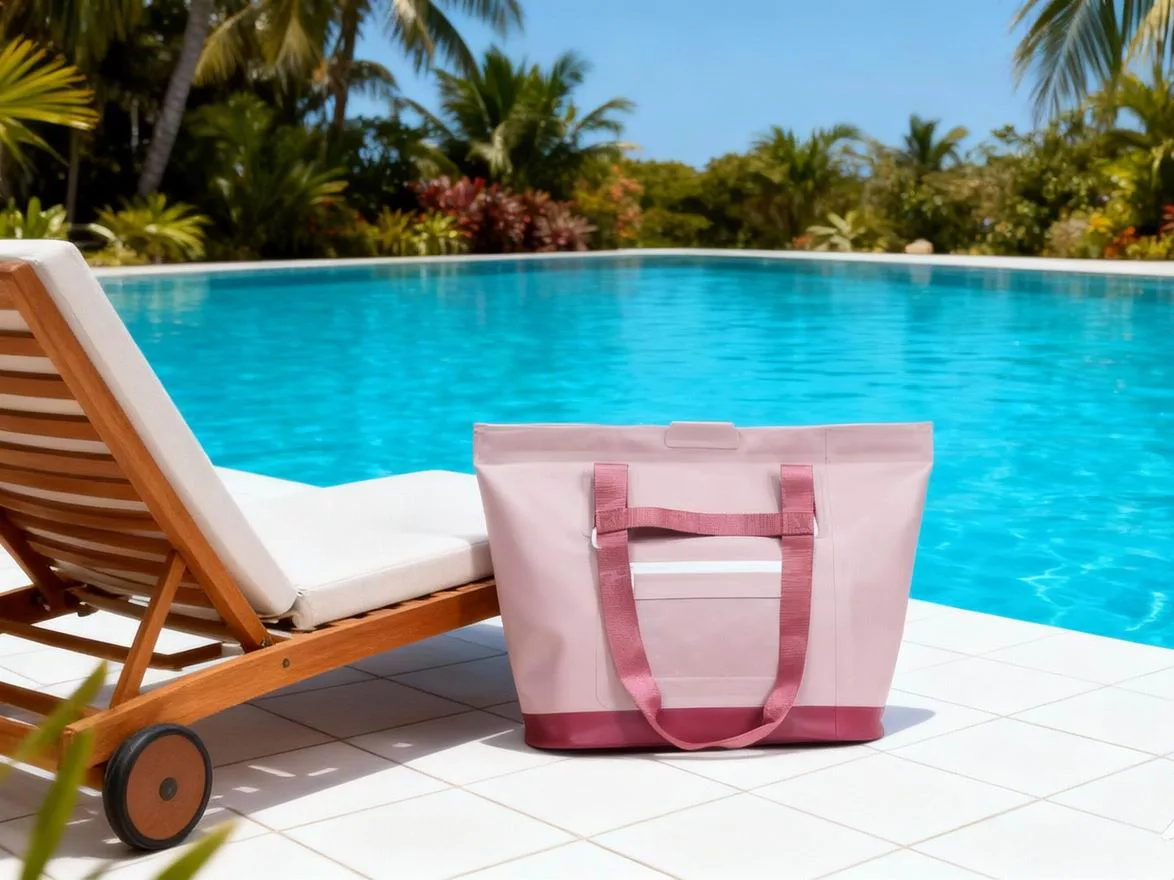
Damp kit costs volume as well as water, because a rolled damp bundle does not compress the way dry fabric does. A two-suit plus towel bundle occupies about 2.4 litres once rolled and sealed, against roughly 1.6 litres for the same items dry, and that gap is 8 percent of a 10 litre day bag. Size the outer shell with the pouch in mind rather than with the dry load alone.
Weight climbs by exactly the retained water: 300 millilitres is 300 grams, and a saturated cotton towel can add close to a kilogram before you start. That matters on airlines enforcing a 7 kilogram cabin allowance, and it is the reason a microfibre towel earns its place on any trip with a pool in it. The wider cabin arithmetic sits in cabin bag size and weight tips.
Choosing the wet pouch: film, mesh or lining fabric
Three materials compete and they behave very differently. A welded TPU pouch is genuinely watertight, weighs 45 to 70 grams in a 3 litre size, and holds every drop, which is ideal inside a bag that also carries a passport or a phone. A mesh pouch drains and breathes but leaks, so it only works inside a bag that is already wet or in a locker. A lining-fabric pouch is light and soft but wicks, so it becomes damp itself.
The decision rule is simple: if the pouch shares space with anything that must stay dry, use film; if it lives in a wet locker or hangs on a hook, use mesh. For a day that moves from pool to plane, film wins every time, because a leaking mesh pouch inside a cabin bag is the fastest route to a damp passport. Thickness matters too: a 0.3 mm film pouch is light enough for a beach tote, while a 0.5 mm film survives being sat on at a poolside bar.
| Pouch material | Weight in 3 L | Water held back | Drying time | Best situation | Main weakness |
|---|---|---|---|---|---|
| Welded TPU film | 55 g | 100% | Wipe dry, 30 s | Shared with dry kit | No airflow, needs wiping |
| Polyester mesh | 30 g | 0% | Air dries, 40 min | Locker or hook | Drips onto everything |
| Coated lining fabric | 40 g | 70% | 90 min | Short transfers | Wicks and stays damp |
| Silicone-coated nylon | 48 g | 95% | Wipe dry, 45 s | Gym bag insert | Coat wears at folds |
| Clear TPU with weld window | 62 g | 100% | Wipe dry, 30 s | Security and pool | Stiff when cold |
Odour and mildew: the clock that starts when you seal the bag
Mildew needs three things: moisture, a food source and warmth. A damp swimsuit supplies all three, because skin cells, body oils and sunscreen residue are the food, and a sealed bag at 28 degrees C is a greenhouse. Visible growth can appear on fabric within 24 to 48 hours under those conditions, and the sour smell arrives before anything you can see, usually around the 12-hour mark.
The practical limit is therefore a day, not a week. If you cannot dry the kit within 24 hours, at least open the pouch, spread the contents and let them breathe for an hour; that single step resets the clock. Guidance on indoor mould and moisture control from the EPA applies here as much as it does to a bathroom, and the same principle drives the drying advice in removing mildew from a dry bag.
| Elapsed time | Bag condition | What is happening | Action that still works |
|---|---|---|---|
| 0-2 h | Sealed, 28 C | Water redistributing | Nothing needed yet |
| 4-8 h | Sealed, warm | Bacteria multiplying | Open and air for 30 min |
| 12 h | Sealed, warm | Sour odour detectable | Rinse suit, dry both |
| 24 h | Sealed, warm | First visible spotting | Wash with mild detergent |
| 48 h | Sealed, warm | Mildew established | Full clean, treat shell |
| 72 h+ | Sealed, hot | Odour in the film itself | Deodorise the shell, retest |
Chlorine, salt and sunscreen: rinse order on the road
Rinse order matters because the three contaminants behave differently. Salt crystals are abrasive and hold moisture, so they come off first with fresh water and a 60-second soak. Chlorine is volatile and largely leaves with the water, but it leaves a smell bonded to elastane, so a second rinse with a drop of mild detergent helps at 30 degrees C. Sunscreen is oily and needs the detergent stage, not more water.
Do not use a hotel hairdryer on a swimsuit. Elastane loses recovery above about 60 degrees C and a hairdryer nozzle runs far hotter than that at close range, which is how a good suit ends up sagging at the leg openings after two trips. Air and time are safer: a suit hung over a shower rail in a room with the extractor running dries in roughly three hours, and one hung in a closed bathroom takes eight or more.

Hotel, gym and pool: three scenarios with real numbers
In a hotel room the winning sequence is shower-rail drying plus the extractor fan. Wring the suit, roll it in a microfibre towel, hang both on the rail with the towel spread rather than bunched, and run the fan for two hours. That combination removes roughly 90 percent of the remaining moisture and means the pouch goes into the bag genuinely dry the next morning.
A gym locker is harder, because there is no airflow and the bag may sit for six hours before you return. Use a film pouch, wring twice, and add a small dry microfibre cloth inside the pouch as a moisture buffer; it will pull another 10 to 15 millilitres out of the bundle and can be wrung out at home. A pool deck is the easiest case: the sun and the breeze will dry a suit in 40 minutes, so pack it only if you are leaving immediately.
| Scenario | Drying window | Best containment | Residual water after plan | Risk if ignored |
|---|---|---|---|---|
| Hotel room, overnight | 8-12 h | Microfibre roll plus rail | 10 ml | Odour by morning |
| Gym locker, 6 h | 0 h | Film pouch plus buffer cloth | 35 ml | Damp kit all day |
| Pool deck, same day | 40 min | Air dry, then pack dry | 5 ml | None if truly dry |
| Beach to airport, 3 h | 0 h | Wring, roll, film pouch | 40 ml | Soaked cabin bag |
| Hostel, shared room | 4 h | Pouch plus airflow break | 25 ml | Smell in shared space |
What must never share a bag with damp swimwear
Paper, electronics and anything with a leather or glue construction. A passport wetted at the edge wicks across the whole document page within minutes and will not recover its flatness; a phone in a damp pouch is at risk from condensation as much as from direct contact. Keep documents in a separate small welded sleeve, which is the subject of documents and passport protection.
Also keep protein-based snacks, powdered drink sachets and any medication out of the same compartment. Moisture plus food residue is exactly the combination that produces odour inside a film shell, and once a TPU bag smells, the cure takes days rather than minutes. The safe rule is two zones in every travel bag: a dry zone for paper, electronics and food, and a wet zone that holds nothing else.
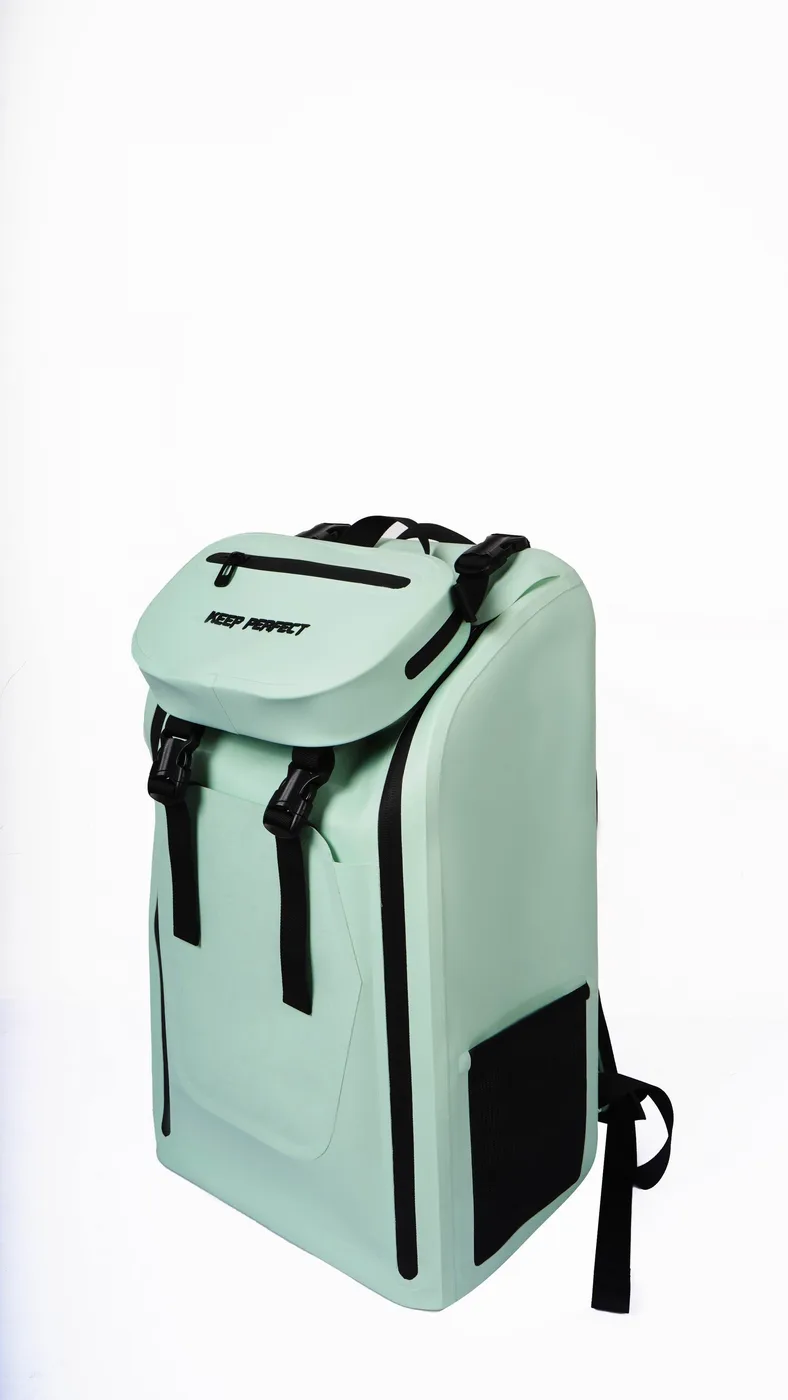
Drying the shell itself after a wet week
The dry bag needs attention too, not just its contents. Empty it completely, invert it over a rail or a towel, and wipe the inside with a microfibre cloth, paying attention to the two bottom corners where water pools in a flat-bottomed roll-top. Leave the mouth open and the buckle unclipped so air can circulate; a closed bag left in a cupboard is how an otherwise sound shell develops a smell of its own.
Dry in shade rather than sun. Film-laminated fabric tolerates ambient drying indefinitely, but direct sun on a wet interior raises the surface temperature well above ambient and accelerates hydrolysis in the adhesive layer over repeated cycles. Two hours of shade with the mouth propped open is enough for a 10 litre shell, and four hours for a 30 litre with a damp corner.
Odour control that does not damage the film
If a bag has already picked up a smell, work through the safe sequence before reaching for anything aggressive. Rinse with fresh water at ambient temperature, wipe with a bicarbonate solution at roughly 20 grams per litre, leave it open overnight, then reassess in the morning. Bicarbonate neutralises acidic odour compounds without attacking the film, and unlike vinegar it does not leave a smell of its own.
Bleach, solvent cleaners and machine washing all shorten the life of a welded shell, and a hot wash can delaminate a film edge in a single cycle. If the smell survives the bicarbonate stage, the problem is usually in a seam corner rather than across the whole panel, and the full step order is set out in deodorising a dry bag safely. Public health guidance on skin infections picked up in damp changing areas is published by the CDC.
A packing order that keeps the dry zone dry
- Wring the suit in sections, then press it flat between your palms.
- Roll it in an open microfibre towel and press three times with a forearm.
- Check the towel: if it is saturated, swap to a dry section and roll again.
- Seal the damp bundle in a welded film pouch sized to the load, not the wardrobe.
- Place the pouch low in the dry bag, flat side down, clear of the fold line.
- Pack the dry zone last, on top and away from the pouch, with paper in a separate sleeve.
- Set a 24-hour alarm: open the pouch and air the contents if you cannot dry them.
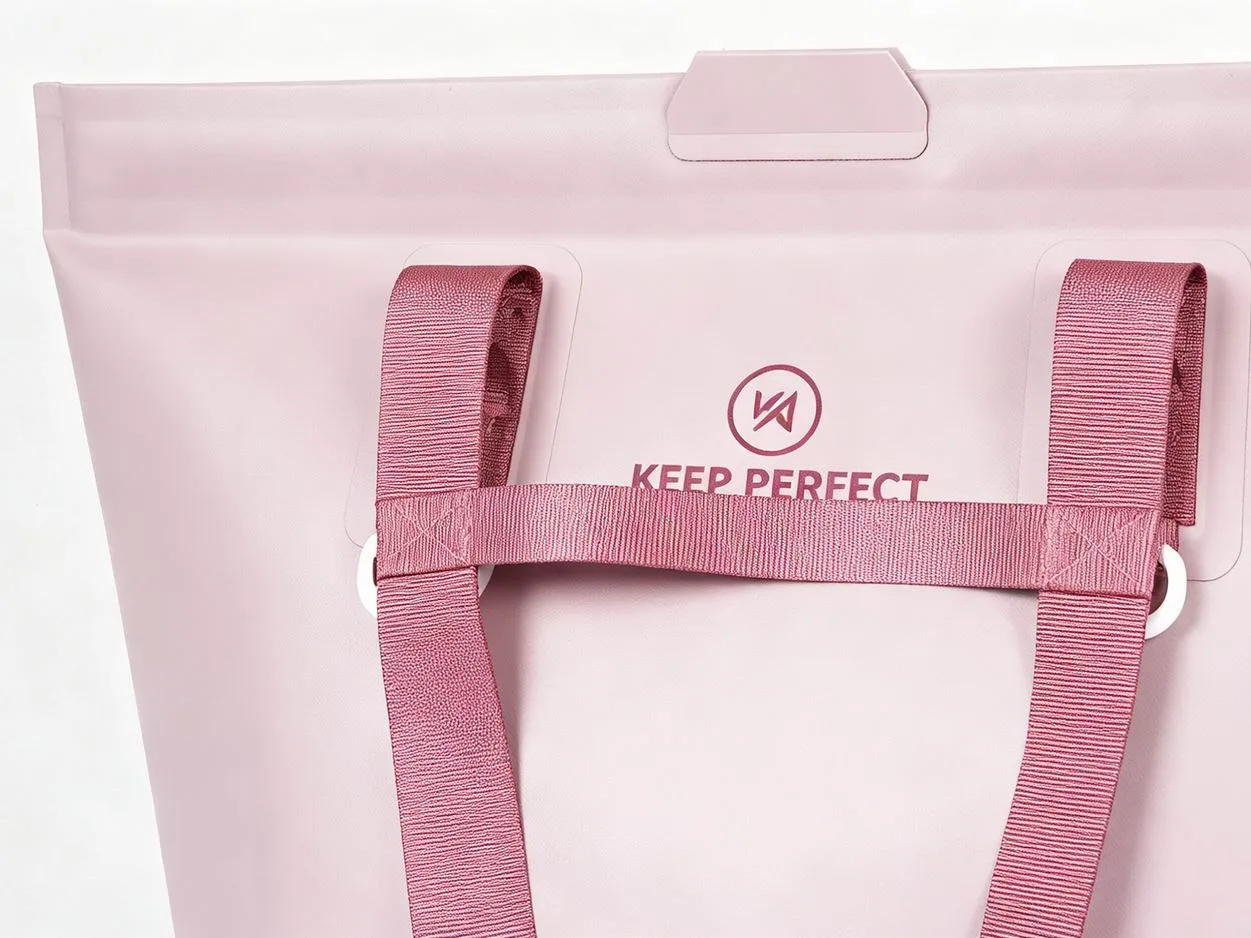
That order costs about four minutes at the pool and removes roughly 95 percent of the water that would otherwise migrate into the dry zone. It also makes unpacking predictable, because the wet pouch comes out first and goes straight to the rail while everything else stays where it is. Run it in the same sequence every time and it becomes automatic within three trips, and the buffer cloth is the piece people forget, even though it is the cheapest item in the whole system.
The 24-hour alarm is the step that rescues a trip when drying is impossible. Opening the pouch for an hour resets the mildew clock almost completely, and that one habit prevents most of the odour problems owners blame on the bag itself. Set the alarm on your phone the moment you seal the pouch, and do the same for the shell once you are home.
Buying checklist for a wet-kit setup
- One microfibre towel at 300 g/m2 per swimmer, sized at least 60 x 40 cm.
- A welded film wet pouch of 2 to 5 litres, with a closure you can work one-handed.
- A dry bag at least 5 litres larger than your dry load, so the pouch is not compressed.
- A separate small welded sleeve for passport, boarding pass and phone.
- Two colour-coded bags or pouches so the wet zone is obvious in a dark hotel room.
- A travel scale if you fly with a 7 kg cabin allowance and swim every day.
- A spare dry microfibre cloth to act as a moisture buffer inside the pouch.
Buy the pouch and the shell as one system rather than separately, because the pouch has to sit flat inside the bag without pushing against the fold. Sizes and formats across the full product line are built around that relationship, and the same two-zone logic is reused in poolside and aquapark kit and beach day organisation. A 3 litre pouch inside a 10 litre shell works well; the same pouch in a 5 litre shell does not, because the fold has to close over the pouch as well as over the load. Match the two once and the system keeps working for years.
If you are specifying this kit for a resort, a swim school or a retail programme, the brief is mostly about the pouch: film gauge, closure type, weld geometry and a colour that reads as wet-zone rather than dry-zone.
Frequently asked questions
Q1. How do you store a wet swimsuit without soaking your bag?
Wring it, roll it in a microfibre towel to pull out most of the water, then seal the damp bundle in a small welded pouch and keep that pouch inside the dry bag. Two stages: remove water first, contain what remains.
Q2. How much water does a wet swimsuit hold?
About 120 to 220 millilitres after a 30-second drip and roughly 55 to 95 millilitres after a firm hand wring. A lined training suit holds more than an unlined brief, and a cotton towel can hold over 900 millilitres.
Q3. Can you put a wet swimsuit in a dry bag?
Only inside a sealed inner pouch. A dry bag has no drain and no lining, so free water wicks through the whole load within about 20 minutes and the bag starts to smell within a day at 28 degrees C.
Q4. What size wet pouch do I need?
A 2 litre pouch covers one swimmer, a 3 to 5 litre pouch covers two suits and a microfibre towel. Size it to the damp load so the pouch stays flat inside the dry shell and clear of the fold line.
Q5. Is a mesh bag good for wet swimwear?
Mesh drains and dries quickly but leaks, so it works in a locker or on a hook and fails inside a bag that also holds dry clothing. Use film when the pouch shares space with anything that must stay dry.
Q6. How long can wet swimwear stay sealed?
Around 12 hours before smell and 24 to 48 hours before visible mildew at 28 degrees C. If you cannot dry it within a day, open the pouch and air the contents for an hour to reset the clock.
Q7. Does a dry bag keep water in as well as out?
Yes, which is exactly the problem with wet kit. A welded TPU shell holds every drop you seal inside it, so a wet item has to be wrung, rolled and contained before it goes in.
Q8. Should I wring a swimsuit hard?
No. Twist gently in sections and press between your palms. Elastane recovers from gentle twisting, but aggressive wringing breaks fibres at the hip seam and the suit loses shape within a season.
Q9. Can I use a hotel hairdryer on swimwear?
Avoid it. Nozzle temperature at close range exceeds the 60 degrees C where elastane loses recovery, and a sagging leg opening is permanent. Use a shower rail and the extractor fan instead.
Q10. How do I stop my bag smelling after a beach week?
Rinse with fresh water at ambient temperature, wipe with a bicarbonate solution at about 20 grams per litre, then dry open and in shade. Never machine wash or use bleach on a welded shell.
Q11. What should never share a bag with damp swimwear?
Passports and paper, phones and electronics, leather goods, and any food or medication. Keep documents in a separate welded sleeve and treat the bag as two zones: wet and dry.
Q12. How long does a swimsuit take to dry in a hotel room?
About three hours on a shower rail with the extractor running, and eight hours or more in a closed bathroom. Spread the towel open rather than bunching it and dry times roughly halve.
Q13. Do I need a special bag for wet kit?
A welded film pouch is the useful piece of kit. It weighs 45 to 70 grams in a 3 litre size, wipes dry in under a minute, and stops the 25 to 40 millilitres left after wringing from reaching dry clothing.
Q14. Does salt water change how I pack wet kit?
Yes. Salt crystals hold moisture and abrade fabric, so rinse with fresh water first, then deal with chlorine, then sunscreen last with a drop of mild detergent. Rinse order is salt, chlorine, oil.
Q15. Can I pack a damp towel in hand luggage?
Yes, but weigh it: 300 millilitres of retained water is 300 grams against a 7 kilogram cabin allowance, and a saturated cotton towel can add close to a kilogram. Use microfibre.
Q16. How do I dry a dry bag after a wet trip?
Empty it, invert it over a rail, wipe the inside with a microfibre cloth and pay attention to the two bottom corners. Leave the mouth open and the buckle unclipped, and dry in shade rather than direct sun.
People also ask
How do you pack a wet swimsuit for travel?
Wring it gently, roll it in a microfibre towel and press, then seal the bundle in a welded film pouch placed low in the dry bag. Keep paper and electronics in a separate sleeve.
Why does my gym bag smell after swimming?
Damp fabric sealed in a warm bag grows bacteria within 4 to 8 hours and mildew within 24 to 48. Air the contents within a day and wash the suit with mild detergent.
Can you put a wet towel in a dry bag?
Only inside a sealed inner pouch. A saturated cotton towel holds over 900 millilitres, and a dry bag has no drain, so all of that water stays in the shell and wicks through the load.
What is the best bag for wet swimming kit?
A welded TPU pouch of 2 to 5 litres used inside a larger dry bag. Film holds all the water and wipes dry in seconds; mesh only works when the pouch can drain freely.
How do you dry swimwear quickly while travelling?
Roll it in a microfibre towel and press, then hang both spread open on a shower rail with the extractor fan running. That combination removes about 90 percent of residual moisture in two hours.
Is it bad to leave a wet swimsuit in a sealed bag?
Yes. At 28 degrees C the load smells within 12 hours and shows mildew spotting within 24 to 48. Open the pouch and air the contents for an hour if you cannot dry them properly.
Need this in production volume?
QUANZHOU JUNYUAN BAGS has produced waterproof bags since 2014 in an SGS-verified 4,950 m2 facility in Fujian, China. Minimum order 500 pieces, sampling in 6–10 working days, bulk in 35–50 days, FOB Xiamen — write to service@junyuanbags.com with your spec and target market.