Home / Blog / Buying & Comparisons
20L vs 30L Dry Bag: Which to Buy
Choose 20L for a one or two day trip with a packed load of 4 to 7 kilograms, and 30L for three to five days, for winter bulk, or for any load that includes a sleeping bag at 7 to 12 kilograms. The 30 litre bag stands about 90 millimetres taller, weighs roughly 140 grams more empty, and costs 25 to 35 percent more, but the gap that actually decides it is usable volume: three folds leave about 16.5 litres in a 20L and 25.5 litres in a 30L.
This comparison works through the real numbers rather than the printed litre figure: external dimensions against hatch apertures and overhead bins, usable capacity after rolling, the weight each size puts on a carry, what the extra ten litres genuinely buys, and where the bigger bag becomes a liability. There is a decision matrix by trip profile and a five-minute test you can run at home with your own kit before spending anything.
- The decision in one line, and the number behind it
- Dimensions, empty weight and the aperture test
- Usable volume after three folds
- What a 20L actually holds, item by item
- What the extra ten litres really buys
- Where the 30L becomes a liability
- Closure, seams and hardware at each size
- Cost per litre, and cost per season
- Trip profiles: a decision matrix
- Carrying each size: harness, straps and load centre
- Fit checks for boats, racks and overhead bins
- A five-minute decision test you can run at home
- Which one to buy, stated plainly
The decision in one line, and the number behind it
If your typical trip is a single overnight or a long day with bulky kit, buy the 20 litre. If your typical trip is a long weekend, a week of moving between hostels, or anything with a synthetic sleeping bag and a stove, buy the 30 litre. The crossover point is a packed volume of about 16 litres of gear, which is the moment a 20L stops closing comfortably and a 30L starts earning its keep.
That 16 litre figure comes from the roll-top tax. Rolling a closure three times consumes roughly 3.5 litres on a 20L and about 4.5 litres on a 30L, so the printed number is never the packing number. Anyone who has bought a bag that was exactly the size of their kit will recognise the failure: the fold will not sit flat, the buckle fights you, and the seal is compromised by the very act of closing it.
Dimensions, empty weight and the aperture test
Capacity is printed in litres but fit is decided in millimetres, because every opening the bag has to pass through is a rectangle or an oval with fixed dimensions. A typical 20 litre roll-top is around 480 millimetres tall when packed and 230 millimetres in diameter, while a 30 litre is closer to 570 by 265. Those 90 millimetres are what decide whether the bag goes into a kayak day hatch or sits on the deck.
Measure the aperture before you buy, not after. Sea kayak day hatches commonly accept a 200 to 240 millimetre oval, so a loaded 20L slides in and a loaded 30L usually does not, however flexible the fabric. On the other side, a 30L fits the floor of a two-person tent vestibule and a 20L often gets kicked during the night. The relevant measurement is always the smallest hole on the route, which is usually a hatch or a locker, never the bag.

Usable volume after three folds
Three folds is the standard closure for immersion-grade sealing, and each fold takes a slice of the bag. On a cylindrical roll-top the loss runs at 16 to 18 percent of nominal capacity, so a 20L gives you about 16.5 usable litres and a 30L about 25.5. That nine litre difference is the entire argument for the bigger bag, and it is worth translating into objects rather than litres.
Nine litres is a synthetic sleeping bag, a compact stove and a two-day food bag, or a wetsuit plus a towel plus a shell jacket. It is also roughly the volume of a small camera cube. If none of those are ever in your load, the 30L is empty space that you will fill with things you did not need, and that is how a 30 litre bag ends up weighing 11 kilograms on a trip that needed seven.
| Measure | 20L roll-top | 30L roll-top | Difference | What it means |
|---|---|---|---|---|
| Nominal capacity | 20 L | 30 L | +10 L | Printed figure |
| Usable after 3 folds | 16.5 L | 25.5 L | +9.0 L | Real packing space |
| Packed height | 480 mm | 570 mm | +90 mm | Hatch and locker fit |
| Packed diameter | 230 mm | 265 mm | +35 mm | Aperture clearance |
| Empty weight, 0.5 mm TPU | 420 g | 560 g | +140 g | Always carried |
| Typical loaded weight | 4-7 kg | 7-12 kg | +3-5 kg | Shoulder and trim load |
What a 20L actually holds, item by item
List the load before you look at the bag. A summer overnight kit packs to about 14 litres: a 1.2 kilogram one-person shelter at 3.5 litres, a down bag in a compression sack at 4 litres, a sleeping mat at 2.5 litres, a change of base layer at 1.6 litres, a wash kit at 0.8 litres and a food bag at 2 litres. That fits a 20L with a little air left and closes with a clean flat fold.
Add a stove, a litre of water and a warm jacket and the same kit reaches 17 litres, which is past the comfortable limit of a 20L and still easy in a 30L. This is the pattern that catches people out: summer kit fits the smaller bag, shoulder-season kit does not, and one bag cannot honestly serve both. If your season runs from March to October, the 30L is the safer single purchase.
| Item | Packed volume | Weight | In a 20L with 16.5 L usable | In a 30L with 25.5 L usable |
|---|---|---|---|---|
| One-person shelter | 3.5 L | 1.2 kg | Yes, with room | Yes, easily |
| Down sleeping bag | 4.0 L | 0.9 kg | Yes | Yes |
| Synthetic sleeping bag | 9.0 L | 1.6 kg | Very tight | Yes |
| Inflatable sleeping mat | 2.5 L | 0.6 kg | Yes | Yes |
| Stove, pot and fuel | 2.2 L | 0.9 kg | Tight | Yes |
| Two days of food | 2.0 L | 1.4 kg | Yes | Yes |
| Five days of food | 5.0 L | 3.5 kg | No | Yes |
| Wetsuit and towel | 6.5 L | 2.8 kg | Tight | Yes |
Read that table as a whole and the pattern is clear: a 20L is a summer bag with discipline, and a 30L is a bag that tolerates a real season. The single item that forces the decision is the sleeping bag, because the five litre gap between a compressed down bag and a synthetic one is more than half the difference between the two sizes.

What the extra ten litres really buys
The honest answer is winter bulk, group kit and camera gear. A synthetic bag that fills 6 litres in summer fills 9 in shoulder season, a fleece adds 2.5, and gloves, hat and a shell add another litre and a half. Those three items alone are the difference between the two sizes, and they are the reason a 20L owner ends up strapping a second bag to the outside of their pack by October.
The other thing the extra volume buys is air. A bag packed to 85 percent closes with a clean, flat three-fold and seals reliably; the same bag packed to 100 percent bulges, and the fold creases across a curve instead of along a line. If you routinely stuff your bag to the top, the 30L will keep more of your gear dry than a 20L ever can, because closures fail on geometry long before fabric fails.
Where the 30L becomes a liability
Three places: open boats, aircraft cabins and your back. On a sit-on-top kayak or a canoe with a small hatch, a 30L is simply the wrong shape, and paddlers who buy one end up carrying it loose where it can shift. In a cabin, a packed 30L is often taller than the sizer frame at the gate and too bulky for the under-seat space on a narrow-body aircraft, whereas a 20L usually passes.
Then there is the weight discipline problem. Extra volume gets filled. Field notes from rental fleets show the same pattern every season: give a paddler a 30 litre bag for a two-day trip and the average packed weight rises by 2.5 to 4 kilograms against the same trip with a 20 litre, with no measurable gain in comfort. Waterproof volume is not free, because you carry everything you pack for every kilometre of the trip.
Closure, seams and hardware at each size
The closure geometry does not change with size, and that is deliberate: a 20L and a 30L from the same range share a collar, a buckle and a fold count, so muscle memory transfers and a fleet can standardise. What changes is the load on the hardware. A full 30L puts roughly 12 kilograms against the shoulder strap and the side D-rings, against 7 for a full 20L, and that is the number the webbing and weld points are specified against.
Look for the same three things at either size: a welded collar band rather than a sewn one, side release buckles rated above the loaded weight by a factor of three, and D-rings welded to the body rather than stitched to a patch. Film gauge matters more on the bigger bag, because a 30L holdall carries tools and cans and gets dragged; 0.5 mm TPU is the sensible floor at 30 litres, where 0.3 mm is acceptable at 20.
Cost per litre, and cost per season
Price does not scale with volume. A 30 litre bag typically costs 25 to 35 percent more than the 20 litre in the same range, which means the cost per usable litre actually improves: roughly 1.9 currency units per litre at 30L against 2.4 at 20L on a mid-range TPU build. If you will genuinely use the space, the bigger bag is better value before you even count the seasons.
Service life is where the argument settles. A 0.5 mm TPU bag with welded seams lasts five to ten years of weekend use with a rinse after every trip, so the difference between the two sizes amortises to a few currency units per year. Buying the 20L to save money and then buying the 30L a year later is the only expensive route, and it is the most common one.
| Cost line | 20L | 30L | Comment |
|---|---|---|---|
| Indicative price band | 1.00 x | 1.30 x | Bigger is not proportionally dearer |
| Cost per usable litre | 2.4 | 1.9 | 30L wins if the space is used |
| Service life, weekend use | 5-10 years | 5-10 years | Same film, same seams |
| Cost per season, 8 years | Low | Lower per litre | Amortised gap is small |
| Replacement risk | Outgrown in year 1 | Rarely outgrown | The expensive mistake |
| Resale or hand-me-down value | Moderate | Higher | Bigger bags move faster |
Trip profiles: a decision matrix
Map your own season before you decide, and weight the matrix by frequency rather than by ambition. One five-day expedition in three years does not justify a 30L if eleven weekends a year are day trips. Conversely, four long weekends a year make the smaller bag a false economy, even if most of your other trips are short. Write down the last twelve trips rather than the one you are planning, and the answer usually becomes obvious within a minute.
There is a third option for anyone whose season genuinely splits: a 20L plus a 10L. Two bags weigh about the same as one 30L, pack more flexibly into awkward hatches, and give you redundancy, because a single failed closure only ever risks part of the load. The trade-off is two things to keep track of and slightly more time spent packing at the car.
| Trip profile | Packed volume | Loaded weight | Recommended | Why |
|---|---|---|---|---|
| Long day paddle or hike | 8-12 L | 3-5 kg | 20L | Room to fold, easy carry |
| Summer overnight | 13-15 L | 4-6 kg | 20L | Closes flat at 85% fill |
| Shoulder-season weekend | 16-20 L | 6-9 kg | 30L | Winter bulk does not fit 20L |
| Three to five days | 20-26 L | 7-12 kg | 30L | Sleeping bag plus stove plus food |
| Canoe or raft, group kit | 24-30 L | 9-14 kg | 30L | One bag per two people |
| Carry-on travel | 12-18 L | 4-7 kg | 20L | Cabin sizer and under-seat fit |
Carrying each size: harness, straps and load centre
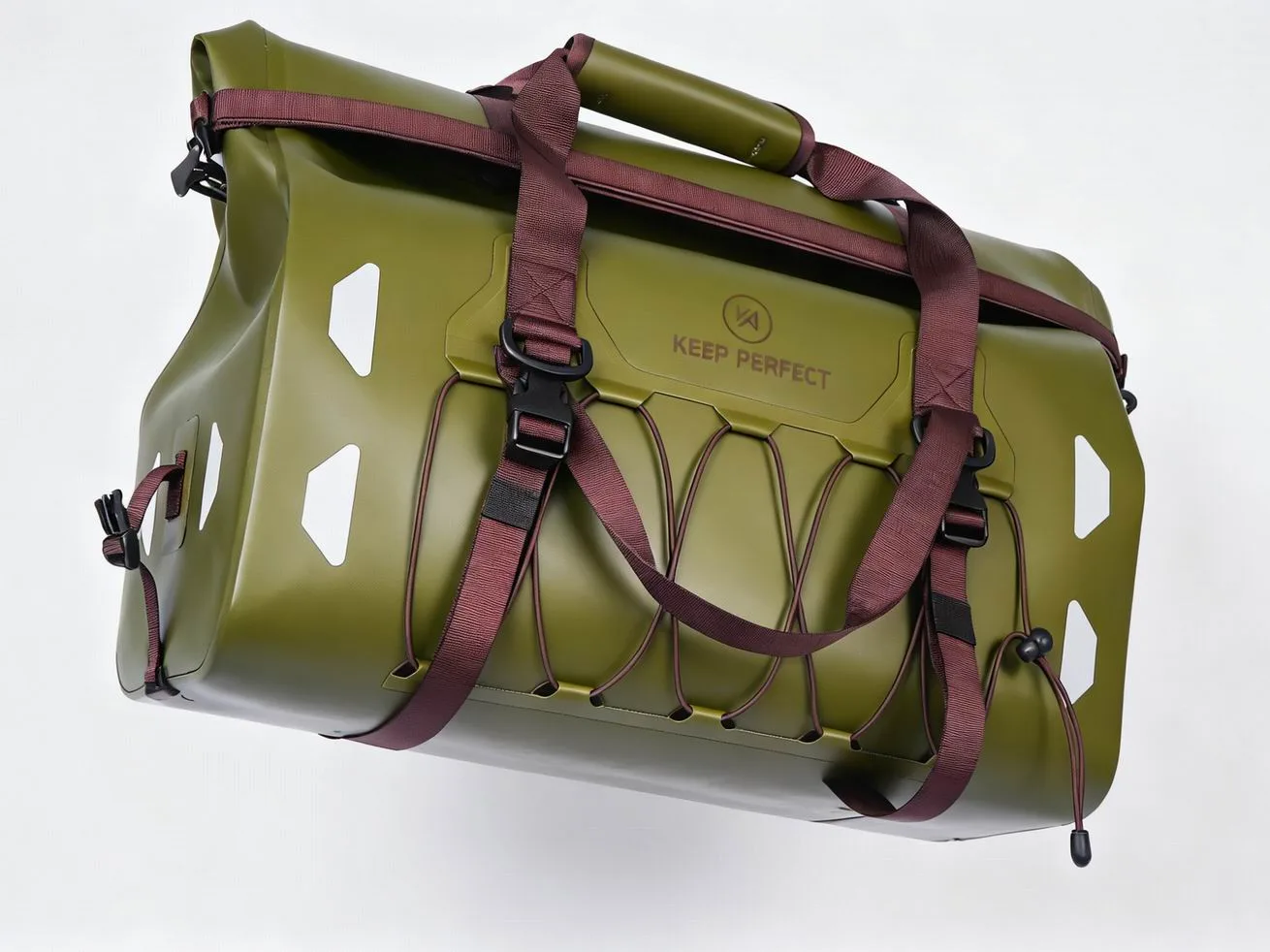
A 20 litre bag is a shoulder-sling object: single strap, one hand on the mouth, and you can carry it for 800 metres without thinking about it. At 30 litres and 10 kilograms, a single strap is uncomfortable after 400 metres and genuinely bad for your shoulder after two kilometres, because the load hangs off-centre and the bag swings with every step.
If you buy the 30L, buy it with a harness or a duffel strap arrangement that puts the load centre close to your spine, and check that the strap anchor is welded rather than sewn. Padded straps help, but geometry helps more: a bag carried high and close at 10 kilograms feels lighter than the same bag carried low and loose at 7. Our backpack versus duffel comparison covers the same trade-off in more detail.
Fit checks for boats, racks and overhead bins
Weight distribution matters as much as dimensions once the bag is loaded. A 30L with 10 kilograms inside needs to sit against your back rather than hang from a shoulder, and the difference between a well-placed and a badly-placed load at that weight is the difference between a comfortable two kilometres and a sore shoulder by the first gate. Check that the strap anchor sits at or above the load centre, not below it.
Three measurements decide everything, and they take five minutes with a tape measure. First, the smallest hatch or aperture on your route. Second, the height of the locker, bin or frame the bag must sit in. Third, the distance from your shoulder to the ground when the bag is carried, because a 570 millimetre bag on a short torso drags on steep ground.
Canoe trippers should measure between the thwarts, since a 30L dropped between two thwarts at 600 millimetres spacing stays put nicely, while the same bag in a kayak hatch will not go in at all. Cyclists should measure rack top to pannier hook, and flyers should check the airline sizer, which is typically 550 by 400 by 200 millimetres for a cabin bag. Our roll-top dry bag range lists packed dimensions for every size rather than litres alone.
A five-minute decision test you can run at home
- Pile up the kit from your most frequent trip, not your most ambitious one.
- Pack it into a cardboard box and measure the pile in litres using a tape and arithmetic.
- Add 15 percent for fold room and for the day you carry more water than planned.
- If the total is under 16 litres, buy the 20L; if it is over, buy the 30L.
- Check the result against the smallest aperture on your route, then buy the smaller bag that passes.
Run the test twice, once for summer and once for shoulder season, and let the larger answer decide. Buyers who run this test rarely return a bag, and buyers who skip it usually own both within eighteen months. For a fuller walk through the volume arithmetic, see how dry bag capacity is measured. Mark the summer line and the shoulder line on the box so the next person in the household can reuse the measurement instead of guessing again next season.
The third number worth writing down is packed weight, because airlines and shoulders both respond to kilograms rather than litres. Weigh the box on a bathroom scale with the kit inside and compare it with the allowance you actually travel under. If the summer load comes out at 5 kilograms and the shoulder load at 9, buy for 9 and simply pack light in July.
Which one to buy, stated plainly
Buy the 20L if your trips are one or two days, if your kit list is summer-weight, if you paddle a sit-on-top or fly with carry-on only, or if the bag has to disappear into a hatch or a locker. Buy the 30L if your trips run three days or longer, if a synthetic sleeping bag or a wetsuit is always in the load, if you carry group or family kit, or if you routinely pack to the top of whatever bag you own.
When both descriptions apply, buy the 30L and pack it to 85 percent. An under-filled big bag closes cleanly, floats well and carries comfortably; an over-filled small bag does none of those things, and no amount of careful rolling fixes a fold that has to bend around a bulging load. Volume you do not use costs 140 grams; volume you do not have costs you a dry sleeping bag.
For clubs, rental fleets and retail ranges the same logic becomes a spec decision: standardise on the 30L as the default and the 20L as the day option, because the 20L is the size that gets outgrown. Our team has produced waterproof bags since 2014 in an SGS-verified 4,950 m2 facility with 7 production lines and a 500-piece minimum, sampling in 6 to 10 working days and bulk in 35 to 50 days.Ratings language on both sizes follows ISO definitions, and abrasion and coating test methods referenced in a brief usually come from ASTM. Further sizing detail sits in what fits in a 20L bag, what fits in a 30L bag and the full product line.
Frequently asked questions
Q1. Should I buy a 20L or a 30L dry bag?
Buy 20L for one or two days with a packed volume under 16 litres, and 30L for three days or more, winter bulk or a sleeping bag. A 30L gives 25.5 usable litres against 16.5 for the 20L.
Q2. How much usable space does a 20L dry bag really have?
About 16.5 litres once the top is rolled three times, because the folds consume roughly 3.5 litres. Pack to 85 percent of that, around 14 litres, and the closure stays flat and reliable.
Q3. Is a 30L dry bag too big for a kayak?
Usually yes for a day hatch, which commonly accepts a 200 to 240 millimetre oval. A packed 30L is about 570 millimetres tall and 265 millimetres across, so it tends to travel on the deck or in a canoe instead.
Q4. How much more does a 30L dry bag weigh?
About 140 grams empty for the same 0.5 mm TPU build, 420 grams against 560 grams. Loaded, the difference is much larger: 7 to 12 kilograms against 4 to 7.
Q5. Does the bigger bag cost much more?
Around 25 to 35 percent more, which works out cheaper per usable litre: roughly 1.9 against 2.4 for the 20L. Over an eight-year service life the amortised gap between the two is very small.
Q6. What fits in a 20L bag that will not fit in a 10L?
A full summer overnight kit: a one-person shelter, a down sleeping bag, a mat, a base layer, a wash kit and two days of food, at roughly 14 litres packed.
Q7. Can I take a 30L dry bag as cabin luggage?
Often it is too tall. Cabin sizers run around 550 by 400 by 200 millimetres, and a packed 30L is close to 570 millimetres tall, so a 20L is the safer carry-on choice.
Q8. Is one 30L better than a 20L plus a 10L?
For flexible packing, two bags win: they fit awkward hatches, split the load and give redundancy if one closure fails. For simplicity and cost, one 30L wins. Most mixed seasons suit the pair.
Q9. What film thickness should I choose at 30L?
0.5 mm TPU. A 30 litre bag gets dragged, sat on and filled with hard objects, and 0.3 mm film is a deck-bag specification rather than a holdall specification.
Q10. Do both sizes use the same closure?
Yes, in a coherent range. The collar, buckle and three-fold count are shared across 20L and 30L so muscle memory transfers and a club can standardise on one system.
Q11. How heavy is a full 30L dry bag?
Typically 7 to 12 kilograms depending on contents, against 4 to 7 for a full 20L. That is the number to check against strap ratings and against your own carrying comfort over two kilometres.
Q12. Will a 30L bag float better than a 20L?
It has more potential buoyancy because it traps more air, but a tightly packed 30L with the air pressed out can still sink. Neither size is a buoyancy aid, and neither replaces a life jacket.
Q13. Which size suits a canoe trip?
The 30L. It drops between thwarts spaced around 600 millimetres, carries group kit for two people, and holds the bulky items a canoe trip always accumulates: a wetsuit, a stove and a food barrel.
Q14. Which size suits carry-on travel?
The 20L. It fits under-seat space on narrow-body aircraft, keeps a laptop sleeve and a spare layer at about 12 to 15 litres, and stays within cabin weight allowances with room to spare.
Q15. What is the biggest mistake buyers make between these two sizes?
Buying the 20L to save money and then outgrowing it in the first season. Winter bulk, a sleeping bag and a stove add roughly nine litres, which is exactly the gap between the two.
Q16. Should I size up for safety margin?
Yes, but only once. A bag packed to 85 percent seals, floats and carries well, while one packed to 100 percent bulges and folds badly. Sizing up gives you that margin; sizing up twice gives you ballast.
People also ask
How do you choose between two dry bag sizes?
Measure the kit from your most frequent trip, add 15 percent for fold room, and compare it with the usable capacity of each size after three folds. Then check the smallest aperture on your route.
Is a 30L dry bag too big?
It is too big for a kayak day hatch, a cabin sizer and any trip where discipline slips, since extra volume tends to get filled. It is right for three days or more, winter kit and group loads.
What fits in a 20L dry bag?
About 14 litres of real kit: a compact shelter, a down bag, a mat, a base layer, a wash kit and two days of food. Adding a stove, a litre of water and a warm jacket pushes it past the comfortable limit.
How heavy is a 20L dry bag?
About 420 grams empty in a 0.5 mm TPU build, and 4 to 7 kilograms loaded. The 30 litre version weighs roughly 560 grams empty and 7 to 12 kilograms loaded.
Are bigger dry bags better value?
Per usable litre, yes: cost runs at about 1.9 per litre at 30L against 2.4 at 20L on a comparable build. The value only holds if you actually use the space rather than fill it.
Can you use a 30L dry bag for carry-on?
Sometimes, but it is close to the limit. A packed 30L is around 570 millimetres tall against a typical 550 millimetre sizer, so a 20L is the safer choice for flights.
Need this in production volume?
QUANZHOU JUNYUAN BAGS has produced waterproof bags since 2014 in an SGS-verified 4,950 m2 facility in Fujian, China. Minimum order 500 pieces, sampling in 6–10 working days, bulk in 35–50 days, FOB Xiamen — write to service@junyuanbags.com with your spec and target market.