Home / Blog / Buying & Comparisons
Dry Bag Backpack vs Dry Duffel
A 20L dry bag backpack and a 20L dry duffel carry the same nominal volume but behave completely differently after the first 400 metres. The backpack moves roughly 70% of an 8 kg load onto the hips, which is why it stays comfortable out to 3 km, and it costs you 12 to 20 seconds to open and close a roll-top from your back. The duffel opens in three seconds, holds 8 to 10% more usable volume because its closure eats less of the length, and becomes unpleasant on the shoulder after about 500 metres at 8 kg. Buy the backpack if you walk to the water; buy the duffel if a vehicle, a boat or a raft does the carrying.
The comparison below runs on measurable differences rather than impressions: empty weight, usable litres after the closure is rolled, access time with wet hands, strap load limits, abrasion patterns and cost per usable litre. Both shapes use the same welded TPU construction and the same closure families in a good range, so the decision is really about geometry, carry distance and how often you need to get into the bag during the day.
- Where each shape wins, stated plainly
- Carry geometry: spine length, load centre and hip transfer
- Opening geometry and access time
- Closure behaviour under pressure
- Usable litres versus stated litres
- Empty weight and packed density
- Straps, handles and the retrofit problem
- Where each shape wears out first
- Fit with boats, racks, vehicles and overhead bins
- Cost per usable litre
- A decision matrix by trip profile
- When the honest answer is one of each
Where each shape wins, stated plainly
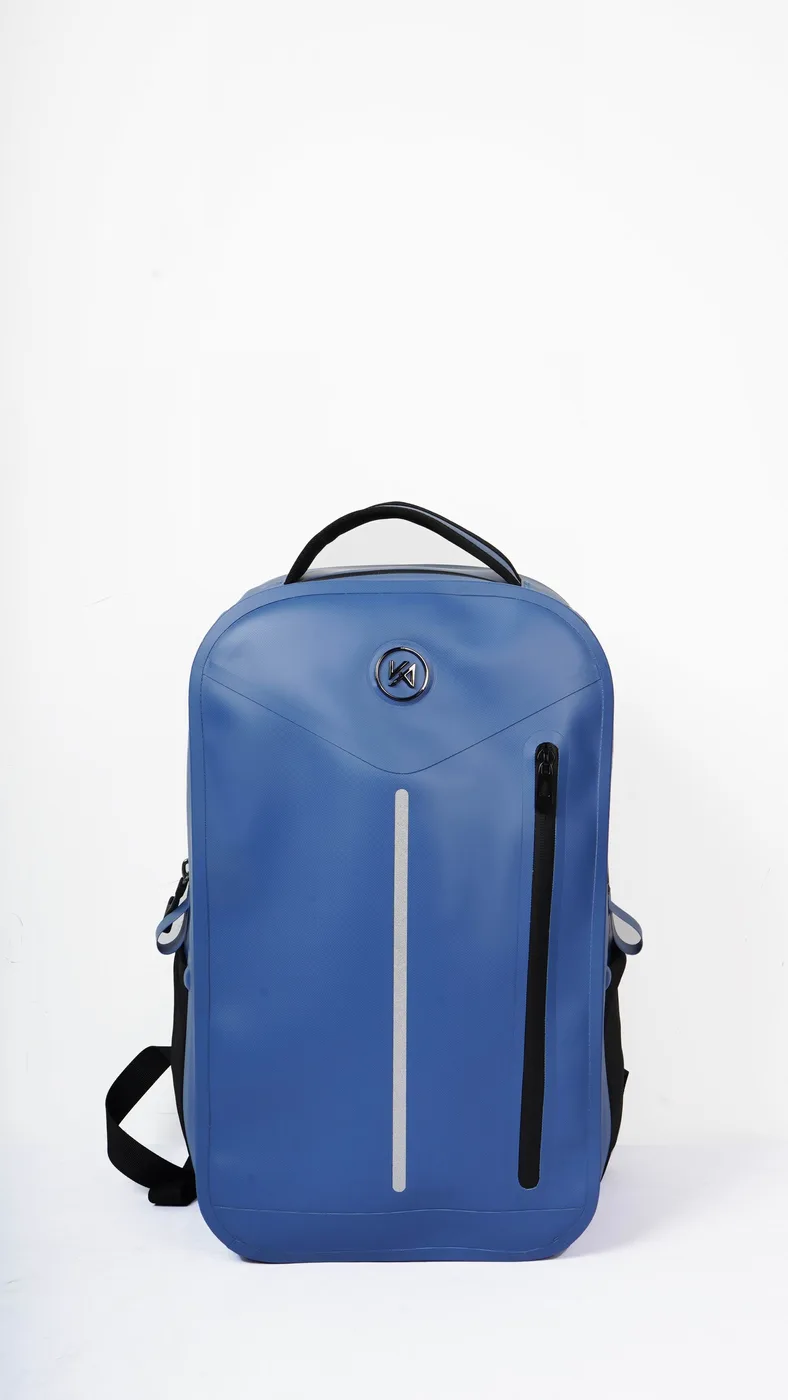
A dry bag backpack exists to move a load on your body. Its harness transfers weight to the pelvis, its centre of mass sits close to your spine, and its volume is distributed vertically so a tall narrow load does not swing. That makes it the correct choice for a walk-in campsite, a 2 km portage, a bike commute, or any trip where the bag is on your back for more than ten minutes at a time.
A dry duffel exists to move a load efficiently and to be opened often. Its rectangular cross-section packs tighter than a cylinder, its long opening gives access to everything at once, and it stacks flat in a hull, a raft bay or a vehicle boot. It is the correct choice for rafting, sailing, car camping, dive boats and any trip where the bag is set down for hours and then emptied in one go.
The overlap zone is real but narrow: a walk of under 300 metres with a load under 6 kg, opened twice a day. In that band either shape works, and the tie-breaker should be what else you own. If you already carry a daypack, a duffel complements it; if you carry a holdall, a waterproof backpack adds a capability you do not have.
Carry geometry: spine length, load centre and hip transfer
Comfort is mostly a load-centre problem. A backpack that keeps its centre of mass within 100 mm of the spine at shoulder height lets the pelvis take most of the weight through a properly fitted hip belt; a duffel carried on one shoulder puts the centre of mass 250 to 350 mm lateral to the spine, which forces the obliques and the trapezius to work continuously to keep the torso upright.
The practical consequence is a distance limit rather than a weight limit. At 8 kg, most people can shoulder-carry a duffel for about 500 m before the neck and the opposite hip start to complain; the same 8 kg in a backpack with a hip belt is comfortable for 2 to 3 km. Switching shoulders every 150 m buys another few hundred metres but does not change the ratio.
| Carry mode | Load centre offset | Comfortable distance at 8 kg | Muscles doing the work | Failure sign |
|---|---|---|---|---|
| Backpack, hip belt fitted | 60-100 mm | 2-3 km | Legs and pelvis | Hot spots on the hips |
| Backpack, straps only | 100-150 mm | 800 m - 1 km | Trapezius and deltoids | Shoulder strap pressure |
| Duffel on one shoulder | 250-350 mm | 400-500 m | Obliques and neck | Neck and opposite hip ache |
| Duffel by the handles | 150-200 mm | 200-300 m | Forearm and grip | Grip fatigue |
| Duffel crossbody | 180-240 mm | 600-800 m | One shoulder girdle | Strap dig at the neck |
Opening geometry and access time
Access is where the duffel wins outright, and the margin is larger than most people expect. A roll-top backpack has a single opening at the top: reaching a first-aid pouch at the bottom of a 30L bag means unloading the top two-thirds or fishing blind for 20 to 40 seconds. A duffel with a long end-to-end opening presents the entire contents at once, and a specific item takes 3 to 5 seconds to identify and remove.
Backpacks have improved here. A side zip access panel, a front pocket, or a lid compartment turns a 30-second dig into a 6-second reach, at the cost of one extra seam and roughly 120 g. If your bag is opened more than ten times a day, that seam is worth having; if it is opened twice, it is a leak path and dead weight. The trade-off is set out in more detail in the roll-top versus zipper comparison.
| Action | Roll-top backpack | Dry duffel | Bucket style | Notes |
|---|---|---|---|---|
| Identify a mid-depth item | 20-40 s | 3-5 s | 5-8 s | Backpack needs unloading |
| Open fully, dry hands | 8-12 s | 3 s | 5 s | Roll-top needs three folds undone |
| Close and seal properly | 15-20 s | 12-15 s | 8 s | Rolling takes longer than clipping |
| Grab a top-layer item | 10 s | 3 s | 5 s | Backpack lid pockets help |
| Repack from empty | 60-90 s | 40-60 s | 50 s | Rectangular duffel packs tighter |
Closure behaviour under pressure
Both shapes rely on the same closure families, but the geometry changes how they behave when immersed. A roll-top on a backpack is a horizontal fold across a narrow width, so the seal line is short and the buckle sits clear of the load. A duffel roll-top runs along the length, which doubles the seal line and adds two corners where the film must turn; corners are where a poorly executed roll leaves a channel.
That is a manageable difference, not a defect. A duffel rolled with three full folds and clipped at both ends performs to the same IPX7 level as a backpack, and its longer closure is more forgiving of a slightly overfilled load because the fold has more length to distribute the bulge. What it is less forgiving of is an uneven load: a hard object under one corner of a long fold will lift that corner, so dense items go in the middle of a duffel rather than at the ends.
Seam count matters too. A simple backpack has two side welds, a base weld and a harness attachment; a duffel with detachable straps adds four to six strap anchor welds. Every anchor is a tested joint, but more joints means more places to inspect. Look for anchors that are welded as a wide patch rather than a narrow tab, and pull-test them at 20 kg before you trust them with a real load.
Usable litres versus stated litres
Stated capacity is measured on an open bag, and both shapes lose volume to their closure. A roll-top backpack loses 2.5 to 4 litres on a 20L and 4 to 6 litres on a 40L, because the fold consumes height that a duffel takes from its length instead. A duffel loses about 8 to 10% of nominal volume, which on a 40L is 3 to 4 litres and still leaves more usable space than an equivalent backpack.
Shape efficiency is the second factor. A rectangular duffel packs to around 88% efficiency with soft items; a cylindrical backpack packs to about 78%, because the curved walls leave unusable crescents at the top and bottom. Combine the two effects and a 40L duffel genuinely holds 32 to 34 litres of kit where a 40L backpack holds 27 to 29 litres, which is a full day of extra clothing.
| Nominal size | Backpack usable volume | Duffel usable volume | Difference | What the difference buys |
|---|---|---|---|---|
| 20L | 15.5-17 L | 17.5-18.5 L | +2.5 L | A light shell and a towel |
| 30L | 23-26 L | 26-28 L | +3 L | A sleeping bag liner |
| 40L | 33-35 L | 36-38 L | +3 L | A two-person cook kit |
| 60L | 50-53 L | 54-57 L | +4 L | A winter bag and a stove |
| 90L | 76-80 L | 82-86 L | +6 L | Group food for three days |
Empty weight and packed density
Empty weight is the number most buyers ignore and then regret. A 40L dry backpack with a padded harness weighs 1.1 to 1.4 kg empty; a 40L duffel with detachable straps weighs 900 g to 1.1 kg; a stripped duffel with only carry handles weighs 700 to 850 g. On a flight with a 10 kg cabin allowance that 300 to 500 g difference is half a camera body.
Weight matters differently by activity. On a raft or a sailboat, empty weight is irrelevant and durability dominates. On a 12 km walk-in, 400 g of harness is a fair trade for hip transfer. On a flight, every gram counts twice, once against the baggage allowance and once against your shoulder in a terminal. Decide which of those three situations describes 80% of your trips before you look at a spec sheet.
The split is easy to see at 40L. Body and welds are close to identical at around 600 to 620 g, since both shapes use a similar area of film. The harness adds 480 g against 180 g for a set of detachable duffel straps, and a hip belt adds another 160 g that the duffel simply does not carry. Hardware is the one line where the duffel is heavier, at 110 g against 90 g, because lash points along a long body are more numerous than on a narrow one.

Straps, handles and the retrofit problem
Straps are the most common disappointment in this comparison. A duffel sold with detachable backpack straps is not a backpack: the anchor points sit lower and wider than a real harness, the load centre ends up further from the spine, and the straps dig at 8 kg in a way a purpose-built harness does not. Detachable straps are excellent for a 300 m walk to a boat and poor for anything longer.
Retrofitting in the other direction is also imperfect. Adding a harness to a bag that was never designed for one puts load into welds that were sized for handles, and the result is usually a strap anchor that peels after a season. If you need both, buy a backpack for the walking trips and a stripped duffel for the vehicle ones; two well-matched bags cost less over five years than one compromise that does neither job properly.
Strap width is a useful proxy for quality. A 40 mm webbing strap spreads an 8 kg load over enough area to stay comfortable for an hour; a 25 mm strap at the same load produces visible pressure marks in 20 minutes. On the duffel side, look for a wrap-around handle with a Velcro closure rather than two loose grab handles, because a joined handle halves the grip effort on a 12 kg bag.
Where each shape wears out first
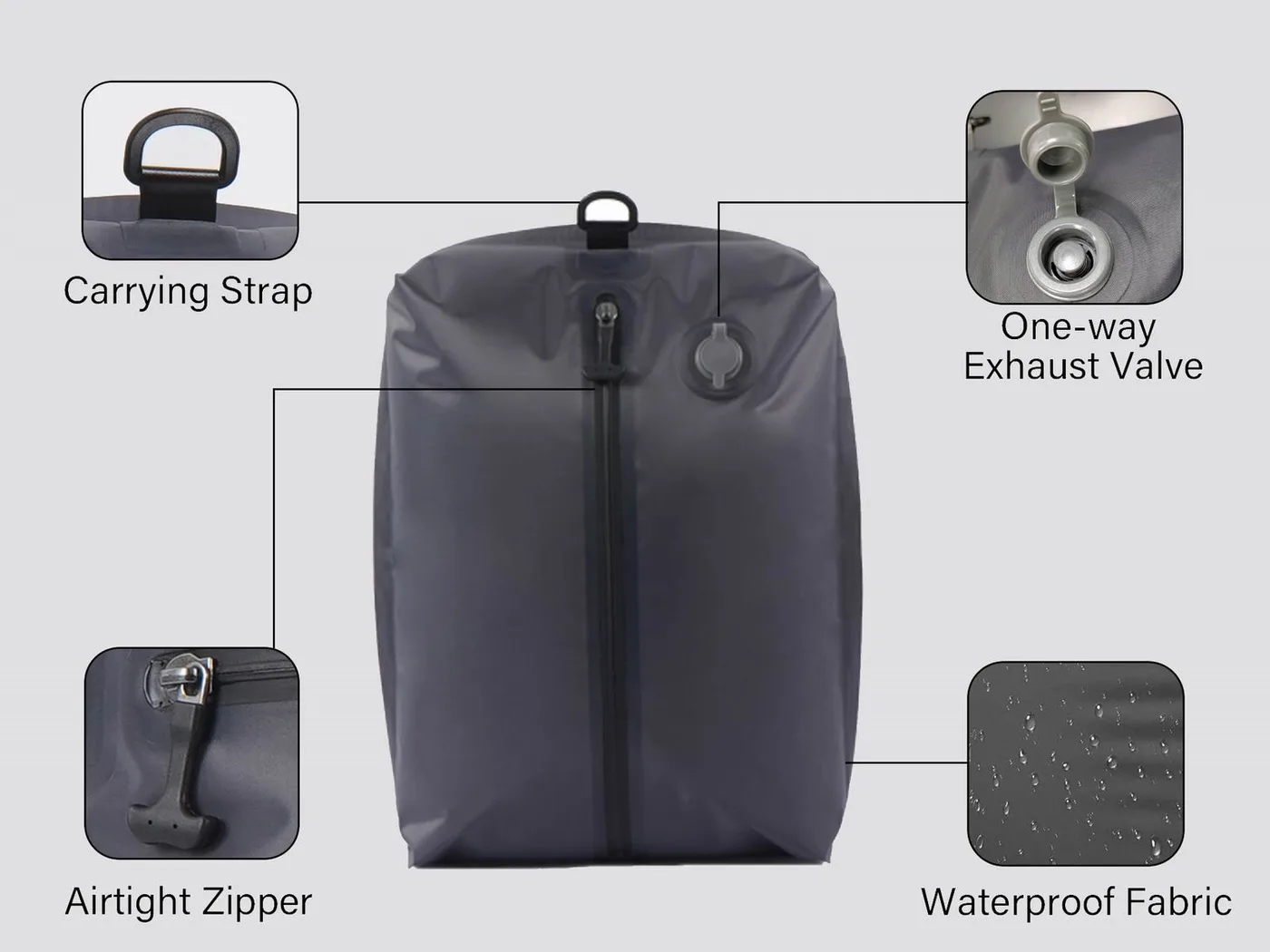
Failure patterns differ because contact patterns differ. A backpack wears at the base corners, where it is set down hundreds of times a season, and at the top of the shoulder straps, where webbing rubs the film on every step. A duffel wears along the bottom edge, which is dragged rather than set down, and at the corners of the long closure, where the fold flexes most often.
Abrasion resistance is measurable, and the comparison should be made on the same test rather than on feel. Ask for a rub or abrasion cycle figure from a recognised method published by ASTM, and treat anything below 4,000 cycles as a bag for occasional use. A 0.5 mm TPU film handles both wear patterns well; a 0.3 mm film will show through at the corners of a 40L duffel inside two seasons of raft use.
Timing differs as well. Shoulder strap rub shows on a backpack after one to two seasons, because webbing polishes the film on every step, while base corner scuffing arrives at two to three seasons as grey marking that eventually becomes pinholes. On a duffel the sequence is reversed: the dragged bottom edge and the end corners go first at two to four seasons, and the closure fold whitens at three to four seasons where a backpack fold might last longer.
Hardware fails on the same schedule in both shapes, and for the same reason. Salt crystals left in a buckle for a winter will make it slip under load by the following spring; the same buckle rinsed after every trip still holds tension after five years. Rinse, work the mechanism through its full travel while wet, and let it dry before storage.
Fit with boats, racks, vehicles and overhead bins
Compatibility with the thing carrying you is often decisive and rarely discussed. An oval sea kayak hatch takes a soft cylindrical bag far better than a rectangular duffel, because the duffel corners jam against the hatch rim. A raft frame bay, by contrast, is a rectangle and wastes 15 to 20% of its volume around a cylinder. A bike rear rack wants two soft panniers; a car boot wants flat rectangular shapes that stack.
Air travel sits in the middle. A 40L backpack fits under a seat and satisfies most cabin dimension rules without argument; a 40L duffel is usually within the same limits but is more likely to be challenged on a soft-sided dimension gauge because its corners hold their shape. If you fly with the bag more than twice a year, the backpack is the lower-friction choice.
Cost per usable litre
Price per litre is the wrong metric; price per usable litre is the right one, and it flips the ranking at some sizes. A 40L backpack at a given price gives 33 to 35 usable litres; a 40L duffel at a similar price gives 36 to 38 litres and a simpler bill of materials. At the premium end the gap narrows, because a good harness costs real money and a duffel with welded strap anchors is not cheap to build either.
The better question is cost per trip. If a backpack saves you a second bag because it covers both walking and water duty, it is cheaper over five years even at a higher unit price. If a duffel lasts twice as many raft seasons because it never sees a harness load, it is cheaper despite holding fewer litres per gram. Count the trips, not the litres.
A decision matrix by trip profile
Most buyers are choosing for one dominant trip type with occasional outliers. Identify the trip that accounts for most of your days on the water and buy for it; then cover the outlier with a cheap small bag rather than a compromised large one. The matrix below maps seven common profiles to the shape that wins, with the carry distance and access frequency that drive each answer.
| Trip profile | Carry distance | Openings per day | Winner | Size |
|---|---|---|---|---|
| Walk-in wild camp | 2-8 km | 2-3 | Backpack | 40-60L |
| Raft support trip | 50-200 m | 4-8 | Duffel | 60-90L |
| Dive or sailing liveaboard | 100-300 m | 3-5 | Duffel | 40-60L |
| Kayak day paddle | 200-800 m | 2-4 | Backpack | 20-30L |
| Bikepacking | On the bike | 4-6 | Backpack | 20-40L |
| Car camping weekend | 20-50 m | 6-10 | Duffel | 30-60L |
| Flight plus boat transfer | 500 m - 2 km | 2-3 | Backpack | 30-40L |
Two profiles deserve a caveat. Bikepacking looks like a backpack case and often is not, because a handlebar or rack mounting system accepts a soft duffel-shaped dry bag better than a harnessed one; check the mounting hardware before you buy. And a liveaboard looks like a duffel case until you have to carry it up a 40 m pier in the rain, at which point a harness matters more than access speed.
When the honest answer is one of each
The most common successful setup we see is a 30L backpack plus a 40L duffel, not one 60L bag of either shape. The backpack carries clothing, food and anything that must stay dry during the walk; the duffel carries the bulky items that are only touched in camp. The pair weighs less than a single large bag of equivalent capacity and gives redundancy, because a closure failure on one bag loses half the kit rather than all of it.
Split by risk rather than by category. Put the items you cannot replace, and the items you need during the day, in the bag you can open quickly and keep close. Put the items you can afford to wet, or that you only unpack once, in the bigger bag that lives in the boat or the tent. That rule survives every trip type in the matrix above, and it is more useful than any single-shape recommendation.
If you are buying for a club, a rental fleet or a retail range, the split matters even more: a fleet of two shapes covers more use cases than twice as many of one shape, and standardising on a single closure geometry means one spare part across the whole fleet. Our team has produced waterproof bags since 2014 in an SGS-verified 4,950 m2 facility with seven production lines, sampling takes 6 to 10 working days and the minimum is 500 pieces per colourway.Dimensional tolerances across a range are covered by ISO standards for textile and luggage testing, and it is reasonable to ask which of them a bag was measured against.
Before you commit, read the sack, bag and duffel breakdown for the third format that sits between these two, and the backpack versus liner comparison if you already own a rucksack and are deciding whether to add a waterproof shell. Carry comfort detail is in the carry guide, and the single versus double layer notes explain the durability jump at each price point. Then compare the two shapes side by side in the current range before ordering.
Frequently asked questions
Q1. Should I buy a dry bag backpack or a dry duffel?
Buy the backpack if you carry the load more than 500 metres, because it transfers about 70% of an 8 kg load to the hips. Buy the duffel if a boat, raft or vehicle does the carrying and you need to open the bag often, because it opens in three seconds and holds more usable litres.
Q2. Which holds more usable space, a 20L backpack or a 20L duffel?
The duffel, by about 2.5 litres. A roll-top backpack loses 2.5 to 4 litres to its closure and packs at roughly 78% efficiency, while a duffel loses about 8 to 10% of nominal volume and packs at around 88% efficiency because a rectangle wastes less space than a cylinder.
Q3. Are detachable backpack straps on a duffel good enough?
For a 300 metre carry to a boat, yes. For anything longer, no: the anchor points sit lower and wider than a real harness, so the load centre moves away from the spine and the straps dig at 8 kg in a way a purpose-built harness does not.
Q4. How far can I comfortably carry a duffel?
About 400 to 500 metres at 8 kg on one shoulder, and 600 to 800 metres crossbody. Switching shoulders every 150 metres buys a few hundred more. The same 8 kg in a backpack with a hip belt is comfortable for 2 to 3 kilometres.
Q5. Is a duffel as waterproof as a backpack?
Yes, if both are welded and rolled three times. The duffel closure is longer and has two corners, so an uneven load under one corner is the risk; keep dense items in the middle rather than at the ends and clip both ends of the fold.
Q6. Which shape is better for a kayak hatch?
A backpack or a soft roll-top cylinder, because an oval hatch jams on the corners of a rectangular duffel. A raft frame bay is the opposite case: it is rectangular and wastes 15 to 20% of its volume around a cylinder, so a duffel wins there.
Q7. How much does each weigh empty at 40L?
A 40L backpack with a padded harness is 1.1 to 1.4 kg; a 40L duffel with detachable straps is 900 g to 1.1 kg; a stripped duffel with handles only is 700 to 850 g. The 460 g difference is half a camera body against a 10 kg cabin allowance.
Q8. Which wears out first?
A backpack wears at the base corners and the top of the shoulder straps, where webbing rubs the film every step. A duffel wears along its dragged bottom edge and at the corners of the long closure. Expect first signs at 1 to 3 seasons depending on use.
Q9. Can I add a harness to a duffel later?
It works but it is a compromise. Strap anchors on a duffel were sized for handles, not for a harness load, and a retrofit usually peels at the anchor within a season. Buying one bag per job is cheaper over five years.
Q10. What strap width should I look for?
40 mm webbing for any load above 6 kg. A 40 mm strap spreads the load over enough area to stay comfortable for an hour; a 25 mm strap at 8 kg produces visible pressure marks within 20 minutes.
Q11. Does a duffel fit cabin baggage rules?
Usually. A 40L duffel measures about 600 x 320 x 320 mm and fits the 55 x 40 x 20 cm gauge used by most European carriers. A backpack of the same volume is more likely to exceed the 20 cm depth limit by 8 to 12 cm.
Q12. Which is better value per litre?
Per usable litre the duffel is usually cheaper, because it has no harness and loses less volume to the closure. Per trip the backpack often wins, because one bag covers both walking and water duty instead of two.
Q13. Should a club buy one shape or both?
Both. A fleet of two shapes covers more use cases than twice as many of one shape, and standardising on a single closure geometry means one spare part across the whole fleet. A 30L backpack plus a 40L duffel covers most club trips.
Q14. What is the best two-bag combination?
A 30L backpack for clothing, food and anything needed during the walk, plus a 40L duffel for bulky camp-only items. The pair weighs less than one large bag of equivalent capacity and means a closure failure loses half the kit rather than all of it.
Q15. Is a 0.3 mm or 0.5 mm film better for a duffel?
0.5 mm for any duffel above 30L. A 40L duffel is dragged rather than set down, and a 0.3 mm film shows through at the corners within two seasons of raft use. The 90 g penalty is negligible at that size.
Q16. How do I decide if I am torn between the two?
Count your carry distance and your daily openings. Over 500 metres of carrying or under three openings a day points to a backpack; under 300 metres of carrying or more than five openings a day points to a duffel. The narrow overlap band is a short walk with a light load.
People also ask
What is the difference between a dry bag backpack and a dry duffel?
A backpack has a harness that moves about 70% of the load to the hips and suits carries beyond 500 metres. A duffel has a long opening, packs tighter and opens faster, but it is uncomfortable on the shoulder past about 500 metres at 8 kg.
Are dry duffels waterproof?
Yes, when the body is welded and the roll-top closure is folded three times and clipped at both ends. The longer closure has two corners that need an even load, so keep dense items in the middle of the bag rather than at the ends.
Which dry bag is best for kayaking?
A soft cylindrical roll-top or a compact waterproof backpack, because an oval kayak hatch jams on the corners of a rectangular duffel. In the 20L to 30L range a backpack also handles the walk from the car park to the launch.
Can you use a dry duffel as a backpack?
Only for short distances. Duffels with detachable straps are fine for 200 to 300 metres, but the anchors sit lower and wider than a real harness, so the load centre moves away from the spine and the straps dig at 8 kg.
How much does a 40L dry duffel hold?
About 36 to 38 usable litres once the closure is rolled, versus 33 to 35 for a 40L backpack. The duffel loses roughly 8 to 10% of nominal volume and packs at around 88% efficiency, while a cylindrical backpack packs at about 78%.
Is a dry bag backpack worth the extra weight?
Yes if you walk more than 500 metres with the load. A 40L harness adds about 460 g over a stripped duffel, and that weight buys hip transfer, two to three kilometres of comfortable carrying and one bag instead of two.
Need this in production volume?
QUANZHOU JUNYUAN BAGS has produced waterproof bags since 2014 in an SGS-verified 4,950 m2 facility in Fujian, China. Minimum order 500 pieces, sampling in 6–10 working days, bulk in 35–50 days, FOB Xiamen — write to service@junyuanbags.com with your spec and target market.