Dry Bag for Day Kayaking: Packing and Sizing Guide
A day kayak trip needs roughly 10 to 20 litres of waterproof capacity for a sit-in kayak and 5 to 15 litres for a sit-on-top, split across two or three roll-top dry bags that never exceed 3 kg combined. Paddle for three hours in 28 °C coastal water with 15 km/h wind and you will be hit by splash from three directions: bow spray, paddle drip and cockpit wash, which is why a single 20L dry bag plus a 5L grab bag covers 90% of day paddles. A 0.5 mm TPU roll-top bag that passes an IPX7 immersion check keeps spare clothing, phone, keys and food dry through a full capsize, while a splash-proof pack will not.
This guide sets out the capacity maths, the bag formats that actually work on a kayak deck, the closure technique that survives a wet exit, and a 10-minute care routine for salt water and UV. Every size recommendation below is tied to a real load: insulation layers, a 1.2 kg lunch, a 400 g first-aid pouch, or a 3.4 kg camera kit. Use the tables to match capacity to your trip profile, then check the load against your kayak trim before you launch.
- How much dry bag capacity a day paddle really needs
- The three-bag system: what goes where on the water
- Roll-top, duffel or backpack: matching format to kayak type
- Roll-top closures: how many rolls survive a wet exit
- Waterproof ratings that matter on a day paddle
- Fabric and seam choices for salt and sun
- What fits in 5L, 10L and 20L bags
- Weight, trim and the 3 kg rule
- Attaching bags without creating a hazard
- Where water actually gets in
- The 10-minute post-paddle routine
- Sizing checklist before you buy
How much dry bag capacity a day paddle really needs
Work backwards from what must stay dry rather than from the bag you already own. On a day paddle the absolute list is small: phone, keys, wallet, spare thermal layer, a light rain shell, food, water treatment, and a basic first-aid pouch. That list weighs 1.1 to 1.6 kg and occupies 6 to 9 litres unpacked. Once you add a towel, a change of base layer and a compact camera, the volume climbs to 12 to 16 litres.
The trap is buying one bag for everything. A single 30L bag sounds efficient but becomes a 6 kg lump that slides in a cockpit and is impossible to pass from boat to boat. Two bags in the 5L to 12L range give redundancy: if a seal ever fails, only part of your kit is at risk. Three bags, with one small 2L to 5L grab bag on the deck line, is what most paddlers converge on after a season.
| Trip profile | Water time | Waterproof volume | Typical packed weight | Bag split |
|---|---|---|---|---|
| Sheltered river paddle | 1-2 h | 5-8 L | 1.0-1.5 kg | 1 x 10L |
| Coastal day paddle | 3-4 h | 10-15 L | 2.0-2.8 kg | 1 x 10L + 1 x 5L |
| Surf zone or rock garden | 3-5 h | 12-18 L | 2.4-3.2 kg | 1 x 15L + 1 x 5L |
| Tidal estuary with camera kit | 4-6 h | 18-22 L | 3.0-4.0 kg | 1 x 20L + 1 x 5L |
| Overnight bivvy by kayak | 2 days | 40-60 L | 7-11 kg | 1 x 40L + 2 x 10L |

The three-bag system: what goes where on the water
Assign a job to each bag and never mix jobs. The dry bag that lives on the deck holds what you need with wet hands: water, snack, sunscreen, a phone in a secondary pouch. The bag in the cockpit holds the layers you may add when the wind picks up. The bag in the day hatch holds the things you only touch on shore: keys, wallet, dry towel, spare batteries.
This split matters because each position has a different risk profile. Deck bags are hit by the most water, so they should be the smallest and the most frequently checked. Day-hatch bags sit in the driest place on the boat, which is why keys and electronics belong there, not on the deck where a wave can slap the closure.
| Position | Risk level | Bag size | What belongs there | Attachment |
|---|---|---|---|---|
| Deck bungees | High splash | 2-5 L | Water, snack, phone pouch | Two deck lines, one turn |
| Cockpit / footwell | Medium wash | 10-15 L | Spare layer, rain shell | Loose, clipped to a short leash |
| Day hatch | Low | 10-20 L | Keys, wallet, towel, batteries | Tether to a fixed point |
| PFD pocket | Constant drip | 0.5-2 L | Emergency contact, torch | Zip pocket, no roll-top |
Roll-top, duffel or backpack: matching format to kayak type
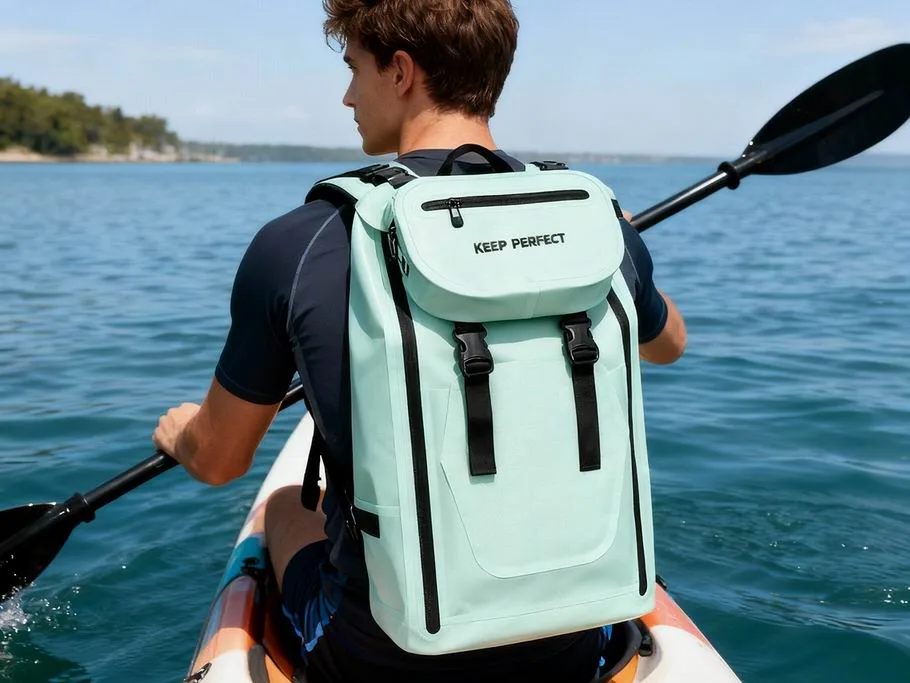
Format is a comfort and access decision, not a waterproofing decision. A roll-top dry bag with a single top closure is the fastest to open one-handed and the easiest to squeeze into a hatch. A dry duffel opens along its length, which is excellent for a long straight hatch such as a sea kayak rear compartment, but it needs two hands on deck and therefore stays inside the boat.
Waterproof backpacks with welded shoulder straps earn their place on shore, not on the water. Wearing a backpack in a cockpit is uncomfortable and raises your centre of gravity; carrying 15 kg from the car to the launch is exactly what the harness is for. If you walk your boat on a trolley for 800 m, a 20L waterproof backpack is genuinely useful; if you launch from the car park, it is dead weight.
Roll-top closures: how many rolls survive a wet exit
Three folds is the standard for a reason. Rolling the fabric three times creates three contact lines, each of which must be crossed by water travelling sideways under pressure. Two rolls will hold spray; three rolls hold a brief immersion; four rolls start to shorten the usable volume and stiffen the fabric at the fold, accelerating crease damage over a season.
For a day kayak trip, half-fill the bag, expel most of the air by pressing down before the first fold, then close the buckle and pull it tight. Trapped air is the enemy: it makes the bag buoyant on deck, unpredictable when you climb out, and it pushes the closure open when the bag is squeezed inside a hatch. If your bag has a purge valve, use it after packing, not after rolling.
Waterproof ratings that matter on a day paddle
Ingress protection ratings describe the test, not the marketing claim. IPX6 covers powerful water jets, IPX7 covers immersion for 30 minutes at one metre, and IPX8 is a depth agreed in the test protocol by the brand running the test. The IEC defines these grades in IEC 60529, which is why a reputable spec sheet names the standard rather than inventing adjectives.
Day kayaking generally sits between IPX6 and IPX7. Paddle splash and a bow wave are jet events; a capsize in shallow water is a short immersion. A bag rated IPX7 with welded seams covers both. A stitched bag with a water-repellent coating will pass a splash test and fail the moment it is squeezed underwater at depth, because the pressure gradient pushes water through the needle holes.
| Exposure | What happens | Rating needed | Seam type that survives |
|---|---|---|---|
| Paddle drip | Continuous light contact | IPX4 | Welded or coated |
| Bow spray at 15 km/h | Directed water jets | IPX6 | Welded |
| Wave over the deck | Burst of water | IPX6 | Welded |
| Wet exit in 1 m of water | 30 s immersion | IPX7 | Welded, continuous |
| Dragged under for 2 min | Sustained pressure | IPX7-IPX8 | Welded, 0.5 mm film or heavier |
Fabric and seam choices for salt and sun
Two fabric families dominate: TPU laminated to a nylon or polyester face, and PVC coated onto a woven base. TPU is lighter, stays flexible at low temperature, has no plasticiser to migrate, and welds cleanly with radio-frequency energy. PVC is heavier, cheaper per square metre, and hardens over years in strong UV. On a saltwater day boat, the flexibility of TPU matters because the bag is folded and squeezed every launch.
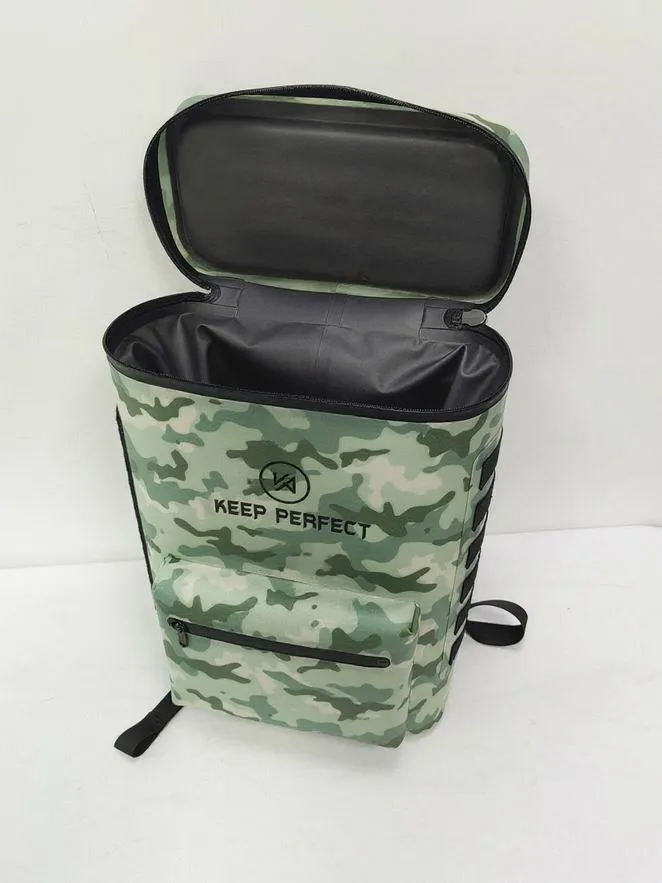
Film thickness drives puncture resistance more than denier does. A 0.3 mm TPU film is fine for a 5L grab bag that lives on deck but will not survive being stuffed beside a pump and a paddle float. A 0.5 mm film adds about 90 g to a 20L bag and takes a decade of abrasive sand contact. For 420D and 500D face fabrics combined with TPU, we see the best balance of weight and abrasion life in coastal use; the same construction carries through our TPU waterproof backpack line.
What fits in 5L, 10L and 20L bags
Volume tables are only useful when they list real objects. The list below is based on items packed as they would be for a day paddle, not compressed to a theoretical maximum. Treat these numbers as planning figures and leave 15% headroom for wet hands, a wetsuit hood, or a second water bottle.
| Item | Packed volume | Weight | Fits in 5L | Fits in 10L | Fits in 20L |
|---|---|---|---|---|---|
| Spare thermal top | 2.0 L | 320 g | Yes | Yes | Yes |
| Light rain shell | 1.6 L | 280 g | Tight | Yes | Yes |
| Compact towel | 1.4 L | 210 g | No | Yes | Yes |
| Lunch box, 1.2 kg | 2.2 L | 1.2 kg | No | Tight | Yes |
| Camera body and one lens | 1.8 L | 1.1 kg | No | Tight | Yes |
| First-aid pouch | 0.9 L | 400 g | Yes | Yes | Yes |
| Full day of the whole list | 9.9 L | 3.5 kg | No | No | Yes |
Notice how quickly a 5L bag is consumed by two soft items. The 5L is a grab bag, not a storage bag. The 10L is the workhorse for a three-to-four hour paddle, and the 20L is the correct size when a camera, a lunch box and a towel travel together. If you are choosing your first two bags, buy a 10L and a 20L rather than two 10s.

Weight, trim and the 3 kg rule
Adding weight to a kayak is easy; adding it in the wrong place is what makes a day paddle tiring. Aim to keep total waterproof load under 3 kg on deck and put the remainder as low and as central as possible. A 3 kg bag lashed forward of the cockpit raises the bow and makes the boat weathercock in a crosswind; the same 3 kg in a day hatch behind the seat barely registers.
Check trim by floating the loaded boat in waist-deep water and sighting along the waterline from the side. If the bow sits more than 3 cm higher than the stern, move gear aft or reduce deck load. This is also the moment to make sure every bag is actually tethered: an untethered bag that floats free after a capsize is a recovery problem, not an inconvenience.
| Load position | Effect on handling | Mass limit | Best use |
|---|---|---|---|
| Front deck | Bow lift, weathercocking | 1.5 kg | Grab bag and water only |
| Behind the seat | Neutral, minimal effect | 6 kg | Day kit, layers |
| Day hatch | Slight stern squat | 8 kg | Spares, tools, electronics |
| Cockpit between knees | Raised centre of gravity | 2 kg | Soft items only |
Attaching bags without creating a hazard
Two deck lines, one full turn, is the standard lashing for a deck bag. A single line allows the bag to shift and roll; three turns make it slow to release in an emergency. The same principle applies inside the cockpit: a short leash that keeps a bag from drifting under your legs is good, a long leash that can wrap a thigh in a wet exit is not.
Hard points matter more than knots. Welded D-rings on a TPU bag take a 40 mm webbing strap and a cam buckle without deforming; a plastic loop sewn onto a low-grade bag will tear at 60 to 80 kg of shock load. If you use a carabiner, choose a screw-gate and keep it away from the paddle shaft path so it cannot catch during a sweep stroke.
Where water actually gets in
After a season of day paddling, leaks almost always come from three places and none of them is the fabric. The first is a closure that was rolled while the bag was over-filled, so the fold did not seal. The second is a sand grain trapped in the fold. The third is a hatch cover that was not seated, which soaks the bag rather than the bag leaking.
Rinse the closure with fresh water before you roll it, and check the fold line with your thumb for grit. If you paddle in surf, add a monthly inspection of the corners where the film is welded, because that is where fatigue shows first. A 30-second air test, rolling the bag closed and squeezing it while listening for a hiss, catches nearly every seal failure.
The 10-minute post-paddle routine
- Empty every bag completely and turn it inside out over a rail.
- Rinse with fresh water at ambient temperature; never use a hot hose on TPU.
- Wipe the closure line with a soft cloth and inspect for sand or salt crystals.
- Dry in shade with the mouth open; direct sun for two hours is enough to stiffen a PVC bag.
- Store rolled loosely, not folded flat, and leave the buckle unclipped.
Salt is the real enemy of hardware. Rinse buckles and cam levers, work them through their full travel while wet, then let them dry before storage. A cam buckle that has been left salty for a season will slip under load; the same buckle rinsed every trip still holds tension after five years of weekend use. Full detailing steps for roll-top bags are in our cleaning guide.

Sizing checklist before you buy
- Measure your real load: weigh and estimate volume of the kit you carry on a typical paddle.
- Buy two mid-size bags rather than one large bag so a single failure is survivable.
- Match film thickness to abrasion risk: 0.3 mm for deck bags, 0.5 mm for hatch bags.
- Confirm the closure geometry: at least three fold lines and a reinforced mouth.
- Check hard points: welded D-rings for lashings, no sewn loops on load-bearing points.
- Choose TPU if the bag will be folded, squeezed and stored in the cold.
- Ask for the test standard behind any waterproof claim, not just the adjective.
- Compare the specification against the full product line before you commit to a size.
If you are specifying bags for a club, a rental fleet or a retail range, the same checklist becomes a purchasing brief. Volume, film thickness, closure design, hard points and the test standard are the five lines that decide whether a bag survives a rental season. Our own production line has built waterproof bags since 2014 in an SGS-verified 4,950 m2 facility, with a 500-piece minimum and sampling in 6 to 10 working days, and the same sizing questions come up in every project.
For cold-water paddlers there is one more variable: hypothermia risk is not a bag problem. Carry a means of communication in a PFD pocket that is reachable with cold hands, and read the safety guidance published by the CDC before you plan a winter paddle. A dry bag keeps kit dry; it does not keep a person warm.
Tidal planning changes the volume you carry as well. A paddle that ends against a 2 m tide needs light, well-lashed bags so you can land quickly; check local predictions through NOAA if you paddle in US waters. Reference our sea kayaking sizing guide when the trip stretches beyond a single day, and the capacity guide when you are comparing platforms across a whole product range. Our roll-top dry bag range covers 5L to 90L, and every size uses the same three-fold closure so a club can standardise on one system.
Frequently asked questions
Q1. What size dry bag do I need for a day kayak trip?
For a three to four hour coastal paddle, plan on 10 to 15 litres total: a 10L bag in the cockpit for layers and a 5L grab bag on the deck. Sit-on-top paddlers with no hatch can work from a single 15L to 20L bag tethered behind the seat.
Q2. Is a 20L dry bag too big for a kayak?
A 20L bag is the right size when you carry a camera, a lunch box and a towel, which pack to about 10 litres plus headroom. It is too big if it becomes a 6 kg lump, so keep the loaded weight under 3 kg on deck.
Q3. How many times should I roll a dry bag closed?
Three folds. Two folds hold paddle spray but not a wet exit; four folds shorten usable volume and put a hard crease in the fabric that fatigues faster over a season.
Q4. Do I need a dry bag with a purge valve for kayaking?
Only if you pack compressible gear. A valve lets you squeeze air out after closing so the bag sits flat in a hatch. If you mostly carry clothing and food, a standard roll-top with no valve is simpler and has one fewer seal to fail.
Q5. Will a dry bag keep my phone dry if I capsize?
Yes, if it is rated IPX7 and the closure is properly rolled. A capsize is a short immersion, which IPX7 covers. For extra safety put the phone in a small 2L roll-top inside the main bag so it has two independent seals.
Q6. What is the difference between IPX6 and IPX7?
IPX6 means protection against powerful water jets, which is what bow spray and breaking waves produce. IPX7 means the item survives immersion at one metre for 30 minutes. Day kayaking crosses from the first into the second the moment you wet exit.
Q7. Should I lash my dry bag to the deck?
Yes, always. Use two deck lines and a single full turn so the bag cannot shift but releases quickly. An untethered bag that floats away after a capsize turns a minor incident into a lost-kit recovery.
Q8. Is TPU or PVC better for saltwater kayaking?
TPU stays flexible when cold, has no plasticiser to migrate and welds cleanly, which suits a bag that is folded and squeezed every launch. PVC is heavier and hardens under sustained UV. For coastal day paddling a 420D or 500D face with a 0.5 mm TPU film is the practical choice.
Q9. How do I stop sand getting into the closure?
Rinse the fold line with fresh water before you roll, then run a thumb along it to check for grit. One sand grain in the fold is enough to create a capillary path that wicks water into the bag over an hour of paddling.
Q10. Can I put wet gear in a dry bag?
You should not. Wet gear adds water, weight and mildew risk. There is no wall or drain inside a roll-top bag, so a soaked towel keeps the whole load damp until you open it on shore.
Q11. How much does a full day-paddle dry bag load weigh?
A typical day load of spare layer, shell, towel, lunch and first-aid pouch weighs 3.2 to 3.6 kg packed into about 10 litres. Keep deck load under 3 kg and move the rest into the day hatch to protect trim.
Q12. Do dry bags float if they are full?
A sealed bag with trapped air floats easily; a tightly packed bag with the air pressed out may float low or sink slowly depending on contents. Do not treat a dry bag as a buoyancy aid, and never as a substitute for a PFD.
Q13. How long does a TPU dry bag last in saltwater?
With a rinse after every paddle and shaded storage, a 0.5 mm TPU bag with welded seams typically gives five to ten years of weekend use before the film shows fatigue at the fold. UV exposure and sand abrasion are the two factors that shorten that most.
Q14. Can I wash a kayaking dry bag in a machine?
No. Machine washing abrades the film and twists welded seams. Rinse by hand with fresh water at ambient temperature, wipe the closure, and dry in shade with the mouth open.
Q15. What is the smallest useful dry bag on a kayak?
A 2L roll-top is the smallest genuinely useful size: it holds a phone, keys and a compact camera. Anything smaller than 2L is better used as an inner pouch inside a larger bag.
Q16. Do I need a dry bag for a sit-on-top kayak?
Yes, and more so than in a sit-in boat. A sit-on-top has no cockpit to shelter gear, so all water lands directly on your bag. Use IPX7 welded bags and lash a 5L grab bag to the deck lines within reach.
People also ask
How do you pack a dry bag for kayaking?
Pack heavy items at the bottom, keep the load to about 85% of the bag volume, press the air out before the first fold, then close with three folds and a tight buckle. Keep the deck bag to the items you need with wet hands.
Are 5L dry bags useful?
A 5L bag holds a spare layer and a first-aid pouch, or a phone, keys and a snack. It is a grab bag rather than a storage bag, and it is the most useful size to keep on a deck line during a day paddle.
What happens if water gets into a dry bag?
Once water is inside, it wicks through the whole load within minutes because there is no internal cavity and no drain. Rinse and dry everything on shore and re-test the closure with an air squeeze before the next trip.
Can you use a regular backpack instead of a dry bag on a kayak?
A regular backpack absorbs water, gains weight and stays wet for hours. A waterproof backpack with welded seams works for carrying kit to the launch, but inside a cockpit smaller roll-top bags sit better and keep trim neutral.
How do you test a dry bag before a trip?
Close it with three folds, squeeze it and listen for a hiss, then submerge it for 30 seconds in a bath and check for moisture inside. Repeat if the bag has been stored folded for months.
Do kayak dry bags need a window?
A clear window helps you identify a bag inside a hatch without opening it, but the window weld is an extra seam. Choose a window only where a bag is stored out of reach, and rely on colour coding elsewhere.
Need this in production volume?
QUANZHOU JUNYUAN BAGS has produced waterproof bags since 2014 in an SGS-verified 4,950 m2 facility in Fujian, China. Minimum order 500 pieces, sampling in 6–10 working days, bulk in 35–50 days, FOB Xiamen — write to service@junyuanbags.com with your spec and target market.