Home / Blog / Waterproof Technology
IPX Waterproof Ratings for Dry Bags
An IPX rating on a dry bag describes a laboratory test, not a promise. IPX4 means the bag survived 10 minutes of splashing from every direction, IPX6 means it survived 3 minutes of 100 litres per minute jets at 100 kPa from a 12.5 mm nozzle, and IPX7 means it survived 30 minutes submerged at 1 metre. The X is not decoration: it means the dust protection digit was never tested, which is why you will rarely see IP67 on a fabric bag. Those three numbers cover everything a dry bag realistically needs.
The practical problem is that the rating describes a new bag, tested once, in fresh water, at room temperature, by a laboratory that chose the sample. It says nothing about a closure that has been folded 400 times, a seam that has aged in sunlight, or a bag squeezed at 40 kPa of pressure in a hatch. This guide sets out exactly what each grade tests, where dry bags realistically land, how far a rating degrades in service, and the four facts that must appear on a label before a claim is worth anything.
- The IP code, read from left to right
- What each step of the second digit actually applies
- Which grades each bag format can honestly reach
- The jet grades: pressure, distance and where bags fail
- Immersion grades and the variable nobody prints
- How a roll-top earns an immersion grade without a gasket
- Hydrostatic head, spray grade and immersion grade are three different tests
- Fresh water, salt water and the temperature the lab used
- How far a rating drops after a season of use
- Reading a bag label: the four facts that must be present
- Laboratory immersion against the bath test at home
- Matching a grade to the exposure you actually face
- Writing the waterproof requirement into a specification
The IP code, read from left to right
The code is defined in IEC 60529 and has two digits after the letters. The first digit covers solid particle ingress on a scale of 0 to 6, the second covers liquid ingress on a scale of 0 to 9. A rating written IP68 therefore means dust-tight and protected against continuous immersion under conditions agreed between the tester and the client. When a brand writes IPX8, the X declares that the solid-particle tests were never run and no claim is made about them.
For soft goods the X is normal rather than suspicious. A roll-top dry bag has a closure that is opened and closed by hand, and sealing it against fine dust requires a completely different geometry from sealing it against water. Very few fabric products achieve a tested 5 or 6 on the solid scale, and the ones that do tend to use a screw closure or a welded zip rather than a roll-top. The IEC publishes the standard and the test fixtures, and a reputable spec sheet names it rather than inventing adjectives.
The number after IP is also worth checking for a second reason: IP69K, sometimes printed on hard cases, is a high-temperature high-pressure wash-down test designed for food-industry equipment. It has no meaningful application to a kayak dry bag, and a bag claiming it is almost certainly borrowing language from a different product category.
What each step of the second digit actually applies
The liquid scale is not linear. IPX1 and IPX2 are dripping water tests, IPX3 and IPX4 are spraying tests, IPX5 and IPX6 are jet tests, IPX7 and IPX8 are immersion tests, and IPX9 is the high-pressure hot wash. Each band uses different apparatus, different durations and different pass criteria, so moving from one number to the next is a change of test rig rather than a small increase in severity.
| Code | Test apparatus | Water applied | Duration | Typical dry bag claim |
|---|---|---|---|---|
| IPX3 | Oscillating spray or sprinkler | 0.7 L/min at 50-80 kPa | 5 min | Rarely claimed |
| IPX4 | Spray from all directions | 10 L/min at 80-100 kPa | 10 min | Splash-proof liners |
| IPX5 | 6.3 mm nozzle jet | 12.5 L/min at 30 kPa | 3 min | Light roll-tops |
| IPX6 | 12.5 mm nozzle jet | 100 L/min at 100 kPa | 3 min | Mainstream dry bags |
| IPX7 | Immersion tank | 1 m depth, 15 mm above the top | 30 min | Quality roll-tops |
| IPX8 | Immersion, conditions agreed | Depth agreed with the tester | Continuous, agreed | Dive and technical bags |
Two details from that table decide most buying decisions. First, the jump from IPX5 to IPX6 is a factor of eight in flow rate, which is the difference between a hose and a breaking wave. Second, IPX8 has no fixed depth at all: the standard says the conditions must be more severe than IPX7 and agreed between the parties. An IPX8 claim without a stated depth and duration is not a specification, and any brand making one should be asked for the number.
Which grades each bag format can honestly reach
Format sets the ceiling on the rating long before fabric does. A roll-top with three folds and welded seams is the strongest soft configuration and routinely reaches IPX6 to IPX7. A waterproof zip closure reaches IPX5 to IPX6 at best, because the zip teeth are a continuous mechanical path that has to be sealed by pressure from the slider rather than by a fold. A bucket bag with a stiff rim and no rolling closure sits at IPX4 to IPX5.
Waterproof backpacks are the format most often overrated. The body fabric and the seams may be genuinely IPX7 capable, but the shoulder straps are welded or stitched onto the back panel at four or more points, and each attachment is a stress concentration that flexes under load. A well-built welded backpack claims IPX4 to IPX6 for that reason, and a backpack claiming IPX7 on the whole product should be asked which part was tested.
Knowing the ceiling saves time. If you need IPX7, you are choosing between a roll-top bag and a rigid case. If IPX6 covers the exposure, a zip or a welded backpack becomes available and usually more convenient to pack. Decide the grade first, then let the format follow, rather than buying a shape and hoping the number fits it.
The jet grades: pressure, distance and where bags fail
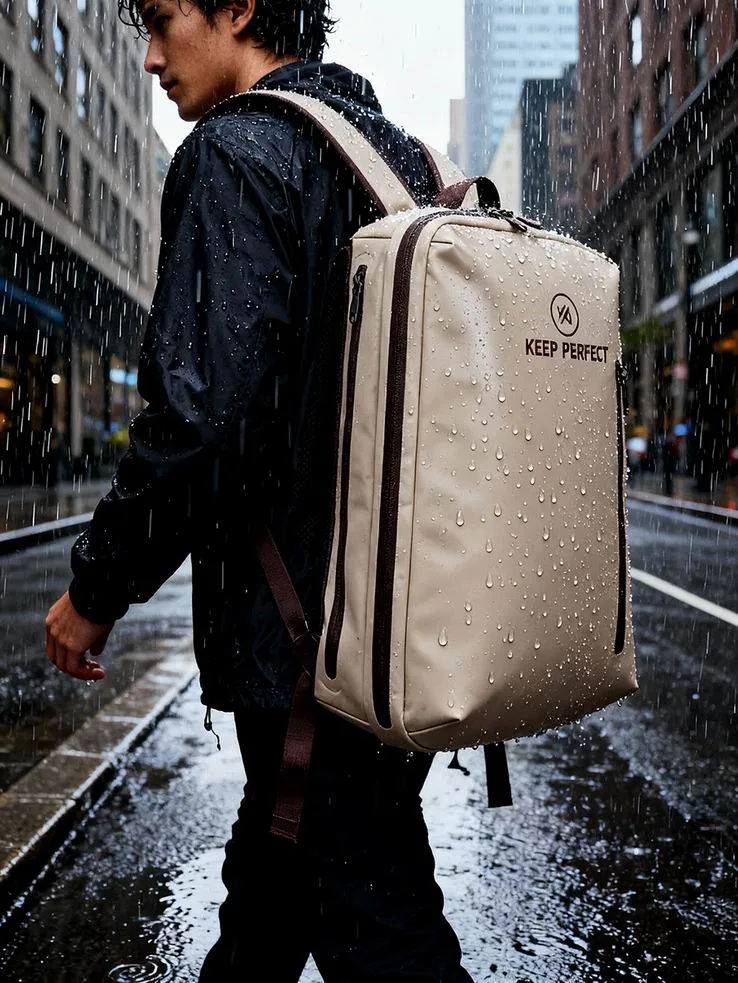
IPX5 and IPX6 are performed with a nozzle held at a specified distance, typically 2.5 to 3 metres, and the sample is sprayed from several directions. The dominant failure point for a dry bag is not the panel fabric but the closure and the seam intersections. A welded side seam with a 20 mm flange survives easily; a roll-top folded only twice lets a jet drive water laterally under the second fold and into the body.
Distance matters more than buyers expect. The standard fixes it, but real conditions do not: a bow wave at 15 km/h delivers roughly the energy of an IPX6 jet at close range, while the same wave at the far side of a wide bay is closer to IPX4. This is why a bag rated IPX6 will still get a little water past the closure in a surf landing, and why the honest response is to add a fold rather than to claim a higher grade.
Immersion grades and the variable nobody prints
IPX7 is unambiguous: 30 minutes with the lowest point of the enclosure 1 metre below the surface and the highest point at least 150 mm below it. That second clause is the one that catches people. A tall bag tested upright in a shallow tank may have its closure only 200 mm under, which is a fraction of the pressure at the base. If the test report does not record the orientation and the depth of the topmost point, the result is not comparable.
Pressure is the hidden variable. Water pressure rises by roughly 9.8 kPa per metre of depth, so a bag at 1 metre sees about 10 kPa above atmospheric and a bag at 3 metres sees about 30 kPa. A closure that seals by contact pressure will hold until the external pressure exceeds the contact pressure at the fold line, which is why the same bag can pass IPX7 and leak when dragged 2 metres down by a current. Depth, not duration, is the demanding part of an immersion claim.
IPX8 therefore needs three numbers to be meaningful: the depth, the duration and the temperature of the water. A serious claim reads like an agreement, for example 3 metres for 60 minutes at 20 degrees Celsius. If a listing says IPX8 and nothing else, treat it as marketing and check whether the bag also carries an IPX7 result, which at least has a defined test behind it.
How a roll-top earns an immersion grade without a gasket
A roll-top is not a sealed enclosure in the way a phone case is. It creates a waterproof barrier by pressing two film surfaces together along three parallel fold lines, and the seal is generated by the stiffness of the fabric and the tension in the buckle rather than by an elastomer. Water has to travel laterally past three contact lines, each of which has to be forced open by pressure, and the resistance is cumulative.
This is why the number of folds matters more than the rating of the fabric. Two folds gives two contact lines and generally holds IPX5; three folds reliably reaches IPX6 and usually IPX7; a fourth fold adds little and costs volume. The closure also depends on being clean: a single grain of sand 0.5 mm across creates a capillary channel that defeats all three lines, which is why a bag that passes IPX7 in the laboratory can leak on a beach.
The closure mechanics guide sets out the contact-pressure maths in full. For the purposes of a rating, the practical takeaway is that an immersion grade on a roll-top is a property of the way the bag is closed on the day, not a fixed attribute of the product. Any test report should state how many folds were used.
Hydrostatic head, spray grade and immersion grade are three different tests
Buyers routinely confuse three numbers that measure incompatible things. Hydrostatic head, reported in millimetres of water column, measures how much pressure a flat clamped fabric sample takes before water appears at its third point of failure. An IPX grade measures a complete assembled product under a spray or an immersion. A 10,000 mm fabric can be made into a bag that fails IPX4 if the seams are stitched, and a 3,000 mm fabric can be made into a bag that passes IPX7 if the seams are welded.
| Test | What is measured | Applies to | Typical figure | What it does not tell you |
|---|---|---|---|---|
| Hydrostatic head | Pressure to first leak | Flat fabric sample | 8,000-12,000 mm | Seam performance |
| IPX4 spray | Splash from all sides | Finished bag | 10 min pass or fail | Immersion behaviour |
| IPX6 jet | Directed water at 100 kPa | Finished bag | 3 min pass or fail | Depth performance |
| IPX7 immersion | 1 m for 30 min | Finished bag | Pass or fail | Long-term ageing |
| Air inflation | Pressure hold over time | Finished bag | 10 kPa for 5 min | Where the leak is |
Only one of those rows tells you where a leak is, and it is the last. An air inflation test at 10 kPa held for five minutes finds pinholes that an immersion test can miss entirely, because air escapes through a smaller defect than water will enter. The two tests are complementary, and a good quality process runs both. Our notes on the air inflation leak test describe the setup.
Fresh water, salt water and the temperature the lab used
IEC 60529 specifies fresh water for the tests, at a temperature within a few degrees of the sample. Neither condition matches the field. Salt water is about 2.5 percent denser, so it applies marginally more pressure at the same depth, and more importantly it leaves crystals in the fold line when it evaporates. A bag that passes IPX7 in fresh water and is then used daily in the sea will fail sooner, not because the fabric changed but because the closure is no longer clean.
Temperature affects the result through the film. A TPU laminate stiffens as it cools, which raises the force needed to form a flat fold but also raises the contact pressure once folded. The net effect at 5 degrees Celsius is usually neutral to slightly positive for a properly rolled closure and negative for a hurried one, because a stiff film will not conform around grit. Standard laboratory practice is 20 to 25 degrees, and any test report should state the temperature it used.
How far a rating drops after a season of use
A rating is a measurement of a new sample. In service, four mechanisms erode it: crease fatigue at the fold line, UV embrittlement of the film, abrasion of the face yarn, and relaxation of the buckle tension. The first two are the important ones, and neither is visible from the outside until the bag fails a test.
| Ageing factor | Exposure | Effect on the seal | Rating impact | Prevention |
|---|---|---|---|---|
| Crease fatigue at the fold | 400-600 closures | Film thins at the fold line | IPX7 to IPX6 | Store rolled loosely, not flat-folded |
| UV embrittlement | 1,000 h sun | Film loses elasticity | IPX7 to IPX5 | Dry in shade, avoid roof-rack storage |
| Salt crystals in the fold | 30 sea trips | Capillary channel forms | Any grade to fail | Rinse the closure before rolling |
| Grit in the closure | Beach and surf use | Lifts the contact line | Any grade to fail | Wipe the fold with a thumb |
| Buckle relaxation | 2-3 years | Lower contact pressure | IPX7 to IPX6 | Replace webbing and buckle |
| Seam peel at the base | Heavy loads | Opens a 10-20 mm path | Any grade to fail | Do not overload past 12 kg |
Read together, that table says something useful: most rating loss is preventable and almost all of it is about the closure rather than the fabric. A bag that is rinsed, dried in shade and stored loosely will hold its original grade for years. The same bag left salty on a roof rack will drop two grades in a season. Rinsing after salt water is the single highest-value habit.
Reading a bag label: the four facts that must be present
A waterproof claim is worth reading only if it carries four pieces of information: the grade, the standard it was tested to, the configuration of the sample, and the name of the laboratory or the internal test method. Three of those four are missing from most listings. A hang tag that says IPX8 in large type and nothing else is a marketing statement, not a specification.
- The grade, written as IPX6, IPX7 or IPX8 rather than as an adjective such as stormproof.
- The standard, normally IEC 60529, and whether the sample was sprayed, jetted or immersed.
- The configuration: number of folds used, orientation in the tank, and whether hardware was fitted.
- The source: an accredited laboratory name, or a clear statement of the internal protocol used.
- A depth and duration figure for anything above IPX7, because IPX8 has no default definition.
Where a brand publishes an accredited result, ask for the report number. Where it does not, run the field version of the test yourself: seal the bag with three folds, submerge it in a bath for thirty seconds, and open it over a dry towel. That thirty-second check reproduces most of what an IPX7 pass actually demonstrates for a soft bag, and it takes less time than reading the listing. The home testing guide gives the full procedure.
Laboratory immersion against the bath test at home
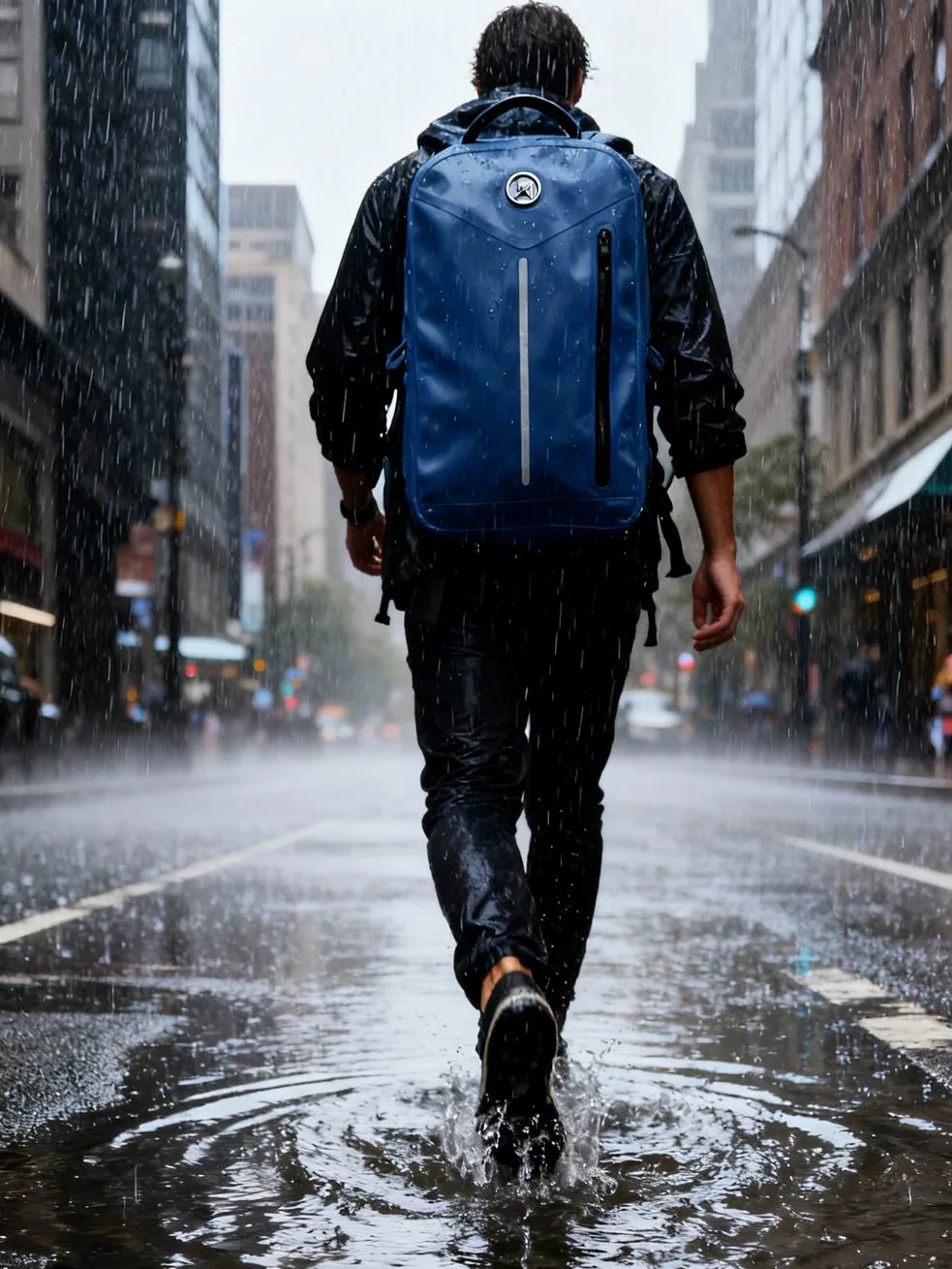
A thirty-second bath test and a thirty-minute laboratory immersion are not measuring the same thing, and it is worth being precise about what the home version proves. The laboratory test controls depth, orientation, temperature, water chemistry and sample conditioning, and it records all of them. The bath test controls none of those, and a bag 200 mm under the surface in a domestic tub sees about 2 kPa rather than the 10 kPa of a proper IPX7 rig.
What the home test does prove is the thing most likely to be wrong: whether the closure is clean, flat and correctly folded on that particular day. Almost every leak reported on a bag that passed its production test is a closure event, not a material failure, and a closure event shows up in thirty seconds. Use the laboratory number to choose a product and the bath test to maintain one.
If you want to go further at home, add weight to the bag so it sits fully under, use a ruler to hold the top 150 mm below the surface, and run it for five minutes rather than thirty seconds. That approximates IPX7 closely enough to catch any bag that is marginal, and it costs one bath towel and a kettle of water.
Matching a grade to the exposure you actually face
The right rating is the one that covers the worst credible event, not the best one. A commuter walking 800 metres in rain needs IPX4 and gains nothing from IPX7. A sea kayaker who might capsize and be towed needs IPX7, because a wet exit is a genuine immersion event. A whitewater rafter needs IPX6 plus redundancy, because the exposure is continuous jetting rather than immersion.
The one case where the grade is the wrong tool entirely is a bag that will be dragged underwater. A dry bag towed behind a boat at 2 metres for ten minutes is outside every rating a roll-top can honestly claim, and the correct response is not a higher number but a different product: a rigid case, or a dry bag used as an inner liner inside a rigid container. Ratings describe protection, not invulnerability.
There is also a safety boundary worth stating plainly. A bag that passes IPX7 is not a buoyancy aid. A sealed dry bag with trapped air floats, but the air escapes if the closure is disturbed, and no rating test covers that. If flotation matters, use a product designed for it; our floating dry bag range is built around that requirement rather than around an ingress grade.
Writing the waterproof requirement into a specification
For anyone specifying bags for a fleet, a retail range or a club, the requirement has to be written as a testable clause. Name the grade, name the standard, state the sample configuration and the number of folds, state whether the test is on the finished product or on a fabric coupon, and set an acceptance number across a production run. Vague clauses produce inconsistent product.
- Name the grade and the standard: IPX7 to IEC 60529, immersion at 1 metre for 30 minutes.
- State the configuration: three closure folds, buckle clipped, hardware fitted, sample upright.
- State the sample size and pass criterion: for example 5 pieces per 500, zero permitted failures.
- Add a second test that locates leaks: air inflation at 10 kPa held for 5 minutes.
- Add an abrasion or flex preconditioning step if the bag will meet sand or a frame.
- Require the report number and the laboratory name on every production batch.
- Require a retained-grade retest after 1,000 hours of accelerated UV exposure.
Test methods for the supporting clauses are published by the same bodies that maintain the ingress standard, and the ISO catalogue covers the conditioning and sampling procedures most programmes reference. Two authorities, IEC for the code itself and ISO for the conditioning, is usually enough to write a clause that a production partner cannot interpret three different ways.
On our own line, waterproof bags have been produced since 2014 in an SGS-verified 4,950 m2 facility with 149 machines across seven production lines, and immersion testing runs alongside AQL 2.5 inspection on every bulk order. For the narrower question of which grade to choose, the IPX6 against IPX7 comparison and the immersion testing notes go deeper.
One closing point on honesty. A dry bag that is sold as IPX6 and behaves as IPX6 is a better product than one sold as IPX8 with an unsupported number, because the first can be trusted in the conditions it was designed for. Ratings exist to make comparison possible, and comparison only works when the number describes a test that was actually run.
Frequently asked questions
Q1. What does IPX7 mean on a dry bag?
It means the bag survived 30 minutes submerged in fresh water with its lowest point 1 metre below the surface and its highest point at least 150 mm below it, tested to IEC 60529.
Q2. What does the X in IPX7 mean?
It means the solid-particle protection digit was not tested. Fabric bags with a hand-operated closure are rarely dust-tested, so the X is normal rather than a sign of a weak product.
Q3. Is IPX8 better than IPX7?
It should be, but IPX8 has no fixed depth or duration in the standard; the conditions must be agreed and stated. An IPX8 claim with no depth and time printed alongside it is not a specification.
Q4. What IPX rating does a dry bag need for kayaking?
IPX6 as a minimum for deck spray, and IPX7 if a capsize or a rescue tow is possible. Most quality roll-tops reach IPX7 when closed with three folds.
Q5. Can a dry bag be IP68 rated?
Very rarely. The first digit requires tested dust-tightness, which a roll-top closure does not achieve. IPX7 or IPX8 is the realistic target for a soft bag.
Q6. How is IPX7 different from a 10,000 mm hydrostatic head?
Hydrostatic head tests a flat clamped fabric sample for pressure resistance; IPX7 tests the assembled bag underwater. A strong fabric with stitched seams can fail IPX4.
Q7. Do dry bags lose their IPX rating over time?
Yes. Crease fatigue after 400 to 600 closures, UV exposure and salt crystals in the fold can drop an IPX7 bag to IPX6 or below. Rinsing, shade drying and loose storage slow this sharply.
Q8. Does salt water change the rating?
The rating is measured in fresh water. Salt water is slightly denser and leaves crystals in the closure when it dries, so a sea-used bag degrades faster even though the tested grade is unchanged.
Q9. How many folds do I need for an IPX7 result?
Three. Two folds generally reaches IPX5, three folds reliably reaches IPX6 and usually IPX7, and a fourth fold adds little while costing usable volume.
Q10. Can a dry bag rated IPX7 be dragged underwater?
Not safely for long. Pressure rises about 9.8 kPa per metre, so a bag dragged to 2 or 3 metres is outside what a roll-top contact seal can reliably hold. Use a rigid case instead.
Q11. Is IPX6 enough for a rainy commute?
Yes, comfortably. Rain and splash are IPX3 to IPX4 events. A commuter gains nothing practical from IPX7 unless the bag may be dropped in water.
Q12. What is IP69K and does it matter for bags?
It is a high-temperature, high-pressure wash-down test designed for food-industry equipment. It has no meaningful application to a kayak or travel dry bag.
Q13. How do I test an IPX claim at home?
Seal the bag with three folds, submerge it in a bath for 30 seconds, and open it over a dry towel. Add an air inflation hold at 10 kPa for 5 minutes to find pinholes.
Q14. Does a welded seam matter for the rating?
Yes. Stitched seams create needle holes that leak under pressure, so a stitched bag may pass a spray test and fail immersion. Immersion grades effectively require welded or fully taped seams.
Q15. Should a rating be tested on the finished bag or the fabric?
On the finished bag. A fabric coupon result tells you about the laminate only and says nothing about the closure, the seams or the hardware, which is where soft bags actually leak.
Q16. Does an IPX7 dry bag work as a flotation aid?
No. A sealed bag with trapped air floats, but the air escapes if the closure is disturbed and no ingress test covers buoyancy. Use a purpose-built floating product instead.
People also ask
What is the best IPX rating for a dry bag?
IPX6 covers deck spray and heavy rain; IPX7 covers capsize and short immersion. For paddling, travel and commute use, IPX7 with welded seams and three closure folds is the practical target.
Are IPX ratings the same as waterproof ratings?
No. IPX grades are standardised tests defined in IEC 60529. Words such as waterproof, stormproof or water resistant have no standard behind them and cannot be compared.
How do you test if a dry bag is IPX7?
Submerge the sealed bag with its lowest point 1 metre below the surface and its top at least 150 mm under, hold it for 30 minutes, then open it and check for any moisture inside.
Does IPX8 mean a dry bag is submersible forever?
No. IPX8 means continuous immersion under conditions agreed between the tester and the client. Without a stated depth, duration and temperature, the claim says nothing specific.
Why do some dry bags only claim IPX6?
Because IPX6 covers the jet exposure a bag actually meets on a deck or a frame, and because the brand may not have commissioned immersion testing. It is an honest, testable grade.
Can stitched seams pass an IPX7 test?
Rarely and unreliably. Needle holes leak under immersion pressure, so a sustained IPX7 result generally requires welded seams or a fully taped seam construction.
Need this in production volume?
QUANZHOU JUNYUAN BAGS has produced waterproof bags since 2014 in an SGS-verified 4,950 m2 facility in Fujian, China. Minimum order 500 pieces, sampling in 6–10 working days, bulk in 35–50 days, FOB Xiamen — write to service@junyuanbags.com with your spec and target market.