Home / Blog / Capacity & Sizing
Dry Bag Size for a 7-Day Expedition
Plan on 90 to 130 litres of waterproof capacity per person for a seven-day self-supported expedition, split across five to eight bags between 5 and 90 litres, with a total packed weight of 14 to 22 kg. A raft trip where the group shares tents, stoves and kitchen kit pushes the party total to 380 to 460 litres, while a packraft or bikepacking trip with no shared hull drops back to 60 to 80 litres because every item has to ride on one craft. Those two numbers, volume and bag count, decide everything else: hatch diameter, portage strategy and how badly a single failed seal hurts you on day four.
This guide builds the volume block by block instead of starting from a bag you already own, then converts the blocks into a named bag plan you can buy against. The tables cover a summer temperate trip and a shoulder-season trip, six different craft, and the food curve that changes your volume every single day. Where a recommendation depends on a closure losing capacity or on a hatch opening being too narrow, the number is given so you can check it against your own boat or frame before you commit.
- Where a 90 to 130 litre budget comes from
- Sleep system: the largest single block
- Clothing for seven days with no laundry stop
- Food and kitchen: the block that changes every day
- How much of the load must be genuinely waterproof
- Matching the bag plan to the craft
- The bag-by-bag split that still works on day six
- What the closure costs you in usable volume
- Weight distribution, portage and the 22 kg ceiling
- Redundancy: planning for a failed bag on day four
- Colour coding and group logistics
- Resupply, caching and cold-weather adjustments
- Turning the plan into a specification
Where a 90 to 130 litre budget comes from
The total is built from six blocks, and the blocks matter more than the total because they tell you which bag to buy first. A summer seven-day trip in a temperate range breaks down roughly as follows: sleep system 20 to 28 litres, clothing 16 to 22 litres, food 20 to 26 litres, kitchen and fuel 8 to 12 litres, safety and electronics 5 to 8 litres, and wash kit 4 to 6 litres. That is 73 to 102 litres before any group equipment is shared out and before you add carried water.
Two more additions close the gap. Two paddlers sharing a two-person tent split about 11 litres of tent body, poles and footprint between them, so each carries 5.5 litres of shelter. Water is the heavier addition: a desert or dry-canyon leg with four litres carried is 4 extra litres and 4 extra kilograms, which is why water volume and food volume are planned together rather than separately.
Shoulder-season trips move the same list by 15 to 25%. A synthetic-fill sleeping bag rated to -5 °C occupies around 30 litres instead of 22, an insulated jacket adds 2.4 litres, and a second pair of gloves plus a balaclava add about a litre between them. If five of the seven days are wet, add a dedicated 10 litre wet bag as well, because a soaked shell packed next to dry clothing will move moisture into everything it touches inside a sealed roll-top.
| Kit block | Summer volume | Shoulder season | Packed weight | Waterproof priority |
|---|---|---|---|---|
| Sleep system | 20-28 L | 25-35 L | 1.8-3.2 kg | Critical |
| Clothing carried | 16-22 L | 22-30 L | 2.4-4.0 kg | Critical |
| Food, seven days | 20-26 L | 24-32 L | 5.5-8.0 kg | Critical |
| Kitchen and fuel | 8-12 L | 10-14 L | 1.6-2.6 kg | Medium |
| Safety and electronics | 5-8 L | 6-10 L | 1.2-2.4 kg | Critical |
| Wash kit and personal | 4-6 L | 5-7 L | 0.8-1.4 kg | Low |
| Share of group shelter | 4-6 L | 5-8 L | 1.0-1.8 kg | Medium |

Sleep system: the largest single block
A roll-top dry bag does not compress. A compression sack squeezes a bag to 60% of its lofted volume with four straps; a roll-top squeezes it only as far as the film will fold, so expect a sleeping bag to need 20 to 35% more space inside a dry bag than inside a compression sack. A 850-fill down bag rated to -5 °C that packs to 12 litres in a compression sack needs an 18 litre dry bag; the same rating in synthetic fill needs 26 litres.
Pads, pillows and liners are the easy part and are usually packed with the bag rather than separately. An inflatable pad rolls to 3.2 litres, a foam pad straps to the outside of the bag instead and takes no internal volume, and a liner adds 1.1 litres. If you sleep in a shared tent, split the tent across two people: 8 litres of body, 2.4 litres of poles and a 1.5 litre footprint comes to about 6 litres each, and poles travel better strapped along the outside of a duffel than coiled inside a roll-top.
Clothing for seven days with no laundry stop
The layering maths is short and unforgiving: one base layer worn, one spare, one mid layer, one insulated layer worn in camp, one shell, two pairs of socks worn and spare, plus camp insulation. In volume terms that is 1.1 litres for a merino base layer, 3.2 litres for a fleece, 2.4 litres for a down jacket, 1.6 litres for a shell and about 1.4 litres for socks and underlayers together, roughly 10 litres before trousers and camp shoes.
Camp shoes are the item people forget to budget: a pair of light trainers is 3.5 litres and 480 g, and they are usually the bulkiest single clothing item on the list. Trousers add 2.2 litres if you carry a second pair and nothing if you do not. Eight people on a raft trip who each carry a spare pair of trousers are spending 17 litres of hull space on something six of them will never unpack.
Separate wet from dry deliberately. A 10 litre wet bag holding a soaked shell, wading shoes and a wash kit keeps 3 litres of water away from the clothing bag, and it is the difference between dry sleep layers on day six and damp ones. Wet items belong in a bag you can leave strapped outside the main load; a welded roll-top dry bag in the 10 litre size does that job without absorbing any of the water it holds.
Food and kitchen: the block that changes every day
Food is the only block whose volume falls as the trip progresses, and sizing for day one leaves you carrying air by day six. A typical ration of 1.4 to 1.8 kg per person per day for seven days is 9.8 to 12.6 kg, and dry ration packs at roughly 1.6 litres per kilogram, which is 16 to 20 litres on day one and about 3 litres on the last morning. Splitting food into a 20 litre bag for the first four days and a 10 litre bag for the last three keeps the small bag useful rather than half empty.
Kitchen volume is small but awkward in shape. A 230 g gas canister is 0.9 litres, a remote stove is 0.6 litres, a 1.8 litre pot nests the stove and takes 2.4 litres packed, and a shared two-pot set comes to about 5 litres. Fuel is the safety constraint: canisters travel strapped outside the main load and never inside a bag that also holds food, because a slow leak in a sealed roll-top concentrates gas in exactly the place you put your face.
Where a bear canister or a hard food container is required, budget for it separately. A standard canister occupies 4.2 litres of internal volume, weighs 1.2 kg empty, and will not fit through the mouth of a 20 litre roll-top, so it travels strapped to a frame or in a 40 litre duffel with the food packed around it rather than inside a roll-top closure.
| Day of trip | Food remaining | Volume needed | Weight remaining | Bag in use |
|---|---|---|---|---|
| Day 1 morning | 7 days | 18-20 L | 9.8-12.6 kg | 20 L full, 10 L full |
| Day 3 morning | 5 days | 13-15 L | 7.0-9.0 kg | 20 L half, 10 L full |
| Day 5 morning | 3 days | 8-9 L | 4.2-5.4 kg | 20 L empty, 10 L full |
| Day 7 morning | 1 day | 2-3 L | 1.4-1.8 kg | 10 L half |
| Resupply at day 4 | 4 days reloaded | 11-13 L | 5.6-7.2 kg | 20 L refilled |

How much of the load must be genuinely waterproof
Exactly three blocks are non-negotiable: sleep system, insulation clothing and electronics or communications. If any one of those gets wet on day two, the trip changes character. Food, kitchen and wash kit are negotiable in the sense that a soaking costs comfort rather than safety, which is why a mixed kit of fully welded bags plus a couple of lighter splash-resistant sacks is a legitimate way to save weight on a trip with a low capsize risk.
Match the rating to the exposure. A raft running continuous class III water subjects every bag to repeated immersion, so every block needs an IPX7 welded bag. A canyon trek with a flash-flood risk needs the same rating on the sleep and electronics bags only. An alpine traverse where the exposure is seven days of rain can run IPX6 on most bags and reserve IPX7 for the two bags that must survive a stream crossing. The rating ladder is set out in our IPX ratings guide.
Matching the bag plan to the craft
The craft sets the largest single bag you can use, and that constraint decides the bag count more than the volume does. A sea kayak with a 24 cm oval hatch will not accept a 40 litre duffel; you are building the same 90 litres out of six 15 to 20 litre bags instead of three 30 litre ones. A raft frame accepts a 90 litre bag but needs the load spread across at least four lash points so it cannot shift in a hole.
Bikepacking and packrafting have the tightest geometry of all. A handlebar roll and a frame bag sit under 14 litres each, so an 80 litre load is carried across seven attachment points rather than four bags, and the weight ceiling per attachment is roughly 3 kg before handling suffers. Trekking with a backpack is the easiest case: a 40 to 60 litre welded liner inside the pack plus two 10 litre roll-tops outside covers the same volume with no hull geometry to fight.
| Craft | Waterproof litres per person | Largest single bag | Typical bag count | Notes |
|---|---|---|---|---|
| Sea kayak | 70-90 L | 20 L | 6-8 | Hatch diameter limits bag size |
| Open canoe | 100-130 L | 40 L | 4-6 | Duffels work, roll-tops better for the small items |
| Raft, shared group kit | 90-110 L plus 120-200 L group | 90 L | 5-8 | Four lash points minimum per large bag |
| Packraft | 55-75 L | 20 L | 4-6 | Everything rides on or behind the paddler |
| Bikepacking | 60-80 L | 14 L | 6-9 | 3 kg ceiling per attachment point |
| Trekking | 80-110 L | 60 L liner | 3-5 | Liner inside the pack, roll-tops outside |
The bag-by-bag split that still works on day six
Named bags beat anonymous ones on a long trip, because on day six nobody wants to open four identical black sacks to find the coffee. Assign one size and one colour to each category, write the category on the white roll-top panel with a marker, and keep the assignment for the whole trip. The plan below covers a 105 litre summer load for one paddler on a canoe trip with shared kitchen kit.
Note that three of the eight bags are under 10 litres. Small bags are not wasted weight on an expedition; they are what let you reach one item without unpacking a 25 litre bag in the rain, and they are what let you split risk so a single failed seam costs you coffee rather than a sleeping bag.
| Bag | Size | Contents | Weight when full | Colour |
|---|---|---|---|---|
| Sleep bag | 25 L | Down bag, pad, liner, pillow | 2.8 kg | Olive |
| Clothing bag | 20 L | Base layers, fleece, jacket, socks | 3.1 kg | Black |
| Food A, days 1-3 | 20 L | Breakfasts, lunches, snacks | 4.4 kg | Camo |
| Food B, days 4-7 | 10 L | Dinners, drinks, emergency rations | 4.0 kg | Camo |
| Kitchen bag | 10 L | Pot, stove, mug, scrub, lighter | 1.9 kg | Grey |
| Electronics | 5 L | Phone, camera, batteries, sat messenger | 1.4 kg | Blue |
| Safety pouch | 5 L | First aid, repair kit, head torch | 1.2 kg | Orange |
| Wet bag | 10 L | Shell, wading shoes, wash kit | 1.6 kg | Pink |

What the closure costs you in usable volume
A roll-top closure is not free capacity. Three folds consume about 1.5 litres on a 10 litre bag, 2.5 litres on a 20 litre bag and 4 to 5 litres on a 40 litre bag, because the folded panel occupies space that would otherwise hold kit. Buy 15% above your measured volume and you will still be able to close the bag on the day you overpack by a fleece.
Mouth geometry matters as much as litres. A 40 litre duffel with a 45 cm straight opening accepts a bear canister, a nested pot set and a coiled hose; a 40 litre roll-top with a 30 cm round mouth does not. If your expedition carries anything rigid, spec a duffel or a wide-mouth roll-top for that one item and roll-tops for everything soft. The mechanics are set out in our capacity loss guide and the capacity measurement guide.
Weight distribution, portage and the 22 kg ceiling
Total load is only half the problem. On a canoe trip with a 1.2 km portage, the practical ceiling is 22 kg per person carried in two trips, and any single bag over 18 kg cannot be lifted comfortably by one person on uneven ground. Split the heaviest block, usually food at 8 kg, into two bags of 4 kg so a portage becomes two balanced carries rather than one back-breaking one.
On the water, position beats weight. In a canoe, heavy food sits low and forward of centre, the sleeping bag sits high and aft, and nothing heavy goes above the gunwale where it raises the centre of gravity. On a raft frame, the load is lashed so that the heaviest bag sits over the rower bay and the lightest sits at the bow, which keeps the bow from burying in a hole. Our canoe camping load plan walks through the same trim checks for a shorter trip.
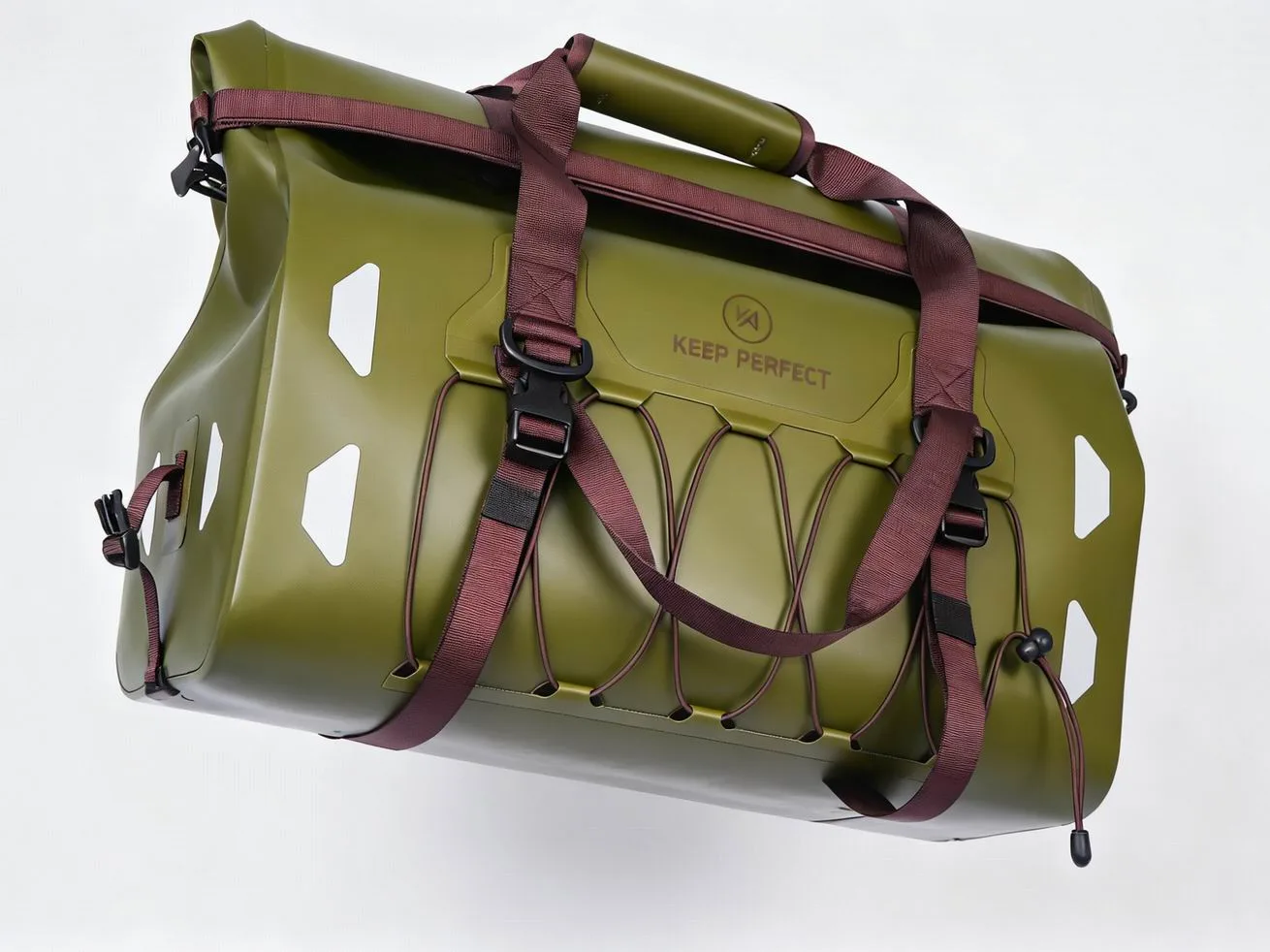
Redundancy: planning for a failed bag on day four
Split by consequence, not by convenience. Insulation, first aid, communications and medication should never share a bag with fuel, sunscreen or anything that can leak, and ideally they should not share a bag with each other. Two 10 litre bags with one critical item each survive a single failure; one 20 litre bag with everything critical does not.
Carry a 5 litre pouch that lives on your person, not in the hull. On a raft or canoe trip that pouch holds a firestarter, a head torch, an emergency ration and a satellite messenger, and it stays clipped to your life jacket so it survives a swim or a wrapped boat. That single habit removes most of the worst-case scenarios from an expedition plan.
A repair kit weighs 30 g and takes five minutes to use: two TPU patches, a 15 cm strip of repair tape, three cable ties and a small tube of seam sealant. Test every bag with an air inflation check the evening before launch, and re-test any bag that has been strapped against an abrasive frame for three days. If a welded seam does let go mid-trip, the failure usually starts as a slow weep at a corner rather than a split, and the repair window is measured in hours, not minutes; the failure modes are described in our seam failure guide.
Colour coding and group logistics
On a group trip, colour does the work that labels cannot. Assign one colour per person for personal kit and a single shared colour for group kit, so at camp the four group bags are obvious and nobody opens somebody else's sleeping bag to find a stove. Write the owner and contents on the white roll-top panel with a permanent marker; marker on a matte TPU face survives a week of rain and comes off with alcohol at the end of the trip.
Weigh and label every bag before the trip on a group expedition. An eight-person raft trip carrying 34 bags benefits from a 15 minute loading plan drawn on a tarp: bag, owner, category, weight and which bay it rides in. That plan also makes the daily repack faster, because everyone knows which bag comes out at camp and which stays lashed to the frame.

Resupply, caching and cold-weather adjustments
A resupply at day four changes the whole plan: food drops from 18 litres to 11 litres, and the freed 7 litres is usually best left empty rather than filled with something heavier. Pre-positioned caches work the same way in reverse; a buried or hung 10 litre bag with two days of food and a fuel canister removes 3 kg from the load for the middle third of the trip and costs nothing but planning time.
Water is the biggest single swing factor. A dry canyon leg with four litres carried adds 4 litres and 4 kg, and a desert leg with eight litres carried adds 8 kg, more than the entire clothing block. Water does not need a welded bag; a simple roll-top with a wide mouth is easier to fill from a shallow spring, and it is the one item where a leak is inconvenient rather than dangerous.
Turning the plan into a specification
- Fix the bag count first: five to eight bags beats two large ones on any craft with hatch limits.
- Size each bag 15% above measured volume to pay for the three-fold closure.
- Specify 0.5 mm film on the two bags that rub against a frame or hull, 0.3 mm on the small pouches.
- Assign one colour per person and one for group kit, and write contents on the roll-top panel.
- Keep the heaviest block split so no single bag exceeds 18 kg on a portage.
- Compare sizes against the full product line before you standardise on a range.
- Sanity-check the numbers with the 2L to 90L capacity guide or the weekend trip plan if the trip length moves.
If you are kitting out a guiding operation, a club fleet or a retail range, the same list becomes a purchasing brief, and the five lines that matter are size, film thickness, closure geometry, weld method and colour. Waterproof bags have been produced on our line since 2014 in an SGS-verified 4,950 m2 facility with seven production lines and a 200,000 piece monthly capacity; sampling takes 6 to 10 working days, bulk runs 35 to 50 days, inspection is to AQL 2.5 and terms are T/T 30/70 FOB Xiamen at a 500 piece minimum.
Two external checks belong in the planning phase as well. Weather and water conditions drive both volume and risk, so pull the forecast and, for coastal trips, the tide predictions published by NOAA before you finalise the load. Water treatment is the other: a seven-day trip usually means filtering or chemically treating surface water, and the CDC guidance on drinking water treatment is the reference most expedition medics use.
Frequently asked questions
Q1. What size dry bag do I need for a 7-day expedition?
Plan 90 to 130 litres per person for a self-supported seven-day trip, carried in five to eight bags between 5 and 90 litres. Buy a 25L for sleep kit, 20L for clothing, two food bags of 20L and 10L, and small 5L pouches for electronics and safety.
Q2. How many dry bags should I take on a week-long trip?
Five to eight. More bags means smaller hatches can be used, one item can be reached without unpacking everything, and a single failed seal costs you one category instead of the whole kit.
Q3. Is a 90L dry bag enough for seven days?
A 90L bag suits a raft or canoe trip where group kit is shared out, but it will not fit through a sea kayak hatch. On a kayak, the same 90 litres has to be split across six or more bags of 20 litres or less.
Q4. How much does seven days of expedition kit weigh?
Between 14 and 22 kg per person including food, water and a share of group shelter. Food is the heaviest single block at 5.5 to 8 kg, and water adds 1 kg per litre carried.
Q5. Should food be split across two bags?
Yes. Food volume falls from about 18 litres on day one to 3 litres on day seven, so a 20L bag for the first three days and a 10L for the rest keeps both bags usable instead of one becoming a slack half-empty sack.
Q6. Do I need every bag to be IPX7?
Only the sleep system, insulation and electronics bags. On a raft running continuous whitewater every bag needs IPX7; on a trek where the exposure is rain, IPX6 is enough for kitchen and clothing bags.
Q7. What is the largest bag that fits a sea kayak hatch?
Usually 20 litres through a 24 cm oval hatch, sometimes 25 litres on a larger day hatch. Build a 90 litre load from six bags rather than two 40 litre duffels that will not pass through the opening.
Q8. How much capacity does the roll-top closure cost?
About 1.5 litres on a 10L bag, 2.5 litres on a 20L and 4 to 5 litres on a 40L. Size each bag roughly 15% above your measured volume so it still closes when you overpack.
Q9. How heavy should a single bag be for a portage?
Keep any one bag under 18 kg so one person can lift it on uneven ground, and keep the total under 22 kg per person. Split the food block so no single carry exceeds the limit.
Q10. Should I carry a wet bag on an expedition?
Yes, a 10 litre one. A soaked shell, wading shoes and wash kit hold litres of water, and sealed inside a clothing bag that moisture moves into your sleep layers within a day.
Q11. What goes in a personal pouch on a raft trip?
Firestarter, head torch, emergency rations and a satellite messenger, clipped to the life jacket rather than stowed in the hull. That pouch is what survives a swim or a wrapped boat.
Q12. How do I label dry bags for a group trip?
One colour per person for personal kit and one shared colour for group kit, plus owner and contents written in permanent marker on the matte roll-top panel. Marker survives a week of rain and wipes off with alcohol afterwards.
Q13. Can I use a duffel instead of roll-tops for expedition kit?
Use duffels for rigid or awkward items such as a bear canister or a nested pot set, because the straight opening is wider. Use roll-top bags for everything soft; they seal faster with cold hands and take less volume in a hatch.
Q14. How much extra volume does cold weather add?
Between 15 and 25%, mostly from a bulkier sleeping bag, an insulated jacket and additional gloves and headwear. A -5 °C synthetic bag needs about 30 litres where a summer bag needs 22.
Q15. What film thickness should expedition bags use?
0.5 mm on bags that ride against an abrasive frame, hull or sand, and 0.3 mm on small pouches that live inside another bag. The 0.5 mm film adds about 90 g to a 20 litre bag and roughly doubles abrasion life.
Q16. How do I test expedition bags before the launch day?
Run an air inflation check on every bag the evening before: roll three times, squeeze, and listen for a hiss, then submerge for 30 seconds in a bath or eddy. Re-test any bag that has been strapped against a frame for more than three days.
People also ask
How do you pack a dry bag for a week-long trip?
Pack by category rather than by day, keep each bag to about 85% of nominal volume, press the air out before the first fold, then close with three folds. Label each bag with owner, category and weight so camp setup takes minutes.
Are 40L dry bags worth it for expeditions?
A 40L bag is worth it when you carry rigid or awkward items such as a bear canister, a nested pot set or group shelter. For soft kit, two 20L bags pack more efficiently and fit hatches that reject a 40L body.
What size dry bag fits a sleeping bag for seven days?
An 18 litre bag fits an 850-fill down bag rated to -5 °C; the same rating in synthetic fill needs 26 litres. A roll-top compresses less than a compression sack, so allow 20 to 35% more volume than the stuff-sack figure.
How much water should a seven-day trip carry?
Two to four litres per person in temperate country and up to eight litres on a dry canyon or desert leg. Water adds 1 kg per litre, so it is usually the heaviest single item and the one least in need of a welded bag.
Can too many small dry bags be a problem?
Yes, past about nine bags on one craft you spend more time finding things and more time lashing them down. Five to eight bags covers a 90 to 130 litre load with one category per bag and no duplication.
Do expedition dry bags need a purge valve?
Only for compressible sleep kit. A valve lets you squeeze air out after closing so a 25L sleeping-bag load sits flat in a hatch or against a frame. Food and kitchen bags gain nothing from a valve and gain one more seal that can fail.
Need this in production volume?
QUANZHOU JUNYUAN BAGS has produced waterproof bags since 2014 in an SGS-verified 4,950 m2 facility in Fujian, China. Minimum order 500 pieces, sampling in 6–10 working days, bulk in 35–50 days, FOB Xiamen — write to service@junyuanbags.com with your spec and target market.