Home / Blog / Materials & Construction
Fabric Flexibility vs Durability
Flexibility and durability in a dry bag fabric are controlled by the same two variables pulling against each other: film thickness and face fabric weight. A 0.3 mm TPU film laminated to 210D nylon folds with roughly 4 N of force and survives about 8,000 Martindale abrasion cycles, while a 0.5 mm film on 500D needs close to 9 N to fold and survives 25,000 cycles. The soft bag packs to 60% of its open volume and seals without fighting you; the stiff bag outlives it by three to one on sand and rock.
Neither is better in the abstract, which is why the decision has to be made against a dominant stress. Folding, cold and packability push you toward thin and light. Abrasion, puncture and daily commercial handling push you toward thick and heavy. This guide sets out the two levers, the five failure modes each one creates, the test methods that quantify them, and a matching table that turns all of it into a specification. Read it with a real use case in mind: a winter commute, a canyon descent, or a rental fleet that gets used 200 days a year.
- Why soft and tough pull in opposite directions
- Film thickness: the first lever
- Face fabric and denier: the second lever
- Lamination versus coating: how the layers move together
- Cold flexibility: what happens below freezing
- Fold fatigue: where flexible fabric fails first
- Abrasion and puncture: where stiff fabric wins
- Seam behaviour: welding a soft film versus a stiff one
- Hydrostatic head: how stiffness helps and hurts
- What over-specifying actually costs
- Matching the balance to the activity
- Testing the trade-off yourself
- Turning the trade-off into a specification
Why soft and tough pull in opposite directions
A waterproof laminate is a sandwich. A film layer does the waterproofing and a woven face fabric carries the mechanical load, and every property you want from one of them costs you something in the other. Thick film resists puncture and abrasion but resists folding just as strongly, because the same molecular chain entanglement that stops a sharp rock also stops a crease from forming cleanly. That is the whole trade in one sentence.
The practical consequence shows up at the closure. A roll-top has to fold three times, every time it is used, in cold conditions, often with wet hands. A stiff laminate fights that fold, so users roll it twice instead of three times, and the waterproofing fails for a reason that has nothing to do with the fabric being punctured. Flexibility is therefore not a comfort feature; it is part of the sealing system.
Durability has the same hidden dimension. Most buyers think of it as abrasion resistance, but in the field the three most common fabric deaths are crease cracking at the fold line, hydrolysis of the film in hot humid storage, and weld peel starting at a corner. All three are influenced by thickness, and not all in the same direction. A thicker film welds stronger and abrades better but creases worse, which is why the specification has to name which failure mode you are buying against.
Film thickness: the first lever
Thermoplastic polyurethane film for dry bags is typically supplied between 0.25 mm and 0.7 mm. Because TPU has a density near 1.15 g per cubic centimetre, thickness converts almost directly to weight: 0.3 mm is about 345 g per square metre and 0.5 mm is about 575 g per square metre. On a 20 L bag with roughly 0.55 square metres of material, moving from 0.3 mm to 0.5 mm adds about 125 g to the finished bag before any hardware is fitted.
| Film thickness | Mass | Fold force | Abrasion cycles to fail | Realistic service life |
|---|---|---|---|---|
| 0.25 mm | 290 g/m2 | 3.0 N | 5,000 | 2-4 years, light use |
| 0.30 mm | 345 g/m2 | 4.0 N | 8,000 | 4-6 years, light use |
| 0.40 mm | 460 g/m2 | 6.5 N | 15,000 | 6-9 years, mixed use |
| 0.50 mm | 575 g/m2 | 9.0 N | 25,000 | 8-12 years, hard use |
| 0.70 mm | 805 g/m2 | 14.0 N | 45,000 | 10+ years, commercial |
Those numbers assume a reasonable face fabric underneath. Film alone does not tell the whole story, because abrasion almost always damages the film first and then exposes the weave, at which point the face fabric decides how quickly the hole grows. This is also where a lot of spec sheets mislead: a headline thickness quoted without the face fabric weight is only half of the laminate. The comparison in our 0.3 mm versus 0.5 mm article goes through the same figures with photographs of the failure modes.
Face fabric and denier: the second lever
Denier is the mass in grams of 9,000 metres of a single yarn, so a higher denier means a thicker yarn and a heavier cloth. In dry bag laminates the common steps are 210D, 420D, 500D and 840D, sitting at roughly 60, 110, 150 and 240 grams per square metre respectively. The face fabric contributes almost nothing to waterproofing and almost everything to tear strength, dimensional stability and how the laminate behaves when it is dragged across rock.
There is an important asymmetry here. Going from 210D to 420D nearly doubles tear strength and adds only 50 g per square metre, which is cheap insurance on any bag that will touch the ground. Going from 500D to 840D adds 90 g per square metre for a much smaller gain, and the heavier cloth becomes noticeably harder to roll. Most all-round bags land at 420D or 500D for exactly this reason, and our 420D versus 500D comparison shows where the crossover sits in abrasion testing.
| Face fabric | Mass | Tear strength | Added stiffness | Best paired with |
|---|---|---|---|---|
| 210D nylon | 60 g/m2 | 18 N | Very low | 0.25-0.30 mm film |
| 420D nylon | 110 g/m2 | 34 N | Low | 0.35-0.45 mm film |
| 500D polyester | 150 g/m2 | 46 N | Medium | 0.40-0.50 mm film |
| 840D nylon | 240 g/m2 | 78 N | High | 0.50-0.70 mm film |
| 1000D Cordura-style | 300 g/m2 | 95 N | Very high | 0.60-0.70 mm film |

Lamination versus coating: how the layers move together
A laminated construction bonds a pre-made film to the cloth with heat and adhesive, so the two layers remain distinct and the film keeps its own mechanical properties. A coated construction spreads liquid polymer onto the cloth and cures it in place, so the polymer penetrates the weave and the finished sheet behaves more like a single material. Laminated sheets are stiffer per unit of thickness because the film is a continuous layer; coated sheets drape better and fold with less force.
That difference matters at the crease. In a laminated sheet, repeated folding can eventually delaminate the bond line at the fold, producing a milky line that is visible before it leaks. In a coated sheet the failure mode is different: the coating cracks in the crack of the weave, which shows up as pinholes under a hydrostatic test long before it is visible to the eye. Both are managed by keeping the thickness appropriate to the fold radius, and both are worsened by storing a bag folded flat for months. The full argument is laid out in our lamination versus coating guide.
Cold flexibility: what happens below freezing
Polymers stiffen as they approach their glass transition temperature, and the practical result is that a bag that rolls beautifully at 20 °C can feel like cardboard at minus 15 °C. TPU remains workable well below freezing because its soft segments have a glass transition around minus 35 °C, so a 0.3 mm TPU bag can still be folded at minus 25 °C with care. PVC relies on plasticisers to stay soft, and a standard PVC sheet becomes brittle at the fold somewhere near minus 10 °C.
| Temperature | 0.3 mm TPU | 0.5 mm TPU | Standard PVC |
|---|---|---|---|
| +20 °C | Very soft | Soft | Soft, plasticised |
| 0 °C | Soft | Firm | Firm |
| -10 °C | Firm | Stiff | Brittle at folds |
| -20 °C | Stiff but folds | Hard, slow to fold | Cracks at creases |
| -30 °C | Folds with care | Risk of crease damage | Not usable |
Two field habits reduce cold risk more than any material choice. Warm the closure in your hands or inside your jacket for 30 seconds before rolling, and never force a fold that resists; a forced crease in cold film is a permanent crease. If you operate below minus 20 °C regularly, specify the thinner film rather than the thicker one, because the cold penalty scales with thickness. Our cold crack article gives the test method and the actual numbers by formulation.

Fold fatigue: where flexible fabric fails first
Every roll-top closure is a fatigue test that the user runs without knowing it. Folding a 0.5 mm TPU laminate through 180 degrees and back takes roughly 12,000 cycles before a visible crack appears at the fold line; a 0.3 mm laminate reaches about 30,000 cycles on the same rig. At three folds per opening and 60 openings a year, that is 66 years for the thin film and 27 years for the thick one, which sounds comfortable until you add grit, cold and UV.
The crack always starts at the same place: where the fold line crosses a welded corner or a stiffening band. That is the spot with the highest local strain, and it is also the spot where a trapped grain of sand does the most damage. The design fix is a soft, unreinforced fold zone of at least 40 mm above the stiffening band, which lets the crease form wherever the user happens to fold rather than at a fixed stress concentration.
Abrasion and puncture: where stiff fabric wins
This is the failure mode that justifies every gram of extra thickness. Dragging a loaded bag across wet granite removes film at a rate that scales roughly with the square of contact pressure, so a bag dragged rather than carried can lose 0.05 mm of film in a single canyon day. Abrasion resistance is measured on standard rigs; the ASTM publishes rotary platform and Martindale methods, and the ISO publishes the equivalent textile abrasion series, which is why a serious spec sheet names the method and the cycle count.
Puncture is a separate property and it responds to thickness even more strongly. A 0.3 mm laminate on 420D resists a 2 mm steel probe at roughly 55 N; the same construction at 0.5 mm reaches about 95 N. That difference is the margin between surviving a stray fishing hook in the bottom of a boat and losing the bag. Note the trade-off again, though: the bag that survives the hook is the bag a cold-handed paddler will roll twice instead of three times. Our abrasion testing article covers the rig setup and how to read the results.
Seam behaviour: welding a soft film versus a stiff one
Radio-frequency welding melts the film at the joint and fuses it under pressure, and the strength of that joint depends on how much film is there to melt. A 0.3 mm laminate typically gives a peel strength near 45 N per 25 mm, and a 0.5 mm laminate reaches about 70 N per 25 mm. Welding also stiffens the joint locally, because the molten film flows and re-solidifies without the woven reinforcement, so the seam becomes the stiffest line on the bag.
That local stiffness is why thick-film bags crack at the corner welds. The weld is stiff, the panel next to it is not, and strain concentrates at the boundary between them. Good design handles this by tapering the weld, by keeping corner radii at 25 mm or more, and by avoiding welds that run parallel to the fold line within 30 mm of it. On a thin-film bag the same geometry is far more forgiving, which is one more reason thin laminates dominate small bags.

Hydrostatic head: how stiffness helps and hurts
Hydrostatic head is the height of a water column a fabric can hold before it leaks, measured in millimetres under ISO 811 and similar methods. A 0.3 mm TPU laminate typically tests around 8,000 mm and a 0.5 mm laminate around 12,000 mm, which sounds like a clear win for the thick film. In a real bag, however, the film is rarely the weak point; the closure, the weld corners and any hardware penetration are, and all of them fail well below 8,000 mm.
Stiffness hurts in one specific way here. A thick, stiff bag holds its shape, which means it resists being squeezed into a hatch, and a bag that resists being squeezed is a bag the user packs less carefully and closes with a rushed fold. A softer bag conforms to the load, presses flat, and closes more reliably. For immersion use, sealed seams and closure discipline beat a higher hydrostatic number every time, which is why the number alone should never drive a purchase.
What over-specifying actually costs
The penalty for specifying too tough is not just weight. A 0.7 mm laminate on 840D produces a 20 L bag weighing about 780 g empty, against 420 g for a 0.35 mm on 420D version of the same pattern. That is 360 g of penalty carried on every trip, and on a multi-day trip with three bags it is over a kilogram. The heavier bag also packs to a larger minimum volume because it will not compress, so it takes up more space in a hatch or a rucksack.
There is a second cost in use. Heavy laminate is slow to dry inside because the film does not wick and the thick face fabric holds water at the fold, and a bag that stays damp grows mildew. There is a third cost in handling: stiff bags are harder to inspect, because crease damage is difficult to see on a surface that does not want to bend. Over-specifying is the most common error in bag briefs, and it is usually driven by a fear of returns rather than by data.
Matching the balance to the activity
| Activity | Dominant stress | Film | Face fabric | Expected service life |
|---|---|---|---|---|
| Winter commuting | Cold flex, daily fold | 0.30 mm | 210D | 5-8 years |
| Day kayaking | Folding, UV, spray | 0.40 mm | 420D | 6-9 years |
| Canyoneering | Abrasion on rock | 0.50 mm | 500D | 3-5 years |
| Packrafting | Puncture, sand | 0.50 mm | 840D | 4-6 years |
| Expedition rafting | Everything, 90 days | 0.70 mm | 840D | 6-10 years |
| Rental fleet | Daily handling, 200 days/yr | 0.50 mm | 500D | 2-3 years |
Read that table as a starting position and then adjust by one step if you have evidence. A rental fleet that loses bags to punctures moves up; a paddle school where instructors complain the bags will not roll moves down. The two activities that should never be over-specified are winter commuting and any trip where the bag is carried on the back for hours, because in both cases the user penalty is immediate and the durability benefit never arrives.
Testing the trade-off yourself
- Weigh the empty bag and divide by its surface area to get grams per square metre; 480 g/m2 is a mid-weight laminate.
- Roll the closure three times at room temperature and note how much force your hands need.
- Repeat the roll at 0 °C after two hours in a refrigerator and compare the effort honestly.
- Press a thumb hard into the folded crease and look for a white stress line that does not relax.
- Rub the flat panel with wet sand under a thumb for thirty seconds and check for burnishing.
- Fill the bag, close it, and submerge it for 30 minutes, then check the closure line for moisture.
The refrigerator step is the one that separates a good specification from a good marketing story. A laminate that feels acceptable at room temperature and unpleasant at 2 °C will be genuinely difficult to use on a winter morning, and no amount of abrasion resistance compensates for a closure the user cannot be bothered to roll properly. If you are comparing samples, run all six checks on the same day, in the same order, and write the results down.
Turning the trade-off into a specification
- Name the dominant failure mode first: crease, abrasion, puncture, hydrolysis or weld peel.
- Set film thickness against that failure mode, not against a competitor product sheet.
- Choose the lightest face fabric that meets your tear strength target; 420D covers most uses.
- Specify the weld peel strength in newtons per 25 mm, not as a pass or fail statement.
- Add a cold flexibility requirement with a temperature, such as folding cleanly at minus 15 °C.
- Require the abrasion method and cycle count, for example 15,000 cycles Martindale.
- Define the fold zone geometry: no welds within 30 mm of the primary fold line.
- Compare the whole construction against the full product line before sign-off.
For a brand or a fleet buyer, those eight lines are the difference between a bag that comes back in warranty and one that does not. Waterproof bags have been produced on our line since 2014 in an SGS-verified 4,950 m2 facility, with a 500-piece minimum, sampling in 6 to 10 working days and bulk in 35 to 50 days, and the same thickness-versus-flexibility question comes up in nearly every project.
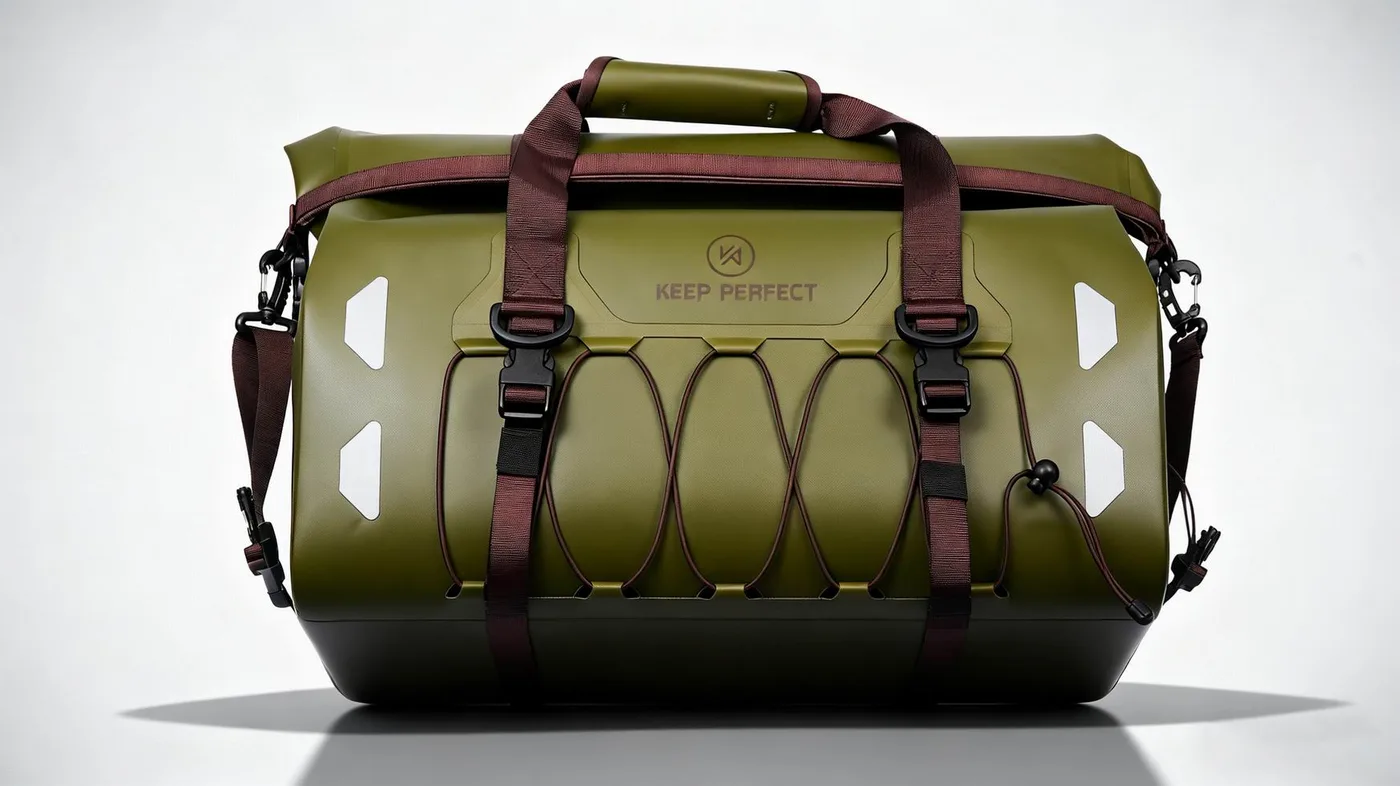
One closing caution. Fabric choice is only half of the durability story, and the other half is how the bag is treated after use: rinsed, dried in shade, stored loosely rolled and kept out of prolonged sun. A well-cared-for 0.4 mm bag outlasts an abused 0.7 mm bag in almost every field dataset we have seen. Start with the right laminate using the roll-top dry bag range as a reference, then spend the remaining effort on the care routine, which costs nothing and doubles service life.
Frequently asked questions
Q1. Should I choose a flexible or a durable dry bag fabric?
Choose against your dominant failure mode. Folding, cold and packability favour a thin laminate such as 0.3 mm on 210D; abrasion and puncture favour 0.5 mm on 500D. Most mixed use lands at 0.4 mm on 420D.
Q2. Does thicker TPU fabric always last longer?
Only against abrasion and puncture. A thicker film creases sooner, folds with more force in the cold and welds into a stiffer joint, so a 0.7 mm bag can fail at a corner weld before a 0.4 mm bag shows any wear.
Q3. What film thickness is best for general use?
Around 0.4 mm on a 420D face. It folds with roughly 6.5 N of force, survives about 15,000 abrasion cycles and adds only 50 g per square metre over a 0.3 mm construction.
Q4. Why does my dry bag feel stiff in winter?
Polymers stiffen as they approach their glass transition temperature. TPU stays workable to about minus 25 °C, but thicker film stiffens sooner, so a 0.5 mm bag that rolls easily at 20 °C can fight you at minus 15 °C.
Q5. Is PVC more durable than TPU?
PVC resists abrasion reasonably and costs less per square metre, but it relies on plasticisers that migrate and it turns brittle near minus 10 °C. TPU keeps its flexibility, has no plasticiser to lose and welds more cleanly.
Q6. How much weight does a thicker film add?
About 230 g per square metre when moving from 0.3 mm to 0.5 mm, which is roughly 125 g on a 20 L bag. Going to 0.7 mm on 840D adds about 360 g over a mid-weight build.
Q7. What denier should I look for in a dry bag?
420D or 500D for most uses. 210D saves weight but tears at around 18 N; 840D adds 90 g per square metre over 500D for a smaller gain and makes the bag noticeably harder to roll.
Q8. Does a higher hydrostatic head mean a better bag?
Not on its own. A 0.5 mm laminate tests near 12,000 mm against 8,000 mm for 0.3 mm, but real bags leak at the closure and the weld corners long before the film is challenged.
Q9. Where does a dry bag fabric fail first?
At the fold line, where the crease crosses a welded corner or a stiffening band. A 0.5 mm laminate shows a visible crack there after about 12,000 fold cycles, compared with roughly 30,000 for a 0.3 mm laminate.
Q10. Is a laminated or a coated fabric better?
Laminated keeps the film properties intact and welds strongly but can delaminate at a fold. Coated drapes and folds more easily but cracks in the weave under pressure. Both are fine if the fold zone is kept clear of welds.
Q11. How do I test fabric flexibility before buying?
Roll the closure three times at room temperature, then repeat it after two hours in a refrigerator at about 2 °C. If the cold roll needs noticeably more effort, the laminate is too thick for winter use.
Q12. Can I repair a cracked fold line?
Yes, with a TPU patch and a heat press or a contact adhesive patch, but the repair is always stiffer than the original film and will crack again nearby. Treat a cracked fold as a sign to down-spec the thickness next time.
Q13. What is the most durable construction for a rental fleet?
About 0.5 mm TPU on 500D with taped or reinforced corners, inspected every 60 days. In daily commercial use the fabric is rarely the first failure; buckles, straps and closure discipline fail earlier.
Q14. Does a heavier fabric dry more slowly?
Yes. Thick film does not wick and a heavy face fabric holds water at the fold, so a 0.7 mm bag takes noticeably longer to dry inside than a 0.35 mm bag and is more prone to mildew if stored damp.
Q15. How does UV affect the flexibility versus durability balance?
UV crosslinks the surface of the film, making it stiffer and more prone to creasing over time. A bag used 200 days a year in strong sun will stiffen measurably within three seasons, regardless of the starting thickness.
Q16. Should a small bag use thinner fabric than a large one?
Usually yes. A 5 L bag is folded far more often per litre of contents and is carried lightly, so 0.3 mm on 210D makes sense. A 60 L expedition bag sees abrasion and heavy loads and belongs at 0.5 mm or thicker.
People also ask
What makes a dry bag fabric flexible?
Thin film and a light face fabric. A 0.3 mm TPU film on 210D nylon folds with about 4 N of force, while the same film at 0.5 mm on 500D needs close to 9 N because the thicker polymer resists creasing.
Is a thicker dry bag always better?
No. Thickness improves abrasion and puncture resistance but worsens fold fatigue, cold handling and weld flexibility, so an over-specified bag is often heavier and less reliable at the closure than a correctly specified one.
How do you measure fabric durability on a dry bag?
With standard abrasion rigs such as the Martindale and rotary platform methods published by ASTM and ISO, reported as cycles to failure, plus a puncture probe test in newtons and a weld peel test in newtons per 25 mm.
Why does my dry bag crack at the fold?
Because strain concentrates where the crease crosses a welded corner or stiffening band. A 0.5 mm laminate reaches a visible crack in about 12,000 fold cycles, and grit plus cold shortens that considerably.
What fabric works best in freezing conditions?
A thin TPU laminate. TPU soft segments have a glass transition near minus 35 °C, so 0.3 mm film still folds at minus 25 °C, whereas standard PVC turns brittle at the fold near minus 10 °C.
Does denier affect waterproofing?
Barely. Waterproofing comes from the film or coating; the face fabric controls tear strength, dimensional stability and abrasion behaviour. 420D versus 1000D changes how the bag wears, not whether it leaks.
Need this in production volume?
QUANZHOU JUNYUAN BAGS has produced waterproof bags since 2014 in an SGS-verified 4,950 m2 facility in Fujian, China. Minimum order 500 pieces, sampling in 6–10 working days, bulk in 35–50 days, FOB Xiamen — write to service@junyuanbags.com with your spec and target market.