Home / Blog / Materials & Construction
Cold Crack Temperature of TPU
Polyether-based TPU stays flexible to roughly minus 45 degrees Celsius and polyester-based TPU to about minus 30 degrees, while standard plasticised PVC turns brittle between minus 10 and minus 20 degrees and stiffens noticeably well before that. Those three figures explain why a TPU dry bag can still be rolled shut at minus 25 degrees and a PVC bag of the same thickness cracks at the fold line.
Cold crack temperature is the point at which a film stops deforming and starts breaking, and it is a different property from stiffness, from water resistance and from tensile strength. A film can be stiff and still safe, or flexible and already failing. This guide separates those ideas, shows how the test is actually run, and gives the numbers you need to specify a bag for a real winter climate.
- What cold crack temperature actually means
- Glass transition, brittle point and why there are two numbers
- Polyether versus polyester TPU in the cold
- How PVC behaves below freezing
- Reading a cold bend or impact test report
- Thickness, weld and the cold penalty
- What happens at the fold line in winter
- Cold plus water: the combined effect
- Plasticiser migration and how ratings drift
- Field checks for cold flexibility
- Specifying low temperature performance
- Care and storage in cold climates
- Where cold crack sits among the other material limits
What cold crack temperature actually means
Cold crack temperature is the temperature at which a film, subjected to a defined impact or bend, fractures rather than deforms. It is sometimes called the brittle point. Below that temperature the polymer chains have too little thermal energy to rearrange under load, so stress that would normally be absorbed by chain movement is instead taken up by bond stretching, and the material fails in a brittle manner.
The property matters for dry bags for one specific reason: the roll-top closure. Every time you close a bag you put a tight bend into the film at the fold line, and that bend is the highest strain event in the life of the bag. If the film is below its brittle point when you make that bend, the fold cracks, and a cracked fold line is a permanent leak path even after the bag warms up again.
It is worth separating brittleness from stiffness, because people conflate them constantly. A film can stiffen substantially in the cold and still be perfectly serviceable, because stiffness only makes the bag harder to handle. Brittleness is different in kind: once the material cracks, the damage is permanent. Winter usability is set by stiffness; winter survival is set by the brittle point.
Glass transition, brittle point and why there are two numbers
Two figures appear in polymer data sheets and they are not the same thing. The glass transition temperature, written Tg, is where the amorphous phase of the polymer changes from rubbery to glassy. It is measured by differential scanning calorimetry or dynamic mechanical analysis and appears as a gradual transition over a temperature range rather than as a single point.
The brittle point is a performance measurement taken under a specific test: a defined specimen, a defined impact or bend, and a defined pass criterion. It is always higher than the Tg, typically by 10 to 25 degrees, because a film can already be past its glass transition and still survive a gentle bend. The brittle point answers the practical question; the Tg answers the materials science question.
That gap is the reason a film with a Tg of minus 50 degrees can still crack in a hard fold at minus 25 degrees. If you are writing a specification, quote the brittle point from a named test method and a named geometry, not the Tg. A Tg figure alone will consistently over-promise, and the person who discovers that will be standing in the cold with a cracked bag.
Polyether versus polyester TPU in the cold
TPU is a block copolymer with hard segments that provide strength and soft segments that provide flexibility, and the chemistry of the soft segment determines the low temperature behaviour. Polyether soft segments give the best cold performance, with brittle points commonly in the minus 45 to minus 60 degree range. Polyester soft segments give better abrasion and oil resistance but a higher brittle point, typically minus 25 to minus 40 degrees.
The trade is real and worth stating plainly. A polyester-based TPU will outlast a polyether-based one on abrasion by a meaningful margin, which matters for bags dragged across rock, but it stiffens earlier in the cold. For a bag that will see both, the usual answer is a polyester TPU body with a slightly heavier film, because film thickness partly compensates for the higher brittle point in a fold.
| Film family | Glass transition | Typical brittle point | Abrasion life | Best duty |
|---|---|---|---|---|
| Polyether TPU | -55 to -65 degrees | -45 to -60 degrees | Good | Cold climates, expedition |
| Polyester TPU | -35 to -48 degrees | -25 to -40 degrees | Very good | General and rocky use |
| Polycaprolactone TPU | -30 to -42 degrees | -20 to -35 degrees | Very good | Temperate, high wear |
| Plasticised PVC, fresh | -20 to -32 degrees | -10 to -20 degrees | Fair | Mild climates only |
| Plasticised PVC, aged 5 years | -5 to -15 degrees | 0 to -12 degrees | Poor | Not for cold use |
| Silicone-coated nylon | -45 to -55 degrees | -35 to -50 degrees | Fair | Ultralight pack liners |
Read the last two rows together, because they carry the most important message in this guide. A PVC bag that is fine in its first winter can be a cracking risk by its fifth, because the plasticiser that gives PVC its flexibility is not permanently bound and slowly leaves the film. Ageing moves the brittle point upward by 10 to 20 degrees over five years.
How PVC behaves below freezing
Rigid PVC is brittle at room temperature. Flexible PVC is made workable by adding a plasticiser, typically 25 to 45 percent by weight, which sits between the polymer chains and keeps them mobile. The plasticiser is what gives the film its low temperature flexibility, and it is also the component that is not chemically bonded to anything and can therefore leave.
Migration happens through three routes: volatilisation into air, extraction by water and oils, and contact transfer into whatever the film touches. In a dry bag the dominant route is usually volatilisation, and it accelerates with heat, so a bag stored in a hot garage loses plasticiser faster than one stored cool. A five-year-old PVC bag can have lost 15 to 25 percent of its plasticiser content, which is enough to raise the brittle point above freezing.
This is not an argument that PVC is unusable. In temperate climates where the bag never sees temperatures below about minus 5 degrees, a fresh PVC bag performs adequately and costs less. It is an argument that cold-climate product should not be specified in PVC at all, and that any PVC product should carry a service life expectation rather than an indefinite one. Our TPU versus PVC comparison covers the rest of the trade.
Reading a cold bend or impact test report
Two test families dominate low temperature work. The bend or mandrel test wraps a strip around a rod of defined diameter at a series of falling temperatures and records the lowest temperature at which no cracks appear. The impact test strikes a folded or flat specimen with a defined striker energy and records the temperature at which 50 percent of specimens fail.
The impact method is the stricter of the two and usually reports a higher brittle point for the same film, because impact loading gives the chains less time to respond. Both methods are published by the ASTM, and equivalent low temperature flexibility methods exist from the ISO. Whichever you use, the report must state the method, the specimen thickness, the mandrel diameter or striker energy, and the conditioning time.
Conditioning time is the clause most often skipped, and it invalidates the result. A specimen pulled from ambient and placed in a cold chamber needs long enough for the whole cross-section to reach temperature; for a 0.5 mm film that is around 30 minutes, and for a laminate with a heavy face fabric it can be 45 minutes or more. Test too early and the core is still warm, and the reported brittle point will be optimistic by several degrees.
Thickness, weld and the cold penalty
A thicker film behaves worse in a cold bend test than a thin one made of the same polymer, because the outer surface of a bend sees more strain as thickness rises. Bending a 0.6 mm film around a 6 mm mandrel puts roughly 5 percent more surface strain on the outside of the bend than bending a 0.3 mm film around the same rod. That difference moves the apparent brittle point upward.
In practice a 0.3 mm polyether TPU might record a brittle point near minus 55 degrees while the same polymer at 0.6 mm records closer to minus 45 degrees. The film has not changed; the strain state has. This is why thickness and cold performance pull against each other, and why a winter bag is not simply the thickest bag available.
| Film build | Mandrel diameter | Outer surface strain | Apparent brittle point shift | Comment |
|---|---|---|---|---|
| 0.30 mm | 6 mm | 4.8% | Baseline | Thin films bend tightest |
| 0.40 mm | 6 mm | 6.3% | +3 to 5 degrees | Small penalty |
| 0.50 mm | 6 mm | 7.7% | +6 to 9 degrees | Common expedition build |
| 0.60 mm | 6 mm | 9.1% | +9 to 13 degrees | Reinforced base panels |
| 0.50 mm | 12 mm | 4.0% | -2 to 3 degrees | Gentler fold recovers margin |
| 0.60 mm | 20 mm | 2.9% | -5 to 7 degrees | Loose roll, low strain |
The last two rows contain the practical fix. A gentler fold radius recovers most of the cold margin that thickness costs, which means a bag designed with a wide, relaxed roll geometry can use a thicker film and still work in the cold. Fold geometry is a design decision, and it is free. Our film thickness guide covers the same trade from the durability side.
What happens at the fold line in winter
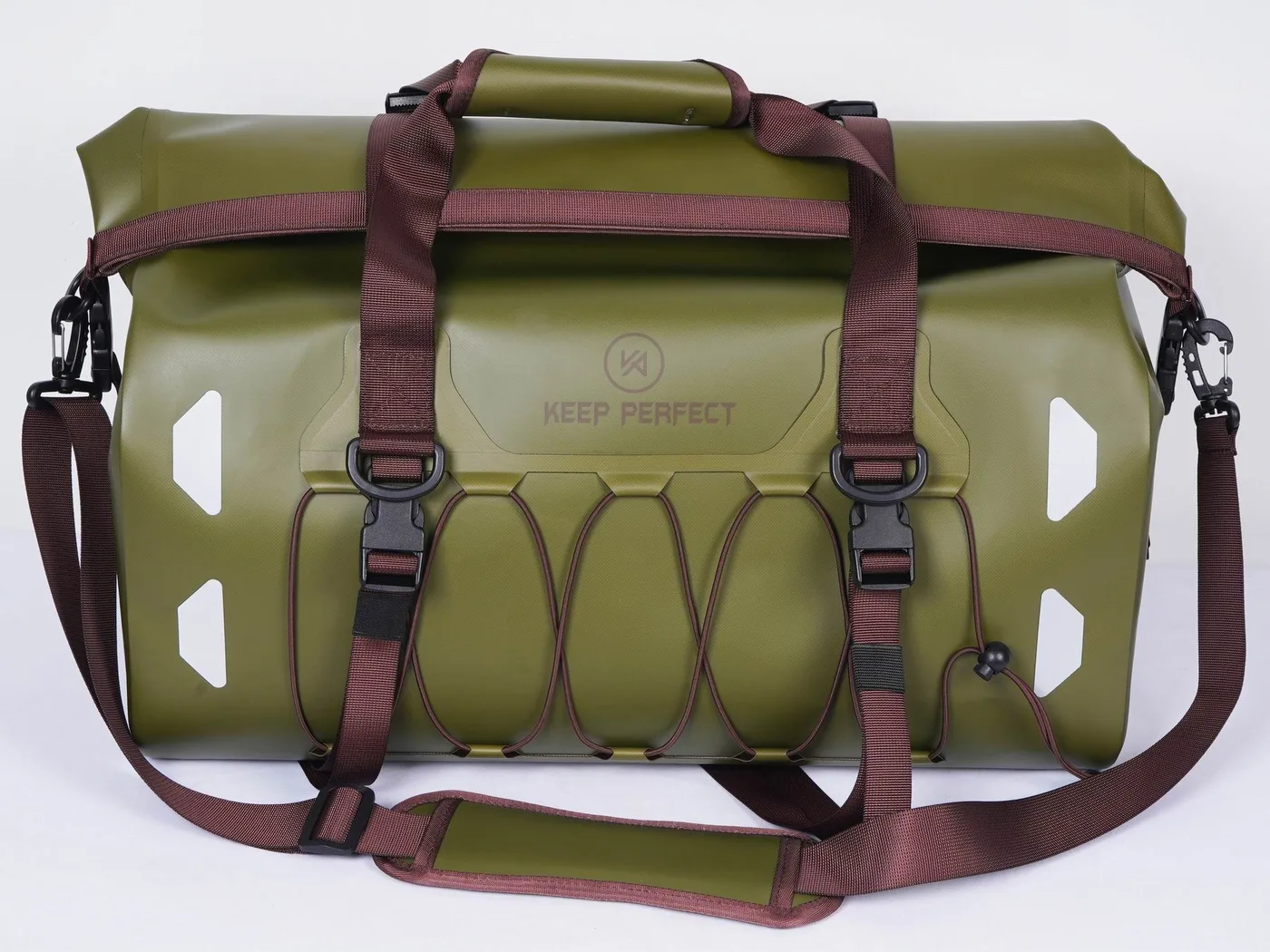
The fold line is where cold damage starts, and the pattern is distinctive. A bag rolled at a temperature below its brittle point develops fine cracks running along the fold, usually 2 to 8 mm long and aligned with the roll direction. These are easy to miss because they close up when the bag is unrolled, and they only reveal themselves as leaks in the next immersion.
Cracking is cumulative. One cold fold may produce a few microcracks that do not leak; a winter of daily cold folds propagates them into a continuous split along the fold line, at which point the bag is finished. The failure looks sudden but it is not. Inspecting the fold line with a bright light at the end of a winter season catches it while the bag can still be repaired.
The second winter failure mode is not cracking at all but closure failure. Cold film is stiffer and does not conform to itself, so three folds made at minus 20 degrees seal less completely than three folds made at room temperature. Warm the mouth of the bag with your hands or against your body before rolling, and add a fourth fold in deep cold to restore the sealing margin.
Cold plus water: the combined effect
Water changes low temperature behaviour, and the direction of the change depends on the polymer. For TPU, absorbed moisture acts as a mild plasticiser and tends to lower the effective stiffening temperature slightly, which is helpful. But water also freezes, and ice formed inside the face fabric weave turns a flexible composite into a stiff board.
The stiffening from frozen water in the weave is usually the dominant effect and it is not a property of the film at all. A soaked bag frozen to minus 15 degrees is considerably stiffer than a dry bag at the same temperature, and the stiffness is concentrated exactly where you need movement: at the fold. Shake out as much water as possible before the temperature drops, and if the bag has frozen overnight, warm it before rolling.
There is also an abrasion interaction. Frozen grit held in the weave acts as an abrasive paste against the film every time the bag flexes, and cold film is less able to deform around a hard particle. That combination is why bags used on frozen ground wear through the lower panels faster in winter than in summer, and why winter bags deserve a reinforced base. See our puncture data for how much strength is lost when a frozen wet laminate is probed.
Plasticiser migration and how ratings drift
No film rating is permanent, and the one that drifts fastest is the brittle point of plasticised PVC. Migration is slow at room temperature and much faster in heat: losing plasticiser at 40 degrees happens roughly four to six times faster than at 20 degrees. A bag left on a dashboard or in a hot container can lose more plasticiser in one summer than in three years of cool storage.
TPU has no plasticiser to lose, which is the single biggest durability argument in its favour and the reason its brittle point is effectively stable over the service life. Its low temperature performance does drift slightly through another mechanism: hydrolysis and UV-induced chain scission slowly change the soft segment, but the shift is typically only 3 to 6 degrees over a decade of normal use.
| Storage condition | Years to +10 degree shift, PVC | Years to +10 degree shift, TPU | Main mechanism |
|---|---|---|---|
| Cool dark, 15 degrees average | 7-9 years | 20+ years | Slow volatilisation |
| Temperate, 20 degrees average | 5-7 years | 18-22 years | Volatilisation |
| Warm, 28 degrees average | 3-4 years | 14-18 years | Accelerated volatilisation |
| Hot vehicle, 45 degrees peak | 1-2 years | 9-12 years | Rapid loss plus oxidation |
| Hot and humid, 35 degrees | 2-3 years | 8-11 years | Loss plus hydrolysis |
| Continuous strong UV exposure | 2-3 years | 7-10 years | Chain scission |
The practical rule is that TPU keeps its cold rating roughly three times longer than PVC under the same conditions. For a rental fleet, a rescue team or anyone who cannot control storage, that ratio is the whole argument. It also explains why a used PVC bag bought cheaply in a warm market may already be a cold-crack risk regardless of how it looks.
Field checks for cold flexibility
You do not need a cold chamber to make a reasonable judgement about a film. A household freezer reaches minus 18 degrees, which is cold enough to separate the films that matter from the ones that do not, provided you condition properly and use a consistent bend geometry. Run the same test on two bags and you will get a reliable ranking.
- Cut or fold a test strip from an inconspicuous area, or use a sample swatch if one is available.
- Place the strip flat in a freezer at minus 18 degrees for at least 45 minutes so the core is fully cold.
- Fold the cold strip around a 6 mm rod with the film side outward, in one smooth motion, within 10 seconds.
- Inspect the fold under a bright light for whitening, which is the precursor to cracking.
- Unfold and refold twice more, then inspect again for any crack longer than 2 mm.
- Repeat the whole sequence on a wet strip that has been frozen, which is the harsher and more realistic case.
Whitening alone is not failure; it is stress-induced crystallisation and it usually disappears as the film warms. Cracking is failure. A film that shows whitening but no crack at minus 18 degrees will generally be usable to around minus 25 degrees; one that cracks at minus 18 degrees should not be taken below about minus 10 degrees.
Specifying low temperature performance
Write the requirement as a brittle point from a named test method, at a stated thickness, with a stated conditioning time, plus a margin over the lowest temperature the product will actually see. A margin of at least 15 degrees is sensible, because real-world folds are faster and tighter than laboratory ones and because ageing will erode part of the margin over the service life.
Then specify the polymer class, not just the number. Naming polyether or polyester TPU makes the requirement verifiable at incoming inspection through a simple bend test, and it prevents a substitution that meets the number on paper through a different formulation with poorer abrasion life. Specify both properties, because either one alone can be met in a way that harms the other.
| Target market climate | Lowest expected temperature | Required brittle point | Recommended film | Extra measures |
|---|---|---|---|---|
| Temperate coastal | -5 degrees | -25 degrees | Polyester TPU, 0.4 mm | None |
| Continental winter | -20 degrees | -40 degrees | Polyester TPU, 0.5 mm | Wide fold geometry |
| Nordic and alpine | -35 degrees | -55 degrees | Polyether TPU, 0.4 mm | Reinforced fold line |
| Polar expedition | -50 degrees | -65 degrees | Polyether TPU, 0.35 mm | Warm before rolling |
| Winter rental fleet | -25 degrees | -50 degrees | Polyether TPU, 0.5 mm | Annual fold inspection |
| High altitude tropical | -15 degrees | -40 degrees | Polyester TPU, 0.5 mm | UV stabiliser package |
Notice the polar row: the film gets thinner, not thicker. At extreme low temperature the strain argument dominates, and a thinner film with a wide fold geometry outperforms a thick one. This is the counter-intuitive part of cold specification and the reason generic advice to buy the thickest bag available is wrong in cold climates.

Care and storage in cold climates
Most cold damage is avoidable through handling rather than specification. Warm the mouth of the bag before rolling, using your hands or the inside of a jacket for 30 to 60 seconds. Roll slowly rather than quickly, because a fast fold applies a higher strain rate and effectively raises the brittle point by several degrees. Add a fold rather than forcing a tight one.
Avoid flexing a frozen bag at all if you can. If a bag has frozen overnight, bring it inside or into a sleeping bag for 20 to 30 minutes before opening or closing it. Never stamp on a frozen bag, never sit on one, and never drag one across frozen ground by a strap, because all three apply impact or peel loads to film that has no ability to deform.
- Warm the mouth for 30 to 60 seconds before rolling in sub-zero temperatures.
- Roll slowly; a fast fold raises the effective brittle point by several degrees.
- Add a fourth fold in deep cold to restore the sealing margin lost to stiffness.
- Never flex, stamp on or drag a bag that has frozen solid; let it thaw first.
- Inspect the fold line under a bright light at the end of every winter season.
- Store bags loosely rolled in a cool dark place; heat accelerates every ageing route.
Where cold crack sits among the other material limits
Cold crack is one of five properties that decide whether a dry bag film is fit for purpose, alongside water column resistance, abrasion life, tear strength and UV stability. It is unusual among them in one respect: it is the only one where the failure is instantaneous and permanent rather than gradual. Abrasion gives warning over months; a cold crack happens in one motion.
It is also the property most often omitted from specifications, because most product is sold into temperate markets where it never becomes critical. The moment a range is sold into a winter market, or used by a rescue team, or shipped through a cold chain, it moves to the top of the list. Brands that sell globally should test for it even if only part of the range needs it.
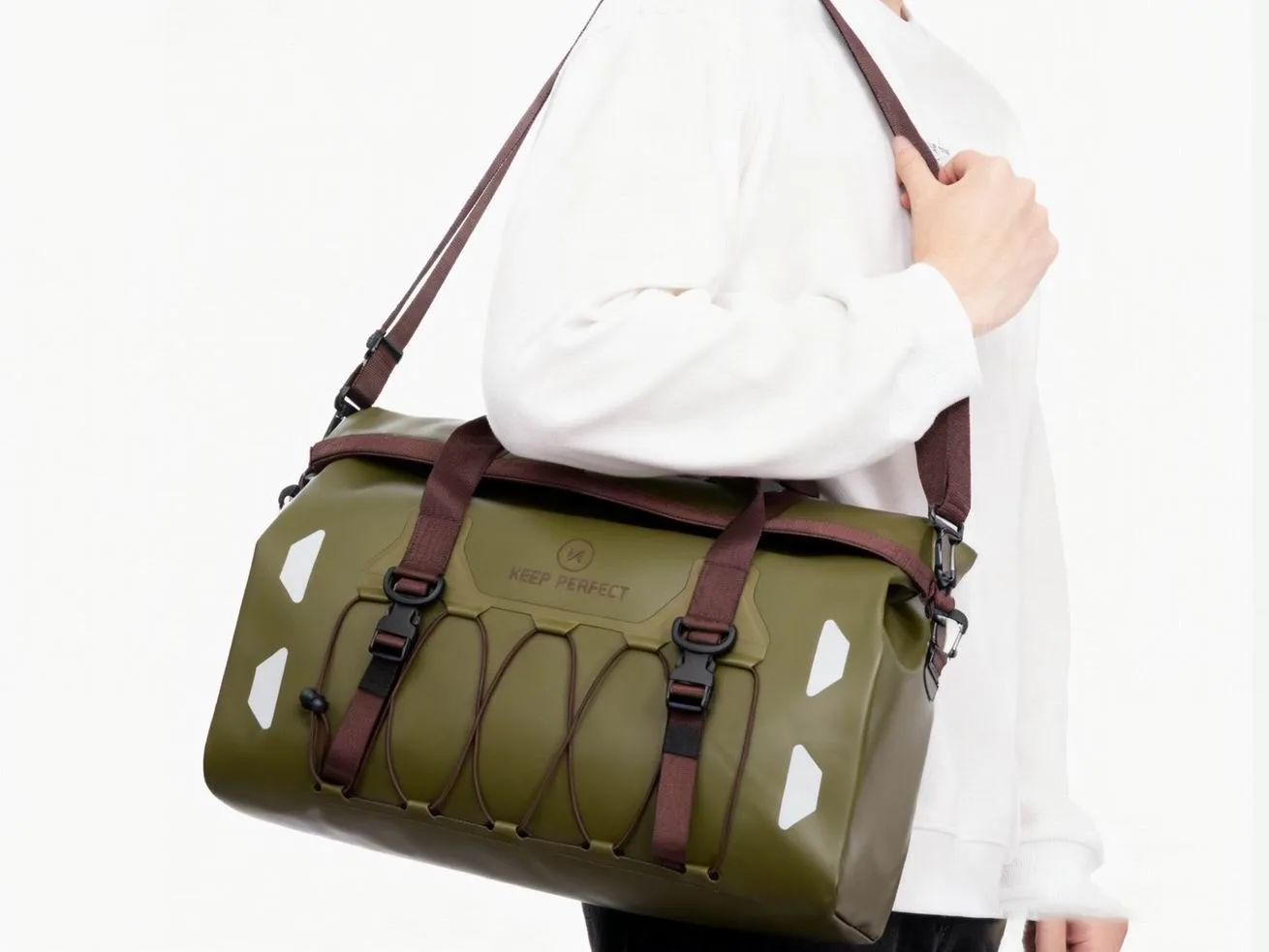
Our line has been produced since 2014 in an SGS-verified 4,950 m2 facility with 149 machines across seven production lines, and cold performance is specified by polymer class rather than by a generic figure for exactly the reasons above.Minimum order is 500 pieces with sampling in 6 to 10 working days and bulk in 35 to 50 days. Our flexibility versus durability notes take the trade further, the plasticiser discussion covers the chemistry, and the freezing conditions guide answers the practical questions people actually search for. Start from the roll-top dry bag range to see the fold geometry these numbers assume.
Frequently asked questions
Q1. What is the cold crack temperature of TPU?
Polyether-based TPU has a brittle point around minus 45 to minus 60 degrees and polyester-based TPU around minus 25 to minus 40 degrees. Both stay flexible well below anything a dry bag will meet in normal winter use.
Q2. At what temperature does PVC become brittle?
Fresh plasticised PVC typically turns brittle between minus 10 and minus 20 degrees. As the plasticiser migrates out, that point rises by 10 to 20 degrees over about five years, so an aged PVC bag can crack near freezing.
Q3. Will a TPU dry bag crack in winter?
Not at normal winter temperatures. A polyether TPU bag rolled at minus 25 degrees is still roughly 20 to 30 degrees above its brittle point, so the fold line is safe.
Q4. What is the difference between glass transition and brittle point?
Glass transition is a materials measurement of where the polymer turns glassy; brittle point is a performance test under a defined bend or impact. The brittle point is usually 10 to 25 degrees higher than the glass transition.
Q5. Why does a thicker film crack sooner in the cold?
A thicker film puts more strain on the outer surface of the same bend. Going from 0.3 mm to 0.6 mm around a 6 mm mandrel roughly doubles surface strain and raises the apparent brittle point by 9 to 13 degrees.
Q6. Does water make cold cracking worse?
Yes, mainly through ice in the face fabric. A soaked bag frozen to minus 15 degrees is much stiffer than a dry one at the same temperature, and the stiffness is concentrated at the fold where you need movement.
Q7. How do I test a bag for cold flexibility at home?
Freeze a strip at minus 18 degrees for at least 45 minutes, fold it around a 6 mm rod in one motion, and inspect for cracks. Whitening is not failure; any crack longer than 2 mm is.
Q8. Should I use a thicker bag for winter?
Not necessarily. At extreme low temperature a thinner film with a wide, relaxed fold geometry outperforms a thick one, because bend strain is the limiting factor rather than film strength.
Q9. Why do dry bags crack at the fold line?
The fold is the highest strain event in the life of the bag. Rolled below the brittle point, the film develops fine cracks along the fold that close up when unrolled and only show as leaks later.
Q10. How many folds should I use in cold weather?
Four rather than three. Cold film is stiffer and conforms to itself less completely, so an extra fold restores the sealing margin that stiffness costs.
Q11. Does TPU lose its cold performance over time?
Very slowly. There is no plasticiser to migrate, so the brittle point shifts by only about 3 to 6 degrees over a decade, against 10 to 20 degrees for PVC in five years.
Q12. How does heat affect the cold rating?
Heat accelerates every ageing route. Plasticiser loss at 40 degrees runs four to six times faster than at 20 degrees, so a bag stored in a hot vehicle can lose in one summer what cool storage loses in three years.
Q13. What brittle point should I specify for a Nordic market?
Minus 55 degrees for a market reaching minus 35 degrees, using polyether TPU at 0.4 mm with a reinforced fold line. That gives a 20 degree margin over the expected low.
Q14. Is polyether or polyester TPU better for a dry bag?
Polyether for cold performance, polyester for abrasion. For a bag that sees both, use polyester TPU with a slightly heavier film and a wide fold geometry.
Q15. Can a cracked fold line be repaired?
Yes if caught early. A welded or bonded patch across the fold restores the barrier, but the fold becomes stiffer locally, so the bag should be retired from cold-season use after the repair.
Q16. How should I store dry bags in cold climates?
Loosely rolled, cool and dark, and thawed before flexing. Never fold, stamp on or drag a bag that has frozen solid, because cold film has no ability to deform under impact.
People also ask
At what temperature does TPU crack?
Polyether TPU cracks around minus 45 to minus 60 degrees and polyester TPU around minus 25 to minus 40 degrees under standard bend testing. Both figures sit far below typical winter conditions.
Is TPU better than PVC in cold weather?
Yes, substantially. TPU has no plasticiser to lose and stays flexible three times longer, while PVC turns brittle between minus 10 and minus 20 degrees when fresh and drifts higher as it ages.
Why does my dry bag crack in the winter?
Because it was folded below its brittle point. The roll-top fold is the highest strain event in the life of a bag, and a film rolled too cold develops fine cracks that only show as leaks later.
How do you keep a dry bag flexible in freezing weather?
Warm the mouth for 30 to 60 seconds before rolling, fold slowly rather than quickly, add a fourth fold, and never flex a bag that has frozen solid until it has thawed.
Does thickness make a dry bag more cold resistant?
No, it makes it less so under the same bend. A thicker film puts more strain on the outside of the fold, raising the apparent brittle point by 9 to 13 degrees from 0.3 mm to 0.6 mm.
What temperature is safe for a PVC dry bag?
Above about minus 5 degrees for a fresh bag, and above freezing once it is a few years old. Below that, choose TPU, which is rated far lower and holds its rating much longer.
Need this in production volume?
QUANZHOU JUNYUAN BAGS has produced waterproof bags since 2014 in an SGS-verified 4,950 m2 facility in Fujian, China. Minimum order 500 pieces, sampling in 6–10 working days, bulk in 35–50 days, FOB Xiamen — write to service@junyuanbags.com with your spec and target market.