Home / Blog / Materials & Construction
TPU Film Thickness: 0.3mm vs 0.5mm
Between 0.3mm and 0.5mm TPU film, the 0.3mm option is about 40% thinner and can save roughly 220 g per square metre, while 0.5mm provides more puncture reserve, a broader welding window and better tolerance of deck abrasion. On a 20L roll-top using 0.72 m2 of film, the theoretical film difference is about 158 g before webbing and hardware. Choose 0.3mm for compact inner bags and low-contact day use; choose 0.5mm for exposed watersports, rental fleets, rigid contents and repeated dragging.
Thickness is not a quality grade by itself. Resin formulation, textile backing, weld width, temperature control and closure geometry can overturn a simple millimetre comparison. This guide separates bare-film arithmetic from finished-bag performance, then sets realistic decision rules for buyers reviewing TPU material samples. It also explains which tests reveal a meaningful difference and which sales claims merely repeat a thickness number without controlling the rest of the construction.
- What 0.3mm and 0.5mm describe in a TPU specification
- The weight difference in a finished dry bag
- Abrasion reserve on decks, rocks and vehicle racks
- Puncture behaviour around tools and hard corners
- Flexibility, fold radius and closure feel
- Cold weather and hot-car performance
- RF welding windows for thin and heavy film
- Waterproofness is not proportional to thickness
- Matching gauge to activity and bag format
- Service life, repairability and visible warning signs
- How to compare samples without misleading results
- Writing a purchase brief that controls more than gauge
- The practical verdict on 0.3mm vs 0.5mm TPU film
What 0.3mm and 0.5mm describe in a TPU specification
A thickness callout can refer to a free-standing TPU film, the polymer layer on a textile, or the complete laminated material. Those are not interchangeable. A 420D polyester base laminated with TPU may measure 0.45 mm overall even though the TPU component is much thinner. Before comparing two quotations, ask where the micrometre is placed, how many readings are taken and whether adhesive plus textile are included. A nominal value without a measurement method can hide variation larger than the difference under discussion.
For this guide, 0.3mm and 0.5mm mean homogeneous TPU film measured away from welds, embossing and edges. A sensible incoming check records at least five positions across the usable width and reports minimum, maximum and average. Thickness gauges should use a defined foot pressure because a soft film compresses under the instrument. ASTM International publishes film and sheeting measurement methods that can anchor the procedure, but the purchase document still needs agreed tolerances.
| Specification term | What it measures | Typical tool | Common mistake |
|---|---|---|---|
| Nominal film thickness | Target polymer gauge | Micrometre | Assuming every point equals target |
| Total composite thickness | Textile, bond and polymer | Thickness gauge | Calling it film thickness |
| Minimum gauge | Thinnest accepted reading | Five-point map | Reporting only the average |
| Weld stack | Two layers under pressure | Cross-section or gauge | Comparing it with one free layer |
| Coating add-on | Polymer mass per area | Scale and area cutter | Converting directly to millimetres |

The weight difference in a finished dry bag
TPU density is commonly near 1.10 to 1.22 g/cm3 depending on formulation. Using 1.15 g/cm3, a 0.3 mm film weighs about 345 g/m2 and a 0.5 mm film about 575 g/m2, a difference of 230 g/m2. Cutting waste does not enter the finished bag, so calculate weight from actual panel area rather than purchased roll area. A 5L pouch using 0.32 m2 gains about 74 g; a 40L duffel using 1.45 m2 gains about 334 g.
Finished weight includes face textile, reinforcement, straps, buckles, labels and weld overlaps. On a harnessed backpack, 158 g of extra film may be less than 8% of total mass; on an ultralight 2L pouch it can increase mass by more than half. The decision therefore depends on product format. Compare complete prototypes, not loose swatches, and weigh five samples to expose process variation. The fabric-weight matching guide adds denier and reinforcement to the same calculation.
| Bag format | Estimated film area | 0.3mm film mass | 0.5mm film mass | Difference |
|---|---|---|---|---|
| 2L inner pouch | 0.22 m2 | 76 g | 127 g | 51 g |
| 5L roll-top | 0.32 m2 | 110 g | 184 g | 74 g |
| 20L roll-top | 0.72 m2 | 248 g | 414 g | 166 g |
| 30L backpack body | 1.05 m2 | 362 g | 604 g | 242 g |
| 40L dry duffel | 1.45 m2 | 500 g | 834 g | 334 g |
Abrasion reserve on decks, rocks and vehicle racks
Abrasion removes material one small pass at a time. A thicker film begins with more sacrificial depth before a scuff reaches the textile bond or creates a pinhole, so 0.5mm has a genuine advantage where the exposed polymer face slides on sand, painted metal or moulded boat decks. The advantage is not a universal 67% increase in life, because wear rate changes with grit size, pressure, temperature and whether the surface is wet. A rough quartz grain can cut either gauge quickly if a loaded bag is dragged.
Placement changes the answer. A 0.3mm pouch protected inside a kayak hatch may show little wear after years, while a 0.5mm duffel pulled 20 m across a gravel campsite can be damaged on its first trip. Add replaceable base reinforcement where contact is predictable and teach users to lift rather than drag. For a direct discussion of test methods and failure surfaces, use the TPU abrasion resistance guide. Thickness provides reserve; it never makes poor handling harmless.

Puncture behaviour around tools and hard corners
Puncture starts with concentrated force. A key tooth, fishing lure, stove leg or camera mount places the load on a tiny area, stretching the film until it yields. A 0.5mm sheet generally needs more energy to drive a point through because there is more polymer to deform, but hardness and elongation can change the ranking. A soft 0.5mm formulation may stretch around a rounded object, while a harder one can resist initial indentation yet tear after a notch begins.
Test with the objects the bag will carry. A standard probe offers repeatability, but a packed trial with a 1 kg metal tool roll and a 300 mm controlled drop reveals contact patterns a laboratory point may miss. Protect sharp contents in sleeves and keep them away from weld toes. If puncture is the dominant hazard, thicker film plus an internal floor panel is more efficient than increasing every surface. The puncture testing article explains probe shape, speed and result reporting.
Flexibility, fold radius and closure feel
A 0.3mm TPU film bends around a smaller radius with less force, which makes compact roll-tops easier to close and easier to pack inside another bag. That soft hand is valuable at 2L to 10L, where the closure strip is short and every fold consumes usable height. At 0.5mm, the mouth tends to spring open unless the fold reinforcement and buckle position are tuned. The heavier gauge feels substantial, but an overly stiff closure can encourage users to make only two rolls.
Repeated flexing is not simply won by the thinner option. Thin film experiences lower bending force but has less cross-section remaining after scratches; thick film carries more stress at a tight crease but tolerates surface loss. Avoid designing a permanent knife-edge fold in either gauge. Use a broad roll radius, store the bag loosely and keep the buckle open between trips. The practical closure mechanics are shown in roll-top closure engineering and apply regardless of the thickness printed on the data sheet.
| Decision factor | 0.3mm tendency | 0.5mm tendency | Design response |
|---|---|---|---|
| Hand feel | Soft and compact | Firm and structured | Match mouth reinforcement |
| Three-roll height | Lower | Higher | Allow 15-25 mm extra |
| Corner conformability | Wraps small objects | Bridges hard shapes | Round internal corners |
| Pack-away size | Small | Moderate | Use thin gauge for liners |
| Crease consequence | Less bending force | More local stress | Store loosely rolled |
| Wet grip | Can feel slippery | Easier to hold when textured | Specify surface finish |
Cold weather and hot-car performance
TPU remains flexible across a wider cold range than many plasticised vinyl constructions, but formulation controls the actual low-temperature limit. Thickness does not shift the glass transition temperature; it changes how stiff the user perceives the panel and how much force is required to fold it. At -10 °C, a 0.5mm mouth can be noticeably harder to roll even when the material has not cracked. A 0.3mm bag is easier with gloves, provided the contents do not present sharp frozen edges.
Heat creates a different concern. A closed vehicle can exceed 60 °C in sun, softening some films and allowing tightly folded surfaces to block together. The thicker gauge takes longer to reach ambient temperature but eventually becomes just as hot. Store empty bags out of direct heat, loosen folds and never infer a safe range from gauge alone. Ask for the specific film data sheet, conditioning method and cold-crack result. The cold-crack guide shows why sample conditioning must be stated alongside the number.

RF welding windows for thin and heavy film
Radio-frequency welding heats polar TPU within a controlled field while pressure brings the layers together. Thin film reaches its processing state quickly and leaves less margin between a weak weld and excessive thinning. A 0.5mm stack contains more material, so the process window can be broader, but it also needs enough energy and cooling time to stabilise. Electrode width, power, dwell, pressure and ambient conditions must be recorded as a recipe for each material rather than copied from a different gauge.
A good weld is continuous, centred and free from scorched gloss, bubbles or a sharp step at the electrode edge. Destructive peel or burst checks should fail in the parent material or meet the agreed load, not open neatly along the interface. The RF welding guide covers process fundamentals, while ISO standards can support quality-system control and test documentation. Neither replaces a bag-specific validated recipe.
Waterproofness is not proportional to thickness
An intact 0.3mm TPU film is already a continuous water barrier. Making it 0.5mm does not automatically turn a splash bag into an immersion bag, because most real leakage occurs at the roll-top, a weld interruption, a valve or an attachment. Hydrostatic resistance can increase with gauge, yet a narrow overheated seam may fail far below the film limit. Judge the complete closed product under the intended pressure and duration, then inspect where the first water appears.
This distinction prevents inflated specifications. If two bags use the same closure and both pass a one-metre, 30-minute immersion check, the heavier film should be selected for mechanical life rather than a claim of deeper waterproofing. Read hydrostatic head explained to separate water-column pressure from an IP enclosure test. For carried electronics, test after abrasion and flex conditioning too; a pristine-film result says little about a bag after 500 closure cycles.
Matching gauge to activity and bag format
Use 0.3mm where low packed bulk, easy rolling and protected placement dominate. Examples include document pouches inside luggage, first-aid modules inside a larger pack, phone bags and lightweight liners. Use 0.5mm where the outer wall contacts boat decks, vehicle racks, rough floors or rigid equipment. Exposed paddleboard bags, rental duffels and work-boat tool carriers fall into this group. A hybrid can put heavier material on the base and lighter material on the upper body, provided the transition weld is tested.
Capacity also changes the decision. At 2L, 50 g matters and thick film can consume a disproportionate share of roll height. At 40L, the load itself may reach 12 kg, making puncture reserve and dimensional stability more valuable than a 330 g saving. Evaluate the whole system through the product overview, then record activity, maximum load, contact surface, closure cycles and lowest use temperature in the brief. Gauge becomes defensible when tied to those five conditions.
- Choose 0.3mm for protected inner organisers and smooth pocket contents.
- Choose 0.5mm for exposed deck use, rentals and rigid equipment.
- Consider a heavier base panel instead of adding mass to every face.
- Preserve three comfortable rolls by adjusting body height and mouth reinforcement.
- Test the finished closed bag after abrasion, flex and low-temperature conditioning.
Service life, repairability and visible warning signs
Service life depends on cycles and damage, not a calendar promise. Record how many times the mouth is rolled, how often the base is dragged and whether the bag dries between uses. A light inner pouch may see 30 closure cycles a year; a rental bag can exceed 300. The heavier film offers more depth before abrasion becomes a hole, but both gauges should be retired when a crease turns white, a weld edge lifts, the surface becomes tacky or an air squeeze reveals a persistent leak.
Small punctures in compatible TPU can often be patched with the correct adhesive system and rounded repair piece, but repair approval should follow the product instructions. Thick film offers a broader stable area around a hole; thin film is easier to distort with excess heat or solvent. Do not treat a patch as restoration of the original tested rating without retesting. The TPU patch-kit guide explains preparation, cure time and why field tape is a temporary measure.
How to compare samples without misleading results
Condition all samples for the same 24-hour period, then measure thickness and mass before testing. Cut comparison pieces in the same orientation because textile-backed composites can differ along warp and weft. Run a bend check at room temperature and at the lowest claimed temperature, a controlled abrasion sequence, a puncture test and a seam peel. Finished bags should then receive an air-leak screen and exposure test after conditioning. Five specimens per construction reveal outliers that one presentation sample can conceal.
Write observations as measurements: grams lost after abrasion, newtons at puncture, millimetres of seam peel, leakage location and closure force. Words such as heavy-duty are not test outputs. If the intended claim references ingress protection, consult the IEC framework and use an appropriate competent laboratory. The goal is not to make 0.5mm win every column; it is to discover whether the lighter construction meets the real duty cycle with acceptable margin.
| Check | Specimens | Condition | Useful output | Decision trigger |
|---|---|---|---|---|
| Thickness map | 5 sheets | 23 °C, 24 h | Min, mean, max in mm | Minimum below tolerance |
| Mass per area | 5 cuts | Dry, conditioned | g/m2 | Finished weight exceeds target |
| Abrasion sequence | 5 panels | Wet grit interface | Cycles to film exposure | Base wears before target |
| Puncture | 5 panels | Defined probe and speed | Peak force in N | Hard contents exceed margin |
| Seam peel | 5 weld strips | After 24 h cooling | N per 25 mm | Interface opens cleanly |
| Closed-bag exposure | 3 bags | After 500 folds | Leak location and time | Any internal wetting |
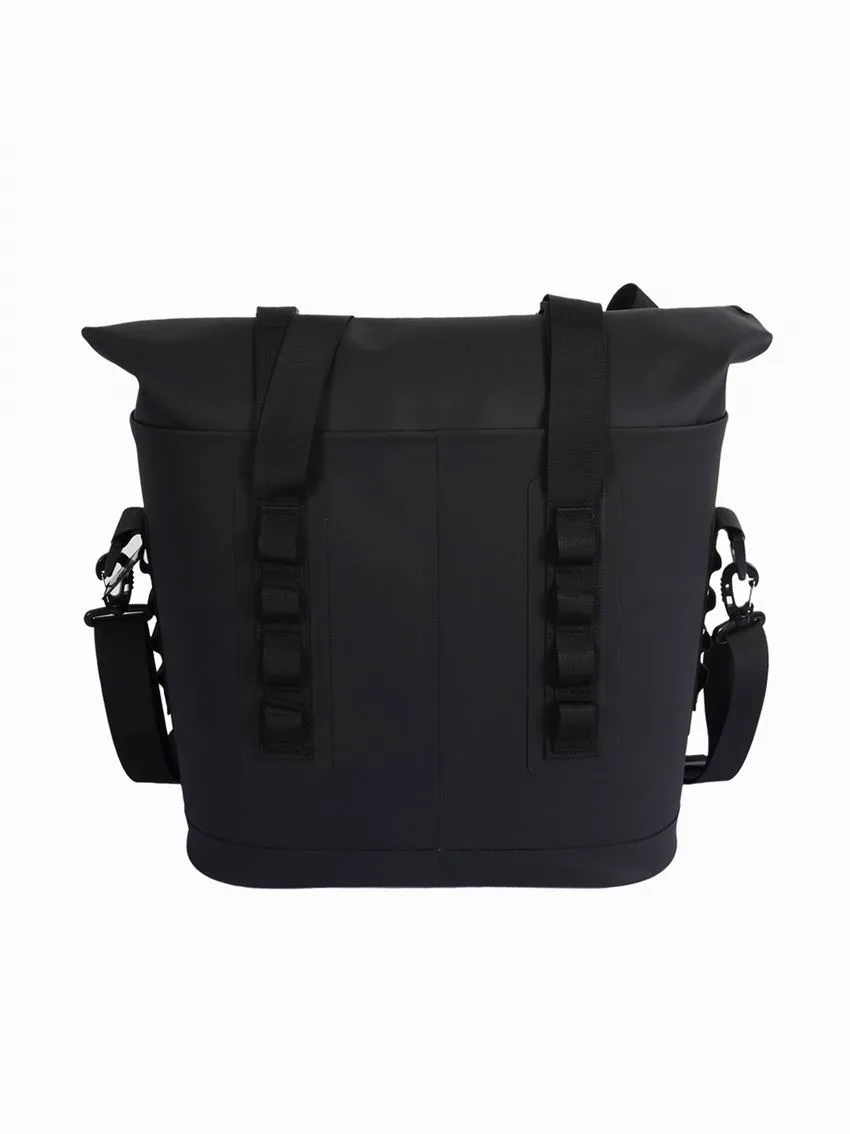
Writing a purchase brief that controls more than gauge
A useful brief names polymer type, colour, surface finish, nominal and minimum thickness, overall composite construction, usable width and allowed variation. It then defines weld width, target bag mass, maximum load, closure folds and exposure test. Include the objects carried and the contact surface: a 3 kg camera kit on a smooth hatch floor is different from 3 kg of metal tools on a work boat. Approve a signed reference sample only after dimensional, mechanical and water checks are complete.
Production since 2014, an SGS-verified 4,950 m2 facility, 137 staff and 7 lines support controlled comparisons across material gauges. Typical planning starts at 500 pieces, with sampling in 6-10 working days, bulk in 35-50 days, AQL 2.5 and FOB Xiamen terms where agreed. Use the project contact page to submit the duty cycle and test criteria with the drawing.
The practical verdict on 0.3mm vs 0.5mm TPU film
Choose 0.3mm when the bag is small, carried inside another pack, loaded with smooth items and opened often. Its lower mass, smaller fold radius and compact storage are real advantages. Choose 0.5mm when the bag is an exposed outer layer, carries hard equipment, sees frequent abrasion or must survive rental handling. The extra material is insurance against mechanical damage, not permission to drag, overfill or ignore seam design.
If the use case falls between those groups, prototype both and measure the trade. Weigh the finished bag, record three-roll closure force, condition it at the lowest use temperature, abrade the base, puncture representative panels and repeat the water test after 500 folds. Select the lighter build when it passes with the agreed margin; select the heavier build when failure is driven by film damage. That evidence-based rule is more reliable than treating one thickness as universally premium.
Frequently asked questions
Q1. Is 0.5mm TPU better than 0.3mm for a dry bag?
Not always. A 0.5mm film gives more abrasion and puncture reserve, while 0.3mm is lighter, folds more easily and packs smaller. Choose according to exposure, contents, bag size and verified finished-bag tests rather than thickness alone.
Q2. How much heavier is 0.5mm TPU than 0.3mm TPU?
At a TPU density near 1.15 g/cm3, the theoretical difference is about 230 g/m2. That adds roughly 74 g to a 5L body, 166 g to a 20L body and 334 g to a 40L duffel before hardware.
Q3. Does thicker TPU make a dry bag more waterproof?
Thicker intact film can resist more pressure, but complete-bag leakage usually starts at a closure, weld, valve or attachment. If both constructions pass the same exposure test, select thickness for durability and handling rather than a vague waterproofness claim.
Q4. Is 0.3mm TPU thick enough for kayaking?
It can be enough for a small pouch protected in a hatch or pack. An exposed deck bag carrying hard items benefits from 0.5mm film or a reinforced base because sand, fittings and boat surfaces add abrasion and puncture risk.
Q5. Which TPU thickness is better for a 2L pouch?
A 0.3mm film usually suits a 2L inner pouch because it saves about 50 g and forms compact closure rolls. Use 0.5mm if the pouch is exposed on deck or carries keys, mounts or other hard objects.
Q6. Which gauge works for a dry duffel?
A dry duffel commonly benefits from 0.5mm in high-contact panels because loads are heavier and the base meets floors, docks and vehicle racks. A hybrid construction can use a lighter upper body with a heavier, tested base.
Q7. Does 0.5mm TPU crack less in cold weather?
Low-temperature cracking is controlled primarily by TPU formulation and conditioning, not gauge. The 0.5mm film may feel stiffer and require more rolling force in cold conditions, even when neither material has reached its crack temperature.
Q8. Can 0.3mm TPU be RF welded?
Yes. It can produce reliable RF welds with a validated electrode, energy, pressure, dwell and cooling recipe. Its processing window may be narrower, so settings from 0.5mm material should not be copied without trials.
Q9. How should TPU thickness be measured?
Measure away from edges, embossing and welds with a gauge using defined foot pressure. Record at least five positions across the usable width and report minimum, maximum and average, stating whether the result covers film alone or a full composite.
Q10. What tolerance should a TPU film specification use?
Tolerance depends on the material process and application. Instead of accepting only a nominal figure, agree minimum and maximum readings plus the sampling map. The minimum matters where abrasion reserve and weld consistency are critical.
Q11. Does thicker TPU last 67% longer?
No. A move from 0.3mm to 0.5mm adds 67% thickness, but service life is not linear. Grit, pressure, formulation, textile support, weld quality, UV, folds and handling can dominate the wear rate.
Q12. Can a dry bag combine both TPU gauges?
Yes. A heavier base and lighter upper body can place mass where abrasion occurs. The transition weld must be validated, and both panels should remain compatible in chemistry, stiffness, colour and processing response.
Q13. How do I test the two thicknesses fairly?
Condition equal specimens together, measure gauge and mass, then compare bend, abrasion, puncture and seam peel results using identical methods. Test complete bags after flex conditioning and record where leakage begins.
Q14. Is film thickness the same as fabric thickness?
No. Film thickness covers the TPU layer, while a laminated fabric also includes woven textile and bonding layers. Always state whether the number describes polymer alone or total composite thickness.
Q15. What warning signs appear before TPU failure?
Look for whitening at folds, deep scuffs, exposed textile, lifted weld edges, tackiness and air leakage under a gentle squeeze. Retire or repair the bag according to instructions before trusting it with water-sensitive equipment.
Q16. Should a lighter TPU film cost less?
Material use is lower, but finished cost also reflects textile, welding time, reinforcement, hardware, inspection and order scale. Compare performance, bag mass and tested service needs rather than assuming gauge alone determines value.
People also ask
What is the best TPU thickness for dry bags?
There is no single best gauge. Use 0.3mm for light protected pouches and 0.5mm for exposed bags, hard contents and abrasion, then confirm the choice through finished-bag testing.
How thick is 0.5mm TPU in practical use?
It is half a millimetre before any textile backing is included. At about 575 g/m2 for the film alone, it feels firmer and needs a larger fold radius than 0.3mm TPU.
Why does TPU film thickness affect bag weight?
Film mass equals area multiplied by thickness and density. Increasing gauge from 0.3mm to 0.5mm adds about 230 g/m2 when TPU density is approximately 1.15 g/cm3.
Can thin TPU film survive immersion?
Yes, intact thin TPU can block water, but immersion performance depends on welds, closure and attachments. Verify the complete bag after flex and abrasion conditioning rather than judging the film alone.
Does thicker TPU weld more easily?
A heavier stack may offer a broader processing window, but it still needs its own RF energy, pressure, dwell and cooling settings. Too much energy can thin or scorch 0.5mm material as well.
Are 0.3mm and 0.5mm measurements always film-only?
No. Some documents quote the full laminated composite. Confirm the measurement boundary, gauge method, pressure and tolerance before comparing values from different material sheets.
Need this in production volume?
QUANZHOU JUNYUAN BAGS has produced waterproof bags since 2014 in an SGS-verified 4,950 m2 facility in Fujian, China. Minimum order 500 pieces, sampling in 6–10 working days, bulk in 35–50 days, FOB Xiamen — write to service@junyuanbags.com with your spec and target market.