How Long Do Dry Bags Last in Saltwater?
A welded TPU dry bag rinsed with fresh water after every session and dried in shade lasts 8 to 12 years in saltwater use; the same bag left salty and stored damp lasts 2 to 3 years. PVC laminate manages 5 to 8 years with good care and 2 to 4 without, and a coated bag with stitched and taped seams is typically finished in 1 to 3 seasons. Material sets the ceiling, and rinse discipline decides whether you get near it.
What kills a bag in the sea is rarely a single event. It is the combination of salt crystals held at the fold line, ultraviolet exposure on a deck or a beach, grit working into buckles, and off-season storage in a hot locker. This guide puts numbers on each of those, ranks the parts that fail first, and sets out the checks that tell you when a bag is genuinely finished rather than simply dirty.
- The short answer, by material and use pattern
- What salt water actually attacks
- Service life by material
- Exposure hours: how use pattern changes the number
- The parts that fail first, in order
- Rinse discipline: the single biggest lever
- Salt and sun together: why the combination is worse
- Hardware: buckles, D-rings and zips in salt
- Signs a saltwater bag is near the end
- Testing an ageing bag at home
- Six habits that add years
- Fleet maths: when replacement beats repair
- Retirement and what to do with the old bag
The short answer, by material and use pattern
Start with material, because it sets the ceiling nobody beats. A 0.45 mm TPU laminate with radio-frequency welded seams, used at weekends and rinsed every time, reaches eight to twelve years before the corner welds or the fold line shows fatigue. Move the same bag to daily charter use, where it is rinsed most days and left in the sun for eight hours, and the realistic figure drops to four to six years.
PVC laminate is the middle case. It welds well and is tough in the first years, but the plasticiser that keeps it flexible migrates out over time, and heat and salt accelerate that loss. Expect five to eight years with disciplined care and two to four without. A coated polyester shell with a stitched and taped seam is the short-life option: the film is thin, needle holes are capillaries, and the tape edge lifts once salt gets under it, so one to three seasons is the honest range.
Use pattern moves the number more than brand does. The three multipliers that matter are rinse frequency, hours of direct sun per year, and whether the bag is stored dry. A bag rinsed every session, kept in shade and stored dry at the end of the season will outlast an identical bag abused on all three counts by a factor of three or more.
What salt water actually attacks
Salt does not dissolve a laminated film. Sodium chloride is chemically mild to TPU and to polyester, and a bag left in clean seawater for a month comes out largely unchanged. The damage comes from what happens next: as the water evaporates, crystals form, and those crystals are hygroscopic, so they hold moisture at the surface and keep the fold line permanently damp.
That damp, salty film at the fold is where failure begins. The fold is already the most stressed area of the bag, because it is bent three times on every closure. Add a permanent salt residue that keeps the surface slightly wet and slightly abrasive, and the fold line develops micro-cracks years earlier than the rest of the panel. This is why the first leak on a saltwater bag almost always appears at the closure, not in the middle of a panel.
The other direct attack is on hardware. Chloride ions drive pitting corrosion in some metals, and salt crystals inside a buckle spring or a zip slider mechanically jam the mechanism. Fabric survives salt far better than hardware does, which is why most saltwater bags are retired with the shell still sound and the buckle or zip finished.
Service life by material
The table below assumes weekend use, roughly 40 sessions a year, in temperate or tropical seawater, with the rinse discipline stated in the last column. Read it as a planning figure for a fleet or a buying decision, not as a warranty: individual bags vary, and a bag that is dragged across rock will fail earlier than one that lives in a hatch.
| Build | Film | Rinsed every session | Rinsed weekly | Rarely rinsed |
|---|---|---|---|---|
| TPU laminate, welded | 0.45 mm | 8-12 years | 5-7 years | 2-3 years |
| TPU laminate, welded | 0.30 mm | 5-8 years | 3-5 years | 1-2 years |
| PVC laminate, welded | 0.45 mm | 5-8 years | 3-5 years | 2-4 years |
| Coated nylon, taped seam | 0.25 mm | 2-4 years | 1-2 years | 1 season |
| PVC with a waterproof zip | 0.50 mm | 4-6 years | 2-4 years | 1-3 years |
| TPU with a clear window | 0.45 mm | 6-9 years | 4-6 years | 2-3 years |
Notice that the care column swings the result more than the material column does. A thin TPU bag rinsed every session outlasts a thick PVC bag that is rarely rinsed. If you are choosing between spending more on the bag and spending ten minutes on the rinse, the rinse wins.
Exposure hours: how use pattern changes the number
Two bags can both be four years old and be in completely different condition, because ultraviolet exposure is counted in hours and not in years. A bag that lives in a kayak hatch in Northern Europe might see 200 sun hours a year; the same bag on a charter boat in the Mediterranean sees 1,200. That is a sixfold difference in the dominant ageing mechanism.
The practical measure is sun hours per year multiplied by the local ultraviolet index. A bag used 40 days a year at four hours a day in a UV index 8 climate accumulates roughly 1,280 exposure units a year; the same use at index 4 accumulates 640. Fleet operators who log this per boat can predict replacement far better than any calendar rule.
| Use pattern | Sessions per year | Sun hours per year | Typical life, TPU | Typical life, PVC |
|---|---|---|---|---|
| Weekend paddling, temperate | 40 | 300-400 | 10-12 years | 6-8 years |
| Weekend paddling, tropical | 40 | 900-1,200 | 6-8 years | 4-5 years |
| Charter or rental, tropical | 180 | 1,400-1,800 | 3-5 years | 2-3 years |
| Liveaboard, shaded storage | 120 | 600-900 | 5-7 years | 3-5 years |
| Rescue or professional use | 250 | 1,200-1,600 | 2-4 years | Not recommended |
The parts that fail first, in order
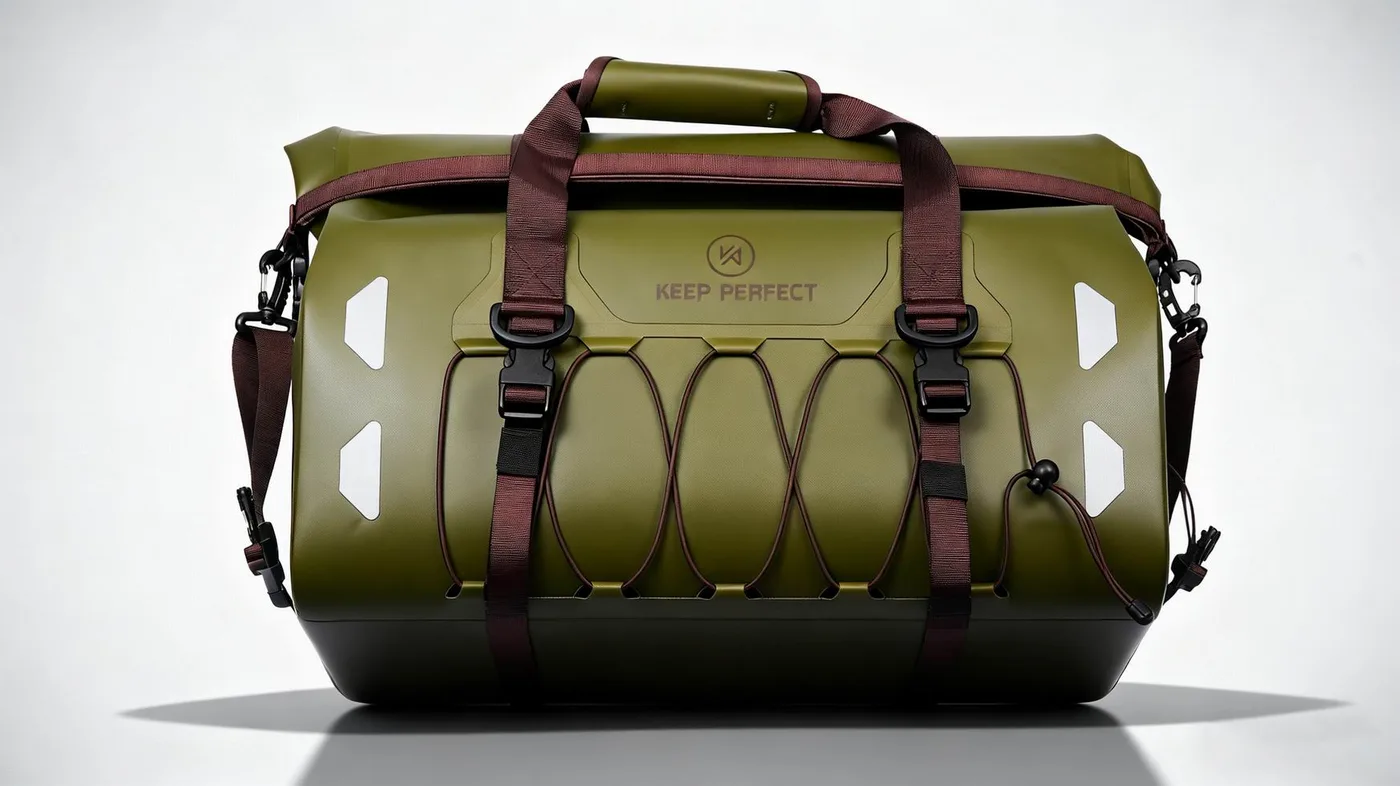
Saltwater bags fail in a predictable sequence, and knowing the order tells you where to look during an inspection. First is the buckle spring, which loses tension or jams with crystals within two to four years if it is never rinsed. Second is the fold line at the closure, which crazes and then cracks. Third is the corner weld, where the seam turns a tight radius and peel strength is lowest. Fourth is a zip, if the bag has one.
The panel in the middle of the bag almost never fails first. That matters because it means a failed bag is usually repairable: a buckle can be replaced, a fold line can be re-welded or patched, and a corner can be reinforced. What cannot be fixed cheaply is general chalking and stiffening across the whole shell, which is the sign that ultraviolet has done its work and the material itself is finished.
Rinse discipline: the single biggest lever
Nothing in this guide moves the number as much as rinsing. Salt left to crystallise holds moisture at the surface, feeds abrasion and corrodes hardware; salt dissolved and washed away within hours does none of those things. A bag rinsed with fresh water at the end of every session beats a bag rinsed weekly by a margin of roughly two to three years of service life.
The rinse itself is quick if it is done in the right order: closure and hardware first, then the exterior from the top down, then a sluice of the interior, then drain and dry in shade. Use fresh water at ambient temperature and low pressure. A pressure washer is the fastest way to turn a sound seam into a leaking one, because it drives water through the fold line at forces the closure was never designed to meet.
- Rinse the closure line and every buckle within a few hours of the session.
- Work each buckle through its full travel while it is wet, to flush the spring.
- Sluice the exterior top-down, then the interior.
- Shake out and stand the bag mouth-down to drain for ten minutes.
- Dry in shade with the mouth open, then store loosely rolled with the buckle unclipped.
Salt and sun together: why the combination is worse
Either agent alone is survivable; together they compound. Ultraviolet breaks polymer chains at the surface and makes the film slightly rough and chalky. Salt crystals then sit in that roughened surface, hold moisture against it, and abrade it every time the bag is folded. The result is a fold line that cracks years before an inland bag used just as often.
Temperature amplifies both. A bag on a tropical deck reaches 55 to 65 °C at the surface, and every 10 °C rise roughly doubles the rate of the chemical reactions behind ultraviolet degradation and plasticiser loss. That is why the same bag lasts far longer in Scotland than in the Red Sea, and why shade is worth more than any product upgrade.
Reflective surfaces make it worse again. Water, sand and a white deck all bounce ultraviolet back onto the underside and the sides of a bag, so a bag sitting on a bright deck is being exposed from below as well as above. Lifting a bag onto a rack or hanging it under a bimini cuts total exposure by more than half.
Hardware: buckles, D-rings and zips in salt
Acetal buckles resist salt well and fail mechanically rather than chemically: crystals jam the spring, or grit wears the catch until it slips. Stainless fittings resist corrosion but can pit in warm chloride environments if the grade is wrong, and a pitted D-ring is a real load risk. Aluminium hardware is light and strong but needs an anodised finish to survive seawater, and coated finishes chip where the bag is dragged.
Zips are the weakest hardware in salt. A waterproof zip has a polymer coating over the teeth, and salt crystals abrade that coating every time the slider runs. Rinse the zip along its whole length, open and closed, and lubricate it with the product the brand specifies; a dry silicone-free lubricant that attracts grit is worse than nothing. Expect three to six years from a saltwater zip against eight to twelve from a roll-top closure.
Signs a saltwater bag is near the end
- A white, chalky surface that does not disappear when the bag is wet.
- A visible white line at the fold that stays after the bag is opened and flattened.
- A buckle that slips under load or will not click home on the first try.
- Corner welds that show a lip or a gap when the bag is inflated and squeezed.
- Stiffness that persists after the bag has been warm and dry for a day.
- A permanent smell that survives a full wash and 24 hours of drying.
- Pinholes visible when the bag is held up to a bright light.
Any one of the first three is a reason to demote the bag to non-critical use rather than retire it. A chalky bag still keeps a towel dry on a beach; it is simply no longer the bag to trust with a phone during a crossing. Two or more signs together, or any pinhole, means the bag is finished for waterproof duty.
Testing an ageing bag at home
Three tests take fifteen minutes between them and give a reliable verdict. The squeeze test: roll the bag closed with three folds, press it firmly and listen for a hiss while watching the fold. The light test: hold the bag up to a bright lamp in a dark room and look for pinpoints of light at the corners and along the seams. The immersion test: close the bag around a dry paper towel, submerge it in a bath for 30 minutes and check the towel.
Run them in that order, because each is more conclusive and more effort than the last. A bag that passes all three is serviceable regardless of its age. A bag that fails the immersion test should be retired or demoted immediately, and the fact that it failed should be recorded, because the same failure will appear in the rest of the batch if they were bought together.
Six habits that add years
- Rinse within a few hours of every session, in the order closure first, shell second.
- Dry in shade with the mouth open; never dry a salty bag in direct sun.
- Store rolled loosely with the buckle unclipped, in a cool dark place.
- Work buckles and zips through their travel during the rinse, every time.
- Keep the bag off hot decks and out of reflective sun for the middle of the day.
- Run the three home tests at the start and the end of every season.
Together those habits are worth roughly a doubling of service life, which is the largest single effect available to anyone who already owns a bag. They are also free, which is why they come before any buying decision in this guide. Full rinse detail is in our saltwater rinse guide, and the retirement thresholds are covered in our retirement guide.

Fleet maths: when replacement beats repair
For a club, a charter operator or a school, the decision is economic rather than sentimental. Compare the cost of a repair against the remaining life it buys. A new buckle costs a few dollars and restores a bag to full function. A re-welded corner costs more and is worth doing on a bag under five years old, and not worth doing on one that is chalky as well, because the next failure will be somewhere else.
| Fault | Typical repair cost | Life added | Replace instead when |
|---|---|---|---|
| Buckle or slider | USD 3-8 | 2-5 years | Body is chalky or stiff |
| Corner weld peel | USD 10-18 | 1-3 years | Bag is over 6 years old |
| Fold line crack | USD 8-15 | 1-2 years | Crack runs into the panel |
| Zip coating worn | USD 20-35 | 1-2 years | Zip is over 4 years old |
| General UV chalking | Not repairable | None | Immediately |
Build the replacement into the budget rather than reacting to failures. A fleet of forty bags used 180 days a year in the tropics will turn over roughly a third of its bags every two years, and budgeting for that avoids the situation where half the fleet fails in the same month because it was all bought together. Staggering purchases by six months is the cheapest reliability measure available to a fleet operator.
Retirement and what to do with the old bag
A retired saltwater bag still has uses. Demote it to a wet-kit bag, a laundry bag, a car-boot bag or a garden carrier, and label it so nobody packs a phone in it. Cut the straps off before you pass it on, so it cannot be mistaken for a serviceable bag or used as a buoyancy aid, which a sealed bag with trapped air is not rated to be.
Disposal depends on the material. A laminated TPU and polyester shell is a mixed-material product and is not accepted in most kerbside streams, so check local guidance rather than assuming. Where a take-back scheme exists, use it; where it does not, the most useful thing you can do is to have kept the bag in service for a decade rather than replacing it every second season.
Two external references are worth keeping in a fleet folder. Guidance on seawater and material behaviour is published by NOAA, and the test methods that underpin any service-life or rating claim are maintained by ISO, which is worth naming whenever you specify a replacement batch. Material-by-material comparisons are in our service life guide, and the hardware detail is in our corrosion resistance notes; our current line lists the builds referenced here.
For buyers specifying a fleet rather than a single bag, the practical brief writes itself from this guide: 0.45 mm TPU, radio-frequency welded seams with reinforced corners, acetal hardware with a published cycle rating, a roll-top closure rather than a zip, and a written rinse schedule posted in the kit room.
Frequently asked questions
Q1. How long do dry bags last in saltwater?
A welded TPU bag rinsed after every session and dried in shade lasts eight to twelve years; the same bag left salty lasts two to three. PVC manages five to eight years with good care, and a stitched coated bag lasts one to three seasons.
Q2. Does saltwater damage dry bags?
Not chemically. The damage comes from salt crystals left after evaporation: they hold moisture at the fold line, abrade the surface and jam buckles. Rinsing within a few hours removes almost all of it.
Q3. Which lasts longer in saltwater, TPU or PVC?
TPU. It has no plasticiser to lose, so it keeps its flexibility for eight to twelve years with care. PVC stiffens as plasticiser migrates out, giving five to eight years at best in warm seawater.
Q4. How often should I rinse a dry bag used in the sea?
After every session, ideally within a few hours. Rinsing every session rather than weekly is worth roughly two to three years of extra service life on an identical bag.
Q5. What fails first on a saltwater dry bag?
The buckle spring, then the fold line at the closure, then the corner welds, then any zip. The middle of a panel almost never fails first, which is why most failed bags are repairable.
Q6. Can I use a pressure washer to rinse salt off?
No. High pressure drives water past the fold line and can split a seam that has never leaked. Use fresh water at ambient temperature and low pressure, then drain and dry in shade.
Q7. How do I know when a dry bag is finished?
Chalky surface that stays when wet, a permanent white line at the fold, a buckle that slips, or pinholes you can see against a bright light. Any of those means retire or demote the bag.
Q8. Do waterproof zips last in saltwater?
Three to six years against eight to twelve for a roll-top closure. Salt crystals abrade the zip coating every time the slider runs, so rinse along the full length and lubricate as specified.
Q9. Does sun make saltwater damage worse?
Yes. Ultraviolet roughens the surface, salt crystals sit in it and abrade the fold, and heat roughly doubles the degradation rate for every 10 °C. Shade is worth more than any upgrade.
Q10. How long do dry bags last on a charter boat?
Three to five years for a welded TPU bag used 180 days a year in the tropics, and two to three for PVC. Stagger purchases by six months so the whole fleet does not fail together.
Q11. Is a ten-year-old dry bag still safe to use?
Only if it passes the squeeze, light and immersion tests. Age alone is not the test; a shaded, well-rinsed bag at ten years can be sounder than a four-year-old bag left on a tropical deck.
Q12. Can a salt-damaged dry bag be repaired?
Buckles and corner welds can, yes. General ultraviolet chalking cannot, and a fold-line crack that has run into the panel is not worth repairing on a bag over six years old.
Q13. How should I store a dry bag between seasons?
Clean, completely dry, rolled loosely with the buckle unclipped, in a cool dark place. Never store a salty or damp bag in a hot locker, which is the fastest route to mould and stiffening.
Q14. Do stainless fittings corrode in seawater?
They can pit in warm chloride environments if the grade is wrong. Acetal hardware corrodes less but fails mechanically when crystals jam the spring; inspect both at every rinse.
Q15. Why does my bag leak at the closure but nowhere else?
Because the fold line is the most stressed area and salt residue keeps it damp and abrasive. Re-welding or patching the fold is possible, but the same failure will recur if rinsing does not improve.
Q16. What should I do with a retired dry bag?
Demote it to wet kit or garden use, cut the straps so it cannot be mistaken for a buoyancy aid, and check local guidance on disposal, because a laminated shell is not accepted in most kerbside streams.
People also ask
How do you make a dry bag last longer in the sea?
Rinse it with fresh water after every session, starting with the closure and buckles, dry it in shade with the mouth open, and store it loosely rolled. Those habits roughly double service life.
Are dry bags saltwater resistant?
Welded TPU and PVC shells are, yes. The film itself is not damaged by salt; the risk is crystals left at the fold line and corrosion or jamming in hardware.
Why does my dry bag get stiff after a season in the sea?
Usually plasticiser loss in a PVC build, accelerated by heat and ultraviolet. A TPU bag does not stiffen the same way, which is why it is the better choice for warm seawater.
Can you repair a dry bag that leaks at the seam?
Often yes. A corner weld can be re-welded or patched for USD 10 to 18, and that is worth doing on a bag under five years old that is not chalky elsewhere.
How often should rental dry bags be replaced?
About a third of a tropical fleet every two years. Budget for it in advance and stagger purchases by six months so bags bought together do not fail in the same month.
Does rinsing with fresh water really matter?
Yes, more than any other factor. Rinsing after every session rather than weekly is worth two to three years of extra life on an identical bag used in the same water.
Need this in production volume?
QUANZHOU JUNYUAN BAGS has produced waterproof bags since 2014 in an SGS-verified 4,950 m2 facility in Fujian, China. Minimum order 500 pieces, sampling in 6–10 working days, bulk in 35–50 days, FOB Xiamen — write to service@junyuanbags.com with your spec and target market.