Home / Blog / Materials & Construction
Corrosion Resistance in Dry Bag Hardware
On a waterproof bag used in salt water, the buckles, D-rings and rivets fail years before the shell does. A 500D TPU laminate survives roughly 3,000 hours of salt spray exposure with no functional loss, while a plated zinc-alloy buckle on the same bag shows white rust at 96 hours and red rust at 240. That is a gap of more than an order of magnitude, and it means the hardware specification, not the fabric specification, decides how long the bag stays usable.
This guide compares the four hardware families actually fitted to dry bags, explains what a salt spray hour is worth as a prediction, and sets out which metal pairs must never touch in seawater. Figures come from neutral salt spray testing and from field returns on bags used in temperate coastal water at around 16 °C and 3.5 percent salinity. Use the tables to write a hardware clause into a purchase brief, and the inspection routine to catch a failing part before it strands you.
- Why hardware fails before the fabric does
- The four hardware families fitted to waterproof bags
- Stainless grades: what 304 and 316 actually mean
- Galvanic couples and the pairs to avoid
- Salt spray hours and what they predict
- Coatings: anodising, plating and polymer finishes
- Acetal and nylon: where plastic beats metal
- The five detail points where corrosion starts
- Rinse, dry and inspect: the routine that works
- Specifying hardware for a fleet or a rental season
- Reading a hardware specification honestly
- Repair and replacement intervals
- A hardware audit before the season
Why hardware fails before the fabric does
A welded shell is a single continuous surface with no holes, no fasteners and no exposed edges, which is almost the ideal corrosion geometry. Hardware is the opposite: it introduces crevices, contact faces, moving parts, threaded posts and, in many designs, a metal insert pressed into a polymer body. Every one of those is a place where an electrolyte can sit, concentrate and start an electrochemical cell.
The second reason is geometry rather than chemistry. A fabric carries load across thousands of filaments, so losing a few percent of its section changes nothing measurable. A buckle carries load across two thin latch faces; losing 0.2 mm of section on a face is a meaningful fraction of the part. Corrosion therefore reaches functional failure on hardware at a material loss that would be invisible on the shell.
The third reason is that hardware is handled. A buckle is opened and closed dozens of times a day, rubbed against webbing, dropped on concrete and loaded with grit. Each of those events removes a little of the protective oxide or coating, and the exposed metal then has to re-form it in an environment that is actively trying to dissolve it. Fabric is not treated this way, which is why the comparison is so lopsided.
The four hardware families fitted to waterproof bags
Four material groups cover almost every buckle, ring, cam and adjuster on a dry bag: austenitic stainless steel, aluminium with a conversion or anodic coating, zinc alloy with a decorative plating, and engineering polymer, usually acetal or polyamide. Each has a distinct failure signature, a distinct cost and a distinct place where it is the right answer.
Stainless is the strongest and heaviest option, and the only one that tolerates being scratched, because the chromium oxide layer re-forms in the presence of oxygen. Aluminium is light and takes a good finish, but it corrodes by pitting once the anodic layer is breached and it is the worst choice in a galvanic couple. Zinc alloy is cheap and dimensionally precise but depends entirely on its plating. Acetal is immune to corrosion, absorbs almost no water and costs least.
| Material | Typical part | Salt spray to first sign | Relative cost | Weight, 25 mm buckle | Failure signature |
|---|---|---|---|---|---|
| 316 stainless | D-rings, rivets, spring hooks | 1,000-2,000 h | 4.0x | 14 g | Crevice staining, rarely functional |
| 304 stainless | Rivets, lash plates | 400-600 h | 2.6x | 14 g | Surface tea staining, pitting in crevices |
| Hard anodised aluminium | Cam levers, adjusters | 300-500 h | 2.2x | 6 g | Pitting where the layer is scratched |
| Plated zinc alloy | Decorative buckles, tips | 96-240 h | 1.0x | 11 g | White rust then red rust, then seizure |
| Acetal (POM) | Side-release buckles, ladderlocks | No corrosion | 0.6x | 5 g | UV embrittlement, latch wear |
| Glass-filled polyamide | Load-bearing buckles | No corrosion | 0.8x | 6 g | Water absorption, dimensional drift |
Read the weight column alongside the cost. A stainless D-ring costs four times a zinc one and weighs about 25 percent more, but it will still be serviceable at the end of a decade. A zinc buckle is the cheapest way to hit a price point and the fastest way to generate a warranty claim from a coastal buyer. Acetal has no corrosion mode at all and is the default for a reason.
Stainless grades: what 304 and 316 actually mean
The difference between 304 and 316 is two percent molybdenum, and that two percent is the whole story in seawater. Molybdenum raises the resistance to chloride pitting and crevice attack, which is exactly the failure that kills stainless in marine use. In a splash zone a 304 rivet will tea-stain within a season; the same part in 316 will still be bright after five years of the same exposure.
Neither grade is immune. In a warm, oxygen-depleted crevice, such as under a washer or inside a pressed insert, 316 will still pit, because the protective oxide cannot re-form without oxygen. That is why the detail matters as much as the grade: a 316 part in a well-drained design outperforms a 316 part clamped against a wet fabric fold by a wide margin.
If the specification says only stainless, it is not a specification. Ask for the grade, and ask whether the part is passivated after forming. Passivation removes free iron left on the surface by cutting and bending tooling, and a part that is formed and shipped without it will rust at the tool marks regardless of how good the alloy is.
Galvanic couples and the pairs to avoid
Put two dissimilar metals in contact in an electrolyte and the less noble one corrodes faster than it would alone, while the more noble one is protected. Seawater is a good electrolyte, and a dry bag is full of metal-to-metal contacts. The classic disaster is an aluminium cam lever riveted to a stainless plate: the aluminium sacrifices itself, and a part that would have lasted eight years fails in one.
| Metal pair in contact | Potential difference | Risk in seawater | Where it appears on a bag | Fix |
|---|---|---|---|---|
| Aluminium + 316 stainless | 0.45-0.55 V | Severe | Cam lever riveted to a lash plate | Polymer shoulder, or use 316 for both |
| Aluminium + brass | 0.25-0.35 V | Moderate | Adjuster on a brass eyelet | Isolate, or make both aluminium |
| Plated zinc + stainless | 0.35-0.45 V | Severe | Plated insert pressed into a ring | Do not pair; use acetal or 316 |
| Carbon steel + stainless | 0.20-0.30 V | High | Steel spring in a stainless body | Use a 316 spring |
| Brass + 316 stainless | 0.05-0.15 V | Low | Decorative trim on a ring | Acceptable with a rinse routine |
| Titanium + aluminium | 0.60-0.75 V | Severe | Exotic trim on an alloy part | Never pair |
The mitigation is simple and it is always the same three steps: keep the area of the less noble metal large relative to the noble one, break the electrical path with a polymer washer or a plastic shoulder, and keep the joint dry. In practice the third is what most designs get wrong, because the joint sits under a fabric tab that stays wet for days after the bag comes off the water.
Watch for the hidden couple as well. A stainless spring inside an acetal body is safe, because the polymer is an insulator. A stainless spring inside a plated zinc body is not, because the plating is conductive and the zinc substrate under it will be consumed from the inside once the plating is scratched through at the entry point.
Salt spray hours and what they predict
Neutral salt spray testing exposes a part to a fog of 5 percent sodium chloride at 35 °C and records the time to the first sign of corrosion. It is an accelerated comparison test, not a life prediction, and the conversion factor is rough: 96 hours of salt spray corresponds to somewhere between six and eighteen months of real coastal use, depending on how much sun, drying and abrasion the part sees.
Used properly the test ranks materials and finishes, which is exactly what a hardware clause needs. Used improperly it becomes a marketing number, because a bag maker can quote 500 hours without saying whether that is to white rust, to red rust, or to a functional failure. Always ask which, and ask for the standard behind it.
The test methods themselves are published and worth naming in a brief: the practice used across most of the industry is maintained by ASTM International, and the equivalent international method is held by ISO. A clause that names the method and the acceptance criterion is enforceable; a clause that says marine grade is not.

Coatings: anodising, plating and polymer finishes
Anodising is not a coating applied to aluminium, it is a thickened oxide grown out of it, which is why it does not peel and why a scratch through it is a real problem rather than a cosmetic one. A hard anodic layer of 25 to 50 micrometres gives 300 to 500 salt spray hours on its own; the same part with the layer sealed properly, usually with a nickel acetate or hot water seal, gains another 30 percent.
Decorative plating on zinc is a barrier, and barriers fail at defects. A nickel-chrome layer of 8 to 12 micrometres on a die casting looks excellent out of the box and starts to blister at the first pore or edge, after which the zinc underneath corrodes volumetrically and lifts the rest of the layer. This is the finish that fails fastest in the field and it is the one to write out of a coastal specification.
| Finish | Typical thickness | Salt spray to first sign | Cost index | Fails by | Verdict for coastal use |
|---|---|---|---|---|---|
| None, bare 316 | - | 1,000-2,000 h | 4.0 | Crevice staining only | Best |
| Hard anodise, sealed | 25-50 µm | 300-500 h | 2.4 | Pitting at scratches | Good |
| Hard anodise, unsealed | 25-50 µm | 150-250 h | 2.0 | Rapid pitting | Avoid |
| Nickel-chrome on zinc | 8-12 µm | 96-240 h | 1.2 | Blistering, white then red rust | Avoid |
| Black oxide on steel | 1-2 µm | 24-72 h | 1.1 | Uniform red rust | Never |
| Mass-coloured acetal | - | No corrosion | 0.6 | UV, not corrosion | Best value |
The last row is the one that gets overlooked. Colouring a polymer in the mould rather than coating a metal produces a part with no coating to fail, and it is the cheapest option in the table. Where a hardware colour has to match a fabric range, mass colour also holds a better match than any applied finish, because there is no film thickness shifting the hue.
Acetal and nylon: where plastic beats metal
Acetal, usually called POM, is the default for side-release buckles and ladderlock adjusters, and it is not a cost compromise. It does not corrode, it absorbs under 0.3 percent water by weight so it does not swell or seize, it has a low friction coefficient so a latch releases smoothly after a winter in a shed, and it takes a moulded colour that goes all the way through the part.
Its two limits are ultraviolet light and creep. Unstabilised acetal loses tensile strength measurably after about 1,500 hours of direct sun exposure, which is a season and a half of daily use on a deck, so a black stabilised grade is the right call for anything left outdoors. Under sustained load it creeps, which is why a heavily loaded cam lever is metal and a lightly loaded buckle is polymer.
Glass-filled polyamide takes higher loads and higher temperatures than acetal but absorbs more water, up to 2.5 percent at saturation, which changes dimensions slightly and can make a tight tolerance fit sticky in a humid climate. For a bag that lives on a tropical boat, an acetal buckle with a stainless spring is the more predictable combination than a filled nylon one.
The five detail points where corrosion starts
- Under a rivet head or washer, where a wet crevice never dries out.
- At the entry point of a plated insert, where the coating was cut by the pressing tool.
- In the latch faces of a buckle, where grit has polished the finish off.
- At a spring cavity, where water is drawn in by capillary action and stays.
- Under a welded fabric tab, where the hardware is clamped against material that holds moisture.
Every one of these is a design issue and every one can be mitigated cheaply. Drain the spring cavity, isolate the rivet with a polymer shoulder, specify a sealed rather than an unsealed anodic layer, and never let a fabric tab clamp metal against metal without a barrier between them. None of these adds more than a few cents to a part.
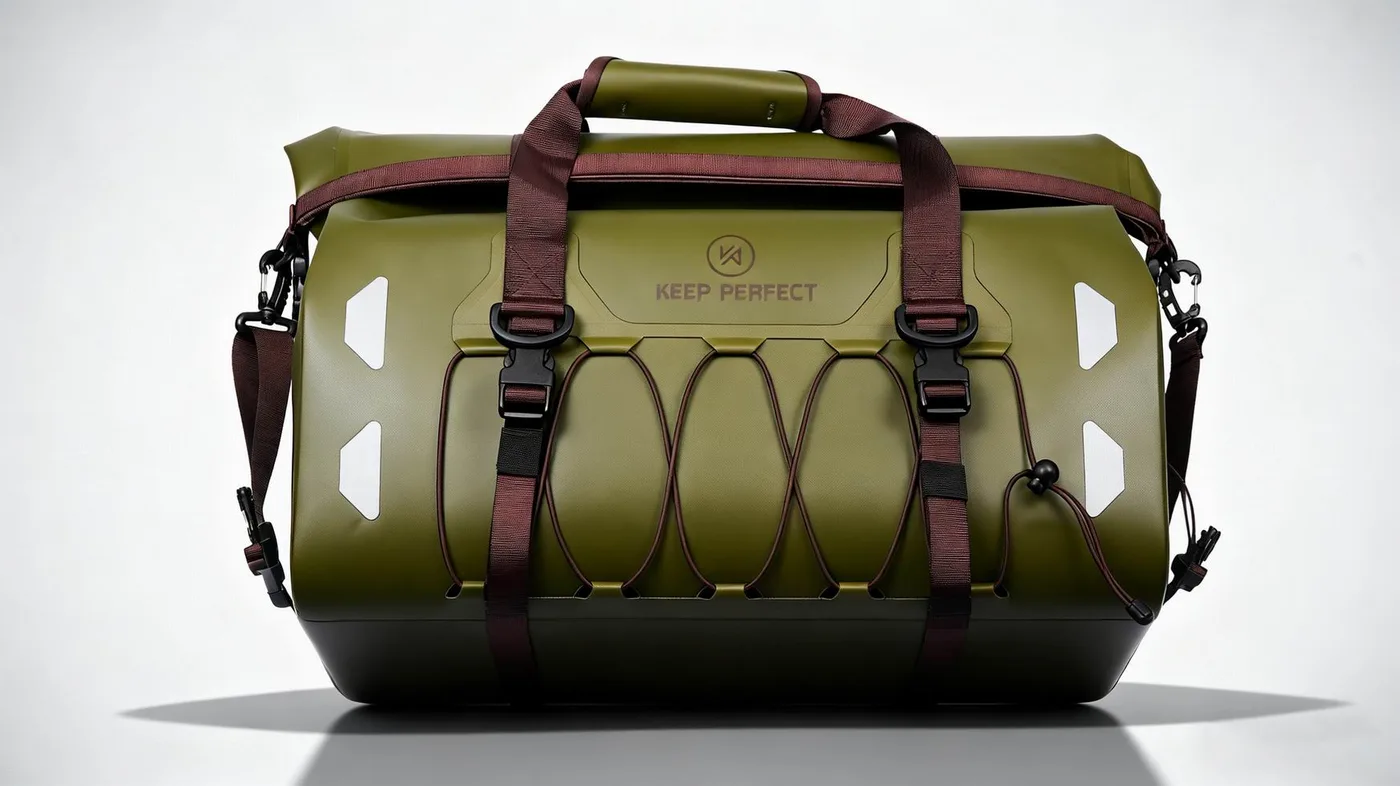
The fifth point is the one that most often escapes attention, because it is not visible in a product photograph. A metal D-ring welded into a fabric tab sits against material that stays damp long after the outside of the bag is dry, and the tab is doing the same job as a wet rag wrapped around a nail. Specifying a polymer isolation patch under the ring costs almost nothing and removes the problem entirely.
Rinse, dry and inspect: the routine that works
Corrosion prevention on hardware is mostly about removing the electrolyte, and the order of operations matters more than the effort. Rinse the whole bag in fresh water first, at ambient temperature, before opening any buckle, because opening a dry buckle that still has salt crystals in it grinds those crystals across the latch faces and strips the finish. Then work each buckle through its full travel while it is still wet.
Drying is the step people skip. Hang the bag open, with every buckle released and every strap pulled out of its adjuster, in moving air and shade. A buckle clipped shut will still be wet at the contact faces 24 hours later, and those faces are exactly where corrosion starts. In a humid climate a fan is worth more than sunlight, because direct sun degrades the polymer while it dries the metal.
| Step | Action | Time | Temperature | Why it matters | Common mistake |
|---|---|---|---|---|---|
| 1 | Rinse whole bag closed | 2 min | Ambient | Removes bulk salt | Hosing a hot bag |
| 2 | Release and work each buckle | 1 min | Ambient | Flushes the latch faces | Opening before rinsing |
| 3 | Fresh-water rinse again, open | 1 min | Ambient | Clears loosened grit | Using a pressure washer |
| 4 | Shake out, hang open in shade | 4-12 h | Below 30 °C | Dries crevices | Drying in direct sun |
| 5 | Inspect faces and rivets | 2 min | Dry | Catches early pitting | Only looking at the shell |
| 6 | Store released, low humidity | Off-season | 5-20 °C | Stops slow attack | Storing clipped shut |
The inspection in step five takes two minutes and it is the difference between replacing an 11 g buckle and replacing a bag. Look for white powder on a plated part, for tea-staining around a rivet, for a latch that has gone stiff, and for any roughness on a face that used to be smooth. Our saltwater rinse guide covers the full sequence for the shell as well.
Specifying hardware for a fleet or a rental season
A rental fleet is the hardest environment a bag will ever see: 120 to 200 uses a season, no owner to rinse it, salt, sand, sun and guests who force a buckle rather than read it. In that duty cycle a plated zinc buckle will not survive a single season, and the labour cost of replacing buckles mid-season exceeds the cost of specifying stainless spring hardware and acetal bodies from the start.
Write the clause in four lines. Name the material and grade for each part class. Name the finish and the standard it is tested to, with the acceptance criterion. Name the isolation requirement wherever metal meets metal. Name the replacement interval and the spare part strategy, because a fleet operator needs a buckle that can be swapped in five minutes rather than a bag that has to be retired.
Then validate it on a sample rather than on paper. Pull five samples from a pre-production run, put them through a salt spray screen to the named standard, and open and close each buckle 500 times wet with a pinch of sand in the latch. The parts that survive that abuse will survive a rental season, and the ones that do not will show up before you have 2,000 units on the water.
Reading a hardware specification honestly
- Ask for the alloy or polymer grade by name, not for the words stainless or metal.
- Ask which salt spray standard was used and whether the hours quoted are to white rust, red rust or failure.
- Ask whether an anodic layer is sealed, and to what thickness.
- Ask whether the part is passivated after forming.
- Ask what isolates the metal from the fabric and from any adjacent metal.
- Ask for the spring material inside a polymer body, and whether it is isolated.
- Ask for a spare-part route: a buckle that can be replaced is worth more than a heavier one that cannot.
Two adjacent specifications are worth reading at the same time. Restricted-substance rules affect platings and coatings directly, and our RoHS hardware notes cover what that means for a finish choice. Load ratings and attachment geometry are covered in the buckle types guide, which lists the working loads each family is actually asked to carry.
For the attachment side, the anchor is as important as the buckle. Our D-ring and lash point guide sets out how a ring is welded into a shell and how to check that weld in the field, and the hardware finish guide covers matching a finish to a colour range. Our own line has been produced since 2014 in an SGS-verified 4,950 m2 facility with 7 production lines and 149 machines, 200,000 pieces of monthly output, a 500-piece minimum, sampling in 6 to 10 working days and bulk in 35 to 50 days, FOB Xiamen.
Repair and replacement intervals
Set intervals by duty, not by calendar. A bag used twice a month in fresh water needs a hardware inspection once a year. A bag used weekly in salt needs one every three months. A rental bag needs one every month during the season, and a fleet operator should budget on replacing roughly 8 percent of buckles per season even with a good specification, because guest abuse is not a specification problem.
Replace on evidence rather than on looks. A plated part with white rust at the latch faces has already lost section and should go, because the next stage is red rust and seizure. A 316 part with surface tea-staining is cosmetic and can stay in service for years. An acetal part that has gone chalky or has lost its gloss has taken enough UV to lose strength and should be replaced before the season rather than during it.
Keep a small spares kit and the knowledge to fit it. Two spare buckles of the type fitted, a spare spring where the design uses one, a short length of the correct webbing and a means of cutting and sealing it will handle almost every hardware failure in the field. Our buckle replacement guide shows the fitting sequence, and the product line lists which sizes share hardware so a fleet can standardise on one spare.
A hardware audit before the season
Walk the bag once, part by part, before the first trip of the year and record what you find. Start at the closure buckle and work down: latch faces, springs, rivets, D-rings, cam levers, adjusters, handle anchors and any strap keeper. Release everything, look at it dry and in good light, and note anything that is stiff, rough, discoloured or loose in its anchor.
Finish the audit by writing down the specification you actually have, because most people discover at this point that half the hardware on the bag is unmarked. Once you know what is fitted, the replacement decision becomes easy: keep the 316 and the acetal, schedule the plated parts for replacement, and change the specification on the next order so the same audit is shorter next year.
Frequently asked questions
Q1. What hardware lasts longest on a saltwater dry bag?
316 stainless for rings, rivets and springs, and acetal for buckle bodies. A 316 part reaches 1,000 to 2,000 salt spray hours before the first sign of attack, and acetal has no corrosion mode at all.
Q2. Is 304 stainless good enough for a dry bag?
It survives, but it tea-stains within a season in a splash zone and pits in crevices. If the bag lives on salt water, the two percent molybdenum in 316 is worth the cost difference on every part you cannot easily replace.
Q3. Why does my buckle go stiff after a season?
Salt crystals have formed in the latch faces and the spring cavity. Rinse the closed bag before opening it, work each buckle while wet, and dry it released in moving air rather than clipped shut.
Q4. Are metal buckles better than plastic ones?
Not for corrosion. Acetal does not corrode, absorbs under 0.3 percent water and releases smoothly after storage, which is why it is the default. Metal earns its place in heavily loaded cam levers and in rings that take shock loads.
Q5. What does a salt spray hour mean in real use?
Roughly six to eighteen months of coastal exposure per 96 hours of testing, depending on sun, drying and abrasion. Treat the figure as a ranking between materials and finishes, not as a life prediction.
Q6. Can I mix aluminium and stainless on one bag?
Only with isolation. In seawater the aluminium sacrifices itself to the stainless, and a cam lever that would last eight years can fail in one. Use a polymer washer or shoulder to break the electrical path.
Q7. Is anodised aluminium safe in salt water?
If it is hard anodised and sealed, yes, with 300 to 500 salt spray hours. Unsealed anodising drops to 150 to 250 hours and pits rapidly wherever the layer is scratched.
Q8. Why do plated buckles fail so fast?
Because the plating is a barrier that fails at defects. Once a pore or edge is breached the zinc underneath corrodes volumetrically and lifts the rest of the layer, which is why 96 to 240 hours is typical.
Q9. How often should I inspect dry bag hardware?
Once a year for fresh water at twice a month, every three months for weekly salt use, and every month during a rental season. Budget on replacing about 8 percent of buckles per season in fleet service.
Q10. Should I rinse a dry bag with the buckles open or closed?
Closed first, then open. Rinsing a closed bag removes bulk salt before you release anything; opening a dry buckle with crystals still inside grinds them across the latch faces and strips the finish.
Q11. Does a stainless part ever need replacing?
Rarely for corrosion. Replace on mechanical damage or on crevice attack that has progressed to pitting under a washer. Surface tea-staining on 316 is cosmetic and can stay in service for years.
Q12. What is passivation and does it matter?
It is the removal of free iron left on the surface by cutting and bending tools. Without it a part rusts at the tool marks regardless of alloy quality, so always ask whether the part was passivated after forming.
Q13. Does UV damage plastic buckles?
Yes. Unstabilised acetal loses tensile strength after roughly 1,500 hours of direct sun, about a season and a half of daily deck use. Specify a black stabilised grade for anything stored outdoors.
Q14. Can corrosion be stopped once it has started?
Not reversed, but it can be slowed. Rinse thoroughly, dry completely, remove loose corrosion product with a soft brush, and isolate the part from contact with fabric or adjacent metal. Replace plated parts once white rust appears.
Q15. Is titanium worth it for dry bag hardware?
Rarely. It is fully corrosion-immune and light, but it costs several times more than 316 and the parts that need replacing on a bag are more often the polymer bodies than the metal rings.
Q16. How do I know if hardware is marine grade?
You do not, from the word alone. Ask for the alloy, the finish, the test standard and the acceptance criterion. A specification that says marine grade without those four details is not enforceable.
People also ask
What metal is best for saltwater hardware?
316 stainless. The two percent molybdenum content raises resistance to chloride pitting, which is the failure that kills stainless in marine use, and it gives 1,000 to 2,000 salt spray hours against 400 to 600 for 304.
Do dry bag buckles rust?
Plated zinc buckles do, showing white rust at 96 hours and red rust at 240 in salt spray. Acetal and polyamide buckles cannot rust, which is why they are the default on any bag that sees salt water.
How do you stop hardware corroding on a dry bag?
Rinse the closed bag in fresh water, work each buckle while wet, rinse again, then dry released and in shade. Isolate metal from metal with a polymer washer and keep metal off damp fabric.
What is galvanic corrosion on a bag?
It is the accelerated attack on the less noble metal when two dissimilar metals touch in an electrolyte. Seawater is a strong electrolyte, so an aluminium part against stainless sacrifices itself and fails in a fraction of its normal life.
Are plastic buckles strong enough for dry bags?
Yes. A 25 mm acetal side-release buckle carries far more than the load a dry bag imposes, and it has no corrosion mode. Metal is reserved for cam levers and rings where sustained or shock load is higher.
How long does dry bag hardware last in saltwater?
Acetal and 316 parts last a decade or more with a fresh-water rinse. Plated zinc parts typically need replacing within one to two seasons, and unsealed anodised aluminium within one.
Need this in production volume?
QUANZHOU JUNYUAN BAGS has produced waterproof bags since 2014 in an SGS-verified 4,950 m2 facility in Fujian, China. Minimum order 500 pieces, sampling in 6–10 working days, bulk in 35–50 days, FOB Xiamen — write to service@junyuanbags.com with your spec and target market.