Home / Blog / Travel & Packing
Sun and Sea Storage for Water Gear
A week of sun and sea needs three separate storage zones rather than one big bag: a wet zone for masks, fins and swimsuits, a dry zone for clothing and documents, and a sealed electronics zone, because a black roll-top laid on sand at midday reaches 62 °C inside while the air is 31 °C. Split a typical beach day across a 20L dry zone, a 10L wet zone and a 2L electronics pouch and nothing that matters gets soaked, sanded or cooked.
The rest of the problem is discipline rather than equipment. Salt crystals in a fold line, sunscreen on a film surface and two hours of direct noon sun on a sealed bag account for almost every ruined item we hear about on a beach holiday. This guide sets out the temperature numbers, the packing split by day type, the rinse order that actually removes salt, and the storage habits that keep a bag serviceable through a fortnight of daily salt water.
- What sun and salt do to gear left on the sand
- The three-zone kit: wet, dry and electronics
- Sizing a beach and boat day
- Shade, orientation and the two-hour rule
- Sand: keeping grit out of closures and buckles
- Salt spray, rinse order and the ten-minute routine
- Floating bags and the water-line decision
- Cooling: using a roll-top as a cooler without soaking kit
- Sunscreen, oils and the chemistry that softens film
- Hotel, villa and boat storage between sessions
- End of trip: drying, cleaning and packing for the flight home
- A sun-and-sea week checklist
What sun and salt do to gear left on the sand
Sand is not just dirt; it is a fine abrasive that works into every moving part it can reach. A single grain in a roll-top fold creates a capillary path, and the same grain inside a buckle spring removes the tension that keeps the closure shut. Salt is the second agent: as water evaporates it leaves crystals that are hygroscopic, so a bag that looks dry keeps a damp, slightly sticky patch at the fold line and stays that way for days.
Ultraviolet is the third, and it is the one that ends a bag. Direct tropical sun at UV index 11 delivers more exposure in four hours than a British summer delivers in a month. The damage is cumulative and invisible until the film chalks, the print fades and the weld line at a corner starts to peel. None of this is dramatic day to day, which is exactly why people notice it only when a bag fails in the second season.
Put together, those three agents explain the storage rules that follow: keep grit out of moving parts, dissolve salt before it crystallises, and keep the bag out of noon sun. Almost every habit in this guide is a variation on one of those three ideas, and skipping one of them shortens the life of the bag more than any buying decision.
The three-zone kit: wet, dry and electronics
One bag cannot do three jobs. Wet gear carries water and salt, dry gear must never meet either, and electronics need a sealed environment with a desiccant and no temperature swing. Mixing them means the dry clothing ends up damp by lunchtime and the phone sits in a bag that was holding a wet mask an hour earlier.
Give each zone its own bag and its own colour, so the system survives being used by children, guests or anyone who did not pack it. A dark bag for the wet zone, a light bag for the dry zone and a small bright pouch for electronics is a scheme people follow without being told twice. Colour coding is the cheapest reliability measure available on a beach holiday.
The wet zone is the one most people forget to bring. Without it, a swimsuit and a mask go into the same bag as a paperback and a shirt, and by the second day everything in the bag is slightly damp and slightly salty. A 10L roll-top dedicated to wet kit costs less than the paperback it protects, and it can be hosed out at the end of the day without touching anything else.
| Zone | Volume | Bag type | Contents | Where it lives |
|---|---|---|---|---|
| Wet | 10 L | Roll-top, dark | Mask, snorkel, swimsuit, rash vest | Shade, open, draining |
| Dry | 20 L | Roll-top or tote | Clothing, towels, books, documents | Under a towel or in a shade bag |
| Electronics | 2 L | Small roll-top | Phone, cards, keys, power bank | Inside the dry bag, never on sand |
| Food and drink | 15 L | Cooler roll-top | Water, fruit, ice | Deep shade, off the sand |
| Rinse and spares | 5 L | Bucket roll-top | Fresh water, repair tape, spares | Car or villa |
Sizing a beach and boat day
Volume follows the day type, not the number of people. A two-hour swim off a sandy beach needs almost nothing: towels come back with you, and the whole kit fits in one 10L bag. A full beach day with children adds food, water, spare clothing, sunscreen and toys and moves you to 30 to 40 litres spread over three bags.
A boat day is a different calculation, because everything has to survive spray and there is nowhere to put a wet bag down. On a small charter boat, plan 15 to 20 litres per person in sealed bags, with one shared 40L bag for the group kit that stays in the shade of the console. Anything that is not sealed will be wet within an hour of the first run.
| Day type | Hours | Sealed volume per person | Bag split | Notes |
|---|---|---|---|---|
| Short swim off sand | 2 h | 5 L | 1 x 5L | Keys and phone only |
| Full beach day | 6-8 h | 20 L | 1 x 10L + 1 x 5L + 2L pouch | Add shade, not volume |
| Beach day with children | 6 h | 30 L | 1 x 20L + 1 x 10L | Wet zone is non-negotiable |
| Charter boat day | 8 h | 15-20 L | 1 x 20L | Everything sealed, nothing loose |
| Snorkel trip from shore | 4 h | 12 L | 1 x 10L + 2L pouch | Rinse kit in the car |
Shade, orientation and the two-hour rule
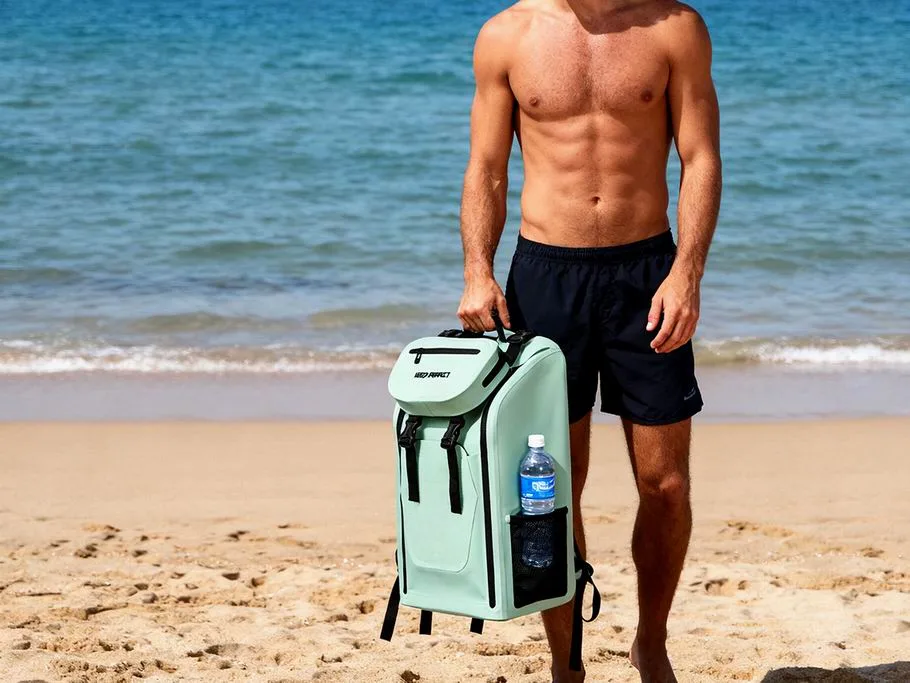
Shade is a stronger lever than any product choice. A bag moved from full sun into the shade of a parasol sits roughly 20 °C cooler at the surface, and that difference is what keeps sunscreen from softening, chocolate from melting and a phone from shutting down with a thermal warning. If there is no natural shade, a light-coloured towel thrown over the bag achieves most of the same effect.
Orientation matters too. Lay a bag on its side with the closure pointing down and any water that gets past the fold runs towards the closure rather than away from it; lay it on its base with the mouth up and a shower sheds off the body. Burying the lower third in cool sand is a legitimate trick on a hot beach, but only if the sand is damp and the bag is rinsed afterwards.
The two-hour rule is the practical habit: anything sealed and left in direct sun gets moved or turned every two hours. That is roughly the interval at which the interior of a dark bag crosses 55 °C, and it is also the interval at which most people naturally change what they are doing anyway, so it fits the day rather than fighting it.
| Bag colour | Air temperature | Interior after 30 min | Interior after 2 h | Safe for electronics |
|---|---|---|---|---|
| Black | 31 °C | 48 °C | 62 °C | No |
| Olive | 31 °C | 44 °C | 57 °C | No |
| Blue | 31 °C | 41 °C | 52 °C | Marginal |
| Mint | 31 °C | 38 °C | 47 °C | Marginal |
| Any colour in shade | 31 °C | 33 °C | 35 °C | Yes |
| Any colour buried in damp sand | 31 °C | 31 °C | 32 °C | Yes |
Sand: keeping grit out of closures and buckles
Grit gets into a bag by three routes: on wet hands, on the bag itself when it is put down, and through the closure when it is rolled on a windy beach. The first two are solved by a rinse bottle and a mat; the third is solved by rolling the bag with the mouth facing away from the wind and closing it over a towel rather than over sand.
Before every roll, run a thumb along the fold line. It takes three seconds and it is the single highest-value habit in this guide, because one grain in the fold is enough to wick water into a bag over an afternoon. If you find grit, rinse the line with fresh water from a bottle rather than wiping it, because wiping drives the grain into the film.
Buckles and zips take longer to show damage. Rinse them at the end of the day and work them through their full travel while wet, which flushes grit out of the spring and the slider. A buckle that has been left gritty for a week will slip under load; the same buckle rinsed each evening still holds after five seasons of beach use.
Salt spray, rinse order and the ten-minute routine
Rinse order matters more than rinse duration. Start with the closure and the hardware, because that is where salt does mechanical damage; then the exterior, starting from the top so dirty water runs away from clean areas; then the interior, which usually only needs a sluice unless something has spilled. Finish by shaking the bag out and standing it mouth-down to drain.
Use fresh water at ambient temperature and low pressure. A hot hose on a laminated film softens the surface and a pressure washer drives water past the fold, which is how a bag that never leaked starts leaking. Ten minutes at the end of the day is enough for a family kit of four bags, and it is the difference between a bag that lasts a decade and one that is chalky by the third season.
- Rinse the closure line and buckles first, working each buckle through its travel.
- Sluice the exterior from the top down, then the interior.
- Shake out the water and stand the bag mouth-down on a rail for 10 minutes.
- Dry in shade with the mouth open, never on hot sand in full sun.
- Store rolled loosely with the buckle unclipped until the next session.

Floating bags and the water-line decision
Whether the bag should float depends on where the water line is. If you swim out from a beach and want your kit to follow you, a buoyant bag with trapped air is the right choice, and a roll-top rolled three times with a little air inside will support several kilograms. If the bag is going on a boat or staying on the sand, buoyancy is a nuisance: it makes the bag roll, drift and catch the wind.
A floating bag is also a bag that has to be tethered. Clip it to a belt loop or a mask strap with a short leash and a screw-gate carabiner, never with a long cord that can wrap a limb. The arithmetic is simple: a 20L bag with half its volume as air supports about 10 kg of buoyant force, which is more than enough for a towel and a shirt and nowhere near enough to be a flotation aid for a person.
Our floating dry bag range is built for the first case, with welded lash tabs and high-visibility colourways that can be spotted from the shore. For the second case, a plain roll-top with the air pressed out is better: it sits where you put it, packs flat, and does not advertise the fact that your phone is on the beach.
Cooling: using a roll-top as a cooler without soaking kit
A sealed roll-top makes a serviceable cooler because the welded shell holds melt water and the closure is genuinely watertight when rolled three times. The trap is mixing ice with dry items: melt water finds everything, and a bag used as a cooler in the morning will still be wet inside at four in the afternoon. Keep one bag for cooling and one for everything else.
Ice life is a function of volume, insulation and sun, in that order. Two litres of ice in a 15L bag in the shade lasts about four hours; the same ice in a black bag on sand lasts under ninety minutes. Pre-chill the contents, use block ice rather than cubes where you can, and keep the bag out of the sun rather than buying a bigger bag.
| Setup | Ice volume | Ambient | Ice life | Interior at 4 h |
|---|---|---|---|---|
| 15L bag, full shade | 2 L | 31 °C | 5-6 h | 6 °C |
| 15L bag, towel over it | 2 L | 31 °C | 4 h | 9 °C |
| 15L black bag, full sun | 2 L | 31 °C | 1.5 h | 18 °C |
| 15L bag, block ice, shade | 2 L | 31 °C | 7-8 h | 4 °C |
| 15L bag with frozen bottles | 1.5 L | 31 °C | 6 h | 7 °C |
Sunscreen, oils and the chemistry that softens film
Sunscreen is the most under-rated hazard in a beach bag. Most formulations contain oils and solvents that plasticise a coated film on contact, and a bottle that leaks inside a sealed bag leaves a soft, tacky patch that will never recover. Carry sunscreen in its own small pouch, and check the bottle cap every time it goes back in the bag.
If a spill happens, deal with it the same day. Rinse with fresh water, then wipe with a mild detergent solution and rinse again; do not use alcohol, solvent or a scourer, because all three remove the surface layer of the film along with the sunscreen. A spill left for a week will have softened the film permanently, and that area becomes the first place the bag abrades through.
The same caution applies to insect repellent and to some hair and body oils, which are the two other substances that routinely find their way into a beach bag. Anything in a pump bottle should be double-bagged. This is also the reason a food-safe inner liner is worth asking about if the bag will regularly carry fruit, sunscreen and drinks together.
Hotel, villa and boat storage between sessions
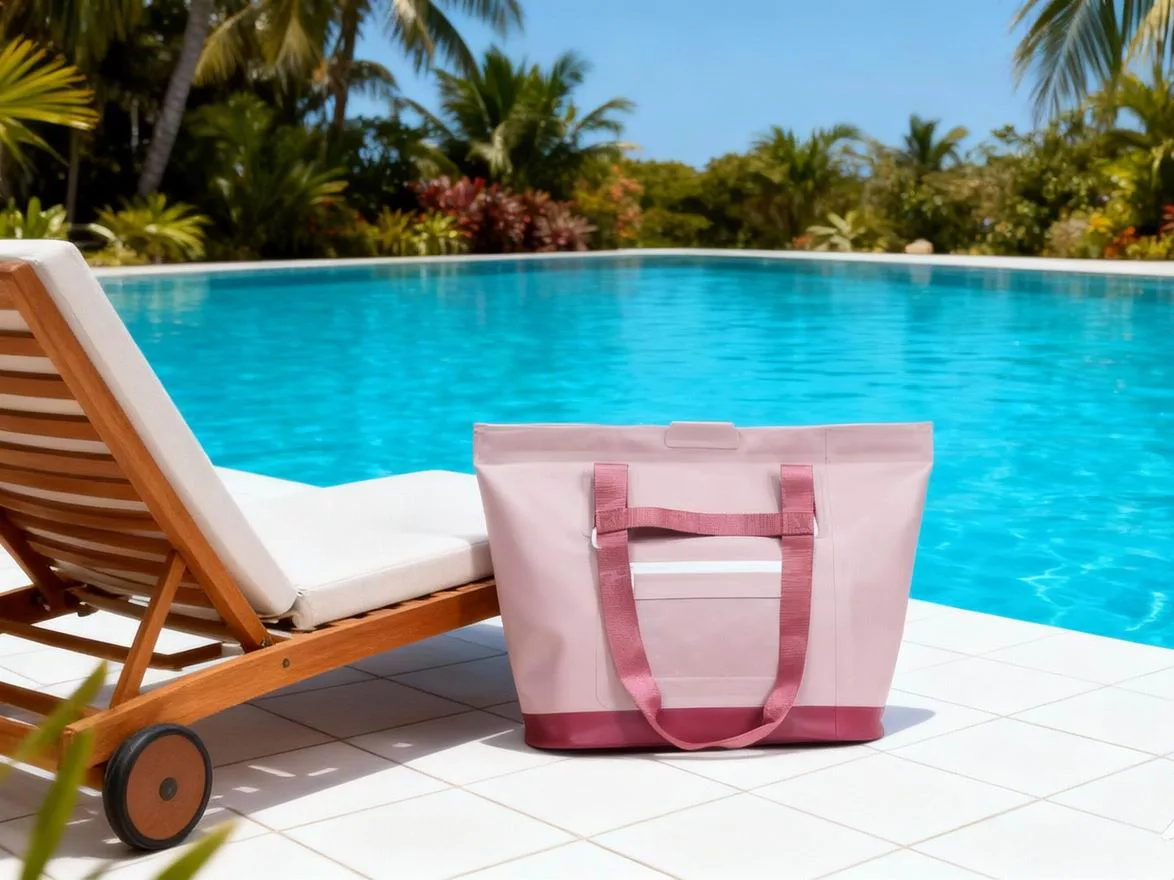
Storage between sessions is where most holiday damage happens, because wet bags get closed and thrown in a cupboard for twelve hours. Hang every wet bag mouth-down on a rail or a hook, in shade, with the mouth open, and leave it there until it is dry on the inside as well as the outside. A bag closed while damp will smell by day three and be mouldy by day seven.
Air conditioning helps and hurts. It dries the outside quickly, which is good, but it also circulates dry air that pulls moisture out of the film unevenly and can stiffen a PVC-coated bag over a fortnight. If the room has a balcony, use it: moving air in shade is the ideal drying condition, and a bag left on a balcony rail overnight is ready by breakfast.
On a boat, the rule is that nothing sealed stays in a locker. A locker is hot, dark, unventilated and usually slightly wet, which is the worst possible combination for a roll-top bag. Keep bags on deck in the shade of the console or the bimini, lashed so they cannot roll, and take them ashore at the end of the day even if they look dry.
End of trip: drying, cleaning and packing for the flight home
Give yourself a full drying day before the flight. A bag packed damp into a suitcase will be mouldy when you unpack, and the mould grows on the film rather than just on the surface, so it does not wash off. Dry every bag inside and out, in shade, for at least twelve hours before anything goes into the hold.
Before packing, do the checks that are hard to do on holiday: rinse and work every buckle, inspect the corner welds with a thumb, and roll each bag closed and squeeze it to listen for a hiss. A bag that fails the squeeze test at the airport is a bag you should have retired on the last day, when a replacement was still buyable.
Pack bags flat rather than rolled for the flight, because a rolled bag trapped in a suitcase for nine hours keeps a crease that will survive into the next trip. Put the small pouches inside the large bags to save space, and keep one 5L bag out as the wet bag for the journey home: swimsuits rarely dry in time, and a sealed bag is the only way to put one in a suitcase.
A sun-and-sea week checklist
- Three zones, three colours: dark for wet, light for dry, bright for electronics.
- A 2 L fresh-water rinse bottle in the car, used on the fold line before every roll.
- Shade plan for midday: parasol, towel over the bag, or a bag buried in damp sand.
- Move or turn anything sealed every two hours in direct sun.
- Rinse order each evening: closure, hardware, exterior, interior, drain.
- One bag for cooling, one bag for everything else, never both jobs in one.
- Sunscreen and repellent double-bagged, checked at every repack.
- Wet bags hung mouth-down and open overnight, never closed in a cupboard.
- A full drying day before the flight, plus the squeeze test on every bag.
- More day plans in our beach day guide, pool kit in our poolside guide, and wet-kit handling in our swimwear storage notes.
Two external checks are worth building into the plan before you travel. Daily ultraviolet forecasts are published by NOAA, and the index number is what should decide whether the midday session happens at all. Water quality and swimming advisories matter just as much after heavy rain, and the health guidance from the CDC covers what to avoid in warm coastal water.
If you are kitting out a villa, a charter fleet or a beach club rather than a family, the same three-zone logic scales up and the specification becomes the buying document: one wet size, one dry size, one cooler size, two colourways, welded seams and a rinse station at the door. Retail and fleet sizes are listed under our product line, and tropical volume planning is covered in our tropical sizing guide.
Frequently asked questions
Q1. How should I store water gear on a beach holiday?
Split it into three zones: a dark 10L roll-top for wet kit, a light 20L bag for dry clothing and documents, and a 2L sealed pouch for electronics. Keep all three in shade and rinse the closure before every roll.
Q2. How hot does a dry bag get in the sun?
A black bag on sand at 31 °C air reaches about 48 °C inside after 30 minutes and 62 °C after two hours. The same bag in shade stays near 35 °C, which is why shade matters more than colour.
Q3. Should a beach dry bag float?
Only if it goes in the water with you. Buoyancy is useful when you swim out from shore and a nuisance on a boat or on sand, where a floating bag rolls and drifts.
Q4. How do I keep sand out of a dry bag closure?
Rinse the fold line with fresh water before every roll and run a thumb along it to check for grit. Roll with the mouth facing away from the wind and close the bag over a towel, not over sand.
Q5. Can I use a dry bag as a beach cooler?
Yes, if it is a dedicated bag. Two litres of ice in a shaded 15L bag keeps contents near 6 °C for five to six hours; the same ice in a black bag in full sun lasts about ninety minutes.
Q6. Does sunscreen damage a dry bag?
It can. Oils and solvents in sunscreen plasticise a coated film and leave a soft tacky patch that never recovers. Carry bottles double-bagged and rinse any spill with mild detergent the same day.
Q7. What is the best way to dry a wet bag overnight?
Hang it mouth-down with the mouth open in moving shaded air, on a balcony rail or a hook. Closing a damp bag for twelve hours produces odour by day three and mould by day seven.
Q8. How much waterproof storage does a family beach day need?
Roughly 30 litres: a 20L dry bag for clothing, towels and books, a 10L wet bag for swimsuits and masks, and a small pouch for phone, cards and keys.
Q9. Should I rinse my bag with fresh water every day?
Yes, and in this order: closure and buckles first, then the exterior top-down, then the interior. Ten minutes a day at ambient pressure is enough for a family kit of four bags.
Q10. Can I use a pressure washer on a dry bag?
No. High pressure drives water past the fold line and can split a seam that has never leaked. Use fresh water at ambient temperature and low pressure, then drain and dry in shade.
Q11. How do I pack a dry bag for the flight home?
Only when it is completely dry inside. Give yourself a full drying day, squeeze-test every bag, pack them flat rather than rolled, and keep one 5L bag out for the damp swimsuits.
Q12. Do dark bags get hotter than light ones on the beach?
Yes. A black bag runs roughly 10 to 15 °C hotter inside than a mint or light blue bag in the same sun. Colour helps, but moving the bag into shade makes a bigger difference than any colour choice.
Q13. Is it safe to leave a phone in a sealed bag on the sand?
Not in direct sun. Interior temperatures above 55 °C will trigger a thermal shutdown on most phones, and battery health degrades faster above 40 °C. Keep the electronics pouch in shade or buried in damp sand.
Q14. How often should I check a bag during a beach day?
Every two hours. That is the interval at which the interior of a dark sealed bag in full sun crosses 55 °C, and it fits naturally around swimming, eating and moving shade.
Q15. What should I do if a bag smells after a week away?
Wash it with mild detergent and fresh water, dry it fully in shade for 24 hours, then leave it open with a sachet of bicarbonate for a day. Persistent smell after that usually means mould has grown into the film.
Q16. Can I store bags in a boat locker between sessions?
No. A locker is hot, dark and unventilated, which is the worst environment for a laminated bag. Keep bags lashed in shade on deck and take them ashore at the end of the day.
People also ask
How do you keep gear dry at the beach?
Use three separate bags: a wet zone for swimsuits and masks, a dry zone for clothing, and a sealed pouch for electronics. Keep them in shade, rinse the closure before each roll and never put a damp bag away closed.
Why does my bag get wet inside at the beach?
Almost always because of sand or sunscreen in the fold line, or because the bag was overfilled so the fold could not seal. Rinse the closure, leave 15% headroom and roll three times.
Are dry bags worth it for a beach holiday?
Yes if you carry anything that must not get wet. A 10L roll-top costs less than a paperback and protects clothing, documents and phones from spray, sand and the inevitable spill.
How do you stop salt damaging a dry bag?
Rinse with fresh water at the end of every session, working the buckles through their travel, then dry in shade with the mouth open. Salt that crystallises at the fold stays damp and damages the film.
Can you leave a dry bag in the sun all day?
You can, but it shortens the life of the bag and cooks the contents. Ultraviolet is cumulative, and a fortnight of noon sun ages a laminated shell more than a season of ordinary use.
What size dry bag for a day at the beach?
About 20 litres of sealed storage per adult: a 10L bag for wet kit, a 5L for food and valuables, and a 2L pouch for electronics. With children, add a shared 20L bag for towels and toys.
Need this in production volume?
QUANZHOU JUNYUAN BAGS has produced waterproof bags since 2014 in an SGS-verified 4,950 m2 facility in Fujian, China. Minimum order 500 pieces, sampling in 6–10 working days, bulk in 35–50 days, FOB Xiamen — write to service@junyuanbags.com with your spec and target market.