Tropical Travel: What Size Dry Bag Do You Need?
For a one-week tropical trip most travellers need 25 to 40 litres of waterproof capacity split across three bags rather than one: a 5L sealed pouch for documents and electronics, a 10 to 15L day bag for beach and boat days, and a 30 to 40L main bag for clothing and laundry. Ambient humidity of 80 to 90% means nothing dries overnight, so the split matters more than the total, and a single 60L bag is the wrong answer because one wet item then contaminates the entire load.
This guide sizes that system against real trip lengths and traveller types, from a long weekend at a beach resort to three weeks of island hopping with a dive kit. It covers the day bag for open boats, the sealed pouch for passports, the separate wet volume for swimwear and laundry, airline weight limits, and the choice you face on the shelf between two sizes that both look plausible. Every number is a planning figure you can check against your own packing list.
- Why the tropics turn sizing into the hard question
- The three-bag split and why one big bag fails
- Sizing the day bag for beach and boat days
- Documents, medication and electronics
- The wet volume: swimwear, laundry and wet shoes
- Airline weight limits and the grams that matter
- Condensation and mildew at 85% humidity
- Sizing for families and shared loads
- Choosing between two sizes on the shelf
- What travellers get wrong about tropical sizing
- Season, storms and what to check before you book
- Sizing checklist before you buy
Why the tropics turn sizing into the hard question
In a temperate climate, waterproof capacity is a rain problem and the answer is small: a 10L liner keeps a sleeping bag dry. In the tropics the same question becomes a volume problem, because two conditions change simultaneously. Rain arrives at 25 to 100 mm per hour for an hour or two most afternoons, and relative humidity sits between 80 and 90% day and night, so a wet item stays wet for the entire trip rather than drying by morning.
That second condition drives the whole sizing argument. If nothing dries, then wet items accumulate rather than resolving, and by day five of a two-week trip they can occupy 8 to 12 litres of a poorly planned load. Sizing therefore has to include a dedicated wet volume from the start, and the total has to be larger than a traveller from a dry climate would instinctively choose.
| Trip length | Traveller type | Waterproof volume | Suggested split | Packed weight |
|---|---|---|---|---|
| Long weekend | Resort, one base | 15-22 L | 1 x 15L + 1 x 5L | 3.5-5.0 kg |
| One week | Beach plus day trips | 25-40 L | 1 x 30L + 1 x 10L + 1 x 5L | 6.0-9.0 kg |
| Two weeks | Island hopping | 35-50 L | 1 x 40L + 1 x 10L + 1 x 5L | 9.0-12.5 kg |
| Three weeks | Backpacking, laundry en route | 40-55 L | 1 x 40L + 2 x 10L | 10.0-14.0 kg |
| Dive or surf trip | Specialist kit | 50-70 L | 1 x 50L + 1 x 20L + 1 x 5L | 14.0-20.0 kg |
Read the table as a starting point and adjust for laundry access. A traveller who can wash and machine-dry every four days needs about 30% less volume than one who cannot, because the limiting factor is not the number of outfits carried but the number of days between washes. If you are unsure, size down on clothing and up on the wet volume.
The three-bag split and why one big bag fails
Three bags, each with one job, beat one large bag in a humid climate for a reason that has nothing to do with tidiness. A roll-top bag is sealed, so whatever goes inside stays at the humidity it was packed at; put one damp swimsuit in with a week of clothing and every item in the bag is damp by the following morning. Separating the load into a dry volume, a wet volume and a valuables pouch means a mistake costs you one bag rather than the whole trip.
| Bag | Volume | Contents | Where it lives |
|---|---|---|---|
| Valuables pouch | 2-5 L | Passport, cards, phone, spare cash | On your person or in the day bag |
| Day bag | 10-15 L | Sunscreen, water, camera, towel, shell | With you on boats and beaches |
| Dry clothing bag | 30-40 L | Clothing, medication, chargers | At the accommodation |
| Wet volume | 10-20 L | Swimwear, laundry, wet shoes | Bathroom or balcony, open |
| Overflow duffel | 20-40 L | Kit bought en route, dive gear | Folded until needed |
The valuables pouch deserves particular attention because it is the one bag that must survive immersion rather than spray. A 5L roll-top with welded seams rated IPX7 keeps a passport dry through an open-boat transfer in a 1 m swell, which is a genuinely common event on island routes. Keep it clipped inside the day bag rather than in a pocket, since pockets are where phones are lost over the side.

Sizing the day bag for beach and boat days
The day bag is the one you actually carry, so it should be sized to the longest day rather than the average one. A beach day with a towel, sunscreen, water, a phone and a paperback packs to about 8 litres; add a camera and a light shell for an open-boat transfer and you are at 11 to 13 litres. A 15L bag leaves the headroom to close three rolls, which is why 10L feels tight and 20L feels like luggage.
| Day type | Hours out | Volume needed | Rating | Notes |
|---|---|---|---|---|
| Resort beach | 3-5 h | 6-9 L | IPX5 | Splash and sand only |
| Beach plus snorkel stop | 5-7 h | 9-13 L | IPX6 | Wet entry on a small boat |
| Open-boat island transfer | 1-3 h | 12-16 L | IPX7 | Spray over the gunwale |
| Waterfall or jungle walk | 4-6 h | 10-14 L | IPX6 | Downpour plus river crossings |
| Dive boat day | 6-8 h | 16-22 L | IPX7 | Constant water on deck |
The jump from IPX6 to IPX7 on the boat rows is not marketing caution. An open boat in a 1 m swell throws solid water over the gunwale every few minutes, and a bag on the deck or the bench seat is submerged for seconds at a time rather than sprayed. That is an immersion event, and a bag specified for spray will take in 50 to 150 ml over an hour of it.
Documents, medication and electronics
Passports, cards and medication belong in their own sealed volume, sized at 2 to 5 litres and kept on your person rather than in checked luggage or a beach bag. The reasoning is straightforward: this is the one category where failure ends the trip rather than spoils an afternoon, and it is also the smallest and easiest to protect. A flat 2L roll-top holds two passports, a phone, cards and a small medication strip.
Electronics need the same logic plus desiccant. A phone, a compact camera and a power bank pack to about 1.5 litres, and at 85% humidity they will attract condensation on their own cool surfaces the moment they are moved into air-conditioned space. Add 10 to 20 g of silica gel to the pouch and regenerate it every four days in a warm oven. The fuller treatment is in documents and passport protection and camera gear in a dry bag.
The wet volume: swimwear, laundry and wet shoes
This is the bag travellers forget and then improvise with a plastic carrier bag. Two people on a two-week tropical trip generate 6 to 10 litres of permanently wet material: two swimsuits, a rash vest, wet shoes, a quick-dry towel and three or four days of laundry. Give it a dedicated 10 to 20 litre bag with an open top, keep it in the bathroom or on a balcony, and never let it touch the dry clothing bag.
The bag itself should be cheap and disposable in the sense that it does not matter if it smells. A simple roll-top in a dark colourway, rinsed with fresh water every two days and dried open in shade, will handle a three-week trip; the same items sealed inside your main clothing bag will produce mildew in 48 to 72 hours. Practical separation methods are set out in storing wet swimwear.
Airline weight limits and the grams that matter
Waterproof bags are heavier than coated ones, and that matters when the cabin allowance is 7 kg. A 40L welded TPU bag with a 0.5 mm film weighs 640 g empty against 420 g for a 0.3 mm build and about 700 g for a comparable PVC construction, so the film choice is worth 220 g across a three-bag system. That is 3% of a 7 kg allowance and it buys roughly three times the abrasion life.
| Bag | Volume | Empty weight, 0.5 mm TPU | Empty weight, 0.3 mm TPU | Packed weight |
|---|---|---|---|---|
| Valuables pouch | 5 L | 150 g | 120 g | 600-900 g |
| Day bag | 15 L | 340 g | 260 g | 2.2-3.2 kg |
| Clothing bag | 40 L | 640 g | 520 g | 6.0-8.5 kg |
| Wet volume | 20 L | 410 g | 320 g | 1.5-3.0 kg |
| Three-bag system | 60 L | 1,130 g | 900 g | 9.0-12.5 kg |
Weigh the system before you fly rather than at the check-in desk. A three-bag setup at 60 litres and roughly 1.13 kg empty comes to 9 to 12.5 kg packed, which fits most checked allowances but exceeds a 7 kg cabin limit, so decide in advance which bag is the cabin bag. Cabin strategy and security handling are covered in cabin bag size and weight tips and airport security with dry bags.
Condensation and mildew at 85% humidity
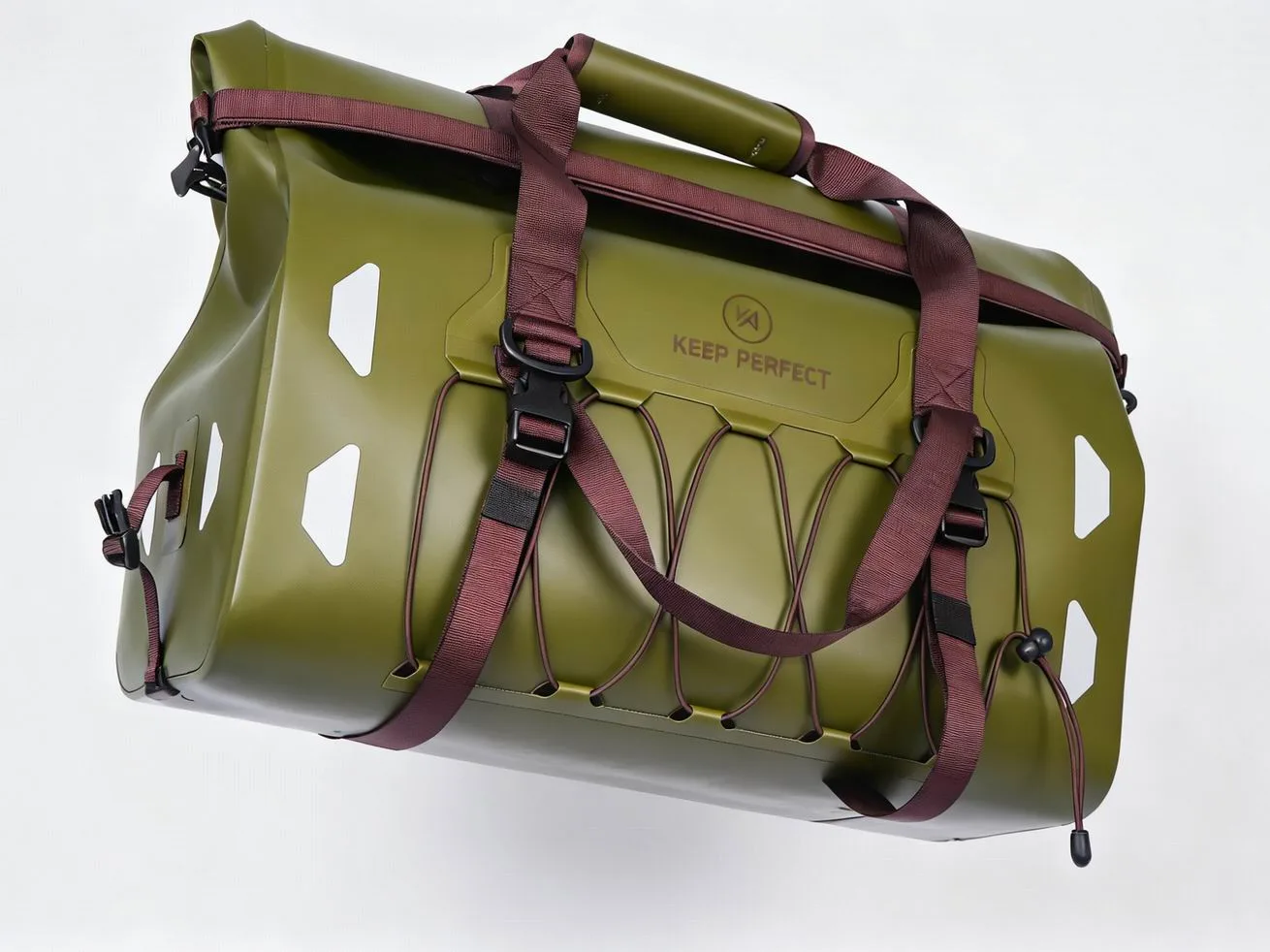
Condensation is the most misunderstood problem in tropical travel, because it looks exactly like a leak. Air sealed inside a bag at 30 °C and 85% humidity holds about 26 grams of water per cubic metre; cool that same air to 22 °C in an air-conditioned room and roughly a third of it condenses on the coolest available surface. In a 40L bag that is 3 to 8 ml, enough to dampen a shirt collar and fog a lens.
Three habits control it. Press the air out of a bag before rolling it, keep anything damp in the wet volume rather than the dry one, and open every bag for an hour each day in the coolest room you have. Desiccant helps electronics and does nothing for clothing, because the volume of water involved is far too large for a sachet. The mechanism is explained fully in condensation inside a dry bag.
Sizing for families and shared loads
Families should not scale linearly. Two adults and two children do not need four times the waterproof volume of one traveller, because clothing for small people occupies far less space and because wet items can be pooled into a single larger wet volume. A realistic family figure for two weeks is 60 to 80 litres total: two 30L clothing bags, one shared 20L wet volume, and one 15L day bag per adult.
The part that does scale is the valuables pouch, because each traveller who carries a passport needs their own small sealed volume or a clearly separate compartment. Give each child a 2L roll-top with their documents and medication in it, and keep the pouches in the adults' day bags rather than in children's pockets. Kids' sizing is treated in dry bag sizes for kids.
Choosing between two sizes on the shelf
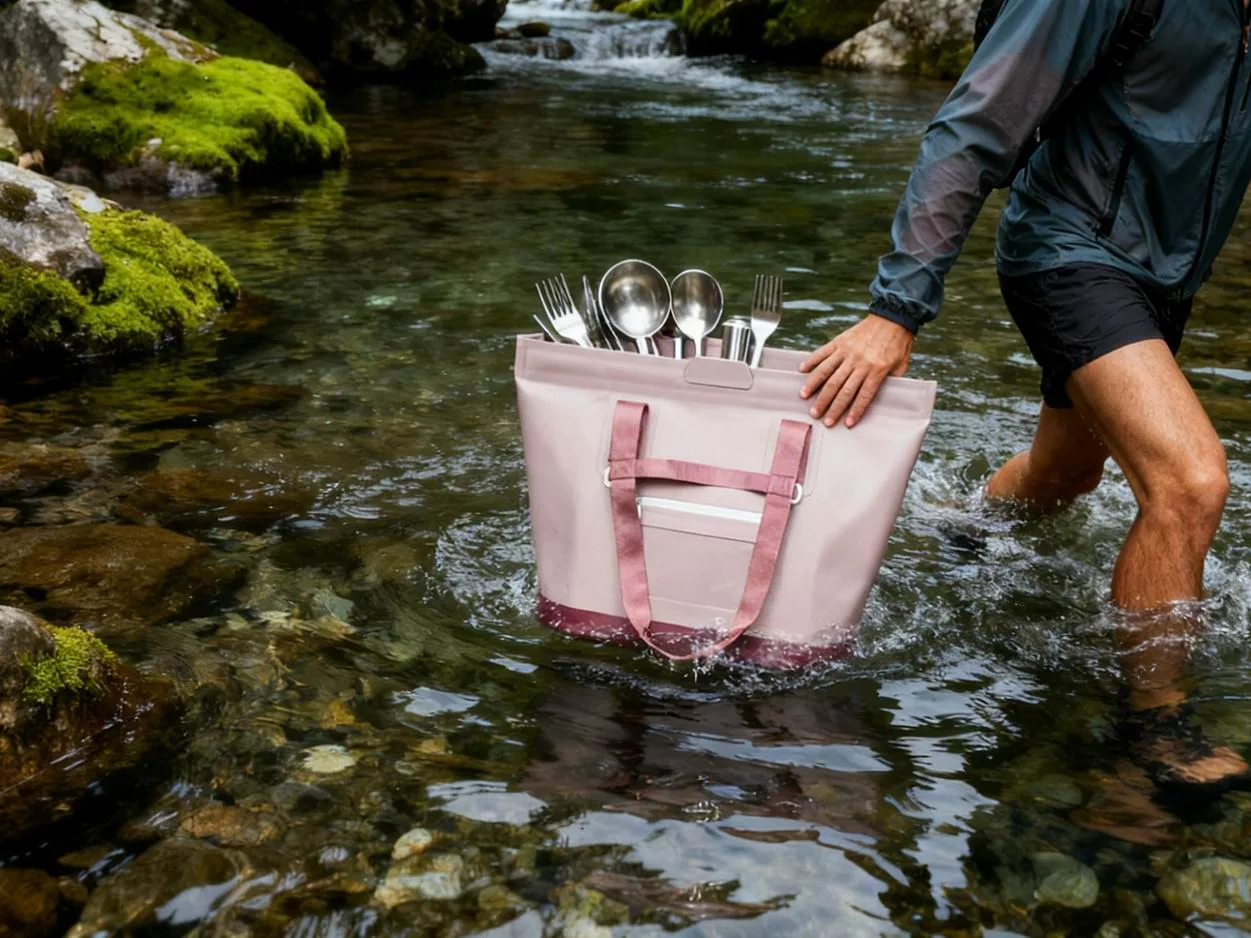
The decision almost always comes down to two adjacent sizes, and the tie-breaker is closure headroom rather than contents. A roll-top needs roughly 15% of its nominal volume free to close three clean folds, so a load that measures 14 litres needs a 20L bag even though a 15L looks adequate on paper. Always size the bag to the load plus 15%, then round up to the next available size.
The second tie-breaker is the single largest item you will carry. A dive mask and fins, a folded sarong and a towel, or a 15-inch laptop each set a floor on the dimensions rather than the volume, and a bag that fits 30 litres in a narrow shape will not take any of them. Check the mouth width and the flat base dimensions against your largest item before you commit, not just the litre figure.
What travellers get wrong about tropical sizing
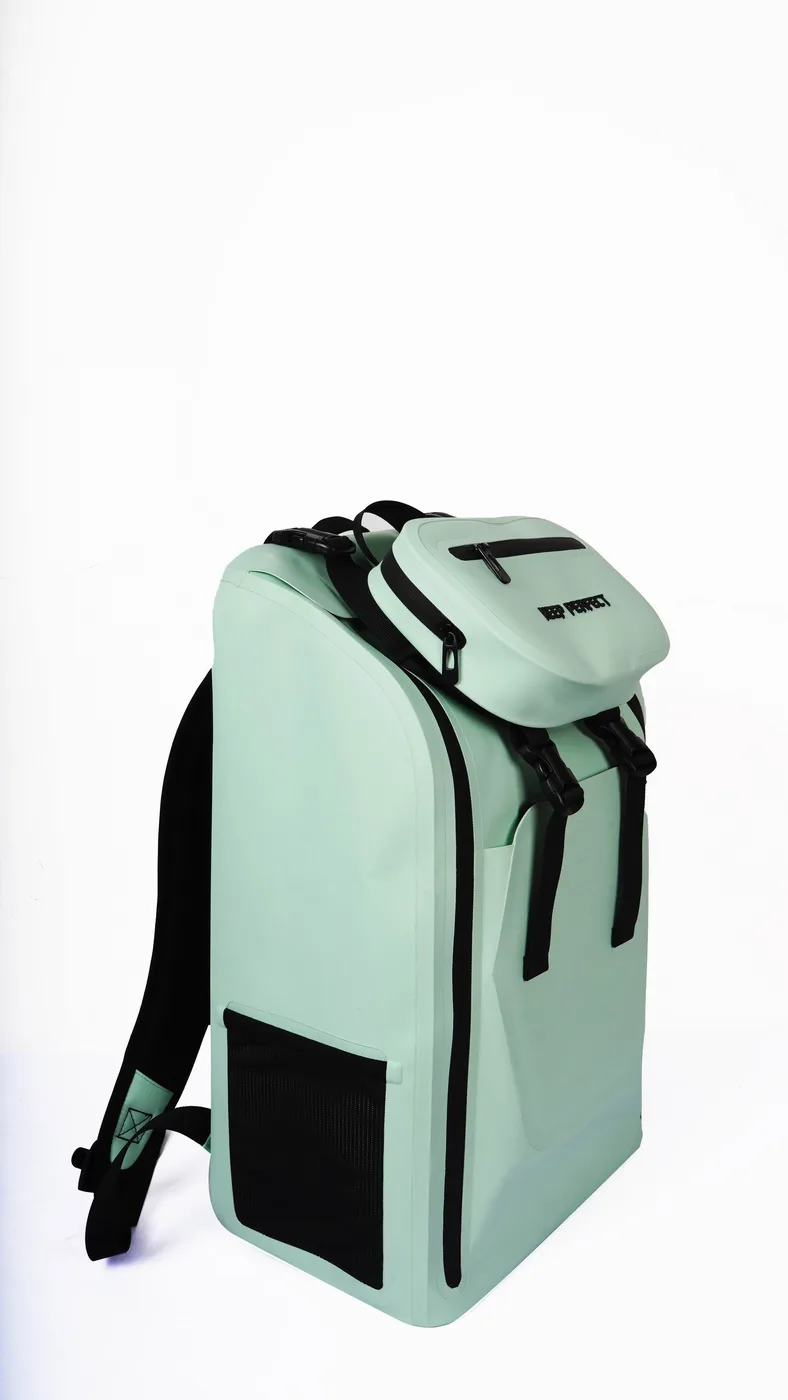
Four mistakes account for most disappointing purchases, and all four are avoidable with a moment of arithmetic. The first is buying one large bag instead of a system, which mixes wet and dry. The second is sizing the day bag for an average day rather than the longest one, which leaves you carrying a shop-bought carrier bag by day three. The third is ignoring the wet volume entirely.
The fourth is buying for the rain and forgetting the sun. Ultraviolet exposure in the tropics is severe, and a bag left on a balcony for a week accumulates damage that shortens its life more than the rain ever will. Rinse, dry in shade, and store inside where possible. Long-term exposure effects are covered in preventing UV damage and sun and sea storage.
Season, storms and what to check before you book
Tropical sizing is also a calendar question. Shoulder season brings short afternoon downpours and lower humidity, while the peak of a wet season can deliver 200 mm in a day and keep relative humidity above 90% for weeks, which pushes both the wet volume and the drying discipline to their limits. Check seasonal rainfall and storm risk through NOAA before fixing your dates.
Health preparation matters as much as packing, particularly for travellers moving between rural coastal areas and cities. Vaccination, food and water precautions and insect-borne disease risk are all region-specific and change from year to year; the CDC publishes destination guidance that is worth reading several weeks before departure rather than at the airport.
Sizing checklist before you buy
- Size the total to trip length and laundry access, not to the number of outfits.
- Build in a separate wet volume of 10 to 20 litres from the start.
- Add 15% headroom to every bag so three rolls close cleanly.
- Rate the day bag IPX7 if open-boat transfers are on the itinerary.
- Check mouth width and base dimensions against your largest single item.
- Weigh the whole system against the cabin allowance before you fly.
- Give documents and medication their own 2 to 5 litre sealed pouch.
Run the list against a real packing session rather than in the abstract. Lay out everything you intend to take, split it into dry, wet and valuables piles, and measure each pile rather than estimating it. Most travellers find their dry pile is 30% smaller than they assumed and their wet pile is twice as large, which is exactly the correction the three-bag split exists to make.
If you are specifying bags for a resort programme, a dive operator or a retail range aimed at tropical destinations, the seven lines become a brief: total volume by trip length, wet-volume provision, closure headroom, rating by transfer type, critical dimensions, system weight and valuables protection. Our team has produced waterproof bags since 2014 in an SGS-verified 4,950 m2 facility, with a 500-piece minimum, sampling in 6 to 10 working days and bulk in 35 to 50 days FOB Xiamen.
Three further reads complete the picture. Wet-season logistics are set out in tropical rainy-season travel, short trips are sized in dry bag size for a weekend trip, and hand-luggage-only travel is handled in dry bags for carry-on-only travel. Compare builds in the roll-top dry bag range or browse the full product line.
Frequently asked questions
Q1. What size dry bag do I need for a one-week tropical trip?
Plan on 25 to 40 litres total, split as a 30L clothing bag, a 10L day bag and a 5L valuables pouch, plus a separate 10 to 20 litre wet volume for swimwear and laundry.
Q2. Why not just take one large dry bag?
Because a sealed bag holds humidity as well as water. One damp swimsuit inside a 60L bag dampens everything by the next morning at 85% relative humidity, whereas a three-bag split limits the damage to a single small volume.
Q3. How big should my tropical day bag be?
15 litres for most travellers. A beach day packs to 6 to 9 litres and a boat day to 11 to 13, and the extra two litres are the headroom needed to close three clean rolls.
Q4. Do I need IPX7 or is IPX6 enough?
IPX6 covers beach spray and downpours. Choose IPX7 if your itinerary includes open-boat transfers or dive boats, where solid water comes over the gunwale and the bag is briefly submerged rather than sprayed.
Q5. How much wet volume should I allow?
About 8 litres of wet material per person per week. A 10L wet bag suits a week for two people and a 20L one suits three weeks, provided it is left open and rinsed every couple of days.
Q6. Why is my bag damp inside with no leak?
Condensation. Air sealed at 30 °C and 85% humidity gives up roughly a third of its water vapour when cooled to 22 °C, which is 3 to 8 ml inside a 40L bag. Press air out before rolling and open bags daily.
Q7. Can I take a dry bag as cabin luggage?
Yes, but check the weight: a three-bag system at 60 litres weighs about 1.13 kg empty and 9 to 12.5 kg packed, which exceeds a 7 kg cabin allowance. Decide in advance which single bag travels in the cabin.
Q8. What size pouch for passports and medication?
Two to five litres. A flat 2L welded roll-top holds two passports, a phone, cards and a medication strip, and it is small enough to keep on your person through a boat transfer.
Q9. How do I stop mildew on a three-week trip?
Separate wet from dry, rinse the wet bag with fresh water every two days, and dry it open in shade. Sealed damp items grow mildew within 48 to 72 hours in tropical humidity.
Q10. Is TPU or PVC better for tropical travel?
TPU. A 0.5 mm TPU build with a 420D face weighs about 480 g per square metre less than a comparable PVC coating, stays flexible in heat and resists the ultraviolet load that makes PVC stiffen and crack.
Q11. How much does film thickness change the weight?
About 90 g on a 20L bag and 220 g across a three-bag system. That is roughly 3% of a 7 kg cabin allowance and buys three times the abrasion life, which makes it a good trade.
Q12. What size for a family of four for two weeks?
60 to 80 litres total: two 30L clothing bags, one shared 20L wet volume and one 15L day bag per adult. Valuables pouches scale per person, at 2 litres each.
Q13. Should I size up or down when between two sizes?
Size up, and specifically add 15% headroom over your measured load. A roll-top needs that free volume to close three folds, so a 14 litre load requires a 20L bag rather than a 15L one.
Q14. What is the largest single item I should check against?
Whichever of these you carry: dive fins, a rolled towel and sarong, or a 15-inch laptop. Each sets a floor on mouth width and base dimensions that a litre figure alone will not reveal.
Q15. Does the sun damage bags more than the rain in the tropics?
Yes. A bag left on a balcony for a week takes an ultraviolet dose that shortens its life more than the downpours do. Rinse with fresh water, dry in shade and store inside when you can.
Q16. Do I need a dry bag at all if I am staying at a resort?
You need a small one. A 5L pouch covers passports, phone and medication, and a 10 to 15 litre day bag covers beach and boat days, which is where water actually reaches your kit.
People also ask
How many litres do you need for a tropical holiday?
About 25 to 40 litres for a week, 35 to 50 for two weeks and 40 to 55 for three, plus a separate 10 to 20 litre wet volume. Laundry access every four days reduces those figures by roughly 30%.
What is the best dry bag size for island hopping?
A 40L clothing bag plus a 10L day bag and a 5L valuables pouch, with the day bag rated IPX7 for open-boat transfers. Pool everything wet into one 20L bag that never touches the clothing volume.
Do you need waterproof bags for a beach holiday?
You need two: a small sealed pouch for documents and a 10 to 15 litre day bag rated IPX6 for beach and boat days. Full clothing waterproofing matters only if you travel by open boat or camp.
Why does everything feel damp in the tropics?
Because ambient humidity of 80 to 90% means evaporation almost stops, and sealed bags trap that moisture. Anything damp stays damp, and condensation appears whenever a warm sealed bag enters an air-conditioned room.
How do you pack for humidity?
Split into dry, wet and valuables, press air out of each sealed bag before closing, open bags daily in the coolest room, and use 10 to 20 g of desiccant for electronics only.
Can you take dry bags on a plane?
Yes. Roll-tops pass security normally and welded seams raise no issues; the practical constraint is weight, since a full three-bag system typically exceeds a 7 kg cabin allowance by 2 to 5 kg.
Need this in production volume?
QUANZHOU JUNYUAN BAGS has produced waterproof bags since 2014 in an SGS-verified 4,950 m2 facility in Fujian, China. Minimum order 500 pieces, sampling in 6–10 working days, bulk in 35–50 days, FOB Xiamen — write to service@junyuanbags.com with your spec and target market.