Home / Blog / Waterproof Technology
AQL Inspection for Dry Bags
AQL inspection on a dry bag order answers one question: given a random sample of 200 bags from a 5,000-piece shipment, how many defective units can you tolerate before rejecting the whole lot? Under general inspection level II with AQL 2.5, that sample of 200 permits 10 defects and rejects at 11, which sounds permissive until you understand that every leak at a welded seam is classed critical and therefore fails the bag regardless of the arithmetic.
This guide walks through how lot and sample size are set, how to classify the defects specific to waterproof construction, and how to combine the standard with product-specific checks such as air-inflation leak testing and roll-top closure cycling. It also covers the disputes that come up most often, and how inspection slots into the sampling and bulk calendar without delaying shipment.
- What AQL actually means on a bag line
- How lots and sample sizes are set
- The three defect classes and how to define them
- Reading acceptance numbers the right way
- Waterproof checks inside the AQL sample
- Closure cycling: the check nobody writes into the plan
- Hardware, prints and dimensions
- Common disputes and how to avoid them
- A worked example: 5,000 pieces at AQL 2.5
- What AQL inspection does not cover
- Building a defect catalogue before bulk starts
- Fitting inspection into the production calendar
- Writing the inspection clause that protects you
What AQL actually means on a bag line
AQL stands for acceptable quality limit, and despite the name it is not a promise of quality. It is a sampling plan: a rule that tells the inspector how many units to pull from a shipment and how many defective units the plan tolerates before statistical inference says the whole shipment is unlikely to be representative. The standard in use across most bag programmes is the sampling scheme published by ISO as ISO 2859-1, also issued as ANSI/ASQ Z1.4, and the two are functionally equivalent for practical purposes.
The misunderstanding that costs people money is treating AQL as an upper bound on defects shipped. It is not. A plan with an acceptance number of 10 still ships roughly 2.5 percent defective product when lots sit at the limit of their accept probability. That is why smart programmes pair the standard plan with a zero-tolerance rule for defects that actually matter, which for a waterproof bag means anything compromising the seal.
Inspection is also not quality control in the broader sense. Quality control is the whole system of material approval, first-article checks, in-line monitoring and final inspection described in our quality control guide. AQL inspection is one instrument inside that system, and using it as the only instrument is the most common structural mistake in bag programmes. A single sample taken on the final day cannot correct a decision made six weeks earlier about film formulation.
How lots and sample sizes are set
Everything starts with the lot. A lot is a defined quantity of identically produced goods presented for inspection at one time, and its size determines the sample size through a code letter. Splitting one physical shipment into several small lots is a well-known way to game the statistics, because smaller lots carry smaller samples and a smaller acceptance budget in absolute terms, even though the percentage is the same.
General inspection level II is the norm for bags, giving the code letters and counts below. Special levels S-1 to S-4 exist for destructive or expensive testing, which is exactly how you should classify a destructive water immersion or a weld-peel test: run those on a small side sample rather than across every inspected unit. Keeping destructive work in a side lot also leaves the main sample saleable, which matters when every unit counts.
| Lot size band | Code letter | Sample size | Accept / Reject at AQL 1.0 | Accept / Reject at AQL 2.5 | Accept / Reject at AQL 4.0 |
|---|---|---|---|---|---|
| 51-90 | E | 13 | 0 / 1 | 0 / 1 | 1 / 2 |
| 151-280 | G | 32 | 1 / 2 | 2 / 3 | 3 / 4 |
| 281-500 | H | 50 | 1 / 2 | 3 / 4 | 5 / 6 |
| 501-1,200 | J | 80 | 2 / 3 | 5 / 6 | 7 / 8 |
| 1,201-3,200 | K | 125 | 3 / 4 | 7 / 8 | 10 / 11 |
| 3,201-10,000 | L | 200 | 5 / 6 | 10 / 11 | 14 / 15 |
| 10,001-35,000 | M | 315 | 7 / 8 | 14 / 15 | 21 / 22 |
Notice how flat the sample growth is. Going from a 1,200-piece order to a 10,000-piece order only triples the sample size, which is why larger shipments are not proportionally more inspected and why single-lot discipline matters so much. If your routine buy is above 3,200 units, consider stepped rather than sampled inspection of critical features, discussed further below. The whole plan assumes defects are randomly distributed, and anything breaching that assumption needs a different instrument entirely.
The three defect classes and how to define them
Every plan sorts findings into critical, major and minor. Critical defects are those that make the product unsafe, illegal, or unfit for its fundamental purpose. Major defects materially reduce usability or saleability. Minor defects are workmanship imperfections that a reasonable buyer would accept. The definitions are standard, but the mapping of specific bag faults onto those definitions is what programmes get wrong.
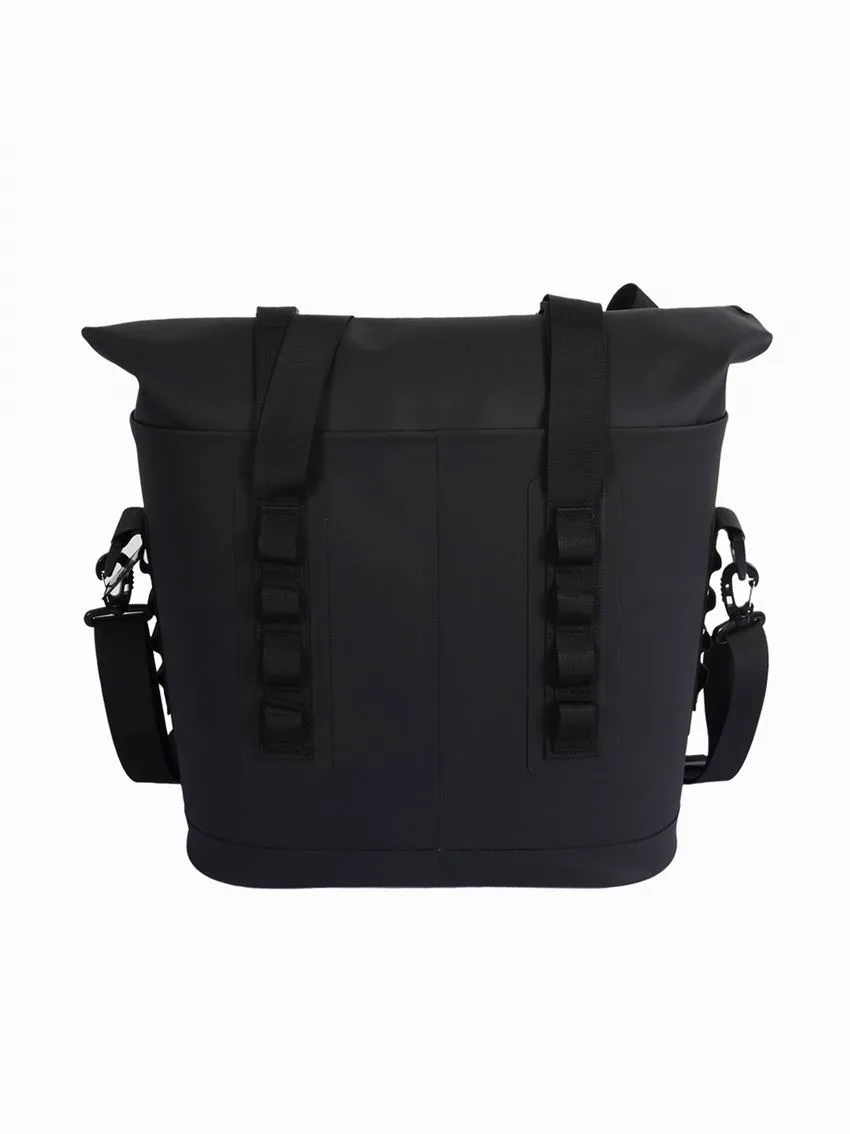
For a dry bag, the mapping should be explicit and written down before inspection begins, because arguments at nine in the morning on the last day of a booked container are expensive. The recommended mapping puts every leak path in critical: a weld void, a pinhole in the film, a bonded seam that has not fully fused, or a closure geometry that will not hold three rolls. Those all defeat the single purpose of the product.
| Fault | Class | Why that classification | How it is found | Typical rate on a mature line |
|---|---|---|---|---|
| Leak at any weld | Critical | Defeats the product purpose | Air inflation plus immersion | 0.1-0.4% |
| Roll-top cannot seal | Critical | Waterproof claim fails entirely | Three-roll closure test | 0.05-0.2% |
| Buckle fracture under load | Critical | Load path failure in use | Load test to 150 N | Below 0.1% |
| Colour outside agreed delta E 2.0 | Major | Not saleable as specified | Grey scale plus instrument | 0.3-0.8% |
| Strong solvent odour | Major | Retail rejection and complaint risk | Odour panel, 3 assessors | 0.2-0.6% |
| Print misregistration over 2 mm | Minor | Visible but usable | Ruler against drawing | 0.5-1.2% |
| Dimension over tolerance | Minor | Usually still fits the use | Tape against spec drawing | 0.4-1.0% |
| Loose thread at webbing end | Minor | Cosmetic, easily trimmed | Visual at 1 m | 0.6-1.5% |
Reading acceptance numbers the right way
An acceptance number is not a target. On a 5,000-piece lot at AQL 2.5 the inspector pulls 200 units and accepts the shipment if she finds ten or fewer defects. Finding nine and declaring success misunderstands what happened: the plan simply failed to prove the lot was bad, it did not prove the lot was good. Operating consistently near the accept boundary guarantees that roughly one in forty bags reaching your users has something wrong with it.
This is why experienced programmes tighten the defect classes rather than the AQL number. Setting AQL 1.0 for cosmetics makes the plan expensive and slow while barely improving outcomes. Keeping AQL 2.5 for cosmetics and applying zero tolerance to an agreed critical list costs almost nothing extra and addresses the failures users actually notice. Nobody writes a review about a loose thread; everybody writes one about a bag that leaked.
Switching rules are the other underused lever. The standard defines normal, tightened and reduced inspection, with rules for moving between them based on recent history. A programme that has accepted five consecutive lots can move to reduced inspection and save real money, while two rejections in five lots should trigger tightened inspection until performance recovers. Agreeing those rules in advance also removes any suggestion that a change of level is punitive.
Waterproof checks inside the AQL sample
Not every useful test scales to 200 units. A 30-minute immersion of every sampled bag is technically possible but consumes the better part of a day, and it damages nothing, so it is simply slow rather than destructive. A faster screen that scales well is air inflation: seal the bag, inflate to a defined pressure, hold for 30 seconds, and monitor. Pressure decay above a defined threshold flags the unit for immersion testing.
A good protocol runs like this: every sampled unit gets a visual and dimensional check plus an air-inflation screen taking about 90 seconds each. Any unit flagged goes to a 30-minute water immersion at one metre equivalent, which is the confirmatory test described in our immersion testing guide. Then a small destructive subset, typically two or three units from the sample plus two from the side lot, gets a weld peel and a hydrostatic head test run to the referee methods published by ASTM.
The pressure you choose for the inflation screen matters. Too high and you pass units that would fail later; too low and you generate false flags that slow everything down. Our own line uses around 6 kPa for roll-top bags, which corresponds roughly to the pressure difference experienced at 60 cm of submersion, with a decay limit of 10 percent over 30 seconds; the step-by-step procedure is set out in our air inflation leak test.

Closure cycling: the check nobody writes into the plan
Roll-top closures fail in use long before they fail in a single test, so counting defects at time zero misses the population most likely to disappoint users. The cheap addition is a closure-cycling test: take one or two units from the sample, roll and unroll them 500 times, then run them through the standard air-inflation screen and compare the decay rate with an uncycled unit.
The failure mode this catches is crease fatigue at the fold line, which shows as a fine network of surface cracks in the film after cycling. Those cracks do not necessarily leak immediately, but they leak eventually, and they are invisible at the first-article stage. Cycling is the only practical way to detect the difference between a film formulation that tolerates folding and one that does not.
A worked comparison helps calibrate expectations. In one qualification round, two otherwise identical 0.5 mm constructions were cycled 500 times. The polyether-based film held its pressure-decay figure within 4 percent of new, while the polyester-based film lost 21 percent and showed visible crazing at the second fold. Had the programme relied on appearance alone, both would have passed. The two constructions were visually indistinguishable until roughly the twentieth cycle, which is precisely why the test pays for itself.
Hardware, prints and dimensions
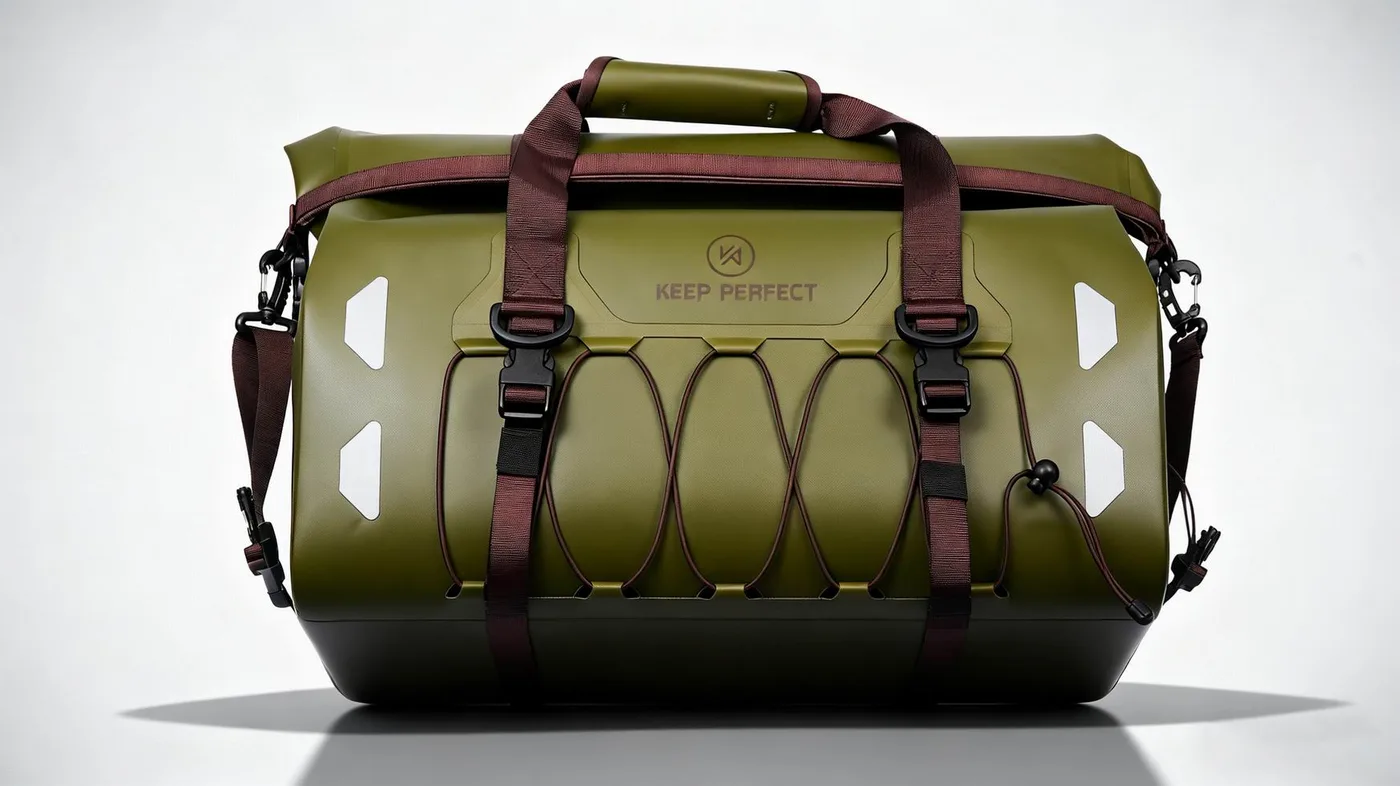
Hardware failures are rare on a mature line and catastrophic when they happen, which argues for a small but genuinely destructive test rather than a wide scan. Pull-testing a sample of buckles and D-rings to failure takes fifteen minutes and tells you whether the strength requirement is genuinely being met. A typical requirement is 150 N for a lash point and 250 N for a shoulder strap anchor.
Print checks need a reference. There is no objective pass or fail without an approved colour standard and a tolerance, so insist that the first-article approval includes a signed reference print plus a stated delta E tolerance measured under D65 light. In practice a tolerance of delta E 2.0 is achievable on flat TPU film, while anything above 3.0 is visible to untrained eyes under shop lighting.
| Feature checked | Method | Typical tolerance | Sample size | Equipment |
|---|---|---|---|---|
| Shell dimensions | Tape against spec drawing | +/- 5 mm | Every sampled unit | Steel tape, 0.5 mm |
| Print registration | Overlay against reference film | +/- 2 mm | Every sampled unit | Light table |
| Colour shade | Instrument delta E versus standard | Delta E 2.0 | 5 units per lot | Spectrophotometer |
| Buckle pull strength | Tensile test to failure | 150 N minimum | 6 units per lot | Tensile rig, 5 kN |
| D-ring weld peel | Peel at 100 mm per minute | 35 N per 25 mm | 4 units per lot | Tensile rig with peel jig |
| Odour | Three-person panel, 24 h bag-off | Grade 3 or better | 3 units per lot | Odour chamber at 40 °C |
Common disputes and how to avoid them
Three arguments account for almost every bad-tempered inspection. The first is lot splitting, described above, and it is solved contractually: state in the purchase terms that the lot size equals the total quantity presented for that shipment, not what the line happens to have completed. The second is whether the inspector may open retail packaging, which should also be settled in advance and is usually resolved by allowing repacking at the production partner’s cost.
The third and largest dispute is defect classification. A loose thread is a minor fault to a maker repairing ten units and a critical fault to a brand whose entire positioning rests on finish. There is no universal answer, which is exactly why the classification table must be agreed and signed before bulk begins rather than negotiated on the final morning.
A worked example: 5,000 pieces at AQL 2.5
Take a real-scale purchase. The order is 5,000 roll-top bags across four colourways, produced over 22 days, and inspection is booked for the fourth day after packing begins. The lot at inspection is 5,000 units, which sits in the 3,201 to 10,000 band, giving code letter L and a sample of 200 units drawn randomly across cartons rather than picked from the accessible top layer.
| Finding | Count in sample of 200 | Class | Counted against AQL 2.5? | Disposition |
|---|---|---|---|---|
| Leak at a base weld | 2 | Critical | No, separate rule | Automatic lot rejection pending 100% screening |
| Closure will not hold three rolls | 1 | Critical | No, separate rule | Same: reject unless corrected and resampled |
| Colour outside delta E 2.0 | 4 | Major | Yes | Toward the accept budget |
| Print misregistration | 5 | Minor | Yes | Toward the accept budget |
| Loose thread, trimmable | 3 | Minor | Yes | Toward the accept budget |
| Total non-critical defects | 12 | Mixed | Yes | Above accept 10, below reject 11 is not possible: 12 means reject |
Read the last row carefully: twelve non-critical defects exceeds the acceptance number of ten, so the lot fails even before the three critical units are considered. In practice the critical findings would have stopped the inspection anyway, because most programmes treat them as immediate cause for full screening. The worked example makes the arithmetic visible, and it is the kind of exercise worth running with your own numbers before you agree a plan.
What AQL inspection does not cover
Sampling plans say nothing about the mean quality of a lot, only about its probability of acceptance. They also do not protect against a systematic error that affects every unit identically, which is the single most dangerous category in this product group. If the wrong catalyst ratio was used in a batch of film, or if a machine die has drifted 1 mm, every unit may be affected and no amount of random sampling from that lot will reveal a trend.
This is why the plan must sit alongside first-article approval, in-line checks during the first two hundred pieces, and periodic destructive testing sent to an independent laboratory. The comparison between those two approaches is set out in our field and laboratory testing comparison, and it is worth reading before you write a single acceptance criterion. Systematic problems need process controls, not better statistics applied at the very end.
Sampling also ages badly if the plan never changes. A programme that ran happily for three years should still be reviewed after any material change, any new colourway, or any move to a second line, because the defect population changes with every one of those events and historical acceptance numbers stop being meaningful. The same logic underpins the periodic re-qualification described in our warranty testing standards.
Building a defect catalogue before bulk starts
- List every plausible fault with a unique code, so findings are recorded consistently across inspectors.
- Photograph a physical reference for each code with lighting and distance stated.
- Assign a class to each code and get that classification signed by both parties.
- Set threshold quantities for automatic 100% screening, independently of the AQL outcome.
- Agree who pays for sorting and repacking when a lot fails and is later re-presented.
- Decide the switching rules in advance rather than renegotiating them after a rejection.
Two of those lines deserve extra emphasis. The threshold quantities are what turn a statistical plan into a practical one: even at accept counts, most brands will demand full screening once any critical defect appears, because the reputational asymmetry between shipping one leaking bag and inspecting five thousand units is enormous. Write the threshold into the document rather than relying on goodwill on the day.
The cost clause is equally important and frequently skipped. A failed lot typically costs five to eight working days to sort, screen and re-present. Knowing in advance whether that expense falls on the production partner concentrates attention on avoiding it, which is precisely the behavioural effect you want from the clause. An unallocated cost is a cost that will eventually be argued about at the worst possible moment.
Fitting inspection into the production calendar
Our team has produced waterproof bags since 2014 in an SGS-verified 4,950 m2 facility with 7 production lines and 149 machines, running monthly output near 200,000 pieces, and inspection booking is the most common cause of avoidable delay we see. A final random inspection typically takes one to two working days on site, so it must be scheduled before the container cut-off, not on the same day.
Standard timing works like this: sampling in 6 to 10 working days once materials are confirmed, bulk in 35 to 50 days, then final inspection with results issued within 24 hours of completion. A failed lot adds five to eight days for sorting. Building a buffer of ten days between packed stock and vessel cut-off costs nothing if unused and saves the entire shipment if it is not.
Every programme we run ships against AQL 2.5 with FOB Xiamen terms and T/T 30/70 payment, and the inspection clause is part of the same purchase document rather than a separate email thread. Written that way, there is one place to look when someone asks what happens next, which is most of what makes a dispute resolvable quickly on our roll-top platform and across the wider product range.
Writing the inspection clause that protects you
A usable clause runs to about ten lines and answers six questions: which standard and revision, which inspection level, which AQL values per defect class, whether lot size equals total presented quantity, who pays for sorting after rejection, and what happens on re-inspection. Anything longer usually indicates that some question remains unanswered and someone is hoping volume will hide it.
Add two procedural sentences that save hours later. State that random sampling follows a documented random-number map across cartons, so nobody selects units from the top of the nearest pallet. State that the inspector may open and reseal retail packaging for destructive tests, with reasonable replacement, so access disputes do not consume the morning. Both sentences take half a minute to agree and remove two of the three arguments that routinely delay despatch.
Finally, tie the clause to a measurable product claim. If your warranty rests on the bag surviving immersion, then the warrantied requirement and the inspection criterion must describe the same event, otherwise you will be arguing about whether a bag that passed inspection can be rejected by a user. Whatever terms you write should be validated against realistic use rather than the other way round.
Frequently asked questions
Q1. What does AQL 2.5 mean for dry bags?
AQL 2.5 sets how many defects a random sample may contain before a shipment is rejected. On a 5,000-piece lot at general level II you inspect 200 units and accept at 10 defects, reject at 11. Leaks and closure failures should sit outside that arithmetic as critical defects with zero tolerance.
Q2. Which standard governs AQL sampling?
ISO 2859-1, published in equivalent form as ANSI/ASQ Z1.4. Both give the same code letters and acceptance numbers, and either is defensible in a purchase contract as long as the revision is stated.
Q3. How many bags are inspected from a 5,000-piece order?
200 units at general inspection level II. That corresponds to code letter L, where AQL 2.5 gives accept 10 and reject 11, AQL 1.0 gives 5 and 6, and AQL 4.0 gives 14 and 15.
Q4. Should a leaking seam be a critical defect?
Yes. Anything that defeats the product’s fundamental purpose belongs in the critical class with zero tolerance, regardless of the numerical AQL chosen for cosmetic faults. A single leaking unit should trigger full screening rather than counting toward an acceptance budget.
Q5. Is AQL inspection enough on its own?
No. It does not detect systematic defects affecting every unit, and it says nothing about the mean quality of a lot. Pair it with first-article approval, in-line checks and periodic destructive testing at an independent laboratory.
Q6. What is a destructive side sample?
A small group of units set aside for tests that damage the product, such as weld peel, buckle pull to failure or hydrostatic head to destruction. Typically two to five units, specified separately from the main sample to keep the remaining units saleable.
Q7. How should I define a lot?
The lot is the total quantity presented for one inspection of identically produced goods. State this explicitly in the contract, because splitting one shipment into several small lots reduces absolute sample counts and weakens the statistical basis of the whole plan.
Q8. What inspection level should bags use?
General inspection level II, which is the default across sewn and welded soft goods. Special levels S-1 to S-4 are reserved for expensive or destructive tests, where a smaller sample is justified by the cost of each measurement.
Q9. How long does a final inspection take?
One to two working days on site for a typical order, with the report issued within 24 hours of completion. Always schedule inspection with a buffer before the vessel cut-off rather than on the day loading begins.
Q10. What happens when a lot fails?
Standard practice is either to accept with concession, to screen the entire lot at the responsible party’s cost, or to reject and remake. Screening typically takes five to eight working days, which is why the cost clause should be agreed before bulk starts.
Q11. Can I move to reduced inspection?
Yes. The switching rules allow reduced inspection after a sustained run of accepted lots, typically five or more, which lowers sample size and cost. Two rejections in five lots move you the other way into tightened inspection until performance recovers.
Q12. How are colour differences judged?
Against a signed reference standard, ideally measured with a spectrophotometer and reported as delta E under D65 lighting. A tolerance of delta E 2.0 is realistic on flat film; above 3.0 the difference is visible to untrained eyes in retail lighting.
Q13. What is closure cycling?
Rolling and unrolling a sample bag several hundred times, then retesting it, to catch crease fatigue in the film at the fold line. It detects film formulations that fail in real use while still passing every test at time zero.
Q14. Do I need third-party inspection?
For most programmes, yes, at least on first orders and after any material or line change. An independent report also settles disputes quickly because neither party controls the methodology or the sampling.
Q15. How much does inspection cost?
Budget roughly one to two inspector days plus travel for a standard order, typically a small fraction of order value. Set against the cost of a returned shipment or a recall caused by a batch of leaking seams, it is consistently the cheapest insurance available.
Q16. What belongs in a written inspection clause?
Standard and revision, inspection level, AQL per defect class, definition of lot size, responsibility for sorting costs after rejection, and the re-inspection procedure. Ten lines answering those six points prevents almost every dispute that arises on inspection day.
People also ask
How do you calculate AQL sample size for bags?
Find your lot size band, take the general level II code letter, then read the sample size and accept and reject numbers for your chosen AQL. A 5,000-piece lot gives code letter L, 200 units, accept 10 and reject 11 at AQL 2.5.
What is a good AQL for waterproof bags?
AQL 2.5 for major and minor faults is standard, paired with zero tolerance for critical defects such as welded seam leaks or closures that will not seal. Tightening cosmetics rarely improves outcomes; sharpening the critical list does.
Can you 100% inspect instead of sampling?
Yes for small or high-risk orders, and it is often worth it above a critical finding. It typically adds five to eight working days to the schedule and costs several times more, which is why it is used selectively rather than routinely.
Why did my AQL inspection miss a systematic defect?
Because sampling detects variation, not uniform errors. If every unit shares the same fault, for example a mis-set welding die, any random sample reflects that same uniform condition and the lot can pass while every unit is affected.
Is AQL 2.5 better than AQL 1.0?
For cosmetics, AQL 1.0 mostly adds inspection time and cost. The better route is to keep AQL 2.5 for appearance and add zero-tolerance rules for anything affecting the waterproof function, so effort goes where failures are noticed.
What defects should be classed as critical on a dry bag?
Any leak path: a weld void, a pinhole in the film, an incomplete bonded seam, a buckle that fractures under load, or a closure that cannot hold three rolls. All defeat the single purpose of the product, so all sit outside the numeric plan.
Need this in production volume?
QUANZHOU JUNYUAN BAGS has produced waterproof bags since 2014 in an SGS-verified 4,950 m2 facility in Fujian, China. Minimum order 500 pieces, sampling in 6–10 working days, bulk in 35–50 days, FOB Xiamen — write to service@junyuanbags.com with your spec and target market.