Dry Bag Setup for Beach Days
A simple beach day runs on 20 to 25 litres of waterproof capacity split three ways: one 20L roll-top for towels and dry clothing, one 5L for phone, keys, sunscreen and snacks, and one 2L liner for wet swimwear on the drive home. Three bags keep the loaded total under 4.5 kg, which is what most people can carry 600 m across soft sand without stopping to rest. Sand, not water, is what ruins most beach loads: one grain trapped in the closure lifts the fold by roughly 0.2 mm and opens a capillary path that wets the contents within 40 minutes.
The setup below assigns a single job to each bag and then deals with the four hazards that actually damage gear: wind-driven grit, direct sun at a UV index of 8 or above, salt spray, and the damp towel that grows mildew in a hot car. Every recommendation is tied to a number you can check: 0.5 mm film thickness, three folds minimum, a 45 °C ceiling for phone storage, and a rinse-and-dry routine that takes five minutes at the tap beside the car park.
- What a beach day actually asks of your dry bags
- The three-bag beach setup: sizes and jobs
- Sand management: keeping grit out of the fold
- Where phones, keys and wallets belong
- Towels, wet swimwear and the damp-load problem
- Shade, UV and what heat does to film
- Wind: anchoring everything without losing it
- Carry distance and shoulder comfort
- Waterproof ratings that matter at the shoreline
- Scaling the plan for a family or group
- Failure modes seen after one season of beach days
- The five-minute rinse-down before you leave
- Beach-day checklist before you pack the car
What a beach day actually asks of your dry bags
A day on the sand exposes a bag to four phases in sequence rather than one hazard at a time. Transport comes first: 30 to 45 minutes in a boot that reaches 52 °C on a sunny afternoon, with sunscreen leaking and grit already on the floor. Then the walk, typically 300 to 800 m over soft sand, during which every strap and seam is loaded at an angle it never sees in a kayak hatch. Then the static phase, four to six hours under direct sun at a UV index between 7 and 11, with dark fabric reaching surface temperatures near 58 °C. Finally, the drive home with two wet swimsuits sealed inside a closed bag.
Water is the least of it. A roll-top bag that survives a capsize will not necessarily survive six hours buried in silica, because quartz grains are harder than the TPU film and polish it from the outside in. Theft loss surprises people too: a phone sitting on a towel inside sight lines is a five-second opportunity for anyone walking past. Build the plan around those four phases rather than around the marketing photo of somebody holding a bag above a breaking wave.
The three-bag beach setup: sizes and jobs
Three sizes cover every normal beach day, and each one has a single job it never swaps. The 20L holds towels and dry clothing, the 5L holds everything you touch while you are lying down, and the 2L liner is the only place that ever gets wet. Keeping one bag permanently dry matters because it means the car seats, the picnic blanket and the book you are halfway through stay dry no matter what happens in the surf.
| Bag | Size | Contents | Loaded weight | Position on the blanket |
|---|---|---|---|---|
| Dry main bag | 20 L | Two towels, spare T-shirts, sun hats | 2.6-3.2 kg | Centre, under the umbrella |
| Valuables grab bag | 5 L | Phone, keys, wallet, sunscreen, snack | 0.8-1.2 kg | In the shade, within arm’s reach |
| Wet liner | 2 L | Swimsuits, swim nappies, sandy goggles | 0.6-1.0 kg | Hot side of the towel, mouth open |
| Food and drinks bag | 10 L | Sandwiches, fruit, four 330 ml bottles | 3.0-3.6 kg | Corner, buried 100 mm deep |
| Beach toy dump bag | 30 L | Buckets, spades, inflatables | 1.5-2.5 kg | Upwind edge, always closed |
If you only own one bag, make it a 20L and use a supermarket bag as the wet liner until the second bag arrives; that single substitution removes most of the damp-load problem. Families should double the main bag rather than triple it: two adults and two children need roughly 45 litres total, carried as one 30L plus two 10L bags, because one 45L bag becomes a 9 kg lump nobody wants to carry from the car.
Sand management: keeping grit out of the fold
Sand reaches the closure in three ways, and each has a fix. It falls onto the open mouth while you are packing; it creeps in on wet hands when you reach for a snack; and it blows sideways along the blanket in any wind above 15 km/h. Once inside the roll, a grain 0.5 mm across holds the two film faces apart by its own diameter, which is enough for water to wick along the fold line even when the buckle is tight.
Pack on a raised surface, never directly on the blanket. A folded towel, a camp stool, or the boot lip of your car all lift the mouth of the bag away from the sand layer that migrates under everything. Before each closing, run a thumb along the fold line in both directions and knock the bag upside down once; those two actions take four seconds and remove nearly all the risk. Roll the bag away from the wind so the final fold traps any remaining grit on the outside of the roll rather than on the sealing faces.

Where phones, keys and wallets belong
Use the two-seal rule for anything that would ruin your afternoon: the object goes into a small pouch, and the pouch goes into the roll-top bag. A 2L liner with its own three-fold closure gives two independent barriers, and two barriers fail together only if both are rolled badly. Keys are the awkward part because a metal key ring abrades film; put them in a soft pocket or wrap them in a microfibre cloth before they meet TPU.
Heat is the second threat, and it is the one most people ignore. A phone left on top of a dark towel in full sun can pass 45 °C, above which lithium cells lose cycle life and thermal throttling kicks in. Keep the valuables bag under the umbrella, or bury it 100 mm under loose sand where the temperature stays close to 26 °C even on a 34 °C afternoon. If you want a bag that also floats when a wave takes it, look at our floating dry bag range and treat buoyancy as insurance rather than as permission to relax.

Towels, wet swimwear and the damp-load problem
A roll-top bag has no internal wall and no drain, so anything damp shares its moisture with everything else in the bag. Two swimsuits at 60% residual moisture carry roughly 120 ml of water; sealed with two towels, that water redistributes within 20 minutes and you arrive home with laundry that smells faintly of chlorine by the following morning. Separate the damp from the dry before you leave for the beach, not after.
The 2L liner handles this, and it doubles as the sandy-item bag for goggles and beach shoes. Rinse it at the tap before it goes into the car, then hang it open from a headrest for the drive. Detailed techniques for the damp compartment, including a drying schedule for hotel balconies, are covered in our guide to keeping wet swimwear out of your dry bag.
Shade, UV and what heat does to film
Ultraviolet light attacks the polymer itself, not just the colour. TPU with a UV-stabilised topcoat loses around 8% of its tensile strength per 1,000 hours of equivalent sun exposure at a UV index of 9; unprotected PVC loses flexibility faster and shows it as surface crazing within two seasons. Reflected UV off pale sand adds roughly 15% to the dose a bag receives, so the underside of a bag is not safer than the top.
Shade is the cheapest mitigation and the most skipped. Moving a bag 400 mm into the umbrella shadow drops its skin temperature from 58 °C to about 34 °C, which halves the rate of any chemical ageing. Check the daily forecast before you leave and plan around the peak three hours; the index published by NOAA is worth reading at breakfast. Deeper maintenance habits are in our notes on preventing UV damage, and in the seasonal guide to sun and sea storage.
Wind: anchoring everything without losing it
Coastal beaches routinely see 20 to 35 km/h onshore winds, which is enough to send an empty 5L bag skidding 10 m in seconds. Every bag should either be buried, weighted, or clipped to something fixed. A 20L bag half-filled with towels already weighs enough to stay put; the risk concentrates in the small bags, which is why the valuables bag goes inside the umbrella footprint rather than on its own patch of blanket.
Use the D-ring and one short strap rather than a long leash. A long cord attached to a wind-caught bag becomes a tripping hazard for children running past, and on a busy beach that is the sort of detail other families remember. If you use an umbrella as the anchor, remember it is the first thing to go: a gust that lifts the umbrella will take the bags with it, so keep the valuables within reach of your own hand rather than trusting any anchor point.
Carry distance and shoulder comfort
The walk from car park to sand is the most physically demanding part of a beach day, and it is where strap design shows its value. A 4.5 kg load carried 600 m over soft sand costs roughly three times the effort of the same load on pavement, because every step sinks 40 to 60 mm and you lift your body mass out of that depression repeatedly. Single-shoulder carry with a soft load is fine for 200 m; beyond that, switch to a harness.
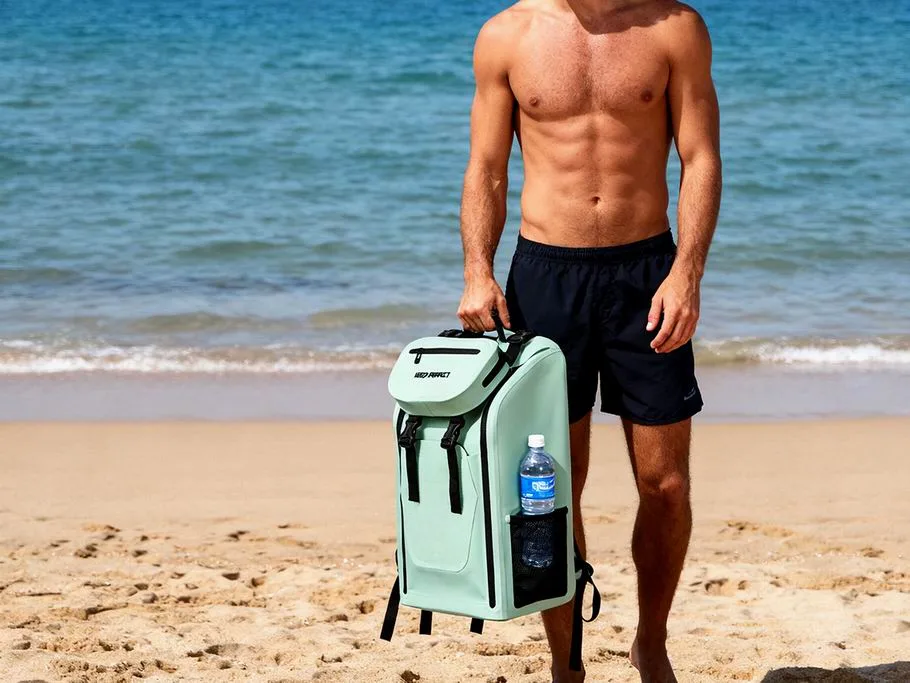
A welded waterproof backpack spreads that 4.5 kg across both shoulders and keeps the load centred, which matters when you are picking your way across hot sand with a child on one hand. Our TPU waterproof backpack line uses the same film and closure as the roll-top bags, so the two formats share a care routine. If you prefer one bag that does everything, start from the roll-top dry bag range and add a shoulder harness later.

Waterproof ratings that matter at the shoreline
Ratings describe a test, so the useful question is which test matches a beach day. Standing splash from children is a low-pressure jet event; a wave that washes over the bag is a higher-pressure jet; swimming out to a buoy with the bag tethered to your wrist is sustained contact with water moving past the closure at maybe 1.5 knots. Each of those three states maps to a different grade, and only the last one involves real immersion.
The IEC publishes the IPX grades under IEC 60529, which is why a credible specification names a standard instead of adjectives. Ask which grade the bag was tested to and for how long; a bag tested for 30 minutes at one metre behaves very differently from one tested under a shower nozzle for two minutes.
| Situation | Water pressure | Grade needed | Seam construction |
|---|---|---|---|
| Children tipping water | Low splash | IPX4 | Welded or taped |
| Washing sand off at a tap | Directed jet | IPX5 | Welded |
| Wave washing over the bag | Strong jet | IPX6 | Welded |
| Swim to a buoy with the bag | Sustained contact | IPX7 | Welded, 0.4 mm film or heavier |
| Bag dragged under for 30 s | Immersion at 1 m | IPX7 | Welded, three folds |
| Bag taken by a rip and recovered | Immersion below 1 m | IPX8 | Welded, 0.5 mm film or heavier |
Scaling the plan for a family or group
Groups break the three-bag rule in a predictable way: everyone brings one bag and nobody knows which one holds the sunscreen. Assign by colour rather than by size once you have four people, and label the exterior with a permanent marker near the closure so you can identify a closed bag without opening it on the sand. One 30L dry bag plus two 10L bags covers a family of four for a six-hour day with room for a picnic.
| Group | Total capacity | Recommended split | Total weight | Carry strategy |
|---|---|---|---|---|
| Solo adult | 20-25 L | 20L + 5L | 3.5 kg | One hand, soft shoulder strap |
| Two adults | 35-45 L | 30L + 10L + 5L | 6.5 kg | Backpack for the heavy bag |
| Family of four | 45-55 L | 30L + 10L + 10L | 9.0 kg | Two trips or a beach trolley |
| Family of five with toys | 65-80 L | 40L + 20L + 10L + 10L | 13.0 kg | Trolley plus one shoulder bag |
| Group of eight adults | 120-160 L | Two 40L + four 10L | 24.0 kg | Wheeled cart, single drop point |
The weight column is the honest one. Four people generating 13 kg of kit are better served by a folding cart than by better straps, particularly over soft sand where wheels sink and steering effort climbs. Keep the drop point within sight of the water line, group the bags under one umbrella, and let one person own the keys pouch so it never gets buried by someone smoothing the blanket.
Failure modes seen after one season of beach days
- Closure rolled while the mouth is still dusty, which leaves a gritty film that wicks water all afternoon.
- Sunscreen transfer from hands onto the fold line, leaving an oily patch that degrades TPU surface tack.
- Buckles stored with sand inside, which raises release force from about 25 N to over 60 N by the end of summer.
- Bags dried in direct sun on hot sand, which pushes skin temperature past 60 °C and stiffens PVC permanently.
- Wet items sealed into the dry main bag, producing chlorine odour within 24 hours and mildew in three days.
- Dark-coloured bags used as seats, concentrating abrasion and body load on the same 300 mm of film.
Each of those has a five-second fix if you notice it early. Sunscreen on the fold line is best handled with a mild soap wash, not solvent, because alcohols can haze a clear window cloud immediately. Buckles that have stiffened respond to a soak in fresh water followed by a drop of silicone-free lubricant worked through the full travel; grit is usually in the spring channel rather than on the visible surfaces.
Abrasion from being used as a seat deserves special mention because it is invisible until it is not. Ten afternoons of sitting on a 20L bag leaves the bottom panel matte and slightly thinner, and eventually creases appear where the load was folded. Carry a cheap foam pad, or accept that this bag becomes the toy bag for the rest of its life.
The five-minute rinse-down before you leave
- Empty every bag completely, including the toy bag, and shake it upside down away from the wind.
- Rinse with fresh water at ambient temperature; a tap left in the sun can exceed 45 °C and is too hot for TPU.
- Wipe the fold line with a wet thumb, then run the closure through three folds dry to check for residual grit.
- Open all bags at home and hang them mouth-down over a rail or a chair back for two hours.
- Store loosely rolled with the buckle undone and no weight on top.
Do not skip the rail. A bag left in a closed car boot overnight with damp sand inside will smell within a day, and the smell survives several washes because it lives in the film rather than on the surface. If swimmers reported an upset stomach afterwards, it is worth reading the water-quality guidance published by the EPA, since beach advisories explain more incidents than any bag ever has.
If the beach has no tap, carry two litres of fresh water in a bottle and pour rather than wipe; wiping moves grit around, while pouring carries it away. Do the valuables bag first, since that is the one you will repack the following morning.
Beach-day checklist before you pack the car
- One 20L dry bag for towels and clothing, kept permanently dry.
- One 5L valuables bag packed last so it stays on top and inside reach.
- One 2L wet liner for swimwear, goggles and sandy footwear.
- A raised surface to pack on, even if it is only a folded towel.
- Three folds minimum on every closure, checked with the thumbnail test.
- Umbrella shadow reserved for the electronics and food, not for the empty bags.
- Five minutes of rinse time budgeted at the tap before the drive home.
If you are specifying bags for a resort, a rental fleet or a retail range aimed at the same beach-day use case, the checklist converts directly into a brief: sizes, film thickness, closure geometry, colour coding and the test standard are the five lines that decide whether a bag survives a season in silica and salt.
For gear that goes further than the shoreline, the same three-bag logic scales down for a swim and up for a boat day. Start with the full product line when you are choosing sizes across a household, then read our beach day organisation notes if three people are sharing one blanket, and the longevity guide on whether sunlight ruins a dry bag before you leave anything outside all summer.
Frequently asked questions
Q1. What size dry bag should I take to the beach?
Take a 20L for towels and clothing, a 5L for phone, keys and sunscreen, and a 2L wet liner for swimwear. That is 27 litres total and about 4.5 kg loaded, which one person can carry 600 m across soft sand.
Q2. Do I really need three bags for a beach day?
Two is the minimum and three is comfortable. The third bag exists to keep wet swimwear out of the dry load, which is what prevents chlorine odour and mildew on the drive home.
Q3. How do I stop sand getting into the closure?
Pack on a raised surface, knock the bag upside down, then run a thumb along the fold line before each roll. One 0.5 mm grain in the fold is enough to wick 30 ml of water into the bag over an afternoon.
Q4. Will a dry bag keep my phone safe at the beach?
Yes, using the two-seal rule: phone in a small pouch, pouch inside a roll-top bag kept in the umbrella shade. Keep it below 45 °C, because direct sun on dark fabric reaches about 58 °C.
Q5. Should I bury my dry bag in the sand?
Burying works well for the food bag, since 100 mm of loose sand keeps contents near 26 °C even on a 34 °C day. Do not bury the valuables bag, because you will not find it again quickly in an emergency.
Q6. What is better for beach use, TPU or PVC?
TPU. It stays flexible, has no plasticiser to migrate, and tolerates repeated folding in heat far better than PVC, which stiffens and crazes after one or two seasons of strong UV.
Q7. Can I leave a dry bag in the sun all day?
You can, but it shortens service life. Reflected UV off pale sand adds about 15% to the dose, so move bags into the umbrella shadow where skin temperature drops from 58 °C to roughly 34 °C.
Q8. How do I carry heavy bags across soft sand?
Use two shoulders for anything over 4 kg and any distance over 300 m. Soft sand triples the effort per metre, so for family loads of 13 kg a folding cart beats better straps every time.
Q9. Can I put wet swimsuits in the same bag as dry towels?
No. A roll-top bag has no internal wall and no drain, so 120 ml of residual water in two swimsuits redistributes through the towels within 20 minutes and develops an odour within a day.
Q10. How often should I rinse a beach bag?
After every visit. Rinse in fresh water at ambient temperature, wipe the closure, then hang it open at home for two hours. Salt and silica left in the buckle raise release force from 25 N to more than 60 N over a summer.
Q11. Will sunscreen damage my dry bag?
Chemical filters can haze clear windows and leave an oily patch on the fold line that reduces tack. Wash with mild soap and water rather than solvents, and wipe hands before handling the closure.
Q12. Do dark bags get hotter than light ones?
Yes. Black TPU can reach 58 °C surface temperature in full summer sun while an olive or mint version of the same bag sits near 47 °C. If the contents include chocolate, electronics or medication, colour matters.
Q13. What rating should a beach dry bag have?
IPX6 covers children tipping water and waves washing over the bag, which is most of a beach day. Move to IPX7 if you plan to swim with the bag tethered, since that is sustained contact rather than a splash.
Q14. How many litres does a family of four need at the beach?
Plan on 45 to 55 litres: one 30L plus two 10L bags for a six-hour day with a picnic. That totals around 9 kg, which is why a beach trolley becomes worthwhile at exactly this group size.
Q15. Can I use one dry bag as a seat?
Only if you have accepted the consequence. Body load plus sand abrasion concentrates on the same 300 mm of film, and after ten afternoons the bottom panel goes matte and begins to crease. Carry a foam pad instead.
Q16. Is a dry bag safe from thieves on a busy beach?
Nothing left unattended is. Keep the valuables bag within arm's reach, do not let phones sit visible on the towel, and treat the three-bag setup as organisation rather than security.
People also ask
How do you pack a dry bag for the beach?
Keep one bag permanently dry for towels and clothing, one small bag for what you reach for constantly, and one liner for anything wet. Pack on a raised surface, roll three folds, and bury the food bag 100 mm deep in the shade side of the umbrella.
Are dry bags worth it for beach days?
Yes, mainly for sand and theft control rather than water. Sand is abrasive enough to polish TPU, and a single grain in the closure can admit 30 ml of water; a closed bag also keeps valuables out of sight from people walking past.
What should not go in a beach dry bag?
Do not seal damp swimwear, sandy shoes or leaking sunscreen into a bag holding dry towels and electronics. There is no internal drain, so everything shares moisture and residue within about 20 minutes.
How hot does a black dry bag get in the sun?
Around 58 °C surface temperature at midday on a clear summer beach, roughly 11 °C hotter than a mid-tone colourway. Contents buried 100 mm under sand stay near 26 °C, which is why burying the food bag works.
Can you swim out with a dry bag?
You can if it is rated IPX7 and closed with three folds, and you should tether it to your wrist rather than carry it. An inflated bag acts as a drag anchor at about 1.5 knots of relative water flow.
Why does my dry bag smell after a beach trip?
Dampness trapped in a closed bag produces odour within a day and mildew within three. Rinse in fresh water, empty completely, and hang the bag mouth-down at home for two hours before storing it loosely rolled.
Need this in production volume?
QUANZHOU JUNYUAN BAGS has produced waterproof bags since 2014 in an SGS-verified 4,950 m2 facility in Fujian, China. Minimum order 500 pieces, sampling in 6–10 working days, bulk in 35–50 days, FOB Xiamen — write to service@junyuanbags.com with your spec and target market.