Does Sunlight Ruin a Dry Bag?
Yes, sunlight degrades every dry bag material, but far more slowly than most people assume: a 0.5 mm TPU bag used for twenty-five beach weekends a year at six hours a session accumulates about 150 hours of strong sun annually and needs roughly three years, or 400 to 600 hours, before yellowing and a measurable loss of stretch become visible. PVC coated bags reach visible stiffening sooner, at 300 to 500 hours, because the damage mechanism is plasticiser loss rather than chain scission. Neither failure makes a bag leak on its own; leaks come later, when a stiffened fold line cracks along its length.
The dose is what matters, not the adjective. A bag left on dry sand at UV index 8 gets about 1.2 times the dose of the same bag on grass, because sand reflects 10 to 25 per cent of ultraviolet radiation, and a bag left on a white boat deck gets 1.25 to 1.35 times. This guide sets out how to estimate your own annual dose, what each material does with it, where the damage appears first, how to test for it at home, and the four storage habits that cut the dose by 80 to 99 per cent.
- What sunlight actually does to a dry bag
- UV dose: measure it rather than guess
- Material by material: how each one fails
- Heat versus ultraviolet: separate the two
- Where the damage shows first
- Does colour change how fast a bag ages?
- Salt, sand and the combined effect
- Reflection: the multiplier nobody counts
- Testing for UV damage at home
- What actually stops ultraviolet damage
- Storage routine after sunny days
- When to retire a sun-damaged bag
What sunlight actually does to a dry bag
Ultraviolet radiation carries enough energy to break chemical bonds in the polymers used for waterproof fabric, and the two dominant materials fail in different ways. Thermoplastic polyurethane undergoes chain scission in its soft segments, which shows up first as yellowing, then as a loss of elasticity and finally as a chalky surface layer that rubs off on your hand. Polyvinyl chloride loses plasticiser to the surface, becomes rigid, and then cracks at the points where the film is folded, because a rigid film cannot distribute the strain of a fold.
Neither process is visible in the first season, which is why the damage gets ignored until it is structural. The practical sequence is colour change, surface chalk, stiffness at the fold, hairline cracks at the fold, and only then a leak. A bag that is retired at the chalk stage still functions perfectly as a liner or a wet-gear bag, and that is the sensible moment to demote it rather than waiting for it to fail on a trip.
UV dose: measure it rather than guess
Damage accumulates with dose, and dose is intensity multiplied by time. The UV index published in weather forecasts is a scale of erythemal irradiance, and the index values most dry bags see in service are 5 to 11. A summer afternoon in northern Europe sits near index 5, the Mediterranean midday near 8, and a tropical dry season near 10 to 11, which means an hour in Queensland is roughly twice the dose of an hour in Cornwall.
Estimate your own annual dose by multiplying session length by sessions per year. Twenty-five beach days at six hours is 150 hours; a liveaboard season of forty days at eight hours is 320 hours; a bag that lives on a deck all summer accumulates 600 to 900 hours in a single season, which is why deck-stored bags age three to five times faster than bags that are packed away after every outing. Forecast indices are published by NOAA for most populated regions.
| Exposure scenario | UV index | Hours per session | Sessions per year | Annual hours |
|---|---|---|---|---|
| Northern Europe, summer afternoon | 4-5 | 4 | 20 | 80 |
| Mediterranean, summer midday | 7-8 | 6 | 30 | 180 |
| Tropical dry season, open beach | 10-11 | 5 | 40 | 200 |
| Alpine winter, reflected off snow | 5-6 | 4 | 12 | 48 |
| Left on a deck all season | 6-9 | 10 | 70 | 700 |
| Behind window glass indoors | 1-2 | 8 | 300 | 2400 |

Material by material: how each one fails
The differences between materials are large enough to change a buying decision. TPU is the most UV-tolerant of the common films because it is a single homogeneous polymer with no additive to migrate out; it yellows and gradually loses stretch. PVC is cheaper per square metre and initially tougher, but its plasticiser is a small molecule that migrates to the surface and evaporates, so stiffness arrives earlier and cracking follows. Polyurethane coatings on woven nylon fail by hydrolysis as much as by UV, which is why they chalk.
Recycled content changes very little on its own. A recycled polyester face fabric fades because the dye is the weakest link, not the film, and a recycled TPU film behaves close to a virgin one provided the stabiliser package is intact. What matters more than recycled content is whether the film carries a hindered amine light stabiliser at all, because an unstabilised film of any origin will chalk within two seasons of tropical use.
| Material | Main UV mechanism | Hours to visible change | Strength retained at 1,000 h |
|---|---|---|---|
| TPU film, 0.5 mm | Chain scission, yellowing | 400-600 h | 80-88% |
| PVC coated, 0.5 mm | Plasticiser loss, stiffening | 300-500 h | 70-80% |
| PU-coated nylon | Coating hydrolysis, chalking | 500-800 h | 65-75% |
| Silicone-coated ripstop | Coating thinning | 700-1000 h | 75-85% |
| rPET face with TPU film | Dye fade before film change | 400-600 h | 78-86% |
| Unstabilised PVC, 0.3 mm | Rapid stiffening and cracking | 150-250 h | 50-65% |
Heat versus ultraviolet: separate the two
Sunlight damages a bag by radiation and by heat, and the two are easy to confuse because they arrive together. A black film in full sun at 32 degrees Celsius ambient with no wind reaches a surface temperature of 60 to 68 degrees, while the same bag in shade sits 15 to 20 degrees cooler. That heat accelerates plasticiser migration and softens the film temporarily, so a bag can feel limp and damaged in the afternoon and perfectly normal the next morning.
The test that separates them is simple: leave two identical bags out on the same day, one in full sun and one under a towel. After ten sessions the covered bag will show almost no change while the exposed one will have faded, and the covered bag will also be measurably more supple. That tells you the radiation is doing the permanent work and the heat is doing the temporary work, which matters because a bag that has only been heated is fine and a bag that has been radiated is not.
Where the damage shows first
Damage is never evenly distributed. The fold line at the top of a roll-top takes the most, because it is creased, because it presents a changing angle to the sun through the day, and because folding concentrates strain in the same few millimetres of film every time the bag is closed. The weld line is next, because welding slightly reorients the polymer and leaves a narrow heat-affected zone either side of the seam.
Hardware and webbing fail earlier than the film. Polyester webbing loses 20 to 30 per cent of its breaking strength after about 500 hours of strong exposure, and polyoxymethylene buckles chalk and lose their spring. That is worth checking twice a season, because a strap that fails at 60 kg is more dangerous than a film that yellows, and both are easy to see if you look at the webbing rather than the body of the bag.
Does colour change how fast a bag ages?
Colour does two opposing things. Dark colours absorb more infrared and run hotter, which is bad for plasticiser retention; but carbon black pigment is also one of the most effective ultraviolet absorbers available, so a black TPU film is frequently the longest-lasting option in a range. Light colours run cooler and look cleaner for longer, but they show yellowing far more obviously and they lack the pigment protection.
Practically, choose black or a dark colourway if the bag will live outdoors, and a light colourway if it will be stored indoors and you care about how it looks in year three. Printed camouflage patterns fade unevenly because each colour in the pattern has a different light fastness, so a camo bag that has seen 400 hours of sun often looks blotchy rather than uniformly faded. Colour fastness data is covered in our colour fastness guide.
Salt, sand and the combined effect
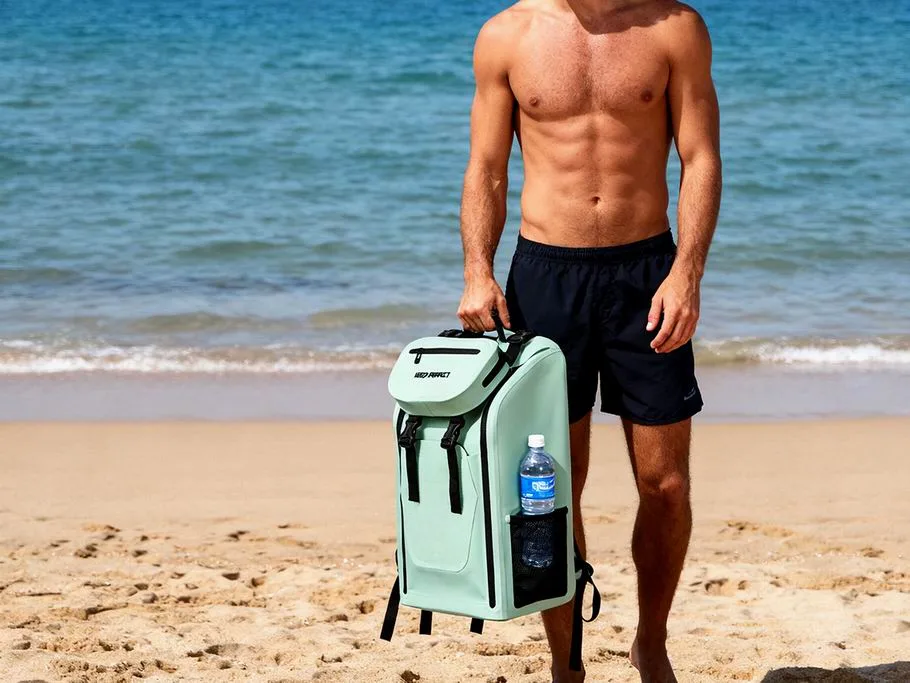
Sunlight rarely acts alone on a dry bag. Sand abrades the outermost microns of film, and those microns are exactly where the stabiliser package is most concentrated, so a bag dragged across sand loses its protection layer faster than one that is simply left in the sun. Salt crystals left on the surface act as lenses and as an abrasive paste, and a salty bag that dries in the sun is being sanded and irradiated at the same time.
The combined effect is roughly additive rather than multiplicative, but the timing matters far more. Rinsing a bag within an hour of leaving the water removes the salt before it crystallises, and a single rinse costs about ninety seconds. Leaving it until the next morning means the crystals have formed, dragged on the film overnight and attracted moisture from the air, which keeps the surface damp and the salt active for longer.
Reflection: the multiplier nobody counts
A bag sitting on a reflective surface receives direct and reflected radiation, and the reflected component can add a third to the dose. Dry sand reflects 10 to 25 per cent, calm water 5 to 10 per cent, white gelcoat 25 to 35 per cent and fresh snow up to 80 per cent. That last figure is why a winter bag left on snow at index 5 accumulates damage at the rate you would expect from an index 8 summer day.
The practical consequence is that position matters as much as duration. A bag standing upright on a white boat deck receives radiation from above and from the deck; the same bag lying flat in the shade of a cockpit coaming receives almost none. Moving a bag two metres, from the foredeck into the shadow of the mast, cuts its dose by roughly 85 per cent and costs nothing at all.
| Surface | UV reflectance | Effective dose multiplier | What it means |
|---|---|---|---|
| Dry sand | 10-25% | 1.1-1.25 | Beach use ages bags about a fifth faster |
| Calm water | 5-10% | 1.05-1.10 | Small effect for floating bags |
| White gelcoat deck | 25-35% | 1.25-1.35 | Worst common boating surface |
| Fresh snow | 60-80% | 1.6-1.8 | Winter exposure is not mild exposure |
| Grass | 2-5% | 1.0 | Baseline for comparison |
| Shade of any kind | n/a | 0.1-0.2 | The single largest saving available |
Testing for UV damage at home
Four quick tests tell you where a bag is in its life. The pinch test: squeeze a flat panel between thumb and forefinger; a healthy film springs back immediately, a degraded one leaves a visible crease. The chalk test: rub a dry finger firmly across the panel; any powdery residue means the surface layer has broken down. The fold test: fold a corner tightly and look for hairline cracks along the fold. The stretch test: pull the film gently and watch whether it returns to shape.
Compare against a known-good reference rather than against memory. If you own two bags bought a year apart, test them side by side and the difference will be obvious in seconds where it would be invisible in isolation. Record the result once a season with a photograph, because the change is slow enough that you will not notice it in person and fast enough that it will surprise you in a photograph.

What actually stops ultraviolet damage
Only four interventions make a real difference, and they are ranked by how much dose they remove rather than by how much they cost. Shade is the largest, removing 80 to 90 per cent of the dose at once. Indoor storage between trips removes 95 to 99 per cent and is the single habit that most extends service life. A stabiliser package in the film roughly doubles to triples life at the point of purchase. A light-coloured cover or towel reduces surface temperature by 15 to 20 degrees and cuts dose by 70 to 85 per cent.
What does not work is worth listing too. Sprays marketed as UV protectants for vinyl sit on the surface, wash off in the first immersion and can leave a film that interferes with welding if the bag is ever repaired. Storing a bag wet inside a dark bag is worse than storing it dry in the light, because trapped moisture and warmth accelerate hydrolysis. Global guidance on ultraviolet exposure and protection is published by the WHO.
| Mitigation | Dose reduction | Effect on service life | Cost |
|---|---|---|---|
| Shade on the beach or deck | 80-90% | 3 to 6 times longer | None |
| Dry and store indoors between trips | 95-99% | 5 to 10 times longer | None |
| Film with a stabiliser package | n/a | 2 to 3 times longer | Small, at purchase |
| Light-coloured outer panel | Surface 15-20 degrees cooler | 1.5 to 2 times longer | None |
| Cover with a towel in full sun | 70-85% | 3 to 5 times longer | None |
| Surface protectant sprays | 0-10% | No measurable gain | Recurring |
Storage routine after sunny days
- Rinse with fresh water within an hour of leaving salt water, before crystals form.
- Shake out the fold line and wipe it dry; trapped sand abrades the stabilised surface.
- Dry in shade with the mouth open, never in direct sun on a reflective surface.
- Store loosely rolled in a dark cupboard, away from windows and away from heat sources.
- Check webbing and buckles twice a season and replace hardware before it fails under load.
- Photograph the fold line once a season so slow change is visible in a comparison.
The routine takes under five minutes and it is the whole difference between a bag that lasts three seasons and one that lasts ten. The two steps people skip are the first and the fourth: rinsing within the hour, because it always seems unnecessary at the time, and storing in the dark, because a bag hanging on a hook in a sunny garage is receiving a low but constant dose every day of the year. Constant low dose adds up; 2,400 hours behind window glass at index 1 is not negligible.
Long-term storage has its own rules, particularly over a winter or a monsoon season, and our off-season storage guide covers the humidity and airflow questions in detail. For boats and beach houses where the bag lives on site, the sun and sea storage guide sets out the shading options that work without taking up deck space.
When to retire a sun-damaged bag
Retire a bag when it shows two or more of four signs: powdery chalk that rubs off on a dry finger, hairline cracks longer than five millimetres along the fold line, a crease that stays visible after a pinch test, or webbing that has faded to a noticeably lighter shade than the protected section under a strap. Any one of these on its own means demote the bag to wet-gear or liner duty; two together means stop trusting it with electronics or documents.
Material life varies enough to be worth checking against a baseline rather than a rule of thumb, and our service life comparison gives the figures for each film type. The full retirement criteria, including seam and weld checks, are in our retirement guide.
Prevention at the specification stage is cheaper than replacement later. A film with a hindered amine stabiliser, a dark or mid-tone colourway for outdoor use, and welded rather than stitched seams together triple the outdoor life of a bag for a small increase in unit cost, and all three are decisions made once, at the point of order. Our UV-stabilised fabric guide explains what to ask for, and the prevention guide covers the daily habits. Start from the full product line if you are choosing a bag for a climate with an index above 8.
Frequently asked questions
Q1. Does sunlight ruin a dry bag?
Eventually, yes. A 0.5 mm TPU bag needs about 400 to 600 hours of strong sun before yellowing and loss of stretch become visible, which is roughly three years of twenty-five beach weekends. PVC stiffens sooner, at 300 to 500 hours. Neither leaks immediately.
Q2. How many hours of sun can a dry bag take?
TPU tolerates 400 to 600 hours before visible change and keeps 80 to 88 per cent of its strength at 1,000 hours. PVC reaches visible stiffening at 300 to 500 hours. A bag left on a deck all season accumulates 600 to 900 hours in one year.
Q3. Is TPU or PVC better in strong sun?
TPU. It yellows and slowly loses stretch, retaining 80 to 88 per cent of strength at 1,000 hours, where PVC loses plasticiser, stiffens and then cracks at the fold, retaining 70 to 80 per cent. Unstabilised PVC can stiffen in as little as 150 hours.
Q4. Does a black dry bag get damaged faster by the sun?
No, usually the opposite for UV, because carbon black pigment is an effective ultraviolet absorber. Black film does run hotter, reaching 60 to 68 degrees in full sun, which is worse for plasticiser retention, but the pigment protection usually wins.
Q5. Does sand make sun damage worse?
Yes. Sand abrades the outer microns of film where the stabiliser is most concentrated, and salt crystals act as an abrasive paste. Rinse within an hour of leaving salt water so crystals never form, and wipe the fold line before it dries.
Q6. How much does shade help?
Enormously. Shade removes 80 to 90 per cent of the ultraviolet dose, and indoor storage between trips removes 95 to 99 per cent. Moving a bag two metres into the shadow of a coaming is the cheapest life extension available.
Q7. Does reflected sun off water or snow matter?
Yes. Calm water adds 5 to 10 per cent, dry sand 10 to 25 per cent, white gelcoat 25 to 35 per cent and fresh snow up to 80 per cent. A winter bag on snow at index 5 ages at roughly the rate of an index 8 summer day.
Q8. What are the first signs of UV damage?
Colour shift, then a powdery chalk that rubs off on a dry finger, then stiffness at the fold line, then hairline cracks along the fold, and only then a leak. Retire or demote the bag at the chalk stage.
Q9. Do UV protectant sprays work on dry bags?
Very little. They sit on the surface, wash off at the first immersion and can interfere with welding if the bag is later repaired. Shade and indoor storage remove 80 to 99 per cent of the dose for no cost and no maintenance.
Q10. How do I test a dry bag for sun damage?
Four quick checks: pinch a panel and see whether it springs back, rub a dry finger across the film for powder, fold a corner tightly and look for hairline cracks, and compare the bag against a newer one side by side.
Q11. Does window glass protect a stored bag?
Partly. Glass blocks most UVB but transmits a good deal of UVA, so a bag on a sunny windowsill still accumulates dose. At index 1 to 2 behind glass, 2,400 hours a year is not negligible, so store bags in a dark cupboard instead.
Q12. How long do dry bags last stored outdoors?
A bag left on a deck all season accumulates 600 to 900 hours, which reaches the visible-change threshold for most films in a single year. The same bag stored indoors between trips would need five to ten years to reach the same point.
Q13. Do buckles and webbing fail before the fabric?
Usually yes. Polyester webbing loses 20 to 30 per cent of its breaking strength after about 500 hours and polyoxymethylene buckles chalk and lose their spring. Check hardware twice a season; a strap failure is more dangerous than a yellowed film.
Q14. Can a sun-damaged dry bag be repaired?
Surface chalk cannot be reversed, but a cracked fold line or a small crack in the body can be patched with a TPU patch and a heat press or a suitable adhesive. Any repair on a film that has lost more than 30 per cent of its strength is temporary at best.
Q15. Does recycled fabric fade faster in the sun?
Not the film. A recycled polyester face fades because the dye is the weakest link, while a recycled TPU film performs close to a virgin one if the stabiliser package is intact. Ask about the stabiliser rather than the recycled content.
Q16. What should I ask for when buying bags for a sunny climate?
A film with a hindered amine light stabiliser, a dark or mid-tone colourway for outdoor service, welded seams, and the accelerated weathering hours behind any claim. Those three specification choices roughly triple outdoor life for a small increase in unit cost.
People also ask
How long can a dry bag stay in the sun?
A few hundred hours before visible change. TPU reaches yellowing at 400 to 600 hours of strong sun, PVC stiffens at 300 to 500 hours. That is about three years of weekend beach use, or one season if the bag lives on a deck.
Why do dry bags go stiff in the sun?
Because ultraviolet radiation breaks polymer chains and, in PVC, drives plasticiser out of the film. The fold line stiffens first because it is creased and because folding concentrates strain in the same few millimetres every time.
Does a dry bag fade in the sun?
Yes. Printed patterns fade unevenly because each colour has a different light fastness, so a camouflage bag after 400 hours often looks blotchy rather than evenly faded. Solid dark colourways age most gracefully.
Can you leave a dry bag on a boat deck all summer?
You can, but it will accumulate 600 to 900 hours in one season, which is enough to reach the visible-change threshold for most films. Move it into the shade of a coaming and the dose drops by about 85 per cent.
How do you protect a dry bag from UV?
Store it dry and indoors between trips, which removes 95 to 99 per cent of the dose, and keep it in shade outdoors, which removes 80 to 90 per cent. Rinse salt off within the hour and dry out of direct sun.
Is UV damage the same as heat damage on a dry bag?
No. Heat temporarily softens the film, so a bag can feel limp in the afternoon and normal the next morning. Ultraviolet causes permanent chain scission and plasticiser loss, which is why a shaded bag stays supple after ten sessions.
Need this in production volume?
QUANZHOU JUNYUAN BAGS has produced waterproof bags since 2014 in an SGS-verified 4,950 m2 facility in Fujian, China. Minimum order 500 pieces, sampling in 6–10 working days, bulk in 35–50 days, FOB Xiamen — write to service@junyuanbags.com with your spec and target market.