Home / Blog / Buying & Comparisons
Bucket Dry Bag vs Roll-Top Dry Bag
A 20L bucket dry bag has a mouth of about 280 mm and stands upright on a base stiffener, which makes it roughly 25% heavier than a 20L roll-top of the same film and about 40% faster to pack. A 20L roll-top compresses to a third of its height when empty, weighs 420 to 520 g, and slides into a kayak hatch or a pannier that will never take a rigid-sided bucket. Both shapes reach IPX7 when the seams are welded and the closure is rolled three times; the difference is access, storage and where the weight sits.
This comparison puts numbers on the trade-offs: mouth diameter, packing speed, compressed height, lashing behaviour in a moving boat, base abrasion over a season, and cost per litre. It also sets out the cases where the bucket shape is plainly better, the cases where the roll-top wins outright, and how to build a size ladder that mixes the two. If you are still deciding between bag families in general, our dry bag versus dry sack versus dry duffel guide covers the wider field first.
- What the two shapes actually are
- Mouth diameter and how fast you can pack
- Standing up, collapsing down
- Compression: getting the air out
- Closure mechanics: collar, roll and lid
- Where the waterproof rating really comes from
- Carrying: handles, straps and load centre
- Lashing and stability on a boat or a rack
- Base wear, abrasion and service life
- Weight, packed volume and cost per litre
- A use-case map for the two shapes
- Building a size ladder that includes both
- When a bucket shape is the wrong answer
What the two shapes actually are
A roll-top dry bag is a soft tube, sealed at one end, with a stiffened band at the mouth that is folded over itself and clipped. Its proportions are tall and narrow: a 20L model is typically 240 mm in diameter and 520 mm tall when unrolled. There is no frame, no base plate and nothing to stop it collapsing, which is the source of both its strengths and its frustrations.
A bucket dry bag keeps the same welded construction and the same closure principle but changes the proportions and adds structure. It is short and wide, roughly 300 mm in diameter and 380 mm tall in a 20L size, with a stiffened collar that holds the mouth open and usually a reinforced or moulded base. Some use a roll-top collar, some a clip lid, and some a drawcord under a storm flap; the waterproof result depends on which of the three is fitted.
The practical consequence is that a bucket bag behaves like a container and a roll-top behaves like a sack. A container can be packed with one hand while you hold a paddle with the other; a sack has to be held open, filled, then closed. Once both are shut, though, they are close to identical in the water, because the seal is made by the same folded fabric and the same buckle tension.
| Attribute | Bucket dry bag, 20L | Roll-top dry bag, 20L | Why it matters |
|---|---|---|---|
| Typical diameter | 300 mm | 240 mm | Buckets will not enter a narrow hatch |
| Typical height, closed | 380 mm | 480 mm | Roll-tops are taller and slimmer |
| Mouth opening | 260-300 mm | 180-230 mm | Bucket takes a hand and forearm |
| Empty weight | 600-760 g | 420-520 g | Base stiffener costs 180 to 240 g |
| Compressed height | 380 mm, does not compress | 160-180 mm, rolls down | Roll-top stores in a third of the space |
| Stands upright empty | Yes | No | Bucket is a camp container |
| Fits a 250 mm hatch | Rarely | Usually | Decides the choice on a kayak |
Mouth diameter and how fast you can pack
Access is the single biggest quality-of-life difference. A 280 mm mouth admits a forearm, a rolled sleeping mat or a camera body with a lens attached, and it stays open while you work because the collar is stiffened. A 210 mm mouth on a roll-top needs one hand to hold it open, which means anything bulky becomes a two-person job on a moving deck.
Timing bears this out. Packing a 20L load of camp kit takes about 55 seconds into a bucket bag and about 95 seconds into a roll-top, because the roll-top has to be held, filled, then closed with two hands while the contents settle. Finding a specific item later is a larger gap: 8 to 12 seconds to reach into a standing bucket against 30 to 50 seconds to unroll, dig and re-roll a soft sack.
Wet hands exaggerate both numbers. TPU is grippy when dry and slick when soaked, so holding a collapsing mouth open with wet hands is slower and more awkward than it looks. If you expect to pack and unpack several times a day with wet hands, on a raft or a dive boat, the collar is worth every gram of the extra weight.
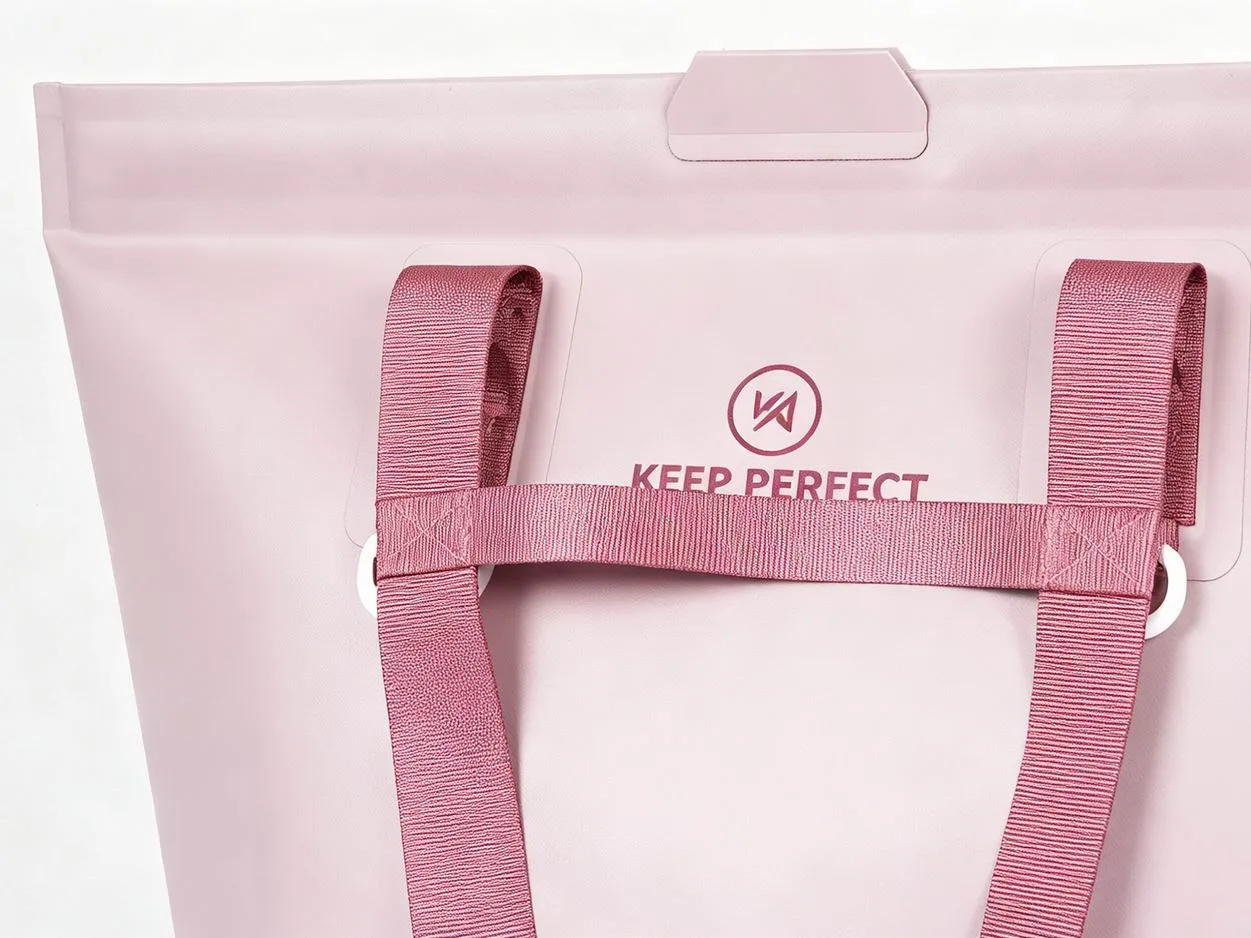
Standing up, collapsing down
A bucket bag is a container you can leave standing at camp. It holds a water bottle upright, keeps a stove and a mug out of the dirt, and doubles as a wash basin or a seat at a push. That convenience is why the shape is popular for car camping, dive boats and any situation where the bag stays in one place for hours.
The same structure costs you storage. A 20L roll-top rolls down to a cylinder about 170 mm tall and packs into a suitcase corner or a kayak day hatch; a 20L bucket keeps its 380 mm height forever. In a car, on a bike rack or in a full expedition load, that uncompressible volume is the most expensive thing about the shape.
One useful compromise exists: some bucket designs use a semi-rigid collar with a soft base, so the bag stands when loaded and folds along a diagonal when empty. It is not as rigid as a moulded base and not as compact as a pure roll-top, but it lands in the middle at about 250 mm compressed height for a 20L, which suits people who split their time between a vehicle and a boat.
Compression: getting the air out
Compression is the roll-top signature. Because the mouth is rolled down over the load, a half-full 30L bag becomes an effectively sealed 20L package with the excess fabric folded into the closure. That means one bag covers a range of loads: the same 30L serves an overnight trip at half capacity and a two-day trip at full capacity.
A bucket bag cannot do this. Its height is fixed by the collar and the base, so a half-full 20L bucket is still a 20L container with 10 litres of air inside. Air matters for two reasons: it makes the bag float unpredictably if it goes overboard, and it lets the contents shift, which is noisy on a portage and hard on anything fragile inside.
You can mitigate the shifting with a compression strap over the top, and many bucket bags offer one. It recovers perhaps half the benefit of a roll-down, at the cost of an extra 40 g of webbing and a buckle. If your load varies a lot between trips, that is the argument for the roll-top; if your load is roughly constant, the bucket loses nothing.
Closure mechanics: collar, roll and lid
Three closure families appear on bucket bags and they are not equivalent. A roll-top collar on a bucket gives the same three-fold seal as a conventional roll-top and reaches IPX7. A clip-on lid with a gasket gives fast access and typically IPX6, because the gasket is a compression seal that loses tension as the lid flexes. A drawcord under a storm flap gives IPX4 at best and should be treated as a rain cover, not a submersion seal.
The roll-top collar on a bucket is slightly harder to seal than on a soft sack, because the stiffened band resists folding. It has to be rolled with deliberate pressure along the whole width, not pinched at the buckle, and it benefits from a wider stiffener so the fold stays flat. In practice a well-designed bucket collar needs three folds and a firm pull, exactly like any other roll-top.
If you want a bucket for the access and IPX7 for the water, specify the roll-top collar version and check the fold with an air test before the trip: roll it shut, squeeze, and listen for a hiss. Our closure guide explains why the seal works and what defeats it, and the same three-fold rule applies regardless of the bag shape.
Where the waterproof rating really comes from
Shape does not determine the rating; construction does. A welded TPU shell with a continuous radio-frequency seam and no needle holes will hold IPX7 in either geometry, because the closure is the same folded fabric and the film is the same barrier. What changes with shape is the number of seams and the stress on them: a bucket with a moulded base has an extra circumferential weld of roughly 900 mm on a 300 mm diameter, and that weld is the one that gets dragged across concrete.
The rating language is defined in IEC 60529 by the IEC: IPX6 is powerful water jets, IPX7 is 30 minutes at one metre. A bucket advertised as waterproof with a drawcord is making a claim its closure cannot support, and this is the most common misleading specification in the category. Ask which closure is fitted and which test it passed, not whether the bag is waterproof.
There is one genuine shape effect on real-world wetness. A bucket standing upright in a canoe or on a deck collects water on its lid or collar, and that water pours into the bag the moment it is opened. A roll-top, opened mouth-down or on its side, sheds it. It is a small thing that explains a surprising number of damp sleeping bags.
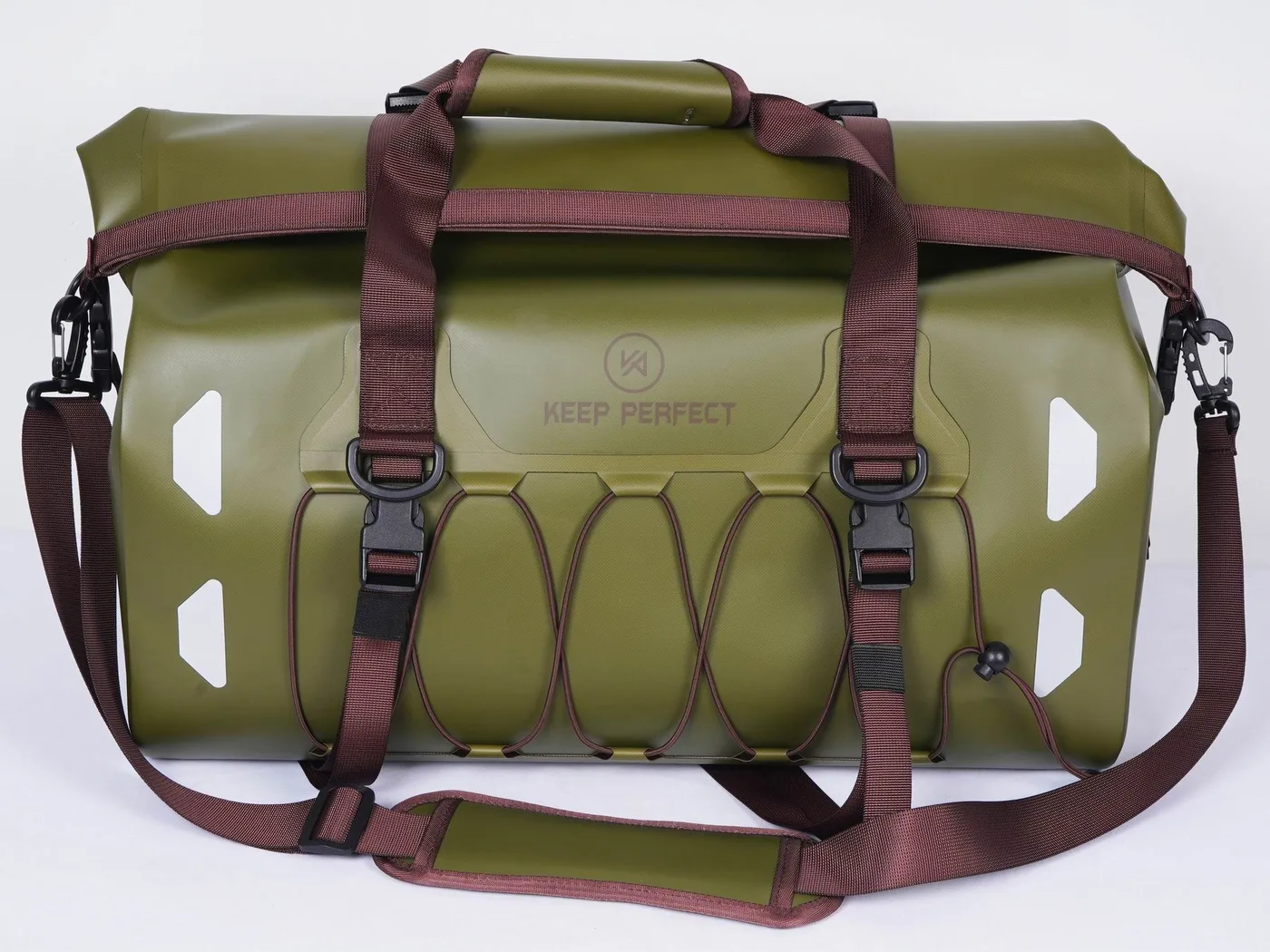
Carrying: handles, straps and load centre
Bucket bags are usually carried by two webbing handles or a tote-style grab loop, because the shape suits a hand carry at the side of the body. That works well for 20 to 40 metres from a car to a campsite and badly for anything longer: a 12 kg bucket carried by a short handle swings, hits the knee and loads the forearm.
Roll-tops come with a single shoulder strap or nothing at all, and the taller shape carries better on the back precisely because it is tall and narrow. It sits along the spine rather than away from it. This is why expedition loads are almost entirely roll-tops: above about 8 kg, a container that stands beside you is a worse carry than a sack that hugs you.
Some bucket models add detachable backpack straps, and those change the verdict. With a proper harness, a 20L bucket carries acceptably for 800 m to a launch, and then the straps come off and it becomes a camp container again. Without them, treat a bucket as a carry of 100 m and a roll-top as a carry of 2 km.
| Carry task | Bucket dry bag | Roll-top dry bag | Better choice |
|---|---|---|---|
| 20 m from car to tent | Excellent, upright, one hand | Good, needs two hands to close | Bucket |
| 100 m across a beach | Good with handles | Good with a shoulder strap | Either |
| 800 m portage | Poor unless straps are fitted | Good, tall and narrow on the back | Roll-top |
| 2 km walk to a launch | Poor, swings and hits the knee | Good with a padded harness | Roll-top |
| Lashed in a canoe all day | Excellent, stable and upright | Good, but rolls around | Bucket |
| Through a 250 mm kayak hatch | Usually fails | Passes | Roll-top |
Lashing and stability on a boat or a rack
In a canoe, a bucket is simply better. It stays upright between the thwarts, it does not roll into the bilge, and its flat-ish footprint means two of them sit side by side in the same space one soft sack occupies while sliding. Lashing is easier too, because the stiffened collar gives a hard edge to hook a strap over rather than a soft roll that slips.
In a kayak the position reverses. Hatches are round and narrow, typically 250 to 300 mm on a day hatch, and a bucket with a 300 mm diameter plus a stiffened collar simply will not pass. The roll-top is the only realistic choice there, and its ability to deform is the reason: a soft 20L can be pushed through a 240 mm aperture and will reshape itself inside.
On a roof rack or a motorcycle, the bucket wins again for a different reason. It does not need a frame or a net to hold its shape, so one strap over the top is enough, and the base stiffener spreads the strap load instead of letting it cut into a soft corner. Expect to re-tension the strap once after the first 20 km, which is normal for any welded shell that warms in the sun.
Base wear, abrasion and service life
Every bucket bag eventually fails at the base, and the base is doing a job no roll-top has to do. Dragged across a concrete ramp, a gravel launch or a boat deck, a TPU shell with a 0.5 mm film loses roughly 0.02 mm of thickness per 100 metres of dragging on rough concrete, which over a season of 40 launches is the difference between a bag that lasts eight years and one that lasts five. Abrasion of this kind is measured to standard methods published by the ASTM, though a season of dragging tells you more than any laboratory cycle.
Roll-tops wear at the fold line instead. The first fold sees the most flexing and the most grit, which is why crazing and pinholes show up there first on a well-used bag. Both failure modes are gradual and visible: a base that has gone matt and grey, or a fold line that shows hairline cracking under 10x magnification, is telling you to retire or repair the bag.
Repairability favours the roll-top, because its failure point is a flat accessible panel that takes a patch cleanly. A moulded base with a welded corner is harder to patch well and often needs a welded repair rather than an adhesive one. Our puncture repair guide covers both cases, and when to retire a dry bag sets the threshold.
| Wear point | Bucket dry bag | Roll-top dry bag | Typical time to first sign | Repair difficulty |
|---|---|---|---|---|
| Base or lower weld | High wear, dragged | Moderate wear | 2-4 seasons | Bucket: hard, roll-top: easy |
| First fold line | Moderate, stiffener resists | High, flexed every closure | 3-6 seasons | Easy on both |
| Collar stiffener | Fatigues if folded hard | Not applicable | 4-7 seasons | Moderate |
| Handle attachment | High load, short carry | Low load | 3-5 seasons | Easy |
| Mouth abrasion from grit | Low, collar is protected | High, folded on itself | 2-5 seasons | Easy |
Weight, packed volume and cost per litre
The stiffener is the weight penalty. A 20L bucket with a moulded base and a stiffened collar weighs 600 to 760 g against 420 to 520 g for an equivalent roll-top, a penalty of 180 to 240 g, or 30 to 45%. Scale that across four bags in a canoe load and you are carrying roughly 800 g of structure that does nothing once the bag is shut.
Cost follows weight, but not proportionally. At retail the bucket typically carries a 15 to 25% premium per litre, less than the weight penalty, because the moulded base is cheap in production compared with the extra fabric and the additional weld time. In a programme of 500 pieces, expect a 20L bucket at about USD 1.20 to 1.80 more per unit than the roll-top.
Value per litre should be judged against use, though. A bucket that serves as a camp container, a wash basin and a dry bag is doing three jobs, and 200 g is a small price for that. A roll-top that compresses into a kayak hatch is doing a job nothing else can do. The expensive outcome is buying the wrong shape for the dominant use and then working around it for years.
| Capacity | Bucket weight and height | Roll-top weight and rolled height | Cost per litre, bucket | Cost per litre, roll-top | Weight penalty |
|---|---|---|---|---|---|
| 10 L | 430 g, 260 mm | 300 g, 120 mm | USD 1.60 | USD 1.35 | 130 g |
| 20 L | 680 g, 380 mm | 470 g, 170 mm | USD 1.15 | USD 0.95 | 210 g |
| 30 L | 880 g, 430 mm | 600 g, 190 mm | USD 0.95 | USD 0.80 | 280 g |
| 40 L | 1,150 g, 480 mm | 760 g, 210 mm | USD 0.85 | USD 0.70 | 390 g |
| 60 L | 1,620 g, 560 mm | 1,050 g, 240 mm | USD 0.75 | USD 0.62 | 570 g |

A use-case map for the two shapes
Start from the dominant use, not the average one. If the bag spends most of its life standing in one place and is opened several times a day, the bucket wins on every measure that matters. If the bag spends most of its life inside something else, whether a hatch, a pannier, a rucksack or a suitcase, the roll-top wins because it deforms to fit.
The second question is how much the load varies. Constant load, such as a dive kit or a camp kitchen, suits a fixed-volume container. Variable load, such as clothing that compresses or a food bag that empties over a week, suits a roll-down closure that follows the contents down.
The third question is water exposure. If the bag may be submerged, take the welded roll-top collar version of either shape and check the rating; if it only ever sees rain and spray, a clip-lid bucket is genuinely more pleasant to live with. Most people who own both reach for the bucket at camp and the roll-top on the move.
Building a size ladder that includes both
A mixed kit is usually better than a matched one. For a canoe trip, two 20L roll-tops for clothing and sleeping kit, one 10L bucket for the camp kitchen and one 5L roll-top grab bag covers almost everything and weighs about 2.4 kg empty. Swap either roll-top for a bucket and the same kit will not fit the same spaces.
When you specify a range, keep the closures identical across shapes so that one instruction covers every bag. A fleet where some bags use a lid and some use a roll-top generates mistakes, because people close the lid bag as if it were a roll-top and the roll-top as if it had a lid. Standardising on a welded roll-top collar across both shapes removes that failure mode entirely.
Programme economics also favour a shared platform. One film, one weld setting and one closure geometry across a 10L to 60L ladder keeps sampling to 6 to 10 working days and bulk to 35 to 50 days at a 500-piece minimum, and the shared tooling is why mixed shapes do not cost much more than a single shape. The production sequence behind that is set out and the size selection logic is covered in our capacity guide.

When a bucket shape is the wrong answer
Three situations rule the bucket out. Anything that has to pass through a round hatch under about 300 mm, which covers most kayaks and many bike panniers. Anything carried more than 500 m at a time, unless detachable straps are fitted. And anything where the load halves during the trip, because a fixed container cannot follow the contents down.
A fourth case is worth naming: cold-weather use. A moulded base stiffener in a polypropylene or HDPE grade becomes brittle below about minus 10 °C, and cracking a base on a winter trip is a trip-ending failure. TPU shells handle the cold well, but the stiffener is the weak part, so check its temperature rating before taking a bucket bag winter camping.
If any of those apply, take the roll-top and solve the access problem another way: pack in a stuff-sack order, keep the items you need most near the mouth, or use a small bucket for the camp kitchen only. That mixed approach is what most experienced paddlers end up with, and it is cheaper than buying a shape that fights the trip. Our buying checklist runs through the same questions, and the full shape range sits on the product line page.
Frequently asked questions
Q1. What is the difference between a bucket dry bag and a roll-top dry bag?
A bucket is short and wide with a stiffened collar and usually a reinforced base, so it stands open and upright. A roll-top is tall and soft with no frame, so it compresses to about a third of its height. Both reach IPX7 with welded seams and a three-fold closure.
Q2. Is a bucket dry bag heavier than a roll-top?
Yes, by 180 to 240 g in a 20L size: about 600 to 760 g against 420 to 520 g. The extra weight is the base stiffener and the collar, which buy upright stability and one-handed packing.
Q3. Which shape is easier to pack?
The bucket. Its 260 to 300 mm mouth stays open on its own, so packing a 20L load takes about 55 seconds against roughly 95 seconds for a roll-top, and finding an item later takes 8 to 12 seconds instead of 30 to 50.
Q4. Do bucket dry bags compress when empty?
No. A 20L bucket keeps its 380 mm height, while a 20L roll-top rolls down to 160 to 180 mm. If storage space or hatch clearance is tight, that fixed volume is the deciding factor.
Q5. Are bucket dry bags as waterproof as roll-tops?
Only if they use a roll-top collar. A welded bucket with a three-fold closure reaches IPX7; a clip lid with a gasket is typically IPX6; a drawcord under a flap is IPX4 and is a rain cover, not a submersion seal.
Q6. Will a bucket dry bag fit in a kayak hatch?
Usually not. Day hatches are commonly 250 to 300 mm across, and a bucket with a 300 mm body plus a stiffened collar will not pass. A soft roll-top deforms through a 240 mm aperture and reshapes inside.
Q7. Which is better for canoeing?
The bucket, for stability. It stays upright between the thwarts, does not roll into the bilge, and gives a hard collar to hook a strap over. A mixed kit of roll-tops for clothing and one bucket for the camp kitchen works best.
Q8. How much more does a bucket dry bag cost?
About 15 to 25% per litre at retail, or USD 1.20 to 1.80 more per unit on a 20L in a 500-piece programme. The premium is smaller than the weight penalty because a moulded base is cheaper to add than fabric and weld time.
Q9. Can a bucket dry bag be carried on the back?
Only with detachable backpack straps. Carried by its handles, a 12 kg bucket swings and hits the knee, so treat it as a 100 m carry and use a roll-top with a harness for anything longer.
Q10. Which shape lasts longer?
The roll-top, in practice. Buckets wear at the base, losing about 0.02 mm of film per 100 m dragged on rough concrete, and a moulded base weld is harder to patch. Roll-tops wear at the fold line, which is flat, accessible and easy to repair.
Q11. Do bucket dry bags work as a cooler?
Well, because they stand upright and hold ice around the contents. A 20L bucket holds about 8 kg of ice plus a day of drinks. Check the food-contact status of the film first; our cooler guide covers the details.
Q12. Can a bucket dry bag be used in winter?
Check the stiffener. TPU shells stay flexible in the cold, but a polypropylene or HDPE base can turn brittle below about minus 10 °C, and a cracked base ends a trip. Ask for the temperature rating.
Q13. Why does my bucket bag pour water in when I open it?
Because it stands upright and collects water on the lid or collar. Tip it or open it on its side before unclipping, which is the one real-world wetness penalty of the upright shape.
Q14. Should I buy one shape or both?
Both, if you do more than one activity. Two 20L roll-tops for clothing and sleeping kit, a 10L bucket for the camp kitchen and a 5L grab bag covers a canoe trip at about 2.4 kg of empty bag weight.
Q15. How do I lash a bucket bag in a boat?
One strap over the top hooked on the stiffened collar, tensioned once more after the first 20 km as the shell warms. The collar gives a hard edge that resists slipping, unlike the soft roll of a sack.
Q16. Are bucket dry bags good for camera gear?
For access, yes: the wide mouth takes a body with a lens attached and stays open while you work. For protection in transit, a padded roll-top or a dedicated insert is better, because a fixed volume lets the kit shift unless you add dividers.
People also ask
What is a bucket dry bag used for?
Anything that benefits from an upright, open container: a camp kitchen, a dive-boat kit bag, a canoe bilge organiser or a cooler. It stands on its base and can be packed one-handed, which a soft roll-top cannot.
Are bucket dry bags waterproof?
The welded shell is, and a roll-top collar closure reaches IPX7. A clip lid with a gasket reaches about IPX6 and a drawcord under a flap only IPX4, so check which closure is fitted before trusting the claim.
Which dry bag shape packs down smallest?
The roll-top. A 20L rolls down to 160 to 180 mm, about a third of its open height, while a 20L bucket stays at 380 mm because the collar and base hold their shape.
Why do canoers prefer bucket bags?
Stability. A bucket stays upright between the thwarts instead of rolling into the bilge, and two of them sit side by side in the space one soft sack slides around in.
Can you use a bucket dry bag as a wash basin?
Yes, and it is one of the shape's real advantages. An upright welded container holds 10 to 15 litres of water without collapsing, which a soft roll-top will not do unsupported.
How much weight does a base stiffener add?
About 180 to 240 g on a 20L bag, or 30 to 45% of the empty weight. Across four bags in a canoe load that is roughly 800 g of structure that does nothing once the bags are closed.
Need this in production volume?
QUANZHOU JUNYUAN BAGS has produced waterproof bags since 2014 in an SGS-verified 4,950 m2 facility in Fujian, China. Minimum order 500 pieces, sampling in 6–10 working days, bulk in 35–50 days, FOB Xiamen — write to service@junyuanbags.com with your spec and target market.