Home / Blog / Buying & Comparisons
Dry Bag vs Dry Sack vs Dry Duffel
The three names describe shape and closure, not three levels of waterproofing. A dry sack is a cylinder with a roll-top mouth, typically 2L to 35L, weighing 19 to 26 grams per litre; a dry duffel is a box or barrel with a wide end or side opening, 20L to 90L, at 26 to 35 grams per litre; a waterproof backpack adds a welded harness at 35 to 48 grams per litre. All three can carry the same welded TPU construction and the same IPX7 rating, so the decision is about what fits through your hatch, how fast you can reach your kit, and how much a box wastes inside a round compartment.
This comparison walks through footprint, closure geometry, access with cold hands, weight per litre, carrying hardware, immersion behaviour, abrasion failure points, buoyancy, cost per season and the activity matrix that decides it. Two numbers do most of the work: a 20L cylinder is about 260 mm in diameter and 420 mm tall, while a 20L box is roughly 480 by 280 by 220 mm. If your hatch aperture is 240 mm, that single figure rules out one of the three before anything else matters.
- What each of the three names actually describes
- Footprint: cylinder versus box, and what it costs you
- Closure geometry across the three formats
- Getting to your kit with cold, wet hands
- Grams per litre: what the formats really weigh
- Straps, handles and lash points compared
- Waterproof performance by shape, not by name
- Abrasion and puncture: the corners that go first
- Float behaviour and trapped air
- What you pay per litre, and per season
- Matching a format to the activity
- The two-bag combination that covers most trips
- A format checklist before you order
What each of the three names actually describes
The vocabulary is looser than shoppers expect. “Dry bag” is the generic term for any bag built to keep water out, and in a retail listing it is often applied to all three shapes. “Dry sack” came out of backpacking and paddling and implies a soft cylinder with a roll-top closure and no harness. “Dry duffel” describes a larger, wider-mouthed bag with carry handles and often detachable shoulder straps. None of the three tells you anything about film, seam type or rating, which is why the shape answer and the waterproof answer have to be evaluated separately.
That separation is the whole trick of buying well. Ask two questions in order. First: what aperture and compartment shape will this bag live in, and what is the largest rigid item that has to go inside it? Second: does the closure and seam construction carry a tested rating, and can you name the standard behind the claim? Answer the first and the format is usually decided. Answer the second and you know whether the bag is worth owning at any shape.
There is a fourth category worth naming so the comparison is honest: the dry bag backpack, which is a cylinder or box with a welded harness. It costs the most per litre and carries the most comfortably over distance. Most people end up owning one duffel and two sacks, or one backpack and one sack, rather than three of anything.
Footprint: cylinder versus box, and what it costs you
Volume is not shape, and shape is what gets a bag through an opening. A 20L cylinder measures roughly 260 mm across and 420 mm tall when packed; a 20L box measures about 480 by 280 by 220 mm. Round kayak hatches and canoe barrels take the cylinder easily and refuse the box. Car boots, raft frames and boat cabins take the box happily and waste the cylinder’s vertical space.
Packing efficiency runs the other way. A soft cylinder realistically fills to 85% to 90% of its nominal volume because the corners of the load do not reach the corners of the bag; a box with a wide mouth reaches 92% to 95% when it is carrying rectangular items such as dry boxes, camera cubes and packing cubes. So the box wins on capacity utilised and the cylinder wins on aperture compatibility, and neither wins on both.
There is a third dimension people forget: the bag when empty. A soft sack rolls to a 200 mm bundle and weighs under 400 g in a 20L size, so it can ride inside a loaded bag as a spare. A duffel with a stiffened base keeps its shape when empty, which is excellent for packing at home and a nuisance to stash. If you travel with a spare waterproof bag — and anyone who has had a closure fail on day three does — the sack is the one you carry.
| Format | Typical sizes | Packed shape (20L) | Fill efficiency | Best compartment |
|---|---|---|---|---|
| Dry sack | 2-35 L | 260 mm dia x 420 mm | 85-90% | Round hatch, barrel, pannier |
| Dry duffel | 20-90 L | 480 x 280 x 220 mm | 92-95% | Raft frame, car boot, cabin |
| Dry bag backpack | 15-40 L | 300 x 220 x 480 mm | 88-92% | On the back, deck, shore |
| Compression sack | 5-20 L | 240 mm dia x 380 mm | 80-88% | Inside a rucksack |
| Barrel / hard case | 10-115 L | Fixed body | 95-98% | Exposed deck, expedition |
Closure geometry across the three formats
The roll-top is the shared inheritance: a stiffened mouth, three folds, and a buckle across the top. On a sack it closes the full width of the cylinder, which is the easiest closure to make reliably because the two faces meeting each other are the same width and there are no corners. On a duffel the roll-top usually closes a shorter end panel or a side zip line, and corners are where a roll stops sealing: a 12 mm radius at the corner needs the film to conform on two axes at once.
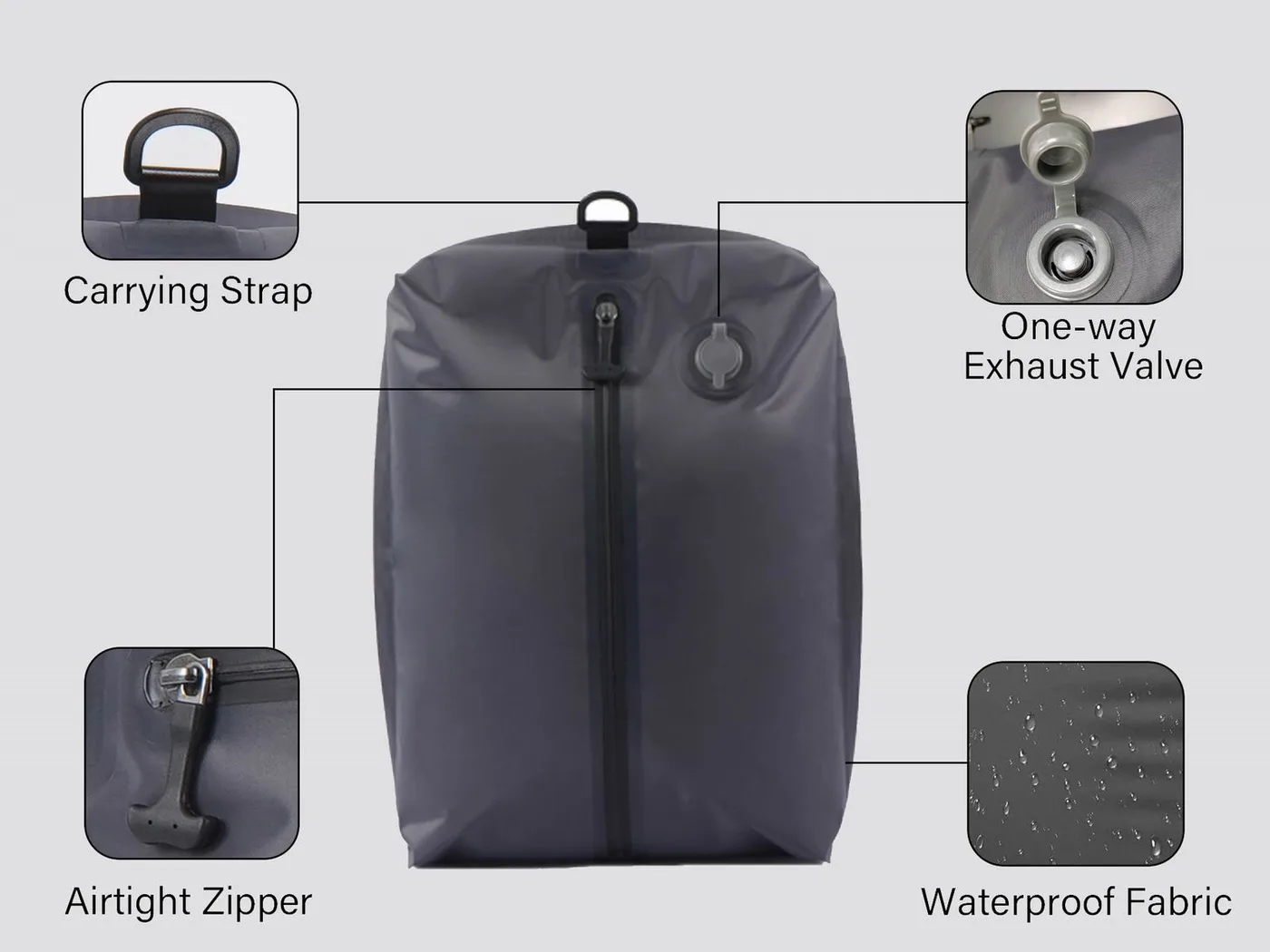
Zippered duffels exist because a 90L bag is impossible to roll closed by one person when it is half full of camp kit. A waterproof zip of 600 to 900 mm across the top face gives full-width access and a genuinely sealed closure if the tape is laminated and the teeth are moulded. The trade is maintenance: rinse the teeth, keep grit out of the track, and expect to work the slider firmly. The full argument is set out in our roll-top versus zipper comparison.
One mechanical detail settles most arguments: how much capacity the closure consumes. Three folds take 2.5 to 4 litres out of a 20L sack, roughly 15% of the nominal volume. A duffel zip consumes almost nothing, which is why a 20L duffel genuinely holds more than a 20L sack even before the shape efficiency difference is counted. Buy the sack one size larger than your measured load.
Getting to your kit with cold, wet hands
Access is where format is felt most, and it is rarely on a specification sheet. A 20L sack is a top-loader: whatever you packed last comes out first, and reaching a phone at the bottom means unloading 8 litres of clothing onto a wet deck. A duffel with a full-length zip is a side-loader: open it like a suitcase, see everything at once, close it in four seconds.
Colour coding and small bags beat clever organisation. Two 10L sacks in different colours, one for clothing and one for food, outperform one 20L sack with an internal divider, because you can identify the bag without opening it and you can hand one to another person. On a raft or a support boat, that matters more than any feature: the crew member who needs the first-aid kit should be able to recognise it from 3 metres.
Test access with gloves on before you commit. Roll a sack closed, drop it on the floor, and open it with wet hands in the dark. If it takes more than 15 seconds, the closure is too stiff for the conditions you will use it in, and no amount of capacity planning fixes that. This is also the moment to check whether the buckle can be operated with one hand while the other is holding a paddle or a rail.
Grams per litre: what the formats really weigh
Empty weight is the most honest comparison between formats because it isolates construction from accessories. A 0.5 mm TPU laminate with a 420D face runs about 380 to 520 g in a 20L sack, 520 to 700 g in a 20L duffel, and 700 to 950 g in a 20L backpack once the harness and back panel are welded on. Divide by litres and the pattern is stable across sizes: 19 to 26 g/L, 26 to 35 g/L and 35 to 48 g/L respectively.
Harness weight is not waste. A welded shoulder harness on a 20L bag adds 250 to 350 g and converts a bag you carry 200 metres into a bag you can carry 5 kilometres. On a kayak trip that is irrelevant and the grams are dead weight; on a walk-in campsite or a ferry terminal the same 300 g is the difference between one trip and two. Weight per litre only matters once you know the carry distance.
| Format | Size | Empty weight | Grams per litre | Comfortable carry distance |
|---|---|---|---|---|
| Dry sack, 0.3 mm film | 10 L | 180-240 g | 18-24 | Under 200 m |
| Dry sack, 0.5 mm film | 20 L | 380-520 g | 19-26 | Under 300 m |
| Dry duffel with handles | 40 L | 900-1,250 g | 22-31 | 200-800 m |
| Dry duffel with straps | 60 L | 1,300-1,750 g | 22-29 | 1-3 km |
| Dry bag backpack | 20 L | 700-950 g | 35-48 | 5-15 km |
| Dry bag backpack | 30 L | 1,000-1,350 g | 33-45 | 5-15 km |

Straps, handles and lash points compared
A sack carries by its closure: roll the top, clip the buckle, and use the resulting roll as a handle. That is fine for 5L and 10L and uncomfortable above 20L, because the whole load hangs from a folded seam. Sacks above 15L should have a welded side handle or a webbing loop so the bag can be carried at its centre of gravity rather than from the top.
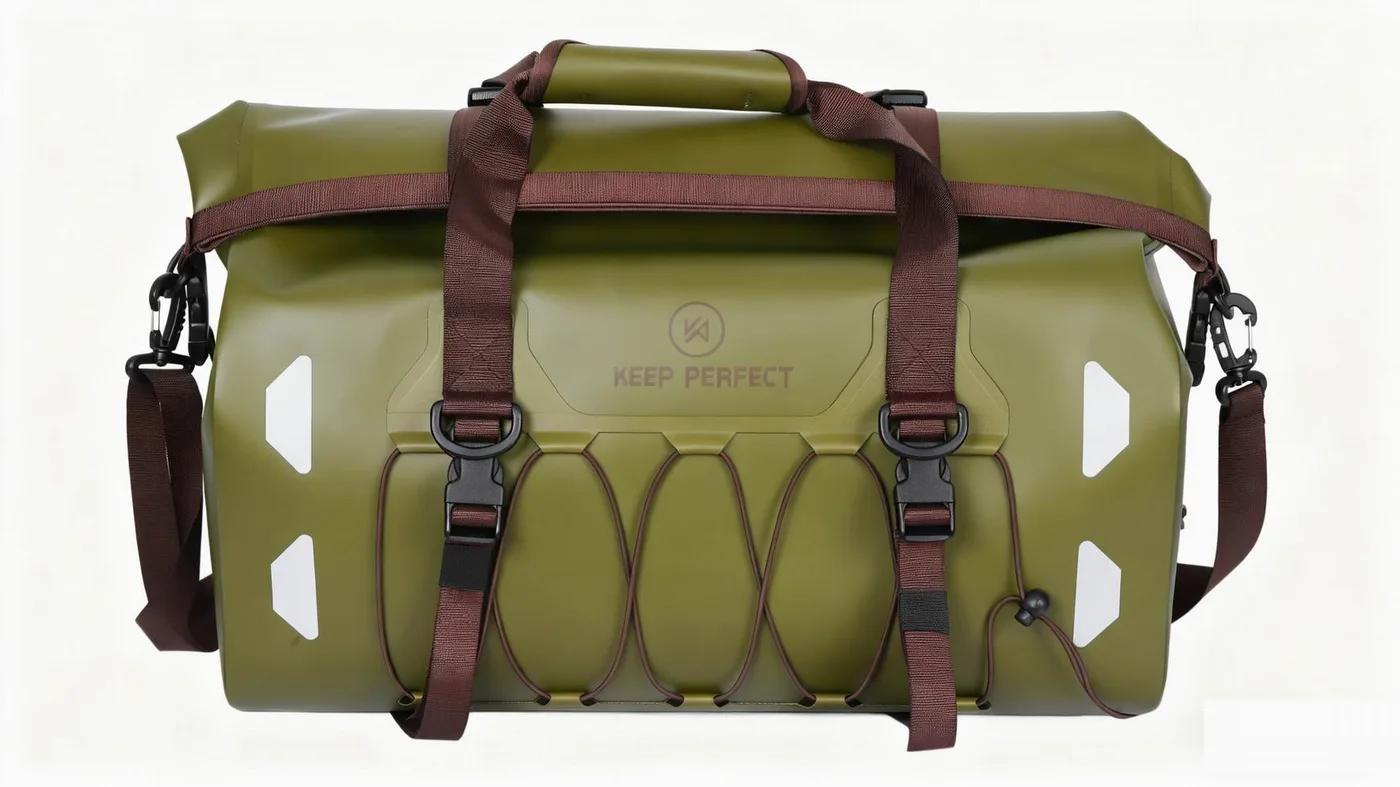
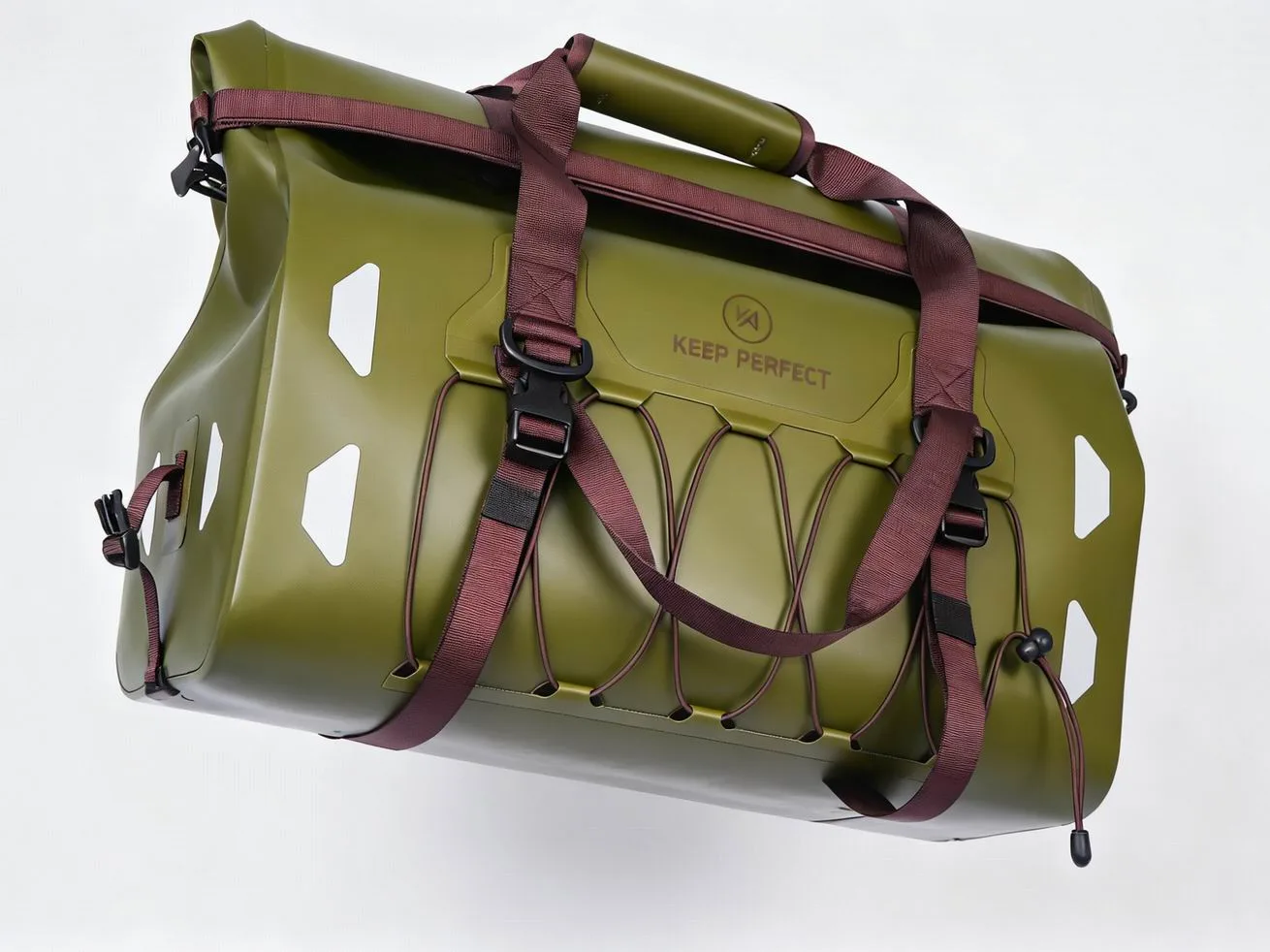
Duffels carry properly because they have room for hardware: two grab handles that meet with a padded wrap, a shoulder strap on welded D-rings, and sometimes a backpack harness on 25 mm webbing. Check that the D-rings are welded patches and not sewn tabs; a sewn tab on a 40L bag loaded to 12 kg is the single most common hardware failure in the category. Load rating matters: look for 25 mm webbing rated above 200 kg and D-ring patches wider than 60 mm.
Lash points decide how a bag behaves on a boat. Sacks typically offer one D-ring near the closure, which is enough to tether but not enough to secure; duffels offer four to eight lash points along the body, which is why they are the standard on raft frames and dinghy floors. If a bag will be strapped to anything moving, count the lash points before you count the litres.
Waterproof performance by shape, not by name
Shape does not change the film, but it does change the seal. A cylinder with a single full-width roll has one closure line and two corners; a box duffel with a rolled end has four corners and a longer closure line. Every corner is a place where the two film faces must conform on two axes, so more corners means a statistically higher chance of a fold that does not seat. This is why a 20L sack is easier to seal reliably than a 20L box with a rolled end.
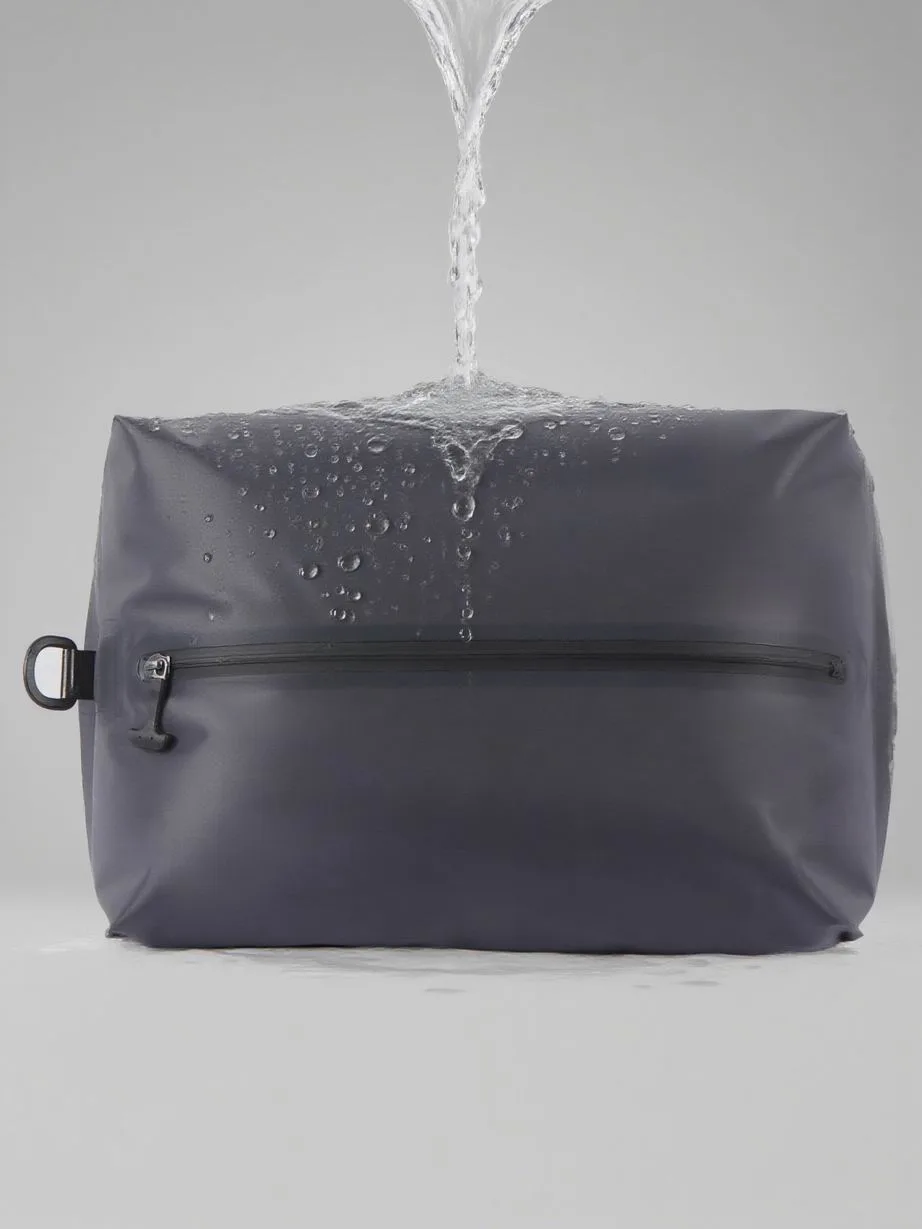
Immersion behaviour follows closure quality rather than shape. Both formats reach IPX7 with welded seams and three clean folds, and both fail at IPX4 if the fold is rolled over a strap or a grain of sand. The ingress codes themselves are defined in IEC 60529, published by the IEC, and a serious spec sheet names that standard instead of printing an adjective. If a listing says waterproof without a code, assume splash resistance.
| Format | Closure lines | Corners to seal | Realistic rating | Most common leak |
|---|---|---|---|---|
| Dry sack, rolled | 1 | 2 | IPX7 | Grit in the fold |
| Dry duffel, rolled end | 1 | 4 | IPX6-IPX7 | Corner crease at the fold |
| Dry duffel, waterproof zip | 1 zip | 0 | IPX6-IPX7 | Grit in the zip track |
| Dry bag backpack | 1 | 2 | IPX6-IPX7 | Harness seam under load |
| Bucket bag, stiff mouth | 1 | 0 | IPX5-IPX6 | Mouth distorted by a hard load |
Abrasion and puncture: the corners that go first
Every format fails at predictable points and the film does not get the blame. Sacks abrade at the base circle, where the cylinder is set down on grit, and at the fold band, which is worked 300 to 500 times a season. Duffels abrade at the two lower corners, which take the load whenever the bag is dragged rather than carried, and along the bottom seam of any stiffened panel.
Puncture follows load, not format. A camera tripod leg inside a soft sack is a puncture waiting for a bumpy road; the same leg inside a duffel with a stiffened base and a padded divider is fine. If you carry hard, sharp kit, choose the format with a base panel and pack the hard items low and centred. If you carry only soft kit, the sack is lighter, cheaper and easier to stow.
Film thickness is the lever that matters more than shape. Moving from 0.3 mm to 0.5 mm TPU adds about 90 g to a 20L bag and roughly doubles the abrasion cycles to first wear in our own testing, while adding 15% to 20% to the cost. For a bag that lives on a raft frame, on a dinghy floor or in the back of a pickup, that 90 g is the cheapest insurance available. Our film thickness comparison gives the numbers.
Float behaviour and trapped air
A sealed bag floats because of the air inside it, not because of the material. A 20L bag rolled closed with 12 to 16 litres of trapped air displaces 20 litres of water and therefore generates close to 20 kg of buoyant force minus its own weight, which is why a packed raft bag pops back to the surface after a flip. Press all the air out before you roll and the same bag floats low or sinks slowly depending on what is inside.
Format changes how much air survives handling. Cylinders hold a stable air pocket at the top and float consistently upright; boxes hold air in the corners and tend to float on a face, which is better for spotting and worse for stability when strapped to a frame. Neither is a flotation device, and the distinction is set out in ISO 12402, the personal flotation standard published by the ISO. Never lash a bag to yourself as buoyancy.
What you pay per litre, and per season
Retail pricing across the category is broadly linear in volume with a premium for hardware. Expect roughly 18 to 30 currency units for a 10L sack, 28 to 45 for a 20L sack, 55 to 85 for a 40L duffel and 90 to 150 for a 20L backpack with a welded harness. Per litre that is about 1.8 to 3.0 for sacks, 1.4 to 2.1 for duffels and 4.5 to 7.5 for backpacks, which is a fair reflection of the harness and back panel cost rather than of the waterproofing.
Cost per season is the number that actually matters and it inverts the ranking. A 20L sack used weekly on a kayak lasts five to ten years with a rinse after each trip, which puts it below 6 currency units a year. A duffel used on a raft frame in grit and sun lasts three to six seasons before the base corners go, which is still under 20 a year. The expensive backpack is the cheapest per season if you commute in it daily, because it replaces a bag you would otherwise replace every two years.
Matching a format to the activity
Rather than argue abstractly, match the format to the aperture and the carry distance of the activity. Paddling is dominated by hatch diameter and the need for several small bags; rafting and sailing are dominated by load volume, lash points and abrasion; travel is dominated by carry distance and access; commuting is dominated by laptop protection and drying time. One format rarely wins two of those.
| Activity | Typical load | Best format | Size | Deciding reason |
|---|---|---|---|---|
| Day kayaking | 8-15 L | Dry sack | 10 L + 5 L | Round hatch aperture, two-bag redundancy |
| Sea kayak touring | 40-70 L | Dry sack set | 3 x 20 L | Long hatches, weight distribution |
| Whitewater rafting | 60-120 L | Dry duffel | 1 x 90 L + 2 x 20 L | Lash points, abrasion base |
| Dinghy sailing | 20-40 L | Dry sack | 20 L | Fits under a thwart, floats if flipped |
| Backpacking | 10-20 L inside pack | Compression sack | 10-15 L | Compresses, packs inside the rucksack |
| Carry-on travel | 30-45 L | Dry duffel or backpack | 40 L | Carry distance and access |
| Daily commute | 20-30 L | Waterproof backpack | 25 L | Harness comfort, laptop pouch |
The two-bag combination that covers most trips
Most people need two bags, bought in this order. First, a 20L sack in 0.5 mm TPU with welded seams: it fits the majority of hatches, seals reliably, carries enough for a day, and is cheap enough to own three. Second, either a 40L duffel if you load boats, cars and campsites, or a 25L backpack if you walk with your kit. The second choice is entirely determined by carry distance.
Resist the starter set of five sizes. A ladder of 5L, 10L, 20L, 30L and 40L sounds thorough and in practice leaves you using the 20L for everything and storing the rest. Buy the 20L, use it for a season, and let the specific frustration — too small, wrong shape, hard to carry — tell you what the second bag should be. That is how the size guides in our capacity guide get used in practice.
If you are equipping a club, a rental fleet or a guide operation, standardise on two formats and one closure geometry. Crews trained on one roll direction and one buckle type make fewer sealing errors than crews mixing three systems, and a single spares inventory covers every bag. Look at the backpack versus duffel comparison before you split a fleet order across formats.
A format checklist before you order
- Measure the aperture first: a 240 mm round hatch rules out a box duffel regardless of volume.
- Weigh your real load and buy one size up to cover 2.5-4 L lost to three folds.
- Check grams per litre against carry distance: under 300 m needs no harness.
- Inspect the closure corners: four corners means four places a fold can fail to seat.
- Confirm welded D-rings, not sewn tabs, on any bag above 15 L.
- Choose 0.5 mm film for frames, decks and pickup beds; 0.3 mm for inner liners.
- Ask which standard sits behind the rating: IEC 60529 with a named code, not an adjective.
- Buy two bags rather than one large one so a single closure failure is survivable.
Run the checklist in that order, because the first item eliminates more options than the rest combined. Aperture, then load, then carry distance, then construction: four questions, and the format is decided before you look at a single product photograph. Everything after that is colour and price.
For programmes bought in volume, the same checklist becomes a specification line. Volume, film thickness, closure geometry, hardware rating and named test standard are the five lines that decide whether a fleet survives a season, and they are the lines that should appear in every quote you compare. Waterproof bags have been produced here since 2014 across an SGS-verified 4,950 m2 site with 7 lines and 149 machines, 500-piece minimum, sampling in 6 to 10 working days and bulk in 35 to 50 days FOB Xiamen, inspected to AQL 2.5.Compare the formats against the roll-top range and the wider product line, and read the spec sheet guide before you sign anything.
Frequently asked questions
Q1. What is the difference between a dry bag and a dry sack?
Dry bag is the generic category; a dry sack is a soft cylinder with a roll-top closure and no harness, usually 2L to 35L. Both can share identical film and seams, so the name describes shape and closure, not a level of waterproofing.
Q2. Is a dry duffel more waterproof than a dry sack?
No. Waterproofing comes from the film, the seam and the closure quality, not the shape. A duffel has four corners to seal against a sack’s two, which slightly increases the chance of a fold that does not seat.
Q3. Which format fits a kayak hatch?
A dry sack, almost always. A 20L sack is about 260 mm in diameter against a 20L box at 480 by 280 by 220 mm, and most round hatches will not take the box at all.
Q4. How much capacity do three folds cost?
About 2.5 to 4 litres on a 20L sack, roughly 15% of nominal volume. A zippered duffel loses almost nothing, which is why a 20L duffel holds more than a 20L sack even before shape efficiency is counted.
Q5. What is the lightest way to carry 20 litres of dry storage?
A 0.5 mm TPU dry sack at 380 to 520 g empty, or 19 to 26 grams per litre. A 20L waterproof backpack with a welded harness weighs 700 to 950 g and buys comfort over distance instead.
Q6. Should I buy one large bag or two smaller ones?
Two. Redundancy means a single closure failure costs you part of the kit rather than all of it, and two differently coloured 10L sacks are easier to identify than one 20L with an internal divider.
Q7. Are waterproof zips on duffels reliable?
Yes when clean. A laminated tape with moulded teeth seals to IPX6 or IPX7, but grit in the track scores the tape and the zip starts weeping at the bottom stop after a season. Rinse the track and work the slider firmly.
Q8. Do dry duffels float if they go overboard?
A sealed duffel with trapped air floats, though it tends to settle on a face rather than upright. Cylinders float more predictably. Press the air out and any bag may float low or sink slowly, so never rely on one for flotation.
Q9. Which format is best for whitewater rafting?
A dry duffel in 0.5 mm film with four or more welded lash points, typically a 90L for group kit plus two 20L bags for personal kit. Lash points and abrasion resistance beat volume and weight on a frame.
Q10. How long does each format last?
A rinsed 20L sack used weekly lasts five to ten years; a duffel worked on a raft frame in grit and sun lasts three to six seasons before the base corners go. UV and abrasion, not immersion, decide service life.
Q11. Can I use a dry duffel as a carry-on bag?
Yes. A 40L duffel fits most cabin frames, holds 92-95% of its nominal volume with rectangular packing, and opens flat for a security check. Add a backpack harness if you walk more than a kilometre.
Q12. What film thickness should I choose?
0.5 mm for anything strapped to a frame, dragged on grit or carried in a pickup bed; 0.3 mm for inner liners and light deck bags. The 90 g difference on a 20L bag roughly doubles abrasion life.
Q13. Why do my duffel corners leak when the sack does not?
Because a rolled end has four corners where the film must conform on two axes at once. Crease the corner gently before folding, keep the closure clean, and check the corner radius in the specification.
Q14. What is a compression dry sack for?
For sleeping bags and clothing inside a rucksack. Straps squeeze the air out so 15L of down packs to 8L, but the compression straps also remove the air pocket that makes a sealed bag float.
Q15. How many litres do I need for a weekend canoe trip?
Plan 40 to 60 litres split across three bags: one 40L duffel for camp kit and two 10L sacks for clothing and food. Three bags distribute weight better in a canoe and give redundancy.
Q16. Do I need different bags for saltwater and freshwater?
The format does not change, but the maintenance does. Rinse with fresh water after every saltwater trip, especially the closure and hardware, and dry in shade. Salt crystals in a fold or a buckle shorten life faster than any amount of use.
People also ask
What is a dry sack used for?
For keeping soft kit dry inside a rucksack, a kayak hatch or a canoe barrel: sleeping bags, clothing and food in 2L to 35L cylinders. The roll-top doubles as a handle and the whole bag compresses as you roll it down.
Are dry duffels worth the extra weight?
Yes if you load boats, cars or campsites and need full-width access. A 40L duffel costs 150-300 g more than the equivalent volume in sacks and buys a wide mouth, carry handles and four or more lash points.
Can you use a dry sack as a backpack?
Not comfortably above 15L. The roll-top closure becomes the only handle and the load hangs from a folded seam. Above that size choose a dry bag backpack with a welded harness, which carries 5-15 km rather than 300 m.
Which dry bag shape packs most efficiently?
A box duffel, at 92-95% of nominal volume with rectangular items, against 85-90% for a soft cylinder. But the cylinder fits round hatches, and aperture compatibility usually decides the purchase before efficiency does.
How do you choose between 20L and 30L?
Measure the load and add 15% for the folds. If your kit measures 17 litres you need a 20L; if it measures 22 litres buy a 30L. Two 10L sacks beat either when you want redundancy and easier identification.
Do dry bags need different care by format?
The film care is identical: rinse, dry in shade, store loose. The format changes what to inspect: fold bands and base circles on sacks, corner wear and zip tracks on duffels, harness seams on backpacks.
Need this in production volume?
QUANZHOU JUNYUAN BAGS has produced waterproof bags since 2014 in an SGS-verified 4,950 m2 facility in Fujian, China. Minimum order 500 pieces, sampling in 6–10 working days, bulk in 35–50 days, FOB Xiamen — write to service@junyuanbags.com with your spec and target market.