Home / Blog / Materials & Construction
Dry Bag Straps and Harness Design
A dry bag strap fails long before the film does. A 25 mm polyester webbing strap has a straight-pull breaking strength of 400 to 600 kg, yet the same strap pulls out of a 0.5 mm TPU body at 45 to 70 kg because the join, not the webbing, is the weak link. That is why the design decisions that matter on a harness are the attachment geometry, the weld width at the strap root, and the buckle rating, not the headline material. On a 12 kg loaded bag dropped from shoulder height, the shock load at the strap root can exceed 90 kg for a few milliseconds.
This guide walks through the strap system from the webbing up: how width maps to load, why radio-frequency welding beats stitching at the root, how reinforcement patches spread peel stress into the film, and what a shoulder harness has to do to stay comfortable with 10 kg on your back. There are tables for webbing ratings, carry positions, the four field tests worth running, and the strap specification that matches each bag volume. If you are writing a specification or comparing two samples, start at the strap root and work outwards.
- Webbing: the material every strap starts from
- Strap width, breaking strength and the load they really see
- Stitching versus welding where a strap meets the body
- Reinforcement patches and how load spreads into film
- Shoulder harness geometry on a roll-top body
- Sternum straps and hip belts: where they pull and why
- Handle placement and the carry positions people use
- Buckles, adjusters and cam hardware matched to webbing
- Lash points and D-rings inside the same system
- Abrasion, salt and UV at the contact points
- Field tests that predict strap failure before it happens
- Matching a strap system to bag volume
- A strap and harness checklist for a spec sheet
Webbing: the material every strap starts from
Nearly every dry bag strap begins as flat woven webbing, and the polymer choice sets the behaviour of the whole system. Polyester webbing is the default: it stretches about 8% at break, absorbs very little water, and holds its rated strength when wet. Nylon webbing is stronger per millimetre and softer in the hand, but it absorbs up to 8% of its weight in water and loses around 10 to 15% of its breaking strength when saturated, which matters on a bag that lives on a kayak deck.
Polypropylene webbing appears on low-cost bags and should be avoided on anything load-bearing. It is cheap, floats and resists mildew, but it has poor abrasion life and creeps under sustained load, so a strap that feels fine on day one will have visibly lengthened by the end of a season. On a bag that carries 10 kg for hours at a time, creep shows up as a shoulder strap that needs re-tightening every twenty minutes.
Weave density matters as much as polymer. A tight plain weave resists the sawing action of a buckle adjuster far better than a loose one, and holds a welded edge without fraying. If the cut end of a strap unravels when rubbed, the buckle will chew through it within a season regardless of the stated breaking strength.
Strap width, breaking strength and the load they really see
Published breaking strengths are measured as a slow, straight pull on a new, dry strap in a laboratory. Real use is nothing like that. A strap is bent over a buckle radius, abraded against a shoulder, loaded at an angle, and often shock-loaded. The safe working load is conventionally one fifth of the breaking strength, and on dry bags the practical design limit is even lower because the strap is attached to film rather than to a frame.
| Webbing width | Breaking strength, polyester | Safe working load | Bag volume it suits | First failure mode in service |
|---|---|---|---|---|
| 15 mm | 200-280 kg | 40-55 kg | 2-5 L | Buckle slip |
| 20 mm | 300-400 kg | 60-80 kg | 5-15 L | Webbing wear at the adjuster |
| 25 mm | 400-600 kg | 80-120 kg | 10-30 L | Weld peel at the strap root |
| 38 mm | 700-900 kg | 140-180 kg | 30-50 L | Shoulder pressure, then weld peel |
| 50 mm | 1,000-1,300 kg | 200-260 kg | 50-90 L | Handle tear-out at the body |
Read the last column rather than the second one. Below 30 litres the strap itself almost never fails; the join does. Above 30 litres the strap is usually fine and the complaint becomes comfort, because a 25 mm strap carrying 12 kg concentrates roughly 0.5 kg per millimetre of webbing width onto the trapezius muscle. Width is a comfort specification as much as a strength one.

Stitching versus welding where a strap meets the body
There are two ways to put a strap on a waterproof body, and only one of them keeps the body waterproof. Sewing a strap to a laminated panel is fast and strong in peel, but every needle hole is a capillary path. A stitched-on strap therefore needs a welded patch over the back of the stitch line, or a liquid sealant that will eventually migrate and crack. It is a repair waiting to happen on a bag that gets immersed.
Radio-frequency welding fuses a TPU-coated webbing tab directly to the TPU film of the body, forming a continuous bond with no perforation at all. The weld is as wide as the electrode, commonly 20 to 30 mm, and the strength comes from that width rather than from thread tension. A 25 mm strap on a 25 mm by 30 mm welded tab typically holds 45 to 70 kg in peel, which is well above anything a 20L bag will see but marginal on a 60L bag loaded to 14 kg and dropped.
The hybrid approach is common: the strap is welded to a TPU tab, and the tab is welded to the body over a larger footprint, spreading load across perhaps 60 mm by 60 mm of film rather than 25 mm by 30 mm. When comparing two samples, turn them inside out and measure the welded footprint. The smaller one will fail sooner.
Reinforcement patches and how load spreads into film
Film is strong in tension and weak in peel. A strap pulling straight down a panel loads the film in tension, which 500D laminate handles easily. A strap pulling sideways, as it does when a bag is dragged, loads the bond in peel, and peel strength is typically 10 to 20% of tensile strength. The engineering answer is a reinforcement patch that converts peel into shear by extending the bond well beyond the strap edges.
A well-designed patch is a second layer of laminate welded over the strap root, extending at least 20 mm beyond the strap on every side and feathered at the edges so there is no step for an abrading surface to catch. A poor patch is the same size as the strap, which adds weight and stiffness but no strength, because the peel front still starts at the strap edge. On heavy bags, patches belong at all four lift points, not just the two obvious ones.
Every patch adds a region that will not flex with the body, and a bag with six large patches becomes awkward to roll. Good design puts patches below the fold line and keeps the upper third of the body free of bonded hardware, which is why a bag that rolls easily is often a sign the strap engineering was thought through.
Shoulder harness geometry on a roll-top body
A dry bag backpack harness has to solve a problem a normal rucksack does not have: there is no rigid frame to transfer load to a hip belt, so the shoulder straps carry nearly everything. That makes strap curvature, padding density and the anchor point more important than on a framed pack. The anchor should sit at or above the top of the rolled closure, so the load hangs from a point that cannot slip down the smooth cylinder.
Padding on a waterproof harness is usually closed-cell foam inside a welded or laminated sleeve. Open-cell foam is more comfortable for the first hour and then becomes a sponge that holds salt water against the film and stays wet for two days. At 10 kg and above, padding thinner than 8 mm does almost nothing, because the strap edge cuts in; padding thicker than 15 mm starts to round the strap into a shape that rolls off the shoulder.
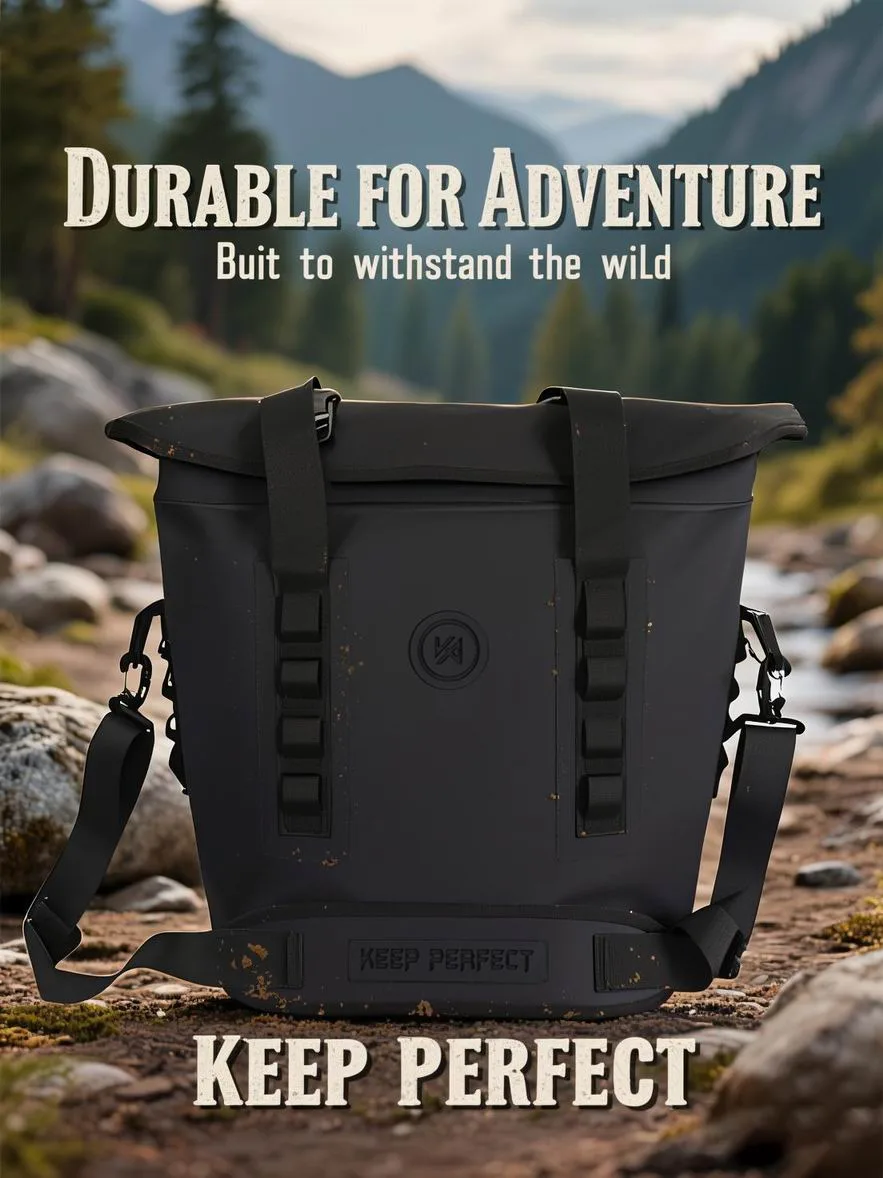
Strap spacing decides whether the load sits on the trapezius or pulls the shoulders back. For an adult torso the two straps should leave the body 160 to 200 mm apart and converge to about 120 mm at the top. Narrower spacing lets the bag swing; wider spacing digs into the neck. On a cylinder there is no back panel to hold that geometry, so a webbing yoke above the closure is the detail to check on any sample.
Sternum straps and hip belts: where they pull and why
A sternum strap is the cheapest comfort upgrade on any harness. It stops the two shoulder straps migrating outward, which is the main cause of the neck pain people report after an hour with a loaded waterproof pack. The strap should be adjustable over 100 mm of vertical travel and anchored on a webbing ladder rather than a fixed point, because the correct height changes with the load and with what else you are wearing.
A hip belt on a frameless dry bag is a different proposition from a hip belt on a trekking pack. Without a frame, it cannot transfer more than about 20 to 30% of the load to the hips, but that 20 to 30% is still worth having above 10 kg. A 25 mm webbing belt with a thin padded section works; a 50 mm moulded belt is wasted weight because the bag will simply deform rather than push load into it.
The failure mode with hip belts is attachment, not the belt. If the belt is stitched to the body, it will eventually tear out, and the repair is difficult on a welded shell. On bags above 40 litres the belt should attach to a welded tab on the lower third of the body, positioned so that when the bag is worn the belt sits on the iliac crest rather than on the soft tissue above it.
Handle placement and the carry positions people use
People carry dry bags in four ways: by the rolled closure, by a single top handle, by a side handle, and by two handles shared between two people. Each places a completely different load on the body, and a bag designed for one is often poor at the others. Grabbing a loaded 40L bag by the rolled closure, for instance, pulls directly on the fold, which is the one part of the bag you want to keep undisturbed.
| Carry position | Handle type | Typical load | Advantage | Weakness |
|---|---|---|---|---|
| Rolled closure | None, gripping the fold | Under 4 kg | Always available | Disturbs the seal, pulls the fold open |
| Single top handle | 25 mm webbing loop | 4-8 kg | Simple, light | Bag swings, load on one weld |
| Two top handles | Two 25 mm loops | 8-15 kg | Two-person carry | Uneven if one tears |
| Side grab handle | Welded 20 mm tab | 6-12 kg | Keeps the bag upright | Peel load at the side seam |
| Shoulder harness | Two 38-50 mm straps | 8-14 kg | Hands free, stable | Heaviest and most expensive option |
The most useful upgrade on a mid-size bag is a second handle. Two handles 180 to 220 mm apart let two people share a 14 kg load, let you pass the bag up a bank without touching the closure, and give redundancy if one weld is damaged. Above 50 litres two handles are a requirement, because a single-handle lift rolls the bag against your leg.
Buckles, adjusters and cam hardware matched to webbing
Hardware is rated by the webbing width it accepts, and mismatch is the most common assembly defect in the field. A 25 mm buckle on 20 mm webbing allows the strap to shift and wear; a 20 mm buckle will not accept 25 mm webbing at all and the strap gets folded, which halves its effective strength. Every buckle on a sample should be checked with a gauge, not by eye, because moulded sizes vary by up to 1 mm between tooling sets.
Acetal, usually called POM, is the standard polymer for side-release and cam buckles: stiff, dimensionally stable when wet, and able to hold a tooth profile that grips webbing without cutting it. Nylon buckles are tougher against impact but swell slightly, which makes an adjuster stiff after a week in salt water. Metal hardware corrodes, adds weight, and presses a hard edge into the film.
Cold is the condition that kills hardware. Acetal remains usable down to about -30 °C, but a nylon buckle becomes noticeably brittle below -10 °C, and a thin moulded cam lever will crack if it is forced while frozen. For winter expeditions or snowmobile use, specify a low-temperature acetal grade and a lever with a cross-section of at least 4 mm, and avoid any buckle with a living hinge thinner than 1 mm.
Lash points and D-rings inside the same system
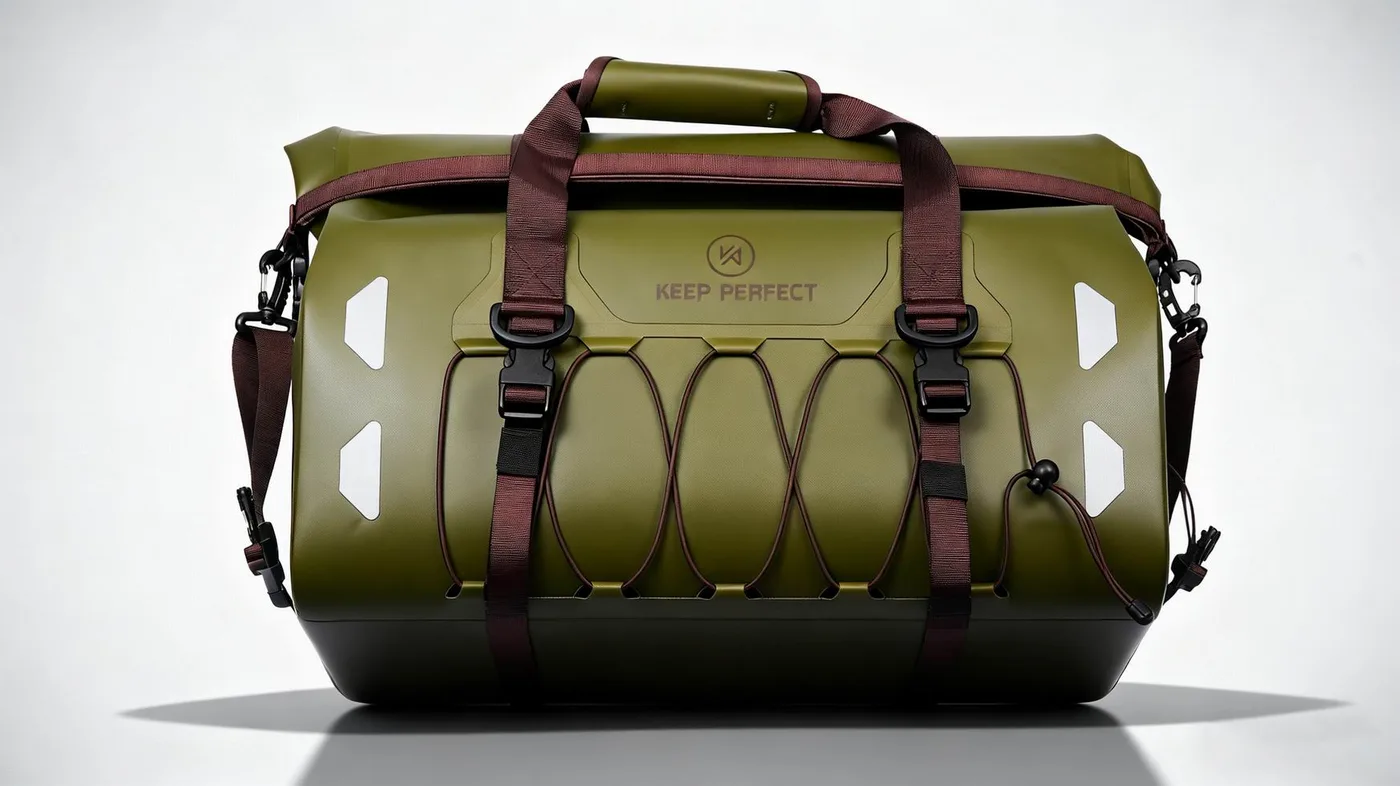
Lash points are part of the harness, not an accessory, because a bag strapped to a deck or a rack loads the same welded roots a shoulder strap does. A welded D-ring behaves exactly like a strap root: strong in tension, weaker in peel, and dependent on the welded footprint. The difference is sustained vibration rather than shock, and vibration is what grows a small peel front into a leak.
Position matters more than count. Four D-rings placed at the quarter points of the body, low enough to avoid the fold line, let you lash a bag in any orientation with two straps. Six D-rings clustered at the top look impressive on a sample and are useless in practice, because a lash strap wants to cross the load, not to hang off one corner. On a bag that will be lashed every day, ask for the D-rings to be welded to the same reinforcement patch as the handles.
Abrasion, salt and UV at the contact points
Straps wear where they move against something, and on a dry bag there are three such places: the buckle adjuster, the shoulder contact point, and the point where a strap crosses a boat edge or a rack bar. The adjuster is the worst, because the tooth profile is designed to grip and the strap slides a few millimetres with every load cycle. Over a season of daily use that is tens of thousands of small sawing movements.
| Contact point | What wears | Typical life before service | Mitigation | Sign to watch for |
|---|---|---|---|---|
| Buckle adjuster | Webbing face and weave | 2-4 years daily use | Tight weave, bar-tacked stop | Fuzz and glazed patches |
| Shoulder contact | Strap edge and foam | 4-6 years | Bound edge, 10 mm foam | Foam compression set |
| Boat edge or rack bar | Strap and body film | 1-2 seasons | Sleeve or tarp under the strap | Shiny polished film |
| D-ring under a lash strap | Weld edge | 3-5 years | Welded patch, rounded edge | Whitening at the weld |
| Handle grip | Webbing and stitching | 5-8 years | Two-layer webbing | Broken filaments at the fold |
Ultraviolet attacks the filaments themselves, invisibly. A strap that has spent two summers on a boat rail can lose 30 to 40% of its breaking strength while looking normal, because degradation starts at the filament surface. Store straps out of UV, and treat any chalky or faded strap as suspect regardless of age.
Salt is the other silent one. Crystals that form inside a weave act as an abrasive paste, and a strap that is never rinsed will wear through at the adjuster in a fraction of its normal life. Rinse in fresh water, work the buckle while wet, and dry in shade. Full routines for the rest of the bag are covered in the saltwater rinsing guide, and hardware behaviour in particular in hardware corrosion resistance.
Field tests that predict strap failure before it happens
Four tests catch almost every strap problem on a sample or a bag already in service, and none needs a laboratory. They are worth running before a bulk order and worth repeating once a season on rental or club fleets, because strap failure is the single most common cause of a bag being returned while still otherwise waterproof.
| Test | How to run it | Pass threshold | What it catches |
|---|---|---|---|
| Static hang | Load to twice the intended weight, hang for 24 h | No creep over 3 mm at the root | Undersized weld footprint |
| Shock lift | Drop the loaded bag 150 mm onto concrete, six times | No change at the strap root | Brittle weld or thin film |
| Peel pull | Pull the strap at 90 degrees to the body by hand | Film deforms before the bond moves | Peel weakness at the patch |
| Adjuster cycle | Run the cam through 200 cycles with the rated load | Slip under 2 mm per cycle | Tooth wear and webbing glazing |
Order matters. Run the static hang first, because a bag that creeps will fail the shock test anyway, and the slow failure tells you more. Inspect the weld edge with a 10x loupe after each test: a whitened or crazed line is a peel front that has started, and it will propagate even if the bag has not yet leaked.
For formal purchasing, these field checks sit alongside the laboratory methods published by ASTM International, whose textile and webbing standards define how breaking strength and abrasion are measured. Where a specification has to be defensible across markets, the corresponding ISO methods are usually cited instead, and a serious bag maker will name the standard rather than just the number.
Matching a strap system to bag volume
The strap specification should scale with volume, because the load a bag can hold grows far faster than the area available to attach a strap to. A 5L bag carrying 2 kg needs almost nothing; a 60L bag carrying 13 kg needs a system. The table below is the specification ladder we use as a starting point before a project-specific load case is run, and it is the same ladder applied across our TPU waterproof backpack range.
| Bag volume | Typical loaded weight | Strap width | Attachment | Hardware |
|---|---|---|---|---|
| 2-5 L | 1-2 kg | 15 mm | Welded tab, 20 mm | 15 mm side release |
| 5-15 L | 2-5 kg | 20 mm | Welded tab with patch | 20 mm side release |
| 15-30 L | 5-8 kg | 25 mm | Welded patch, 40 mm footprint | 25 mm acetal buckle |
| 30-50 L | 8-12 kg | 38 mm harness | Welded patch plus yoke | 38 mm ladderlock, sternum strap |
| 50-90 L | 12-16 kg | 50 mm harness, two handles | Welded patch, four lift points | 50 mm cam, hip belt |
Two rules cut through most arguments. Size the attachment for twice the expected load, because shock loading doubles it in an instant. And never let a single weld carry the whole bag: every lift point above 8 kg should be independent, so a failed bond drops a corner rather than the entire load.
A strap and harness checklist for a spec sheet
- Name the webbing polymer and width; polyester for wet use, polypropylene only on trim.
- State the attachment method and the welded footprint in millimetres, not just the strap width.
- Require reinforcement patches that extend at least 20 mm beyond the strap on every side.
- Specify acetal hardware sized exactly to the webbing, with low-temperature grades for winter use.
- Anchor shoulder straps above the fold line on a yoke so the harness cannot slide down the body.
- Ask for two independent handles on anything above 50 litres.
- Set a test threshold: 24-hour static hang at twice the rated load, plus a 150 mm shock drop.
- Confirm UV and salt rinsing guidance is written into the care instructions, not left to the user.
Work through that list against the full product line before committing to a build, and read dry bag buckle types for the hardware half of the decision. The lash-point side of the same system is covered in D-ring and lash point design, and the body-side attachment options in welded handles on TPU dry bags. Getting the strap root right is usually worth more than any other single specification line.
On the production side, strap geometry is one of the few areas where a drawing is genuinely necessary rather than a nice-to-have. Webbing width, weld footprint, patch size and hardware model all have to be fixed before tooling, and changes after sampling cost time. Our lines have run waterproof bag production since 2014 in an SGS-verified 4,950 m2 facility, sampling in 6 to 10 working days and bulk in 35 to 50 days, with AQL 2.5 inspection and a 500-piece minimum.
Two material references finish the picture. Face fabric weight interacts with strap design, because a heavier shell resists peel better than a light one; the trade-off is set out in 420D versus 500D dry bag fabric. And because the strap root is where abrasion and puncture questions meet, abrasion resistance of TPU explains what the film itself can absorb before the bond becomes the limiting factor in the system.
Frequently asked questions
Q1. What is the strongest way to attach a strap to a dry bag?
Radio-frequency welding a TPU-coated webbing tab to the TPU body, over a reinforcement patch that extends at least 20 mm beyond the strap. Welding perforates nothing, while stitching creates needle holes that need a second sealed patch to stay waterproof.
Q2. How much weight can a dry bag strap take?
The webbing itself is rated for hundreds of kilograms, but the strap-to-body bond is the limit: typically 45 to 70 kg in peel for a 25 mm welded tab. Design for no more than 8 to 12 kg of carried load on that size of attachment.
Q3. Why does my dry bag shoulder strap keep slipping?
Either the adjuster teeth are worn, the webbing face has glazed over, or salt crystals are inside the weave. Rinse the hardware in fresh water, work the lever through its travel, and replace the buckle if slip exceeds 2 mm per load cycle.
Q4. Should I choose nylon or polyester webbing for a dry bag?
Polyester. It absorbs almost no water and keeps its rated strength when wet, whereas nylon takes up around 8% of its weight in water and loses 10 to 15% of breaking strength when saturated.
Q5. What width strap do I need for a 30L dry bag?
38 mm for a harness, or 25 mm if the bag is only carried by hand. At 8 kg a 25 mm strap concentrates about 0.3 kg per millimetre of width, which becomes uncomfortable within twenty minutes on the shoulder.
Q6. Do dry bags need a hip belt?
Above about 10 kg, yes, but expect it to transfer only 20 to 30% of the load because there is no frame. A 25 mm webbing belt with light padding is sufficient; a moulded 50 mm belt is wasted weight on a soft body.
Q7. What is a sternum strap for on a waterproof pack?
It stops the shoulder straps migrating outward, which is the main cause of neck pain after an hour with a loaded bag. It should adjust over 100 mm of vertical travel and anchor to a webbing ladder rather than a fixed point.
Q8. How do I test whether a strap will fail?
Load the bag to twice its intended weight and hang it for 24 hours, looking for more than 3 mm of creep at the root. Then drop it 150 mm onto concrete six times and inspect the weld edge with a loupe for whitening.
Q9. Can a torn strap root be repaired?
Often yes, if the film around it is sound. A welded repair patch over the original footprint restores most of the strength, but if the peel front has reached a corner or a base seam the bag should be retired. See the seam tear repair guide.
Q10. Are metal D-rings better than welded ones?
Not usually. Metal is stronger but corrodes, adds weight and presses a hard edge into the film. A welded D-ring on a reinforced patch is lighter, cannot corrode, and spreads load over a larger area of the body.
Q11. Why do straps break rather than the bag leaking?
Because the strap root is a small bonded area loaded in peel, while the film is loaded in tension. Peel strength is typically 10 to 20% of tensile strength, so the join is always the first thing to reach its limit.
Q12. Does UV really weaken webbing?
Yes, and invisibly. A strap left on a boat rail for two summers can lose 30 to 40% of its breaking strength with no visible change, because degradation starts at the filament surface. Treat any chalky or faded strap as suspect.
Q13. How many D-rings should a dry bag have?
Four, at the quarter points and below the fold line. That lets you lash the bag in any orientation with two crossed straps. Six clustered near the top looks good on a sample but is useless when a strap wants to cross the load.
Q14. What is the difference between a sewn and a welded strap?
A sewn strap perforates the body and needs a sealed patch behind the stitch line to stay waterproof; a welded strap bonds a TPU tab to the film with no holes. Welded is stronger in water resistance and usually better in peel.
Q15. Should handles be welded or stitched on a TPU bag?
Welded. A stitched handle on a waterproof body is a leak path that will eventually open, and stitching also concentrates load on a line rather than spreading it across a patch. Welded handles are standard on TPU bodies.
Q16. How thick should harness padding be?
Between 8 and 15 mm of closed-cell foam. Under 8 mm the strap edge cuts in at loads above 10 kg; over 15 mm the strap becomes too rounded and rolls off the shoulder. Open-cell foam should be avoided because it holds salt water.
People also ask
How do you stop dry bag straps from fraying?
Buy tight-weave webbing with bound or heat-cut edges, and avoid dragging straps over boat rails or rack bars. Where a strap crosses a hard edge, put a sleeve or a tarp underneath, because friction against an edge polishes through film and webbing quickly.
Why do dry bag straps stretch over time?
Polypropylene webbing creeps under sustained load, and polyester creeps slightly when wet and warm. A strap that needs re-tightening every twenty minutes is either overloaded, made from the wrong polymer, or has been UV-damaged.
Can you replace a dry bag buckle?
Yes, if the strap end is accessible. Cut the old buckle off, fit a same-size acetal replacement, and heat-seal the cut webbing end. Match the buckle width to the webbing exactly, because a 1 mm mismatch causes wear and slip.
Are wider dry bag straps always better?
Only up to the point of comfort. Width improves load spread and comfort, but a 50 mm strap on a 10L bag is heavy, stiff and rolls off the shoulder. Match width to volume: 20 mm up to 15 litres, 38 mm at 30 litres, 50 mm above that.
What makes a dry bag comfortable to carry?
Straps anchored above the fold line, 8 to 15 mm of closed-cell padding, a sternum strap to stop migration, and a yoke that holds the two straps 160 to 200 mm apart. Load matters too: above 10 kg, no harness on a frameless bag is comfortable.
Do dry bag harnesses need a frame?
No, and adding one is difficult on a welded shell. The trade-off is that load transfer to a hip belt is limited to roughly 20 to 30%, which is why frameless waterproof packs feel heavier than a trekking pack of the same weight.
Need this in production volume?
QUANZHOU JUNYUAN BAGS has produced waterproof bags since 2014 in an SGS-verified 4,950 m2 facility in Fujian, China. Minimum order 500 pieces, sampling in 6–10 working days, bulk in 35–50 days, FOB Xiamen — write to service@junyuanbags.com with your spec and target market.