Home / Blog / Design & Branding
Hardware Finish Options for Dry Bags
The finish on a buckle decides its service life more than the metal underneath it. A plain nickel-plated zinc ladderlock usually shows white corrosion after 96 to 120 hours in an ASTM B117 salt spray cabinet, while a sealed Type II anodised aluminium part of identical geometry runs past 500 hours before the first pit appears, and a PVD-coated stainless hook can clear 1,000 hours. On a coastal kayak bag used 40 days a season, that spread is the difference between replacing hardware in year two and never touching it in year eight.
This guide compares the five finish families that are actually available on dry bag hardware: anodising, electroplating, vacuum deposition, organic coating and mass-coloured engineering plastic. Each one is rated against salt spray hours, abrasion cycles, colour range, cost index and the failure mode that shows up first in the field. It also covers the problem nobody photographs, which is contact corrosion where a metal buckle sits against a welded TPU tab in 28 °C seawater. Shortlist from the tables, then use the decision sequence at the end to write a finish into a specification.
- Why hardware fails long before the fabric does
- The five finish families used on dry bag hardware
- Reading salt spray hours without being misled
- Anodising: thickness, dye uptake and the sealing step
- Plating on zinc alloy and steel: what fails first
- PVD and vacuum coatings: thin, hard and colour-stable
- Powder coat, soft-touch and painted finishes
- Moulded plastic hardware: mass colour beats any coating
- Matching hardware colour to a fabric range
- Contact corrosion where metal meets welded TPU
- Abrasion, sand and the finish that survives
- Restricted substances and the paperwork buyers ask for
- A decision sequence for specifying a finish
Why hardware fails long before the fabric does
A 0.5 mm TPU laminate with welded seams routinely survives five to ten seasons of weekend use. The buckle, the ladderlock and the D-ring on the same bag do not. In warranty data collected across mixed outdoor programmes, metal hardware accounts for roughly two thirds of all returns on bags that are otherwise structurally sound, and the majority of those returns are cosmetic: white bloom on a plating surface, a seized cam lever, or a hook that has gone dull and grey after one summer on a charter boat.
The reason is that a finish is a system, not a layer. Base alloy, surface preparation, coating thickness, sealing and the geometry of the part all interact, and the weakest link is nearly always an edge or a recess. Sharp corners receive the thinnest electroplate, blind holes trap plating chemistry that later weeps out, and contact points wear through a decorative coating within a few hundred strap cycles. Choosing a finish therefore means choosing a shape and a base metal at the same time, which is why the decision belongs early in the design process rather than at the quotation stage.
The five finish families used on dry bag hardware
Every hardware finish on a dry bag falls into one of five groups, and each group has a characteristic cost, colour range and corrosion ceiling. Anodising is an electrolytic oxide grown into aluminium rather than deposited on it, so it cannot flake. Electroplating puts a metallic layer onto zinc alloy or steel and is the cheapest route to a bright finish. Vacuum deposition produces a very thin, very hard ceramic or carbon layer. Organic coating covers a part in paint or powder. Mass-coloured plastic needs no coating at all because the pigment runs through the whole section.
The cost index below is relative, with standard nickel plating set at 1.0. It reflects the coating operation only, not the base part, so a moulded POM side-release buckle at 0.6 is cheap because there is no coating step, not because the polymer is free. Note also that two finishes with the same salt spray figure can behave very differently in the field: an organic powder coat chalks under ultraviolet exposure, while an anodised layer is an oxide and is effectively immune to UV.
| Finish family | Typical base | Salt spray to first corrosion | Coating thickness | Cost index | Best fit on a dry bag |
|---|---|---|---|---|---|
| Anodising, Type II sealed | 6061 / 6063 aluminium | 336-600 h | 8-18 µm | 2.0 | Ladderlocks, D-rings, hooks |
| Nickel or electroless nickel | Zinc alloy, mild steel | 96-240 h | 5-12 µm | 1.0 | Cam buckles, strap adjusters |
| PVD, TiN / CrN / DLC | 304 / 316 stainless | 600-1,000 h | 0.5-3 µm | 3.2 | Premium hooks, wear edges |
| Powder or soft-touch organic | Steel, zinc alloy | 240-480 h | 60-120 µm | 1.4 | Handles, frame stays |
| Mass-coloured plastic | POM, PA6, glass-filled PA | No corrosion | N/A | 0.6 | Side-release buckles, sliders |

Reading salt spray hours without being misled
Salt spray testing is a comparative tool, not a life prediction. A cabinet running a 5% sodium chloride fog at 35 °C accelerates corrosion in a repeatable way, which is exactly why it is useful for ranking two finishes against each other, and exactly why it cannot be converted into months on a boat. The test method is defined by ASTM International as B117, and the equivalent international method is published by ISO as ISO 9227. Neither standard contains a conversion factor to field years, and any bag maker who offers one is guessing.
What matters when you write the requirement is the acceptance criterion, not the duration. A part rated to 500 hours to first white corrosion and a part rated to 500 hours with less than 1% red rust are two very different components. White corrosion on a nickel deposit is largely cosmetic and can be wiped off; red rust on a steel substrate means the coating has been breached and the base metal is actively corroding. Specify the substrate, the coating build, the duration and the acceptance level, and ask for the test report with photographs at each inspection interval.
Anodising: thickness, dye uptake and the sealing step
Anodising grows aluminium oxide out of the surface, so roughly half the coating thickness sits above the original line and half below it. A Type II decorative layer of 8 to 18 µm takes a dye readily and can be produced in black, bronze, blue, red and gold, with black being the most stable because carbon-based black dye absorbs ultraviolet rather than reflecting it. A Type III hard coat of 25 to 50 µm is denser and more abrasion resistant but takes dye poorly, which is why hard-coated parts are usually grey or near-black rather than a bright colour.
The sealing step is where most cheap anodising fails. Freshly anodised aluminium is porous, and those pores are what hold the dye. If the part is not sealed in hot water, nickel acetate or a cold nickel fluoride bath, the pores stay open, salt wicks in, and the surface blooms within a season. Sealed parts typically triple their salt spray life compared with unsealed parts of identical thickness. When you review a sample, the quick field check is a drop of water on a flat face: on a well-sealed surface it beads and stays beaded for several minutes; on an unsealed surface it darkens the film within ten seconds.
Plating on zinc alloy and steel: what fails first
Decorative plating on a die-cast zinc buckle is normally a three-layer build: a copper strike for levelling, a nickel layer for brightness and corrosion resistance, and sometimes a thin chrome flash on top. The failure mode is undercutting. Corrosion starts at a pore or a scratch, travels sideways under the nickel rather than through it, and lifts the layer off as a blister. That is why a plated buckle often looks fine one week and sheds its skin the next, and why the appearance of health is not evidence of remaining life.
Edge and recess coverage is the practical constraint. A plating bath throws metal unevenly, so a sharp corner may receive half the thickness of a flat face and the inside of a slot may receive almost none. Design rules follow from that: give plated parts a minimum 0.5 mm radius on every external edge, avoid blind holes deeper than their diameter, and keep slot widths above 2 mm. For coastal use, ask for a minimum of 8 µm of nickel over copper with a chrome flash only where a bright finish is genuinely needed, and expect the first bloom at a corner rather than on the face.
PVD and vacuum coatings: thin, hard and colour-stable
Physical vapour deposition puts a ceramic or carbon layer onto stainless steel in a vacuum chamber. The layer is only 0.5 to 3 µm thick, which is a tenth of a decorative anodise, yet it measures 2,000 to 3,000 HV on the Vickers scale compared with roughly 300 to 400 HV for a Type II anodise. The practical result is a part that resists strap abrasion, sand polish and key scratches far better than any plated finish, with colours that run from gunmetal through bronze to a deep near-black that holds its tone indefinitely.
Two limitations decide where PVD belongs. It is a line-of-sight process, so recesses, slots and the inside of a D-ring receive far less coating than exposed faces; a part with deep geometry will corrode from the inside out. And the substrate must be stainless, because a thin hard layer over a soft base alloy will crack when the base deforms. Those two constraints make PVD ideal for open-profile hooks, wear plates and premium ladderlocks, and a poor choice for complex multi-slider castings. Budget 2.5 to 3.5 times the cost of standard plating.
Powder coat, soft-touch and painted finishes
Organic coatings in the 60 to 120 µm range do two things metal finishes cannot: they hide substrate imperfections on a low-cost casting, and they give a tactile surface that reads well on a handle or a frame stay. Polyester powder holds colour better outdoors than epoxy, which chalks badly after a few hundred hours of direct sun; a polyester or polyurethane topcoat is the standard choice for anything that will sit on a beach or a boat deck.
The weakness is impact and edge chipping. A 100 µm powder film on a sharp corner will chip at a 5 to 10 mm impact and, once chipped, the exposed substrate corrodes under the film and lifts it. Round every edge, specify a chromate or zirconium pretreatment rather than a plain iron phosphate, and accept that any painted part will look tired after two to three seasons of hard rental use. For a retail range this is often a fair trade, because the finish delivers the visual identity buyers respond to at a fraction of the cost of PVD.
Moulded plastic hardware: mass colour beats any coating
The most durable finish on a dry bag is often no finish at all. A POM side-release buckle or a glass-filled polyamide slider is moulded with pigment through the entire section, so a scratch reveals the same colour underneath rather than a different metal. There is no galvanic couple with an aluminium D-ring, no coating to wear off, and no salt spray result because the material does not corrode. Glass fill at 15 to 30% raises stiffness and reduces creep, which is what makes a moulded buckle viable on a load-bearing strap.
Plastic hardware has its own ceiling. POM creeps under sustained load, so a buckle holding 40 kg on a raft frame will slowly relax, and polyamide absorbs moisture, which changes dimensions by up to 0.5% between a dry warehouse and a wet boat. Ultraviolet exposure embrittles both unless a stabiliser package is specified; a 1,000-hour xenon exposure is the usual checkpoint. For most dry bags the trade is strongly positive, which is why the highest-volume roll-top dry bag platforms standardise on moulded hardware and reserve metal for hooks and D-rings.
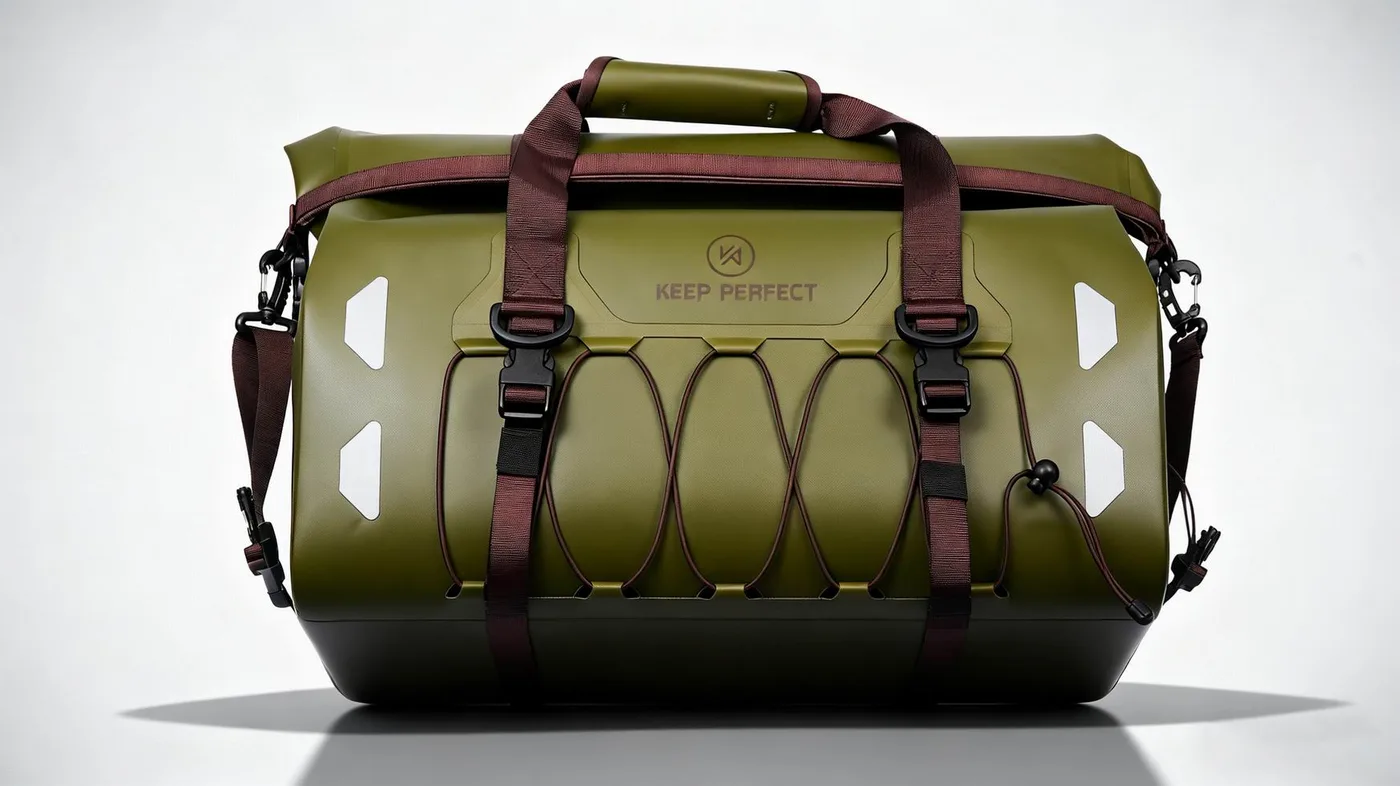
Matching hardware colour to a fabric range
Colour is where finish decisions get commercial. A brand building a three-colourway range wants the buckle on the pink bag to read as the same family as the buckle on the black bag, and that is harder than it sounds: anodised black on aluminium, powder black on steel and mass-coloured black POM sit at visibly different points on the grey scale, sometimes 4 to 6 ΔE apart under a retail light box. The fix is to define one hardware colour per range rather than per colourway, or to accept a deliberate contrast and document it.
Two processes make matching easier. Anodising can be dyed to a target with a tolerance of roughly 1.5 to 2 ΔE on a flat coupon, provided the alloy batch is held constant; a change from 6061 to 6063 shifts the tone enough to see. Powder coat can be matched to almost any shade but has a minimum film thickness that changes the apparent radius of small parts. Whichever route you take, approve against a physical reference chip stored away from light, not against a screen, and re-approve whenever the base alloy or polymer changes. Our colour matching guide covers the tolerance maths in more detail.
| Fabric colourway | Recommended finish | Achievable tolerance | Main risk |
|---|---|---|---|
| Black | Type II anodise, black dye, sealed | 1.5-2.0 ΔE | Purple cast if the alloy batch changes |
| Olive | Powder coat over zirconium pretreatment | 2.0-3.0 ΔE | Chalking after 500 h xenon |
| Camo | Mass-coloured POM, no coating | 3.0-4.0 ΔE | Colour drift between moulding lots |
| Pink or mint | Anodise with a sealed pastel dye | 2.5-3.5 ΔE | Fading without UV-stable dye |
| Blue | PVD gunmetal on stainless | 1.0-2.0 ΔE | Line-of-sight gaps in recesses |
| Grey | Type II natural anodise, clear sealed | 1.0-1.5 ΔE | Visible dye lot variation |
Contact corrosion where metal meets welded TPU
Put an aluminium hook against a stainless D-ring in seawater and the aluminium becomes the sacrificial anode. The galvanic series puts magnesium and zinc at one end, aluminium in the middle and stainless steel at the noble end, and the rate of attack depends on the area ratio: a small aluminium part coupled to a large stainless area corrodes fast, while the reverse is slow. On a dry bag this happens at the hardware tab, where a metal fitting is riveted or sewn to a welded TPU panel that stays wet long after the boat is out of the water.
Three fixes work. Use the same metal family throughout one bag: aluminium hardware with aluminium rivets and washers. Insert a non-conductive barrier, typically a 0.5 mm polyamide washer or a moulded isolating sleeve, between dissimilar metals. Or move the function to moulded plastic, which removes the couple entirely. Whatever you choose, add a fresh-water rinse instruction to the care label, because the electrolyte is the third requirement for galvanic corrosion and salt water is an excellent one. See hardware corrosion resistance for the full couple table.
Abrasion, sand and the finish that survives
Salt spray gets the attention, but abrasion is what actually kills hardware on a beach or a raft. A bag dragged across wet sand six times a day loads the hardware with quartz particles at roughly 7 on the Mohs scale, which is harder than every coating in the table except a PVD ceramic layer. Strap movement adds a second mechanism: the webbing slides across the buckle bar during every adjustment, polishing the coating at the same spot thousands of times per season.
The table below combines laboratory abrasion with a practical field expectation, expressed in seasons of weekend use with a fresh-water rinse after each trip. Read it as a ranking rather than a guarantee, because the two mechanisms interact: a finish that survives sand well but is brittle will chip at an edge, and a finish that is tough but thin will polish through at the strap contact point.
| Finish | Taber cycles to breakthrough | Sand slurry result | Strap contact wear | Field expectation |
|---|---|---|---|---|
| Type II anodise, sealed | 3,000-5,000 | Dulls, no breakthrough | Light polish at 2,000 cycles | 6-9 seasons |
| Type III hard anodise | 8,000-12,000 | Minimal change | Almost none | 9-12 seasons |
| Electroless nickel | 1,200-2,000 | Breakthrough at edges | Visible at 600 cycles | 2-4 seasons |
| Decorative nickel + chrome | 800-1,500 | Blisters under film | Visible at 400 cycles | 1-3 seasons |
| PVD on stainless | 10,000-15,000 | Minimal change | None measurable | 10+ seasons |
| Powder coat, polyester | 2,500-4,000 | Chips at edges | Burnishes at contact | 3-5 seasons |
| Mass-coloured POM | 4,000-6,000 | Uniform dulling | Self-lubricating, low wear | 7-10 seasons |
One result in that table surprises people: moulded plastic beats mid-range plating on abrasion. POM has a low coefficient of friction against polyester webbing, so the strap slides instead of grinding, and there is no layer to break through. That is a good argument for specifying plastic at every adjustment point and metal only where a hook or a D-ring needs the strength, and buckle types and load ratings gives the mechanical side of that decision.
Restricted substances and the paperwork buyers ask for
A finish is a chemical process, and the residues and alloying elements are regulated. Restriction of hazardous substances rules cover lead, cadmium, mercury and hexavalent chromium in the coating and the base alloy; nickel release is limited for anything in prolonged skin contact; and several retailers now ask for a per-part declaration rather than a per-bag one. Because a plated layer is only a few microns thick, the risk sits in the bath chemistry and the passivation step rather than in the bulk metal, which is why the declaration has to come from the plating line and not from the assembly.
Ask for four documents and file them per part number: a restricted substances declaration from the coater, the salt spray report with inspection intervals, the coating thickness measurement with the locations tested, and a colour reference chip. Two is the practical minimum for a retail listing, and four is what a tender will demand. Metal finishing emissions and waste rules are summarised by the US EPA, and the restricted substances angle is covered in our dry bag hardware compliance guide.
| Document | What it proves | Typical threshold or content | Who asks for it |
|---|---|---|---|
| Restricted substances declaration | Coating and base alloy are compliant | Lead, cadmium, mercury, Cr(VI) below limits | Every retail buyer |
| Salt spray report | Comparative corrosion resistance | Duration plus acceptance criterion | Tenders, rental fleets |
| Coating thickness record | Build meets the drawing | Microns at named locations | Engineering review |
| Colour reference chip | Visual approval is traceable | Signed chip, ΔE tolerance stated | Brand and product teams |
| Nickel release test | Safe for prolonged skin contact | Migration below the stated limit | EU and UK retail |
A decision sequence for specifying a finish
- Decide the environment first: saltwater coastal, freshwater lake, chlorinated pool or dry urban use.
- Choose the base metal family, then keep every metal part on a bag in that one family.
- Rank the failure you fear most: corrosion, abrasion, colour drift or cost.
- Pick the finish family against that ranking using the salt spray and abrasion tables.
- Write the acceptance criterion into the drawing, not just the duration.
- Approve a physical colour chip and store it away from light.
- Order 20 to 30 pieces, run them through 40 strap cycles and a 96-hour cabinet check.
- File the four documents per part number before the bulk order is released.
Two patterns recur in the field. The first is a bag specified for freshwater lake use that ends up on a saltwater charter boat, where the finish was never sized for chloride at all; specify for the worst plausible environment, since the gap between a 96-hour and a 500-hour finish is under two dollars per bag. The second is a bright chrome finish chosen in a showroom that blooms white within a season; treat gloss as a retail-only property and matte as a field property.
Budget matters, but the sensible comparison is cost per season, not cost per part. A PVD hook at 3.2 times the price of a plated hook that lasts three times as long is not automatically the expensive option once returns, rework and reputation are counted. For most ranges the best value sits in a hybrid: moulded plastic at every adjustment point, sealed Type II anodise on load-bearing D-rings and hooks, and powder coat only on parts the hand touches. Browse the hardware combinations across the full product line.
Finally, remember that the finish is only half the hardware decision. Geometry, base alloy, contact points and the rinse routine all feed the same outcome, and the cheapest improvement available to any owner is behavioural: a 30-second fresh-water rinse after every saltwater trip does more for hardware life than a move from nickel to PVD. See keeping sand out of dry bag buckles for the maintenance side, and replacing a broken buckle when a part finally does fail.
Frequently asked questions
Q1. Which hardware finish is best for a saltwater dry bag?
Sealed Type II anodised aluminium or PVD-coated stainless steel. Anodising reaches 336 to 600 salt spray hours and PVD 600 to 1,000, against 96 to 120 hours for standard nickel-plated zinc. Specify the acceptance criterion as well as the duration.
Q2. How many salt spray hours should I specify for coastal use?
Ask for 500 hours with a defined acceptance level, such as no red rust and under 1% white corrosion. A duration alone is meaningless, because 500 hours to first bloom and 500 hours to red rust are different parts.
Q3. Can salt spray hours be converted into years of field life?
No. Salt spray is a comparative ranking test run at 35 °C in 5% sodium chloride fog. It orders finishes against each other reliably but contains no conversion factor to seasons of real use, and no standard provides one.
Q4. Is anodising better than plating for dry bag buckles?
For aluminium parts, yes. Anodising grows an oxide into the metal so it cannot flake, and a sealed Type II layer lasts 6 to 9 seasons. Plating sits on the surface and fails by undercutting from pores and edge scratches.
Q5. Why does my plated buckle look fine and then peel?
That is undercutting corrosion. Chloride enters a pore or scratch, travels sideways beneath the nickel layer and lifts it as a blister. The surface looks intact until the coating is already detached over a wide area.
Q6. What does sealing do to an anodised finish?
Sealing closes the pores that hold the dye. An unsealed layer wicks salt and blooms within a season; a hot water or nickel acetate sealed part of the same thickness typically triples its salt spray life.
Q7. Is PVD worth three times the cost of plating?
On high-wear open-profile parts, yes. A 0.5 to 3 µm PVD layer measures 2,000 to 3,000 HV and survives 10,000 to 15,000 Taber cycles. On recessed or complex castings it is wasted, because the process is line-of-sight.
Q8. Which finish holds colour best in strong sun?
Anodised oxide and PVD ceramic are effectively immune to ultraviolet because they are inorganic. Polyester powder coat chalks slowly after several hundred hours of xenon exposure, and epoxy powder chalks much faster.
Q9. Should hardware be plastic or metal on a dry bag?
Use moulded POM or glass-filled polyamide at every adjustment point, because the pigment runs through the section and there is no coating to wear off. Reserve metal for hooks and D-rings that need the strength and cannot be moulded at the section required.
Q10. What causes white powder on my buckles?
White bloom is corrosion product, usually zinc oxide from a zinc alloy base or aluminium oxide from an unsealed anodise. Wipe it off, rinse in fresh water, and expect it to return until the coating is breached through.
Q11. Can I mix aluminium and stainless hardware on one bag?
Only with an isolating barrier. In salt water the aluminium becomes the sacrificial anode and corrodes at a rate set by the area ratio. Use a 0.5 mm polyamide washer, or keep every metal part in one alloy family.
Q12. How thick should an anodised layer be on a buckle?
8 to 18 µm for a decorative Type II finish with dye, and 25 to 50 µm for a Type III hard coat. Hard coat resists abrasion far better but takes dye poorly, so bright colours are restricted to Type II.
Q13. Do painted or powder-coated parts chip easily?
Yes, at edges. A 100 µm film on a sharp corner chips at a 5 to 10 mm impact, after which corrosion spreads under the film. Round every edge to 0.5 mm minimum and use a zirconium pretreatment.
Q14. What documents should I file for hardware finishes?
A restricted substances declaration, the salt spray report with inspection intervals, the coating thickness record with test locations, and a signed colour chip. Add a nickel release test for parts in prolonged skin contact.
Q15. Does hardware finish affect bag cost much?
The coating operation ranges from 0.6 to 3.2 times standard plating cost, but on a finished bag the difference is under two dollars. Compare cost per season, because returns and rework dominate the total.
Q16. How do I test a hardware finish before a bulk order?
Order 20 to 30 parts from the real tooling, run 40 strap cycles on a loaded jig, and put six through a 96-hour cabinet check beside a known reference part. Inspect at 24, 48 and 96 hours.
People also ask
What is the most corrosion resistant finish for bag hardware?
PVD coatings on stainless steel are the most corrosion and abrasion resistant option, reaching 600 to 1,000 salt spray hours and 10,000 to 15,000 Taber cycles. Sealed Type II anodised aluminium is the practical second choice at roughly half the cost.
How do you stop dry bag buckles from corroding?
Choose a sealed anodised or mass-coloured plastic part, keep all metal in one alloy family, rinse with fresh water after every saltwater trip, and dry the bag open in shade. Salt left in a buckle recess is what starts the corrosion.
Are anodised and powder-coated finishes the same thing?
No. Anodising grows an oxide into aluminium and is inorganic, so it does not flake or chalk. Powder coat is an organic film 60 to 120 µm thick laid on top of a metal, which can chip at edges and chalk under ultraviolet light.
Why does salt spray testing use 5% sodium chloride?
A 5% sodium chloride fog at 35 °C produces repeatable, accelerated corrosion that ranks finishes against each other. The concentration is fixed by the test standard so results from different laboratories remain comparable.
Can hardware finishes be colour matched to fabric?
Yes, within limits. Anodised dye holds 1.5 to 2 ΔE on flat coupons if the alloy batch is constant, powder coat matches almost any shade, and mass-coloured plastic sits 3 to 4 ΔE from an anodised equivalent.
Do plastic buckles last longer than metal buckles?
On abrasion, usually yes. POM slides against webbing instead of grinding and has no layer to break through, giving 4,000 to 6,000 Taber cycles and 7 to 10 seasons. Metal still wins on absolute strength at small sections.
Need this in production volume?
QUANZHOU JUNYUAN BAGS has produced waterproof bags since 2014 in an SGS-verified 4,950 m2 facility in Fujian, China. Minimum order 500 pieces, sampling in 6–10 working days, bulk in 35–50 days, FOB Xiamen — write to service@junyuanbags.com with your spec and target market.