Home / Blog / Design & Branding
Colour Matching Across a Bag Range
Colour matching across a bag range is a measurement problem before it is a styling one. A five-colourway waterproof range realistically needs a Delta E of 1.0 to 1.5 between panels of the same bag and no more than 2.5 between the bag body and its webbing, and it takes an average of three lab-dip rounds on TPU laminated fabric to reach those numbers. Get the tolerance wrong at the brief stage and a range that looked coherent on a screen arrives as five products that nobody will merchandise together.
This guide walks through where colour actually drifts in a welded bag, how to write a colour brief that a production partner can hold, which fastness tests are worth paying for, and how to keep a reorder identical twelve months later. It covers numeric tolerances, substrate behaviour, hardware finishes and the approval loop, with the data tables you need to set spec lines rather than adjectives. If you are building a range for retail, for a club, or for a resort programme, the same rules apply.
- Why waterproof fabric makes colour matching harder
- Setting a tolerance you can actually hold
- From Pantone reference to approved lab dip
- The five places colour drifts inside one bag
- Matching a colourway across five formats
- Camouflage, prints and pattern registration
- Hardware finishes: the detail that breaks a match
- Colour fastness tests worth paying for
- Metamerism and the lighting trap
- Designing a capsule of four to six colourways
- Reorders: keeping season two identical
- What a colour approval timeline looks like
- A colour-matching checklist before you commit
Why waterproof fabric makes colour matching harder
A laminated shell behaves differently from the woven textile it started as. Once a 0.3 mm or 0.5 mm TPU film is bonded to a 420D face fabric, the surface stops being diffuse and starts being partly specular: light bounces off the film before it reaches the dye, which lifts gloss and shifts perceived lightness by two to three L* units. Two panels cut from the same roll can therefore read as different colours purely because one is curved and one is flat.
The second reason is thermal. Radio-frequency and hot-air welding run the film to between 160 and 190 °C at the seam. On white, bone and light grey colourways that heat window is wide enough to produce a faint yellow cast within 3 mm of every weld, and the cast deepens over the first month as the polymer relaxes. Any colour brief for a welded product has to name a weld-temperature limit, not just a Pantone reference.
| Substrate | Typical Delta E achievable | Main risk | Notes for the brief |
|---|---|---|---|
| 420D nylon face, 0.3 mm TPU | 0.8-1.5 | Gloss shift on curves | Specify gloss units, not only colour |
| 500D polyester face, 0.5 mm TPU | 0.8-1.5 | Weld yellowing on pale tones | Cap weld temperature at 170 °C |
| rPET face fabric | 1.2-2.0 | Batch-to-batch grey cast | Approve from production yarn, not lab yarn |
| Clear window film | 2.0-3.0 | Haze over printed panels | Match the print, not the film |
| Coated PVC tarpaulin | 1.0-1.8 | Plasticiser bloom dulling surface | Agree a gloss-retained-after-30-days value |
Setting a tolerance you can actually hold
Delta E is the distance between two colours in a perceptual space, and the number you write into a spec sheet decides how much the range will cost. A tolerance of Delta E 1.0 across every component roughly doubles the number of approval rounds against a tolerance of 2.0, because more lots fail and more material is scrapped. The sensible approach is a tiered tolerance: tight where two surfaces meet, looser where they never touch.
Write the tolerance per pair rather than as one global number. Body-to-body panels sit at 1.0 to 1.5. Body-to-webbing can sit at 2.0 to 2.5 because the materials are different and the eye expects some difference. Thread is a special case: it is small, it sits in a shadow line, and most buyers accept Delta E 3.0 there. Anything tighter on thread buys nothing visible and adds a week to sampling.
| Component pair | Realistic Delta E | Visual weight | Recommended spec line |
|---|---|---|---|
| Body panel to body panel | 1.0-1.5 | High | Delta E 1.5 max, D65 light |
| Body to welded seam line | 1.5-2.0 | High | Delta E 2.0 max, no yellowing |
| Body to webbing | 2.0-2.5 | Medium | Delta E 2.5 max, same dye family |
| Body to thread | 2.5-3.0 | Low | Delta E 3.0 max, bonded nylon |
| Body to moulded hardware | 2.5-4.0 | Medium | Match by eye under D65, no numeric gate |
| Print to base fabric | 1.5-2.5 | High | Delta E 2.0 max on the print solid |
From Pantone reference to approved lab dip
A colour reference is only useful when the standard is named. Pantone TCX references are dyed on cotton; Pantone TPG references are dyed on polyester and sit closer to what a synthetic face fabric will actually produce. If a brief says only Pantone 19-4052 without the suffix, the first lab dip will miss by three to five Delta E units and the round is wasted. Naming the suffix, the light source and the substrate removes that first wasted week.
Lab dips should be approved on the exact production substrate, not on a card. A 10 cm by 10 cm swatch of the real laminated fabric, welded along one edge, tells you both the colour and the weld behaviour in a single artefact. Our own sampling runs 6 to 10 working days per round in an SGS-verified 4,950 m2 production facility, and three rounds is the normal budget: first dip to get close, second to correct, third to confirm and freeze the standard.
| Stage | Output | Typical duration | What is decided |
|---|---|---|---|
| Reference freeze | Named code plus substrate | 1-2 days | TCX or TPG, D65 source |
| Lab dip round one | Three swatches around target | 6-10 working days | Direction of correction |
| Lab dip round two | Two corrected swatches | 6-10 working days | Candidate standard |
| Welded confirmation | Production fabric, real seam | 3-5 working days | Yellowing and gloss check |
| Standard freeze | Signed physical standard | 1 day | Reference for bulk and reorder |
The five places colour drifts inside one bag
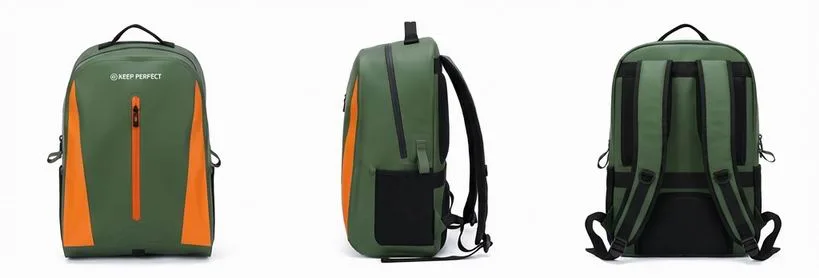
Ask for a single bag built from five components and colour drift appears at predictable points. The face fabric is dyed in a lot and lots vary. The film is extruded and its own slight haze changes with thickness. The webbing is woven from yarn that was dyed in a different bath. The thread is a third dye lot again. The hardware is either moulded from a masterbatch or coated after moulding, and coatings drift with cure temperature.
None of these errors is large on its own; they compound. A face fabric at Delta E 1.2, a webbing at 1.8 and a thread at 2.4 produce a bag that reads as three different colours even though each component passed its own gate. The fix is not tighter individual tolerances but a single reference standard that every component is measured against, plus a physical control bag kept under controlled lighting and replaced every twelve months.
Matching a colourway across five formats
A range rarely consists of one product. The typical waterproof capsule runs a roll-top dry bag, a dry duffel, a tote, a backpack and a cooler-style bag in the same colourway, and each format changes the apparent colour because the panel geometry changes. A 20L roll-top shows one large curved panel; a backpack shows the same fabric next to spacer mesh, printed binding and a moulded back panel.
Plan for format-specific correction rather than forcing one numeric value across all five. In practice we hold the roll-top as the reference product and allow the backpack up to 0.5 more Delta E on panels that sit behind mesh, because the mesh itself modifies the reading. Where two formats will be merchandised touching on a shelf, tighten the pair; where they will be on opposite walls, spend the tolerance elsewhere.
| Format | Visible panel count | Matching difficulty | Practical note |
|---|---|---|---|
| Roll-top dry bag | 1-2 | Low | Use as the reference product |
| Dry duffel | 2-3 | Low | Long panel shows gloss variation first |
| Waterproof tote | 3-4 | Medium | Binding tape is the usual mismatch |
| Waterproof backpack | 5-8 | High | Mesh and moulded back panel complicate reading |
| Cooler-style roll-top | 2-3 | Medium | Liner film adds a second cast |
| Small 2L-5L accessories | 1-2 | Low | Batch these with the roll-top lot |
The accessory sizes are worth calling out separately. A 2L or 5L bag made from offcut material will not match a 20L made from the middle of the roll, because dye lots are not perfectly uniform across a roll width. Buyers who merchandise a small bag next to a large one should specify that both come from the same lot, which we handle by cutting all sizes of one colourway within a single production window.
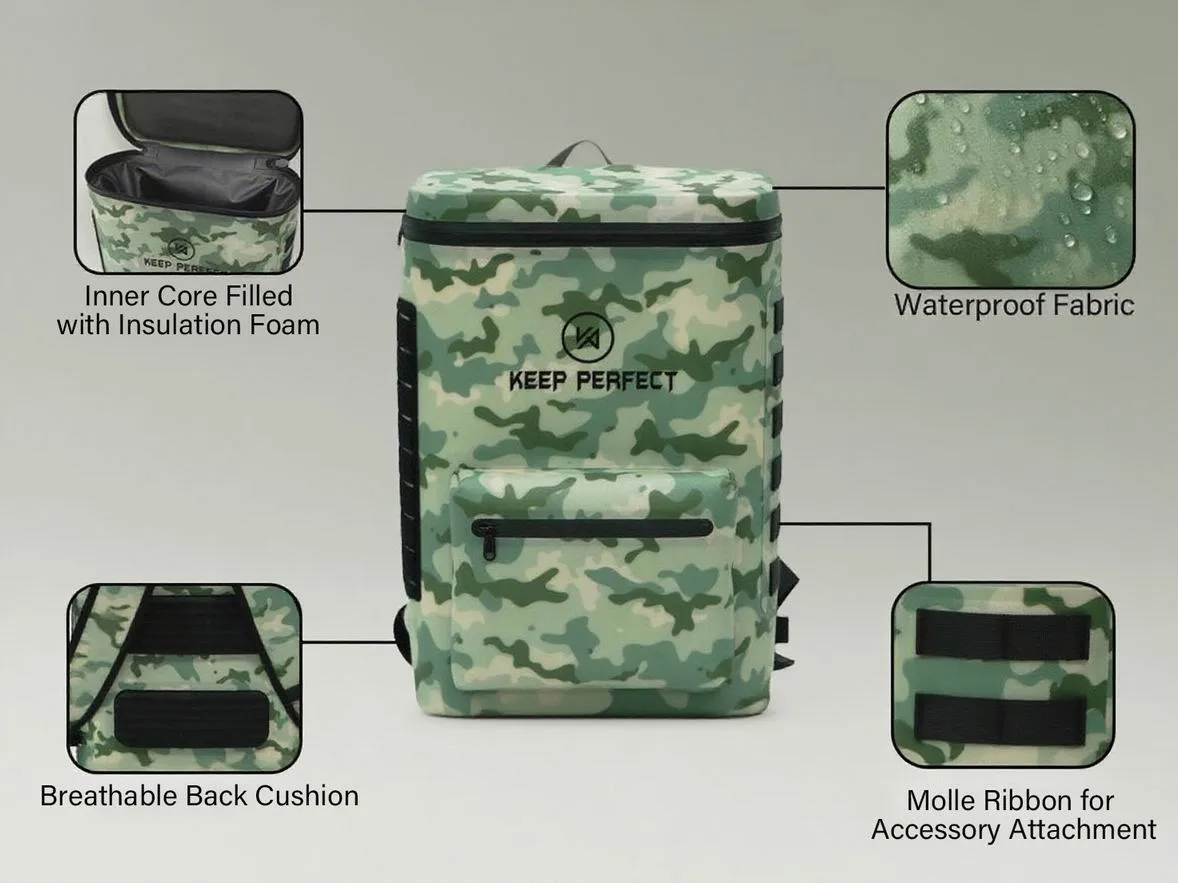
Camouflage, prints and pattern registration
Printed patterns introduce a second tolerance: registration. A camouflage or geometric print produced by rotary or digital methods must align at every welded seam, or the eye reads the misalignment as a defect even when the colours are perfect. On a roll-top bag, where the body is one tube with a single vertical weld, the practical requirement is that the vertical seam lands inside a low-contrast area of the pattern.
Repeat scale is the other variable. A pattern designed for a 90L duffel looks sparse on a 5L bag; the same artwork at 60% scale usually works across the range. Decide the scale per size at the artwork stage rather than at sampling, because rescaling after the print plates or digital profiles are built adds a full round. Our print method comparison sets out where digital beats screen for multi-colour artwork.
Hardware finishes: the detail that breaks a match
Buckles, cam levers, D-rings and eyelets are the most common reason a well-matched range looks mismatched. A moulded acetal buckle in black is not the same black as a matte TPU body: acetal sits glossier and reads one to two L* units lighter under retail lighting. Powder-coated aluminium and anodised aluminium sit at opposite ends of the gloss range again, which is why hardware finish should be chosen before the body colour is frozen.
There is also a corrosion dimension that affects colour over time. Salt exposure dulls an anodised finish within one season of coastal use, while a well-specified stainless or coated finish holds for three to five years. Where a range is sold into watersports, the finish decision is a longevity decision as much as an aesthetic one; the full trade-off is covered in our hardware corrosion guide.
Colour fastness tests worth paying for
Fastness testing answers a different question from matching: not does it look right today, but does it still look right after a season. The relevant exposures for a waterproof bag are light, salt water, chlorinated water, rubbing and perspiration. A test report that only covers rubbing is close to useless for a product that will sit on a beach or a boat deck for eight weeks of summer.
The ISO 105 series defines most of the methods used, and the ASTM light-fastness method is the usual reference for outdoor textile programmes. Ask for the method number on the report, not just a pass statement, because a pass at grade 3 is not the same claim as a pass at grade 4. Grade 4 to light is the realistic minimum for a bag that will be used outdoors.
| Exposure | Common method | Minimum grade for outdoor bags | Failure symptom |
|---|---|---|---|
| Daylight and UV | ISO 105-B02 | Grade 4 | Fading on the sun-facing panel |
| Salt water | ISO 105-E02 | Grade 4 | Bleached tide line at the waterline |
| Chlorinated pool water | ISO 105-E03 | Grade 4 | Pink shift on white and pale blue |
| Rubbing, dry and wet | ISO 105-X12 | Grade 4 dry, 3-4 wet | Colour transfer onto light clothing |
| Perspiration | ISO 105-E04 | Grade 4 | Collar and strap contact staining |
Metamerism and the lighting trap
Two samples that match under the fluorescent tube in a sample room can separate badly under the LED of a shop or the direct sun of a boat deck. That is metamerism, and it happens when two colours match through different pigment routes rather than through identical pigment. It is invisible in the approval room and obvious on the shelf, which is why it is the most expensive colour defect to discover late.
The practical defence is cheap. Evaluate every approval under three sources: D65 daylight simulation, a warm retail LED around 3000 K, and a cool shop fitting around 4000 K. If the samples separate by more than 1.0 Delta E between sources, reject the dip and ask for a reformulation using the same pigment family as the reference. Our saltwater colour fastness notes include the same three-source check applied after exposure.
Designing a capsule of four to six colourways
Most ranges perform better with fewer, better-executed colourways than with a long list that cannot be matched consistently. A capsule of four to six gives a retailer a coherent wall without multiplying the number of dye lots, webbing colours and hardware finishes that have to be held. Each additional colourway adds roughly one week of sampling and one more lot to control in every reorder.
Structure the capsule by role rather than by preference. One neutral anchor that sells in every channel, one high-visibility option for safety-led use, one pattern or camo for the outdoor channel, and one or two seasonal accents that can be rotated without touching the core. That structure keeps the permanent range stable and gives the seasonal range somewhere to change.
Structure the capsule by role rather than by preference. One neutral anchor that sells in every channel and typically carries 35 to 45% of unit volume; one high-visibility option at 10 to 15% for safety-led and watersports channels; one pattern or camo at 15 to 25% for outdoor retailers; and one or two seasonal accents at 10 to 20% that can be rotated without touching the core. A limited drop of 5 to 10% gives a brand something to announce without adding a permanent lot to control.
Assign matching priority by role as well. The anchor colourway gets the tightest tolerance and the strictest reorder discipline because it is the one shoppers compare year on year. Seasonal accents can run at a wider tolerance and be retired after one season. That split is what makes a six-colourway range manageable rather than six separate quality problems.

Reorders: keeping season two identical
The most common colour complaint arrives twelve months after launch, when the reorder lands next to remaining stock and the difference is visible. Dye lots move, yarn lots move, and the pigment formulation itself may have been changed by the mill for regulatory reasons. Without a frozen physical standard and a written formulation reference, there is nothing to hold the second run against.
Keep three artefacts for every colourway: a signed fabric swatch, a welded sample showing the seam, and the lab formulation reference. Store them away from light, and re-verify against a fresh production sample every twelve months, because paper and fabric standards both drift. Where a range is being specified for a club or a retail programme, insist that bulk is cut from a single lot per colourway; splitting a 5,000-piece order across three lots is the fastest way to create visible shade bands on a shelf.
What a colour approval timeline looks like
- Freeze the reference: name the code, the suffix, the substrate and the light source.
- Approve round one lab dips on production fabric, minimum three swatches around target.
- Correct and approve round two; reject if the pair separates across light sources.
- Weld a confirmation sample and check for yellowing at the seam after 48 hours.
- Sign the physical standard and record the formulation reference for reorder.
- Run a pre-production sample in the real format, not just a flat swatch.
- Gate bulk on AQL 2.5 with colour checked against the signed standard, not against memory.
That loop is the whole difference between a range that reads as designed and one that reads as assembled. In our production programme the sampling stage runs 6 to 10 working days per round with a 500-piece minimum and bulk in 35 to 50 days, FOB Xiamen, and the colour standard is the document every station works from. If you want to see how a colour brief is turned into physical parts, the production programme sets out the sequence from artwork to finished goods.
Budget the calendar honestly. A five-colourway range with hardware and print typically needs three lab-dip rounds, one welded confirmation and one pre-production sample, which is 8 to 11 weeks from reference freeze to bulk start. Ranges that skip the welded confirmation step are the ones that discover seam yellowing after 5,000 pieces are already cut.
A colour-matching checklist before you commit
- Name the reference with its suffix and substrate: TCX or TPG, not a bare code.
- Write a tiered Delta E spec, tight where surfaces meet and looser where they do not.
- Approve on welded production fabric, never on a flat card or a screen.
- Cap the weld temperature and check pale colourways for yellowing after 48 hours.
- Choose hardware finish before freezing the body colour, and match gloss as well as hue.
- Request fastness reports with method numbers: light, salt, chlorine and rubbing.
- Evaluate every approval under D65, warm LED and cool shop lighting.
- Freeze a physical standard and a formulation reference for every reorder.
- Check the full product range for the formats you plan to merchandise as a set.

Two further decisions shape how the range reads on a shelf: how many colourways run at once, and how the seasonal accents rotate. Our colour range guide covers the commercial side of that decision, while seasonal colour trends tracks which families are moving in outdoor channels. Pattern-heavy ranges should read the camouflage design notes before committing artwork.
Sustainability requirements now touch colour as well. Water-based pigment systems and restricted-substance lists both constrain the achievable gamut, and a formulation that passes water-based ink criteria may not hit the same Delta E as a solvent system. Set the compliance boundary at the same time as the colour brief, because reformulating for both at once is far cheaper than doing it twice. Our eco-friendly dry bag range is built on that combined constraint, and the roll-top line carries the same colour standards across every size.
Frequently asked questions
Q1. What is a realistic colour tolerance across a bag range?
Hold Delta E 1.0 to 1.5 between body panels of the same bag, 2.0 to 2.5 between body and webbing, and 2.5 to 3.0 on thread. Hardware is matched by eye under D65 rather than by a numeric gate.
Q2. Why does the same fabric look like two different colours on one bag?
A laminated TPU surface is partly glossy, so a flat panel and a curved panel reflect light differently and separate by two to three L* units. Weld heat can also add a yellow cast within 3 mm of each seam on pale colourways.
Q3. Should I specify Pantone TCX or TPG for a waterproof bag?
TPG, because it is dyed on polyester and sits closer to a synthetic face fabric. TCX is dyed on cotton and a first lab dip from a bare code with no suffix will usually miss by three to five Delta E units.
Q4. How many lab-dip rounds should I budget?
Three. Round one establishes the direction of correction, round two produces a candidate standard, and round three confirms and freezes it. Each round runs 6 to 10 working days on production laminated fabric.
Q5. What causes metamerism and how do I catch it?
Metamerism appears when two colours match through different pigment routes, so they separate under a second light source. Check every approval under D65, a warm 3000 K LED and a cool 4000 K shop fitting, and reject anything that moves more than 1.0 Delta E between them.
Q6. Which colour fastness grades matter for an outdoor bag?
Grade 4 to light under ISO 105-B02, grade 4 to salt water and chlorinated water, and grade 4 dry and 3-4 wet for rubbing. Always ask for the method number on the report, not just a pass statement.
Q7. Why does my reorder not match last season?
Dye lots, yarn lots and pigment formulations all move over twelve months. Without a frozen physical standard and a written formulation reference there is nothing to hold the second run against; re-verify the standard annually.
Q8. How do I match hardware to the bag body?
Choose the finish before freezing the body colour. A moulded acetal buckle in black reads one to two L* units lighter than a matte TPU body because it is glossier, so match gloss as well as hue.
Q9. Can one artwork work across a 5L and a 90L bag?
Not at one scale. A pattern drawn for a 90L duffel reads sparse on a 5L bag; rescaling to around 60% for small sizes usually works. Decide scale per size at the artwork stage, before print profiles are built.
Q10. How many colourways should a capsule range carry?
Four to six. One neutral anchor, one high-visibility option, one pattern and one or two seasonal accents. Each extra colourway adds about a week of sampling and another lot to control in every reorder.
Q11. Do small accessory sizes match the large bags?
Only if they are cut from the same lot. Dye is not perfectly uniform across a roll width, so a 2L made from offcuts will not match a 20L cut from the centre unless both are scheduled in one production window.
Q12. What temperature causes yellowing at the weld?
Welding runs the film to 160 to 190 °C. On white, bone and light grey that window can produce a visible yellow cast within 3 mm of the seam. Capping weld temperature at around 170 °C controls it on most pale colourways.
Q13. Is a numeric Delta E gate useful for printed panels?
Yes for the print solid, at Delta E 2.0 against the approved artwork reference. Registration is a separate tolerance: the vertical seam on a roll-top should land in a low-contrast area of the pattern.
Q14. How long does colour approval take before bulk?
Typically 8 to 11 weeks from reference freeze to bulk start: three lab-dip rounds, one welded confirmation and one pre-production sample. Ranges that skip the welded confirmation discover seam yellowing after cutting.
Q15. Do compliance rules limit the colours I can use?
Yes. Water-based pigment systems and restricted-substance lists both narrow the achievable gamut, so a compliant formulation may not reach the same Delta E as a solvent system. Set the compliance boundary with the colour brief, not after it.
Q16. What should I keep on file for each approved colourway?
Three artefacts: a signed fabric swatch, a welded sample showing the seam, and the lab formulation reference. Store them away from light and re-verify against fresh production every twelve months.
People also ask
How do you match colours across a product range?
Freeze one reference product, write a tiered Delta E tolerance per component pair, approve on welded production fabric under three light sources, and keep a signed physical standard plus formulation reference for every reorder.
What is Delta E in colour matching?
Delta E is the numeric distance between two colours in a perceptual colour space. A value under 1.0 is difficult to see, 1.0 to 2.0 is acceptable between panels of one product, and above 3.0 is visible to most people at arm length.
Why do black bags sometimes look different shades?
Black is rarely a single pigment; it is usually a mix tuned for cost, fastness and substrate. Two black components mixed differently will separate under warm shop lighting, which is the classic metamerism failure on black ranges.
Are Pantone references enough to specify a bag colour?
No. A bare code does not name the substrate or the light source, and TCX and TPG versions of the same number differ substantially. Always add the suffix, the substrate, the gloss level and the light source.
How do you stop colours fading on waterproof bags?
Specify grade 4 to light under ISO 105-B02 and grade 4 to salt and chlorinated water, then store bags out of direct sun. UV exposure and salt are the two factors that shorten colour life most.
Can you colour match recycled fabric?
Yes, but expect a wider tolerance. Recycled polyester carries a slight grey cast that varies by batch, so approve from production yarn rather than lab yarn and budget Delta E 1.2 to 2.0 rather than 0.8 to 1.5.
Need this in production volume?
QUANZHOU JUNYUAN BAGS has produced waterproof bags since 2014 in an SGS-verified 4,950 m2 facility in Fujian, China. Minimum order 500 pieces, sampling in 6–10 working days, bulk in 35–50 days, FOB Xiamen — write to service@junyuanbags.com with your spec and target market.