Hunting: 7 Dry Bag Mistakes to Avoid
Seven mistakes account for almost every dry bag problem on a hunt: sealing worn and wet gear with clean kit, choosing a glossy shell that flashes, using one bag for the whole trip, ignoring how loud the closure is at 20 m, having no plan for game contact, leaving the bag in a hot truck, and carrying no repair kit. A soft matte 500D TPU face is roughly 10 to 15 dB quieter than a stiff glossy PVC face when folded at arm's length, and that difference is audible to game on a still morning long before a hunter is visible.
None of the seven is expensive to fix, and most are decisions rather than purchases. What follows takes each mistake in the order it tends to bite, from the packing error that spoils a morning before you leave the truck to the cleaning step that decides whether the bag smells usable next season. Weights, volumes and noise figures are given for a 20L bag, which is the size most hunters carry for a day or an overnight sit.
- Mistake 1: sealing worn and wet gear with clean kit
- Mistake 2: buying a glossy, noisy shell
- Mistake 3: one bag for the whole trip
- Mistake 4: ignoring how loud the closure is at 20 metres
- Mistake 5: no plan for game contact
- Mistake 6: leaving the bag in the sun and the truck
- Mistake 7: carrying no repair kit
- Scent control: what film choice actually changes
- Camouflage and matte finishes that hold up
- A three-day backcountry load plan
- The noise audit: buckles, straps and fabric rustle
- Cleaning a bag after game contact
- Field checklist before you leave the truck
Mistake 1: sealing worn and wet gear with clean kit
A dry bag is watertight, which on a hunt makes it smell-tight as well: whatever goes in stays concentrated and transfers to everything else. Put a shell that has been worn for six hours of drizzle into the same bag as a clean outer layer and you have built a single container in which every item smells of damp fabric and human scent. That is the mistake that ends a morning before it begins, and it is entirely avoidable.
The fix is a hard separation. One bag holds anything that has been worn or wet; a second holds clean, dry layers, food and calls. On a three-day trip that is a 10L wet bag carried on the outside of the pack and a 20L or 30L dry bag carried inside, at a cost of roughly 200 g of extra bag weight. Hunters who make this split consistently report more close encounters than hunters who do not, and the reason is simply that the clean bag still smells of nothing.
Mistake 2: buying a glossy, noisy shell
Finish is a specification, not a cosmetic detail. A glossy PVC face reflects a surprising amount of light even in dull weather, and a stiff face crackles when it folds, both of which work against you at close range. A matte TPU face on a 500D base does neither: it stays flexible down to low temperatures, so it does not stiffen and rustle on a cold morning, and it has no plasticiser to migrate to the surface and create a sheen.
Weight runs against the old assumption that heavier means better here. A 20L matte 500D TPU bag weighs about 480 g and folds quietly; a comparable stiff PVC bag weighs 620 to 700 g and is noticeably louder against a jacket. The TPU version also welds rather than stitches, which removes needle holes from the shell and takes away one more place where scent and moisture can sit.
| Shell finish | Face fabric | Noise when folded | Glare in dull light | Weight, 20L | Best use |
|---|---|---|---|---|---|
| Matte TPU | 500D TPU laminate | Quiet, soft fold | Very low | 460-520 g | Close-range sits, bow hunting |
| Matte TPU, camo print | 500D sublimated face | Quiet | Very low | 480-540 g | Waterfowl, blind use |
| Semi-gloss TPU | 420D TPU laminate | Slight rustle | Low | 400-450 g | General field use |
| Glossy PVC | 500D PVC coated | Crackles, stiffens when cold | High | 620-700 g | Avoid for hunting |
| Coated nylon, no laminate | 420D with DWR | Quiet but wet-through | Low | 380-430 g | Dry weather only |

Mistake 3: one bag for the whole trip
A single 40L bag looks efficient and fails in three specific ways in the field. It cannot be opened quietly, because a large rolled mouth makes more noise than a small one. It cannot be organised, so the item you want at first light is at the bottom under three days of kit. And it concentrates risk: if that one closure is rolled badly in the dark, everything you own is wet.
Three bags is the working answer for a three-day hunt. A 30L for the sleep system and dry layers, a 20L for food, calls and the cooking kit, and a 10L that stays on the outside of the pack for rain gear, wet items and anything you need in the first five minutes of light. Each bag has one job, each is small enough to open quietly, and a single failure costs a third of the load.
Mistake 4: ignoring how loud the closure is at 20 metres
Rolling a dry bag closed is not a silent operation. Fabric sliding against fabric, a buckle clicking shut and a strap tail slapping the shell all carry further in still, cold air than people expect, and first light on a calm morning is the worst possible time. This is the mistake most hunters never identify, because they only ever close the bag at home or in the truck with the engine running.
Test it before the season rather than during it. Stand 20 m from a partner in still air, close the bag normally and listen; then close it slowly with the buckle held in your hand until the last moment, and compare. Most people find the slow technique is quiet enough to use within sight of game, and the whole adjustment costs nothing but attention. Our camo design guide covers the finish side of the same problem.
Mistake 5: no plan for game contact
At some point the bag will carry something that is not clean. Hunters who plan for it bring a dedicated liner: a cheap 10L or 20L open sack that takes the contact so the good bag never does. Hunters who do not plan for it end up wiping a welded shell out with a handful of dry grass and then sealing it closed for the drive home, which is how a bag becomes unusable for the rest of the season.
The liner is also the safer option. Keeping contact off the outer shell means the bag can be cleaned and dried properly at camp instead of being sealed damp, and it keeps anything that touches food separate from anything that touched game. Pack two liners on a multi-day trip so there is a clean spare if the first one is compromised.
Mistake 6: leaving the bag in the sun and the truck
A dark dry bag on a dashboard in autumn sun reaches 55 to 65 °C at the surface, and a welded seam held at that temperature under load for a week of afternoons ages faster than a full season of normal use. The same applies to a bag left on a tailgate in a frost: the film stiffens, the fold takes a set, and the next roll does not seat the way it did in September.
Treat the bag like optics. Keep it in shade, out of the cab when the vehicle is parked in the sun, and loosely rolled rather than folded flat when it is stored between trips. If it has been hot all day, let it come back to ambient before you roll it, because a warm soft film rolled tightly and then cooled overnight holds a crease that becomes a permanent weak line.
Mistake 7: carrying no repair kit
A welded bag will survive years of ordinary use and one bad afternoon on rock or a barbed fence. The failure is usually a small puncture or a lifted corner at a weld, and both are repairable in the field if you have brought the means and useless if you have not. The kit is small: a patch of the same film, a tube of TPU-compatible adhesive, alcohol wipes and a small clamp or a roll of tape to hold pressure while it cures.
Know the limits of the repair as well. A patch on a flat panel restores most of the strength and will hold indefinitely. A patch across a weld corner is a get-you-home fix rather than a permanent one, and a bag with a torn closure fold should be retired rather than patched, because the fold is the seal and nothing field-applied restores a fold line. Our patch kit guide lists what to carry.

Scent control: what film choice actually changes
Film choice does not make a bag scent proof, but it changes how much scent the bag retains between trips. A laminated TPU face is non-porous and wipes clean, where a coated woven fabric holds odour in the weave and releases it slowly for weeks. That is the practical difference: after a season, a TPU bag rinses back to neutral and a coated bag does not.
The other half is routine. Store the bag open, dry and away from anything with a smell, including fuel, boots and dog food. Wipe the inside with a dilute white vinegar solution at the end of the season and dry it completely before it goes into storage. Never store a bag rolled shut with anything damp inside, which is the fastest way to produce an odour that no amount of airing will remove.
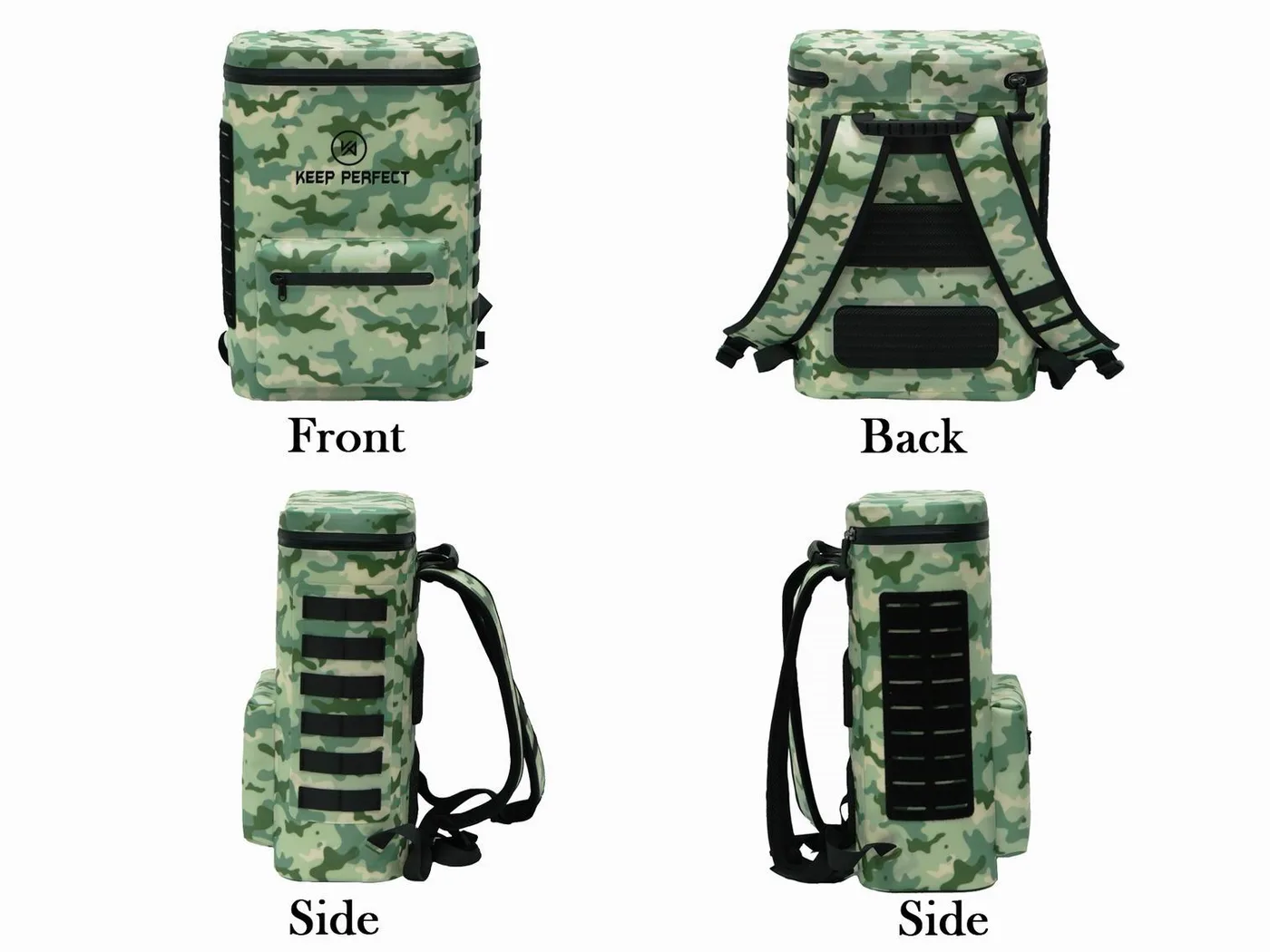
Camouflage and matte finishes that hold up
Printed camo behaves differently from a dyed solid. A sublimated pattern sits inside the face fabric, so it does not crack or peel at the fold and it stays matte, while a surface-printed pattern on a coated face will eventually craze along the roll line. Registration on a four-colour woodland pattern is typically held to about 1.5 mm, which is why the artwork has to be prepared for the panel rather than simply scaled up.
Choose the pattern for the distance you actually shoot from. Large disruption patterns break up a shape at 40 m and beyond; small-scale patterns work at 10 to 25 m and look flat closer than that. For a tree-stand hunter working inside 25 m, the small pattern plus a matte finish is the better combination, and for a waterfowl hunter in a blind the larger pattern with a matte finish does more work.
A three-day backcountry load plan
The table below is one hunter's kit for a three-day backcountry trip with night-time lows near 2 °C and daytime highs near 14 °C, with rain likely. It totals 62 litres and 16.8 kg including the weapon sling and optics, and it assumes water is filtered at camp rather than carried. Figures are packed measurements, taken with each item compressed the way it would sit in the bag.
| Bag | Contents | Packed volume | Weight | Where it rides |
|---|---|---|---|---|
| 30L roll-top, matte | Sleep system, insulated jacket, dry base layers | 27 L | 4.2 kg | Inside the pack, bottom |
| 20L roll-top, camo | Three days of food, stove, calls, licence and tag wallet | 17 L | 4.6 kg | Inside the pack, middle |
| 10L roll-top, matte | Rain shell, wet items, gloves, head torch, first aid | 8 L | 2.9 kg | Outside the pack, top |
| 2L pouch inside the 20L | Phone, GPS, power bank, spare batteries | 1.4 L | 0.7 kg | Inside the pack, lid |
| Two 10L liners | Game contact and wet gear | Packed flat | 0.3 kg | Outside the pack |
| Worn and carried | Optics, knife, water, navigation | - | 4.1 kg | On the body |
Read the split rather than the totals. The 10L on the outside is the bag that gets opened at first light, so it carries only what is needed in the first five minutes and nothing that has to stay dry for three days. The 30L at the bottom of the pack is opened once, at camp. Adjust for weather: a wet-weather trip moves the rain shell out of the 10L and onto your body, and adds a second pair of gloves.
The noise audit: buckles, straps and fabric rustle
Walk through the bag and list every part that can make a sound, then deal with each one. A side-release buckle clicks when it seats; hold it closed with a thumb so it never clicks. A strap tail flaps; cut it to length and tape the end. A D-ring clinks against a buckle; wrap it. Fabric rustles where two panels rub; store the bag loosely rolled so the film is not creased into a stiff line.
| Noise source | When it happens | Audible range in still air | Fix | Cost |
|---|---|---|---|---|
| Buckle seating | Closing the bag | 20-30 m | Hold closed with a thumb, release slowly | None |
| Strap tail slapping | Walking with the bag | 15-25 m | Cut to length, tape the free end | None |
| D-ring against a buckle | Every step | 10-20 m | Wrap the ring in tape or cord | None |
| Fabric slide while rolling | Opening at first light | 20-40 m | Roll slowly, two rolls not three | None |
| Stiff cold film creasing | Below 5 °C | 15-30 m | Keep the bag warm, use a thinner film | Film choice |
| Coil zip on a pocket | Reaching for a call | 10-15 m | Use a welded pocket or a silent pull | Low |
Cleaning a bag after game contact
Clean the bag the same day, at camp if possible and at home otherwise, and never seal it damp. Start by turning it inside out and rinsing with cool fresh water; hot water softens the film and can set protein residue rather than removing it. Work the closure and the weld corners with a soft brush, then treat the surface and let the bag dry open, in shade, for at least 24 hours.
Hygiene matters as much as the bag. Gloves, a dedicated liner and a separate water bottle for washing hands after field dressing are standard practice, and the current guidance on safe handling of game is published by the CDC. For the bag itself, a dilute household disinfectant is enough; check that any product you use is registered for the surface you are cleaning, since registered disinfectants are listed by the EPA.
| Step | Agent | Contact time | Temperature | Note |
|---|---|---|---|---|
| Rinse | Cool fresh water | 2 minutes | Below 30 °C | Never a hot hose on TPU |
| Wash | Mild pH-neutral soap | 3 minutes | Ambient | Soft brush on the weld corners |
| Disinfect | Registered household disinfectant | Per the label, usually 5-10 min | Ambient | Check registration before use |
| Deodorise | Dilute white vinegar, 1:4 | 10 minutes | Ambient | Rinse again afterwards |
| Dry | Air, open mouth, shade | 24 hours minimum | Ambient | Never in direct sun |
| Store | Loosely rolled, unclipped | Until next season | 5-20 °C | Away from fuel and feed |
Field checklist before you leave the truck
Run the same six checks every time and the seven mistakes mostly take care of themselves. Confirm the clean bag contains nothing that has been worn, confirm the wet bag is on the outside of the pack, squeeze each closure and listen for a hiss, confirm the buckles are quiet and taped, check the repair kit is actually in the pack, and confirm nothing is sitting on the dashboard.
The checks take two minutes and they are the difference between a bag that lasts ten seasons and one that is replaced every second year. Our own line has been produced since 2014 in an SGS-verified 4,950 m2 facility with 137 staff and 7 production lines, 200,000 pieces of monthly capacity, a 500-piece minimum, sampling in 6 to 10 working days and bulk in 35 to 50 days, FOB Xiamen.Related detail sits in the waterfowl durability notes, the multi-day bowhunting plan and the bushcraft sizing guide, and our roll-top range covers every size in the load plan.
Frequently asked questions
Q1. What are the biggest dry bag mistakes when hunting?
Seven: packing worn and wet gear with clean kit, choosing a glossy shell that flashes, using one bag for everything, ignoring closure noise, having no plan for game contact, leaving the bag in the sun or a hot truck, and carrying no repair kit.
Q2. Do I need a separate bag for wet gear on a hunt?
Yes. A watertight bag concentrates scent, so a worn shell sealed with clean layers transfers odour to everything. Carry a 10L wet bag on the outside of the pack; it costs about 200 g and removes the problem.
Q3. Is TPU or PVC better for a hunting dry bag?
TPU. A matte 500D TPU face is roughly 10 to 15 dB quieter than a stiff PVC face when folded, weighs about 480 g in 20L against 620 to 700 g, and wipes clean rather than holding odour in the weave.
Q4. How loud is closing a dry bag?
A buckle seating carries 20 to 30 m in still air and fabric sliding while rolling carries 20 to 40 m. Hold the buckle closed with a thumb and roll slowly, and both drop below the range that matters.
Q5. Can I wash blood out of a dry bag?
Yes, with cool water and mild soap, never hot water, which softens the film and sets protein. Turn the bag inside out, brush the weld corners, disinfect per the label, then dry open in shade for 24 hours.
Q6. Should I use a liner inside my hunting dry bag?
Yes, for anything that has been in contact with game. A cheap 10L liner takes the contact so the good bag never does, and carrying two means a clean spare on a multi-day trip.
Q7. How many dry bags do I need for a three-day hunt?
Three. A 30L for sleep and dry layers, a 20L for food and cooking, and a 10L on the outside for rain gear and wet items. Each has one job and each opens more quietly than a single large bag.
Q8. What size dry bag for a day hunt?
A 20L is the workhorse, holding a rain shell, gloves, food, water and a first-aid pouch at about 12 litres packed. Add a 5L for calls, licence and a phone so those stay reachable without opening the main bag.
Q9. Does camouflage print wear off a dry bag?
A sublimated pattern does not, because the dye sits inside the face fabric and stays matte. A surface print on a coated face will craze along the roll line within a season or two of hard use.
Q10. What should be in a dry bag repair kit?
A patch of the same film, a TPU-compatible adhesive, alcohol wipes, and tape or a small clamp to hold pressure while it cures. Everything fits in a 200 g pouch and turns a season-ending puncture into a 20-minute job.
Q11. Can a punctured dry bag be repaired in the field?
Yes, if the puncture is on a flat panel. A patch restores most of the strength and lasts. A patch across a weld corner is a temporary fix, and a torn closure fold should be retired rather than patched.
Q12. How hot is too hot for a dry bag in a truck?
Above about 55 °C at the surface, which a dark bag on a dashboard reaches easily in autumn sun. A welded seam held at that temperature for a week of afternoons ages faster than a full season of normal use.
Q13. Do dry bags keep scent out?
No, but a laminated TPU face retains far less than a coated woven fabric, because it is non-porous and wipes clean. Store the bag open and dry, away from fuel and feed, and wipe it down at the end of the season.
Q14. Should a hunting dry bag be stored rolled or flat?
Loosely rolled with the buckle unclipped. Rolling tightly puts a crease in the film that becomes a permanent weak line, and folding flat does the same at two points instead of one.
Q15. How much does a hunting dry bag setup weigh?
About 1.5 kg of bags for a three-day trip: a 30L at roughly 620 g, a 20L at 480 g, a 10L at 300 g, plus two liners at 150 g each in a matte 500D TPU construction.
Q16. Is a waterproof backpack better than a dry bag for hunting?
A welded waterproof backpack with a harness is better for the walk in and a roll-top is better inside the pack. Most hunters carry both: the backpack for the approach, roll-tops for organisation inside it.
People also ask
How do you keep a dry bag quiet when hunting?
Hold the buckle closed with a thumb so it never clicks, cut strap tails short and tape the ends, wrap D-rings, and roll slowly with two folds instead of three. Test at 20 m in still air before the season.
What dry bag do hunters use?
A matte 500D TPU roll-top in camo or olive, usually three sizes: 30L for sleep kit, 20L for food, and a 10L on the outside of the pack for rain gear and wet items.
Are camo dry bags worth it?
Yes, if the pattern is sublimated rather than surface printed, because the finish stays matte and the pattern does not craze at the fold. Match the pattern scale to the range you normally shoot from.
Can you wash a hunting dry bag?
Yes, by hand with cool water and mild pH-neutral soap. Never use hot water or a machine, and never seal the bag while it is damp. Dry open in shade for at least 24 hours.
Why does my dry bag smell after a hunt?
Because it was sealed damp or because a coated face held odour in the weave. Turn it inside out, wipe with a dilute vinegar solution, dry completely in shade, and store open and loosely rolled.
How do you pack a dry bag for a three-day hunt?
30L for sleep and dry layers at the bottom of the pack, 20L for food and cooking in the middle, and a 10L on the outside for rain gear and wet items. Keep worn gear out of the clean bags entirely.
Need this in production volume?
QUANZHOU JUNYUAN BAGS has produced waterproof bags since 2014 in an SGS-verified 4,950 m2 facility in Fujian, China. Minimum order 500 pieces, sampling in 6–10 working days, bulk in 35–50 days, FOB Xiamen — write to service@junyuanbags.com with your spec and target market.