TPU Dry Bags for Waterfowl Hunting: Durability Notes
A season of waterfowl hunting is harder on a bag than a season of almost any other water sport, because the same bag has to carry 18 kg of keeled decoys, sit in 2 degree Celsius mud, be folded at minus 10 with neoprene gloves on and still close cleanly forty minutes before sunrise. TPU dry bags suit that combination better than coated alternatives: a 0.5 mm thermoplastic polyurethane film stays flexible down to about minus 30 degrees, has no plasticiser to migrate out in the cold, and welds into seams that survive being dragged across frozen stubble and gravel boat ramps.
The failure modes are specific and mostly predictable. Decoy keels abrade the base panel, silt works into the fold line and turns it into grinding paste, and a stiff PVC closure that was fine in October will not roll at all in January. This guide covers decoy loads by decoy type, what cold actually does to film and hardware, mud management, camouflage and glare control, bag formats for blinds and layout boats, and the end-of-hunt routine that gets a bag through a full season rather than half of one.
- What a waterfowl season does to a bag
- Decoy loads: weight, volume and abrasive edges
- Cold: what freezing does to film and closures
- Mud, silt and the grinding paste problem
- Camouflage: pattern, finish and marsh light
- Scent, noise and the quiet bag
- Bag formats for a blind, a layout boat and a walk-in
- Shells, calls and licence organisation
- Water crossings: towing a bag behind a wader
- Hardware that works with gloves and frost
- Keeping electronics and documents dry
- The end-of-hunt routine
- Season-long maintenance and when the bag is done
What a waterfowl season does to a bag
Three things separate this use from ordinary paddling or sailing. The first is abrasion from hard objects: a keeled floater decoy has a moulded keel edge, a lead or steel anchor has corners, and both are thrown into a bag while wet and gritty rather than placed. The second is temperature, because the season runs from early autumn into hard frost and the bag is folded while stiff with cold. The third is timing, since most packing happens in the dark with a head torch and gloves.
Plan for a bag that will be treated badly and still close. That means welded seams rather than stitched ones, a film thick enough to take abrasion at the base, a closure that can be made with gloves, and a colour or pattern that reads correctly in flat pre-dawn light. It also means accepting that a bag used for decoys is a different bag from the one holding your licence, phone and shells, because the two jobs damage bags in opposite ways.
Decoy loads: weight, volume and abrasive edges
Decoys are dense, awkward and sharp-edged. A standard mallard floater weighs about 0.7 kg and occupies 4.5 litres packed loosely; a magnum floater is 1.1 kg and 6.5 litres; a full-body Canada goose shell is 1.6 kg and 12 litres. Add a 170 g anchor per decoy on a Texas rig and two dozen floaters come to roughly 21 kg of decoy and line, which is a two-bag load rather than one, because a single bag at that weight cannot be lifted into a boat one-handed.
The keel is what damages the bag. Weighted keels concentrate the whole mass of a wet decoy onto a moulded edge, and dragging that edge down the inside of a bag cuts the film from the inside out. A cheap solution works best: decoys travel in their own mesh or slot bag and that bag goes inside a dry bag, so the dry bag carries the water and the mesh takes the abrasion. Expect the mesh to wear out in a season and the dry bag to survive several.
| Decoy type | Weight each | Packed volume each | A dozen weighs | Transport method |
|---|---|---|---|---|
| Standard floater | 0.7 kg | 4.5 L | 8.4 kg | Mesh decoy bag inside a 40 L |
| Magnum floater | 1.1 kg | 6.5 L | 13.2 kg | Two mesh bags, two 40 L |
| Full-body goose shell | 1.6 kg | 12 L | 19.2 kg | Stacked in a 60 L duffel |
| Silhouette | 0.35 kg | 1.2 L | 4.2 kg | Flat in a 20 L |
| Anchors and line | 0.17 kg | 0.3 L | 2.0 kg | Separate 10 L, never with decoys |
Cold: what freezing does to film and closures
Cold affects materials in two separate ways that get confused. Flexibility drops gradually with temperature, so a film that folds easily at 20 degrees is noticeably stiffer at zero and stiff enough to resist a crisp fold at minus 10. Brittleness is different: it is the point at which the film cracks rather than bends, and a quality thermoplastic polyurethane reaches that point somewhere around minus 30, well below anything a walk-in hunt will produce.
Coated fabrics behave worse, and not because they crack. A PVC coated bag stiffens sharply as the plasticiser stops doing its job, and the practical result is a closure that will not fold at minus 5 even though the material is nowhere near its cracking point. That is the single most common cold-weather complaint in this activity, and it is solved by material choice at purchase rather than by technique in the field. Our cold crack temperature guide gives the figures by film.
| Film | 20 degrees C | 0 degrees C | -10 degrees C | Field note |
|---|---|---|---|---|
| TPU, 0.5 mm | Supple | Supple | Stiff but foldable | Folds with gloves at -10 |
| TPU, 0.35 mm | Very supple | Supple | Foldable | Easiest cold closure |
| PVC coated, 0.5 mm | Supple | Stiffening | Resists folding | Warm the closure first |
| PU-coated nylon | Supple | Supple | Stiffening | Coating chalks in frost |
| Silicone-coated ripstop | Very supple | Very supple | Supple | Light, low abrasion life |
Mud, silt and the grinding paste problem
Marsh silt is a fine quartz and organic paste that behaves like a liquid abrasive. It gets into the fold line of a roll-top, stays there when the bag is closed, and then grinds the film every time the bag is flexed. Over a season this is more destructive than decoy keels, because it works on the one part of the bag that has to seal. A bag that is never rinsed will show a grey band along the fold line by mid-season and will start weeping at that band shortly after.
The fix is procedural rather than material. Rinse the fold line first and the body second, before anything has dried; a hose at the ramp or a bucket in the truck is enough. Do not wipe mud off a dry bag, because wiping dry grit across film is exactly the abrasion you are trying to avoid. If the bag has to go back in the truck dirty, close it with the fold line tucked under so the mud dries on the outside of the roll rather than inside the seal.
Camouflage: pattern, finish and marsh light
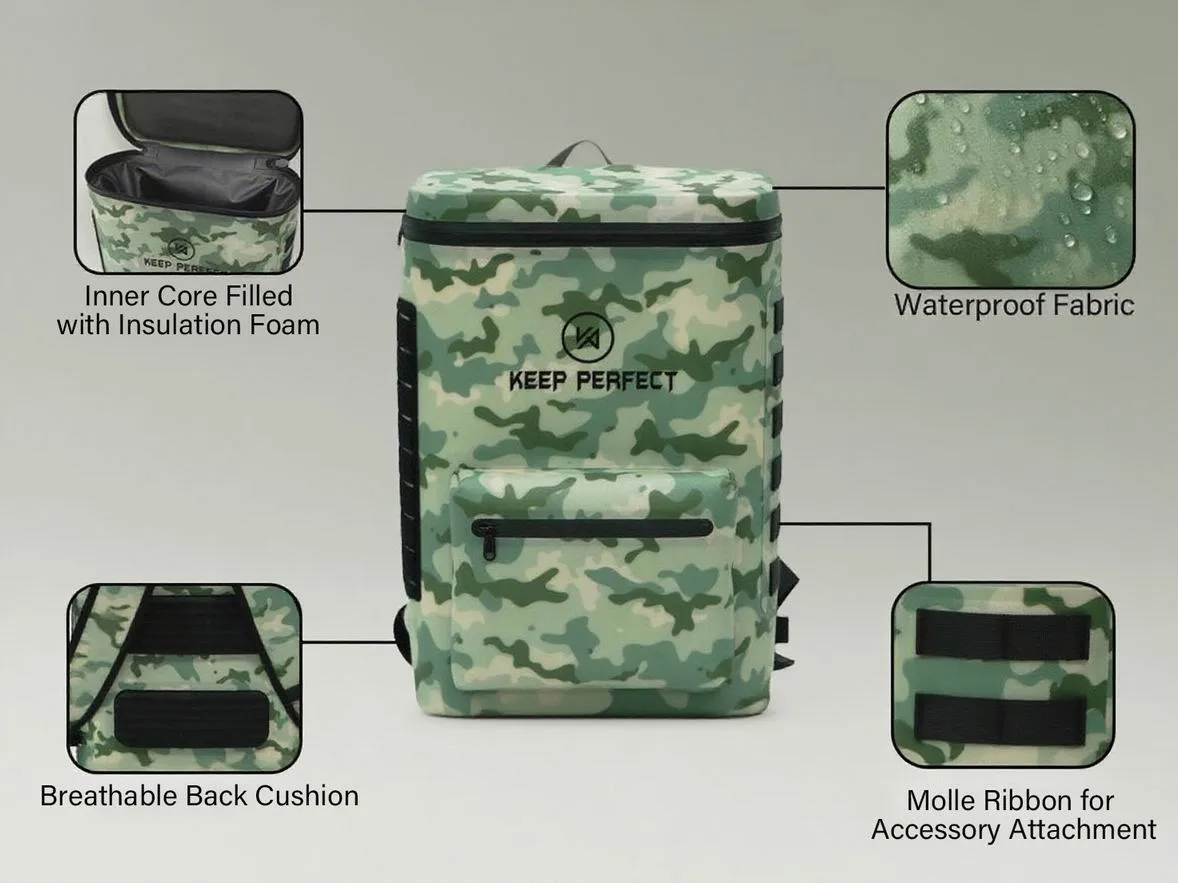
Concealment for gear is about breaking up shape rather than matching a photograph of a marsh. Pre-dawn light is flat and almost colourless, so contrast and outline matter more than hue: a bag with a large single-toned panel reads as a rectangle at 80 metres, while the same bag in a pattern with strong light and dark breaks reads as clutter. Choose a pattern with high internal contrast and a mid-tone base rather than a very dark one.
Finish matters as much as pattern. A glossy film reflects a head torch, a low sun or a flash of water directly back at the birds, and a single specular highlight off a bag in a layout blind is enough to flare a flight at 150 metres. Specify or choose a matt or low-sheen film for anything that sits above the waterline, and accept that matt finishes show scuffs more readily. Pattern and finish options are set out in our camouflage design guide.
Scent, noise and the quiet bag
Two secondary properties decide whether a bag is tolerated in a blind. Noise: a stiff film crackles when it is folded or brushed against, and that sound carries across still water far further than people expect, so a supple film is quieter than a stiff one by a wide margin. Scent: plasticiser-containing films carry a chemical smell when new, and while there is no evidence that it affects birds at the distances involved, it is unpleasant in a closed blind and it fades far faster from a thermoplastic polyurethane than from a coated vinyl.
Hardware noise is the bigger issue. A metal D-ring clinking against a shotgun barrel or a boat gunwale is audible from the next blind, so look for bags with welded fabric attachment points or hardware that can be taped. A roll of camouflage tape over any exposed metal ring costs a few grams and removes the problem entirely, and it is worth doing before the season rather than during the first decent flight of the morning.
Bag formats for a blind, a layout boat and a walk-in
Format follows how far you carry and where the bag sits. A walk-in marsh hunt with 800 metres of flooded timber wants a backpack you can wear with waders on, because carrying 14 kg by hand for that distance is genuinely exhausting and unstable. A layout boat wants a low-profile duffel that lies flat on the floor and can be reached without sitting up. A permanent pit blind wants large capacity and no carrying comfort at all.
A workable three-bag system for a mixed season is a 30L welded backpack for the walk in, a 20L roll-top for shells, calls and licence, and a 60L duffel that never leaves the boat or the blind. The roll-top is the one that must close perfectly every time, so it should be the newest bag in the set and the only one that never carries decoys, anchors or anything with a sharp edge.
| Hunt type | Carry distance | Main bag | Second bag | Load |
|---|---|---|---|---|
| Walk-in flooded timber | 400-900 m | 30 L backpack | 10 L roll-top | 11-14 kg |
| Layout boat | 50-200 m | 60 L duffel | 20 L roll-top | 16-21 kg |
| Permanent pit blind | 20-80 m | 60 L duffel | 20 L roll-top | 18-24 kg |
| Boat blind on open water | 0 m | 40 L duffel | 10 L roll-top | 12-18 kg |
| Field hunt for geese | 300-700 m | 40 L duffel | 20 L roll-top | 15-20 kg |
Shells, calls and licence organisation
Ammunition and paperwork have opposite requirements and should never share a bag. A box of 25 magnum shells weighs about 1.1 kg and occupies 1.3 litres, so three boxes are 3.3 kg and fit easily in a 10L bag with a call lanyard, a choke tube and a knife. Steel shot rattles, and rattling is what wears the print off the inside of a bag and drives people mad in a blind, so wrap each box or use a dedicated shell pouch.
Licences, tags and a phone belong in a small 2L or 5L roll-top kept inside a pocket, not in the main bag. The reason is simple and it happens every season: the main bag gets opened in the dark, in the rain, next to a bag of wet decoys, and anything paper-based that lives there will be damp by the second weekend. A small inner bag costs almost nothing and removes the single most annoying failure in the whole activity.
Water crossings: towing a bag behind a wader
Crossing a flooded slough or a channel at 1.2 metres depth with waders on means the bag goes with you, floating. A sealed 20L bag with most of its air in displaces about 20 kg of water, so a 4 kg load floats high and tows easily on a short line. Keep the tow line under 1.5 metres so the bag cannot wrap a leg, and use a line that floats, because a sinking line in chest-deep water is a genuine hazard.
Buoyancy is a bonus here and never a substitute for judgement. Water at 2 degrees Celsius causes cold shock within seconds and incapacitates within about ten minutes, so a crossing is a decision to make with the depth, the current and the exit bank all assessed first. Cold-water immersion guidance is published by the CDC, and weather and water temperature data for most hunting regions is available from NOAA.

Hardware that works with gloves and frost
Cold, wet neoprene gloves reduce both dexterity and pinch force, so hardware designed for summer use fails exactly when it matters most. A side-squeeze buckle that releases at 40 newtons when dry and warm can need 60 or more when it has ice in the mechanism, and a frozen buckle is usually the reason a hunter gives up and leaves a bag half-closed. Look for oversized hardware with a release tab you can hit with the side of a gloved thumb.
Metal hardware has a second problem in this season: it conducts heat away from a wet hand fast enough to be painful at minus 10 and it can freeze to a glove. Polymer hardware is the better choice for anything you touch with bare or gloved skin, and welded fabric loops beat any hardware at all for lash points because there is nothing to freeze, nothing to rattle and nothing to catch on a wader strap.
| Hardware | At 20 degrees C | At -10 degrees C with gloves | Field note |
|---|---|---|---|
| Standard side-squeeze buckle | Releases at 40 N | 50-60 N, may ice up | Carry a spare, warm it first |
| Oversized tab buckle | Releases at 30 N | 35-45 N | Best choice for this season |
| Cam buckle on webbing | Releases at 25 N | Stiff but usable | Good for lash straps |
| Metal D-ring | Fine | Freezes to wet gloves | Tape it or avoid it |
| Welded fabric loop | Fine | Fine | Nothing to freeze or rattle |
Keeping electronics and documents dry
A phone in a blind takes three kinds of punishment: immersion if you step into a hole, condensation if it is sealed in a warm bag and then carried into cold air, and mud if it shares a pocket with anything that has been in the marsh. The first two are solved by a small welded pouch with a clear window, kept inside a roll-top, and the third by never letting the pouch touch anything that has not been rinsed.
Condensation is the one people miss. A phone taken from a heated truck at 22 degrees and sealed into a bag that is then carried into air at minus 5 will deposit moisture on the coldest surface, which is the inside of the window. Give the pouch a minute in the outside air before sealing it, or keep it in an outside pocket where the temperature change is gradual, and the window stays clear all morning.
The end-of-hunt routine
- Empty everything at the truck, including decoy bags, while it is still wet.
- Rinse the fold line first with fresh water, then the body; never wipe dry mud off film.
- Open the bag fully and hose out the corners where silt collects.
- Hang upside down to drain for twenty minutes before it goes in the vehicle.
- Dry in shade with the mouth open, then store loosely rolled, unclipped.
- Once a month, inspect the base panel and the fold line for cuts and grey abrasion.
Twenty minutes at the truck buys most of the season. The step that gets skipped is the fourth: a bag thrown into a truck bed still full of muddy water will sit for the whole drive home with silt working into the fold, and by the next hunt it has dried into a hard grey crust. Hanging it upside down for twenty minutes while you deal with the decoys costs no extra time at all.
Never store a bag closed for the week between hunts. A closed bag traps residual moisture, and a week of trapped moisture at ambient temperature is enough to start mildew on any organic residue left inside. Store it open, dry and out of the sun; ultraviolet is the only common damage that continues while the bag is doing nothing, and our prevention notes cover that separately.
Season-long maintenance and when the bag is done
Three checks across a season catch almost everything. At the start, pressurise each bag by rolling it closed and squeezing: any hiss means a closure problem or a pinhole, and both are repairable in October. At mid-season, inspect the base panel against a bright light for cuts from decoy keels and anchors. At the end, check the fold line for the grey abrasion band that indicates silt has been winning, and treat it by washing with a soft brush and warm water.
Retire a bag when a cut reaches the base fabric, when the fold line cracks along more than 20 millimetres, or when a weld shows a continuous haze rather than a clear line. The most common mistake in this activity is over-stuffing: a 40L bag packed to 46 litres cannot make three folds, and the closure that results looks fine and leaks slowly for the rest of the season. Our hunting mistakes guide lists the rest, and the multi-day plan covers longer trips.
If you are specifying bags for a hunting club, a guide operation or a retail range aimed at this season, the four lines that matter are film type and thickness, closure geometry, hardware size and finish. Our production lines have built waterproof bags since 2014 in an SGS-verified 4,950 m2 facility with seven lines and 149 machines, at 200,000 pieces per month, with a 500-piece minimum per colourway, sampling in 6 to 10 working days and bulk in 35 to 50 days from FOB Xiamen at AQL 2.5 inspection.
One purchase principle covers the whole season: buy the decoy bag and the gear bag separately and never let them swap jobs. A 0.5 mm thermoplastic polyurethane bag with welded seams, oversized polymer hardware and a matt camouflage finish will handle five to eight seasons as a gear bag and about two as a decoy bag, and keeping those two roles apart is the cheapest way to get the full life out of both. Start from the roll-top dry bag range, and check the flexibility versus durability trade-off before choosing a film weight for a cold climate.
Frequently asked questions
Q1. Are TPU dry bags good for waterfowl hunting?
Yes. A 0.5 mm thermoplastic polyurethane film stays foldable to about minus 30 degrees, has no plasticiser to stiffen in the cold and welds into seams that survive decoy keels and gravel ramps. It is quieter and lower odour than coated vinyl in a closed blind.
Q2. What size dry bag for a dozen duck decoys?
A dozen standard floaters weigh 8.4 kg and pack to about 54 litres, so a 60L duffel or two 40L bags with the decoys inside mesh bags. Add anchors in a separate 10L so their corners never touch the film.
Q3. Why does my dry bag get stiff in cold weather?
If it is a coated vinyl, the plasticiser stops working as the temperature drops and the film resists folding well before it is anywhere near cracking. Thermoplastic polyurethane stays foldable far lower; the practical test is whether you can make three folds with gloves at minus 10.
Q4. How do I stop mud wearing out the fold line?
Rinse before anything dries, never wipe dry grit off film, and hose the corners where silt collects. If it must go in the truck dirty, roll it with the fold line tucked under so mud dries outside the seal.
Q5. Can I tow a dry bag across a channel while wading?
Yes. A sealed 20L displaces about 20 kg of water, so a 4 kg load floats high. Keep the tow line under 1.5 metres and use a floating line so it cannot wrap your legs or sink under you.
Q6. What camouflage works best for a dry bag?
A pattern with high internal contrast and a mid-tone base, in a matt or low-sheen finish. Pre-dawn light is flat and colourless, so outline matters more than hue, and a glossy film throws a highlight that can flare birds at 150 metres.
Q7. Is a glossy dry bag a problem in a blind?
Yes. Gloss reflects a head torch or low sun straight back at the birds. Choose a matt film for anything above the waterline and accept that matt finishes show scuffs more readily than gloss ones.
Q8. Should shells and licence share a bag?
No. A box of 25 magnum shells weighs 1.1 kg and rattles, which wears the inside of the bag and is annoying in a blind. Keep licence, tags, phone and calls in a separate small roll-top in a pocket.
Q9. How much weight can a hunter carry in a dry bag?
For a walk-in of 400 to 900 metres, plan on 11 to 14 kg in a 30L backpack, which is manageable in waders. A layout boat or pit blind can take 16 to 24 kg because the bag is not carried far.
Q10. What hardware works with gloves at minus 10?
Oversized tab buckles that release at 30 to 45 newtons, and welded fabric loops for lash points. Standard side-squeeze buckles can need 50 to 60 newtons when iced, and metal D-rings freeze to wet gloves.
Q11. Why is my phone wet inside a sealed pouch?
Usually condensation from a warm phone sealed into a cold bag, which deposits moisture on the inside of the window. Let the pouch equalise in outside air for a minute before sealing it, or carry it in an outside pocket.
Q12. Can a dry bag be repaired after a decoy cut?
Yes, if the cut has not reached the base fabric. TPU patches bonded with heat or a suitable adhesive hold well on the body of the bag; cuts across the fold line or within 20 millimetres of a weld are best treated as end of life.
Q13. Should I store my hunting bag closed between hunts?
No. A closed bag traps residual moisture and mildew starts within about a week. Store it open, dry, loosely rolled and out of the sun, with the buckle unclipped.
Q14. How long does a TPU dry bag last in a hunting season?
About five to eight seasons as a gear bag and roughly two as a decoy bag, if it is rinsed after every hunt and stored dry. Silt in the fold line and over-stuffing are the two things that shorten that most.
Q15. Why does my bag leak slowly all season?
Over-stuffing is the usual cause. A 40L packed to 46 litres cannot make three folds, so the closure looks fine and weeps. Leave 15 per cent headroom and the seal returns.
Q16. Is a backpack or a duffel better for hunting?
A backpack for walk-ins of 400 to 900 metres, because 14 kg carried by hand in waders is exhausting and unstable. A duffel for layout boats and pit blinds, where the bag lies flat and carrying comfort does not matter.
People also ask
What makes a dry bag good for waterfowl hunting?
A film that stays foldable in the cold, welded seams that survive abrasion, oversized hardware for gloved hands and a matt camouflage finish. TPU at 0.5 mm meets all four; coated vinyl stiffens and is noisier.
How do you keep hunting gear dry in a marsh?
Split the load: decoys in a mesh bag inside a duffel, shells and licence in separate roll-tops, and electronics in a small welded pouch. Rinse the fold line before anything dries and never wipe dry grit off film.
Do dry bags crack in freezing weather?
A quality TPU film reaches its brittle point near minus 30 degrees, well below hunting conditions. Coated vinyl stiffens long before it cracks, so the practical failure is a closure that will not fold, not a film that breaks.
How much weight is a dozen decoys?
A dozen standard floaters weigh about 8.4 kg and pack to roughly 54 litres; magnums are 13.2 kg and full-body goose shells 19.2 kg. Add 170 g per anchor, carried separately.
Why does a dry bag leak after a few hunts?
Silt in the fold line or over-stuffing. Marsh silt works into the roll and grinds the film every time the bag flexes; a bag packed past 85 per cent cannot make three clean folds.
Can you float a dry bag across water while hunting?
Yes. A sealed 20L bag displaces about 20 kg of water, so a 4 kg load tows high behind a wader. Use a floating line under 1.5 metres, and never treat the bag as a flotation aid.
Need this in production volume?
QUANZHOU JUNYUAN BAGS has produced waterproof bags since 2014 in an SGS-verified 4,950 m2 facility in Fujian, China. Minimum order 500 pieces, sampling in 6–10 working days, bulk in 35–50 days, FOB Xiamen — write to service@junyuanbags.com with your spec and target market.