Home / Blog / Design & Branding
Camouflage Dry Bag Designs
A camouflage dry bag range succeeds when three things line up: the pattern is scaled to the printable panel, the print route bonds to TPU film rather than sitting on it, and the finished panel holds a colour fastness grade of 4 or better after 40 hours of xenon exposure. On a 20L roll-top the flat printable front is roughly 260 mm wide by 300 mm tall, which fits only two to three repeats of a woodland motif built from 90 mm blobs. Tile the same artwork onto a 5L bag and you see less than one full repeat, which reads as an olive smudge rather than a pattern.
This guide sets out the six pattern families that sell in outdoor, hunting and paddling channels, the motif sizes that suit each bag size, the four print routes available on laminated film, the test numbers worth writing into a brief, and the safety trade-off that arrives whenever you hide a bag in the landscape. Every figure below sits inside real production ranges: 0.5 mm TPU film, 420D face fabric, orders from 500 pieces, and sampling in 6 to 10 working days. Use it as a working brief, not as a mood board.
- Why camouflage behaves differently on a bag than on a jacket
- Six pattern families and the ground each one matches
- Motif sizing: the 25 to 35 percent rule
- Placement: keeping the design readable after three folds
- Print routes on laminated film: what each one can and cannot do
- Colour fastness numbers worth writing into a brief
- Matching webbing, thread and hardware to the pattern
- Where camouflage is the wrong answer
- Salt, mud and sun: how a printed panel ages
- Mapping patterns onto a size ladder
- Retail and photography: presenting a printed range
- What to send a production partner before sampling
- A camouflage design checklist you can run in an hour
Why camouflage behaves differently on a bag than on a jacket
A jacket presents one large, roughly flat field that moves with a body. A dry bag presents a cylinder that is rolled three times, squeezed by a strap and usually half-hidden behind other kit. Camouflage works by breaking up a recognisable outline, and a roll-top already breaks its own outline because the top third disappears into the folds. So the design job is inverted: the pattern has to read at two to five metres on the lower two thirds of the bag, and it has to survive being compressed to a 60 mm slab inside a hatch.
Contrast beats realism at that distance. A two-tone pattern with 35% to 45% luminance separation still fragments an outline at five metres, while a photorealistic leaf print collapses into a single olive mass because the eye integrates the fine detail. Designers who test at arm’s length and never step back produce artwork that photographs beautifully and disappears on a riverbank. Print a 1 m by 1 m proof, lean it against a wall and walk 6 m away before you approve anything.
Surface finish matters more than most briefs admit. A TPU film with a gloss reading above 40 gloss units at 60 degrees throws a specular highlight that announces the bag regardless of how good the pattern is. A matte or soft-touch finish in the 8 to 15 gloss unit range kills that highlight and lets the pattern do the work. Matte finishes show scuffs more readily, so pair them with a 500D face if the bag will be dragged over rock.
Six pattern families and the ground each one matches
Six families cover almost every commercial request, and each carries a different palette height, motif geometry and channel expectation. Woodland remains the volume seller in hunting and bushcraft; digital or pixelated patterns read as technical rather than traditional and sell better into paddling and tactical channels; marsh and reed patterns are the default for waterfowl; snow and alpine versions sell in Scandinavia, Canada and high-altitude markets; desert and arid tans cover the Middle East and the American southwest; coastal marine blues suit boat and resort use.
Palette height is the number worth pinning first. Woodland patterns sit in a lightness range of L* 22 to 45, marsh patterns run L* 45 to 70, and snow patterns push to L* 78 to 92 with a grey shadow layer to keep them from reading as plain white. If you build a range across three families, keep the darkest tone shared across all three so webbing, buckles and thread can be standardised on one dyed colour instead of three.
| Family | Lightness range (L*) | Matching ground | Best bag sizes | Channel note |
|---|---|---|---|---|
| Woodland | 22-45 | Temperate forest, autumn cover | 10L, 20L, 30L | Volume seller, slowest to date |
| Digital / pixel | 30-60 | Mixed scrub, rock, urban | 5L, 10L, 20L | Reads technical, not traditional |
| Marsh and reed | 45-70 | Wetland, reed beds, stubble | 20L, 30L, 40L duffel | Waterfowl default |
| Snow and alpine | 78-92 | Snowfield, bare rock above treeline | 10L, 20L | Seasonal, sells in short windows |
| Desert and arid | 55-80 | Sand, dry scrub, sandstone | 20L, 30L | Strong in Gulf and southwest markets |
| Coastal marine | 35-65 | Waterline, deck, dune grass | 5L, 10L | Resort and charter crossover |
Motif sizing: the 25 to 35 percent rule
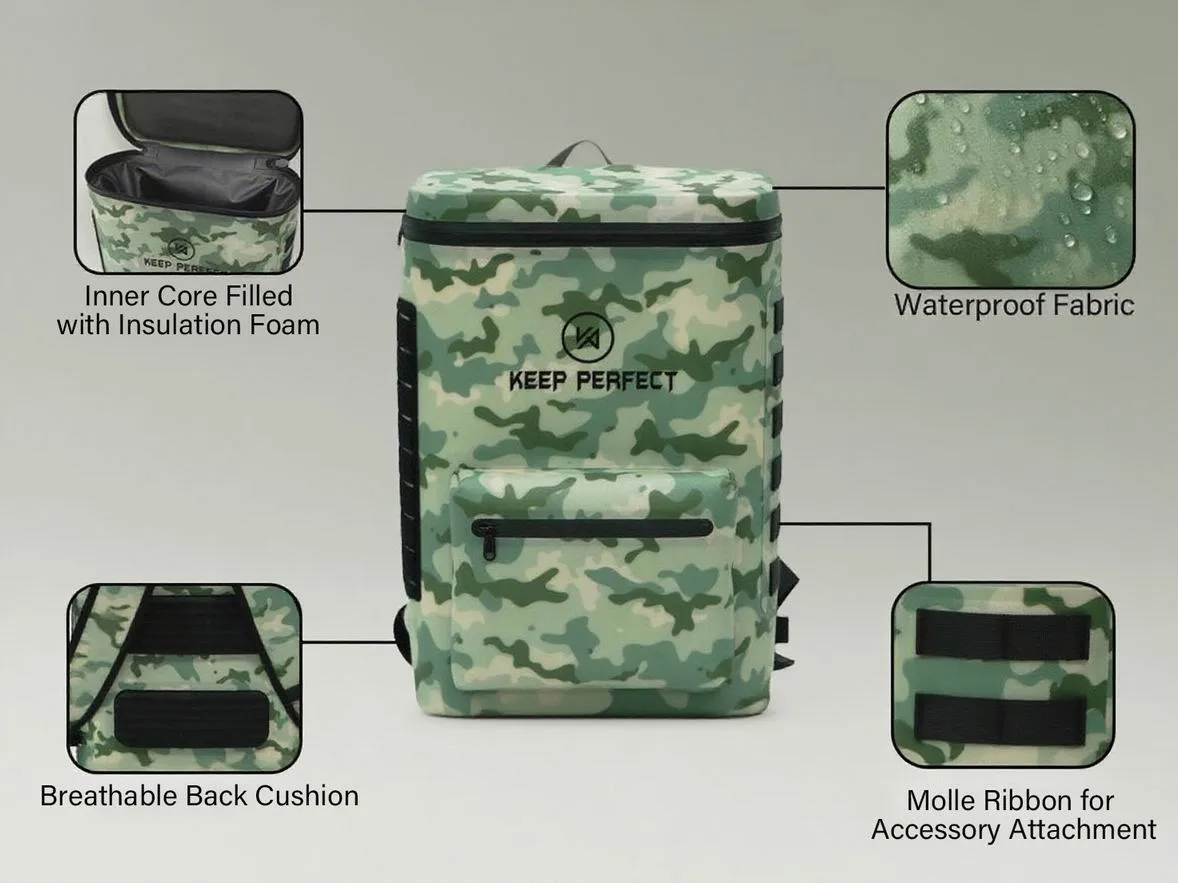
The usable rule from production is simple: the largest dimension of a single motif should sit between 25% and 35% of the printable panel width. Below 25% the pattern turns into noise at distance; above 35% a small bag shows two blobs and a gap. On a 260 mm panel that means motifs in the 65 to 90 mm band, which is why most woodland artwork drawn for apparel has to be scaled up by 1.4 to 1.8 times before it works on a bag.
Small bags punish artwork hardest. A 5L roll-top gives a printable field of about 170 mm by 180 mm once weld margins are removed, so a 90 mm motif appears twice and the eye reads a stripe rather than a field. Either drop to a 35 to 45 mm motif for the 5L or switch that size to a solid colour from the same family. Both answers are commercially defensible; the wrong answer is shipping the 20L artwork unchanged onto the 5L.
| Bag size | Printable panel width | Motif size that reads | Full repeats visible | Usual mistake |
|---|---|---|---|---|
| 5L | 170 mm | 35-45 mm | 3-4 | Artwork copied from the 20L |
| 10L | 220 mm | 55-70 mm | 3 | Motif scaled down, not up |
| 20L | 260 mm | 65-90 mm | 2-3 | Fine detail lost in the fold band |
| 30L | 300 mm | 75-105 mm | 2-3 | Shadow layer too light, print looks flat |
| 40L duffel | 400 mm | 100-140 mm | 2-4 | Tile seam visible on the long side |
| 60L+ duffel | 500-600 mm | 140-200 mm | 3-4 | Registration drift across the panel |
Placement: keeping the design readable after three folds
Three folds consume 90 to 120 mm of height on a 20L bag, and that band is the first thing a strap covers. Treat it as a transition zone and anchor the readable artwork in the bottom 60% of the panel. On a 40L duffel the equivalent band is the zip or roll line along the top face, which is why side panels carry the design and the top face carries a single solid tone.
Weld margins are the second constraint. Radio-frequency welding pulls the film 2 to 3 mm and leaves a slightly discoloured halo of 4 to 6 mm either side of the seam. Keep artwork at least 15 mm clear of any weld line or the pattern will look scorched along every edge. Plan the bleed the same way: 12 mm of bleed on roll-fed digital, 20 mm on a hand-fed screen jig, because placement tolerance on a curved seam runs at 1.5 mm on digital and 3 mm on screen.
- Anchor logos 40 mm above the base weld so a strap never sits across them.
- Keep a 15 mm clear margin on every welded edge to avoid the discoloured halo.
- Run the pattern vertically on roll-tops so the motif follows the fold, not across it.
- Put the darkest tone at the bottom of the panel where scuffs are most likely.
- Reserve the top fold band for a solid tone or a narrow repeat stripe.
Print routes on laminated film: what each one can and cannot do
Four routes are realistic on a TPU laminate, and the choice is a trade between colour count, hand feel, adhesion and minimum quantity. Screen printing with a two-part PU ink gives the thickest deposit, around 25 to 40 microns, and the best opacity on dark grounds, but it needs one screen per colour and tolerates poorly on a curved panel. Digital UV-cure printing needs no screens, lays down 8 to 15 microns and holds registration to 1.5 mm, at the cost of a slightly plastic hand feel and a longer cure check.
Dye sublimation only works on a polyester face and only produces colour on the face fabric, not the film, so it is the route for a soft, breathable hand and the wrong route for a bag that must be wiped clean. Heat-transfer film sits on top of the laminate, feels like a sticker and tends to lift at the fold after 200 to 400 roll cycles. For a range that will be rubbed, folded and salted, screen and digital are the two serious answers; the full comparison is laid out in our guide to digital versus screen printing on dry bags.

Colour fastness numbers worth writing into a brief
Ask for the standard, not the adjective. Colour fastness to light is measured under ISO 105-B02 with a xenon arc and reported as a grade from 1 to 8 on the blue wool scale; a printed outdoor bag should hold grade 4 after 40 hours and grade 3 to 4 after 80 hours. Rubbing fastness follows ISO 105-X12 and should reach grade 4 dry and grade 3 to 4 wet, because a wet bag strapped against a wet jacket is exactly the condition that transfers ink.
Saltwater and chlorinated water are separate tests and the one most briefs forget, and the ISO catalogue is where the specific parts are published. Coastal programmes should ask for ISO 105-E02 against a 30 g per litre sodium chloride solution for 4 hours. UV ageing of the film itself is usually run as an ASTM G155 xenon cycle; 500 hours is a reasonable screening figure for a bag sold in subtropical markets, and 1,000 hours for anything marketed as expedition grade.
| Test | Standard | Target | Exposure | What failure looks like |
|---|---|---|---|---|
| Light fastness | ISO 105-B02 | Grade 4 | 40 h xenon | Tan motifs fade to grey first |
| Rubbing, dry | ISO 105-X12 | Grade 4 | 10 cycles | Ink dusts onto webbing |
| Rubbing, wet | ISO 105-X12 | Grade 3-4 | 10 cycles | Transfer onto hands and clothing |
| Salt water | ISO 105-E02 | Grade 4 | 4 h at 30 g/L | Edge bleed along the weld halo |
| UV ageing of film | ASTM G155 | No crack at 500 h | 500-1000 h | Crazing at the fold line |
| Cold fold | Internal, -20 C | No ink crack | 50 fold cycles | Flaking along the roll |
Matching webbing, thread and hardware to the pattern
A pattern is only as convincing as the trim around it. Webbing dyed to match the mid-tone of the pattern within a colour difference of Delta E 2.0 or less is achievable on a polyester webbing run of 3,000 metres or more; below that length, mills mix to a commercial tolerance of Delta E 3 to 4 and the trim reads as a different product. Specify the tolerance in the brief rather than discovering it on the sixth production run.
Hardware is where ranges drift. A coyote brown POM buckle from one production line and a coyote brown buckle from another can differ by Delta E 4 simply because the masterbatch lot changed. Lock a reference chip, hold it at the inspection bench, and reject outside Delta E 3. Thread follows the same logic: a bonded polyester sewing thread in a dark tone disappears into a woodland panel, while a contrast stitch turns a camouflage bag into a fashion item, which may be exactly what a lifestyle channel wants.
If the range spans four sizes and two patterns, standardising trim is usually worth more than a perfect match on every size. One webbing colour, one buckle colour and one thread colour across eight SKUs cuts component count by roughly 60% and removes the most common cause of a delayed bulk run. Our colour matching guide sets out the chip and tolerance workflow in more detail.
Where camouflage is the wrong answer
Camouflage reduces the distance at which a person sees the bag, and on or near water that is a safety decision rather than a styling one. A dark olive 20L bag on grey water at dusk is effectively invisible beyond 30 metres, while the same bag with a 25 mm retroreflective band showing 400 to 500 candela per lux per square metre is picked up by a car headlamp at 120 to 150 metres. If the bag travels on a road, a bike lane or a rescue boat, put reflective area back into the design.
Two channels should default away from full camouflage: children’s sizes, where visibility to a supervising adult is the point, and any bag sold as a safety or rescue item. In both cases use camo as a 30% panel against a high-visibility ground rather than as a full wrap. The same argument applies to reflective accents for night use, where placement geometry matters more than total area.

Salt, mud and sun: how a printed panel ages
Printed panels fail in a predictable order. UV lifts the lightest tones first, so a snow pattern greys and a marsh pattern yellows within a season of subtropical use. Abrasion then removes ink from the points that touch the ground, which on a roll-top is the bottom 80 mm and on a duffel is the two lower corners. Salt crystals growing between the ink film and the laminate are the third mechanism and the one that produces flaking rather than fading.
Design against that order. Put the mid-tone, not the lightest tone, at the abrasion points; specify a matte overprint or a clear PU topcoat of 5 to 8 microns on bags destined for salt use; and avoid large areas of a single pale tone on the lower third. A bag that fades evenly still looks like a product after three seasons; a bag that flakes at the corners looks broken after one.
| Exposure | Test dose | Observed effect | Design fix |
|---|---|---|---|
| Xenon UV | 500 h | Light tones lose 1-2 blue wool grades | Mid-tones at abrasion points |
| Salt spray | 96 h at 35 C | Edge lift on unsealed prints | 5-8 micron PU topcoat |
| Mud abrasion | 20,000 Martindale cycles | Ink burnish at the base | Darkest tone in the bottom 80 mm |
| Cold fold | -20 C, 50 cycles | Hairline crack in thick ink | Cap deposit at 30 microns |
| Wet stacking | 7 days at 40 C | Ink transfer onto adjacent bag | Full cure plus a rub test in AQL |
Mapping patterns onto a size ladder
Two patterns and three colourways is the range size that most retail programmes can actually merchandise. Beyond that, the wall becomes noise and the buyer halves the order. A workable split is one hero pattern that runs across every size, one accent pattern on the two smallest sizes where a bag is most likely to be carried in public, and a solid colourway drawn from the hero palette for channels that want a quieter product.
Keep the ratio roughly 70% hero, 20% accent and 10% solid by unit volume at launch, then let the first season’s sell-through reallocate it. Resist adding a fourth colourway in year one: it consumes a print setup, a webbing dye lot and a photography set for a share of volume that rarely exceeds 6%. The arithmetic of a colour range is covered in our dry bag colour range guide.
Sizes and patterns should be planned together because the artwork is not portable. Budget one artwork adaptation per size band, at roughly two to four hours of studio time each, and treat that as a fixed cost of the range rather than a change request later. Bags in the 5L to 10L band take the most adaptation work for the least volume, which is why many programmes run those sizes in solids only.
Retail and photography: presenting a printed range
Printed film is a lighting problem before it is a styling problem. Shoot at 5,500 K with a polarising filter and a black flag to control the specular band, and expose for the lightest motif so the dark tones hold detail. A glossy laminate shot with an on-camera flash produces a white hole in the middle of the panel and a product that looks cheap regardless of the artwork quality.
For e-commerce, give the pattern a flat swatch at 1,000 pixels square next to a lifestyle frame, because buyers compare patterns against each other rather than against photographs. Show one frame with the bag rolled and one unrolled: the rolled frame is what the buyer will see in a hatch, on a deck and in a car boot. Full setup notes are in our dry bag photography guide, and the trim decisions behind a retail-ready presentation are in the retail presentation guide.
What to send a production partner before sampling
A sampling round goes quickly when the brief arrives complete. Send the artwork as a vector file with the tile dimensions stated, a Pantone or Lab reference for each tone, the print route you expect, the clear margin from every weld, the fastness targets by test and standard, and the trim colour with a Delta E tolerance. Add the size ladder and the quantity per size, because a 500-piece minimum spread across four sizes means roughly 125 bags per artwork variant.
Sampling for a printed range typically runs 6 to 10 working days once artwork is approved, and bulk runs 35 to 50 days depending on how many colourways share the line. Waterproof bag production here has run since 2014 across an SGS-verified 4,950 m2 site with 7 lines and 149 machines, inspected to AQL 2.5 and shipped FOB Xiamen on T/T 30/70 terms.Ink chemistry is a compliance question as well as a print one, and the EPA publishes guidance on coating and ink emissions that is worth reading before you choose a solvent route.
Ask for one printed sample per colourway plus one unprinted control. The control bag is what lets you judge whether a fastness result belongs to the ink or to the film, and it costs almost nothing next to a failed bulk run. Keep both samples under the same xenon dose so the comparison is meaningful at the 40-hour mark.
A camouflage design checklist you can run in an hour
- Confirm the printable panel width for each size and scale the motif to 25-35% of it.
- Fix palette lightness per family and share one dark tone across the range.
- Set weld clearances at 15 mm and bleed at 12 mm digital, 20 mm screen.
- Choose the print route by colour count and hand feel, not by habit.
- Write fastness targets as standard plus grade: ISO 105-B02 grade 4, X12 grade 4 dry.
- Lock trim to Delta E 2.0 with a physical reference chip at inspection.
- Add reflective area if the bag travels near roads, trails or rescue craft.
- Sample one printed bag and one control bag per colourway, dosed identically.
Run the checklist at artwork approval, not at bulk confirmation. Every item on it is cheap to change on screen and expensive to change once screens are cut, webbing is dyed and film is laminated. A pattern change after sampling typically costs two to three weeks and a fresh ink approval; the same change at brief stage costs an afternoon in the studio.
If the range is a first entry into camouflage, pilot with one hero pattern on two sizes before committing to a full ladder. A 500-piece pilot across a 10L and a 20L tells you whether the artwork scales, whether the ink holds on the fold and whether the channel actually wants the pattern, at a fraction of a full-line commitment. Compare the result against the existing product line and against your roll-top range before you reorder.
Frequently asked questions
Q1. What makes a good camouflage dry bag design?
A pattern scaled to 25-35% of the printable panel width, a print route that bonds to TPU film, colour fastness of grade 4 to light and rubbing, and a weld clearance of at least 15 mm so the seam halo never crosses the artwork.
Q2. Why does my camo artwork look wrong on small dry bags?
Because the artwork was scaled for a 20L or 30L panel. A 5L bag offers about 170 mm of printable width, so a 90 mm motif appears only twice and reads as a stripe. Scale the motif down to 35-45 mm for that size or run it in a solid colour.
Q3. Which print route works best on TPU dry bag film?
Screen printing with a two-part PU ink for opacity and durability on dark grounds, or digital UV-cure when colour count is high and registration tolerance of 1.5 mm matters. Dye sublimation only colours the face fabric and is not wipe-clean.
Q4. How thick should the ink deposit be on a printed dry bag?
Between 25 and 40 microns for screen. Below 25 microns the dark ground shows through the light tones; above 40 microns the ink film cracks along the fold line after about 50 cycles at -20 C.
Q5. What colour fastness grade should I ask for?
Grade 4 to light after 40 hours under ISO 105-B02, grade 4 dry and grade 3-4 wet to rubbing under ISO 105-X12, and grade 4 to salt water under ISO 105-E02 for any coastal programme.
Q6. Do camouflage dry bags fade faster than solid colours?
The printed tones fade first, particularly pale tans and greys, so a printed panel can lose one to two blue wool grades in 500 xenon hours while a solid dyed fabric holds. A 5-8 micron PU topcoat slows this measurably.
Q7. Can I print camouflage across a welded seam?
You can, but you should not. RF welding draws the film 2-3 mm and leaves a discoloured halo of 4-6 mm either side, so any artwork within 15 mm of the weld looks scorched. Keep seams clear and let the pattern live in the panel interior.
Q8. Is a glossy or matte finish better for camouflage?
Matte, in the 8 to 15 gloss unit range at 60 degrees. A gloss reading above 40 units throws a specular highlight that defeats the pattern entirely in bright sun, which is the condition camouflage is meant to work in.
Q9. How do I match webbing and buckles to a camo pattern?
Specify a dyed chip reference and a Delta E tolerance of 2.0 or better, checked against a physical chip at the inspection bench. Without a tolerance, webbing and hardware from different lots drift by Delta E 3 to 4 and read as different products.
Q10. Are camouflage dry bags safe for road or trail use?
A full camo wrap cuts detection distance to roughly 30 metres at dusk. Add a 25 mm retroreflective band rated at 400-500 candela per lux per square metre, which brings a headlamp detection distance back to 120-150 metres.
Q11. How many camouflage patterns should a range carry?
Two: one hero pattern across every size and one accent on the two smallest sizes. Add a solid colourway drawn from the hero palette. Four or more patterns fragment a retail wall and rarely add more than 6% of volume each.
Q12. What file format should I send for camo artwork?
A vector file with the tile dimensions stated in millimetres, plus a Pantone or Lab reference for each tone. Raster files force a resolution decision at the wrong stage and usually arrive too small for a 600 mm duffel panel.
Q13. How much does a camo print add to sampling time?
Artwork adaptation per size band takes two to four studio hours, and printed sampling runs 6 to 10 working days once the artwork is approved. A pattern change requested after sampling typically costs two to three weeks and a fresh ink approval.
Q14. Does camouflage hide wear on a dry bag?
Partly. A busy mid-tone pattern disguises scuffs and salt bloom far better than a solid pale colour, which is why camo bags look newer for longer in rental and guide fleets. It does not hide abrasion at the base corners.
Q15. Can I use a licensed camouflage pattern on a bag?
Only with written permission from the pattern owner, and the licence usually covers a defined product category and territory. Most commercial ranges use original artwork for that reason, with the palette tuned to a named environment rather than a licensed name.
Q16. What is the smallest order for a printed camo range?
Plan on 500 pieces as a working minimum, split across the size ladder. Four sizes at that volume means about 125 bags per artwork variant, which is why most first programmes launch with two sizes rather than four.
People also ask
How do you design a camouflage pattern for a bag?
Measure the printable panel for each size, scale the largest motif to 25-35% of that width, keep 15 mm clear of every weld, then test a printed proof at 6 metres rather than at arm’s length. Contrast between tones matters more than realism.
Why does camouflage look different on waterproof fabric?
TPU laminate is smoother and glossier than woven fabric, so it throws a specular highlight that flattens the pattern. A matte finish at 8-15 gloss units restores the broken-up outline that makes camouflage work.
Can you print on TPU dry bag material?
Yes, with a two-part PU ink by screen or a UV-cure digital print. Both bond to the laminate; dye sublimation does not, because it only colours a polyester face fabric and has poor rub resistance when wet.
Do printed dry bags fade in the sun?
They do. Expect one to two blue wool grades of fade after 500 xenon hours, with pale tans and greys going first. A clear PU topcoat and mid-tones at abrasion points both extend the acceptable life of a printed panel.
What is the best colour for a dry bag on the water?
High contrast against the water and sky rather than a match to the shoreline. Orange, yellow and bright blue are seen at 150 metres or more, while olive and grey drop below 30 metres at dusk on grey water.
How many colours are in a typical camo print?
Three to five for screen printing, because each colour needs its own screen and registration step. Digital printing allows more tones at no extra setup, which is why complex gradients usually move to a digital route.
Need this in production volume?
QUANZHOU JUNYUAN BAGS has produced waterproof bags since 2014 in an SGS-verified 4,950 m2 facility in Fujian, China. Minimum order 500 pieces, sampling in 6–10 working days, bulk in 35–50 days, FOB Xiamen — write to service@junyuanbags.com with your spec and target market.