Home / Blog / Capacity & Sizing
Packing a 20L Dry Bag for Two Days
A 20L dry bag gives 16.5 to 17.5 litres once the roll-top is closed with three folds, and about 14 litres of working space after you leave the 15% headroom needed to align the mouth and push air out. That is enough for a two-day summer trip at 6.5 to 8 kg: one spare base layer, a light mid layer, a shell, a 6 to 8 litre sleep system, six meals and a small electronics pouch. It stops being enough the moment a three-season sleeping bag and a stove kit push the total past 13 litres.
This guide works from a bench-measured load rather than a theoretical one. Every number below comes from real items: a 320 g thermal top at 1.8 litres, a 1.4 kg food bag for six meals at 2.2 litres, a 640 g power bank and cable pouch at 0.6 litres. Build your own list from the tables, then check it against the four-zone order that keeps heavy compressibles at the base and the lunch stop within one hand reach of the mouth.
- What 20 litres actually holds for two days
- The two-day kit list with weights and volumes
- The four-zone packing order
- Compressing soft goods without harming the closure
- Clothing volume by fabric and season
- Food, water and cooking inside three litres
- Sleep system and shelter items that fit
- Electronics, documents and the inner sealed layer
- Weight, balance and how a 20L load carries
- What changes when the bag goes in the water
- Repacking on the morning of day two
- Mistakes that cost space or cause leaks
- Checklist and when to step up to 30L
What 20 litres actually holds for two days
Three different numbers hide behind the printed figure. The shell volume is 20 litres measured to the top of the mouth. The closed volume is what remains below three full folds, typically 16.5 to 17.5 litres on a straight-sided roll-top with a 70 mm reinforced mouth. The working volume is what you can realistically fill and still close cleanly, which is the closed figure less about 15% for headroom: roughly 14 litres. Planning against 20 litres is the single most common reason a two-day kit ends up strapped to the outside of a bag.
Season decides whether 14 litres is comfortable or tight. A summer coastal two-day trip in 18 °C nights needs about 10.5 litres of gear and lands comfortably. The same trip in early spring with a 5 °C forecast needs a warmer bag and a heavier mid layer, which adds 3 to 4 litres and puts the load right on the boundary. If your compressed sleep system alone exceeds 8 litres, or if you are carrying a stove and a 1.5 litre pot, stop sizing at 20 litres and read the weekend trip sizing guide instead.
| Two-day scenario | Clothing | Food and cooking | Sleep and shelter | Total load | Verdict for 20L |
|---|---|---|---|---|---|
| Summer coast, 18 °C nights | 3.0 L | 2.2 L | 6.4 L | 11.6 L | Comfortable |
| Summer hills, 10 °C nights | 3.8 L | 2.4 L | 7.6 L | 13.8 L | Fits with discipline |
| Shoulder season forest, 5 °C | 5.2 L | 2.8 L | 9.0 L | 17.0 L | Too tight, move to 30L |
| Desert two-day, 30 °C days | 2.4 L | 2.0 L | 5.5 L | 9.9 L | Comfortable, spare room |
| Paddle-in camp, 15 °C | 4.0 L | 2.6 L | 8.2 L | 14.8 L | Fits only if compressed |

The two-day kit list with weights and volumes
Write the list before you touch the bag, and weigh the awkward items rather than guessing. Cooked pouches, a stove, a head torch and a water filter are the four things people underestimate; together they can add 900 g and 1.4 litres to a load that looked tidy on paper. Once the list exists, cut it once: remove anything that has no defined job in the next 48 hours, then check the remaining volume against the working figure of about 14 litres.
The item-level table below uses packed dimensions rather than flat-packed ones. A rolled sleeping mat keeps its rolled shape inside a dry bag, so its packed volume is close to its rolled cylinder, not the flat panel area. Food is listed after decanting into soft pouches, which typically removes 25% to 35% of the volume compared with retail packaging, and removes the sharp cardboard corners that abrade a 0.5 mm TPU film from the inside.
| Item | Packed volume | Weight | Priority | Zone in the bag |
|---|---|---|---|---|
| Sleeping bag, summer, 650 fill | 6.4 L | 780 g | Essential | Base |
| Insulated mat, rolled | 2.1 L | 410 g | Essential | Base side wall |
| Spare base layer, merino 200 | 1.8 L | 320 g | High | Middle |
| Light mid layer, synthetic | 2.6 L | 360 g | High | Middle |
| Rain shell, 2.5 layer | 1.4 L | 280 g | Essential | Top |
| Food for six meals, decanted | 2.2 L | 1,400 g | Essential | Middle |
| Stove, pot and fuel | 1.1 L | 520 g | Optional | Middle |
| Electronics pouch | 0.6 L | 640 g | Medium | Top |
| Wash kit and first aid | 0.8 L | 380 g | Medium | Top |
The four-zone packing order
Pack in layers with a defined job, from the base upwards. Zone one is the base: compressible sleep system, pushed down first and spread to fill the corners. Zone two is the middle: food, stove and anything dense but not needed until camp. Zone three is the top: clothing you may want during the day, plus the wash kit. Zone four is the mouth: the rain shell and one snack, because these are the items you reach for with the bag open in bad weather.
Order also governs water risk. In a roll-top, whatever sits nearest the closure is what gets wet first if a fold is imperfect, so electronics never belong in zone four and never directly against the mouth. Food sits below clothing for the opposite reason: a leaking food pouch ruins a sleeping bag, while a damp shell is an inconvenience. If the bag will be strapped to a deck or a rack, put the densest items low as well, because a low centre of mass is what stops a 7 kg load from rolling the bag on its side.
| Zone | Position | Contents | Access frequency | Water risk if the fold leaks |
|---|---|---|---|---|
| Zone 1 | Base | Sleep system, mat | Once per day | Lowest |
| Zone 2 | Lower middle | Food, stove, fuel | Two or three times | Low |
| Zone 3 | Upper middle | Spare clothing, wash kit | Several times | Medium |
| Zone 4 | At the mouth | Rain shell, snack, map | Every stop | Highest |
| External | Water bottle, snacks | Constant | Not applicable |
Compressing soft goods without harming the closure
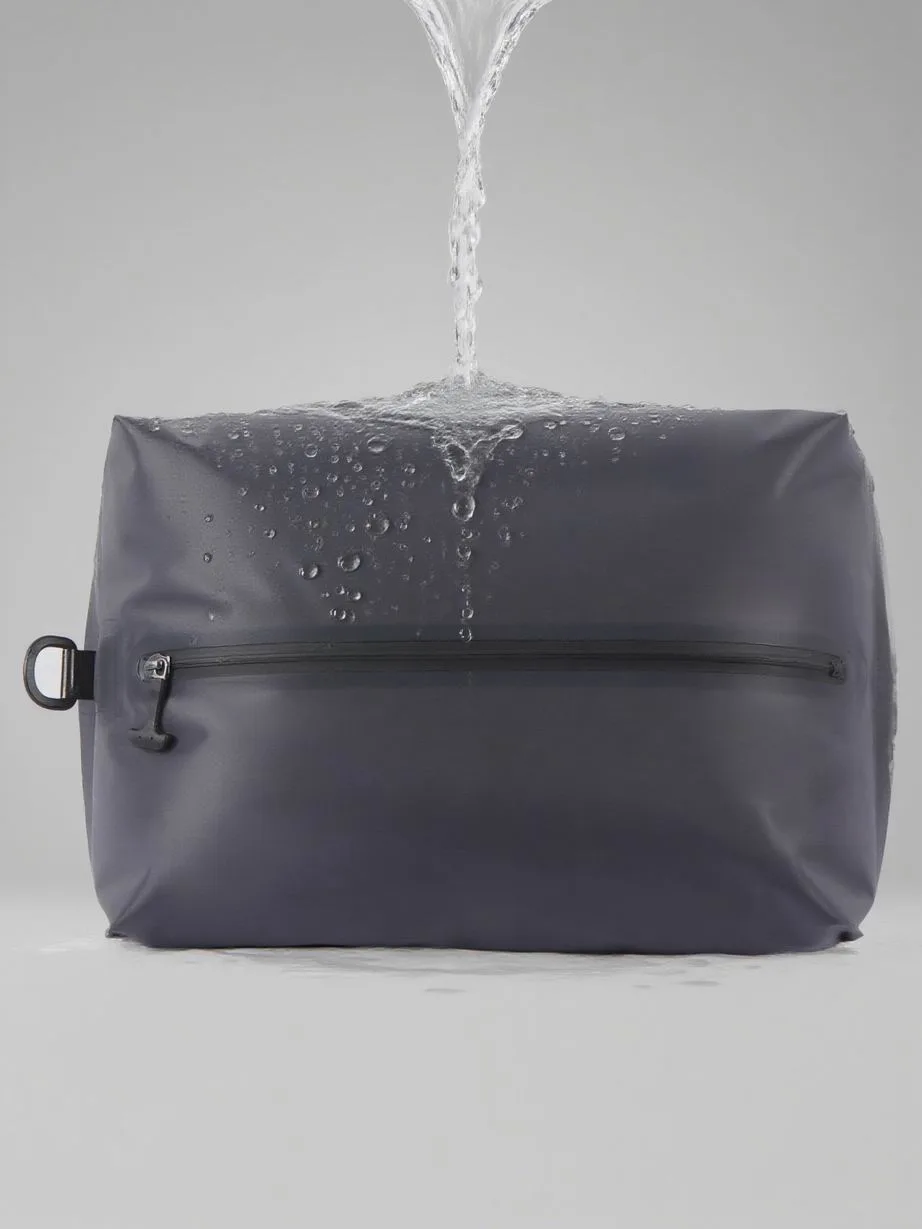
Compression is the cheapest litre you will ever gain. A summer synthetic bag rolled into a 6 litre stuff sack instead of being loosely stuffed takes 6.4 litres down to about 4.6 litres, a 28% saving, and down jackets compress further still. The rule is to compress against the base of the dry bag, never against the closing zone: a hard compressed lump pressed into the fold line prevents the film from making full contact and turns a watertight roll into a capillary path.
A dry bag with a purge valve lets you remove the last of the air after closing, which gains another 8% to 15% and makes a soft load sit flat instead of ballooning. Work through the valve before the final fold rather than after, and never use a vacuum pump on a film lighter than 0.4 mm. Our compression capacity guide covers how much of the saving survives a night of use, because loft recovers and a bag that was 4.6 litres on Friday morning may be 6 litres by Saturday.
Clothing volume by fabric and season
Fabric choice changes packed volume more than most people expect. A 300 g down jacket with 650 fill power packs to about 1.4 litres, while a fleece of similar warmth occupies 3.2 litres and weighs 480 g. Synthetic mid layers sit between the two at roughly 2.4 litres for a 360 g garment. If your two-day clothing plan is consistently 1 litre over budget, swapping one fleece for a down or synthetic fill piece is usually a faster fix than buying a bigger bag.
For a two-day trip the clothing plan is narrow: what you wear, plus one spare base layer, one insulating layer and a shell. Two spare base layers is the point where a 20L stops working. Merino blends earn their place here because a 200 gsm top worn for two days resists odour better than a synthetic equivalent and packs to roughly the same 1.8 litres, which removes the temptation to carry a third top that will never be used.
| Garment | Fabric | Packed volume | Weight | Note for a 20L load |
|---|---|---|---|---|
| Base layer top | Merino 200 gsm | 1.8 L | 320 g | Best warmth per litre |
| Base layer top | Polyester 140 gsm | 1.5 L | 190 g | Lightest option |
| Mid layer | Down 650 fill | 1.4 L | 300 g | Compresses hardest |
| Mid layer | Fleece 200 gsm | 3.2 L | 480 g | Bulky, avoid in 20L |
| Mid layer | Synthetic 60 gsm | 2.4 L | 360 g | Works when damp |
| Rain shell | 2.5 layer laminate | 1.4 L | 280 g | Keep at the mouth |
| Sleep socks and hat | Mixed knit | 0.6 L | 140 g | Fill gaps at the base |
Food, water and cooking inside three litres
Six meals for two days is roughly 5,200 kcal, which decants into 1.8 to 2.4 litres at a realistic 0.55 litres per 1,000 kcal for dried meals, bars, nuts and coffee. Add a 100 g gas canister and a 550 ml pot and the cooking block is about 1.1 litres and 520 g. Cold soaking removes that block entirely and returns a litre to the load, which is often the difference between a 20L that closes and one that does not.
Water is the flexible part of the plan and it should sit outside the dry bag. Carry 1.5 to 2 litres in a bottle or bladder lashed on the outside, and treat on the move rather than carrying 4 litres from the start. Keep every food item sealed in its own pouch: a dry bag has no internal cavities, so one leak wets the whole load within minutes. When you plan menus, remember that the CDC publishes food and water guidance for backcountry travel that is worth following for anything left at ambient temperature for a full day.
Sleep system and shelter items that fit
The sleep system is the biggest single block and the one that decides whether 20 litres works. A summer bag rated to 10 °C comfort compresses to 5.5 to 7 litres; a three-season bag rated near 0 °C rarely compresses below 9 litres with a standard stuff sack and 7.5 litres with a compression sack. A closed-cell mat rolled to 40 cm diameter takes about 2.1 litres, while an inflatable pad in its own sack is closer to 1.3 litres but punctures more easily inside a shared bag.
Shelter is where a 20L reaches its limit. A one-person tent is a 4 to 6 litre block that will not fit alongside a full sleep system, so a two-day trip in a 20L dry bag is realistically a bivvy or tarp trip, or a trip with a hut or bothy booked. If a tent is non-negotiable, split the load: sleep system in the 20L, tent and poles strapped outside in a separate welded sack, or step up one size. Everything in our roll-top range shares closure geometry precisely so that a two-bag split still behaves like one system.
Electronics, documents and the inner sealed layer
Electronics belong in a second, smaller sealed layer inside the main bag. A 2L roll-top holding a phone, a 10,000 mAh power bank, two cables and a head torch weighs about 640 g and adds redundancy: if the outer closure ever fails, the critical items have their own independent seal. Passport, cards and a paper map go in the same pouch, flat, against the body of the bag rather than at the mouth where they would bend with every fold.
Condensation is the quiet risk in a sealed load. A bag closed warm at 24 °C and carried into a 9 °C evening will drop moisture on the coolest surface, which is usually the inside of the film. Two 5 g silica sachets in the electronics pouch cost nothing and absorb that moisture before it reaches a circuit board. Keep electronics in the upper middle zone, never at the base where any water that does enter will collect under gravity.
Weight, balance and how a 20L load carries
A full two-day 20L load weighs 6.5 to 8 kg including food and water, which is light enough to carry by the top handle for short distances and heavy enough that a shoulder strap matters beyond 400 m. Carrying comfort is a geometry problem: a tall narrow 20L with the mass high pulls the shoulder backwards, while a squatter body with the same volume keeps the centre of mass close to the spine and feels roughly a kilogram lighter over two hours.
If the bag has a harness, set the load before you set the straps. Push the sleep system down and forward so it sits against the lower back, then tighten the shoulder straps until the bag stops swinging, and only then close the sternum strap. Over-tightening the shoulder straps to stop swing is the usual mistake and it puts all 7 kg on the trapezius. The alternative for a two-day trip is a TPU waterproof backpack, which spreads the same load across a padded harness when the walk-in is longer than an hour.
What changes when the bag goes in the water
A 20L bag packed to 14 litres with most of the air removed has roughly 6 litres of residual air, which gives about 6 kg of buoyancy in fresh water. That is enough to float the bag but not enough to float a person, and it is not a substitute for a buoyancy aid. The practical value of trapped air is different: it keeps the bag on the surface after a capsize so you can recover it, provided it is tethered to the boat or the pack frame within 1.5 m.
After a full immersion, resist the urge to open the bag immediately. Dry the outside, wipe the closure line, and open it only when you are somewhere you can lay the contents out, because grit on wet hands is how sand gets inside a fold. If the bag was submerged in salt water, plan a full rinse the same evening; salt crystals left in the fold abrade the film with every subsequent roll. The closure geometry guide explains why three clean folds survive a dunking when two do not.
Repacking on the morning of day two
Day two starts with a load that is 5% to 10% bulkier than day one. Loft recovers in a compressed bag overnight, food pouches are half empty but still the same shape, and anything that got damp will not compress as tightly. Plan for that by leaving 1 to 1.5 litres of slack on the first morning rather than packing to the limit, otherwise the second close will be a fight and a forced fold is a leaking fold.
Damp items need a decision, not a compromise. A wet shell goes on the outside of the pack or strapped under a lid, never inside with the sleep system, because a roll-top bag has no drainage and no breathable panel. Any item that is merely cool and damp from condensation can go back in once it has been wiped. Re-close with the same discipline as day one: three folds, air pressed out first, thumb run along the fold line to check for grit before the buckle goes on.
Mistakes that cost space or cause leaks
Most 20L packing failures fall into four patterns: planning against the shell volume rather than the working volume, compressing against the closing zone, packing food retail packaging, and over-filling on day one so day two cannot close. Each one is avoidable with a scale and five minutes on a bench before the trip. The list below covers the same ground as a checklist you can run in the hallway the night before.
- Measuring the kit but not weighing it: 20 litres of clothing is 3 kg, 20 litres of food and fuel is closer to 9 kg.
- Putting the electronics pouch at the mouth, where a single imperfect fold puts it in the water first.
- Packing a stove with a sharp pot rim against a 0.5 mm film with no cloth between them.
- Leaving retail cardboard in the load, which adds 0.6 litres and abrades the inner film on every step.
- Closing with two folds to gain half a litre, which removes one of the three water barriers.
- Storing the bag rolled tight for months, then expecting the fold line to lie flat on the first trip of the season.
- Forgetting that a full 2 litre water bottle inside the bag is 2 litres of volume and 2 kg of mass.
One more failure is worth naming because it is expensive: carrying a bag that is too small and solving the problem by strapping gear outside it. An external water bottle or a wet shell is fine; an external sleeping bag in a light drizzle is not, and it also shifts the centre of mass away from your back. If the checklist says you are consistently 2 litres over, the answer is a bigger bag, not more lashing. Compare the options in the 20L capacity breakdown before you decide.
Checklist and when to step up to 30L
Run this checklist with the bag empty and the kit on the floor. Weigh the full load, add the volume of every item, compare the total against 14 litres rather than 20, and confirm that the heaviest single block is the sleep system at the base. If any single item exceeds the internal diameter of the bag, no amount of packing technique will make it fit, and that is a sizing problem, not a packing one.
- Total packed volume at or below 14 litres, not 20.
- Total packed weight at or below 8 kg including food and water.
- Sleep system compressed at the base, closing zone left flat and soft.
- Electronics and documents inside a second sealed pouch in the upper middle.
- Rain shell and one snack within reach of the mouth.
- Three full folds achievable with the bag on the ground, not only on a bench.
- Water carried outside the bag, food double-sealed inside it.
Step up to 30L when two of these are true: your compressed sleep system exceeds 8 litres, you are carrying a tent, or the trip runs into a third day. Step down to 15L when the whole list fits in 10 litres with room to spare, because a half-empty 20L slumps, rolls on a deck and wastes a kilogram of carried fabric. For clubs, rental fleets and retail ranges the same maths becomes a specification line, and that is where the production side matters: bags in this range have been produced since 2014 in an SGS-verified 4,950 m2 facility with a 500-piece minimum and sampling in 6 to 10 working days. We document the full process from sampling to bulk, and the sizing detail behind every figure here is collected in the complete capacity guide. Weather planning for a two-day window is the last variable; check the forecast through NOAA before you commit to a lightweight kit.
Frequently asked questions
Q1. Can you pack two days of gear in a 20L dry bag?
Yes, for a summer or warm-weather trip. Plan against 14 litres of working space, not the 20 litre shell figure, and keep the total load between 6.5 and 8 kg. A three-season sleep system pushes the load past 17 litres and needs a 30L.
Q2. How many litres does a 20L dry bag actually hold?
About 16.5 to 17.5 litres below three folds, and roughly 14 litres once you leave the 15% headroom needed to align the mouth and close cleanly. That gap is why a 20L feels smaller than the label.
Q3. What should go at the bottom of a 20L dry bag?
The compressed sleep system and the rolled mat. They fill the corners, create a stable base for the food block above them, and they are the items you only unpack once per day.
Q4. What belongs nearest the roll-top mouth?
The rain shell and one snack, because they are needed at any stop. Never put electronics there: whatever sits closest to the closure is the first thing to get wet if a fold is imperfect.
Q5. How heavy is a packed 20L dry bag for two days?
Typically 6.5 to 8 kg including food and 1.5 litres of water carried outside the bag. Clothing alone is around 3 kg; food and cooking add roughly 1.9 kg.
Q6. Should I use a compression sack inside a 20L dry bag?
Yes, for the sleeping bag. A summer bag drops from 6.4 litres to about 4.6 litres in a compression sack. Compress against the base only, and keep the compressed lump away from the closing zone.
Q7. Does a purge valve help when packing a 20L bag?
It does. Removing air after closing gains another 8% to 15% and makes a soft load sit flat instead of ballooning. Use it before the final fold, and never with a vacuum pump on film thinner than 0.4 mm.
Q8. Can I fit a tent and a sleeping bag in a 20L dry bag?
Rarely. A one-person tent is a 4 to 6 litre block and a summer bag is another 6 litres, which leaves nothing for clothing or food. Use a bivvy or tarp, or split the tent into a second welded sack.
Q9. How much food fits for two days?
Six meals at about 5,200 kcal decant into 1.8 to 2.4 litres once removed from retail packaging. Add 1.1 litres and 520 g if you carry a stove, pot and a 100 g gas canister.
Q10. Where should water go when packing a 20L bag?
Outside. A 2 litre bottle is 2 litres of volume and 2 kg of mass, and a leak inside a sealed bag wets everything. Carry 1.5 to 2 litres externally and treat water on the move.
Q11. How do I stop a 20L load from rolling on a deck?
Put the densest items low, keep the centre of mass central, and lash the bag at two points rather than one. A squat body with the same volume resists rolling far better than a tall narrow one.
Q12. Will a packed 20L dry bag float?
It will float if air remains inside: 6 litres of trapped air gives roughly 6 kg of buoyancy in fresh water. That floats the bag, not a person, and it is not a buoyancy aid.
Q13. What do I do if the bag gets fully submerged?
Dry the outside, wipe the closure line, and open it only where you can lay the contents out. Grit on wet hands is how sand gets into a fold. Rinse the same day if the water was salt.
Q14. Why does the bag not close on the second day?
Loft recovers in a compressed bag overnight and damp clothing will not compress. Leave 1 to 1.5 litres of slack on day one so the second morning still has room for three clean folds.
Q15. Is a 20L dry bag too small for a two-day winter trip?
Yes in most cases. A 0 °C bag is around 9 litres, winter clothing adds another 5.2 litres, and the total lands near 17 litres. A 30L or 40L is the honest choice below 5 °C.
Q16. How many folds should I use when closing a packed 20L bag?
Three. Each fold is a separate water barrier. Two folds may gain half a litre but removes one barrier, and a forced fourth fold over a full load stiffens the film at the crease.
People also ask
How do you pack a dry bag for a two-day trip?
Push the compressed sleep system into the base, add food and cooking in the middle, spare clothing above that, and keep the rain shell at the mouth. Press air out, then close with three folds and a tight buckle.
What size dry bag do I need for two days?
A 20L works for a warm-weather two-day trip at about 14 litres of working space. Move to 30L if your sleep system exceeds 8 litres, if you carry a tent, or if night temperatures drop below 5 °C.
Are 20 litre dry bags big enough for camping?
They are big enough for a bivvy or tarp camp with a summer bag, clothing and food. They are not big enough for a one-person tent alongside a full sleep system.
How much weight can a 20L dry bag hold?
The film and welds easily handle 8 kg; the practical limit is your shoulders and the carry system rather than the bag. Above 8 kg a harness or a backpack format is more comfortable than a top handle.
Why does my dry bag feel smaller than the stated size?
Because the label is shell volume. Three folds remove 2.5 to 3.5 litres on a 20L, and another 15% has to stay empty so the mouth can align and close without forcing the film.
Can you compress clothes inside a dry bag?
Yes, and it is the cheapest litre you gain. A compression sack takes a summer bag from 6.4 litres to about 4.6 litres. Compress at the base only and keep the closing zone flat.
Need this in production volume?
QUANZHOU JUNYUAN BAGS has produced waterproof bags since 2014 in an SGS-verified 4,950 m2 facility in Fujian, China. Minimum order 500 pieces, sampling in 6–10 working days, bulk in 35–50 days, FOB Xiamen — write to service@junyuanbags.com with your spec and target market.