TPU Dry Bags for Packrafting: Durability Notes
Packrafting punishes dry bags in three specific ways: 8 to 15 km portages where the bag is worn against your back through willow and rock, compression straps pulling 25 mm webbing across the film at four points for ten hours a day, and ice water between 4 and 12 °C that stiffens every closure you roll. A 420D face fabric with a 0.5 mm TPU laminate survives that combination for three to five seasons; a 0.3 mm bag typically shows frosted contact patches and a measurable loss of thickness within one.
This guide is written for people who paddle whitewater up to class III, hike their boat over passes, and expect their kit to work on day nine without attention. It covers what actually fails, the numbers behind film choice and weld quality, how to distribute strap load so nothing tears, how the film behaves below 10 °C, and the field repair method that holds until you are back at a road. Everything is measurable: grams per litre, newtons across a weld, and abrasion numbers by ASTM test method.
- Why packrafting is harder on bags than any other paddle sport
- Film thickness and face fabric: the decision that sets service life
- Where bags physically fail on a packraft
- Reading a weld before you trust it
- Straps, lash points and distributing load
- Closure life under daily rolling
- Cold behaviour: alpine water and frozen mornings
- Weight budget: grams per litre and what to drop
- Field repair that holds until you reach a road
- Protecting bags from the boat itself
- Durability test routine between trips
- Checklist for a packraft-proof bag specification
Why packrafting is harder on bags than any other paddle sport
Other paddling disciplines give a bag one dominant stress. Sea kayaking gives gentle UV and salt; whitewater rafting gives impact and strap load but usually no carrying; canoe tripping gives long-term abrasion from portage yokes and thwarts. Packrafting gives all of it in one trip, and adds two nobody else deals with: the bag is squeezed against the inflated hull under strap tension, and it is walked out of remote country while carrying the food for nine days.
The combination changes what fails first. On most trips the closure survives and the body of the bag does not, because abrasion and strap pressure attack mid-panel areas that never see sun. A bag can come off the water looking intact and still have lost 0.1 mm of film across a palm-sized contact patch, enough to halve its remaining tear strength at exactly the point where it will next be loaded.
Film thickness and face fabric: the decision that sets service life
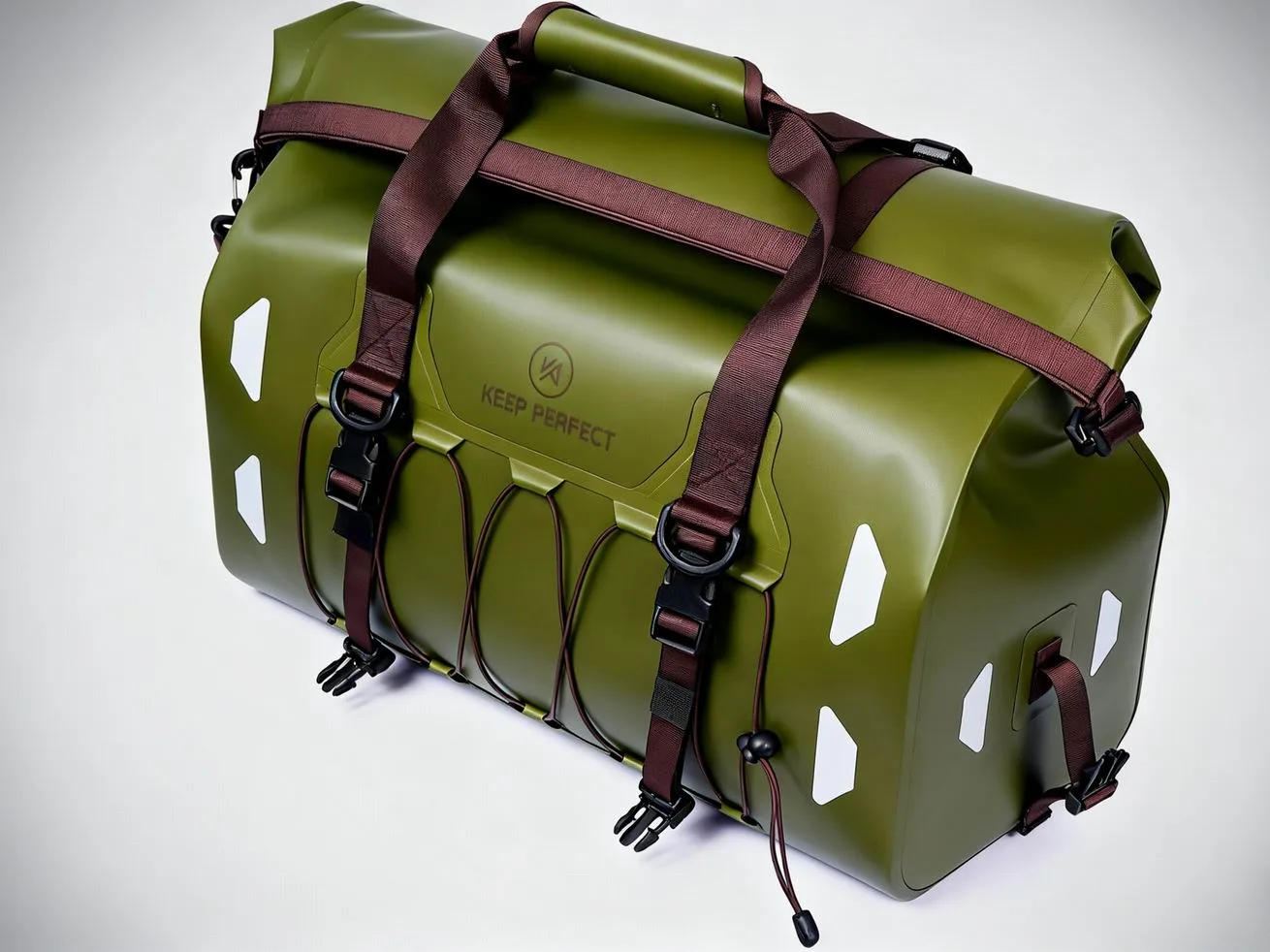
Film thickness is worth more than any other single specification for packrafting. It sets puncture resistance, governs how much material can be lost to abrasion before failure, and determines whether a bag remains flexible at 5 °C. The face fabric matters second, because it protects the film from sharp edges and spreads point loads, but a heavy face on thin film is still thin film underneath.
| Construction | Weight per square metre | Abrasion cycles to visible wear | Flexibility at 5 °C | Realistic life |
|---|---|---|---|---|
| 210D face, 0.3 mm TPU | 255 g | 3,000-4,000 | Good | 1 season of heavy use |
| 420D face, 0.4 mm TPU | 390 g | 6,000-8,000 | Good | 2 to 3 seasons |
| 420D face, 0.5 mm TPU | 480 g | 10,000-14,000 | Very good | 4 to 5 seasons |
| 500D face, 0.5 mm TPU | 540 g | 12,000-16,000 | Good | 4 to 5 seasons |
| PVC coated 500D | 620 g | 5,000-7,000 | Stiff below 10 °C | 3 seasons, then cracking |
Those abrasion figures come from Taber-type tester runs using standard wheels, which is why they are useful for comparison rather than for absolute prediction. Field reality adds variables the tester cannot reproduce: river silt acting as a lapping compound, and grit trapped between bag and hull under strap tension. Multiply lab numbers by about a third when converting to real portage miles.
Hydrolysis resistance is the quieter requirement. Polyester-based TPU is cheaper and slightly stiffer, but loses integrity faster under long warm-wet exposure; polyether-based grades cost more and hold up through repeated multi-day trips followed by damp storage. If you paddle every weekend from April to October, the grade difference is worth more than 60 g of weight.

Where bags physically fail on a packraft
Three locations account for most field failures, and none of them is random. The first is the contact patch where the bag rests against the bow or the side tube under compression strap load. The second is the fold line where the roll-top is creased thousands of times, especially if it is always creased in exactly the same place. The third is at the base of any welded D-ring or daisy chain, where strap tension concentrates into a small area of film.
Learn to identify the early signs. A contact patch that has gone from matte to glossy has had its surface texture polished away, which typically means 0.05 to 0.1 mm of material is gone. A fold line that has turned pale and shows fine parallel lines is about to crack, and that usually happens at the corners where three layers meet rather than along the flat run. Both are repairable if you catch them before water appears.
| Failure location | Warning sign | Typical trigger | Fix |
|---|---|---|---|
| Bow contact patch | Glossy polish, then fuzz | Strap compression plus silt | Rotate strap position, patch if thin |
| Roll-top fold line | Pale crease with fine lines | Always rolling at the same height | Vary roll height, soften folds |
| D-ring base | Webbing lifts at one corner | Shock load in class III | Re-weld or retire to non-load use |
| Side panel at stern tube | Crescent-shaped scuff | Bag shifting during eddy turns | Add a friction pad |
| Bottom corners | Grey fretting of the face fabric | Being walked on a rocky takeout | Use a sacrificial ground mat |
Reading a weld before you trust it
Radio-frequency welding fuses TPU films into a single mass, so a good weld should have no visible boundary between the layers. Run your fingernail along it: a quality weld feels like a smooth transition with a slight ridge, while a poor weld feels like a hard step, because it has only partially melted the films together. Peel strength target should be above 25 N per 25 mm width, and failure should occur in the film rather than at the interface.
Ask how the seams are tested, since spot checks matter more than averages. Standard textile methods published by the ISO and abrasion methods from ASTM give comparable numbers between bag makers, and a credible specification quotes a method rather than a feeling. We cover this comparison in more detail in welded versus stitched seam notes for anyone specifying their own kit.
Straps, lash points and distributing load
Packrafts offer no hard attachment points in the traditional sense, so every bag load transfers into the lash points on the hull and from there into the tube itself. Spread that load. A compression strap tightened across a single point concentrates perhaps 300 N into a contact patch the size of a thumb; the same strap routed through two daisy-chain loops spreads it over four times the area and stops the bag rotating in an eddy turn.
Use 25 mm webbing rather than thinner cord anywhere there is strap tension, because narrow cord concentrates force and slowly cuts into film at the contact point. Tension should be firm rather than maximum: you want the bag to be unable to shift more than 10 mm, and nothing more. Over-tensioning adds nothing to security and measurably accelerates loss of film.
Closure life under daily rolling
A roll-top closure is the most-used moving part on the bag and the least discussed. On a nine-day trip rolled twice daily, that is 18 cycles per trip and roughly 200 cycles per season for a regular paddler. Well-designed closures with a reinforced mouth survive 2,000 cycles or more before the fold line starts to fatigue, and part of reaching that number comes down to how you treat the film.
Vary where you roll. Always folding at the same height creates one stressed line rather than distributing creasing over 40 mm of fabric, and unrolling gently rather than tearing it open prevents the small tears that start at the fold corners. If the bag has been stored rolled for six months, soften it in warm hands before the first trip of the season rather than forcing it.
Cold behaviour: alpine water and frozen mornings
Cold separates good film from mediocre film faster than anything else. Quality TPU stays workable well below freezing, with cold-crack temperatures typically below minus 30 °C for a packrafting grade, whereas PVC visibly stiffens near 0 °C and can crack along a fold at around minus 10 °C. In practice the difference is felt in your hands at 6 °C rather than measured in a lab: good film still rolls into a tight three-fold with cold fingers.
Ice adds a second hazard. If a closure has any moisture in it overnight at minus 5 °C, it can freeze shut, and the instinct to force it open is exactly what tears film. Warm the roll in your jacket for five minutes, or pour ambient water from a bottle over it rather than hot water, which can exceed 45 °C and damage the weld interface. Background figures are in our cold-crack temperature guide.
Weight budget: grams per litre and what to drop
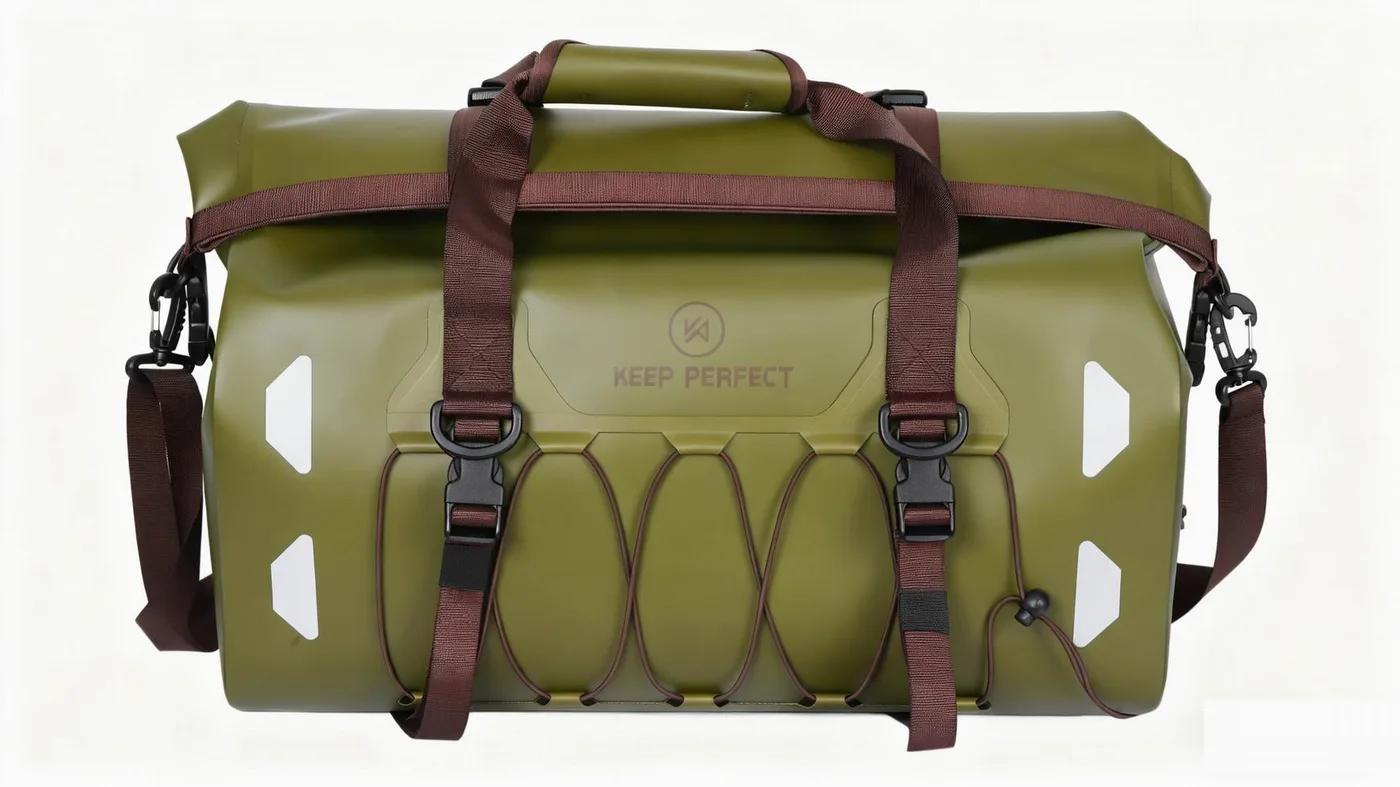
Every portage is a negotiation between durability and grams, and packrafting makes both worse by putting the bag on your back for hours. A 0.5 mm construction adds roughly 90 g to a 20L bag compared with 0.3 mm, which is about 4.5 grams per litre. For most paddlers that trade is worth taking on the load-bearing bags and skipping on internal organisers that never touch anything.
| Component | Volume | Mass with 0.5 mm film | Mass with 0.3 mm film | Recommendation |
|---|---|---|---|---|
| Main gear bag | 40 L | 640 g | 520 g | Thick film, it rides the hull |
| Clothing bag | 20 L | 410 g | 320 g | Thick film, take a small saving |
| Internal organiser | 5 L | 150 g | 120 g | Thin film, no contact risk |
| Food bag | 15 L | 340 g | 270 g | Thick film for food security |
| Repair kit pouch | 1 L | 90 g | 80 g | Either, but keep it accessible |
Notice that the total difference between a fully thick-film setup and a mixed one is about 200 g, roughly the weight of a lightweight camp shoe. Choosing thin film to save that much while carrying nine days of food is a poor trade. Spend weight savings elsewhere, usually on duplicate clothing, and keep the weight where protection matters.
Field repair that holds until you reach a road
- Dry the area completely and wipe it with an alcohol swab; nothing bonds to damp TPU.
- Round the corners of the patch with scissors so it cannot lift from a sharp edge.
- Apply urethane-based adhesive to both surfaces, wait until it is tacky, then press firmly from the centre outwards.
- Roll the repair with a hard object for two minutes to remove air and increase contact.
- Leave it to cure for at least 12 hours, ideally 24, before putting it under load or in water.
Patches fail for predictable reasons, almost all of them preparation. Adhesive needs a dry, clean surface and temperature above 10 °C to cure properly, which is hard to arrange at a rainy put-in with cold fingers. Carry a small square of closed-cell foam to use as a pressure pad, keep everything in a sealed pouch, and read our dedicated guide to building a patch kit for TPU bags before a remote trip.
Seam failures are the exception to self-repair. A corner weld that has started to peel can be stabilised with tape for the rest of the day, but it will not survive a multi-day trip and should be considered retired from load-bearing duty. Relying on it after two temporary fixes is how people lose dry clothing on day six.
Protecting bags from the boat itself
A loaded packraft puts bags into contact with a TPU hull under constant tension, and two smooth TPU surfaces rubbing together with silt between them behave like a lapping process. Insert something sacrificial between them: a cut section of thin foam pad, an old thermal top, or even a folded dry bag liner that is already retired. That layer costs 80 g and takes most of the wear.
Portages deserve separate treatment, because this is where the bag is genuinely mistreated rather than just loaded. Put the loaded bags down on something, never directly on granite or basalt; use a strap configuration that lets you carry them without them dragging on rock behind you; and keep sharp items such as stove legs and tent poles inside a padded sleeve so they cannot work through the film from inside.

Durability test routine between trips
- Inspect every contact patch in raking light and mark anything glossy or fuzzy with chalk.
- Check strap bases and D-rings for lifting, working around each fitting with a thumb.
- Air-test each bag by inflating it, squeezing for ten seconds, and listening for a hiss.
- Roll and unroll each closure five times and feel for stiffness or fine cracking at the crease.
- Weigh the bags; a sudden drop of more than 8 g on a 20L bag suggests lost material.
That routine takes 12 minutes and is best done the day after you get home, while you still remember where each bag sat. Keep notes in a simple log rather than relying on memory, because the useful signal is a change between two consecutive inspections rather than any single reading. Anything that looks like it will fail next trip gets repaired now, in a warm room, rather than at a put-in.
Act on trends rather than single readings. A bag that has lost 5 g between two consecutive inspections is telling you where something is rubbing, and moving that strap by 30 mm often stops the loss entirely. Keeping this log also makes the end-of-season decision easy, since you will know which bags are worn out rather than guessing.
Checklist for a packraft-proof bag specification
- Film thickness of 0.5 mm on every bag that touches the hull or the ground.
- 420D or 500D face fabric for the main loads, 210D only for internal organisers.
- Polyether-based TPU where the bag is used every weekend across a full season.
- Weld peel strength above 25 N per 25 mm, with a method named rather than implied.
- 25 mm webbing at every lash point, routed through two loops to spread load.
- Straps tensioned so two fingers still slide between strap and bag.
- A field patch kit carried on the boat, not in the bag that might be lost.
Those seven lines are also a workable brief if you are developing bags for a paddling range or specifying kit for an expedition operator: film thickness, face fabric, polymer grade, documented test method, hardware width, tension guidance and repairability. Our team has produced waterproof bags since 2014 in an SGS-verified 4,950 m2 production facility with a 500-piece minimum, sampling in 6 to 10 working days and bulk in 35 to 50 days.
Two further reads finish the picture. The laboratory side is covered in detail by puncture resistance testing, while the everyday trade-offs between constructions sit in 0.3 mm versus 0.5 mm film. If you want confirmed field numbers, start with abrasion resistance data, compare formats in the roll-top dry bag range, or browse the full product line with these specifications in hand.
Frequently asked questions
Q1. What thickness of TPU dry bag should I use for packrafting?
Use 0.5 mm for anything strapped to the boat or carried over rock, since it typically withstands 10,000 to 14,000 abrasion cycles versus 3,000 to 4,000 for 0.3 mm. Thin film is acceptable for internal organisers that never touch the hull.
Q2. Do dry bags really need to be 0.5 mm rather than 0.4 mm?
For packrafting, yes. The jump from 0.4 mm to 0.5 mm roughly doubles the cycles to visible wear and adds about 90 g to a 20L bag, which is 4.5 grams per litre for significantly longer service life.
Q3. Where do TPU bags fail first on a packraft?
At the contact patch where the hull presses against the bag under strap tension, followed by the fold line if the closure is always rolled at the same height, then at the base of welded D-rings after shock loads in rapids.
Q4. How can I tell if a weld is good quality?
Run a fingernail along it: a good RF weld is a smooth transition with a slight ridge, while a poor one feels like a hard step. Peel strength should exceed 25 N per 25 mm and failure should occur in the film, not at the interface.
Q5. Will TPU stay flexible in alpine water?
Good packrafting-grade TPU stays workable well below freezing, with cold-crack temperatures below minus 30 °C. PVC stiffens noticeably near 0 °C and can crack along a fold at about minus 10 °C, which is why it is avoided for cold trips.
Q6. What happens if my closure freezes shut overnight?
Do not force it, because that tears the film. Warm it inside your jacket for five minutes or pour ambient water from a bottle over the roll; never use water hotter than 45 °C, which stresses the weld interface.
Q7. How much does a thick-film setup actually weigh?
A 0.5 mm configuration for a nine-day trip totals around 1,630 g across five bags, roughly 200 g more than a fully thin-film setup. That is easily recovered elsewhere and buys several seasons of additional service life.
Q8. Should my dry bags rest directly on the packraft hull?
No. Two smooth TPU surfaces under strap tension with silt between them act like a lapping process. Insert a sacrificial layer such as thin closed-cell foam, costing around 80 g, and let that take the abrasion instead.
Q9. How tight should compression straps be?
Tight enough that the bag cannot shift more than about 10 mm, and loose enough that two fingers still slide between strap and bag. Over-tensioned straps polish through the film within roughly 40 hours of paddling.
Q10. Can I repair a punctured TPU bag on the water?
You can stabilise it with tape for the rest of the day, but a durable repair needs a dry surface, temperatures above 10 °C and 12 to 24 hours of cure. Plan on reaching camp before doing the real repair.
Q11. What webbing width should I use at lash points?
Use 25 mm webbing rather than narrow cord, since cord concentrates force and slowly cuts into film. Route each strap through two daisy-chain loops so the load spreads over four times the contact area.
Q12. How many roll-top closure cycles can I expect?
A reinforced closure commonly reaches 2,000 cycles or more before the fold line fatigues, which is roughly ten seasons at 200 cycles per year. Varying the roll height and unrolling gently each time significantly extends that figure.
Q13. Does polythene or polyether TPU matter for packrafting?
Polyether-based film matters. Polyester-based TPU costs less but loses integrity faster under repeated long warm-wet exposure, so regular paddlers who store bags damp after trips gain more from the grade than they lose in weight.
Q14. How can I check whether my bag has lost film thickness?
Inspect the contact patch in raking light: going from matte to glossy usually means 0.05 to 0.1 mm is gone. Weighing also helps, since an unexplained drop of more than 8 g on a 20L bag suggests lost material.
Q15. Is it safe to put sharp items like tent poles inside a dry bag?
Only inside a padded sleeve. Stove legs and pole tips work through film from the inside during portages, and that damage is often invisible until water appears on day five of a trip.
Q16. Should I carry one big bag or several mid-size bags on a packraft?
Several. Two or three mid-size bags spread the load better across the hull, let you rotate strap positions so no single patch takes all the wear, and give redundancy if one closure is compromised during a swim.
People also ask
How durable are TPU dry bags for packrafting?
Very durable if built for it. A 420D face with 0.5 mm polyether-based TPU typically lasts four to five seasons of class II to III paddling and portaging, while 0.3 mm constructions usually frost and thin within one heavy season.
Why does my dry bag look polished and shiny after a trip?
Because the contact patch has been abraded against the hull or the ground under strap tension. A glossy surface means the matte texture is gone, usually indicating 0.05 to 0.1 mm of film has already been lost.
What repairs can I do in the field on a TPU bag?
Given a dry surface and time, you can patch punctures with urethane-based adhesive given a dry surface, warmth above 10 °C and 12 to 24 hours of cure. Peeling seam welds are the exception, and those bags retire from load duties.
How cold can TPU get before it cracks?
Packrafting-grade TPU commonly has cold-crack temperatures below minus 30 °C, well past anything you will paddle in. The practical limit is your hands, since film becomes harder to roll into a tight fold once fingers are numb.
Do I need to reinforce dry bag straps for packrafting?
You need to widen them rather than reinforce them. 25 mm webbing routed through two loops spreads a 300 N load over four times the contact area of cord, which is what prevents the fitting tearing out in class III.
How do I clean off river silt before it damages the bag?
Rinse within an hour of the takeout using ambient water, paying particular attention to the closure and buckle channels where silt packs and raises release force past 60 N. Then dry open and store loosely rolled.
Need this in production volume?
QUANZHOU JUNYUAN BAGS has produced waterproof bags since 2014 in an SGS-verified 4,950 m2 facility in Fujian, China. Minimum order 500 pieces, sampling in 6–10 working days, bulk in 35–50 days, FOB Xiamen — write to service@junyuanbags.com with your spec and target market.