Home / Blog / Sustainability & Compliance
PVC-Free Dry Bag Alternatives
There are three working PVC-free routes for a waterproof bag shell, and they are not equivalent. TPU laminated at 0.3 to 0.5 mm is the direct substitute, costing 20 to 40 percent more per square metre than PVC while cutting shell mass by 12 to 20 percent and staying flexible down to minus 30 degrees Celsius. TPE and polyolefin films cost 5 to 15 percent more than PVC and weld well, but they crease more readily at a roll-top. Wax or silicone finishes are cheap and light and will not survive immersion at all.
The decision is rarely just environmental. A PVC-free specification changes the welding parameters, the cold-weather folding behaviour, the service life and the end-of-life options, and each of those shows up as a number on a spec sheet. This guide sets out what PVC actually does in a laminate, what replaces it, where the substitutes genuinely underperform, and the documentation needed to make a PVC-free claim that survives an audit rather than a conversation.
- What PVC actually contributes to a waterproof laminate
- The three PVC-free routes, and what each is built from
- Thermoplastic polyurethane as the direct substitute
- TPE and polyolefin films: cheaper, with a crease penalty
- Silicone and wax finishes: water resistance without a film
- PVC-free does not automatically mean safer chemistry
- Coated versus laminated: the process matters as much as the polymer
- Performance numbers side by side
- End of life: what each material can realistically become
- Cost and minimum order realities for a PVC-free programme
- Documentation that turns a claim into evidence
- Where each PVC-free option wins and loses
- Writing a PVC-free requirement into a brief
What PVC actually contributes to a waterproof laminate
Polyvinyl chloride is used on bags as a plastisol coating applied to a woven polyester base. The resin is cheap, it takes pigment easily, it has a wide processing window, and it is naturally flame resistant. Those four properties explain why it dominated the market for forty years. The coating is what makes the fabric impermeable; the base yarn underneath carries the tensile and tear load.
The difficulty is not the polymer backbone but what has to be added to make it flexible. Rigid PVC is brittle, so a bag coating carries 25 to 40 percent by weight of plasticiser, historically phthalate esters such as DEHP or DINP. Plasticiser is not chemically bound to the polymer, so it migrates to the surface over time, which is why a PVC bag stiffens, becomes tacky and develops a distinctive sweet smell as it ages.
End of life is the second problem. PVC releases hydrogen chloride when heated, so it cannot be melted down with mixed polyolefin streams without corroding the equipment and contaminating the output, and it is excluded from most mechanical recycling programmes. Chlorine content also complicates any thermal recovery route, which is why the material attracts scrutiny well beyond the bag category.
The three PVC-free routes, and what each is built from
A PVC-free shell is not a single product. It is one of three constructions, and they behave differently on a production line and in the field. TPU is a block copolymer of hard and soft segments, extruded or calendered into a film and laminated to the shell with heat and pressure. TPE and polyolefin films are blends, usually polyethylene or polypropylene based, chosen for low cost and good weldability. Finish-only treatments deposit silicone or wax on the face of a woven fabric without adding a film at all.
| Construction | Polymer basis | Typical gauge | Weldable | Immersion capable | Relative cost |
|---|---|---|---|---|---|
| TPU laminate | Polyurethane block copolymer | 0.30-0.50 mm | Yes, RF and hot air | Yes, IPX6-IPX7 | PVC +20 to +40% |
| TPE film laminate | Styrene block copolymer | 0.25-0.45 mm | Yes, hot wedge | Yes, IPX6 | PVC +5 to +15% |
| Polyolefin film | PE or PP based | 0.20-0.40 mm | Yes, hot wedge | Yes, IPX5-IPX6 | PVC +5 to +12% |
| Silicone finish | Siloxane emulsion on fabric | No film | No | Splash only | PVC -10 to -20% |
| Wax finish | Paraffin or beeswax blend | No film | No | Splash only | PVC -15 to -25% |
| PVC coated | PVC plus plasticiser | 0.35-0.55 mm | Yes, RF | Yes, IPX6-IPX7 | Baseline |
Read that table by the last two columns rather than the first. Only the film laminates are immersion capable, and only the film laminates can be welded into a seam that holds under pressure. A wax or silicone finish is a legitimate choice for a splash-proof tote or a pack cover, and it is the wrong choice for anything that may end up in the water.
Thermoplastic polyurethane as the direct substitute
TPU is the only PVC-free film that matches PVC across the full performance envelope, and in most respects it beats it. It needs no plasticiser, so it does not stiffen with age and does not develop the tacky surface film that PVC bags acquire after two or three seasons. It welds cleanly with radio-frequency energy because the polar urethane groups respond to the field, which gives fast, repeatable seams.
Cold behaviour is where the gap is widest. A PVC coating starts to stiffen noticeably around 0 degrees and can crack at the fold below minus 10; a polyether-based TPU stays flexible to about minus 30 and will still form a flat fold at minus 20. For anyone paddling, skiing or commuting in a cold climate this is a functional difference rather than a marketing one.
Abrasion and puncture resistance are also better per unit mass. A 0.4 mm TPU laminate typically outperforms a 0.5 mm PVC coating against a sharp point, which is why the lighter film does not translate into a weaker bag. The trade-off is cost and a slightly narrower processing window: TPU scorches if the weld dwell is too long, so the line has to be set up properly.
TPE and polyolefin films: cheaper, with a crease penalty
Thermoplastic elastomer and polyolefin films are the value tier of the PVC-free market. They cost 5 to 15 percent more than PVC rather than 20 to 40 percent, they weld well with a hot wedge, and they are chemically simple, which makes them straightforward to recycle where a polyolefin stream exists. For a flat-panel product such as a tote or a duffel body, they are a sound choice.
The penalty appears at the roll-top. Polyolefin films have a higher elastic memory than TPU, so a fold that has been rolled tight tends to spring back slightly rather than lying flat, and repeated rolling leaves a more persistent crease. In practical terms a polyolefin roll-top may need four folds where a TPU bag needs three, which costs 0.2 to 0.3 litres of usable volume on a mid-size bag.
They are also more prone to stress whitening at a sharp bend, which shows as a pale line along the fold after a season. It is cosmetic rather than structural, but on a retail product it reads as wear. If the bag is a flat-panel design that is not folded daily, neither issue arises and the cost saving is real.
Silicone and wax finishes: water resistance without a film
The third route removes the film entirely. A silicone emulsion or a wax blend is applied to the face of a woven shell, and water beads and runs off rather than being blocked by a membrane. The result is the lightest and cheapest option on the table, roughly 10 to 25 percent below PVC, and it packs down smaller than any laminate.
What it cannot do is hold water out under pressure. There is no continuous film, so a bag made this way is splash resistant and rain resistant and will wet through within minutes of immersion. It is also the only route that cannot be welded, because there is no thermoplastic layer to melt, so the seams have to be sewn and taped, which caps the achievable rating around IPX4.
That is not a criticism. A waxed or silicone-finished bag is a good pack cover, a good liner for dry food, and a good tote for a wet market. It is simply a different product category from a dry bag, and calling it PVC-free in the same breath as a TPU laminate hides a large performance gap. If the brief says immersion, this route is out.
PVC-free does not automatically mean safer chemistry
Removing chlorine removes one set of concerns and can introduce others, so the claim has to be tested rather than trusted. A TPU film is inherently plasticiser free, but the adhesive used to bond it to the yarn may contain solvents, the face fabric may carry a durable water repellent based on fluorinated chemistry, and the print may use a plastisol ink that is itself PVC based.
This is the most common failure we see in a PVC-free programme: the shell is compliant and the print on top of it is not. A plastisol print sits on the surface of a TPU bag and reintroduces exactly the material the brief excluded, at 15 to 40 grams per bag. Specify the ink system alongside the film, and ask for a declaration covering the assembled product rather than the roll of fabric.
Hardware is the second gap. A PVC-free shell with a buckle containing a restricted phthalate or a metal component with a non-compliant plating fails the same audit the fabric was bought to pass. The full route is covered in the notes on hardware compliance and in the PFAS-free fabric guide, which deals with the durable water repellent question specifically.
Coated versus laminated: the process matters as much as the polymer
Two bags can use the same polymer and perform differently because of how it was applied. A coating is spread onto the fabric as a liquid or paste and cured, so it sits largely on the surface and can flake or craze at a fold. A lamination bonds a pre-formed film to the fabric with heat and pressure, so the film keeps its full thickness and its mechanical properties are those of the film rather than of a dried paste.
For a roll-top, lamination is the better construction in almost every case. The fold line is the highest-stress area on the bag, and a coated surface that has been flexed 500 times will show crazing where a laminated film will not. The cost difference is modest, typically 3 to 8 percent per square metre, and it is worth paying on any bag that is folded daily.
There is one exception. On a very small bag, or on a panel that is never folded, a coating is perfectly adequate and slightly cheaper. If you are building a range, the sensible pattern is laminated film on the roll-top sizes and a coated shell on flat-panel accessories.
Performance numbers side by side
Specifications should be compared on measured properties rather than on material names. The figures below are typical ranges for mid-weight constructions at comparable gauge, and they are the numbers worth putting into a brief. Note that the PVC row wins on nothing except price, and that TPE loses ground mainly on crease recovery.
| Property | PVC coated | TPU laminate | TPE or polyolefin | Silicone finish | Test method |
|---|---|---|---|---|---|
| Shell mass, 20L bag | 620-700 g | 480-560 g | 500-580 g | 380-450 g | Weighed sample |
| Cold crack point | -10 to -15 C | -30 to -40 C | -20 to -30 C | Not applicable | Mandrel bend |
| Weld peel strength | 45-65 N/25 mm | 60-85 N/25 mm | 50-70 N/25 mm | Not weldable | Internal peel test |
| Plasticiser content | 25-40% | None | None | None | Declaration |
| Hydrostatic head | 6,000-9,000 mm | 8,000-12,000 mm | 7,000-10,000 mm | 1,500-3,000 mm | ISO 811 |
| Crease recovery after 500 folds | Fair | Good | Poor to fair | Good | Visual and seal test |
Two rows deserve emphasis. The cold crack point is the number that decides whether a winter bag survives, and the gap between minus 15 and minus 35 degrees is the whole argument for TPU in cold climates. The weld peel strength row decides whether the bag holds an immersion rating, and it is a function of both the film and the process settings, which is why it should be tested on the finished seam rather than on the film.
End of life: what each material can realistically become
Recyclability claims are the least regulated part of this conversation, so it is worth being precise. A TPU laminate is technically recyclable, and polyurethane can be mechanically ground and reprocessed or chemically glycolysed back to polyol. In practice neither route is widely available for post-consumer bags, because the volumes are small, the material is contaminated with hardware, and collection does not exist at scale.
A polyolefin film has a better practical story, because polyethylene and polypropylene streams exist in most municipal systems. The catch is that a bag is a laminate of three materials, and the yarn, the adhesive and the film are not separable at end of life. Without disassembly the whole article goes to whichever stream accepts mixed flexible packaging, which in most places is none.
The honest conclusion is that the largest environmental lever available today is service life, not recyclability. A TPU bag that lasts ten years instead of a PVC bag that lasts four removes more material from the system than any recycling scheme currently achieves for soft goods. Design for repair, publish a patching method, and treat recyclability as a secondary claim. The recyclability notes set out the current picture in detail.
Cost and minimum order realities for a PVC-free programme
The material premium is the smallest part of the cost change. At a 500-piece minimum, the raw laminate premium on TPU versus PVC converts to a modest per-bag increase, and it is usually dwarfed by three other effects: slower welding cycles while the line is tuned, a higher reject rate in the first production run, and the cost of the documentation package that a compliance claim requires.
Those effects shrink with volume and with experience. On a repeat run the welding parameters are already set, the reject rate returns to baseline, and the testing is a repeat of an existing file rather than a new one. This is why the first PVC-free order is always the most expensive and why it is worth consolidating a colourway range into a single production slot.
There is one cost that goes down. TPU film is lighter per square metre, so freight weight per unit falls by roughly 12 to 20 percent on the shell, which on a 500-piece shipment of mid-size bags is a visible line on the freight invoice. It rarely offsets the material premium, but it narrows the gap more than buyers expect.
Documentation that turns a claim into evidence
A PVC-free statement on a hang tag is worth nothing without a file behind it, and a auditor will ask for four documents. The first is a material declaration from the film producer naming the polymer and confirming the absence of PVC and of the restricted plasticisers. The second is a declaration covering the adhesive and the print, because those are where a PVC-free shell most often fails.
- A restricted substance list declaration covering the assembled article, not just the fabric roll.
- A phthalate test report on the film, the print and the hardware, ideally from one accredited laboratory.
- A REACH statement confirming no substance of very high concern above 0.1 percent by weight.
- A heavy metal and azo dye test on dyed face fabric and on any printed panel.
- A change-control clause requiring the producer to notify any substitution of film, adhesive or ink.
The change-control clause is the one most often omitted and the one that matters most, because a compliant first order tells you nothing about the tenth. Film, adhesive and ink are all sourced separately, and any of them can be substituted without changing the appearance of the bag. Requiring written notice of any substitution is the cheapest compliance control available.
Testing and reporting obligations for restricted substances are set out in regional chemical programmes, and the EPA publishes the chemical management framework that most North American programmes reference. For the sampling and reporting format, the ISO catalogue carries the generic standards most declarations are written against. Our own REACH notes and the phthalate-free guide cover the practical detail.
Where each PVC-free option wins and loses
Match the route to the product rather than adopting one material across a whole range. TPU earns its premium on anything that is folded daily, used in the cold or expected to last a decade. TPE earns its place on flat-panel products where the crease penalty never appears. A finish-only shell is right for a splash-proof accessory and wrong for a bag that goes near water.
| Product type | Best PVC-free route | Why | Where it loses |
|---|---|---|---|
| Roll-top dry bags | TPU, 0.4-0.5 mm | Fold memory, cold flex, weld strength | Highest material cost |
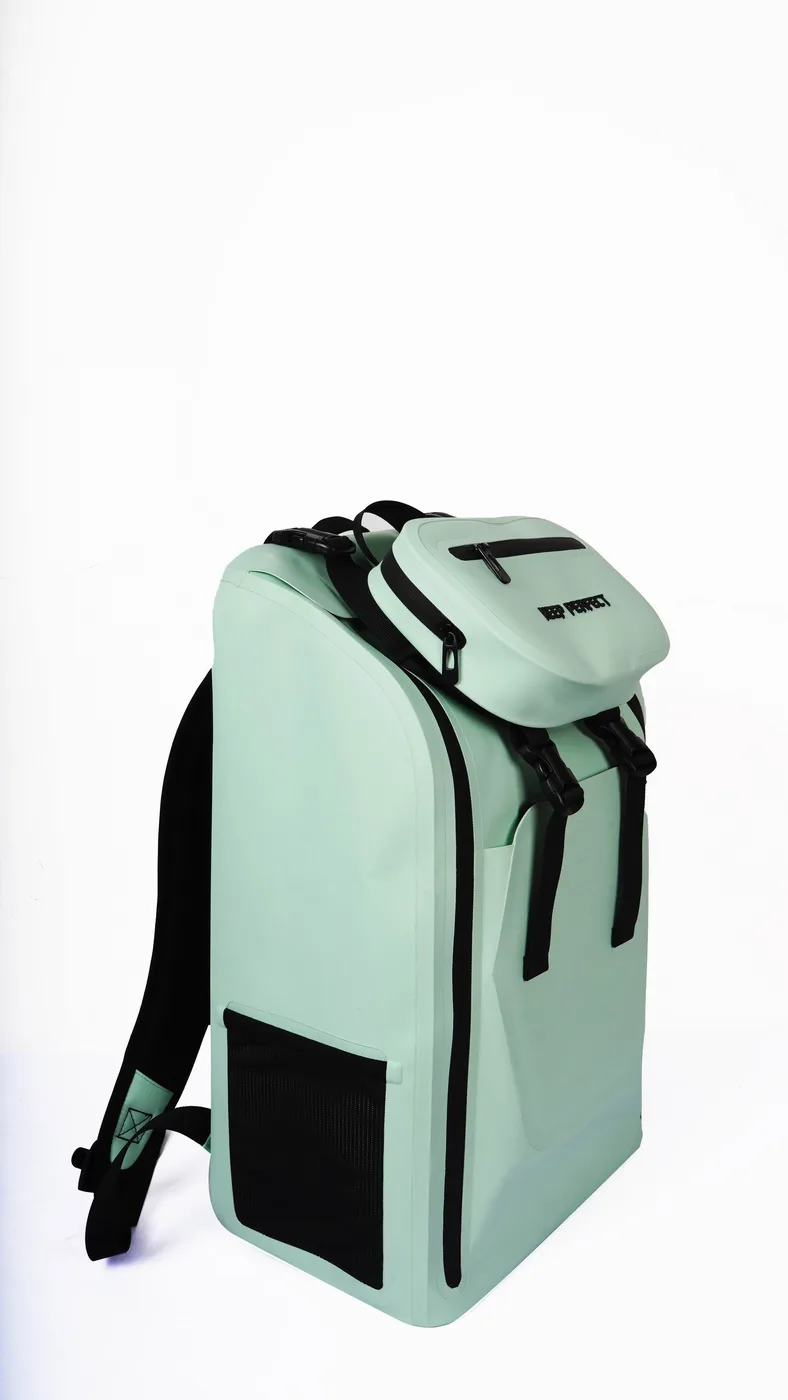
| Waterproof backpacks | TPU, 0.4 mm body | Harness attachment welds hold under load | Slower welding cycle |
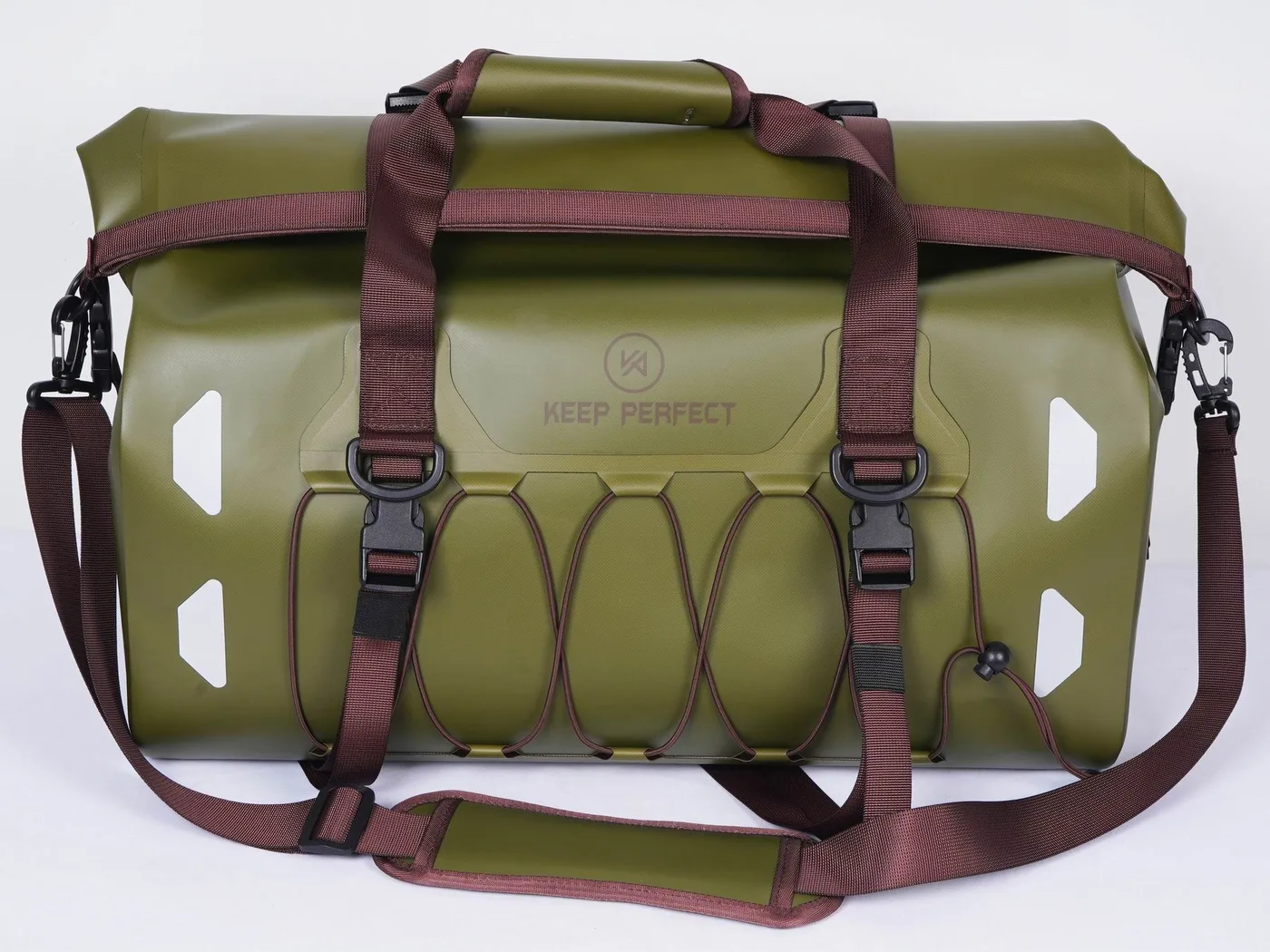
| Flat-panel duffels | TPE or polyolefin | No daily fold, lower cost | Stress whitening at sharp bends |
| Totes and pack liners | Silicone finish | Lightest and cheapest | No immersion protection |
| Kids and resort bags | TPU, 0.3 mm | No plasticiser migration, soft hand | Slightly higher unit cost |
| Cooler-style buckets | TPU, 0.5 mm | Puncture resistance against cans and ice | Heavier than a finished shell |
The kids and resort row deserves a word of explanation. Where a product is handled by children or used in a hot enclosed space such as a poolside cabana, the absence of a migrating plasticiser is the strongest argument for TPU, because that is exactly the condition under which PVC gives off its characteristic odour and surface tack. It is a comfort argument rather than a compliance one, and it is the one a buyer notices first.
Writing a PVC-free requirement into a brief
A usable clause names the polymer, the gauge, the construction method, the excluded substances and the documentation. It does not say PVC-free and stop there, because that phrase is interpreted differently by every party in the chain. Five lines convert the phrase into something testable.
- Name the film: TPU, polyether basis, 0.40 mm, laminated rather than coated.
- Name the exclusions: no PVC, no phthalate plasticisers, no PFAS-based durable water repellent.
- Name the assembly: water-based or plastisol-free ink, compliant hardware, per the restricted substance list.
- Name the test: phthalate scan on film, print and hardware, reported by an accredited laboratory.
- Name the control: written notice required before any film, adhesive, ink or hardware substitution.
- Name the performance floor: weld peel strength and hydrostatic head measured on the finished seam.
- Name the retention: one sealed reference sample per production batch, held for the warranty period.
The last line is the one that resolves disputes. A sealed reference sample from each batch, retained for the warranty period, turns any later disagreement about what was actually shipped into a question that can be answered in a laboratory rather than argued over email. It costs a shelf and a box of labels.
Our line has produced waterproof bags since 2014 in an SGS-verified 4,950 m2 facility, and PVC-free programmes now account for a growing share of the work across 137 staff and seven production lines. Minimum order is 500 pieces, sampling runs 6 to 10 working days, bulk is 35 to 50 days from FOB Xiamen, and inspection is at AQL 2.5.The current eco-friendly range shows what a PVC-free build looks like in production, and the recycled TPU notes take the next step for anyone who wants recycled content as well.
One caution to close on. PVC-free is a material statement, and it is compatible with a badly made bag. A TPU bag with an under-welded seam, a plastisol print and no documentation is not a better product than a well-made coated bag with a clean compliance file. Set the material line and the performance floor together, and buy the pair rather than the adjective.
Frequently asked questions
Q1. What are the alternatives to PVC in dry bags?
Three workable routes: a TPU laminate at 0.3 to 0.5 mm, which is the direct substitute; a TPE or polyolefin film, which is cheaper but creases more; and a silicone or wax finish, which is splash-proof only and not weldable.
Q2. Is TPU a PVC-free material?
Yes. Thermoplastic polyurethane contains no chlorine and no plasticiser, so it does not stiffen, become tacky or develop the sweet odour that an ageing PVC coating acquires.
Q3. How much more does a PVC-free dry bag cost?
TPU laminate costs 20 to 40 percent more per square metre than PVC; TPE and polyolefin films cost 5 to 15 percent more. Converted to a finished bag at a 500-piece minimum the increase is modest.
Q4. Does PVC-free mean the bag is safer?
Not automatically. The film may be compliant while the print, the adhesive or the hardware still contains a restricted substance. Ask for a declaration covering the assembled article rather than the fabric roll.
Q5. Are PVC-free bags as waterproof as PVC bags?
A TPU laminate is usually better, at 8,000 to 12,000 mm of hydrostatic head against 6,000 to 9,000 mm for a PVC coating. A silicone or wax finish is far less waterproof and will wet through on immersion.
Q6. Can PVC-free fabric be welded?
TPU welds with radio-frequency energy and TPE welds with a hot wedge. Silicone and wax finishes cannot be welded at all because there is no thermoplastic layer to melt, so seams must be sewn and taped.
Q7. Which PVC-free fabric is best in cold weather?
Polyether-based TPU, which stays flexible to about minus 30 degrees and still forms a flat fold at minus 20. A PVC coating stiffens near 0 degrees and can crack at the fold below minus 10.
Q8. Why do PVC bags smell sweet as they age?
The plasticiser is not chemically bound to the polymer, so it migrates to the surface over time. That is what produces the tacky feel and the characteristic odour after two or three seasons.
Q9. Can a PVC print be used on a PVC-free bag?
It happens and it defeats the purpose. A plastisol print is itself PVC based and reintroduces the excluded material at 15 to 40 grams per bag. Specify the ink system alongside the film.
Q10. Are PVC-free dry bags recyclable?
Technically yes for TPU and polyolefin, practically rarely, because a bag is a laminate of yarn, adhesive and film that cannot be separated. Service life is a larger lever than recyclability today.
Q11. What is the difference between coated and laminated PVC-free fabric?
A coating is spread as a liquid and cured on the surface, so it can craze at a fold. A lamination bonds a pre-formed film under heat and pressure, keeping full thickness and better fold memory.
Q12. What documents prove a PVC-free claim?
A restricted substance list declaration for the assembled article, a phthalate test report on film, print and hardware, a REACH statement, and a change-control clause requiring notice of any substitution.
Q13. Do PVC-free bags last longer?
Usually. TPU has no plasticiser to lose, so it does not stiffen with age, and a TPU bag commonly outlasts a comparable PVC bag by a factor of two to three in regular use.
Q14. Is a waxed or silicone-finished bag a real dry bag?
No. With no continuous film it is splash resistant only, typically around IPX4, and it will wet through within minutes of immersion. It is a good pack cover or tote, not a dry bag.
Q15. Does going PVC-free change the production process?
Yes. RF welding parameters differ, the processing window is narrower, and the first run usually carries a higher reject rate while the line is tuned. Repeat runs return to baseline.
Q16. What minimum order applies to a PVC-free programme?
Five hundred pieces on our line, with sampling in 6 to 10 working days and bulk in 35 to 50 days from FOB Xiamen. Consolidating colourways into one production slot reduces the per-unit cost.
People also ask
What can replace PVC in waterproof bags?
A TPU laminate is the direct replacement for immersed products, a TPE or polyolefin film suits flat-panel bags, and a silicone or wax finish suits splash-proof accessories. Only the first two can be welded.
Are PVC-free dry bags better?
On cold flexibility, weight, service life and weld strength, yes. On purchase price, no: TPU costs 20 to 40 percent more per square metre than a PVC coating.
How can you tell if a dry bag is PVC-free?
Ask for a material declaration naming the polymer and a phthalate test report covering the film, the print and the hardware. A hang tag statement without a test report is not evidence.
Does TPU contain phthalates?
No. TPU is inherently plasticiser free, which is why it does not stiffen or become tacky with age. The risk sits in the print, the adhesive and the hardware rather than in the film.
Is PVC banned for bags?
PVC itself is not banned, but several plasticisers and additives used in it are restricted in the EU, the UK and parts of the United States, which is why many ranges have moved away from it.
Can PVC-free bags survive immersion?
A welded TPU laminate reaches IPX6 to IPX7. A TPE or polyolefin film reaches IPX5 to IPX6. A waxed or silicone-finished shell is splash-proof only and will wet through on immersion.
Need this in production volume?
QUANZHOU JUNYUAN BAGS has produced waterproof bags since 2014 in an SGS-verified 4,950 m2 facility in Fujian, China. Minimum order 500 pieces, sampling in 6–10 working days, bulk in 35–50 days, FOB Xiamen — write to service@junyuanbags.com with your spec and target market.