Home / Blog / Sustainability & Compliance
How Recyclable Are Dry Bags?
A typical roll-top dry bag is between 60% and 95% technically recyclable by mass and realistically recovered at close to zero, because it is a bonded laminate of two or three polymers plus metal hardware that no mainstream sorting stream can separate. A 0.5 mm TPU film laminated to a 500D polyester face fabric is roughly 55% film and 40% fabric by mass, and mechanical recycling needs those two apart. Without a mono-material build or a chemical route, the honest answer for most dry bags today is: recyclable in principle, landfill or incineration in practice.
That is not a reason to stop buying them, because the dominant environmental term is service life, not end-of-life. A bag that lasts ten years beats a nominally recyclable bag that lasts three, by a wide margin on every measure. This guide sets out the layer-by-layer composition, why laminates break mechanical recycling, the three different end-of-life stories for TPU, PVC and polyethylene builds, the design choices that genuinely raise recovery, and the questions that separate a defensible recyclability claim from a marketing one.
- The honest answer: technically recyclable, practically rarely recycled
- What a dry bag is made of, layer by layer
- Why laminates break mechanical recycling
- TPU, PVC and PE: three end-of-life stories
- Mono-material construction: what it actually changes
- Hardware, inks and the disassembly problem
- How recycling streams sort textiles today
- Chemical recycling and depolymerisation: where it stands
- Design choices that raise real recyclability
- What to ask a bag maker, and how to read the answer
- Repair, second life and take-back: the higher rungs
- Writing recyclability into a specification
- Claims you can defend, and claims you cannot
The honest answer: technically recyclable, practically rarely recycled
Every polymer in a dry bag can be reprocessed. Polyurethane can be reground and re-extruded, polyester can be mechanically or chemically recycled, polyethylene is one of the most widely recycled plastics in the world, and steel and aluminium hardware is recovered efficiently wherever scrap metal is collected. The problem is not that the materials are unrecyclable; it is that they arrive bonded to each other in thin layers with no economical way to separate them.
Mechanical recycling works on single-polymer streams. A bottle made of PET is shredded, washed, melted and repelletised. Feed it a laminate of PET, TPU, pigment, a UV stabiliser package and a welded aluminium D-ring, and the output is a contaminated blend with poor mechanical properties that no converter wants. Sorting infrastructure recognises bottle shapes, not bag laminates, and a dry bag placed in a kerbside bin is typically pulled out as a contaminant or passes through to residue.
The practical recovery rate for dry bags placed in household streams is therefore effectively zero in most markets, and that is the number worth stating plainly. The routes that do work are producer take-back, mono-material design, mechanical grinding into low-grade sheet, and, increasingly, chemical depolymerisation. Each of those requires a decision made at the design stage or by the brand, not by the person holding the bag at the end.
What a dry bag is made of, layer by layer
Take apart a mid-range 20-litre roll-top bag and the mass splits roughly as follows: the film laminate dominates at 55 to 65%, the face fabric and any backing at 25 to 35%, hardware at 4 to 8%, webbing and closure components at 3 to 6%, and printing ink and adhesive at under 1%. Every one of those layers is a different material, and most of them are bonded rather than assembled, which is the core of the problem.
The film itself is a laminate. A TPU film is extruded or calendered onto a woven face fabric with an adhesive tie layer, or heat-laminated directly under pressure. The bond is designed to be permanent, and peeling it is exactly the failure mode the whole product is engineered to avoid. Any recycling route must therefore either break that bond chemically or accept the blend, and both options have costs that the current price of recovered polymer does not cover.
| Layer | Typical mass share | Polymer family | Recyclable alone? | Fate in a mixed stream |
|---|---|---|---|---|
| TPU or PVC film | 30-40% | Thermoplastic elastomer | Yes, in a clean stream | Contaminant, downgrades the melt |
| Face fabric, 420D-500D | 25-35% | Polyester or polyamide | Yes, established routes | Recoverable if separated |
| Adhesive tie layer | 2-5% | Reactive polyurethane | No | Char and gel in the melt |
| Webbing and closure tape | 3-6% | Polyester or polyamide | Yes | Tangles, often screened out |
| Buckles and D-rings | 4-8% | POM, PP, steel or aluminium | Metal yes, polymer sometimes | Metal recovered in some plants |
| Print and coatings | Under 1% | Pigment, resin, PFAS or none | No | Discolours and contaminates |
Two things stand out from that breakdown. The first is that the problematic share is small: the adhesive, the ink and the pigment together are under 6% of the mass, yet they are enough to disqualify the other 94% from a clean stream. The second is that hardware is the easiest thing to recover and the easiest thing to remove at end of life, which is why disassembly design matters more than material choice in the short term.
Why laminates break mechanical recycling
A mechanical recycling line is a series of compromises: shred, wash, separate by density, melt, filter and pelletise. Each stage tolerates a small amount of contamination and none tolerates a bonded laminate. When a TPU-polyester laminate is shredded, the pieces remain bonded; density separation cannot split them; and in the melt the two polymers are immiscible, so they form a two-phase material with weak interfaces and unpredictable mechanical behaviour.
The result is downcycling at best. Ground laminate can be used as filler in low-grade sheet, in park benches or in construction board, and that is a legitimate outcome, but it is not recycling in the circular sense: the material is used once more and then landfilled. The honest description is a single downcycle, and it is worth asking any brand making a recyclability claim which of the two they mean.
Adhesive is the quiet culprit. A reactive polyurethane tie layer does not melt at the processing temperature of either film or fabric; it crosslinks, gels and chars, producing black specks that ruin the appearance and the mechanical consistency of the melt. Removing it means either a soluble adhesive, a compatibiliser that costs more than the recovered polymer is worth, or a design that never used adhesive in the first place.
TPU, PVC and PE: three end-of-life stories
Thermoplastic polyurethane is the best of the three in a technical sense. It is a thermoplastic, so it softens and re-forms under heat, it contains no chlorine and no migrating plasticiser in a phthalate-free formulation, and it can be reground and re-extruded into lower-grade film or mouldings. What it lacks is a collection stream: almost nowhere collects TPU separately, so a TPU bag only gets recycled where a brand has arranged it.
PVC is the worst of the three and the reason is chlorine. At about 57% chlorine by mass, PVC releases hydrogen chloride when heated, requires stabilisers, and contaminates any stream it enters, which is why recyclers treat it as a contaminant and why polyester bottles contaminated with PVC are a known problem. Add plasticiser, which is the softener that makes PVC flexible, and you have a second stream of regulated substances to manage at end of life.
Polyethylene and polypropylene are the easiest to recycle and the hardest to make waterproof as a dry bag film, which is the trade-off in one sentence. A mono-material PE build can enter an existing film stream in many markets and comes out as usable pellet, but PE films weld differently, creep more under load and have different low-temperature behaviour. The result is that PE-based waterproof bags exist, work well for light duty, and are not yet the default for expedition-grade gear.
| Film chemistry | Separate collection stream? | Recycled content achievable | Main barrier | Relative end-of-life impact |
|---|---|---|---|---|
| TPU, phthalate-free | Rare, brand-arranged only | 30-50% in a closed loop | No kerbside collection | Moderate |
| PVC plasticised | No | Under 10% | Chlorine and plasticiser | High |
| Polyethylene | Yes in many markets | 50-100% | Lower performance as a film | Low |
| Recycled rPET face with TPU film | No, still a laminate | Face only, 50-100% | Bond between layers | Moderate |
| Mono-material TPU build | Rare, brand-arranged | 70-100% in a closed loop | Cost and availability | Low to moderate |
Reading that table correctly matters. A bag with a 100% recycled polyester face fabric is not a recyclable bag; it is a bag with a recycled face fabric bonded to a virgin film, and the end-of-life problem is unchanged. Recycled content and recyclability are two different claims, and conflating them is the most common form of greenwashing in this category. Our guide to recycled TPU construction separates the two.
Mono-material construction: what it actually changes
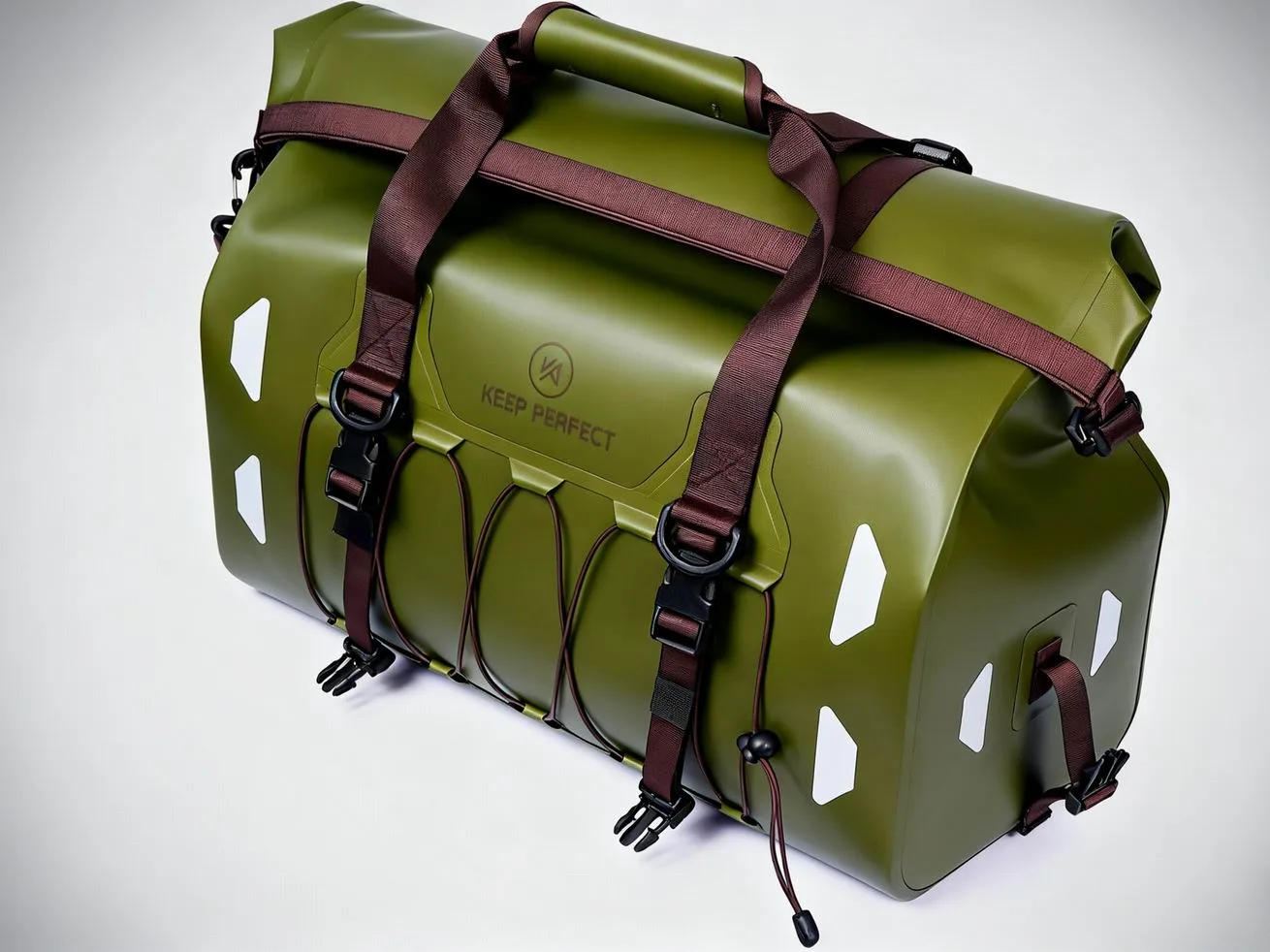
A mono-material bag is built from one polymer family throughout: a TPU film on a TPU-compatible face fabric, TPU-coated webbing, a TPU-sheathed buckle or a buckle made from the same polymer, and no adhesive tie layer because the layers are heat-bonded to themselves. Shred that bag and every fragment is the same chemistry, which means the melt is homogeneous and the output is usable pellet rather than filler.
The change is real but it is not magic. A mono-material bag still needs collection, because there is no kerbside TPU stream in almost any market, and it still needs volume, because a recycler will not run a batch for one brand’s annual returns. The realistic route is a take-back scheme that accumulates bags until there is a tonnage worth processing, then grinds and re-extrudes them into the next production run. That works, and several brands do it, but it is a logistics programme rather than a material property.
There is a performance cost too. Mono-material builds restrict you to one polymer’s properties, so you give up the abrasion resistance of a high-tenacity woven face or the stiffness of a POM buckle unless you accept a hardware exception. The practical compromise most programmes reach is a mono-material body with removable metal or POM hardware, which recovers 85 to 92% of the mass as one polymer and handles the rest separately.
Hardware, inks and the disassembly problem
Hardware is small by mass and large by consequence. A welded D-ring cannot be removed without cutting the film, so it travels with the bag into whatever stream receives it, and a steel ring in a polymer melt is a screen-blocking contaminant. A bolted or clipped ring can be removed in thirty seconds, and a bag designed for disassembly will mark those points clearly so an end-of-life handler knows where to cut.
Inks matter more than their mass suggests. A printed logo is under a gram, but a solvent-based ink introduces resin and pigment into the melt and can introduce regulated substances that disqualify the output from certain applications. Water-based and low-migration ink systems reduce that problem substantially and are now the default for any programme that intends to claim recyclability. The detail is covered in our printing ink guide.
The disassembly sequence worth designing for is short: cut off the webbing and straps, unclip or unbolt the hardware, remove any valve, then send the body to grinding. That is four steps and under five minutes with a knife and a screwdriver, and it recovers the metal, the webbing and the body as three separate streams. Nothing about it is technically difficult; it simply has to be thought about before the bag is drawn rather than after.
How recycling streams sort textiles today
Understanding where a bag actually goes helps set expectations. Kerbside systems are built around rigid packaging: bottles, pots and trays, identified by shape and increasingly by near-infrared spectroscopy. A flexible laminated item usually fails the identification step, is often too floppy to be conveyed correctly, and is screened out either as a film or as residue. Textile banks, where they exist, sort for reusable garments and for fibre, not for coated technical laminates.
Near-infrared sorting is the reason a black bag is harder to recycle than a light one. Carbon black pigment absorbs the near-infrared signal that the sorter uses to identify a polymer, so a black item is frequently unidentified and rejected regardless of what it is made of. Choosing a light or an NIR-detectable colourway is a genuine recyclability decision, and it is one of the cheapest improvements available at the design stage.
Specialist take-back is the route that works today. A brand that collects its own bags, sorts by polymer, and grinds them into sheet or pellet controls every step and does not depend on a municipal stream understanding its product. The cost is real, in reverse logistics, storage and processing, which is why it tends to appear first on premium programmes where the margin supports it and on regulated markets where extended responsibility rules require it.
Chemical recycling and depolymerisation: where it stands
Chemical recycling breaks a polymer back into its building blocks instead of melting it. For polyester that means glycolysis or methanolysis back to monomer; for polyurethane, glycolysis or aminolysis back to polyol. The output is near-virgin quality, tolerates dyes and some contamination far better than mechanical routes, and can in principle handle a laminate by depolymerising one layer and leaving the other.
The honest status is early. Polyurethane depolymerisation works at pilot and limited commercial scale, yields a polyol that can be re-used in new formulations, and is not yet available at the volumes or the cost that a general bag programme would need. Polyester glycolysis is more mature but does nothing for the TPU film in a laminate, which is precisely the layer that makes the bag waterproof.
The practical implication for a buyer today is to design for mechanical recovery and treat chemical routes as upside. A mono-material TPU bag can be ground and re-extruded now, and if a chemical route becomes available at scale in five years the same bag is feedstock for it. A complex multi-polymer laminate is poor feedstock for either. That is the strongest argument for mono-material design and it does not depend on any technology arriving.
Design choices that raise real recyclability
- Move to a mono-material body: one polymer family for film, face fabric and coatings.
- Avoid adhesive tie layers where heat lamination under pressure will do the job.
- Specify removable hardware with bolts or clips rather than welded or riveted attachments.
- Choose light or near-infrared-detectable colourways; carbon black defeats automated sorting.
- Use water-based, low-migration inks and keep print coverage under about 15% of the surface.
- Eliminate PVC and plasticised films from the bill of materials entirely.
- Standardise webbing on the same polymer as the body, or make it removable in one cut.
- Print a polymer identification mark and a take-back address on the bag itself.
Ranked by impact per unit of effort, mono-material construction and removable hardware are the two that matter. Colourway choice is the cheapest single change and the one most often overlooked: switching from carbon black to an NIR-detectable pigment costs almost nothing at the design stage and materially changes whether an automated sorter can identify the item at all. Print coverage is the third cheap win.
There is a tension worth naming. The choices that make a bag most recyclable are not always the choices that make it most durable, and durability dominates the environmental arithmetic. A mono-material bag that lasts four years is worse than a mixed-polymer bag that lasts twelve, on carbon, on resource use and on waste. Take the recyclability wins that are free, and stop before compromising service life. Our design trends guide tracks where that balance is settling.
What to ask a bag maker, and how to read the answer
Four questions separate a real programme from a claim. Which polymer is the body, and is the face fabric the same family? Is the bond heat-laminated or adhesive? Can the hardware be removed without cutting the body? And what happens to a bag returned at end of life — specifically, which facility receives it and what does it become? A vague answer to the last question means there is no programme.
Ask for numbers rather than adjectives. Recycled content should be stated as a percentage by mass with the source named as post-industrial or post-consumer, and post-consumer content is the harder and more meaningful of the two. Recyclability should be stated as a percentage of mass recoverable in a named stream, not as a binary yes. And any claim should come with a document: a declaration, a test report or a certificate with a number on it.
Watch for three evasive patterns. A claim of recyclability with no named stream. A recycled-content figure that covers the packaging or the face fabric only. And a biodegradable claim on a product designed to last a decade, which is a contradiction in terms unless the claim is qualified by the conditions and the timeframe. Biodegradability in this category is almost always unqualified and almost always misleading; the detail is in our biodegradability guide.
| Claim | What it appears to mean | Evidence to request | Warning sign |
|---|---|---|---|
| Recyclable | Goes back into a stream | Named polymer and named stream | No stream named |
| Made with recycled content | Contains recovered material | Percentage by mass and source | Packaging counted as product |
| Mono-material | One polymer throughout | Bill of materials for every layer | Hardware excluded silently |
| Biodegradable | Breaks down naturally | Standard, conditions and timeframe | No conditions stated |
| PVC-free | No chlorine in the film | Declaration plus a screening test | Only the film is covered |
| Take-back scheme | Bags are actually collected | Facility name and annual tonnage | No volume figure available |
Repair, second life and take-back: the higher rungs
The waste hierarchy puts prevention and reuse above recycling, and for dry bags that ordering is correct by a wide margin. Extending a bag from five years to ten halves its annual material footprint, and every repair, demotion and second-life transfer is worth more than any end-of-life route. Programmes that focus on recycling before they have a repair path have the hierarchy upside down.
In practice the sequence looks like this: design for a long service life, sell or supply spare buckles and straps, publish a patch guide, offer a repair service or a bench partner, run a demotion path so retired bags keep working at lower-stakes jobs, and only then collect for material recovery. Each rung is cheaper than the one below it and captures more value. Details of the repair economics are in our repair guide.
Take-back works best when it is specific. A scheme that accepts any bag from any brand generates unsortable mixed feedstock; a scheme that accepts its own bags of known construction generates one clean polymer stream and can quote a real recovery percentage. Where a programme spans several polymers, sort at the point of collection by colourway or by a printed polymer mark, which costs a few seconds per bag and saves the whole downstream process.
Writing recyclability into a specification
A specification is where recyclability either becomes real or stays a slide. The lines that matter are the polymer for each layer, the bonding method, the hardware attachment method, the ink system, the colourway, and the identification marking. Six lines, and each of them is a decision a bag maker can quote against and an inspector can check on a sample.
Add two process requirements alongside them. Require a disassembly trial on a finished sample, timed and photographed, so you know whether the hardware actually comes off in the thirty seconds the drawing claims. And require a grind test on five retired bags, with the output characterised, so the recovery claim is measured rather than assumed. Both are cheap to run and both produce evidence you can publish.
Then set the acceptance thresholds. A programme targeting a credible claim should be able to state at least 85% of product mass as a single polymer, zero PVC and zero plasticised film, all hardware removable without cutting the body, and print coverage under 15% with a water-based system. Those four numbers are achievable today at a modest cost premium and they stand up to audit in a way that an adjective does not.

Claims you can defend, and claims you cannot
Defensible: a percentage by mass of recycled content with the source named; a statement that the body is a single polymer family and therefore mechanically recyclable where a stream exists; a take-back scheme with a named facility and a published annual tonnage; and a measured disassembly time. All four are specific, checkable and can be supported by a document with a number on it.
Indefensible: a bare word recyclable with no stream named; a biodegradable claim with no conditions; a compostable claim on a welded synthetic film; a percentage that covers packaging rather than product; and any claim that depends on a technology not yet operating at commercial scale for that polymer. Each of these is common, and each of them creates real regulatory exposure in markets with green-claims rules.
The compliance direction is clear across major markets: claims must be specific, substantiated and not misleading, and the burden of proof sits with the brand making them. In the European Union, packaging and extended responsibility rules are tightening in parallel, covered in our EPR guide; in the United States, guidance on recyclability labelling and waste management is published by the EPA, and the standards framework behind environmental claims and testing is maintained by the ISO.
Two closing references round this out. The material-by-material end-of-life analysis is set out in material recyclability, and the film chemistries that avoid the worst outcomes are compared in PVC-free alternatives. For anyone specifying a programme, the eco-friendly range shows what a mono-material build looks like in production, and our production partner has built waterproof bags since 2014 in an SGS-verified 4,950 m2 facility with a 500-piece minimum, sampling in 6 to 10 working days and bulk in 35 to 50 days.
Frequently asked questions
Q1. Are dry bags recyclable?
Technically yes, practically rarely. Every polymer in a dry bag can be reprocessed, but they arrive bonded in thin laminated layers with no economical separation route, so kerbside recovery for dry bags is effectively zero in most markets.
Q2. Why can a laminated dry bag not be recycled normally?
Because mechanical recycling needs a single-polymer stream. Shredding a TPU-polyester laminate leaves the layers bonded, density separation cannot split them, and in the melt they are immiscible, so the output is downgraded filler rather than usable pellet.
Q3. Is TPU more recyclable than PVC?
Yes. TPU is a chlorine-free thermoplastic that can be reground and re-extruded, and a phthalate-free formulation has no plasticiser to manage. PVC is about 57% chlorine by mass, releases hydrogen chloride when heated and is treated as a contaminant in most streams.
Q4. Does recycled content make a bag recyclable?
No. A recycled polyester face fabric bonded to a virgin TPU film is still a laminate with the same end-of-life problem. Recycled content and recyclability are separate claims and should always be stated separately.
Q5. What is a mono-material dry bag?
A bag built from one polymer family throughout: film, face fabric, coatings and webbing, with heat bonding instead of adhesive and hardware that can be removed. Shredding it produces a homogeneous melt and usable pellet rather than filler.
Q6. Can dry bag hardware be recycled?
Metal hardware is recovered efficiently wherever scrap metal is collected, and polymer hardware can be recycled if separated. The problem is attachment: a welded D-ring cannot be removed without cutting the film, so specify bolted or clipped fittings.
Q7. Does black colour affect recycling?
Yes. Carbon black pigment absorbs the near-infrared signal that automated sorters use to identify a polymer, so black items are frequently unidentified and rejected. A light or NIR-detectable colourway is a genuine recyclability improvement.
Q8. Is chemical recycling available for dry bags?
Polyester glycolysis is mature but does nothing for a TPU film; polyurethane depolymerisation works at pilot and limited commercial scale. Design for mechanical recovery now and treat chemical routes as future upside.
Q9. What recycled content percentage should I ask for?
Ask for a percentage by mass with the source named as post-industrial or post-consumer. Post-consumer content is harder to source and more meaningful. Treat any figure that covers packaging rather than the product as a red flag.
Q10. Are biodegradable dry bags a real option?
Almost never. A welded synthetic film designed to last a decade is not biodegradable in any conditions a bag will meet, and an unqualified claim without a standard, conditions and timeframe is misleading.
Q11. What should a take-back scheme actually do?
Accept bags of known construction, sort by polymer at the point of collection, accumulate tonnage worth processing, then grind and re-extrude into the next production run. A scheme accepting any bag from any brand produces unsortable feedstock.
Q12. How do I dispose of a dry bag responsibly?
Repair or demote it first, then donate it if it is still usable, then cut it into sheet stock for patching other bags. Household recycling rarely accepts laminated film, and burning a coated fabric releases hydrogen chloride and dioxins.
Q13. Is repair better than recycling for a dry bag?
Yes, by a wide margin. Extending a bag from five years to ten halves its annual material footprint. The waste hierarchy puts prevention and reuse above recycling, and every repair captures more value than any end-of-life route.
Q14. What is the most effective design change for recyclability?
Mono-material construction, followed by removable hardware. Both are achievable at a modest cost premium. Colourway choice is the cheapest single change, because carbon black defeats automated polymer sorting entirely.
Q15. Do take-back schemes cost a lot to run?
They cost real money in reverse logistics, storage and processing, which is why they appear first on premium programmes and in markets with extended responsibility rules. Sorting at the point of collection is the cheapest way to control the cost.
Q16. Which recyclability claims are safe to publish?
A recycled-content percentage with the source named, a single-polymer statement naming the polymer, a take-back scheme with a facility and tonnage, and a measured disassembly time. Avoid bare claims with no stream, no conditions or no number.
People also ask
How recyclable is a dry bag?
Technically 60 to 95% by mass, practically close to zero through household streams, because the polymers are bonded in a laminate that sorting cannot separate. Recovery depends on mono-material design and brand take-back.
Why are laminated fabrics hard to recycle?
The layers stay bonded through shredding, density separation cannot split them, and the polymers are immiscible in the melt, so the result is a weak two-phase material. Adhesive tie layers char and gel, making the output unusable.
Can you put a dry bag in household recycling?
Usually not. Kerbside systems identify rigid packaging by shape and near-infrared signal, and a flexible coated laminate is typically screened out as film or residue. Check with a local textile scheme before assuming otherwise.
Are TPU dry bags better for the environment than PVC?
Yes on both chemistry and end of life. TPU is chlorine-free, has no phthalate plasticiser in a modern formulation, stays flexible in the cold and can be reground; PVC contaminates streams and hardens as it ages.
What makes a bag genuinely recyclable?
One polymer throughout, heat bonding instead of adhesive, hardware that unclips or unbolts, light or NIR-detectable colour, water-based low-migration ink and a printed polymer identification mark.
Is recycled content the same as recyclable?
No. Recycled content describes what went into the product; recyclability describes what happens at the end. A bag can be 100% recycled and unrecyclable, or virgin and fully recoverable, and both claims should be stated separately.
Need this in production volume?
QUANZHOU JUNYUAN BAGS has produced waterproof bags since 2014 in an SGS-verified 4,950 m2 facility in Fujian, China. Minimum order 500 pieces, sampling in 6–10 working days, bulk in 35–50 days, FOB Xiamen — write to service@junyuanbags.com with your spec and target market.