Home / Blog / Travel & Packing
Road Trip Organisation With Dry Bags
Four people driving for two weeks carry 210 to 320 litres of luggage, and almost none of it travels better in a rigid suitcase than in a roll-top dry bag: the soft shape fills the irregular gaps around a spare wheel and a wheel arch, gains roughly 15 to 20% usable space in a hatchback boot, and survives a roof-box leak. Interior temperatures tell the other half of the story. On a 30 °C day, a closed car reaches 55 to 65 °C inside within one hour, which is hot enough to deform low-grade buckles and to push a cheap coated fabric past its softening point.
This guide plans the boot rather than the bag. You get capacity maths by vehicle type, a three-zone layout that keeps daily items reachable, colour coding that stops the whole family unpacking at every fuel stop, a leak defence for drink bottles and ice melt, and a nightly ten-minute unload that makes the system sustainable over 14 nights. Everything below assumes a standard family car with a boot rather than a van conversion; where the numbers change for a roof box or a load bay, they are flagged in the tables.
- Why soft waterproof bags beat boxes and crates in a car
- What heat does inside a parked car
- The three-zone boot plan
- Sizing the set to your vehicle
- What actually goes in each bag
- Colour coding that survives a fortnight
- Keeping liquids inside the car
- Gravel roads, dust and the closure line
- Stopping bags becoming projectiles
- Fuel, handling and the hidden cost of a heavy boot
- The ten-minute nightly unload
- Building a kit for a longer trip
Why soft waterproof bags beat boxes and crates in a car
Boot space is irregular, and rigid luggage wastes it. A 70-litre suitcase occupies 70 litres of rectangular space that does not exist next to a wheel arch, whereas the same volume in three soft bags distributes into the voids and leaves room for a collapsed pushchair or a folding chair. In measured side-by-side packing we see 15 to 20% more usable volume in a hatchback boot when the load is soft, and the gain grows in estate and SUV bays where the wheel arches intrude further.
Weight is the second argument. Three rigid cases for a family run 9 to 12 kg empty before a single item is packed; the equivalent dry bags weigh 1.4 to 2.6 kg for the set. That matters twice: at overhead-loader fees on a ferry, and at your back when the accommodation is four floors up with no lift. Soft bags also compress against each other rather than scuffing, so interior trim survives.
What heat does inside a parked car
Greenhouse heating is fast and uncomfortable. Solar gain through glass lifts cabin air by roughly 20 to 30 °C above ambient in the first hour of closed parking, so a 30 °C day produces a 55 to 65 °C interior. Dashboard surfaces and dark luggage sitting directly behind the glass can read 15 °C higher still. Heat pockets matter because not everything tolerates it: aerosol cans carry explicit storage limits around 50 °C, chocolate melts at about 32 °C, and rechargeable lithium cells lose cycle life quickly when stored above 45 °C.
The bag material copes better than the contents. A welded TPU laminate is serviceable continuously at 60 to 70 °C and survives short peaks higher, but a PVC coated fabric softens and can block together when squeezed at those temperatures for hours. The practical rules follow from that: park in shade where possible, keep dark bags off the rear parcel shelf, never leave pressurised cans or power banks in front of glass, and check the guidance published by the EPA on extreme heat before you plan a long desert leg.
The three-zone boot plan
Divide the boot into a daily zone, a hold zone and a wet zone, and police the boundaries for the whole trip. The daily zone sits closest to the opening lip: snacks, water, sunscreen, a first-aid pouch and one change of clothes per child, packed in two 10L bags. The hold zone is everything you touch at most once a week: spare shoes, winter layers, beach toys, gifts. The wet zone holds swimwear, towels and anything damp, and it lives in a single designated bag rather than migrating.
Bags cross zones for a reason, not by accident. When a day bag becomes full of laundry, empty it into the laundry bag rather than letting it become part of the hold zone; within three days of slippage the system collapses and everyone starts dig through every bag at every stop. Assign each zone a colour family as well as a position, so a four-year-old can be told to fetch the blue bag and get it right.

Sizing the set to your vehicle
Start from the boot opening, not the boot floor. Anything you cannot lift through the aperture with one hand goes unused, so the largest single bag should be about 15% below your comfortable one-handed lift. For most adults that puts the heavy items in 20L to 35L bags rather than one 70L monster, even though the total litres are identical. Measure the narrowest width of the aperture before you buy, and note whether the lip is level with the floor.
Roof boxes change the maths completely. A box has a fixed height, usually 300 to 420 mm internally, and a total mass limit set by the vehicle roof rails, typically 50 to 75 kg dynamic load. That favours low, long soft bags over tall ones, which is exactly the inverse of a boot. Check the vehicle handbook for the roof figure before loading, then distribute so no single bag exceeds 20 kg and the load sits central between the crossbars.
| Vehicle | Boot litres | Suggested split | Total litres | Notes |
|---|---|---|---|---|
| Small hatchback | 280-340 L | 2 x 20L, 2 x 10L, 1 x 5L | 65 L soft + cases | Keep tallest forward |
| Family estate | 500-620 L | 3 x 35L, 2 x 15L | 135 L soft | Load bay takes layers |
| Mid-size SUV | 480-580 L | 2 x 35L, 3 x 15L | 115 L soft | Watch the parcel shelf line |
| MPV, seven seats up | 200-300 L | 2 x 15L, 2 x 10L | 50 L soft | Everything must soften |
| Roof box 420 L | 420 L | 4 x 25L low profile | 100 L soft | Central between bars |
What actually goes in each bag
Generic packing lists hide the useful detail, which is volume and mass per category. Clothing is light and bulky at roughly 0.35 kg per litre; toiletries are dense at about 1.1 kg per litre; shoes are the worst offender at around 0.5 kg per litre with unusable void between pairs. Knowing those ratios lets you split a heavy load across two bags so neither exceeds your lift limit and neither sits high in the boot.
Keep the dense list together for a second reason: security. When you carry passports, chargers and medication, one small bright bag that never leaves the cabin is easier to guard than a distributed set. Our field habit for documents comes straight out of the passport protection guide, and it maps well onto the car: one 5L bag that comes inside every night, everything else stays out.
| Contents | Packed litres | Mass | Best bag | Zone |
|---|---|---|---|---|
| Four sets of casual clothing | 32 L | 11.2 kg | 2 x 20L | Hold |
| Toiletry block, family | 6 L | 6.6 kg | 1 x 10L | Daily |
| Shoes, eight pairs | 46 L | 9.0 kg | 2 x 35L | Hold |
| Snack box and drinks 6 L | 12 L | 9.5 kg | 1 x 20L | Daily |
| Swimwear and towels, damp | 18 L | 7.0 kg | 1 x 25L | Wet |
| Documents, chargers, meds | 4 L | 2.4 kg | 1 x 5L | Cabin |
Colour coding that survives a fortnight
Assign one colour per person and another to the shared categories, then apply the rule with no exceptions for fourteen days. Two people sharing a car can run two colours plus a wet bag; a family of four generally needs six bags to make the scheme work. Bright tones help here because a bag buried under three others still reads instantly at the bottom of a dark boot, which is why the mint and rose tones in our range are more practical than their appearance suggests.
Label as well as colour. A 40 mm strip of tape and a marker on the side panel, or a card zip-tied to the webbing loop, costs almost nothing and lets a passenger who has never met the system find the right bag. This also solves the borrowed-bag problem when someone takes the wrong one into a hotel room; the label settles the argument without an inventory check.

Keeping liquids inside the car
Liquids fail in two ways: a cap loosens under vibration, or ice melts faster than you expect. A 2 kg bag of ice becomes 2 litres of water in about three to four hours at 30 °C ambient, which is a puddle search across the boot. A single 35L bag with a double-fold closure and no interior drain handles both problems if you keep bottles upright in a rigid tray and close the bag properly before every departure.
Food safety sets the real limit on how long anything perishable can travel. The CDC guidance is that chilled food should not sit above 4 °C for more than two hours, and the window collapses to one hour above 32 °C, which most summer boots exceed by mid-morning. Plan on a sealed cool bag plus frozen blocks replaced daily, and treat anything left warm after a long stop as finished rather than as a judgement call.
Gravel roads, dust and the closure line
Dust gets into everything on an unmade road, and it is the fastest way to wreck a closure seal. A fine grit film on the fold line acts as a wick: over two hours of corrugations, water or condensation can creep through a capillary path even on a well-made bag. The defence is procedural rather than technical. Before every departure, run a dry thumb along the fold zone and re-roll if you feel grit, and keep open bags closed whenever the car is moving.
Dust also attacks the buckle mechanism, particularly the cam levers on compression straps. A weekly rinse with fresh water and ten cycles of full travel keeps them working; a season of neglect produces slippage at exactly the moment you need compression over a rough pass. The specific technique for salty, dusty closures is set out in our hardware cleaning note.
Stopping bags becoming projectiles
In a hard braking event at 60 km/h, an unsecured 8 kg bag produces roughly 130 kg of effective force at the moment of impact. Anything on the parcel shelf or the rear bench is therefore a hazard, not just a nuisance. Use the lashing eyes in the boot, the child-seat top tether anchors where available, or the fold-down hooks, and run a single 25 mm strap across the whole load rather than tying individual items.
Placement matters more than force rating for most trips. Heavy bags go forward and low, ideally against the rear seat back so they cannot slide into the cabin; light bulky bags go on top. Never stack a load above the height of the rear shelf in a hatchback, because in a collision there is nothing between it and the passengers, and it also blocks the mirror line by about 15% on many models.
| Position | Max mass | Restraint | Handling effect |
|---|---|---|---|
| Against seat back, low | 25 kg | Seat back plus floor friction | Neutral, slight understeer |
| Boot floor behind axle | 30 kg | Lashing eyes and cross strap | Ideal, keeps centre low |
| Load lip, forward | 12 kg | Net hook | Access without unpacking |
| Rear footwell | 6 kg | Wedged below seat | Fine, blocks passenger space |
| Parcel shelf | 0 kg | None available | Unsafe and blocks vision |
Fuel, handling and the hidden cost of a heavy boot
Extra mass costs real money. As a working rule for a mid-size petrol car, each additional 50 kg adds roughly 1 to 2% to fuel consumption in mixed driving, and considerably more in stop-start urban work. A roof box is worse than a boot because the aerodynamic penalty adds to the mass penalty: expect 10 to 25% extra consumption with a loaded box at 110 km/h, depending heavily on its shape and crossbar position.
The cheaper wins come from discipline rather than equipment. Clear out the 15 kg of things you carried every day and used once, keep tyre pressures checked weekly because load amplifies the penalty of an under-inflated tyre, and pack so the heavy load sits between the axles. If you are travelling through Europe, remember that many border checkpoints ask you to open at least one bag, so keep one bag near the lip rather than buried.
The ten-minute nightly unload
- Park in shade and lift the two daily bags out first, before anyone opens a room door.
- Refill water, remove anything perishable that has spent more than two hours warm.
- Move damp swimwear from the wet bag to a shower rail; never leave it sealed overnight.
- Check every closure for grit, then re-roll with three folds and a tight buckle.
- Consolidate laundry into one 25L bag so tomorrow starts with a full daily bag.
The value of the routine is cumulative. Done every night, the boot stays navigable for fourteen days and nobody ever digs through four bags looking for a charger; skipped twice, the system collapses and the last three days become unpack-at-every-stop chaos. Keep the routine short enough that it always happens, which means keeping it under ten minutes and doing it before anyone sits down.
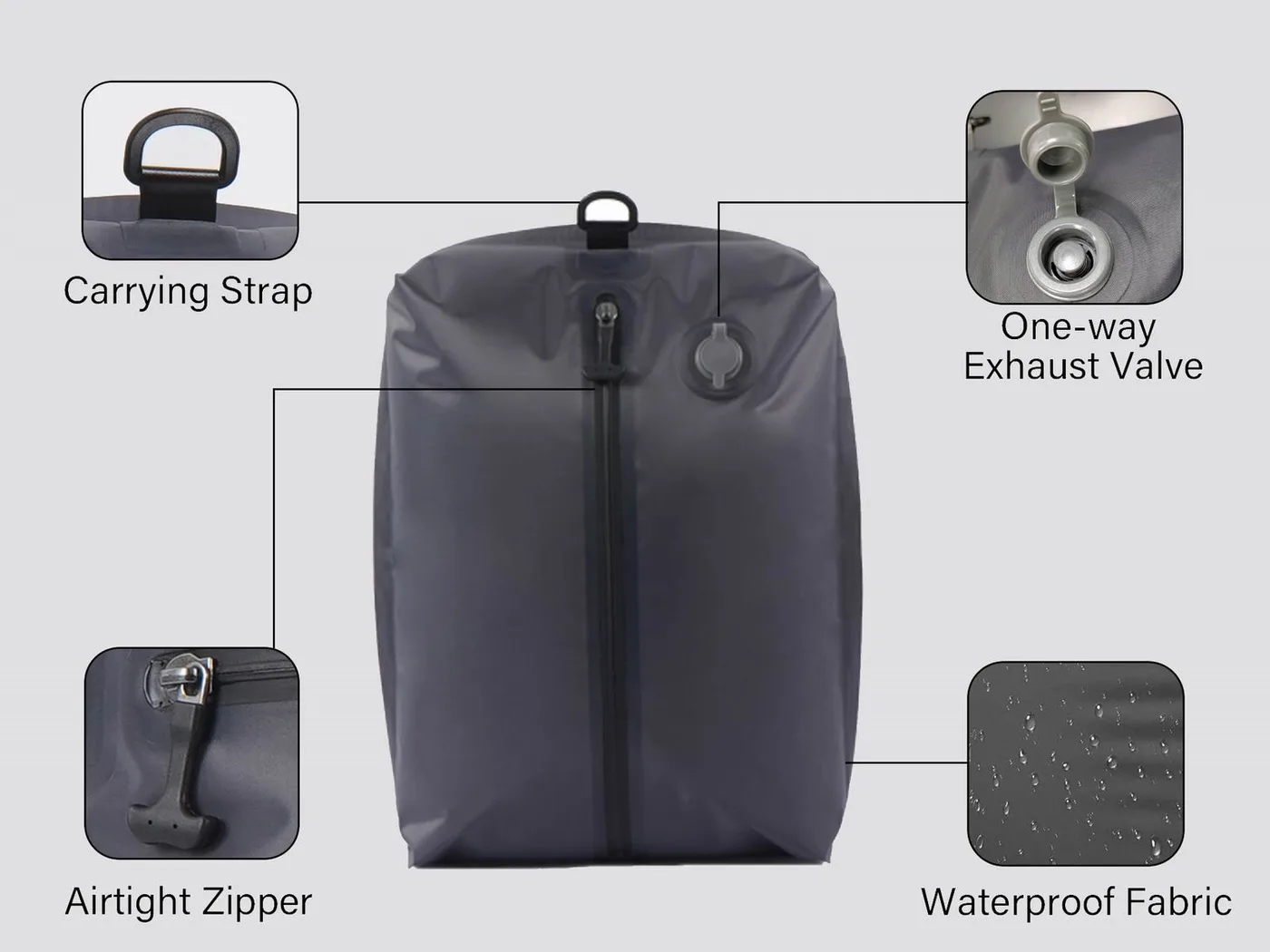
Building a kit for a longer trip
- Two 20L bags for clothing per adult, never one 40L bag you cannot lift through the boot lip.
- One 5L bright bag for documents, chargers and medication that comes into the room nightly.
- A 25L wet bag for swimwear and towels, vented every evening without exception.
- A 20L crowd bag for drinks and ice with double-fold closure and space for frozen blocks.
- A 10L daily bag per child holding one change of clothes, snacks and one toy.
- Two 25 mm lashing straps to hold the whole load against the seat back.
- A soft tape measure and marker for colour labels, plus a spare buckle per bag family.
The list above is deliberately modest, because the most common mistake is buying too much equipment. Six bags does the work of twelve if the zones are respected, whereas twelve bags in three unlabelled colours produces decision fatigue at every fuel stop. If you already travel with a carry-on system for flights, the same rolling discipline applies on the road; the transfer diagramming in carry-on-only travel maps directly onto the daily-bag concept.
Two further extensions are worth reading before you commit to a configuration. Pool stops and hotel leisure floors are handled in our hotel and pool kit guide, and the specific problem of damp kit on a multi-stop itinerary is unpacked in wet swimwear storage. Both sit inside the same three-zone logic used here, so nothing you learn transfers badly.
Finally, a note on equipment specification. Our production partner has built waterproof bags since 2014 in an SGS-verified 4,950 m2 facility running 7 lines and 149 machines, with a 200,000 piece monthly output, and the travel range decisions above come directly from that bench experience; see the process write-up if you are developing rather than buying. Programme minimums start at 500 pieces with AQL 2.5 inspection, sampling in 6 to 10 working days and bulk in 35 to 50 days.
Frequently asked questions
Q1. What size dry bags do you need for a road trip?
For a family of four in an estate car, plan three 35L bags for clothing and shoes plus two 15L daily bags, roughly 135 litres of soft storage. Add one 5L documents bag that comes into the room nightly and a 25L wet bag for swimwear and towels.
Q2. Can dry bags stay in a hot car all day?
Welded TPU bags tolerate continuous exposure at 60 to 70 °C, so the bag is fine, but the contents may not be. Aerosols carry storage limits near 50 °C and lithium cells degrade above 45 °C, so keep both out of direct sun behind glass.
Q3. How much extra fuel does a loaded boot cost?
Each extra 50 kg typically adds 1 to 2% to consumption in mixed driving for a mid-size petrol car. A loaded roof box is worse: expect 10 to 25% extra at 110 km/h because the aerodynamic drag penalty adds to the mass penalty.
Q4. Is it safe to put luggage on the rear parcel shelf?
No. In a 60 km/h braking event an unsecured 8 kg bag generates roughly 130 kg of effective force, and nothing stops it reaching the passengers. Use boot lashing eyes with a cross strap and never stack above the shelf line.
Q5. Should wet swimwear stay sealed in a dry bag overnight?
No. Sealed damp fabric develops odour within twelve hours and can transfer a smell to neighbouring kit. Hang it out each evening, then use the same bag empty for the next day rather than storing anything else in it while damp.
Q6. How do you stop ice melt soaking the boot?
Use double-fold closures rather than a single roll, keep bottles upright in a rigid tray inside the bag, and expect a 2 kg bag of ice to become 2 litres of water in three to four hours at 30 °C. Refreeze blocks at each overnight stop.
Q7. Are soft bags better than suitcases in a car boot?
Yes for irregular spaces. Soft bags deliver roughly 15 to 20% more usable volume in a hatchback because they deform into wheel arch voids, and a family set weighs 1.4 to 2.6 kg empty against 9 to 12 kg for equivalent rigid cases.
Q8. What weight limit applies to a roof box?
Follow the vehicle handbook, which commonly specifies 50 to 75 kg dynamic roof load including the box itself. Keep individual bags under 20 kg for lifting, place the load central between crossbars, and reduce speed in crosswinds of more than 40 km/h.
Q9. How do you organise a boot so kids stop asking for things?
Colour code by person, label every bag with tape, and give each child one 10L daily bag they own completely. When daily items live at the load lip in their own coloured bag, the request is answered without unpacking anyone else's kit.
Q10. Do dry bags need cleaning during a road trip?
A weekly rinse of buckles with fresh water and ten cycles of full travel is enough for a fortnight. On gravel roads, check the fold line for grit before every departure, because dust on the closure acts as a capillary wick over long drives.
Q11. Can perishable food travel in a car without a cool box?
Only for very short periods. Chilled food should stay below 4 °C and the safe window is about two hours, dropping to one hour above 32 °C, which most summer boots exceed by mid-morning. Use frozen blocks and treat anything left warm as finished.
Q12. How many dry bags for two weeks, two people?
Six: two 20L bags for clothing, one 15L daily bag, one 25L wet bag, one 20L bag for drinks and ice, and one 5L bright bag for documents and chargers. That spread covers roughly 85 litres and keeps each item under a comfortable one-handed lift.
Q13. Should the spare wheel well be used for storage?
It suits dense, rarely needed items weighing up to about 10 kg, such as tools and recovery gear, because the position is very low and central. Avoid anything you need daily, since accessing it means unloading everything above it.
Q14. What is the best way to stop bags sliding on corners?
A single 25 mm strap threaded through the boot lashing eyes and run across the whole load works better than restraining individual bags. Combine it with packing heavy items forward against the seat back so friction does part of the work.
Q15. Can you use dry bags instead of a laundry bag?
Yes, and it is the better solution for damp active kit. Dedicate one 25L bag, vent it nightly, and do not mix laundry with clean clothing: a sealed wet garment raises humidity inside neighbouring bags and transfers odour within a day.
Q16. Do I need backpack-style dry bags for a road trip?
Only if you carry loads upstairs or across a campsite. A standard roll-top is cheaper and packs flatter in a boot, but a duffel with detachable straps earns its place on hotel stairs, where a 25 kg boot load otherwise takes three trips.
People also ask
How do you pack a car boot efficiently?
Put heavy bags forward and low against the seat back, light bulky items on top, and daily items at the load lip. Use soft bags so they deform into voids, then secure the whole load with one cross strap rather than restraining each item.
Are dry bags useful for car travel?
Yes, because they compress into irregular spaces, resist leaks from ice melt and drink bottles, and keep wet swimwear separate from clean clothing. The same sealed construction that suits a kayak handles a gravel road equally well.
What temperature does a parked car reach?
Cabin air typically rises 20 to 30 °C above ambient within the first hour of closed parking, so a 30 °C day yields 55 to 65 °C inside, with surfaces behind glass running about 15 °C hotter still.
How heavy should a bag be for comfortable lifting?
Keep each bag roughly 15% below your comfortable one-handed lift, which for most adults means 20L to 35L sizes rather than one 70L bag. Dense contents such as shoes and toiletries drive the decision more than the bag itself.
What should you never store in a hot car?
Pressurised aerosols above their stated 50 °C limit, rechargeable lithium cells above 45 °C, chocolate above about 32 °C, and any perishable chilled food beyond two hours. Each fails well before the bag material does.
How do you keep a car boot organised on a long trip?
Use three fixed zones for daily, hold and wet items, assign one colour per person, label every bag, and run a ten-minute nightly unload that resets the system. Consistency matters more than how much equipment you bring.
Need this in production volume?
QUANZHOU JUNYUAN BAGS has produced waterproof bags since 2014 in an SGS-verified 4,950 m2 facility in Fujian, China. Minimum order 500 pieces, sampling in 6–10 working days, bulk in 35–50 days, FOB Xiamen — write to service@junyuanbags.com with your spec and target market.