Roll-Top Dry Bags for Rock Climbing: Why They Win
A roll-top dry bag wins on rock for one mechanical reason and one practical one. The mechanical reason is grit: granite dust and chalk find zip teeth and jam them, while a rolled closure has no teeth, no slider and nothing to jam, so a 20L bag dragged across a ledge still seals at the end of the day. The practical reason is abrasion, where a 0.5 mm TPU film on a 500D face survives roughly 4,000 cycles of standard abrasion testing against the kind of contact a crag produces.
Climbing also loads a bag in ways other activities do not: it gets scraped on the approach, dropped from waist height onto rock, dragged behind a climber on a haul, and set down in dust that behaves like sandpaper. This guide covers the closure argument in detail, the abrasion and film figures that matter, sizing for single-pitch through big-wall days, how a roll-top works as a haul bag, and the care routine that removes chalk before it grinds into the film.
- Why a rolled closure beats a zip on a crag
- Grit, chalk and the failure mode that ends a day
- Abrasion against granite: what the numbers say
- The approach: carrying a rack, rope and shoes
- At the base: organising gear while you climb
- Hauling: when a roll-top becomes a haul bag
- Size selection by climb type and day length
- Water, food and chalk: what goes where
- Straps, lash points and clipping to a harness
- Care after a day on granite
- Weight, comfort and the approach load
- Checklist for a climbing dry bag
Why a rolled closure beats a zip on a crag
The closure is the only moving part on a dry bag, and climbing is the most hostile environment most closures ever see. Chalk is magnesium carbonate, a fine dry powder that packs into any gap; granite dust is quartz, which is harder than the polymer it is sitting against. A waterproof zip has teeth, a slider and tape, and all three have to stay clean to seal. One afternoon at a dusty crag is enough to make a zip stiff, and a stiff zip is a zip that stops sealing.
A roll-top removes the failure mode entirely because it has no mechanism at all. Three folds of film pressed against film, held by a buckle, and the seal is made by contact pressure rather than by interlocking parts. Grit on the fold is a genuine problem, but it is a visible one you rinse off in ten seconds, whereas grit inside a zip slider usually means the end of the bag. On a multi-day trip where the bag is opened twenty times, that difference compounds.
| Closure type | Grit tolerance | Sealing after dust | Field repair | Weight penalty | Climbing verdict |
|---|---|---|---|---|---|
| Roll-top, three folds | High | Seals after a rinse | Rinse and re-roll | None | Best |
| Roll-top with purge valve | High | Seals after a rinse | Valve is a spare part | +30 g | Good for compressible kit |
| Waterproof zip | Low | Fails as teeth pack | Requires a new zip | +120 g | Avoid on dusty crags |
| Drawcord with storm flap | Medium | Splash only | Re-knot the cord | -40 g | Emergency use |
| Clip-top dry duffel | Medium | Splash only | Replace the clip | +90 g | Base camp only |
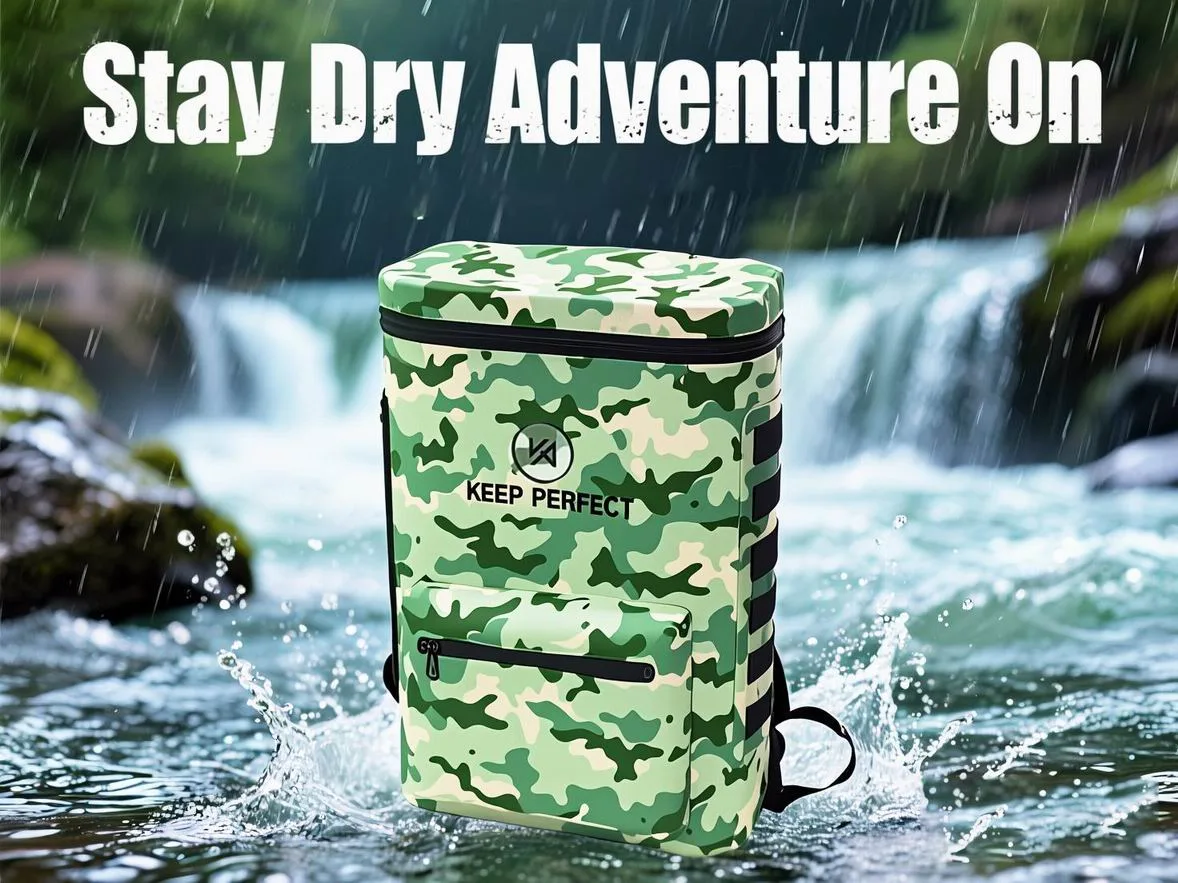
Grit, chalk and the failure mode that ends a day
Chalk is not just a nuisance, it is abrasive and hygroscopic. Magnesium carbonate pulls moisture from the air, so chalk dust left in a fold line becomes a damp paste overnight, and that paste holds grit against the film exactly where the seal has to form. The result is a closure that looks closed and wicks: you find a damp sleeping bag or a damp rope bag the next morning and assume the bag failed, when the truth is that it was closed dirty.
Rinse discipline is the whole solution, and it takes less than a minute. Before any closure, brush the fold line with a dry hand or a soft brush, then wipe it with a damp cloth if water is available. At the end of the day, turn the bag inside out and shake out the chalk. Our grit and buckle guide covers the same mechanism for sand, which behaves identically.
Abrasion against granite: what the numbers say
Abrasion resistance is measured by rubbing a fabric against a standard abrasive under a fixed load until it fails, reported in cycles. A 420D polyester face with a 0.3 mm TPU film typically reaches 1,500 to 2,000 cycles before the coating breaks down. Move to a 500D face with a 0.5 mm film and you see 3,500 to 4,500 cycles, which is the difference between a bag that scuffs and a bag that survives being dragged across a slab.
Denier alone does not buy that improvement, and this is where spec sheets mislead. A 1000D fabric with a thin 0.2 mm coating can abrade worse than a 420D with a heavy 0.5 mm film, because the abrasive contact is with the coating, not with the weave. On rock, buy film thickness first and face fabric second. Detail on the trade-off is in our abrasion guide and the denier comparison.
| Construction | Face fabric | Film thickness | Cycles to coating failure | Suitable for |
|---|---|---|---|---|
| Light roll-top | 210D ripstop | 0.2 mm | 700-1,000 | Indoor gym, sport crag carry |
| Standard roll-top | 420D polyester | 0.3 mm | 1,500-2,000 | Single-pitch days, clean rock |
| Heavy roll-top | 500D polyester | 0.5 mm | 3,500-4,500 | Desert towers, granite slabs |
| Haul bag build | 1000D nylon | 0.8 mm | 6,000-8,000 | Big wall hauling |
| Duffel build | 500D with base panel | 0.5 mm | 4,000-5,000 | Base camp and van |
The approach: carrying a rack, rope and shoes
The approach is where a climbing bag earns or loses its keep. A single rack of 12 quickdraws weighs about 1.2 kg, a 70 m rope is 4.2 to 4.8 kg depending on diameter, a pair of rock shoes is 0.9 kg, and a helmet is 0.35 kg. Add water, food and a shell and a sport day lands at 8 to 10 kg before you touch the rope, which is a load that has to be carried comfortably for 20 to 45 minutes on uneven ground.
That load is why the format matters as much as the closure. A roll-top bag with a proper harness carries 10 kg acceptably; the same bag slung over one shoulder does not. If your approach is longer than about 1.5 km, use a waterproof backpack with welded straps rather than a shoulder-slung roll-top, and put the rope in its own bag so the heaviest single item is not fighting the rest of the kit for space.
At the base: organising gear while you climb
At the base of a route the bag becomes a workspace, and the bag that opens wide and stays open wins. A roll-top rolled fully down and clipped closed keeps everything out but is slow to get into; the working method is to roll it twice, leave it unclipped, and fold the mouth over so dust cannot fall in while the bag stays accessible. This is the one situation where two folds rather than three is correct, because you are protecting against falling dust, not against immersion.
Colour separation helps more than any organiser pocket. Use one bag for the rope, one for the rack and hardware, and one small 5L bag for food, sunscreen and a head torch. The small bag goes in the shade with the water, the hardware bag sits on a jacket rather than directly on grit, and the rope bag stays closed until you flake. Three bags also means the one you are opening constantly stays away from the rope you are about to trust.

Hauling: when a roll-top becomes a haul bag
A roll-top dry bag makes a serviceable haul bag on routes where you are not hauling every pitch. The closure is the advantage: a hauled bag is dragged face-down over rock, and a rolled closure is a smooth surface with nothing to catch, while a zip on the contact face is destroyed in one 30 m haul. Load distribution is the constraint, because a standard roll-top has no frame and no internal structure.
The load path is what you have to solve. A 20L bag holding 14 kg of gear needs the weight carried by welded lash points or a full harness, not by a shoulder strap, because a strap anchor is rated for carrying, not for being dragged. Clip the haul to welded D-rings that are part of the bag structure, tape the closure so it cannot unroll under vibration, and accept that a lightweight roll-top is a one-season answer to a job that a dedicated haul bag does for ten.
Size selection by climb type and day length
Volume follows what you carry, and the rope dominates everything. A 70 m single rope packs to about 5.5 litres coiled or 4.8 litres in a tight stuff sack; a half-rope pair is 7 to 8 litres. Once the rope has its own bag, the remaining kit for a sport day is 6 to 8 litres, which is a 10L bag. A trad day with a full rack, a second rope and belay gear is 14 to 18 litres, which is a 20L.
Multi-pitch and alpine days add clothing and water volume rather than hardware, because you carry a belay jacket, a shell and 2 to 3 litres of water. That pushes a comfortable alpine day to 25 to 30 litres. Big-wall and multi-day work is a different category entirely and belongs in a dedicated haul bag of 40 litres or more, not in a dry bag that happens to be large.
| Climb type | Rope solution | Kit volume | Total packed weight | Recommended bag |
|---|---|---|---|---|
| Gym session | None | 3-4 L | 2.5-3.5 kg | 1 x 5L |
| Sport crag day | Own rope bag, 5.5 L | 6-8 L | 7-9 kg | 1 x 10L in a pack |
| Trad single pitch | Own rope bag, 5.5 L | 12-14 L | 10-12 kg | 1 x 20L |
| Multi-pitch day | Own rope bag, 6.5 L | 18-22 L | 12-15 kg | 1 x 25L or 30L |
| Alpine rock day | Half ropes, 8 L | 22-26 L | 14-17 kg | 1 x 30L + 1 x 10L |
| Big wall, 2 days | Haul line, separate | 40-55 L | 25-35 kg | Dedicated haul bag |

Water, food and chalk: what goes where
Water belongs outside the main kit bag on a dusty crag, because a leak inside a bag that also holds chalk produces a paste that takes real scrubbing to remove. Carry bottles in external sleeves or in a separate small bag, and keep the chalk bag out of the dry bag entirely: magnesium carbonate inside a waterproof bag is a contaminant, not cargo.
Food is the opposite case and should be sealed. A 5L bag holds a day of food for two climbers, and keeping it closed means it stays free of grit and stays dry if an afternoon storm comes through. Pack it at the top of the main bag so it is the first thing you reach for, and keep one bar and one litre of water in a jacket pocket so hydration does not depend on unpacking anything.
Straps, lash points and clipping to a harness
Attachment hardware on a climbing bag has to do two jobs that pull against each other: carry 12 kg comfortably on an approach and release cleanly when you are hanging on a bolt. A welded D-ring on the side panel takes a locking carabiner and holds a static load well; a shoulder strap alone does not, because the bag swings and the strap slides on a harness.
Avoid clipping a loaded bag to a harness haul loop at the belay. A 10 kg bag hanging from a haul loop pulls the harness waistband down and makes it uncomfortable within minutes, and it puts a shock load on the loop the harness was not designed for. Clip the bag to the anchor with a short sling instead, and keep it below the belayer so nothing you drop lands on them.
Care after a day on granite
Clean the bag the same day, while the chalk is still dry and loose. Chalk that has been pressed into the film by a day of carrying then left for a week becomes a bonded layer that needs real scrubbing, and scrubbing is what dulls a TPU surface and gives dust somewhere to grip. A soft brush and thirty seconds at the end of the day prevents all of it.
- Empty the bag completely and shake out chalk and grit while it is still dry.
- Brush the fold line with a soft brush, then wipe with a damp cloth and dry it.
- Rinse the whole bag with fresh water at ambient temperature; never use a hose on full pressure.
- Check welded corners and lash points for any lift after a day of dragging.
- Dry open in shade, then store loosely rolled with the buckle unclipped.
Chalk residue left in a bag becomes mildly alkaline when wet and is worth removing properly rather than wiping at. A solution of about 5 ml of pH-neutral soap per litre of lukewarm water, applied with a soft cloth, removes chalk film without touching the TPU. Rinse thoroughly, because soap residue attracts dust the next time you use the bag, and that dust is exactly what you were removing.
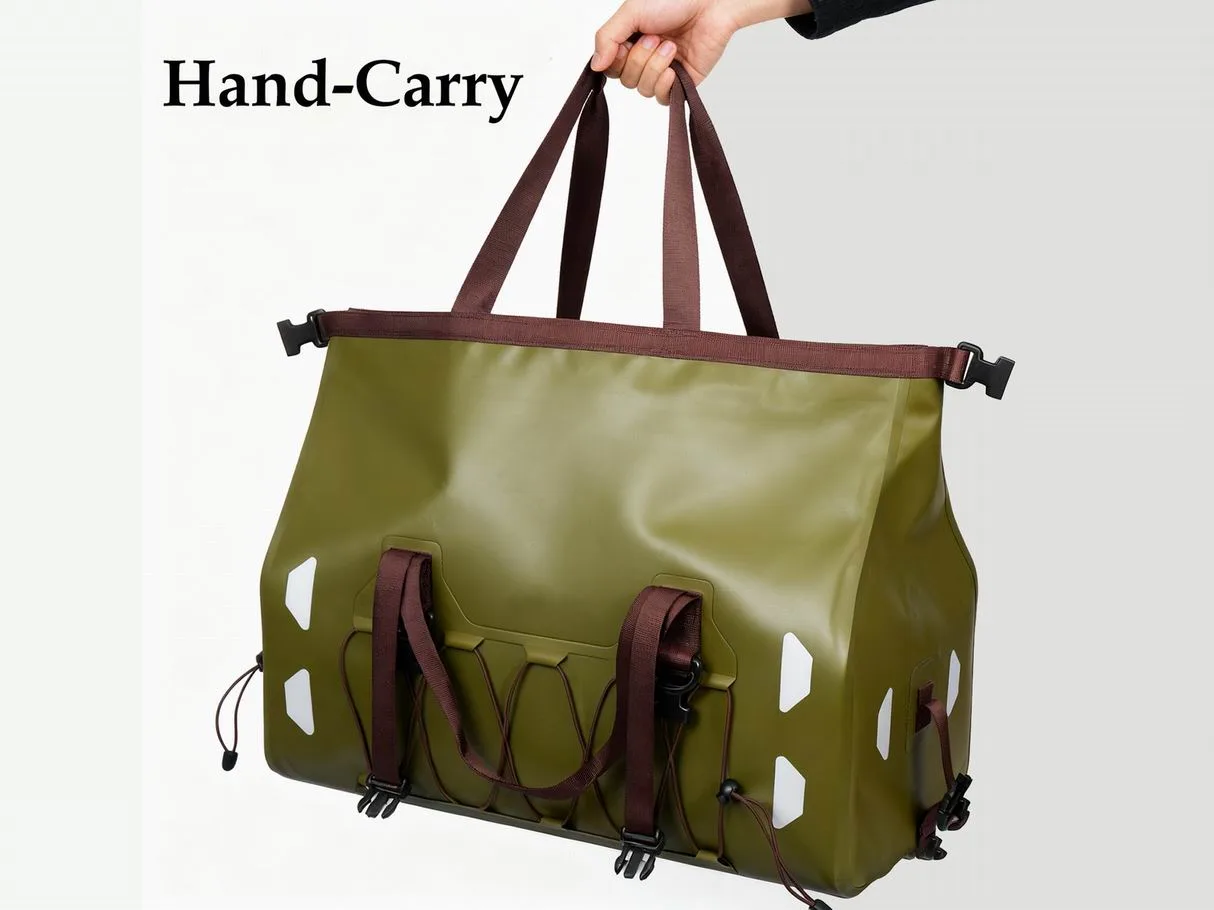
Weight, comfort and the approach load
Approach comfort is governed by load transfer, not by padding thickness. A 10 kg load carried with the bag high and close to the back costs far less energy than the same load carried low and away from the body, which is the reason a harness with a sternum strap and a load lifter matters more than foam density. Aim to keep the bag under 12 kg for any approach longer than 30 minutes.
Split the weight if you cannot reduce it. Rope in one bag, hardware in another, and alternate carriers on a long walk-in; two 6 kg bags carried by two people are quicker than one 12 kg bag carried by one person, and the rope bag can be swapped between climbers without unpacking anything. Our waterproof backpack range uses the same welded strap anchors as the roll-top line, so a mixed system shares one rating.
Checklist for a climbing dry bag
- Choose a roll-top over a zip: no teeth, no slider, nothing for grit to jam.
- Buy film thickness before denier: 0.5 mm on a 500D face for granite and desert rock.
- Give the rope its own bag; it is the single heaviest and bulkiest item you carry.
- Use three bags on a trad day: rope, hardware, and a 5L for food and water treatment.
- Rinse the fold line before every closure; chalk paste is the number one cause of a damp bag.
- Clip a haul to welded D-rings, never to a shoulder strap, and never to a harness haul loop.
- Keep chalk out of the bag entirely and water in an external sleeve.
- Confirm the build against the product line before a season of abuse.
Clubs, guiding operations and retail ranges buy the same bags with a different brief, and the five lines that matter are identical: film thickness, face fabric, closure design, lash point rating and the test standard behind the waterproof claim. We have built welded waterproof bags since 2014 in an SGS-verified 4,950 m2 facility running seven lines, with a 500-piece minimum and sampling in 6 to 10 working days; the process is documented and bulk runs 35 to 50 days from FOB Xiamen at AQL 2.5.
Safety equipment is a separate category from dry storage, and a dry bag must never be treated as part of a protection or belay system. Hardware strength and textile testing methods for climbing equipment are published by ASTM International and ISO, and anything load-bearing in a fall should carry a certification to that standard rather than a kilogram claim. For weather planning on exposed routes, NOAA forecasts are the reference for wind, temperature and afternoon storm risk.
Three guides round this out. The rope sizing guide gives exact volumes by rope diameter and length, the thru-hiking comparison covers the long-approach format in more depth, and the backpacking care guide handles dust and sweat over a long trip. Our roll-top range includes the 0.5 mm builds that survive granite, and the weekend sizing guide applies when the climbing trip runs to two days.
Frequently asked questions
Q1. Why is a roll-top dry bag better than a zip dry bag for climbing?
Because chalk and granite dust jam zip teeth and sliders, while a rolled closure has no mechanism to jam. A roll-top also presents a smooth face when dragged, so it survives hauling, and grit on the fold rinses off in seconds.
Q2. What size dry bag do I need for a sport climbing day?
A 10L bag for kit once the rope has its own sack. A 70 m single rope packs to about 5.5 litres, shoes and harness to 2.5 litres, and food, water and a shell to 4 litres, so 8 litres of kit needs a 10L.
Q3. Can I use a dry bag as a haul bag?
For occasional pitches, yes: a roll-top is smooth on the rock face and the closure will not catch. Clip the haul to welded D-rings rather than a shoulder strap, tape the closure against vibration, and expect a lightweight bag to last one season of regular hauling.
Q4. Will chalk damage a dry bag?
Chalk is abrasive and holds moisture, so chalk dust left in a fold line becomes a paste that holds grit against the film and stops the closure sealing. Brush and wipe the fold before every closure and shake the bag out at the end of the day.
Q5. What film thickness should a climbing dry bag use?
0.5 mm TPU on a 500D face for granite, sandstone and desert rock; 0.3 mm on 420D is fine for a gym bag or a clean sport crag. Film thickness resists abrasion better than denier does, because the abrasive contact is with the coating.
Q6. How much does a full trad rack and rope weigh?
A 12-draw rack is about 1.2 kg, a 70 m single rope 4.2 to 4.8 kg, shoes 0.9 kg and a helmet 0.35 kg. With food, water and a shell, a trad day runs 10 to 12 kg, which is the practical limit for a comfortable approach.
Q7. Can I clip a dry bag to my harness?
Not a loaded one. A 10 kg bag on a haul loop pulls the waistband down and shock-loads a loop not designed for it. Clip the bag to the anchor with a short sling and keep it below the belayer.
Q8. Should the rope go inside the main dry bag?
No. Give the rope its own bag: it is the heaviest and bulkiest item, it is often damp, and keeping it separate means the bag you open twenty times a day never touches the rope you are about to trust.
Q9. Do dry bags survive being dragged over rock?
A 0.5 mm build does, for roughly 3,500 to 4,500 standard abrasion cycles. A 0.3 mm build scuffs at 1,500 to 2,000. The failure is at welded corners and at the fold, so check both after a day of dragging.
Q10. How do I clean chalk out of a dry bag?
Shake out dry chalk first, then wipe with 5 ml of pH-neutral soap per litre of lukewarm water on a soft cloth. Rinse thoroughly, because soap residue attracts dust, and dry open in shade.
Q11. Is a dry bag waterproof enough for an alpine storm?
Yes for immersion-grade welded bags rated IPX7, which covers 30 minutes at one metre. What a dry bag will not do is protect against sustained abrasion in a storm, so keep the bag off rock during high wind.
Q12. Should water bottles go inside the dry bag?
No. A leak inside a bag that also holds chalk makes a paste that is hard to remove, and wet bottles sweat onto adjacent kit. Carry bottles in external sleeves or a separate small bag.
Q13. What is the best bag format for a long approach?
A waterproof backpack with welded shoulder straps, load lifters and a sternum strap. Above about 12 kg or 1.5 km, a shoulder-slung roll-top becomes uncomfortable and shifts constantly on uneven ground.
Q14. Can I put climbing shoes in a dry bag?
Yes, but let them dry first. Sealed damp shoes produce condensation and odour inside the bag, and the rubber soles abrade the film if the bag is carried far. A small 5L bag keeps shoes away from clothing.
Q15. How many bags should a climbing day use?
Three: one for the rope, one for hardware and rack, and a 5L for food, sunscreen and a head torch. Separation keeps grit out of food and keeps the bag you open constantly away from the rope.
Q16. Do roll-top bags work at the base of a route?
Very well. Roll twice and leave the mouth folded over rather than clipped: it keeps falling dust out while staying quick to open, and two folds is enough protection against dust because immersion is not the risk at the base.
People also ask
Are dry bags good for rock climbing?
Yes, particularly roll-top bags, because there are no zip teeth for chalk and granite dust to jam. Choose 0.5 mm TPU on a 500D face for abrasive rock and give the rope its own separate bag.
What size dry bag for climbing gear?
A 10L bag covers a sport day once the rope has its own sack, a 20L covers a trad day with a full rack, and 25L to 30L suits a multi-pitch or alpine day with extra clothing and water.
How do you keep chalk out of a dry bag?
Keep the chalk bag out of the dry bag entirely, brush the fold line before every closure, and shake the bag out dry at the end of the day. Chalk holds moisture and turns into a paste that stops the seal forming.
Can you haul a dry bag up a climb?
Yes for occasional pitches. Clip to welded D-rings rather than a strap, tape the rolled closure so vibration cannot unroll it, and expect a lightweight bag to wear faster than a dedicated haul bag.
Why does my dry bag get damp inside at the crag?
Chalk paste or grit in the fold line, in almost every case. The closure looks closed but a gap of a millimetre wicks water through. Brush and wipe the fold before closing and rinse it at the end of the day.
Do climbing dry bags need welded seams?
Yes. Stitched seams perforate the fabric and let dust and water through at exactly the points that are dragged over rock. Welded seams also have no thread to abrade against granite.
Need this in production volume?
QUANZHOU JUNYUAN BAGS has produced waterproof bags since 2014 in an SGS-verified 4,950 m2 facility in Fujian, China. Minimum order 500 pieces, sampling in 6–10 working days, bulk in 35–50 days, FOB Xiamen — write to service@junyuanbags.com with your spec and target market.