Home / Blog / Capacity & Sizing
Dry Bag Size for a Climbing Rope
A 60 m single rope packs into 8 to 12 litres depending on diameter, which means the right dry bag is a 15 L for a 9.5 mm rope, a 20 L for a 10.2 mm rope, and a 25 L if you want the quickdraws, belay device and a light shell in the same bag. Always buy one size up from the raw rope volume, because a roll-top closure costs 2.5 to 4 litres of usable space and a rope stuffed to full fill will not close.
This guide gives the volume and weight figures for every common diameter from 8.5 mm to 11 mm at lengths from 30 m to 80 m, explains why coiling and stuffing produce different numbers, and shows how dry treatment changes both weight and packed size. Use the tables to size a bag from the rope you already own rather than guessing from a capacity label.
- Rope volume is not the same as rope bag volume
- Diameter and length: the volume matrix
- Dry treatment changes weight and handling
- Coiling versus stuffing: what really changes
- Wet rope weight and the carry penalty
- Choosing a bag size from the rope you own
- Rope bag features that matter more than size
- Half ropes, twins and doubles
- Canyon rope bags compared with crag bags
- Straps, harness and carrying the rope bag
- Keeping grit and water away from the rope
- Sizing checklist for a rope bag purchase
Rope volume is not the same as rope bag volume
A rope is a cylinder of twisted nylon, and its true material volume is easy to calculate: the cross-sectional area multiplied by the length. A 9.5 mm rope at 60 m contains roughly 4.3 litres of nylon. But rope does not pack as a solid; it packs as a tangle of loops with air between them, and the packing efficiency of a stuffed rope stack is typically 50 to 60 percent.
That efficiency figure is the whole reason rope bags are bigger than rope volumes. A rope holding 4.3 litres of material occupies 7.5 to 8.5 litres when stuffed, and closer to 9 or 10 litres when it is new and stiff and has not yet learned the shape of the bag. A rope that has been packed in the same bag for a season will pack tighter, sometimes by a litre, which is one reason a bag that felt too small at first becomes comfortable later.
Then there is the closure. A roll-top bag loses usable volume to the folds themselves, and the loss scales with bag circumference rather than with nominal capacity. On a 15 L bag that loss is typically 2.0 to 2.8 litres; on a 25 L bag it is 3.0 to 4.0 litres. Our capacity loss explainer sets out the geometry behind those numbers for anyone specifying a bag precisely.
Diameter and length: the volume matrix
Diameter dominates the answer because volume rises with the square of the radius. Moving from a 9.5 mm rope to a 10.2 mm rope is a 7 percent increase in diameter and a 15 percent increase in volume, which is often enough to push you up a bag size. Length scales linearly, so an 80 m rope needs about a third more space than a 60 m rope of the same diameter.
The table below gives dry weight and typical stuffed volume for single ropes across the common range. Dry weights are for untreated ropes; dry-treated ropes are marginally heavier but handle very differently when wet, which the next section covers. Treat the volume column as the number to size your bag from, not the nominal rope length.
| Rope | Dry weight | Material volume | Stuffed volume | Recommended dry bag |
|---|---|---|---|---|
| 8.5 mm x 60 m | 2.6 kg | 3.4 L | 6.0-7.0 L | 10 L |
| 9.0 mm x 60 m | 3.0 kg | 3.8 L | 6.8-7.8 L | 12 L or 15 L |
| 9.5 mm x 60 m | 3.5 kg | 4.3 L | 7.5-8.5 L | 15 L |
| 9.8 mm x 70 m | 4.3 kg | 5.3 L | 9.2-10.4 L | 20 L |
| 10.2 mm x 60 m | 4.3 kg | 4.9 L | 8.6-9.8 L | 20 L |
| 10.5 mm x 70 m | 5.3 kg | 6.1 L | 10.5-12.0 L | 25 L |
| 11.0 mm x 60 m | 4.9 kg | 5.7 L | 10.0-11.5 L | 25 L |
| 11.0 mm x 80 m | 6.5 kg | 7.6 L | 13.0-15.0 L | 30 L |
Read the recommended bag column as the minimum comfortable size, not the tightest possible fit. A 9.5 mm rope will physically go into a 10 L bag if you stuff it hard, but you will not close the roll-top cleanly, and a closure that will not make three folds is not waterproof. Choose the size that lets the bag close with one hand.

Dry treatment changes weight and handling
Dry-treated ropes carry a hydrophobic finish on the sheath and usually on the core as well. The treatment adds 3 to 6 percent to the dry weight, so a 3.5 kg untreated rope becomes 3.6 to 3.7 kg treated, and it adds nothing measurable to the packed volume. Where it matters is water absorption, which is a large number on an untreated rope.
Nylon absorbs water into the fibre itself, and an untreated 60 m rope can gain 30 to 45 percent of its dry weight when fully soaked. That is an extra 1.0 to 1.6 kg on a 3.5 kg rope, carried out of the crag in the rain or after a wet alpine descent. A dry-treated rope typically gains only 8 to 15 percent in the same conditions, which is a saving of roughly a kilogram on the walk out.
| Rope type | Dry weight, 60 m | Weight after full soak | Gain | Drying time indoors |
|---|---|---|---|---|
| Untreated 9.5 mm | 3.5 kg | 4.5-5.1 kg | 30-45% | 48-72 h |
| Sheath treated 9.5 mm | 3.6 kg | 4.1-4.3 kg | 14-20% | 36-48 h |
| Fully dry treated 9.5 mm | 3.7 kg | 4.0-4.2 kg | 8-15% | 24-36 h |
| Untreated 10.2 mm | 4.3 kg | 5.6-6.2 kg | 30-45% | 60-84 h |
| Fully dry treated 10.2 mm | 4.5 kg | 4.9-5.2 kg | 8-15% | 30-42 h |
| Half rope pair, 8.0 mm x 60 m | 5.4 kg | 7.0-7.8 kg | 30-45% | 72-96 h |
The drying column has a practical consequence for bag choice. A wet rope placed in a sealed dry bag stays wet for days, and nylon left damp in a warm bag will develop mildew and odour within about a week. If you expect to pack a wet rope, use a bag with a drain point or leave the closure loose for the walk out, then dry the rope properly at home.
Coiling versus stuffing: what really changes
There are two ways to get a rope into a bag and they produce different volumes and very different outcomes on the rock. Coiling produces a neat, repeatable package that packs tighter, typically 8 to 15 percent smaller than a random stuff, and it pays out badly unless you flake it first. Stuffing produces a looser package that occupies more space but feeds out cleanly for the first pitch.
The best method for a dry bag is a hybrid: stuff the first third of the rope so it feeds immediately, then coil or loosely loop the remainder. On a 60 m rope this gives a bag that opens at the belay and feeds without a full re-flake, which is worth more than the litre of space saved by a tight coil. Competent teams often mark the middle with a bight hanging outside the closure.
| Packing method | Volume on a 9.5 mm x 60 m | Payout quality | Time to pack | Best use |
|---|---|---|---|---|
| Tight butterfly coil | 7.2 L | Poor without re-flaking | 3-4 min | Storage and transport |
| Loose loop stack | 7.8 L | Fair | 2 min | Multi-pitch with one long pitch |
| Random stuff | 8.5 L | Excellent for first 20 m | 45 s | Single pitch cragging |
| Hybrid stuff then loop | 8.0 L | Good throughout | 2 min | General purpose |
| Rope bag with integrated tarp | 9.0 L | Excellent | 90 s | Sport climbing on dirty ledges |
Notice that the differences between methods are smaller than the difference between a new and a well-used rope. Expect the first few trips with a new rope to be the tightest, and do not size a bag down to fit a rope that has not yet broken in. One litre of slack at the start is worth a season of easy packing.
Wet rope weight and the carry penalty
The carry penalty of a wet rope is larger than most climbers expect, and it arrives at exactly the wrong moment: at the end of the day, on the descent, when it is raining. An untreated 9.5 mm rope that started at 3.5 kg leaves the crag at 4.5 to 5.1 kg. Add a wet harness, wet shoes and a wet rack and the descent load is routinely 2 to 3 kg heavier than the morning load.
That penalty also changes the bag itself. Water in the bottom of a sealed bag adds weight and sloshes, and it dramatically accelerates wear on the film at the base because the rope is now heavier and grinding against a wet surface. If there is any chance of packing wet, choose a bag with a reinforced base panel rather than the lightest option available, and consider a drain grommet.
For alpine and ice climbing the penalty is compounded by freezing. A rope that is wet when it goes into the bag and then frozen overnight becomes a stiff coil that will not pay out, and it can be impossible to flake until it thaws. Plan to carry the rope outside the pack in sub-zero conditions, or accept that the first pitch of the day will involve wrestling a frozen coil.
Choosing a bag size from the rope you own
Work backwards from the rope rather than forwards from a bag you already have. Measure the stuffed volume rather than trusting the diameter: pack the rope into a bucket of known volume, or use the table above and add 10 percent if the rope is new. Add the roll-top loss for the bag circumference you are considering, then add 1 litre of slack so the closure closes easily.
Decide next whether anything else travels with the rope. Quickdraws and a belay device add 1.2 to 2.0 kg and about 1.5 litres, and they are the items most likely to damage the bag from inside if they are loose. If the rack travels in the rope bag, move up one size and put the hardware in a small padded pouch so carabiner gates cannot work against the film.
Our 20 litre capacity notes and the full capacity guide show the same rope in three different bag families, which is the fastest way to see how much the closure geometry changes the answer. Where two sizes both look plausible, the comparison guide gives a decision rule that does not depend on guessing.
Rope bag features that matter more than size
Once the volume is right, four features determine whether the bag works on real rock. A wide, stiffened mouth that stays open while you stuff. A reinforced or double-thickness base panel, because that is where a 4 kg rope grinds. Welded or protected drain points at the bottom. And an external compression system that lets you shrink the bag when the rope is not full length.
The mouth is the most underrated of these. A floppy mouth on a dry bag means you need three hands: two to hold it open and one to feed rope. A stiffened collar or a semi-rigid insert solves that at a cost of perhaps 60 grams. On a windy belay ledge that 60 grams is the difference between a two-minute pack and a five-minute fight.
Compression straps do double duty. They let one bag serve a 60 m and a 70 m rope, and they stop the rope mass from slumping to one side during the approach, which is what makes a rope bag feel heavier than it is. Two straps compressing a 20 L bag down to 14 L of effective volume also stabilise the load against your back on a scrambly approach.
Half ropes, twins and doubles
Double and twin systems roughly double the packing problem. A pair of 8.0 mm half ropes at 60 m weighs about 5.4 kg dry and packs to 11 to 13 litres, which puts you in a 20 L or 25 L bag. The temptation is to pack each rope separately in a 10 L bag; that works well, because it also lets the team split the load on the approach rather than one person carrying 5.4 kg.
There is a real argument for the split: two 10 L bags are easier to strap to a pack, easier to hand between climbers, and give redundancy if a closure fails. The counter-argument is that at the belay you want both ropes accessible from one place. Most teams settle on two bags for the approach and repack into one at the base, which is a reasonable compromise.
| System | Total dry weight | Total stuffed volume | One bag | Two bags |
|---|---|---|---|---|
| Single 9.5 mm x 60 m | 3.5 kg | 7.5-8.5 L | 15 L | Not needed |
| Single 10.2 mm x 70 m | 5.0 kg | 10.0-11.5 L | 20 L | 2 x 12 L |
| Half pair 8.0 mm x 60 m | 5.4 kg | 11.0-13.0 L | 20 L or 25 L | 2 x 10 L |
| Twin pair 7.5 mm x 60 m | 4.8 kg | 10.0-12.0 L | 20 L | 2 x 10 L |
| Half pair 8.5 mm x 70 m | 6.6 kg | 13.5-15.5 L | 25 L or 30 L | 2 x 12 L |
| Triple rated 9.0 mm x 80 m | 4.1 kg | 9.0-10.5 L | 20 L | Not needed |
Canyon rope bags compared with crag bags
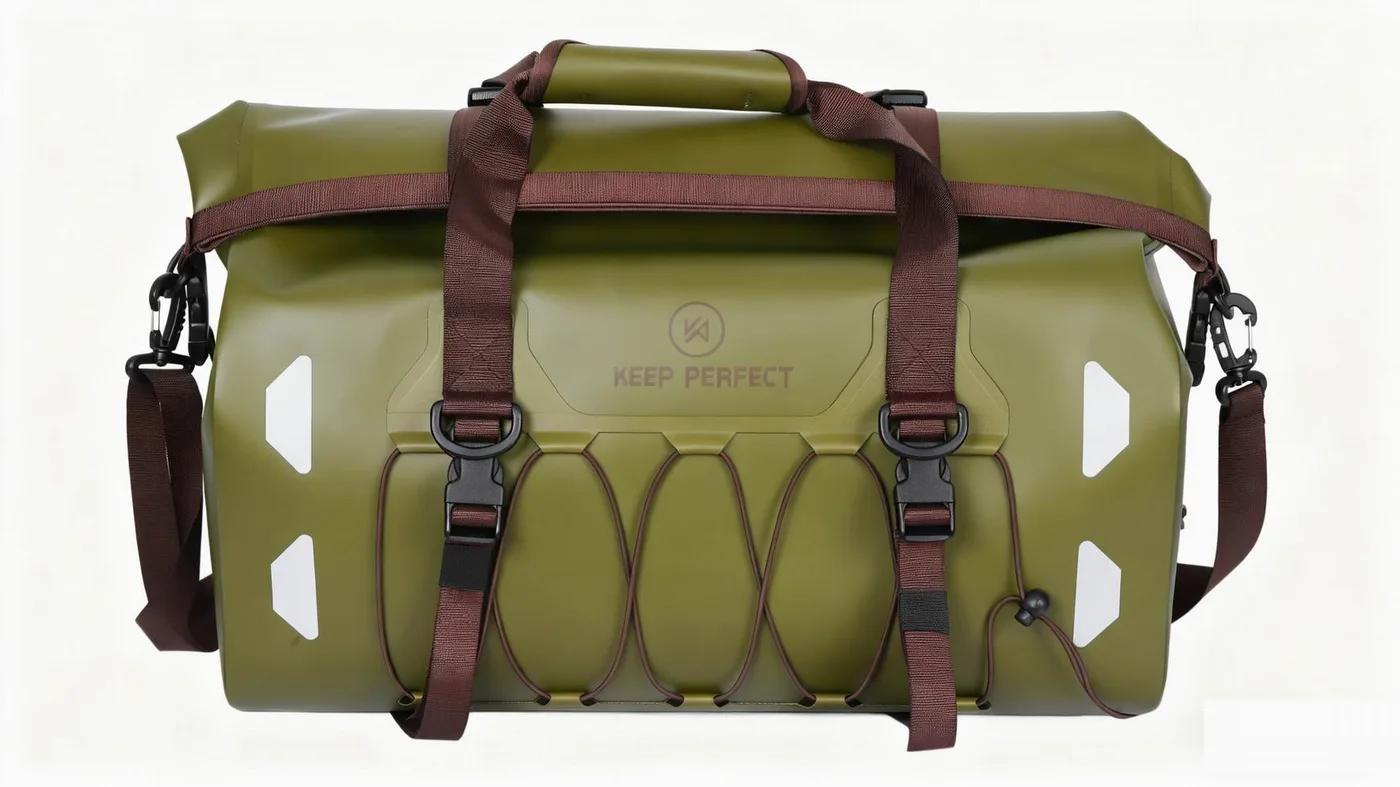
Canyon and crag rope bags solve different problems and are not interchangeable. A crag bag prioritises a clean payout and protection from dirt on a ledge, usually with an integrated tarp and a shoulder carry. A canyon bag prioritises drainage, abrasion resistance and the ability to be strapped to a pack while submerged, and it needs a reinforced base and drain holes.
Waterproofness matters differently too. On a crag, a rope bag that lets rain in is annoying; the rope dries at home. In a canyon, a rope bag that fills with water becomes a 4 kg anchor dragging behind a swimmer, and that is a safety problem rather than a comfort one. Choose a roll-top dry bag with drain points for canyon work, and never seal a rope bag underwater. Our canyon packing list covers the rest of that load.
The one place the two overlap is alpine climbing, where a rope may need to be carried outside the pack in spindrift and then packed wet. A mid-size roll-top with a drain grommet and compression straps serves both roles adequately, and it is the bag most climbers should buy if they only want one.

Straps, harness and carrying the rope bag
A 4 to 6 kg rope bag is a genuinely awkward load, and how it hangs matters more than how much it weighs. Carried high and close to the spine it is unremarkable; carried low or on a single shoulder strap it swings on every step and feels several kilograms heavier. Use a bag with twin padded straps, or strap it to the outside of a pack rather than carrying it separately.
Strap the bag to the top or the side of a pack rather than the bottom. A rope bag on the bottom gets soaked every time you set the pack down and is the first thing abraded when you scramble. Top mounting keeps the weight high and close, which is also the correct position for the heaviest item in any load, and it keeps the bag out of standing water at the base of the route.
For short approaches of under 500 m, a single strap slung across the body is fine and much faster to shrug off at the base. Beyond about 1 km, or on anything scrambly, use a proper harness. A swinging 5 kg bag changes your balance on a downclimb, and balance is what keeps you upright on loose ground. Load limits for straps and anchors are covered in our harness notes.
Keeping grit and water away from the rope
Rope damage comes from grit inside the sheath far more than from water. Sand and rock dust work between the strands and cut the core filaments from the inside every time the rope is loaded and flexed. Keeping a rope out of the dirt is the single most effective thing you can do for its service life, and it is entirely within your control.
A dry bag helps, but the bag itself has to stay clean. Rinse the inside of a rope bag at the end of a dusty day, let it dry fully before the rope goes back in, and check the base panel for embedded grit. A bag with sand in the bottom will abrade the rope sheath every time you carry it, which is the opposite of what you bought the bag for.
- Flake or stuff the rope onto a tarp or the bag itself, never directly onto ground.
- Keep the rope bag closed at the belay so spindrift and dust stay out.
- Rinse the bag interior after every dusty or sandy day and dry it fully before reloading.
- Store the rope loosely, not compressed, and never store it wet in a sealed bag.
- Check the base panel for embedded grit; it abrades the sheath on every carry.
- Replace a rope bag once the base film thins, because that is where the rope grinds hardest.
Sizing checklist for a rope bag purchase
Sizing a rope bag is a five-step calculation and it takes about two minutes. Measure or look up the stuffed volume of your rope, add the roll-top loss for the bag family, add the volume of anything travelling with the rope, add one litre of slack, and then round up to the next available size. Do the calculation once and it holds for the life of the rope.
- Confirm rope diameter and length, then read the stuffed volume from the matrix above.
- Add 2.0 to 4.0 litres for the roll-top folds, depending on bag circumference.
- Add 1.5 litres if quickdraws and a belay device travel in the same bag.
- Add 1.0 litre of slack so the closure closes one-handed at the end of a long day.
- Check that the base panel is reinforced and that any drain point is welded rather than punched.
- Confirm the strap system can carry the wet weight, not just the dry weight.
Teams and retail buyers building a rope bag range should specify from this checklist rather than from a nominal litre figure, because the same rope fits comfortably in one 20 L bag and not at all in another. Our line has been produced since 2014 in an SGS-verified 4,950 m2 facility with seven production lines and a 500-piece minimum.Test methods for rope and textile measurement are published by the ISO and the ASTM.
Start from the roll-top dry bag range for the size families that suit ropes, then check the fit against our capacity measurement method before committing to a volume. Climbers who also work in wet canyons should cross-check with the canyon list, because drainage and abrasion resistance change the recommendation.
Frequently asked questions
Q1. What size dry bag fits a climbing rope?
A 60 m 9.5 mm rope packs to 7.5 to 8.5 litres, so a 15 L dry bag is the right choice. A 10.2 mm rope needs 20 L, and anything above 70 m or a half-rope pair needs 25 L or a pair of 10 L bags.
Q2. Will a 60 m rope fit in a 10 L dry bag?
Only if you stuff it hard, and then the roll-top will not make three clean folds. A 10 L bag suits a slim 8.5 mm rope; for a 9.5 mm rope buy 15 L so the closure seals.
Q3. How much volume does a roll-top closure cost?
About 2.0 to 2.8 litres on a 15 L bag and 3.0 to 4.0 litres on a 25 L bag. The loss scales with bag circumference, not with nominal capacity.
Q4. Does a dry-treated rope pack differently?
Volume is unchanged, and dry weight rises only 3 to 6 percent. The real difference is water absorption: 8 to 15 percent gain when soaked against 30 to 45 percent for an untreated rope.
Q5. How heavy is a wet climbing rope?
An untreated 9.5 mm x 60 m rope goes from 3.5 kg dry to 4.5 to 5.1 kg fully soaked. A fully dry-treated rope of the same size gains only about 0.3 to 0.5 kg.
Q6. Should I coil or stuff a rope into a dry bag?
Use a hybrid: stuff the first third so it feeds immediately, then loosely loop the rest. A tight coil packs 8 to 15 percent smaller but pays out badly without re-flaking.
Q7. What size bag for a pair of half ropes?
A pair of 8.0 mm x 60 m half ropes weighs 5.4 kg and packs to 11 to 13 litres. One 20 L or 25 L bag works, but two 10 L bags let the team split the load on the approach.
Q8. Can I put quickdraws in the rope bag?
Yes, but move up one bag size and keep the hardware in a padded pouch. Loose carabiner gates work against the film from inside and are a common cause of internal damage.
Q9. Do I need a waterproof bag for a climbing rope?
Not strictly, but a roll-top keeps grit out, which matters more than water. Grit inside the sheath cuts core filaments every time the rope flexes under load.
Q10. How do I stop a rope bag smelling?
Never store a wet rope in a sealed bag. Nylon left damp in a warm bag develops mildew and odour within about a week, so dry the rope fully before it goes back in.
Q11. Should a rope bag have drain holes?
For canyon and alpine use, yes. A sealed bag that fills with water becomes a 4 kg anchor. For cragging on dry rock, sealed is fine and keeps dust out.
Q12. Where should I strap a rope bag on a pack?
On the top, high and close to the spine. Bottom mounting soaks the bag every time you set the pack down and abrades it when you scramble.
Q13. How much does an 80 m rope weigh and pack?
An 11 mm x 80 m rope weighs about 6.5 kg and packs to 13 to 15 litres, which needs a 30 L bag. A 9.8 mm x 70 m is 4.3 kg and 9.2 to 10.4 litres, needing 20 L.
Q14. Is a duffel or roll-top better for a rope?
A roll-top suits most climbers because it closes one-handed and compresses down. A duffel opens along its length, which suits a long coil but needs two hands and a flat surface.
Q15. What wears out first on a rope bag?
The base panel. A 4 kg rope grinds against the bottom on every carry, so choose a reinforced base and retire the bag once that film thins.
Q16. How much slack should I leave when sizing?
One litre beyond the calculated figure. It lets the closure close one-handed at the end of a long day and absorbs the extra volume of a rope that has not yet broken in.
People also ask
How do you size a dry bag for a climbing rope?
Take the stuffed volume of the rope, add 2 to 4 litres for the roll-top folds, add 1.5 litres if rack travels with it, then 1 litre of slack and round up. A 9.5 mm x 60 m rope lands on 15 L.
What fits in a 20 L dry bag for climbing?
A 9.8 mm x 70 m or 10.2 mm x 60 m rope at 8.6 to 10.4 litres, plus a light shell and a small rack. Add the roll-top loss and the rack and 20 L is full.
How much does a 60 m climbing rope weigh?
Between 2.6 kg for an 8.5 mm and 4.9 kg for an 11 mm, typically 3.5 kg for a 9.5 mm. Soaked, an untreated rope gains 30 to 45 percent of that weight.
Can you put a wet rope in a dry bag?
Yes for the walk out, but dry it fully before storage. Nylon left damp in a sealed warm bag develops mildew and odour within about a week.
Does a thicker rope need a much bigger bag?
Yes, because volume rises with the square of the radius. Going from 9.5 mm to 10.2 mm is a 7 percent diameter increase but a 15 percent volume increase, often enough to move up a size.
Are rope bags worth it for sport climbing?
Yes, mainly for grit protection rather than waterproofing. Keeping a rope off the ground doubles the useful life of the sheath, and a bag with an integrated tarp does that best.
Need this in production volume?
QUANZHOU JUNYUAN BAGS has produced waterproof bags since 2014 in an SGS-verified 4,950 m2 facility in Fujian, China. Minimum order 500 pieces, sampling in 6–10 working days, bulk in 35–50 days, FOB Xiamen — write to service@junyuanbags.com with your spec and target market.