Home / Blog / Waterproof Technology
Saltwater vs Freshwater Testing
Standard seawater carries about 35 grams of dissolved salt per litre, and that single change shifts density from 0.998 to 1.025 grams per cubic centimetre, raising hydrostatic pressure at one metre from 9.79 to 10.05 kPa, a difference of 2.7%. Surface tension moves the other way, from roughly 72.0 to 72.9 millinewtons per metre, which makes seawater very slightly less eager to wet a seam. Taken together those physics say a freshwater immersion is marginally the more aggressive test, and the difference matters far less than what happens afterwards, once the water has evaporated.
Two following effects dominate real results. The first is conductivity: seawater conducts around 4.8 siemens per metre against perhaps 0.005 for tap water, so a conductivity probe finds a pinhole that a visual freshwater check misses entirely. The second is crystallisation, because sodium chloride begins absorbing moisture above about 75% relative humidity and keeps a seam permanently damp. This guide sets out the property differences, a comparable protocol for both media, cycle counts that produce decisions, and the specification wording that prevents arguments later.
- What 35 grams per litre actually changes
- Density and hydrostatic pressure: a small arithmetic difference
- Surface tension and viscosity: the capillary argument
- Conductivity: how a leak becomes measurable
- Salt crystals after drying: the delayed failure
- Chloride attack on hardware: what to specify
- Biofouling, sunscreen and the chemical edge cases
- A saltwater immersion protocol that yields usable data
- How a freshwater protocol differs in practice
- Cycle counts and how to compare results
- Field versus tank: what a coastline adds
- Writing the test into a specification
What 35 grams per litre actually changes
Open-ocean salinity sits close to 35 practical salinity units, which is the figure oceanographers quote and the number worth putting in a test report because results are meaningless without it. Estuaries and tidal rivers can run anywhere from 0.5 to 30, so a bag tested in a brackish marina is not being tested in seawater at all. Recording salinity, temperature and the date of collection costs minutes and prevents the most common cause of non-comparable data between two laboratories.
Composition matters as much as concentration. Of those 35 grams roughly 27 grams is sodium chloride, 3.8 grams is sulphate, 1.3 grams is magnesium and smaller amounts of calcium, potassium and bicarbonate follow. Magnesium and calcium drive scale deposits on hardware; chloride drives pitting corrosion on steel fittings. NOAA publishes reference values for seawater composition and density, and quoting that source in a test report removes any argument about whether the tank water was realistic.
Density and hydrostatic pressure: a small arithmetic difference
Hydrostatic pressure is simply density times gravity times depth. At one metre, freshwater at 0.998 grams per cubic centimetre gives 9.79 kPa and seawater at 1.025 gives 10.05 kPa. If your test rig specifies depth but not medium, the applied load therefore varies by about 2.7%, which sounds negligible until you remember that most waterproof failures are threshold events: the sample sits just below the pressure needed to push water through a particular defect, and a 3% shift flips the result.
For bags destined for diving or for any sustained depth beyond a metre, the gap widens further. At three metres the difference becomes roughly 0.8 kPa, at ten metres about 2.7 kPa, which is comparable to adding a couple of kilogrammes of load pressing on the bag. Programmes specifying performance at depth should therefore name the medium explicitly and, where the product will be used in the sea, test in water of realistic density rather than adjusting downwards from a freshwater result.
| Property at 20 degrees C | Freshwater | Seawater, 35 PSU | Effect on a leak test |
|---|---|---|---|
| Density | 0.998 g/cm3 | 1.025 g/cm3 | 2.7% higher pressure at equal depth |
| Surface tension | 72.0 mN/m | 72.9 mN/m | Marginally less wetting in seawater |
| Dynamic viscosity | 1.00 mPa.s | 1.07 mPa.s | Slower capillary flow in seawater |
| Electrical conductivity | 0.005 S/m | 4.8 S/m | Pinholes detectable by probe |
| Freezing point | 0 degrees C | -1.9 degrees C | Ice damage arrives later at sea |
| Resistivity | 200 ohm.m | 0.2 ohm.m | Enables electrode leak detection |
Surface tension and viscosity: the capillary argument
Capillary penetration through a pinhole or along a fibre bundle follows the Washburn relationship, in which the penetration rate scales with surface tension and inversely with viscosity. Seawater wins on both counts, being slightly higher in surface tension and about 7% thicker, and the net effect is that fresh water creeps into a fine pathway a few percent faster. That direction of travel is convenient: a freshwater test errs marginally towards severity, so a pass in fresh water is defensible evidence for saltwater use on this mechanism alone.
The exception is contamination, and it dwarfs everything above. Sunscreen, dish soap, fish slime and outboard two-stroke residue are surfactants that pull surface tension down to 30 or 35 millinewtons per metre, less than half the clean-water figure. A bilge or a dive boat deck is rarely clean, so a bag can pass immaculate laboratory immersions and then fail in a real boat because the water it met was chemically different. Adding 0.1% of a mild surfactant to a test tank is the cheapest way to screen for that sensitivity.

Conductivity: how a leak becomes measurable
The largest practical difference between the two media is electrical, not mechanical. Seawater conducts roughly a thousand times better than ordinary tap water and tens of thousands of times better than deionised water. Place a low-voltage electrode pair inside an inverted, inflated bag and immerse the closure in a conductive bath, and any continuous water path shows up immediately as a resistance collapse. Where a visual freshwater test might require twenty minutes of ingress before an inspector sees dampness, a conductive bath can flag the same defect in under thirty seconds.
This converts leaking from a judgement into a number. A practical rig runs two stainless electrodes spaced 20 to 30 mm apart inside the bag, applies 5 to 12 volts, and logs resistance; a dry interior reads above 10 megohms while a bridged path drops below 100 kilohms. Because the method is sensitive, it also finds defects a user would never notice, so the pass criterion should be negotiated deliberately rather than set at the detection floor. Our air inflation leak test describes the dry analogue for workshops without a tank.
Salt crystals after drying: the delayed failure
Water leaves, salt stays. When a bag that has been immersed in seawater dries without rinsing, dissolved solids crystallise inside stitch holes, along fold lines and between film layers. Sodium chloride has a deliquescence point near 75% relative humidity at 20 °C, meaning that above roughly that humidity the crystals absorb moisture from the air and stay damp indefinitely. Those micro-environments are permanently wet, and they sit exactly where failure starts: at seams, at the closure fold and around hardware.
The consequences compound over time. Persistently damp salt accelerates hydrolytic attack on ester-based coatings, feeds mildew growth inside a dark bag, and acts as an abrasive paste between moving layers of fabric. Flexing a fold line carrying dry crystals is like flexing a fold line carrying fine sand. Any test programme claiming to represent coastal use must therefore include dry-down cycles with no rinse, because a protocol that rinses between immersions systematically removes the dominant failure mechanism.

Chloride attack on hardware: what to specify
Fabric rarely fails first in a marine programme; fittings do. Chloride ions penetrate the passive chromium oxide layer on stainless steel and initiate pitting, particularly in warm, low-oxygen crevices such as under a rivet head or inside a spring barrel. Type 304 stainless has a pitting resistance equivalent number around 19 and will show rust blooms within one season near the sea; type 316 sits near 26 and survives years. The difference costs a few cents per fitting and eliminates the most common warranty claim in coastal programmes.
Beyond steel, check plated zinc alloys, which pit aggressively once the coating is breached, and beware brass, which dezincifies in warm chloride water. Anodised aluminium performs well if the anodising is sealed properly, and engineering plastics such as POM are immune but lose strength with ultraviolet exposure. Galvanic contact between dissimilar metals in a conducting medium is the silent accelerator; our hardware corrosion article sets out pairing rules and the effect of each combination on service life.
Biofouling, sunscreen and the chemical edge cases
A bag left wet for a week between uses grows a biofilm, and that film changes what the surface does. Slime retains water against the fabric, moderates the drying cycle, and holds organic acids against the coating. Some marine bacteria produce enzymes that attack ester linkages, which is one reason ester-based polyurethane loses tensile strength faster when bags are stored dirty and damp rather than clean and dry. This is a biological mechanism, not a mechanical one, so no amount of immersion cycling will reveal it unless storage intervals are included.
Chemicals deserve equal attention. Sunscreen formulations are rich in oils and solvents that plasticise or swell certain coatings; insect repellent containing DEET attacks some TPU formulations outright; and fuel spillage from a jerry can or an outboard tank softens film locally. A sensible development programme screens exposed coupons against five or six field-realistic liquids for 24 hours at 40 °C and measures mass change, hardness change and coat thickness afterwards. Coupons cost very little and reveal problems that will never surface in a water-only protocol.
A saltwater immersion protocol that yields usable data
- Record salinity with a refractometer and water temperature; note both in the report header.
- Load each sample with a realistic 2 to 3 kg payload so the closure is under genuine compression.
- Close to exactly three folds and record strap tension or the number of clicks on the buckle.
- Immerse to the agreed depth for 30 minutes, then remove and inspect without opening.
- Dry for 8 hours un-rinsed at 40 to 60% relative humidity, then weigh the sample.
- Repeat for the planned cycle count, inspecting after every fifth cycle.
Two numbers make this protocol interpretable across laboratories: the mass of water admitted in grams, and the visual grade assigned after opening. Weighing is more sensitive than paper towels and produces a continuous variable rather than a pass-fail judgement, so trends emerge long before an outright failure. Track admitted mass against cycle count and the shape of the curve tells you which mechanism is active: steady linear growth suggests a persistent capillary path, while a sudden jump usually means a new mechanical defect such as a cracked fold.
| Test method | Medium | Duration | Pass criterion | Best at finding |
|---|---|---|---|---|
| Static immersion | Seawater | 30 min at 1 m | Under 1 g admitted | Gross closure defects |
| Extended immersion | Seawater | 8 h at 1.5 m | Under 3 g admitted | Slow capillary paths |
| Spray cabinet | Saline mist | 3 min per IEC grade | No ingress at closure | Seam and transition defects |
| Conductive bath | Seawater plus electrodes | 5 min | Resistance above 10 megohm | Pinholes below 0.2 mm |
| Cyclic wet and dry | Seawater, un-rinsed | 20 cycles | Admitted mass growth below 20% | Salt-crystal mechanisms |
How a freshwater protocol differs in practice
Change the medium and three things shift. First, admit defeat on detection sensitivity: without conductivity you are relying on mass measurement, so extend immersion duration from 30 minutes to two hours to give capillary ingress time to accumulate to a weighable amount. Second, adjust depth upward by 2.7% if you want the same hydrostatic load the seawater test applied, remembering that few rigs are calibrated finely enough for this to be the largest source of error.
Third, and most importantly, add artificial ageing to replace what you lost. Freshwater protocols cannot reproduce crystal-driven mechanisms, so substitute a separate drying stage with a 5% salt solution sprayed onto the closure and seams before each dry-down. This hybrid is a fair compromise for inland laboratories and produces data that correlates reasonably with coastal field results. Background on both approaches is set out in our immersion testing notes and the field versus laboratory comparison.
Cycle counts and how to compare results
Cycle arithmetic is where programmes usually go wrong. Twenty wet-dry cycles represent about three weeks of daily weekend use, not three weeks of continuous exposure, and they certainly do not represent a season. Decide first which service interval you are trying to predict, then choose the cycle count that maps to it, and be explicit that a cyclic test accelerates the drying mechanism rather than the immersion mechanism. Results below are indicative for three common constructions at 20 °C in 1 m of seawater.
| Cycles | Welded TPU, 0.5 mm | Stitched plus taped | Sewn and coated only |
|---|---|---|---|
| 5 cycles | Under 0.5 g admitted | 0.5-1.5 g admitted | 1-4 g admitted |
| 20 cycles | 0.5-1.2 g admitted | Tape edge lift begins | Visible dampness inside |
| 50 cycles | 1.2-2.5 g admitted | 2-6 g admitted | Failure, above 20 g |
| 100 cycles | 2.0-4.0 g admitted | 6-15 g admitted | Scrap |
| Field estimate | 5-10 seasons | 2-4 seasons | Under 1 season |
Read across rows rather than down columns. The stitched and taped construction starts respectably and then degrades once the tape edge lifts, which is a step change rather than a slope. Welded construction degrades gently and predictably, which is why it tolerates a much higher inspected-service threshold. This is also why two constructions can appear equivalent after five cycles and differ by an order of magnitude after fifty, a trap for anyone validating a new design over a single weekend.

Field versus tank: what a coastline adds
Every controlled protocol removes variables that matter. A tank has no ultraviolet radiation, no wind-driven drying, no abrasive sand, no flexing under load from a moving deck and no temperature swing between a 35 °C afternoon and a 12 °C night. Those are precisely the factors that turn a marginal product into a returned one, so tank data should be treated as a screening tool that eliminates bad designs cheaply rather than as proof that a good design will survive.
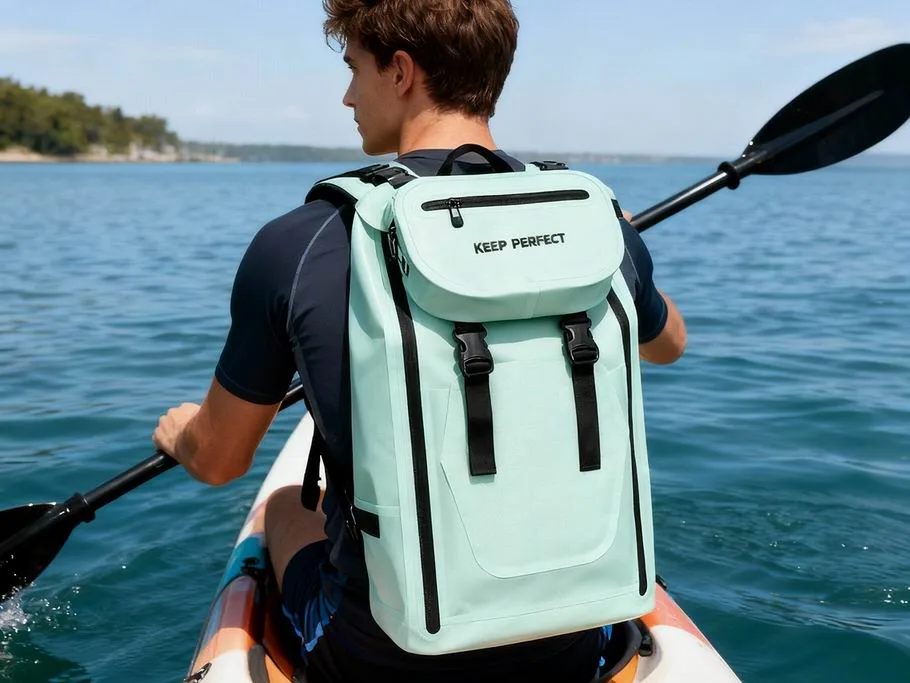
Bridge the gap with a small field panel. Put eight to twelve units into genuine service for one season with a weekly rinse-free protocol on half of them, log admitted mass monthly, and retire one unit per quarter for destructive seam inspection. The cost is modest and the correlation it reveals lets you calibrate later laboratory work. In our experience the strongest single predictor is whether the outer fabric and the interior are separated by a continuous membrane rather than by needle holes, which is why our roll-top dry bag range relies on continuous welding rather than tape.
Writing the test into a specification
- State the medium explicitly, including salinity in practical salinity units and water temperature.
- State the immersion depth, the duration and whether the sample is loaded, empty or inflated.
- Name the detection method: weighing to 0.1 g, visual grading, or electrode resistance with a threshold.
- Define the number of wet-dry cycles and the drying conditions, including whether rinsing is permitted.
- Require at least three units per lot and record both the individual results and the range.
- Specify hardware materials separately, with a chloride exposure test referenced to ASTM B117.
- Quote the ingress grade by number using IEC 60529 from the IEC, never by adjective.
A specification written this way converts a disagreement into a measurement, and it also protects both parties when a design change is proposed later. Re-validation then means repeating a defined protocol rather than arguing about whether the new version is equivalent. It also makes third-party laboratory quotations comparable, because every laboratory is being asked to reproduce exactly the same seven parameters rather than each offering its own interpretation of waterproof.
Production-scale consistency matters as much as laboratory performance. Our team has produced waterproof bags since 2014 in an SGS-verified 4,950 m2 facility, inspecting every lot to AQL 2.5 with 500-piece minimums, 6 to 10 working day sampling and 35 to 50 day bulk delivery on FOB Xiamen terms. Immersion and closure tests are repeated per lot rather than per design, so drifts in weld energy or film batch surface before a shipment leaves.
Close the loop with users rather than certificates. Ask anyone testing coastal gear to rinse with fresh water after every saltwater day, and to report the date and location of any ingress rather than simply the fact of it. Those reports tell you whether your laboratory protocol predicted reality, and after a season you will know exactly which number in your specification needs tightening.
Frequently asked questions
Q1. Does testing in saltwater differ much from freshwater?
Physically, surprisingly little: seawater is 2.7% denser and slightly higher in surface tension, so immersion at equal depth applies marginally more pressure while wetting slightly less. The real differences are electrical and after-effects, since salt water conducts around 1,000 times better and leaves damp crystals behind after drying.
Q2. What salinity should a saltwater test use?
Standard open-ocean seawater at 35 practical salinity units, measured with a refractometer and recorded in the report. Estuary and marina water can be anywhere from 0.5 to 30, so naming the figure prevents non-comparable results between two laboratories.
Q3. Is freshwater testing harder to pass than saltwater testing?
Marginally yes, because fresh water wets a little more readily and flows slightly faster through fine defects. The difference is a few percent, far smaller than the effect of any surfactant contamination in the water.
Q4. How do you detect a pinhole leak?
Use two electrodes spaced 20 to 30 mm inside an inflated, inverted bag immersed in seawater. A dry interior reads above 10 megohms while a bridged water path falls below 100 kilohms, giving a result in about 30 seconds instead of 30 minutes.
Q5. Why do bags fail after the sea rather than in it?
Dissolved salt crystallises in stitch holes and folds when the bag dries, and above roughly 75% relative humidity those crystals reabsorb water and keep the area permanently damp. That localized wetness drives hydrolysis, mildew and abrasion between layers.
Q6. Should test samples be rinsed between cycles?
No, if the aim is to represent coastal use. Rinsing removes the dominant failure mechanism. Alternate instead: immerse, dry un-rinsed for 8 hours at 40 to 60% humidity, weigh, then repeat for the planned cycle count.
Q7. Which predicts longer service life: 20 or 100 cycles?
Neither alone. Cycle count should map to the service interval you want to predict, roughly 20 cycles for three weeks of daily use and 100 for a full season, and the trend in admitted mass matters more than any single threshold.
Q8. What hardware should marine dry bags use?
Type 316 stainless with a pitting resistance equivalent number near 26, or sealed anodised aluminium. Type 304 sits near 19 and will usually show rust bloom within a season, Dezincification rules out brass and POM fittings trade corrosion immunity for ultraviolet sensitivity.
Q9. Does sunscreen affect waterproof testing?
Yes, significantly. Residues can pull surface tension from 72 down to 30 or 35 millinewtons per metre, doubling capillary penetration. Adding about 0.1% of a mild surfactant to a test tank screens for real-world sensitivity cheaply.
Q10. Can spray cabinets replace immersion tanks?
Only for screening closure and seam geometry. A spray cabinet per IEC grade reproduces jet impact but not sustained hydrostatic load, so it misses slow capillary paths that only appear after 8 hours or more under water.
Q11. How many samples per lot is enough?
Three as a minimum for a production lot and five for a first article. Record individual results and the spread, because a wide range usually signals process instability rather than a marginal design.
Q12. What does IPX7 mean in seawater terms?
It means passing 30 minutes at one metre as defined by IEC 60529, irrespective of medium. Because seawater is denser, running IPX7 at sea applies 10.05 kPa rather than 9.79 kPa, so specify the medium whenever the margin is tight.
Q13. How should admitted water be measured?
Weigh the empty dry sample, then reweigh after each cycle on a balance reading to 0.1 g. Mass gives a continuous variable that shows trends long before a pass-fail visual check would flag anything at all.
Q14. Are welded seams better in salt water than taped seams?
Yes, because there are no needle holes to act as capillary paths and no adhesive edge to lift after repeated wet-dry cycling. Taped constructions typically start lift within about 20 coastal cycles.
Q15. Do field trials still matter after laboratory testing?
Always. A tank has no ultraviolet radiation, no wind-driven drying, no grit and no flexing under load, which are among the factors most responsible for real returns. Field trials calibrate the laboratory protocol rather than being replaced by it.
Q16. How often should lot testing be repeated?
Every production lot rather than every design. Per-lot repetition catches drift in weld energy, film batches or buckle tension before a shipment leaves, which is far cheaper than discovering the drift through returns.
People also ask
Why does saltwater damage dry bags faster than freshwater?
Mainly after drying rather than during immersion. Residual salt crystallises in seams and re-absorbs moisture above 75% relative humidity, keeping those areas permanently wet and accelerating hydrolysis, mildew and abrasion.
Can you use tap water for an IPX7 test?
For a preliminary check yes, but the low conductivity removes the most sensitive detection method and the slightly lower density applies 2.7% less pressure. Note the substitution in the report and lengthen the immersion.
How do you make artificial seawater for testing?
Dissolve 35 g of a marine salt mix per litre of deionised water and verify with a refractometer reading close to 35 practical salinity units. Table salt alone lacks the magnesium, calcium and sulphate that drive scale and pitting behaviour.
Is a wet-dry cycle test necessary for coastal gear?
Yes. Continuous immersion misses crystallisation entirely, and salt-driven damage only develops when the water leaves and evaporation begins. Without cycles you are measuring the material, not the failure mechanism.
What breaks first on a dry bag used at sea?
Usually hardware rather than fabric. Buckles, springs, rivets and D-rings pit through chloride attack within a season in Type 304 steel, while a welded 0.5 mm TPU shell may go five to ten seasons.
How long should a coastal season be simulated for?
Around 100 wet-dry cycles approximates one season of daily coastal use with weekly maintenance. Twenty cycles maps to roughly three weeks, so match the count to the interval you genuinely need to predict.
Need this in production volume?
QUANZHOU JUNYUAN BAGS has produced waterproof bags since 2014 in an SGS-verified 4,950 m2 facility in Fujian, China. Minimum order 500 pieces, sampling in 6–10 working days, bulk in 35–50 days, FOB Xiamen — write to service@junyuanbags.com with your spec and target market.