Storing Dry Bags in the Off-Season
A dry bag that is rinsed, dried to under 15 percent moisture by weight, loosely rolled and kept in the dark at 10 to 20 degrees Celsius will typically give eight to twelve seasons of weekend use. The same bag put away damp, folded flat and left on a sunny garage shelf loses 30 to 50 percent of its film strength in one off-season, and it usually fails on the first trip back. Storage is not a passive act: what happens during the four or five months a bag is unused decides more of its service life than anything that happens on the water.
The three mechanisms that destroy a stored bag are moisture, ultraviolet light and compression. Moisture drives hydrolysis in polyamide shells and grows mould on any organic residue. UV breaks polymer chains even through a window, and a garage shelf facing a door can receive 200 to 400 hours of indirect sun a year. Compression puts a permanent crease in a film that then cracks along the fold line the first time it is rolled cold. This guide covers the clean, the drying target, the storage position, the environment numbers, and the checks that tell you whether a bag survived the winter.
- Why the off-season decides how long a bag lasts
- The pre-storage clean: rinse, wash and neutralise salt
- Drying to a standard you can actually check
- Rolled, flat or hung: what the film prefers
- Temperature and humidity: the numbers that matter
- Light: why a garage shelf still damages a bag
- Pests, rodents and the smells that attract them
- Hardware: buckles, valves and webbing in storage
- Containers, covers and desiccant
- TPU and PVC in long-term storage compared
- A labelled shelf system for a club or rental store
- The recommissioning check when the season starts
- When a stored bag should be retired instead
Why the off-season decides how long a bag lasts
Most dry bag failures attributed to age are actually storage failures. A bag retired after three seasons with a cracked fold line almost always shows the same history: put away in October straight from a saltwater trip, folded flat under a pile of other kit, and stored somewhere warm and bright. The film did not wear out; it was creased while damp, then dried in a position that became permanent, then weakened by ultraviolet exposure it never saw on the water.
The reason storage dominates is time. A paddler might use a bag 30 days a year, which is 8 percent of the calendar. The other 92 percent is spent in a cupboard, a shed or a garage, and all three of those are hostile in different ways. Cutting the damage rate during those 335 days is worth more than any amount of careful rinsing during the 30. The table below ranks the common storage locations by what they actually do to a bag.
| Storage location | Typical temperature swing | Relative humidity | Light exposure | Verdict |
|---|---|---|---|---|
| Indoor cupboard, interior wall | 12-22 C | 40-55 percent | None | Best option available |
| Under-bed box in a living space | 15-24 C | 45-60 percent | None | Good, watch for compression |
| Garage shelf, no window | -2 to 38 C | 45-85 percent | Low | Acceptable if sealed and dark |
| Garden shed | -5 to 42 C | 60-95 percent | Medium at the door | Poor; mould and heat risk |
| Loft or attic | -8 to 55 C | 30-80 percent | Low | Poor; heat cycles damage film |
| Boot of a car, summer | 15 to 65 C | 40-90 percent | High through glass | Worst; retire the bag after this |
The pre-storage clean: rinse, wash and neutralise salt
Start with a full fresh-water rinse at ambient temperature. Salt crystals are the enemy because they are harder than the film and cut into it every time the bag flexes, so the rinse has to reach the fold line, the inside of the mouth and the buckle mechanism rather than just the outside of the shell. Two minutes with a hose at low pressure and the bag turned inside out is enough; a pressure washer will abrade the film and force water into the weld corners.
Follow the rinse with a wash if the bag has been in anything other than clean water. Use a pH-neutral technical fabric wash or a litre of lukewarm water with 5 ml of mild dish soap, work it over the inside and outside with a soft cloth, and rinse twice. Do not use bleach, solvent cleaners or a scouring pad: bleach attacks the polyurethane in a laminate and leaves the film cloudy and brittle, and abrasion removes the surface finish that gives the fabric its water shedding.
- Empty the bag completely and turn it inside out over a rail or a stool.
- Rinse with fresh water at ambient temperature; never a hot hose on a TPU film.
- Wash with a pH-neutral soap solution if the bag saw salt, mud or sunscreen.
- Wipe the fold line with a soft cloth and inspect it for sand or salt crystals.
- Rinse twice more and shake out the mouth so no water pools in the base.
- Leave the bag open and upside down on a rack for at least four hours.
Sunscreen and insect repellent deserve special mention. Both leave an oily residue that plasticises the film surface locally and attracts dust, and both are the usual reason a bag develops a tacky patch over the winter. A wipe with a cloth dampened in soapy water removes most of it, and a second wipe with clean water removes the rest. If the bag smells of anything at all when you put it away, it has not been cleaned well enough, and that smell is what attracts rodents later.
Drying to a standard you can actually check
Do not store a bag you hope is dry; store one you have checked. Weigh the empty bag when it is new and note the figure on the hang tag. After drying, weigh it again: a 20L TPU bag that has absorbed water into its fabric face will read 8 to 25 g heavier than its dry baseline, and it should come back to within 3 g before it goes into storage. This is the only practical field test for residual moisture and it takes fifteen seconds.
Airflow matters more than warmth. A bag hung open, mouth down, in a room with gentle air movement dries in 4 to 8 hours at 18 degrees Celsius. The same bag left closed in a warm room takes days and grows mould in the base seam while it waits. Direct sun is not a shortcut: two hours of strong UV is enough to measurably stiffen a PVC-coated bag, and shaded, moving air at room temperature is both faster and safer. Our drying rack notes cover the rack geometry that works.

Rolled, flat or hung: what the film prefers
The short answer for a roll-top bag is loosely rolled, with the mouth unclipped and the roll radius as large as the bag allows. Rolling along the axis the bag was designed to fold puts the least strain on the film and keeps the fold line in the same place it always sits, so the crease that forms is one the bag will use anyway. A tight roll is worse than a loose one, and a bag rolled around a hard object is the worst of all.
Flat storage is the common mistake. Folding a 20L bag in half creates a crease across the middle of the panel, at right angles to the roll-top fold, and that crease becomes a weak line that cracks the first time the bag is rolled in cold weather. If you must store flat, roll it rather than folding it, or lay it flat and unrolled with nothing on top. Hanging by the D-rings is fine for short periods and bad for long ones, because the whole weight of the bag hangs on two welded tabs and slowly peels them.
| Storage position | Crease risk | Hardware load | Space needed | Best for |
|---|---|---|---|---|
| Loose roll, mouth unclipped | Low | None | Small | Roll-top bags, all sizes |
| Rolled around a soft towel | Very low | None | Small | Bags stored over two years |
| Laid flat, unrolled | None | None | Large | Duffels and flat-format bags |
| Folded in half | High | None | Very small | Never recommended |
| Hung by D-rings | None | High on two tabs | Medium | Short-term drying only |
| Compressed under other kit | High | High on buckles | Very small | Never recommended |
Temperature and humidity: the numbers that matter
Aim for 10 to 20 degrees Celsius and 40 to 60 percent relative humidity, and above all aim for stability. Wide swings are worse than a steady imperfect value, because every cycle of heating and cooling moves moisture in and out of the fabric face and stresses the bond between film and cloth. A cupboard that holds 18 degrees year round beats a garage that swings from minus 2 to 38, even though the garage average looks similar.
Humidity above 70 percent for more than a few weeks is where mould becomes likely, and mould grows on the residue inside a bag rather than on the polymer itself, so a clean bag tolerates humidity far better than a dirty one. Below 30 percent, polyamide shells become brittle and the film loses flexibility, which matters in heated indoor spaces in winter. A cheap hygrometer in the storage box costs very little and tells you whether the space is doing its job.
If the space cannot be controlled, control the bag instead. A sealed plastic box with 100 g of silica gel per 50 litres of box volume holds the internal humidity near 40 percent for several months, and the desiccant can be regenerated in an oven at 120 degrees Celsius for two hours. This is the standard approach for bags stored in a shed or a coastal garage, and it turns a poor location into an acceptable one without any building work.
Light: why a garage shelf still damages a bag
Ultraviolet damage is cumulative and invisible until it is not. A polyamide shell loses roughly half its tensile strength after 500 hours of accelerated xenon exposure, and a garage shelf near a window or an open door receives enough indirect light to accumulate a meaningful fraction of that over a single off-season. The film underneath chalks and stiffens, the colour fades unevenly, and the fold line becomes the first place a crack appears.
Dark storage is the cheapest protection available and it costs nothing. Put bags in an opaque box, a closed cupboard or a canvas storage bag rather than on an open shelf. If the only space is bright, cover the shelf with an opaque cloth and check that the bags are not within a metre of any window. Our UV prevention guide sets out the additive packages and colour choices that slow the process down. Light is also why a clear storage bag is a poor idea, however convenient it looks.
Pests, rodents and the smells that attract them
Rodents chew dry bags for two reasons: the fabric makes good nesting material and the bag smells of something interesting. Food residue, sunscreen, sweat and suntan lotion are all attractants, and a bag that went into storage without a proper wash is the one that comes out with a 20 mm hole in the base corner. Mice can gnaw through a 0.3 mm TPU laminate in a single night, and they prefer quiet, dark, undisturbed spaces, which is exactly where bags are stored.
Prevention is a sealed container. A lidded plastic box with a clip closure keeps rodents out completely, while a cardboard box or an open shelf does not. Add no mothballs or naphthalene: both migrate into TPU and leave the film soft and smelling permanently. Peppermint oil on a cloth outside the box is harmless and mildly deterrent, and it is far better than any chemical placed inside the bag. Guidance on cleaning up rodent contamination is published by the CDC.
Mould is the other biological risk and it is more common than rodent damage. If you open a stored bag and find black spotting on the inside, treat it before you use the bag: brush off the dry growth outdoors, wash with a pH-neutral soap, then wipe with a solution of one part white vinegar to four parts water and rinse. Do not use bleach on a laminate. Health guidance on indoor mould cleanup, including when to discard porous items, is available from the EPA.
Hardware: buckles, valves and webbing in storage
Take the load off the hardware before storage. Unclip every buckle, undo any compression strap, and slacken the webbing so nothing is held under tension for months. A cam buckle left tight for a winter can take a permanent set in its spring and slip the following season, and a strap held under tension slowly deforms the welded tab it is anchored to. Leave the roll-top buckle undone as well; a clipped buckle keeps the film creased at exactly the point where it needs to stay flexible.
Purge valves need one specific step. Open the valve and leave it open, so the internal and external pressure equalise and the valve seat is not held closed against its own seal for months. A valve stored closed can stick shut and then fail to seat properly when you need it. Metal hardware should be dry and, if it is any grade other than stainless steel or anodised aluminium, given a very light wipe of silicone-free oil; plastic hardware needs nothing beyond being clean and dry.
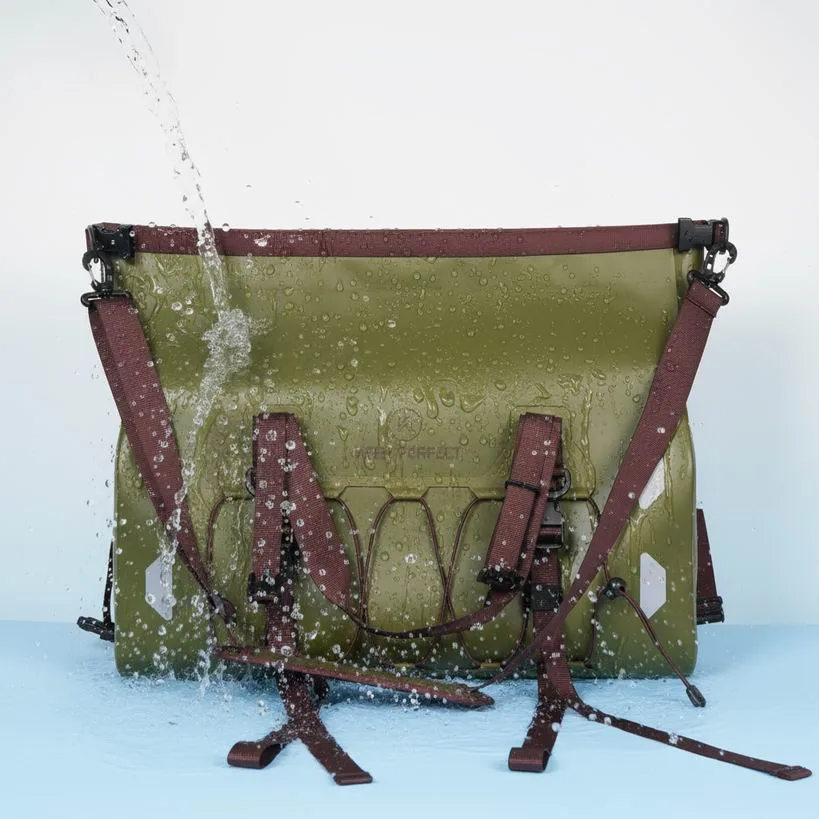
Containers, covers and desiccant
The ideal container is opaque, rigid, lidded and big enough that nothing has to be compressed to fit. A 60 litre plastic storage box holds four 20L bags rolled loosely, or a dozen bags in the 5L to 10L range, with room for a desiccant sachet and a labelled card. Rigid matters because a soft storage bag hung on a hook lets the contents sag and crease; a box keeps the shape. Avoid vacuum storage bags entirely, since compression is the one thing guaranteed to damage a film.
Label the outside of the box with the contents and the date of storage, and put a card inside listing each bag with its size, its material and the season it was bought. That card is what makes the spring check quick, and it is what lets a club or a family see which bags are approaching retirement. For long-term storage beyond a single off-season, add a note of the dry weight of each bag so the moisture check in spring has a baseline to compare against.
TPU and PVC in long-term storage compared
The two film families age differently, and the storage routine should reflect that. A TPU laminate has no plasticiser to lose, so it does not stiffen with age on its own; its risks are crease damage when cold, hydrolysis of a polyamide face if stored damp, and UV chalking. A PVC-coated fabric loses plasticiser continuously, faster when warm, so it stiffens over the off-season and benefits most from cool, dark storage and from being exercised occasionally.
| Material | Main storage risk | Safe temperature | Action before storage | Expected life in good storage |
|---|---|---|---|---|
| TPU laminate, 0.5 mm | Crease cracking when cold | 5-30 C | Dry fully, roll loosely | 8-12 seasons |
| TPU laminate, 0.3 mm | Puncture and crease | 5-30 C | Roll with a soft core | 5-8 seasons |
| PVC coated polyester | Plasticiser loss, stiffening | 5-25 C | Store cool, unroll monthly | 4-7 seasons |
| PU coated nylon | Hydrolysis when damp | 5-25 C | Verify dry weight | 3-6 seasons |
| Silicone-treated shell | Coating wear | 5-30 C | No compression | 3-5 seasons |
| POM and nylon hardware | UV embrittlement | Any, dark | Slacken all straps | Matches the bag |
If you store a mixed fleet, sort by material and treat the PVC and PU-coated bags as the ones needing attention first. A useful habit is to unroll and re-roll each of those once a month through the off-season; thirty seconds per bag keeps the plasticiser distributed and prevents a flat set from developing. Bags in heated indoor spaces age faster than those in a cool cupboard, because every 10 degrees Celsius of extra warmth roughly doubles the rate of plasticiser migration.

A labelled shelf system for a club or rental store
Clubs and rental operations store dozens of bags, and the failure mode there is administrative rather than material: bags get lost, mixed and issued without ever being checked. A simple system solves it. Give every bag a number written on the hang tag and on the base seam with a permanent marker, log the number against a purchase date and a material, and store bags in numerical order on open shelves inside an enclosed cupboard.
- Clean and dry every bag, then weigh it and record the dry weight against its number.
- Roll each bag loosely with the buckle unclipped and the valve open.
- Group by material, because PVC and PU-coated bags need a monthly check.
- Store in numerical order in an opaque box or a closed cupboard.
- Put a 100 g desiccant sachet in each box and note the date on the sachet.
- Keep one card per box listing numbers, sizes and the season each was bought.
- Run a ten-minute monthly walk-through: unroll, look, re-roll, note anything odd.
The monthly walk-through is what makes the system worth having. Ten minutes is enough to open twenty bags, look for mould, smell for mildew, check for rodent damage and re-roll anything that has flattened. Problems found in November can be fixed; problems found in April are usually a lost weekend and a cancelled trip. Clubs that run this routine typically get two extra seasons out of a fleet, which pays for the marker pens several times over.
The recommissioning check when the season starts
Bring every bag back into service with the same short test, and do it a week before the first trip so there is time to fix anything. Weigh it against its dry baseline. Look over the film under a bright light for pinholes, chalking and crease cracks. Flex the fold line between your hands and listen for a crackle, which is the sound of a film that has stiffened. Work every buckle and valve through its full travel.
| Check | Method | Pass criterion | If it fails |
|---|---|---|---|
| Dry weight | Weigh against the recorded baseline | Within 3 g | Dry for 24 hours and re-weigh |
| Film surface | Bright light, inside and out | No pinholes or chalking | Light-box check, then patch or retire |
| Fold line | Flex between both hands | No crackle, no white stress line | Warm to 20 C, re-roll, retest |
| Seams | Pull gently along each weld | No lift at the corners | Weld repair or demote the bag |
| Closure seal | Air squeeze test, 20 seconds | No audible hiss | Re-roll and retest, then retire |
| Immersion | 30 minutes at 1 m with tissue | Tissues dry, no weight gain | Retire from water use |
| Hardware | Work each buckle and valve | Full travel, no slip | Replace the part, not the bag |
Run the immersion test on any bag that failed a previous season, on any bag older than five years, and on a random two bags out of every ten. That sample rate catches a fleet-wide problem without consuming a weekend. A bag that passes everything goes back on the shelf with a fresh date on its tag; a bag that fails gets demoted to a laundry sack or a gym bag rather than being thrown away, which keeps a usable object in service and out of the waste stream.
When a stored bag should be retired instead
Four findings mean the bag is finished for water use. A crack that runs along the fold line for more than 50 mm will open under pressure no matter how carefully you roll it. A weld that has lifted at a corner for more than 20 mm cannot be reliably re-welded in the field. Film that has gone chalky and stiff across a whole panel has lost its barrier, even if it has no visible hole. And any bag that takes in more than 5 ml of water in a 30 minute immersion test should not be trusted with a phone or a sleeping bag.
Retiring a bag does not mean binning it. Cut off the harness and hardware for spares, keep the buckles, and use the body as a laundry sack, a boot bag or a garden carrier. Our retirement checklist covers the grades of demotion, and the rolled versus flat guide goes deeper on the crease question for bags you intend to keep. Full cleaning detail is in the roll-top cleaning guide, and material-by-material life expectations are set out in service life by material.
For operations that put kit away for months at a time, the same routine scales directly into a written procedure: clean, dry, verify, roll, box, label, check monthly, and recommission with a recorded test. Our waterproof line has run since 2014 in an SGS-verified 4,950 m2 facility, and bags are shipped only after an immersion check at AQL 2.5, because the first four months of a bag it does not control are the ones that decide its life.Bags intended for long service lives are covered in our eco-friendly dry bag selection, and the current range sits in the full product line.
Frequently asked questions
Q1. How should I store a dry bag in the off-season?
Rinse and wash it, dry it until it returns to its recorded dry weight, roll it loosely with the buckle unclipped, and keep it in an opaque lidded box at 10 to 20 degrees Celsius and 40 to 60 percent humidity.
Q2. Should dry bags be stored rolled or flat?
Loosely rolled, with the mouth unclipped. Flat folding creates a crease across the panel at right angles to the roll-top fold, and that crease is where the film cracks first.
Q3. Can I store a dry bag if it is slightly damp?
No. Damp storage drives hydrolysis in nylon shells and grows mould inside the base seam. Weigh the bag against its dry baseline and confirm it is within 3 g before it goes away.
Q4. Is a garage a safe place to store dry bags?
Acceptable if the bags are in an opaque sealed box with desiccant. An open shelf in a garage exposes them to temperature swings from minus 2 to 38 degrees and to indirect light at the door.
Q5. Do I need to unclip the buckles before storage?
Yes. Slacken every strap and undo every buckle so nothing is under tension. A clipped buckle keeps the film creased at exactly the point where it needs to stay flexible.
Q6. Should a purge valve be open or closed in storage?
Open. An open valve equalises pressure and stops the seat sticking shut. A valve stored closed can fail to seat properly when you next need it.
Q7. How do I stop mould growing in a stored dry bag?
Clean it properly, dry it to within 3 g of its dry weight, and keep it below 60 percent relative humidity. Mould grows on residue inside the bag, not on the polymer itself.
Q8. Can I use mothballs to protect stored bags?
No. Naphthalene and mothball vapours migrate into TPU and leave the film permanently soft and smelling. Use a sealed box instead, and keep peppermint oil outside the box if you want a deterrent.
Q9. How much desiccant do I need in a storage box?
About 100 g of silica gel per 50 litres of box volume, checked and regenerated every three months. Regenerate it in an oven at 120 degrees Celsius for two hours.
Q10. Will sunlight through a window damage stored bags?
Yes. Indirect light accumulates, and a polyamide shell loses about half its tensile strength after roughly 500 hours of accelerated UV exposure. Store in an opaque box or a closed cupboard.
Q11. What temperature is safe for long-term dry bag storage?
Ten to 20 degrees Celsius, held steady. Stability matters more than the exact value, and every 10 degrees of extra warmth roughly doubles plasticiser loss in PVC-coated bags.
Q12. How do I know if my bag survived the winter?
Weigh it, flex the fold line and listen for a crackle, inspect the film under bright light, then run a 20-second air squeeze and a 30-minute immersion test with dry tissue inside.
Q13. Do PVC and TPU bags store differently?
Yes. TPU has no plasticiser to lose and mainly risks crease cracking. PVC stiffens as plasticiser migrates, so it should be stored cooler and unrolled once a month.
Q14. Can I vacuum-pack dry bags to save space?
No. Compression is the one thing guaranteed to damage a film. It puts a permanent crease in the panel and presses the fold lines flat under load for months.
Q15. How often should stored bags be checked?
Monthly for PVC and PU-coated bags, which need unrolling and re-rolling. TPU bags in a sealed, dark box can be checked once, at the start of the season.
Q16. When should I retire a dry bag after storage?
Retire it from water use if the fold line has cracked for more than 50 mm, a weld has lifted over 20 mm, the film has gone chalky, or it takes in more than 5 ml in a 30-minute immersion test.
People also ask
How do you store dry bags long term?
Clean and rinse them, dry until they return to their recorded dry weight, roll loosely with buckles unclipped and valves open, then seal them in an opaque box with desiccant at 10 to 20 degrees Celsius.
Can dry bags be stored outside in a shed?
Only in a sealed, opaque, lidded box with desiccant. An open shed exposes bags to humidity above 60 percent, wide temperature swings and mould, which is the fastest way to lose a season of service life.
Why did my dry bag crack after being in storage?
It was almost certainly put away damp or creased. Moisture drives hydrolysis in the shell and a flat fold creates a permanent crease line that cracks the first time the bag is rolled cold.
Should you store dry bags with air inside?
Not sealed with air. Press the air out, close loosely and leave the buckle undone, so the film is not under tension and the fold line is not held in a hard crease for months.
How do you get mould out of a stored dry bag?
Brush the dry growth off outdoors, wash with pH-neutral soap, wipe with one part white vinegar to four parts water, rinse twice and dry fully. Never use bleach on a laminated film.
Do dry bags degrade if they are not used?
Yes. Plasticiser migrates out of PVC, polyamide hydrolyses if damp, and UV chalks any exposed panel. Good storage slows all three to the point where a bag lasts eight to twelve seasons.
Need this in production volume?
QUANZHOU JUNYUAN BAGS has produced waterproof bags since 2014 in an SGS-verified 4,950 m2 facility in Fujian, China. Minimum order 500 pieces, sampling in 6–10 working days, bulk in 35–50 days, FOB Xiamen — write to service@junyuanbags.com with your spec and target market.