Avoiding Crease Damage on Dry Bags
A crease is not a cosmetic wrinkle on a dry bag; it is a line where the waterproof film has been stretched beyond its elastic limit and will not fully recover. Bend a 0.5 millimetre TPU film around a 25 millimetre radius and the outer surface carries about 1 percent strain. Bend the same film around a 5 millimetre fold and the strain rises to 5 percent, which is past the point where the polymer starts to craze. Repeat that tight fold at the same place a few hundred times and the line goes white, then hazy, then cracks.
Most bags that come back wet have failed at a crease rather than through a panel. The closure fold line, the two vertical creases where a bag was folded flat for storage and the corners of the welded base are where the damage concentrates, and all three are produced by how the bag is packed, stored and carried rather than by age alone. This guide sets out the strain maths, the temperature limits, the storage radii that keep film healthy, how to relax a crease that has already formed, and the four grades that tell you when a bag should be retired.
- What a crease actually does to a laminated film
- The three places creases form on every dry bag
- Fold radius: the number that decides whether damage happens
- Cold is when creases become cracks
- Rolling, folding flat, hanging: what actually preserves film
- Compression straps, over-packing and sustained load
- Heat, sun and what happens to the film chemistry
- Creases at the weld: why the seam border is vulnerable
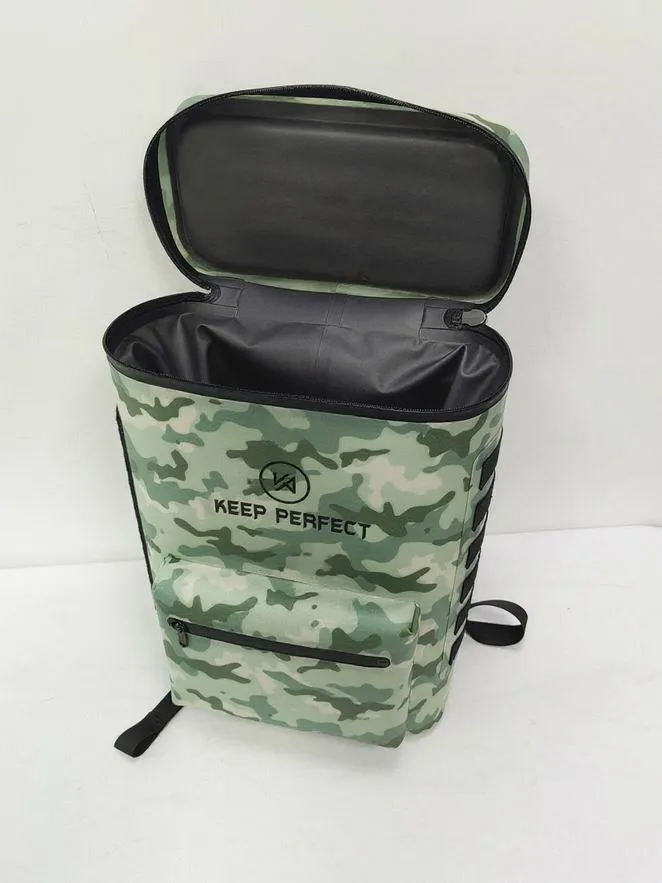
- Relaxing a crease that has already formed
- Four grades of crease damage and the action for each
- A crease-safe routine for the season and the off-season
- Design choices that reduce crease risk from the start
- When a crease means the bag is finished
What a crease actually does to a laminated film
A dry bag shell is a sandwich: a woven face that carries abrasion and a film bonded behind it that carries the waterproofing. When you bend that sandwich, the outer surface of the film is stretched and the inner surface is compressed. For a film of thickness t bent around a radius R, the strain at the outer surface is approximately t divided by 2R. A 0.5 millimetre film folded flat against itself, an effective radius near 2 millimetres, puts 12 percent strain on the outer face, which is well past what a thermoplastic polyurethane accepts repeatedly.
The damage is progressive and visible if you know what to look at. The first stage is stress whitening, where microvoids form in the polymer and scatter light; it is reversible with warmth. The second is crazing, a fine network of surface fissures that stays visible when the film is relaxed. The third is a crack that penetrates the film and reaches the woven face, at which point the bag leaks slowly along a line rather than through a hole. A bag can sit in stage two for a whole season before it crosses into stage three, which is why creases deserve attention long before they leak.
The three places creases form on every dry bag
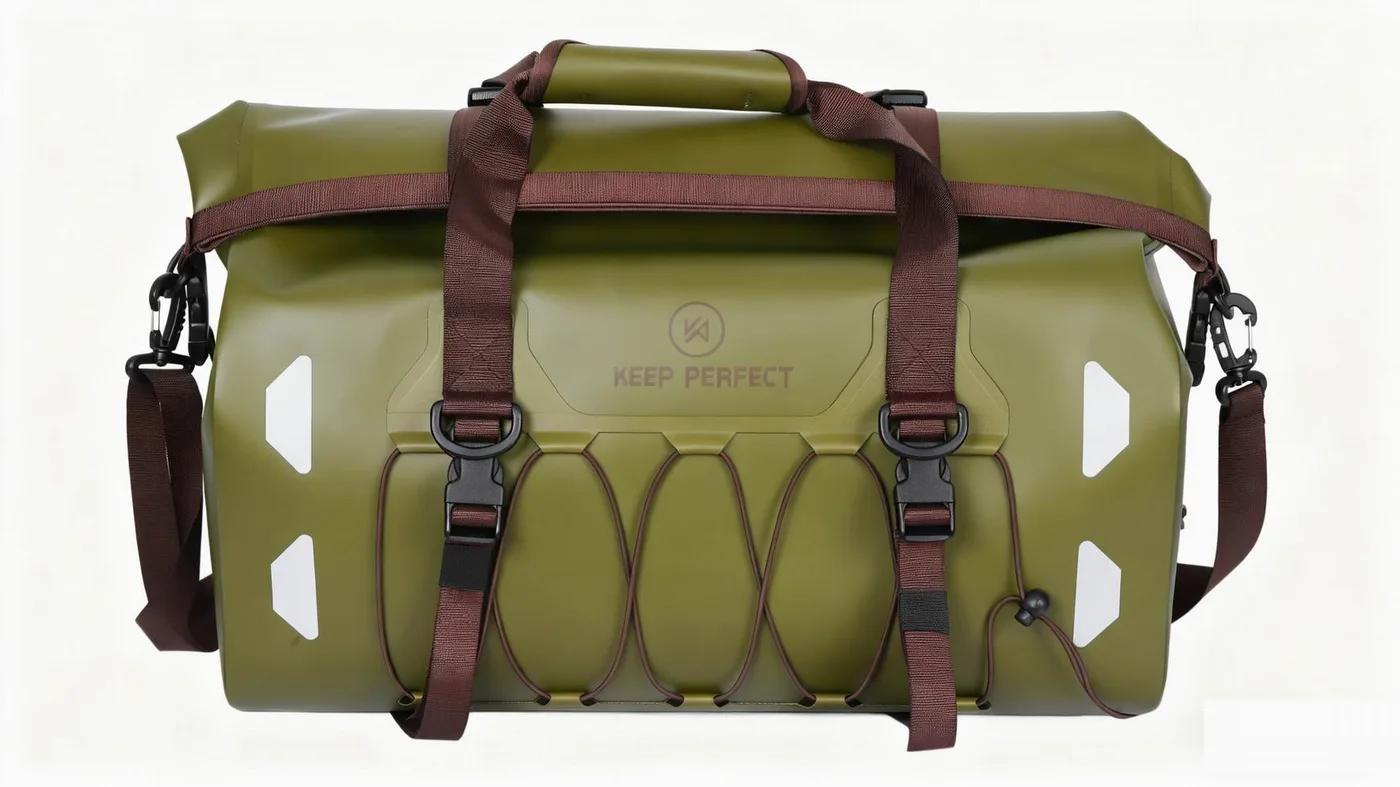
The first is the closure. Every time you roll the mouth you fold the film at roughly the same height, and the fold line that forms is loaded three times per closure over hundreds of trips. This is the crease that gets the most attention and, because the radius of a proper three-fold roll is generous, it is usually the least damaging. The problem starts when a bag is overfilled and the fold is forced flat under tension, or when it is closed around a hard item.
The second is the flat storage fold. A bag folded in half or in thirds and put on a shelf develops two or three sharp vertical creases that sit in exactly the same place for months. Polymer creep does the rest: under sustained strain the film takes a permanent set, and after six months those lines will not relax on their own. The third is the base corner, where the welded seam meets a folded panel and the film is bent in two directions at once. Corner creases are the ones that turn into pinhole leaks.
A fourth, less obvious location is under a compression strap. Tightening a strap across a bag squashes the film into a tight radius at the edges of the strap path, and because the load is sustained for the whole journey it can set a crease in a single afternoon. If you use compression straps on a bike or a raft, pad the edges and slacken them whenever the bag is not actually being carried.
Fold radius: the number that decides whether damage happens
Radius is the only variable you control, and it is worth knowing the thresholds. Above about 50 millimetres of bend radius, a 0.5 millimetre TPU film is under 0.5 percent strain and can be folded indefinitely without cumulative damage. Between 25 and 50 millimetres the strain is 0.5 to 1 percent, which is safe for repeated use and is the range a properly made roll-top closure works in. Below 10 millimetres the strain passes 2.5 percent and damage begins to accumulate with each fold.
A sharp fold, where the film is pressed flat on itself, is the worst case at a radius near 1 to 3 millimetres and 8 to 25 percent strain depending on thickness. That is what a folded-flat storage crease is, and it is why a single careless fold can do more harm than a season of correct rolling. The practical rule follows directly: never store a bag folded, always roll it loosely around something with a diameter of at least 100 millimetres, and keep the closure roll to three folds rather than forcing a fourth.
| Bend radius | Strain on 0.5 mm film | What it looks like | Safe repetition | Verdict |
|---|---|---|---|---|
| 100 mm or more | 0.25 percent | Gentle curve | Unlimited | Ideal storage roll |
| 50 mm | 0.5 percent | Loose roll | Unlimited | Safe for daily closure |
| 25 mm | 1.0 percent | Normal three-fold roll | Several thousand | The working target |
| 10 mm | 2.5 percent | Tight fold | Hundreds | Avoid where possible |
| 5 mm | 5.0 percent | Sharp crease | Dozens | Damage begins |
| 1-3 mm | 8-25 percent | Pressed flat | A few | Immediate risk of crazing |
Cold is when creases become cracks
Every polymer has a temperature below which it stops being flexible and starts being brittle, and for a bag that temperature decides whether a winter fold is harmless or terminal. A quality TPU film stays workable to roughly minus 30 degrees Celsius and many grades lower, which is why TPU bags survive being rolled on a frozen beach. A PVC-coated fabric relies on plasticiser to stay soft, and it stiffens noticeably by minus 10 to minus 20 degrees depending on the formulation and on how much plasticiser has already migrated out.
The rule that follows is simple and worth obeying without exception: never roll, fold or unpack a bag that is below about 5 degrees Celsius. Bring it indoors, let it reach room temperature over an hour or two, and then work the closure. A bag folded at minus 15 degrees can craze along the fold line in a single movement, and the damage will not appear until the film warms up again and the bag is used. Our cold crack temperature notes give the figures by film type.
| Temperature | TPU film behaviour | PVC-coated behaviour | What to do |
|---|---|---|---|
| Above 40 °C | Softens, creases relax | Plasticiser migration accelerates | Good for crease repair |
| 20-40 °C | Fully flexible | Flexible | Normal handling and folding |
| 5-20 °C | Flexible, slightly stiffer | Noticeably stiffer | Handle normally, avoid sharp folds |
| 0 to -10 °C | Still workable | Stiff, crease risk | Warm before folding |
| -20 °C | Limits of most grades | Brittle | Do not fold at all |
| Below -30 °C | Below most TPU limits | Cracks on movement | Leave the bag packed |

Rolling, folding flat, hanging: what actually preserves film
Storage method decides more of a bag life than any care product. Rolling a bag loosely around a towel or a foam cylinder keeps every part of the film above a 50 millimetre radius, costs no shelf space beyond a cylinder about 300 millimetres long, and leaves the bag ready to use. Hanging it by a handle with the mouth open is second best: gravity keeps the panel flat and there is no fold at all, but the bag collects dust and needs 400 millimetres of clear height.
Folding flat is the method to stop. It puts a 1 to 3 millimetre radius crease at the same two lines every time, and polymer creep turns that into a permanent set within months. Compressed storage under straps is worse still, because it adds sustained load to the tight radius. If a bag has to be folded for transport, fold it differently each time, put a rolled towel inside the fold to open the radius, and unfold it as soon as you arrive. Our rolled against flat comparison shows what a year of each looks like.
| Storage method | Effective radius | Risk after 12 months | Space needed | Score |
|---|---|---|---|---|
| Rolled around a 100 mm cylinder | 50 mm | None expected | 300 x 150 mm | Best |
| Rolled loosely with a towel inside | 60-80 mm | None expected | 300 x 200 mm | Best |
| Hung open by a handle | No fold | None, but dust collects | 400 mm height | Good |
| Loose in a drawer, unrolled | Variable | Random light creases | Large | Fair |
| Folded in half on a shelf | 1-3 mm | Permanent crease set | Small | Poor |
| Compressed under straps | 1-5 mm under load | Crease and film blocking | Smallest | Worst |
Compression straps, over-packing and sustained load
Two habits produce creases faster than storage does. The first is over-tightening a compression strap, which forces the film to bend around the strap edges at a small radius while under sustained tension; a strap left tight for a three-day journey can leave a visible line that never fully relaxes. Pad the strap path, use two straps at lower tension rather than one at high tension, and always release them at camp.
The second is over-packing. A bag filled past about 85 percent puts the film under tension across the mouth, and the first closure fold then has to bridge rather than conform. That bridging produces a tight radius at two points near the buckle, and it is also the way a closure starts to leak. Leave 15 percent of the volume free, press the air out before folding, and size up if your load regularly closes tight. Our capacity loss figures help you pick the right size.
Heat, sun and what happens to the film chemistry
Heat is the other half of the crease problem, and it cuts both ways. Moderate warmth around 40 to 50 degrees Celsius relaxes stress whitening and lets a crease recover, which makes it the main repair tool. Sustained heat above about 60 degrees Celsius does the opposite for a PVC-coated fabric: it drives plasticiser out of the film, and a plasticiser-depleted coating becomes stiff, then brittle, then cracks at the slightest fold. A bag left on a dashboard in summer can reach 70 degrees Celsius inside.
Ultraviolet light attacks the polymer chains directly and works with heat rather than separately, so a bag stored in a sunny window ages several times faster than the same bag in a dark cupboard. TPU has no plasticiser to lose, which is one reason it holds up better under heat, but it still chalks and loses tensile strength under sustained UV. Store bags in the dark, cool and dry, and never leave one folded in direct sun. Our UV prevention guide and off-season storage routine cover this in more detail.
Creases at the weld: why the seam border is vulnerable
The strip of film immediately beside a welded seam is stiffer than the rest of the panel, because the heat of welding has changed the polymer structure there. That stiffness gradient means a fold near a weld concentrates strain in a narrow band rather than spreading it over the panel, and it is why creases that start at a seam progress faster than creases in the middle of a bag. Keep at least 30 millimetres between any fold line and a weld wherever you have a choice.
The base corners are the worst case, because two welds meet at a right angle and the film is bent in two directions at once. Never fold a bag through its base corners, do not sit a loaded bag on a sharp edge, and when you pack, keep rigid items with hard corners away from the base welds. A corner crease that has begun to craze can often be stabilised with a TPU patch welded or bonded over it; our patch kit guide sets out what to carry.
Relaxing a crease that has already formed
- Empty the bag completely and brush any grit out of the crease with a soft dry cloth.
- Warm it: hang it in a room at 20 to 25 degrees Celsius for two hours, or use a hairdryer on low at 300 millimetres.
- Apply gentle warmth to the crease itself, around 40 to 50 degrees Celsius, moving continuously.
- Open the radius: roll the bag loosely around a towel so the crease sits on the outside of a large curve.
- Hang it for 24 to 48 hours with a light weight in the base to pull the panel flat.
- Re-test: roll the closure three times, squeeze and listen, then do a 30 minute bath immersion.
- If the line is still visible white when relaxed, mark it and re-check before every trip.
Warmth works because it lets the polymer chains reorganise and the microvoids close. It reverses stress whitening reliably and improves crazing partially; it will not repair a crack that has penetrated the film. Use warm water at 40 degrees Celsius or warm air, never a hot iron, a heat gun or a radiator, because an over-heated patch of film can glaze, shrink and block against itself, which turns a cosmetic line into a permanent one. Never wash the bag to achieve this; our machine washing notes explain why a drum is the wrong tool.
Four grades of crease damage and the action for each
Grading a crease removes the guesswork from the decision to keep or retire a bag. Grade one is a line that appears when the film is bent and disappears when it is relaxed; it is harmless and needs no action. Grade two is stress whitening that persists when relaxed but has no visible texture; it responds to warmth and to better storage. Both grades are cosmetic and the bag remains fully waterproof.
Grade three is crazing: a fine network of surface fissures you can feel lightly with a fingernail and that stays visible under a bright light when the panel is flat. The bag still passes an immersion test now, but the film there has lost most of its margin, so patch it or downgrade the bag to splash duty. Grade four is a crack you can see through, or a crease that has begun to delaminate from the woven face. That bag is finished for water use.
| Grade | What you see | Immersion result | Action | Remaining life |
|---|---|---|---|---|
| 1: elastic line | Disappears when relaxed | Passes | None needed | Full |
| 2: stress whitening | White line persists, no texture | Passes | Warmth and better storage | Full |
| 3: crazing | Fine fissures, felt with a nail | Passes, margin gone | Patch or downgrade | One season, watched |
| 4: through crack | Visible crack or delamination | Fails | Retire from water use | None |
| 4b: crease at a weld | Crack beside a seam | Fails at the seam | Retire or repurpose | None |
A crease-safe routine for the season and the off-season
- After every trip: empty the bag, rinse it, and dry it open in shade before it is put away.
- Before storage: check the fold lines under a bright light and relax any white line with warmth.
- For storage: roll loosely around a towel or a 100 millimetre cylinder, never fold flat.
- Choose a dark, cool cupboard: under 25 degrees Celsius and out of any sunlight.
- Release every compression strap and leave buckles unclipped so nothing is under sustained load.
- Every three months: unroll, re-roll with the fold lines in different places, and re-inspect.
- At the start of the season: air squeeze the closure and run a 30 minute bath immersion.
The re-rolling step is the one most people skip and the one that matters most over years. Moving the fold lines every few months ensures no single line accumulates thousands of cycles, and it costs two minutes. A bag that is rinsed, dried, rolled loosely and re-rolled quarterly will normally reach the five to ten year service life the film is capable of; the same bag folded flat on a shelf can craze at the storage lines inside two years.
Design choices that reduce crease risk from the start
Some bags resist creasing better than others, and the reasons are visible before you buy. A thicker film helps: 0.3 millimetre TPU crazes after roughly 2,000 to 3,000 folds on the same line, while 0.5 millimetre survives 5,000 to 8,000. A printed roll guide or a stiffened fold band at the mouth spreads the closure fold over a wider radius and keeps it in the same place, which sounds contradictory but works, because a wide, consistent fold beats a narrow, wandering one.
Construction details matter too. Welded D-ring tabs spaced so the bag hangs flat beat a single central loop that folds the panel. A base panel that is welded with generous corner radii spreads strain better than one with sharp 90 degree corners. And a bag that is sized correctly for its load never has to be forced closed, which is the single largest cause of closure creases in the field.
- A 0.5 millimetre film roughly doubles fold life, around 5,000 to 8,000 folds against 2,000 to 3,000 for 0.3 millimetre.
- A stiffened fold band at the mouth forces a closure radius of 25 to 40 millimetres instead of a tight crease.
- Generous base corner radii of 15 to 25 millimetres spread two-axis strain instead of concentrating it.
- Two hang tabs spaced 300 to 400 millimetres let the bag hang flat with no centre fold at all.
- A body sized so the load sits at 85 percent fill or less means the closure is never forced flat.
- Welded film tabs rather than sewn loops keep strain off the needle holes beside the seam.
When a crease means the bag is finished
Retire a bag when a crease reaches grade four, when a crazed line sits directly on or beside a weld, or when a bag fails a 30 minute bath immersion twice with the closure correctly rolled. Those three conditions share one feature: the failure is in the material, not in the technique, so no amount of better packing or warmer storage will bring it back. Cut the bag down for dry storage, use it as a liner inside a sound bag, or repurpose the hardware.
Everything short of that is recoverable. A grade two or three crease on a panel can be patched, watched and lived with for a season, and a bag with a tired closure can be demoted to a liner or a dry-storage sack where it will give years more service. Repair is almost always the right first answer; our retirement checklist and the repair-first guide take the decision further. For bags specified in volume, crease resistance is worth writing into the brief: our waterproof line has run since 2014 in an SGS-verified 4,950 m2 facility, and film thickness and base corner radius are the two lines that decide fold life.Fold and flex endurance methods are published by ASTM and conditioning and ageing methods by ISO, so a fold-life claim can be verified rather than taken on trust. Compare the construction on our roll-top dry bag range before you buy the next one.
Frequently asked questions
Q1. What causes crease damage on a dry bag?
Folding the waterproof film around too tight a radius, especially repeatedly at the same line, in the cold, or under sustained load from a strap. Sharp folds put 8 to 25 percent strain on the film and cause crazing, then cracking.
Q2. How tight is too tight when folding a dry bag?
Below about 10 millimetres of bend radius. A 0.5 millimetre film at 25 millimetres carries 1 percent strain and survives thousands of folds; the same film pressed flat carries 8 to 25 percent and fails in a few.
Q3. Is a dry bag better stored rolled or folded flat?
Rolled, always. Roll it loosely around a towel or a 100 millimetre cylinder so every part of the film stays above a 50 millimetre radius. Folding flat sets a permanent crease within months.
Q4. Can you repair a crease in a dry bag?
Stress whitening can be relaxed with warmth at 40 to 50 degrees Celsius and 24 to 48 hours on a wide roll. Crazing can be patched. A crack that penetrates the film cannot be reversed and the bag should be retired.
Q5. Does cold weather crack dry bags?
Not by itself, but folding a cold bag does. TPU stays workable to about minus 30 degrees Celsius, while PVC-coated fabric stiffens by minus 10 to minus 20. Warm any bag to room temperature before rolling it.
Q6. How long does a TPU dry bag last before creases fail?
A 0.5 millimetre film survives roughly 5,000 to 8,000 folds on the same line and a 0.3 millimetre film about 2,000 to 3,000. At three folds per closure and 100 trips a year, that is many years of normal use.
Q7. Do compression straps damage dry bags?
Yes, if they are left tight. A strap forces the film around a small radius under sustained load. Pad the strap path, use two straps at lower tension, and release them whenever the bag is not being carried.
Q8. Why does my dry bag have white lines that will not come out?
Those are stress whitening or crazing, where microvoids or fine fissures have formed in the film. Gentle warmth at 40 to 50 degrees Celsius reverses whitening; crazing is permanent but can be patched if it has not cracked through.
Q9. Can I iron a crease out of a dry bag?
No. An iron exceeds the film limit and will glaze or shrink it. Use warm air from a hairdryer at 300 millimetres, or warm water at 40 degrees Celsius, then roll the bag loosely and hang it for two days.
Q10. Does over-packing cause crease damage?
Yes. Above about 85 percent fill the closure fold bridges rather than conforms, producing a tight radius near the buckle plus a closure that leaks. Size up rather than forcing the bag closed.
Q11. Are creases near a welded seam worse than ones in the middle?
Yes. The film beside a weld is stiffer, so strain concentrates there instead of spreading. Keep at least 30 millimetres between any fold line and a weld, and never fold through a base corner.
Q12. How do I know when a creased dry bag is finished?
Retire it when you can see a crack through the film, when a crazed line sits beside a weld, or when it fails a 30 minute bath immersion twice with the closure correctly rolled.
Q13. Does heat help or harm a creased bag?
Both, depending on the temperature. Around 40 to 50 degrees Celsius it relaxes creases. Sustained heat above 60 degrees Celsius drives plasticiser out of PVC coatings and makes them brittle, and a car dashboard can reach 70 degrees.
Q14. Should I store a dry bag with the buckle clipped?
No. Leave buckles unclipped and straps slack so nothing is under sustained load. Clip the closure only when the bag is in use and needs to be sealed.
Q15. Does sun damage make creases worse?
Yes. UV attacks the polymer chains and works together with heat, so a bag folded in a sunny window ages several times faster than the same bag in a dark cupboard. Store cool, dark and dry.
Q16. What film thickness should I choose to avoid creases?
A 0.5 millimetre film for any bag opened daily, giving roughly 5,000 to 8,000 folds on the same line. A 0.3 millimetre film is fine for an occasional liner at about 2,000 to 3,000 folds.
People also ask
How do you stop a dry bag from creasing?
Never fold it flat. Roll it loosely around a towel or a 100 millimetre cylinder, keep the closure to three generous folds, release compression straps, move the fold lines every few months, and store it cool, dark and dry.
Can a creased dry bag still be waterproof?
Yes, if the damage is grade one or two, where the line disappears or is only white. Once crazing is visible or the bag fails a 30 minute bath immersion, the waterproof margin at that line is gone.
Does folding a dry bag ruin it?
One fold will not, but repeated folding at the same line will. A sharp fold puts 8 to 25 percent strain on the film, and a few hundred cycles at that radius produce crazing, then a crack that leaks.
Why do dry bags crack at the fold?
Because the film is bent past its elastic limit, the polymer crazes under repeated strain, and the crack follows the line of maximum stress. Cold, UV and plasticiser loss all shorten the number of folds it takes.
How do you get creases out of a TPU dry bag?
Warm the crease to 40 to 50 degrees Celsius with a hairdryer at 300 millimetres, roll the bag loosely so the crease sits on a wide radius, hang it for 24 to 48 hours, then re-test with a bath immersion.
Should a dry bag be stored rolled up?
Yes, rolled loosely around something with a diameter of at least 100 millimetres, with the mouth open and the buckle unclipped. Hanging it open is second best; folding it flat is the one method to avoid.
Need this in production volume?
QUANZHOU JUNYUAN BAGS has produced waterproof bags since 2014 in an SGS-verified 4,950 m2 facility in Fujian, China. Minimum order 500 pieces, sampling in 6–10 working days, bulk in 35–50 days, FOB Xiamen — write to service@junyuanbags.com with your spec and target market.