Store Dry Bags Rolled or Flat?
Store a roll-top dry bag loosely rolled with the buckle undone, at 15 to 25 °C and below 60 percent relative humidity, and it will outlast the same bag folded flat in a drawer by three to five years. The reason is crease mechanics: a permanent fold concentrates bending stress into a 3 to 5 mm line, and every handling event flexes that line until the film crazes and the weld beside it lifts.
Flat storage is still correct for two cases, and wrong for most others. This guide sets out the decision rule, the environmental numbers that matter more than the folding method itself, and a short commissioning routine for bringing a rested bag back into service. It also covers what happens to hardware, printed panels and closures while a bag sits unused.
- The short answer, and why it is conditional
- How creases actually form and fail
- Tightly rolled is nearly as bad as folded
- Cleaning and drying before you put anything away
- Humidity: the variable that outranks folding
- Light, heat and the invisible slow damage
- What happens to closures and hardware in storage
- Printed panels and clear windows need special handling
- Semi-rolled: the compromise that suits most shelves
- Bringing a rested bag back into service
- A simple shelf system that works
- What we recommend across a size range
- Decision checklist
The short answer, and why it is conditional
Rolled wins by default because it avoids the one thing that reliably kills stored bags: a permanent crease across a load-bearing panel. Rolling distributes curvature over the whole circumference instead of concentrating it along a line, and if the roll is loose and periodically moved, the curvature never becomes permanent enough to set into the laminate. Nothing else you do to a stored bag has anywhere near the same effect on its remaining service life.
Flat wins when the bag is genuinely flat by design. A wide dry duffel built from panels rather than from a welded tube has no single crease line waiting to form; laying it open on a shelf puts less strain on its box corners than rolling it into an awkward bundle. Storing that same duffel folded into quarters creates four hard creases, which is the worst outcome for any product.
So the decision rule has two steps. First, identify whether the product is a tube or a box. Second, whatever you do, avoid introducing a new permanent fold that the product does not already have. Everything else in this article is detail on how to apply those two sentences across real materials, real hardware and real storage rooms. If you remember nothing else, remember that a new sharp line is the thing to avoid.
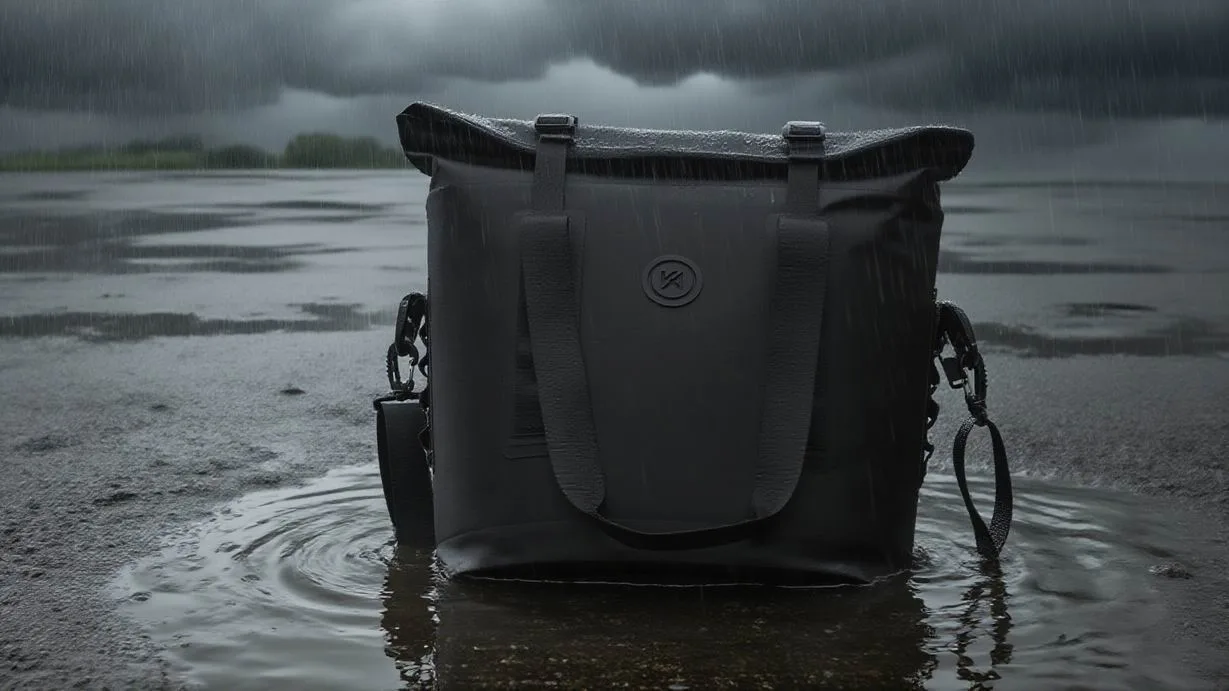
How creases actually form and fail
A crease is a plastic deformation. When a laminate is bent past its elastic recovery angle and held there, the face fabric on the inside of the bend compresses and the film relaxes into a new set position. Leave it for weeks and the set becomes effectively permanent at room temperature. Flex that set line afterwards and you are no longer bending the original material, you are working a damaged line.
The failure sequence is predictable. First the face fabric at the crease fibrillates and loses colour, giving the pale frost line most people have seen on an old bag. Then fine cracks appear in the film along that same line. Finally, if the crease crosses or runs adjacent to a weld, the stiffened weld edge takes the flexing load instead of the shell and begins to peel away from the substrate. The repair thresholds for each stage of that sequence are set out in our crease damage guide.
Temperature decides how fast this happens. Above 40 °C the polymer is soft enough to take a set in hours rather than weeks; below 5 °C it is stiff enough to crack on a single hard fold. Neither condition is exotic: a bag in a car boot in July reaches 55 °C, and one in an unheated shed in January regularly sits near freezing.
| Storage temperature | What the film does | Safe minimum bend radius | Risk from folding |
|---|---|---|---|
| -20 °C | Stiff, approaching cold-crack range | 25 mm | High: single hard fold can craze |
| 0 °C | Noticeably stiffer | 15 mm | Moderate |
| 20 °C | Room-flexible | 8 mm | Low |
| 35 °C | Softening | 12 mm | Moderate from set memory |
| 50 °C | Well above glass transition comfort zone | 20 mm | High: takes a permanent set quickly |
| Above 60 °C | Approaching softening of the tie layer | Do not fold | Severe, joins may creep |
Tightly rolled is nearly as bad as folded
The most common mistake is rolling a bag as tightly as it would roll for use, then leaving it for months. A tight roll puts sustained tension through the weld lines and keeps compressed air out of the interior, so the same geometry that protects a bag on the water becomes a long-term stress when it is static. Roll it loosely, roughly two turns with plenty of air left inside.
Leave the buckle undone. A closed buckle keeps constant tension on the closure panel and the reinforced mouth section, and it also prevents any residual moisture from equalising with room air. Undoing the clips takes two seconds and removes a constant, pointless load from the highest-stress area of the whole bag. It also stops the reinforced panel taking a permanent set along the line where the clips press.
Move the roll occasionally if storage runs beyond a season. Shifting the roll by a quarter turn every few months redistributes any tendency to take a set, in the same way that rotating a stored sleeping bag preserves loft. It sounds fussy and takes almost no time, which is why it is one of the few maintenance habits that actually survives contact with real owners.
| Storage method | Best for | Crease risk | Space used per 20L bag | Verdict |
|---|---|---|---|---|
| Loose roll, buckle open | Roll-top tubes up to 60L | Very low | 0.020 m3 | Default choice |
| Tight roll, buckle closed | Short transit only | Moderate | 0.014 m3 | Avoid for storage |
| Flat, open, hanging | Dry duffels and box-form bags | Low | 0.030 m3 | Good with airflow |
| Flat, folded in half | No appropriate use | High | 0.010 m3 | Never |
| Accordion panel fold | Small grab bags under 5L | Low to moderate | 0.012 m3 | Acceptable |
| Stuffed loose into a crate | Mixed size collections | Very low | 0.035 m3 | Good if kept dry |
Cleaning and drying before you put anything away
Storage begins with what is on the bag, not with how you fold it. Salt is hygroscopic, meaning it pulls moisture out of the air, so a bag put away with salt residue carries a permanently damp microclimate exactly where you do not want one. Sand left in the weave works as an abrasive every time the bag is moved, and organic residue such as lake silt is food for mould.
Rinse the whole shell in fresh water at ambient temperature, including the underside and the area under webbing where sand collects. Wipe the closure line with a soft cloth, working it open rather than closed so grit falls out rather than being pushed deeper. Then dry the bag completely: hang it open, mouth downward, in moving air until both the inside and outside are dry to the touch, which usually takes four to eight hours.
Use airflow rather than heat. A drying rack with genuine movement of air dries a bag in a fraction of the time of a warm corner, and it does not risk the local overheating that distorts thin film. Never put a bag away on the same day it got wet, because the last few percent of residual moisture is precisely what seeds a colony during months of storage.
Humidity: the variable that outranks folding
If you optimise one storage parameter, make it relative humidity rather than fold geometry. Mould spores are present in essentially all indoor air and need only a surface film of moisture and organic matter to establish. A dry bag that was put away slightly damp supplies both, and the resulting staining penetrates the face fabric permanently even after the mould itself is killed.
Below 60 percent relative humidity, mould growth is effectively static for most household species. Between 60 and 75 percent it becomes plausible over weeks. Above 75 percent, visible colonisation on a soiled surface can appear within a month, and health guidance on indoor mould from the CDC is worth reading if you store gear in a damp basement or garage.
| Relative humidity | Mould risk over three months | Typical indoor source | Recommended action | Check interval |
|---|---|---|---|---|
| Below 40% | Negligible | Heated interior rooms | None required | Seasonal |
| 40-60% | Very low | Most living spaces | Ensure bag was dry when stored | Seasonal |
| 60-75% | Moderate | Coastal homes, damp garage | Use a dehumidifier or silica packs | Monthly |
| 75-85% | High | Unheated sheds, bathrooms | Move stock to interior storage | Fortnightly |
| Above 85% | Severe within weeks | Boat lockers, cellars | Relocate; treat any staining | Weekly |
Silica is cheap insurance in borderline spaces. Two hundred grams of desiccant in a sealed crate keeps the local environment below 50 percent for months, and the indicating variety tells you when it needs regenerating. Do not place desiccant directly against welded seams, because locally over-dry conditions near a tight fold can accelerate embrittlement in some PVC constructions. Hang it in the corner of the crate instead, where it works just as well and touches nothing.

Light, heat and the invisible slow damage
Ultraviolet radiation degrades polymers by breaking chains at the surface, and the effect accumulates even through window glass. A bag stored on a sunny shelf can lose more service life in one summer than in several years of weekend paddling, because field use interleaves exposure with recovery while static storage does not. Choose a dark cupboard, or at worst an opaque crate.
Heat interacts with everything else. Every 10 °C rise roughly doubles the rate of the chemical reactions driving oxidation and plasticiser migration, so the same 20 °C bag kept in a loft that reaches 35 °C ages several times faster than one kept indoors. Avoiding lofts, car boots and garden sheds is a bigger lever than any folding decision you will make.
What happens to closures and hardware in storage
Roll-top closures are the least problematic area of a stored bag, provided they are undone. Leaving them clipped keeps constant tension on the mouth reinforcement and can flatten the panel’s natural curvature. Buckles themselves are more robust: most engineering plastics used in hardware lose little strength over decades at room temperature, though the springs in side-release buckles can take a small permanent set if stored compressed.
Metal hardware is the exception worth planning around. Even marine-grade stainless steels will stain in a humid chlorinated environment, and plated steel will pit. Rinse metal components, dry them thoroughly, and if the storage space is damp, store bags with metal parts slightly separated from one another so corrosion products do not transfer. A rust ring on a neighbouring bag is surprisingly difficult to remove once it has bonded to the film.
Webbing behaves differently again. Nylon webbing loses a little tensile strength when stored wet for long periods and can develop a permanent kink if stored tightly bent. Release the tension on harness straps, let them hang loose, and avoid stacking heavy items on top of a harness whose padding will compress permanently over a season. Compressed foam never recovers its original loft, and the comfort loss does not reverse.
Printed panels and clear windows need special handling
Printed areas are stiffer than unprinted film because the ink layer adds thickness and reduces flexibility. When a bag with a large print is folded across that print, the stiff panel does the flexing first and cracks appear preferentially along the edges of the artwork. The practical rule is simple: never fold through printed artwork, and never roll so tightly that print sits against print under pressure.
Clear windows are the most fragile feature on any dry bag. The window material is typically a different polymer from the shell, often bonded rather than welded, and it is far more sensitive to creasing. Store window bags open and flat where possible, or loosely rolled with the window facing outward so it arcs rather than folds. A creased window is almost never repairable.
Semi-rolled: the compromise that suits most shelves
There is a middle option that solves more real-world problems than either extreme. Semi-rolling means folding the bag once along its natural length with a generous radius, then loosely curling it rather than creasing it, giving a bundle about twice the diameter of a working roll with no hard line anywhere. It uses slightly more shelf space than either method and almost eliminates set risk.
This works particularly well for large sizes that are awkward to roll properly on a floor. A 90L bag rolled tightly on a hard surface with your knee in it is being folded, not rolled, and the resulting crease across the middle panel is exactly the failure described earlier. Semi-rolling a bag that size takes less effort and much less risk.
Combine semi-rolling with a breathable storage bag rather than a sealed plastic sack. Cotton or non-woven covers keep dust off while allowing moisture to equalise, whereas a sealed bin liner traps whatever moisture was present and creates the exact conditions the humidity table flags as dangerous. An old pillowcase costs nothing and performs better than any sealed sack sold for the purpose.
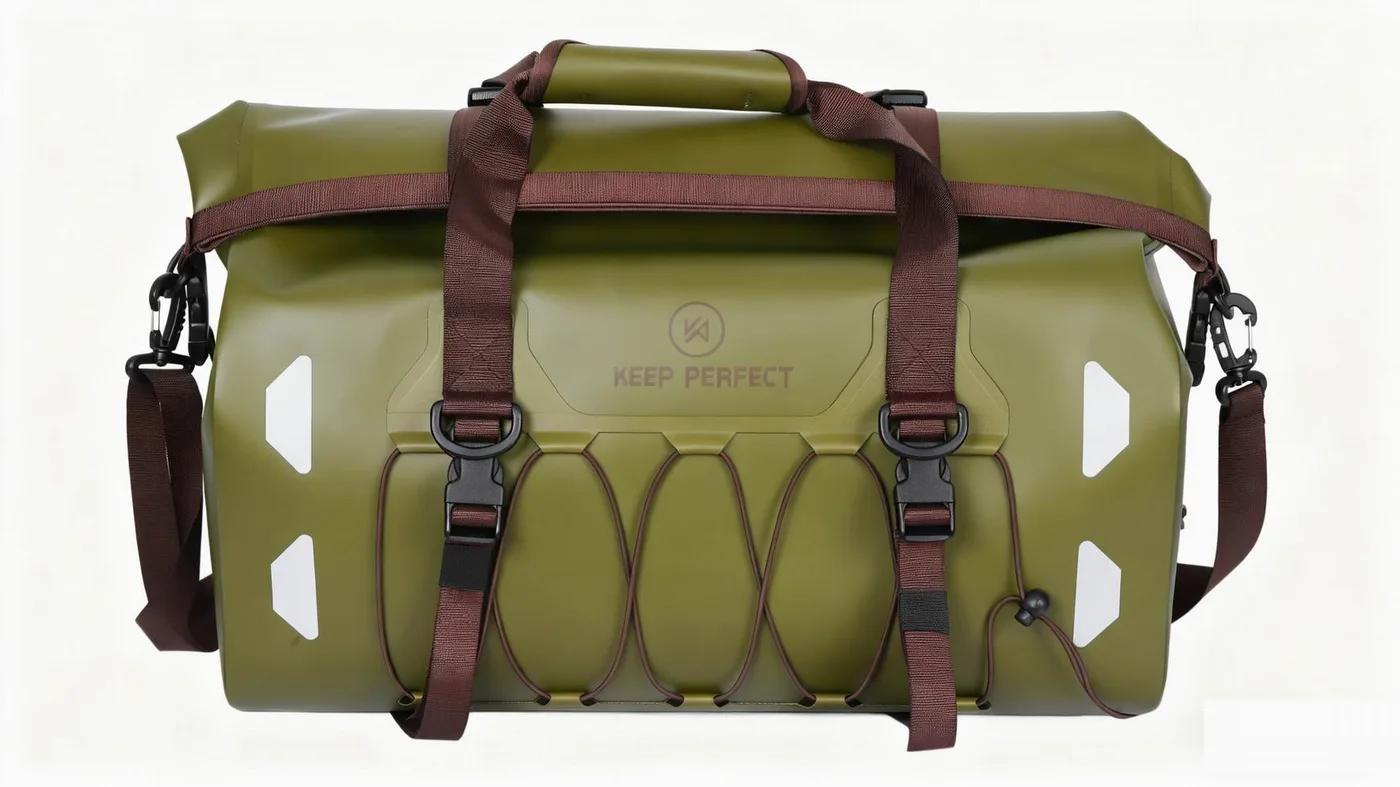
Bringing a rested bag back into service
- Open the bag fully and inspect every weld for lifted edges, paying attention to the base corners.
- Look along the fold lines for frost lines in the fabric; that is the earliest visible warning.
- Fill the bag with air, roll three times, and hold for 30 seconds to check for pressure decay.
- Submerge it briefly if it passes the air test, particularly after more than a year in storage.
- Work each buckle through ten cycles and listen for cracking or grab when released.
- Wipe the whole shell with fresh water and dry it before the first trip of the season.
That air-and-listen step catches almost everything worth catching, and it is the same test covered in detail in the seasonal chapters of our off-season storage guide. Run it before the trip rather than at the put-in, because a bag that fails at the car park costs you a delay while one that fails mid-trip costs you a day. Ten minutes on a Thursday evening is a much better place to discover a slow leak.
Retirement decisions are easier once you have the inspection result. A single short crease that passes the pressure test is fine to use; anything that shows film cracking at a line should stay home; anything leaking at a weld earns either a repair or retirement depending on age. Those thresholds and their reasoning are set out in our retirement criteria.
A simple shelf system that works
Storage succeeds when it is easy. Wire shelving with 30 cm between levels lets most bags sit semi-rolled without compression, and open wire allows air to move around each unit. A hook rail suits box-form duffels hung open, and a shallow crate suits the small grab bags that otherwise migrate into the bottom of everything. The easier the system is to use, the more likely everyone in the household is to follow it.
Label by size rather than by colour, because the inevitable question is which bag fits today’s trip, not what colour it is. Keep a small silica pack at the back of each shelf, swap indicating packs when they change colour, and once or twice a year spend ten minutes shifting every roll a quarter turn. Those three habits account for most of the difference between a five-year bag and a fifteen-year one.
Ventilation guidance published by the EPA on managing moisture in buildings applies here in miniature: a cupboard that gets an hour of air exchange a day will not host mould, whatever the bag was doing before it arrived. If the space smells musty when closed, fix the air movement before optimising anything else about how you fold.
What we recommend across a size range
Our own line has produced waterproof bags since 2014 in an SGS-verified 4,950 m2 facility, and the storage recommendation we ship with each size depends on its construction. Everything up to 20L goes out loosely rolled with the buckle open; everything from 30L upward ships semi-rolled; and every size in the roll-top family uses the same fold geometry so one shelf routine covers the whole range.
Duffels and box-form pieces are the exception, and they ship flat because that is how their geometry wants to rest. If you are planning a range, build the storage instruction into the care label rather than the website, since the label is what the owner sees on the day the decision gets made.
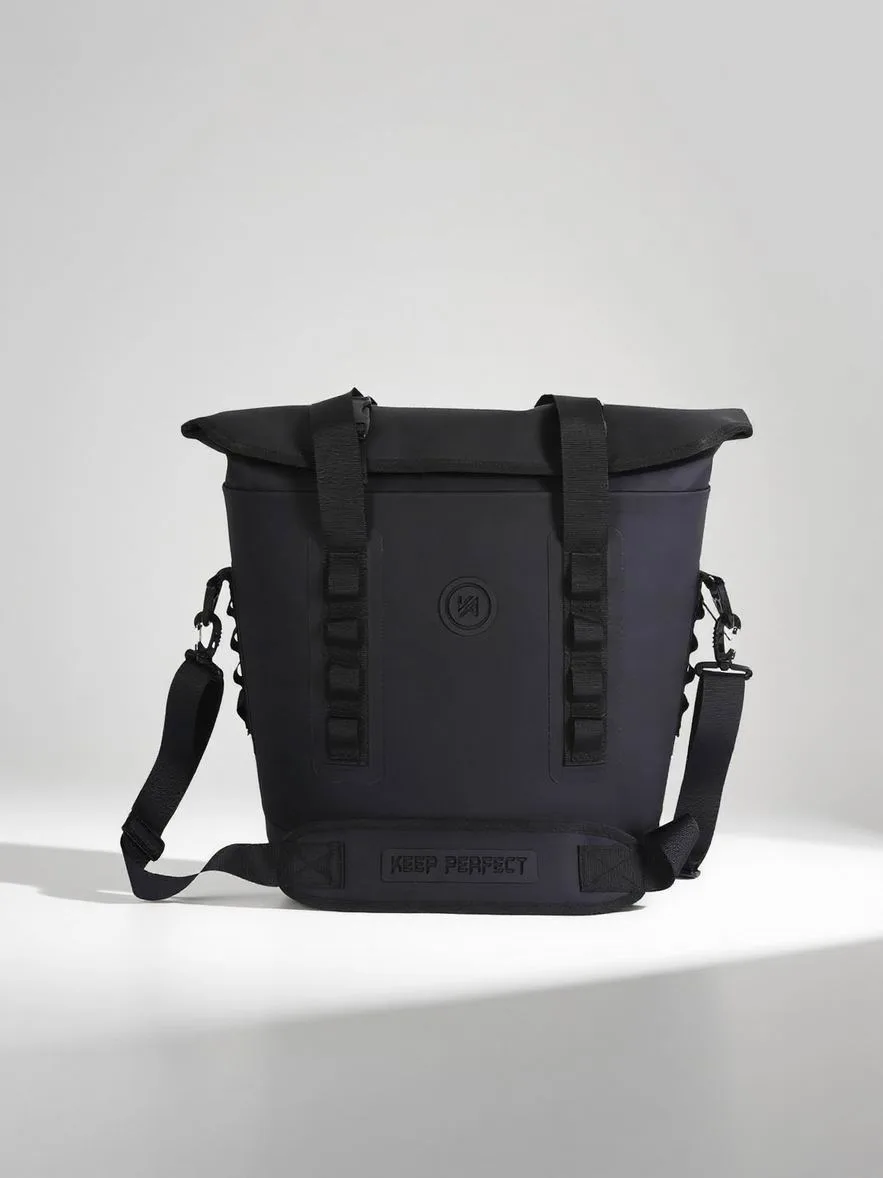
Decision checklist
The whole article reduces to six checks. Answer them in order and you will make the right call for any bag you own, without needing to remember the temperature tables or the humidity thresholds. Print them next to the shelf if storage decisions are made by more than one person. Shared gear fails earliest, usually because everyone assumes somebody else put it away properly.
- Is the bag clean, rinsed and completely dry to the touch inside and out?
- Is it a tube or a box form? Tubes roll loosely; box forms rest open and flat.
- Are there printed panels or a clear window? If so, avoid any fold crossing them.
- Is the storage space dark, cool and below 60 percent relative humidity?
- Are all buckles undone and all straps relaxed before the bag goes away?
- Is there room to store it without compressing the bag underneath it?
Answer yes to all six and the folding method barely matters, because the environmental factors dominate everything else in this list. Answer no to the storage condition and no folding technique will save the bag, whatever the marketing on it claimed at the point of purchase. Environment first, geometry second, and only then worry about which shelf it sits on.
Frequently asked questions
Q1. Should I store dry bags rolled or flat?
Roll them, loosely, with the buckle undone. Rolling avoids the permanent crease that folded storage creates along the film. Store flat only for box-form duffels that have no tube geometry and no printed panel crossing a potential fold line.
Q2. Why does folding damage a dry bag?
Folding creates a permanent set in the laminate, concentrating all future flexing into a 3 to 5 mm line. That line fibrillates, the film crazes, and any weld running beside it begins to peel. Rolling spreads curvature across the circumference instead.
Q3. Should I roll it tightly or loosely?
Loosely. A tight roll puts sustained tension through the weld lines and prevents air equalising inside. Aim for about two loose turns with plenty of trapped air left, and never roll a large bag with your knee against a hard floor.
Q4. Should the buckle be closed in storage?
No. Undoing it removes constant tension from the closure panel and the reinforced mouth, and lets residual moisture equalise with room air instead of staying trapped inside the bag.
Q5. What humidity is safe for storing dry bags?
Below 60 percent relative humidity for long storage. Between 60 and 75 percent mould becomes plausible over weeks, and above 75 percent visible colonisation on a soil residue can appear within a month.
Q6. Can I store dry bags in a shed or garage?
Only if it stays below 60 percent humidity and avoids summer heat above 35 °C. Most unheated sheds fail both. If that is your only option, use a sealed crate with 200 g of indicating silica and check it monthly.
Q7. How long can a dry bag be stored?
A rinsed and dried bag kept dark, cool and dry shows negligible change over five years. The limiting factors are cumulative heat hours above 30 °C and time above 65 percent humidity rather than calendar years alone.
Q8. Should I store a dry bag with air inside?
Yes, loosely. Trapped air maintains a gentle internal pressure that keeps the shell from collapsing into hard creases, and it prevents opposing film surfaces from sticking together in warm conditions.
Q9. Is it safe to stack dry bags on top of each other?
Light stacking is fine; heavy compression is not. Stacking several filled bags on one another compresses the lower unit permanently, which is equivalent to storing it folded for months.
Q10. Do I need to clean a bag before storage?
Always. Salt attracts moisture, sand abrades the film during handling, and organic residue feeds mould. Rinse in fresh water, wipe the closure line open, and dry completely before putting it away.
Q11. How should I store a bag with a clear window?
Open and flat if you can, or loosely rolled with the window facing outward so it arcs rather than folds. Window materials are more sensitive to creasing than the shell, and a creased window is effectively unrepairable.
Q12. Can printed bags be rolled?
Yes, but avoid folding across the artwork. Printed areas are stiffer than bare film and will flex preferentially along the edges of the print, producing cracks that follow the artwork outline.
Q13. What temperature damages a stored dry bag?
Above about 40 °C the laminate takes a permanent set quickly, and above 60 °C the tie layer can creep. At the other end, below roughly -20 °C most films approach their cold-crack range and a hard single fold can craze.
Q14. How do I check a bag that has been stored for a year?
Fill it with air, roll three times, hold for 30 seconds and listen and feel for decay. Follow with a short submersion test. Inspect the fold lines for frost-coloured fuzz in the face fabric before anything else.
Q15. Do desiccant packs help in a storage crate?
Yes. Around 200 g of indicating silica keeps a sealed crate below 50 percent humidity for months. Keep packs away from direct contact with welded seams, since very dry local conditions can embrittle some constructions near a tight fold.
Q16. Should a slightly damp bag be stored closed or open?
Neither: dry it first. Storage decisions assume a dry starting point, and closing a damp bag traps the exact moisture that seeds mould across the interior surface during months of storage.
People also ask
How do you store dry bags long term?
Rinse and fully dry them, then store loosely rolled with buckles undone in a dark space below 60 percent humidity and below 25 °C. Shift each roll a quarter turn every few months and re-test with an air check before the first trip.
Is it bad to fold dry bags?
Yes for long-term storage. A fold creates a permanent crease that concentrates flexing into a narrow line, leading first to frosting in the fabric, then film cracking, then weld peel near that line.
Should dry bags be stored open or closed?
Closed but not sealed: roll the top loosely and leave the buckle undone. That keeps dust out while removing constant tension from the closure and letting any residual moisture escape.
Why do old dry bags crack at the folds?
Because the laminate took a permanent set along that fold and every subsequent handling event flexed the same damaged line. Combined with UV exposure and heat cycling, the repeated bending eventually crazes the film.
Can you store dry bags in plastic bags?
Avoid sealed plastic. It traps residual moisture and creates a humid microclimate that encourages mould. Use a breathable cotton or non-woven cover instead, which keeps dust off while allowing moisture to equalise.
How often should you check stored dry bags?
Inspect visually every season and run an air pressure test before their first use each year. If storage humidity sits above 60 percent, check monthly and keep an eye on any silica indicator in the crate.
Need this in production volume?
QUANZHOU JUNYUAN BAGS has produced waterproof bags since 2014 in an SGS-verified 4,950 m2 facility in Fujian, China. Minimum order 500 pieces, sampling in 6–10 working days, bulk in 35–50 days, FOB Xiamen — write to service@junyuanbags.com with your spec and target market.