Home / Blog / Waterproof Technology
Rain Protection vs Submersion
Rain is a low-pressure, long-duration event driven by droplet impact and wind; submersion is a high-pressure, short-duration event driven by hydrostatic head. A bag that survives four hours of driven rain at 40 km/h may fail 30 seconds after it goes overboard, because immersion at one metre puts 9.8 kilopascals on every seam while rain puts almost nothing on them. The two exposures need different constructions: rain performance depends on coatings and closure covers, submersion performance depends on weld continuity and film thickness.
This guide compares the two with real numbers: the pressure at depths from 0.1 m to 3 m, the 2.9 kilopascals needed to push water through a 0.1 mm needle hole, the 94 kilopascals a loaded shoulder strap applies to a back panel, and what each IPX grade actually tests. It finishes with home test procedures for both exposures and the decision rules that tell you whether you need IPX4, IPX6 or IPX7.
- Rain and immersion are two different problems
- What a spray test proves and what it does not
- Pressure at depth: the actual numbers
- Time: 30 minutes versus four hours
- Why a rain cover passes and then fails
- Seam behaviour under each exposure
- Closures: roll-top versus zipper in rain and under water
- Coatings, laminates and the wetting-out trap
- Choosing by exposure profile
- Testing for rain without a laboratory
- Testing for immersion without a laboratory
- How ratings degrade with age
- Decision rules and a buying checklist
Rain and immersion are two different problems
In rain, water arrives as discrete droplets at 4 to 9 metres per second, hits a small area for a fraction of a second, and then runs off under gravity. There is essentially no sustained pressure. In submersion, the entire surface is loaded continuously by the weight of the water column above it, and any defect anywhere becomes a leak immediately. The failure modes therefore have nothing in common: rain failures are wetting-out and run-off, immersion failures are pressure-driven ingress through a defect.
This is why the two are tested differently and why a single adjective cannot describe both. A shower test asks whether water runs off faster than it is applied. An immersion test asks whether a defect can be sealed against a standing pressure for a fixed time. A fabric can pass the first comfortably and fail the second, or pass the second and still soak through in the first if its face fabric wets out and wicks.
The practical consequence is that you should specify against your worst realistic exposure, not against the label you like. A commuter who cycles 40 minutes through a storm needs jet resistance and a covered closure. A kayaker who may capsize in 1.5 m of water needs weld continuity. Someone who does both needs both, which in practice means a welded roll-top with a reinforced mouth rather than a coated pack with a rain flap.
What a spray test proves and what it does not
Ingress protection grades are defined by IEC 60529, published by the IEC, and each grade names a nozzle, a flow rate, a distance and a duration. IPX5 uses a 6.3 mm nozzle at 12.5 litres per minute for three minutes. IPX6 uses a 12.5 mm nozzle at 100 litres per minute. Both are jet tests, and both are what rain at speed actually looks like.
What a jet test does not prove is anything about pressure holding. Water leaving a nozzle decelerates the moment it hits the bag and then drains away; it never builds a standing head. So IPX6 tells you the shell, closure and seams resist driven water, and it tells you nothing about whether the bag survives being held under. That is the single most common misunderstanding in dry bag buying, and it is why the same bag can be excellent on a motorcycle and useless in a canoe.
| Grade | Test condition | Flow or depth | Duration | Real exposure it matches |
|---|---|---|---|---|
| IPX3 | Spray at 60 degrees | 0.07 L/min | 5 min | Light drizzle, mist |
| IPX4 | Splash, all directions | 0.07 L/min | 5 min | Steady rain, road spray |
| IPX5 | 6.3 mm nozzle jet | 12.5 L/min | 3 min | Storm gusts, boat spray |
| IPX6 | 12.5 mm nozzle jet | 100 L/min | 3 min | Breaking waves, wash-down |
| IPX7 | Immersion at 1 m | 9.8 kPa | 30 min | Capsize, dropped overboard |
| IPX8 | Immersion beyond 1 m | Agreed in the test | Agreed in the test | Sustained submersion |
Pressure at depth: the actual numbers
Hydrostatic pressure is density times gravity times depth, so every 10 cm of water adds roughly 0.98 kilopascals. At 1 m the bag sees 9.8 kilopascals, which is about 0.1 bar, and on a 10 × 10 cm panel that is 98 newtons of force pressing inward. It sounds small, and compared with a jet test it is, but it is continuous, it acts everywhere at once, and it never lets go for the full duration of the event.
The number that matters more than depth is the threshold at which a defect starts to pass water. A needle hole 0.1 mm across resists inflow until the water surface tension is overcome, which happens at roughly 2.9 kilopascals, equivalent to about 30 cm of depth. Below 30 cm a stitched seam with a water-repellent coating can stay dry by surface tension alone. Below 1 m it cannot, and that is the entire reason welded seams exist.
| Depth | Gauge pressure | Force on a 10 x 10 cm panel | Exposure example | Rating needed |
|---|---|---|---|---|
| 0.1 m | 0.98 kPa | 9.8 N | Bag standing in a puddle | IPX4 |
| 0.3 m | 2.9 kPa | 29 N | Shallow wade, surf wash | IPX6 |
| 0.5 m | 4.9 kPa | 49 N | Knee-deep water | IPX7 |
| 1.0 m | 9.8 kPa | 98 N | Standard IPX7 condition | IPX7 |
| 2.0 m | 19.6 kPa | 196 N | Deep capsize, pinned boat | IPX8 |
| 3.0 m | 29.4 kPa | 294 N | Held under by current | IPX8 |
Time: 30 minutes versus four hours
Duration is the variable people forget. IPX7 is a 30-minute test, and most real immersions are far shorter: a capsize recovery takes 20 to 60 seconds, a bag dropped off a raft is retrieved in under two minutes. Four hours of rain is a much longer event, and the mechanism is completely different. Rain does not need to defeat a seal by pressure; it needs only to find a path and keep it wet long enough for capillary action and wicking to carry water inward.
This is why face fabric matters in rain and is irrelevant in a short dunk. A woven polyester shell with a durable water-repellent finish sheds water for the first hour or two and then wets out, at which point the outer layer becomes a wet sponge held against the laminate. The laminate still blocks water, so the bag does not leak, but it gains 100 to 300 grams of absorbed water and the contents feel damp when you open it in a tent.
The other time-dependent mechanism is creep at the closure. A roll-top folded three times holds a jet indefinitely and holds immersion for 30 minutes; over four hours of continuous wetting, water can slowly track along the fold if the fabric has any stiffness memory. If you expect hours of immersion rather than minutes, add a fourth fold and accept the 1.6 litres of capacity it costs on a 50L bag.
Why a rain cover passes and then fails
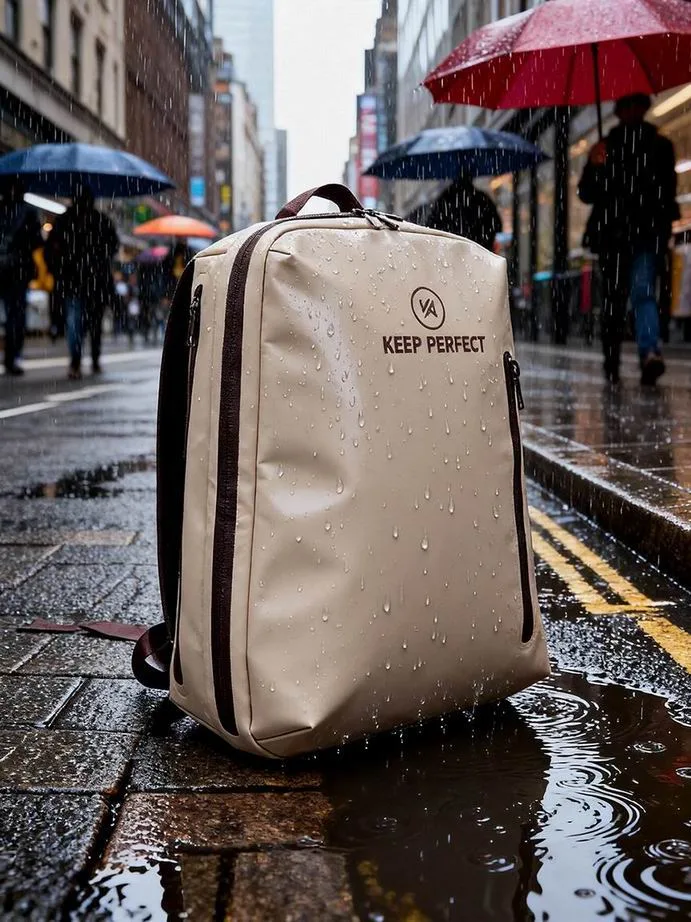
A rain cover solves the top of a pack and ignores everything else. Water running down a wearer’s back enters the back panel directly, which is the largest single surface on any backpack, and a cover does nothing about it. Water that gets between the cover and the shell is held there by the cover itself, so a pack under a cover can end up with a persistently wet panel that a bare shell would have shed.
Covers also fail by abrasion and by fit. A cover that flaps at 40 km/h on a motorcycle abrades itself against the shell within a season, and a cover sized for a 40L pack on a 55L load leaves the sides exposed. They remain a reasonable choice for a hiking pack that only sees occasional rain, because they are light and packable. They are not a substitute for a welded shell on a boat, where the exposure is not rain at all.
The honest comparison is between three approaches for wet weather: a coated pack plus a cover, a pack with a welded liner, and a fully welded dry bag inside or instead of the pack. The coated pack plus cover is lightest and cheapest and fails first. The welded liner is the best compromise for commuting. The welded bag is the only one that survives immersion. Our water-resistant versus waterproof comparison sets out the trade-offs in detail.
Seam behaviour under each exposure
A welded seam is a continuous bond with no holes, so it behaves identically in rain and in immersion up to the point where the film itself fails. A taped seam is a stitched seam with a tape adhered over the needle holes, and it behaves differently: in rain the tape never sees pressure and lasts for years, while in immersion the tape is pushed away from the stitch line and any pinhole in the adhesive becomes a path.
Seam tape also has a direction problem. Tape is applied on the inside of the shell, so immersion pressure pushes water into the stitch holes from outside and then tries to lift the tape from the inside, which is the direction the adhesive is weakest in. This is why taped seams are common on rain shells and rare on genuine submersion gear, and why a bag with taped seams should be treated as splash-proof regardless of what the hang tag says.
Weld width is the quality signal. A radio-frequency weld on TPU produces a 15 to 20 mm band that is stronger than the film around it, so failure moves into the panel rather than the bond. A narrow 4 to 6 mm heat weld on a coated fabric is a different animal: it holds in rain, it resists light splash, and it peels under sustained pressure. Turn the bag inside out and measure before you buy.
Closures: roll-top versus zipper in rain and under water
A roll-top closure is a mechanical seal, and it gets better as the water tries harder to get in: pressure presses the folds together. It is the right closure for immersion and it is perfectly adequate in rain, with one weakness: the fold is a horizontal channel, and in hours of driven rain water can sit in the top fold. Roll three times and the outer fold sheds it; roll twice and you may find a cupful inside.
A waterproof zipper is a precision seal that works well in rain and badly under pressure. Coated zipper tapes rely on two lips being pressed together by the slider, and the seal is only as good as the slider alignment. Under immersion pressure, and especially if the zip is curved around a corner, the lips separate slightly and water tracks along the tape. Zips also wear: a coated zip rated for 5,000 cycles loses meaningful sealing force after about 3,000.
The decision rule is simple. If the bag will be submerged, use a roll-top. If the bag needs frequent one-handed access and will only ever see rain, a waterproof zip is better. If it needs both, buy a roll-top and put frequently used items in an external welded pocket. The specific grades are compared in our IPX6 versus IPX7 guide, and the full ladder is set out in our ratings explainer.
Coatings, laminates and the wetting-out trap
Two constructions dominate. A coating is a layer of polymer applied to one side of a woven fabric; it is cheap, it can be thick, and it sits on the surface where abrasion and hydrolysis attack it. A laminate is a film bonded to the fabric under heat and pressure, usually with a tie layer; it is more expensive, it resists abrasion far better, and it does not flake. Both can reach the same hydrostatic head on day one, and they diverge sharply after two seasons.
Hydrostatic head is the laboratory measure of how much water pressure a fabric resists before three drops appear, and it is defined by test methods published by the ISO. A 10,000 mm head sounds enormous, and in a rain sense it is. But the number is measured on a flat, unstressed swatch, which is not how a bag is loaded. Put a 12 kg load on a 25 mm shoulder strap with a 50 mm contact patch and the local pressure is 94 kilopascals, equivalent to a 9.6 m water column. That strap contact point is where rain leaks start.
This is the practical answer to a question people ask constantly: how can a 10,000 mm fabric leak in ordinary rain? Because the leak is not through the fabric, it is through a stress concentration at a strap, a buckle or a fold, where local pressure exceeds the rating by an order of magnitude. Welding around hard points and distributing strap load over a wider patch is worth more than another 5,000 mm of head.

Choosing by exposure profile
Start from the worst thing that will realistically happen to the bag, not from the average day. For a commuter the worst case is 40 minutes of driven rain at 30 to 40 km/h with a loaded strap pressing on the back panel. For a kayaker it is a 60-second immersion at 1 to 1.5 m. For a rafter it is several minutes pinned under a frame at 1 to 2 m. Those three cases produce three different specifications.
| Use case | Worst realistic exposure | Minimum rating | Closure | Seam requirement |
|---|---|---|---|---|
| Urban walk in rain | 2 h of steady rain | IPX4 | Roll-top, 2 folds | Welded or taped |
| Cycling in a storm | Jet water at 40 km/h | IPX5 | Roll-top, 3 folds | Welded |
| Kayak day paddle | Bow spray, brief dunk | IPX7 | Roll-top, 3 folds | Welded, continuous |
| SUP in surf | Repeated 30 s dunks | IPX7 | Roll-top, 3 folds | Welded, 0.5 mm film |
| Raft in whitewater | Minutes held at 1-2 m | IPX8 | Roll-top, 4 folds | Welded, 0.6 mm film |
| Motorcycle touring | Sustained jet at 90 km/h | IPX6 | Roll-top, 3 folds | Welded |
Notice that only the first row in that table is satisfied by a taped seam. Everything from IPX6 upwards assumes a weld, because from that point on the bag is being asked to resist standing pressure somewhere on its surface. If your exposure profile has one immersion event in twenty trips, specify for the immersion event; the extra 120 grams of weld and film cost nothing compared with the contents of the bag.
The other thing worth reading from the table is how rarely IPX8 is genuinely required. Most people who ask for it are boatside anglers and whitewater users who can be pinned for minutes at a metre or two, and for everyone else IPX7 covers the realistic worst case with margin. Over-specifying to IPX8 usually means a heavier film and a stiffer bag, and stiffness is what makes a roll-top hard to close in the cold.
Testing for rain without a laboratory
- Load the bag to its normal weight and fit the straps as you would wear them.
- Set a shower head 1 m above the bag and run it for 30 minutes at full flow.
- Check the interior with a dry paper towel, starting at the strap contact points.
- Repeat with the bag lying on its side, then with the closure facing up.
- Weigh the bag before and after; 200 g of gain means the face fabric has wetted out.
- Inspect the closure fold for standing water after the run.
The weighing step is the one people skip, and it is the most informative. A shell that absorbs 200 grams of water has not leaked, but it will transfer that water to everything you pack next to it, and on a multi-day trip that is the difference between a dry sleeping bag and a damp one. A laminated TPU shell should gain under 30 grams in the same test, because there is no woven face to hold water.
Run the test twice, once cold and once after the bag has been in the sun for a season. Ultraviolet exposure and hydrolytic ageing change the surface energy of a coated fabric, so a bag that sheds water in month one may wet out in month fourteen. That second run is the closest thing to an accelerated life test you can do at home without equipment.
Testing for immersion without a laboratory
A bath gives you roughly 0.4 m of depth, which is 3.9 kilopascals: enough to catch a bad seal, not enough to prove IPX7. To approximate the standard, fill the bag part-way with air rather than gear, close it with three folds, and press it under with a weight so the whole surface is loaded evenly. Air is far more sensitive than gear, because any leak shows immediately as a stream of bubbles.
Leave it for 30 minutes and watch for the first two minutes, because that is when a marginal seal declares itself. A single steady stream from one point means a defect, and a slow trickle of individual bubbles usually means air escaping around the fold rather than through it. Mark the spot, dry the bag, and repeat with the bag rotated so the suspect area is uppermost; if the leak moves, it is the fold, and if it stays, it is the weld.
A swimming pool gives you a true 1 m test if you can hold the bag down for 30 minutes, and it is the best home proxy for IPX7 that exists. Do not use a hot tub: water above 40 °C softens TPU film and will produce a false pass or a false fail depending on the film formulation. The full method, including how to record results, is in our immersion testing guide.
How ratings degrade with age
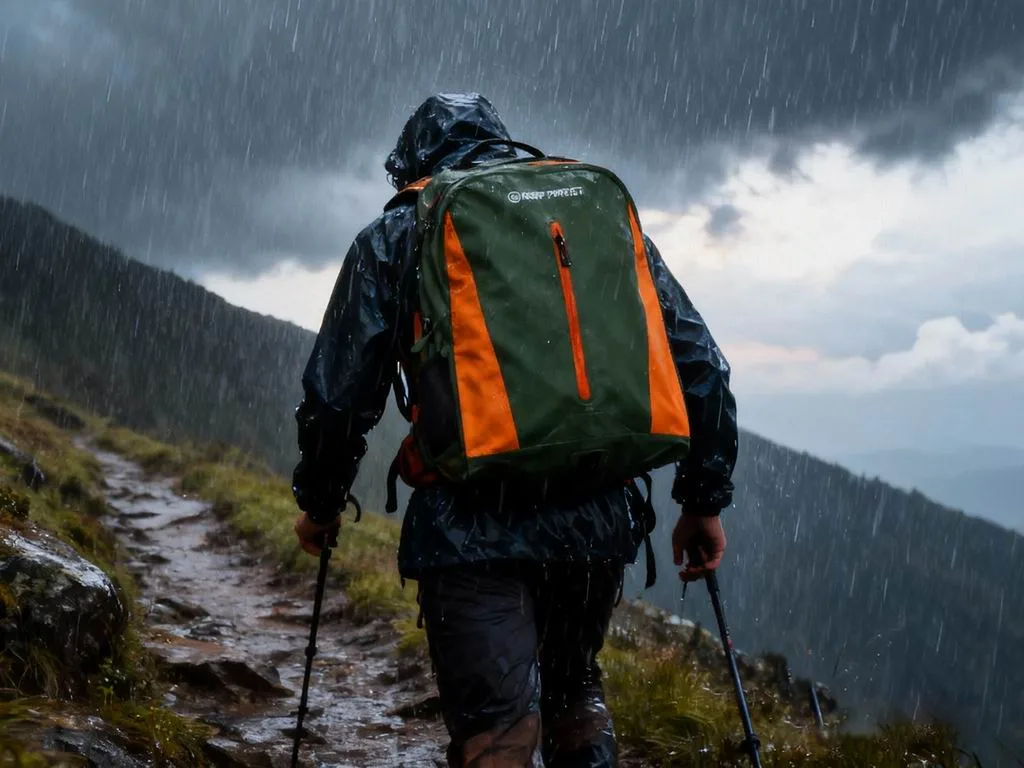
Waterproof performance is not constant over a bag’s life, and the two exposures decay at different rates. Rain performance depends heavily on the durable water-repellent finish, which is the first thing to go: expect meaningful loss after 20 to 30 wash cycles or about two seasons of regular use, and expect the finish to be effectively gone by year four. Submersion performance depends on weld integrity, which decays far more slowly if the bag is stored properly.
Three mechanisms do the damage. Ultraviolet radiation breaks polymer chains at the surface and is the main cause of film stiffening and colour fade. Hydrolysis attacks polyester-based polyurethanes from the inside, especially in warm humid storage, and is the reason a bag stored wet in a garage fails before one stored dry in a house. Crease damage concentrates both at the fold line, which is why the closure is always the first place a bag shows its age.
The maintenance response is unglamorous and effective: rinse salt off, dry in shade, store loosely rolled with the buckle undone, and never leave a bag compressed under other gear for months. Those four habits add years to submersion performance and slow the loss of rain shedding by roughly a season. For the physics behind the coating measurements, see our hydrostatic head explainer.
Decision rules and a buying checklist
- Write down the worst realistic exposure before you look at any product.
- If the bag can be submerged, require welded seams and a roll-top; nothing else qualifies.
- If the bag only sees rain, an IPX4 to IPX6 welded-liner pack is lighter and cheaper.
- Check strap load paths: a 12 kg strap can apply 94 kPa locally, above any fabric rating.
- Ask which IEC or ISO method produced the figure, not just the grade.
- Test on arrival: 30 minutes under a shower, then 30 minutes pressed under in a bath.
- Re-test annually; rain performance decays in about two seasons, welds much more slowly.
If you are specifying bags for a fleet, a club or a retail range, put the exposure profile in the brief rather than a grade. Naming IPX7 without naming a depth, a duration and a method leaves the claim unenforceable, and that is where disputes start. Our waterproof bag line has been produced since 2014 in an SGS-verified 4,950 m2 facility where incoming film is checked and finished bags are inspected to AQL 2.5.
Two closing cautions are worth stating plainly. First, no dry bag is a flotation device: a sealed bag with air floats, a bag with a leaking closure does not, and neither is a life jacket. Second, driven rain at speed combined with cold is a hypothermia risk that no bag addresses; check exposure guidance from the NOAA before committing to a winter trip on the water. A welded shell protects your kit, not your core temperature.
For readers who want the single strongest construction across both exposures, the answer is a welded roll-top with a 0.5 mm film, three folds, and reinforced load paths at every strap anchor. That is the platform behind our TPU waterproof backpack range, and it is the same construction that carries the submersion rating rather than merely a shower rating. Start from the exposure, work back to the rating, and the rest of the specification follows.
Frequently asked questions
Q1. Is rain protection the same as waterproof?
No. Rain is a low-pressure jet event measured by IPX3 to IPX6; waterproof under immersion is a pressure event measured by IPX7 or IPX8. A bag can resist hours of rain and still leak within seconds underwater.
Q2. What rating do I need for rain protection?
IPX4 for steady rain on foot, IPX5 for cycling in a storm, and IPX6 for sustained jet water at speed on a motorcycle or an open boat. None of the three proves submersion performance.
Q3. How much pressure is there at one metre underwater?
About 9.8 kilopascals, or 0.1 bar, which is 98 newtons on a 10 x 10 cm panel. Compare that with rain, which applies almost no standing pressure at all.
Q4. Why does a bag rated IPX6 leak when I capsize?
Because IPX6 is a jet test with no standing head. Immersion loads every seam continuously, and any taped or stitched seam that survives a jet can still pass water under pressure.
Q5. At what depth does a stitched seam start to leak?
Around 30 cm. A 0.1 mm needle hole holds water out by surface tension until roughly 2.9 kilopascals, which is reached at that depth; below it, water tracks through.
Q6. Can a fabric rated 10,000 mm leak in ordinary rain?
Yes, at stress concentrations. A 12 kg shoulder strap on a 25 x 50 mm contact patch applies about 94 kilopascals, equivalent to a 9.6 m water column, which exceeds the flat-swatch rating.
Q7. Are welded seams better than taped seams?
For immersion, yes. A weld has no holes; a tape covers holes and is pushed away from them by pressure acting from the outside, which is the direction the adhesive is weakest.
Q8. Is a roll-top or a waterproof zip better in the rain?
A zip is more convenient and fine in rain. A roll-top is better under pressure because water pressing on the folds tightens the seal, whereas immersion pressure can separate zip lips.
Q9. How long can a dry bag stay underwater?
An IPX7 bag is tested for 30 minutes at 1 m. Real capsizes last under a minute, so a bag that passes the test has a large margin; hours of immersion need a fourth fold and a heavier film.
Q10. Does a rain cover make a pack waterproof?
No. Covers ignore the back panel, which is the largest surface on a pack, and they trap water against the shell. They are a light solution for occasional showers, not for immersion.
Q11. How do I test a dry bag for rain at home?
Load it, run a shower over it for 30 minutes, then check inside with a paper towel starting at the strap points. Weigh it before and after; 200 g of gain means the face fabric has wetted out.
Q12. How do I test a dry bag for immersion at home?
Part-fill it with air, close with three folds, press it under a weight in a bath and watch for bubbles for 30 minutes. A steady stream from one point is a defect; a slow trickle is the fold.
Q13. Does hot water affect a waterproof test?
Yes. Water above 40 C softens TPU film and can produce a false result either way. Test at ambient temperature, and never use a hot tub as a proxy for a bath.
Q14. How long does rain repellency last?
A durable water-repellent finish loses effectiveness after 20 to 30 wash cycles, roughly two seasons of regular use, and is largely gone by year four. Welded seams decay much more slowly.
Q15. What damages a dry bag fastest?
Ultraviolet exposure, warm humid storage that drives hydrolysis, and creasing at the fold line. Rinse salt, dry in shade and store loosely rolled to slow all three.
Q16. Is a dry bag a flotation device?
No. A sealed bag with trapped air floats, but it is not a life jacket and the buoyancy disappears the moment the closure leaks. Use a personal flotation device for people.
People also ask
What is the difference between waterproof and water-resistant?
Water-resistant sheds rain and splash, typically IPX3 to IPX6, and relies on coatings and closures. Waterproof resists standing pressure under immersion, IPX7 or IPX8, and requires welded seams and a mechanical closure.
How deep can an IPX7 dry bag go?
IPX7 is defined at 1 metre for 30 minutes. Many welded bags survive deeper for short periods, but the rating only certifies the tested condition, so treat anything deeper as unverified.
Why does my waterproof backpack get wet inside?
Usually wicking through a wetted-out face fabric, condensation, or water entering at a strap contact point where local pressure far exceeds the fabric rating. Rarely is it a hole in the laminate.
Are taped seams good enough for kayaking?
Not for submersion. Tape protects stitch holes from rain, but immersion pressure lifts it from the inside and any pinhole becomes a path. Use welded seams for any bag that can go under.
Does rain pressure increase with wind speed?
Driven rain behaves like a jet, so wind raises impact energy and flow rate rather than standing pressure. At 40 km/h it resembles IPX5; at highway speed on a bike or motorbike it approaches IPX6.
Can a dry bag be both rain and submersion proof?
Yes, if it is welded with a roll-top closure. Welded seams handle pressure, and a three-fold roll-top sheds driven rain while tightening under immersion. That combination covers both exposures.
Need this in production volume?
QUANZHOU JUNYUAN BAGS has produced waterproof bags since 2014 in an SGS-verified 4,950 m2 facility in Fujian, China. Minimum order 500 pieces, sampling in 6–10 working days, bulk in 35–50 days, FOB Xiamen — write to service@junyuanbags.com with your spec and target market.