Do Dry Bags Work in Freezing Conditions?
Yes, dry bags work in freezing conditions, but the bag material is rarely the problem. A quality TPU laminate has a cold crack point around -40 °C and still folds at -25 °C, while PVC coated fabric starts to stiffen near 0 °C and can crack when rolled at -15 °C. The part that actually fails in winter is the closure: water left in the fold line freezes within about 20 minutes at -10 °C, and a frozen roll-top cannot be rolled flat enough to seal.
Every winter failure we see comes from one of four mechanisms: moisture in the fold, a stiffened film that will not make three clean folds, hardware that will not release with gloved hands, and condensation that appears inside a sealed bag when warm gear meets cold air. This guide gives the temperatures at which each one appears, the material choices that avoid them, and a winter routine that takes about four minutes at the end of the day.
- What freezing does to a dry bag
- Cold crack temperature: TPU against PVC
- The frozen roll-top closure is the real failure point
- Ice in the fold line and how to keep it out
- Buckles, hardware and gloved hands
- Condensation: water that appears inside a sealed bag
- What happens when liquids freeze inside a bag
- Buoyancy and ice: does a frozen bag still float
- Winter activities and the exposure each one creates
- Warming a frozen bag without damaging it
- Drying and storing a winter bag
- Testing a winter dry bag before you rely on it
- Winter checklist and the limits of a dry bag
What freezing does to a dry bag
Cold affects three things separately: the polymer film, the closure geometry and the hardware. The film loses flexibility as temperature falls, which is measurable and predictable. The closure depends on the film folding against itself with enough contact pressure to make a seal, and that depends on how many folds you can physically make. The hardware is mostly a question of metal versus plastic and of whether you can work it through a glove.
The important distinction is between a bag that is cold when you pack it and a bag that gets cold after packing. A bag packed indoors at 20 °C and then carried into -15 °C air behaves differently from one that has been sitting in the cold for hours: the trapped warm air contracts, the internal pressure drops slightly, and moisture inside migrates to the coldest surface, which is usually the inside of the film near the closure. That migration is what forms the frost you find in the morning.

Cold crack temperature: TPU against PVC
Cold crack temperature is the point at which a film fractures when it is folded sharply on a mandrel under a standard test. Thermoplastic polyurethane typically reports below -40 °C, and in practice a 0.5 mm TPU bag can still be rolled three times at -25 °C, though it takes noticeably more force. The film is not damaged by this; it is simply stiffer, and it recovers completely once it warms.
PVC behaves differently because it relies on plasticiser to stay flexible. As temperature falls the plasticiser becomes less effective, the coating stiffens, and by around -15 °C a sharp fold can craze the coating. The woven base underneath is usually intact, so the bag may still hold water briefly, but the crazed coating lets moisture through at the fold within minutes. This is the single strongest argument for TPU in any market with a real winter.
| Material | Cold crack point | Foldable at -10 °C | Foldable at -25 °C | Winter verdict |
|---|---|---|---|---|
| TPU laminate, 0.5 mm | Below -40 °C | Yes, normal force | Yes, firm force | Best choice |
| TPU laminate, 0.3 mm | Below -40 °C | Yes, easy | Yes, moderate force | Good for small bags |
| PVC coated polyester | -10 to -15 °C | Stiff but usable | No, coating crazes | Avoid below freezing |
| Silicone coated nylon | Below -40 °C | Yes, easy | Yes, easy | Good but abrasion weak |
| Coated ripstop nylon, no weld | Depends on coating | Yes | Marginal | Seams leak when stiff |
The frozen roll-top closure is the real failure point
A roll-top closure works because three folds create three long contact lines, and water has to cross all three travelling sideways. That only works if the folds are flat and in full contact. If the fabric has picked up water in the fold line before you close it, that water freezes within 15 to 25 minutes at -10 °C, turns the fold into a rigid curved shell, and leaves a gap of a millimetre or two along the contact line. A millimetre is enough to wick.
The fix is procedural rather than mechanical. Dry the fold line with a gloved hand or a cloth before every closure, close the bag indoors or inside a tent vestibule whenever you can, and if you must close it outside, make the folds before the film has chilled. A bag that has been closed warm and then frozen stays sealed far better than one that is closed cold, because the ice forms on the outside of the fold rather than between the layers.
| Air temperature | Time for fold moisture to freeze | Film handling | Closure advice | Risk |
|---|---|---|---|---|
| 0 to -5 °C | 60-90 min | Normal | Standard three folds | Low |
| -5 to -10 °C | 25-40 min | Slightly stiff | Dry the fold, four folds if possible | Moderate |
| -10 to -20 °C | 12-25 min | Stiff | Close warm, dry fold, check hourly | High |
| -20 to -30 °C | 5-12 min | Very stiff | Close indoors, do not re-open outside | High |
| Below -30 °C | Under 5 min | Rigid | Pack the night before, leave sealed | Very high |
Ice in the fold line and how to keep it out
Moisture reaches the fold from three sources, and knowing which one is yours tells you what to change. Spray and snow melt land on the outside of the mouth while the bag is open. Condensation from your breath forms inside the mouth if you blow into the bag to open it, which people do constantly without thinking. And wet gloves transfer water to the film every time you handle the mouth.
Work dry, and the problem mostly disappears. Open the bag with a pull on the stiffened sides rather than by blowing into it, keep the mouth pointed away from falling snow, and wipe the roll area with a dry cloth or a spare buff before closing. On a multi-day winter trip, dedicate one small dry cloth to this job and keep it in a jacket pocket so it stays unfrozen.
Buckles, hardware and gloved hands
Hardware is the most underestimated winter problem. A side-release buckle in polyoxymethylene works fine at -25 °C, but the release tab becomes hard to depress with a gloved thumb, and a mitten simply will not do it. Metal hardware conducts heat away from your hand fast enough that bare skin contact at -20 °C is uncomfortable within five seconds, which is why welded webbing grab loops beat metal rings on winter bags.
Choose the closure you can operate cold, not the one that looks strongest on a spec sheet. A wide webbing loop with a simple ladderlock is workable in a mid-weight glove; a small cam buckle is not. If a bag must be opened fast in winter, put a cord pull on the buckle release so a gloved hand can find and pull it without fine motor control.
Condensation: water that appears inside a sealed bag
Condensation inside a dry bag surprises people because the bag is, by definition, sealed. It happens when warm, damp items go into the bag and the bag then cools: air at 20 °C and 60% relative humidity holds about 10 g of water per cubic metre, and at -5 °C it holds under 3 g, so the excess condenses on the coldest surface it can find. Ten litres of trapped air gives you roughly 0.07 g of water, which is a visible film of frost on the inside of the film.
The amount is small but it is enough to dampen a sleeping bag cuff or a paper map, and over several days of cycling it accumulates. Pack items dry, press as much air out as you reasonably can before closing, and if you are carrying a down item, put it in a breathable inner sack inside the dry bag so any condensate forms on the film rather than on the down. The physics is set out in our condensation guide.
What happens when liquids freeze inside a bag
Liquids are the other winter hazard, and the failure is volume rather than temperature. Water expands about 9% on freezing, so a full 1 L bottle will split a rigid container and push hard against anything around it. A soft dry bag will stretch rather than split, but a sealed bottle inside a sealed bag is a genuine risk on a long cold night, particularly with glass and with carbonated drinks.
Plan for it: leave 10% headroom in every bottle, use wide-mouth soft bottles rather than rigid ones, and keep fuel and water apart from electronics for a different reason, which is that a thawing bottle sweats on the outside and that sweat lands on whatever is next to it. Alcohol-based liquids and most fuel blends do not freeze at temperatures a person can survive in, which is why winter stove fuel is isobutane-propane mix rather than pure butane.
| Liquid | Freezing point | Expansion on freezing | Winter handling | Container advice |
|---|---|---|---|---|
| Fresh water | 0 °C | About 9% | Leave 10% headroom | Wide-mouth soft bottle |
| Sea water | -2 °C | About 8% | Same, plus salt residue | Rinse the bottle daily |
| Sports drink | -1 to -3 °C | About 8% | Sugar slows freezing | Insulate in a sock |
| Isobutane-propane mix | Below -40 °C | Negligible | Warm canister in a jacket | Keep the cap on |
| Alcohol-based sanitiser | Below -30 °C | Negligible | Fine | Any small bottle |
Buoyancy and ice: does a frozen bag still float
A sealed dry bag with air inside floats because the trapped air is less dense than water, and freezing does not change that. What changes is that a bag frozen into a solid block with ice in the fold behaves like a rigid object: it floats, but it no longer conforms to a hatch or a hull, and it can wedge. Ice also adds weight: a 20L bag with 2 litres of ice frozen into its folds carries an extra 1.8 kg.
Treat a frozen bag as a flotation aid in an emergency only, exactly as you would in summer, and never as a substitute for a life jacket. The practical point is different: if your kit bag goes overboard in freezing water, the closure is probably still sealed and the bag is recoverable, but your own useful consciousness in 4 °C water is measured in minutes, not hours. That is a clothing and planning problem, not a bag problem.
Winter activities and the exposure each one creates
Exposure category matters more than the activity label. Ice fishing is static, cold and dry, with splash limited to the hole, so closure reliability matters more than abrasion resistance. Snowmobiling adds 60 km/h wind and vibration, which flexes the film constantly and is where a stiff PVC bag cracks first. Winter paddling is the worst case: water, spray, immersion risk and sub-freezing air at the same time.
Backcountry skiing and winter mountaineering sit in the middle: dry snow, no liquid water, but long periods at -15 °C or below and constant compression in a pack. For those, film flexibility and closure access matter most, and a stiff bag costs you time every time you open it. Match the bag to the exposure, and check the material before you check the brand name.
| Activity | Typical temperature | Water exposure | Recommended build | Biggest risk |
|---|---|---|---|---|
| Ice fishing | -5 to -20 °C | Splash from the hole | 0.5 mm TPU, welded, wide mouth | Frozen fold line |
| Snowmobiling | -10 to -25 °C | Snow and vibration | 0.5 mm TPU, padded straps | Film fatigue from flex |
| Winter paddling | 0 to -10 °C | Immersion risk | IPX7 welded, 0.5 mm or thicker | Immersion hypothermia |
| Backcountry skiing | -8 to -18 °C | Dry snow only | 0.3-0.5 mm TPU, light | Closure access in gloves |
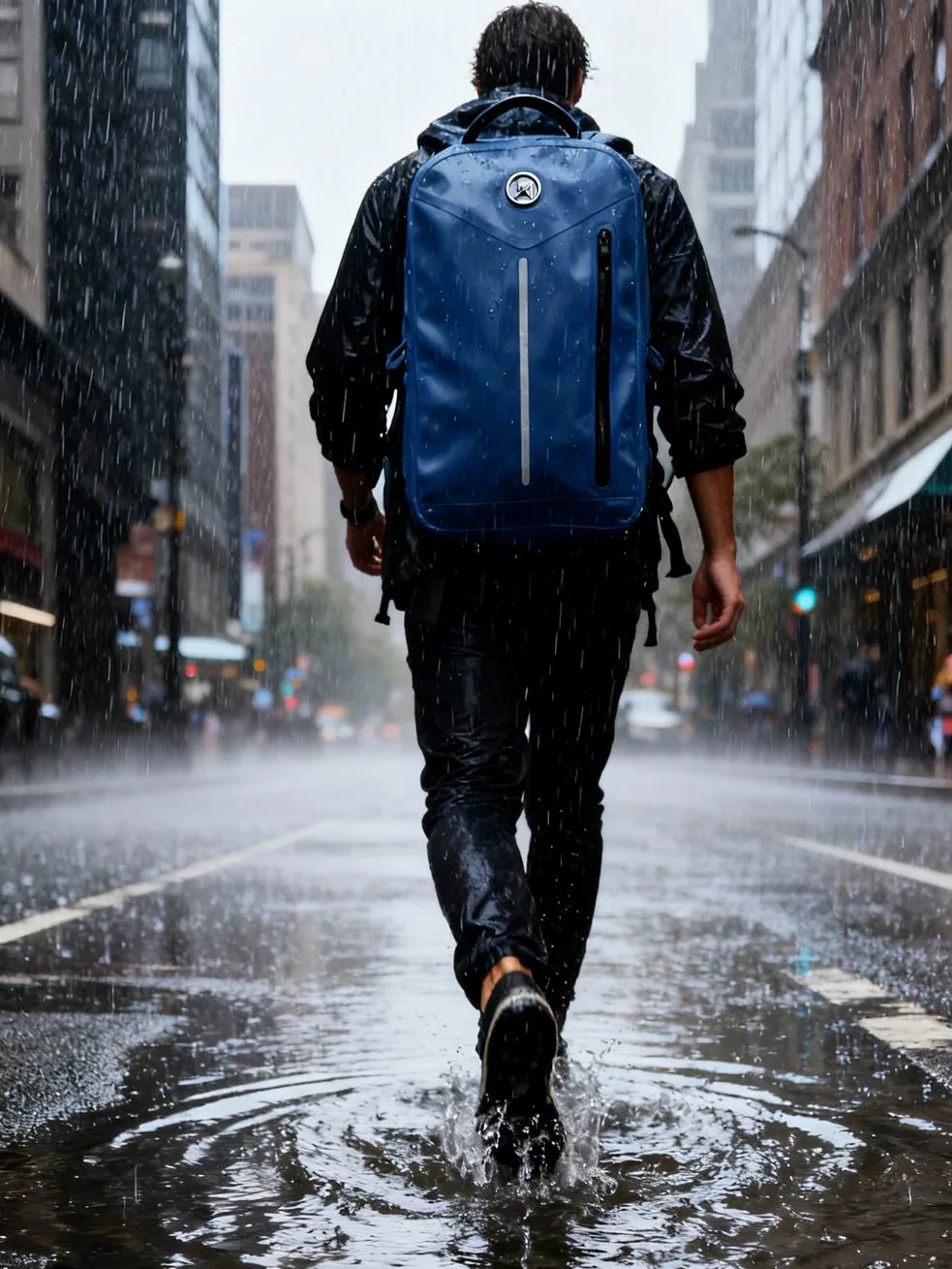
| Winter commuting | -2 to -12 °C | Freezing rain | Welded backpack, covered zips | Hardware freeze-up |

Warming a frozen bag without damaging it
The temperature difference, not the absolute cold, is what harms a bag during a thaw. Taking a bag from -20 °C straight to a 20 °C room creates a 40 degree gradient across the film within minutes: the outside warms and expands while the inside stays cold, and meltwater from the outer surface runs down into the closure. Slowing that gradient is the whole point of the routine below.
- Bring the whole bag indoors or into a tent and let it warm passively for 30 to 60 minutes.
- Never pour hot water on the film; a rapid rise above 60 °C softens TPU and causes creep under load.
- Work the closure gently by hand once the film has lost its rigidity, not before.
- Open the mouth and tip out any meltwater before it refreezes in the seam channels.
- Dry the fold line with a cloth, then re-roll three times and clip the buckle.
Patience is the whole technique. A bag taken from -20 °C into a warm tent will sweat on the outside within minutes, and that meltwater runs straight into the fold line if the bag is standing upright with the mouth up. Lay the bag on its side with the mouth downhill so meltwater drains away from the closure, and wipe the outside before you tip the bag upright again.
Drying and storing a winter bag
A bag that has been out in freezing weather is usually dry on the outside and wet on the inside, because snow brushes off but condensation does not. Empty it completely, shake out any ice from the seam channels, turn it inside out over a rail, and leave it in moving air at room temperature for at least twelve hours. Do not put it on a radiator or in front of a fan heater; localised heat above 60 °C is the fastest way to loosen a welded seam and to soften the film around it.
Store winter bags loosely rolled, unclipped, out of sunlight and at a stable temperature. A bag folded flat along the same crease for months will crack at that crease the following winter, and a bag stored clipped keeps a permanent set in the fold that makes the closure harder to seal. Off-season detail is in our storage guide.
Testing a winter dry bag before you rely on it
Two of these five checks can be done at home in a single evening, and the other three are best folded into the first cold trip of the season when the result costs you nothing. Do them in the order listed, because a bag that cannot be rolled cleanly when cold will fail the freeze test regardless of how good the film is.
- Freeze test: close the bag with a wet fold line, leave it at -10 °C overnight, then check the seal in the morning.
- Fold test: after two hours at -20 °C, roll the bag three times and confirm the folds lie flat.
- Hardware test: release and re-clip every buckle wearing the gloves you will actually use.
- Immersion test: submerge a loaded bag for 30 minutes in cold water and open it dry-side up.
- Paper test: put a dry tissue inside near the closure and check it after a full day out.
Do this once, in October, with the bag you intend to rely on, and you will know exactly what you have before it matters. The paper test is the cheapest and the most informative: a dry tissue taped inside the mouth after a day on the ice tells you more than any marketing claim. If it comes out even slightly damp, the closure technique needs changing, not the bag. Rental fleets and guiding operations running winter programmes should build the same test into their acceptance checks, because a bag that passes at 20 °C tells you nothing about a January morning.
Winter checklist and the limits of a dry bag
- Choose TPU over PVC for any use below freezing; PVC stiffens near 0 °C and crazes at -15 °C.
- Dry the fold line before every closure and close the bag warm whenever you can.
- Operate hardware in the gloves you will wear; add cord pulls if a buckle is unworkable.
- Leave 10% headroom in every water bottle that might freeze.
- Pack items dry and press out air to limit condensation inside a sealed bag.
- Warm a frozen bag passively and lay it mouth-downhill while it thaws.
- Store loosely rolled, unclipped, away from radiators and sunlight.
- Confirm the build against the product line before a winter season.
The limit of a dry bag in winter is that it protects equipment, not people. Cold water immersion is a survival emergency within minutes, and no bag changes the physics of that; the CDC publishes the hypothermia and cold-exposure guidance that belongs in every winter plan, and NOAA is the reference for wind chill and ice conditions in US waters. Material behaviour under cold is standardised through methods published by ASTM International, which is what a cold crack figure should cite.
Two adjacent guides fill in the detail. The cold crack guide explains how the temperature is measured and what a real figure looks like on a spec sheet, and the temperature damage guide covers the heat end of the range, which is where most permanent harm happens. For activity-specific setups, see the ice fishing kit and snowmobile care; our floating bag range and roll-top range both use TPU film rated well below any temperature you will carry them in.
Frequently asked questions
Q1. Do dry bags work in freezing conditions?
Yes, as long as the film is TPU and the fold line is dry. TPU stays foldable to about -40 °C while PVC stiffens near 0 °C and crazes at -15 °C. The common failure is water freezing in the roll-top fold, which happens in 12 to 25 minutes at -10 °C.
Q2. At what temperature does a dry bag stop working?
The bag material does not stop working, but handling degrades fast: below -20 °C the film is rigid enough that three clean folds are difficult, and below -30 °C you should pack the night before and leave the bag sealed.
Q3. Is TPU or PVC better in the cold?
TPU, decisively. TPU has a cold crack point below -40 °C and recovers fully on warming; PVC depends on plasticiser that becomes ineffective as temperature falls and can craze at the fold by -15 °C.
Q4. Why does my dry bag leak in winter?
Almost always moisture in the fold line that froze before the closure sealed, leaving a gap of one to two millimetres along the contact line. Dry the fold with a cloth, close the bag while it is still warm, and wipe away meltwater after a thaw.
Q5. Can I open a frozen dry bag?
Yes, but warm it first. Bring it indoors for 30 to 60 minutes, work the closure gently once the film loses rigidity, and lay it mouth-downhill so meltwater drains away from the fold rather than into it.
Q6. Do buckles freeze up?
The mechanism rarely freezes solid, but release tabs become hard to press in gloves and metal hardware pulls heat from bare skin within seconds. Use wide webbing loops and add a cord pull to any buckle you must open fast.
Q7. Will water bottles burst inside a dry bag?
A completely full rigid bottle can split, because water expands about 9% on freezing. Leave 10% headroom, prefer wide-mouth soft bottles, and keep bottles away from electronics because a thawing bottle sweats on the outside.
Q8. Why is there frost inside my sealed dry bag?
Condensation. Warm damp items and trapped air cool overnight, and air that held 10 g of water per cubic metre at 20 °C holds under 3 g at -5 °C, so the difference condenses on the cold film. Pack dry and press out air before closing.
Q9. Does a dry bag still float when it is frozen?
Yes, trapped air still displaces water. Ice in the folds adds weight, about 1.8 kg for 2 litres, and makes the bag rigid so it can wedge in a hatch. It is a flotation aid in an emergency, never a life jacket.
Q10. Can I put a hot water bottle in a dry bag?
Yes, up to about 60 °C. Above that, TPU softens and creeps under load, and a welded seam next to a hot object can loosen. Use a covered bottle and keep it away from the weld lines.
Q11. How should I dry a dry bag after winter use?
Empty it, turn it inside out over a rail, and leave it in moving air at room temperature for at least twelve hours. Never use a radiator or fan heater; localised heat above 60 °C damages film and welds.
Q12. Should I store a dry bag rolled or flat in winter?
Loosely rolled and unclipped. A flat fold along the same crease cracks the following season, and storing a bag clipped keeps a permanent set in the fold that makes the closure harder to seal.
Q13. Does snow melt leak into a dry bag?
Melted snow behaves exactly like rain, so a welded bag with a dry fold line keeps it out. The risk is closing the bag with snow on the mouth, which then melts inside the fold and refreezes later.
Q14. Can I use a dry bag for ice fishing?
Yes, and it is one of the easiest winter uses because exposure is limited to splash from the hole. Choose 0.5 mm TPU, welded seams and a wide mouth you can close with gloves on.
Q15. How do I test a dry bag for winter before a trip?
Close it with a wet fold, freeze overnight, then check the seal; roll it three times after two hours at -20 °C; and tape a dry tissue inside the mouth for a full day out. A damp tissue means the closure technique needs fixing.
Q16. Does cold permanently damage a dry bag?
No, not within any temperature a person can operate in. TPU stiffens and recovers completely. The permanent damage comes from the other end: heat above 60 °C, UV exposure, and flexing a stiffened PVC bag until the coating crazes.
People also ask
What temperature is too cold for a dry bag?
Nothing a person can survive in is too cold for a TPU bag, but handling degrades below -20 °C and rolling a clean three-fold closure becomes hard. PVC bags are the ones with a real limit, around -15 °C.
How do you keep a dry bag closure from freezing shut?
Dry the fold line with a cloth before every closure, close the bag while it is warm, and lay it mouth-downhill when it thaws so meltwater drains away instead of refreezing in the seam channels.
Are TPU dry bags better in winter than PVC?
Yes. TPU stays flexible to about -40 °C and recovers fully; PVC stiffens near 0 °C because its plasticiser stops working, and a sharp fold at -15 °C can craze the coating and let moisture through.
Why does condensation form inside a sealed dry bag?
Warm damp gear and trapped air cool overnight, and cold air holds far less water than warm air, so the excess condenses on the coldest surface. Pack items dry and press out air before you roll the closure.
Can you put a frozen dry bag in a warm tent?
Yes, and that is the right way to thaw it. Lay it on its side with the mouth downhill, because the outside will sweat within minutes and that meltwater runs into the fold if the bag stands upright.
Do dry bags crack in cold weather?
TPU film does not crack at any temperature you will carry it in. What cracks is a PVC coating folded while stiff, or a bag stored folded flat along one crease for months between seasons.
Need this in production volume?
QUANZHOU JUNYUAN BAGS has produced waterproof bags since 2014 in an SGS-verified 4,950 m2 facility in Fujian, China. Minimum order 500 pieces, sampling in 6–10 working days, bulk in 35–50 days, FOB Xiamen — write to service@junyuanbags.com with your spec and target market.